Discuss the interrelationship of several scientific disciplines embodied in the field of Food Science and Technology. One of the rapidly developing aspects of food science is the production of a whole range of functional health food products, so-called nutraceuticals.
UNIVERSITY OF IBADAN LIBRARY
Food and Its Functions
The Ten Food Groups
The Basic Seven
The Four Main Groups
Eating too many foods of the same class should be avoided so that the body can be properly nourished. The four main groups are mainly used by home economists, as they form the basis of a good meal and are simplified for general use (see the four main groups in the text).
WORK SHEE3F
Food Distribution and Marketing
Animal Products
Manufactured Products (Modified Plants and Animals)
It is important to note that in urban areas, income is the main determinant of the quality and quantity of food consumed. There are four types of malnutrition. i) Energy malnutrition - This is called marasem. ii) Protein malnutrition - This is called kwashiorkor. iii).
Composition and Structure of Nigerian and West African Foods
The variation depends on the cultivation method and the genetic background of the maize kernel. The starch forms a gel of soluble starch dextrin. ii) Two main reactions occur viz. a) the particles undergo a browning reaction.
WORK SHEET
Contamination of Foods from Natural sources
But germs are blown and dispersed from the air in suspended solids like dust and lint, like droplets when we cough or sneeze, in splashes from waterfalls, streams, lakes or the ocean, like dust from powdered foods and foods to name a few. This is the amount of oxygen required for aerobic microorganisms and reducing compounds to oxidize the organic compounds present in a given time and temperature, usually 5 days at 20C. The presence of sewage contamination is tested by the presumptive test for coliform E bacteria. It gives an indication of the possible presence of intestinal pathogens. Soil microbes are also involved in the recycling of carbon, nitrogen and sulphur, which are important in plant growth and by the same principles accelerate food spoilage.
Most microbes are washed off food surfaces during processing and post-harvest processing. Various microbes are found on the surfaces of plants and their products, which are caused by contamination with the soil on which they grow, washing by the consequences of rain and accidental contamination due to a broken sewer pipe, urine of humans and their livestock, and the like. The most common types of microbes are coliform bacteria, salmonella, enterococci and other intestinal bacteria.
Since these microbes are always present around us, students may want to identify other examples of microbial contamination that occur around them every day.__________.
Deterioration and Spoilage of Foods
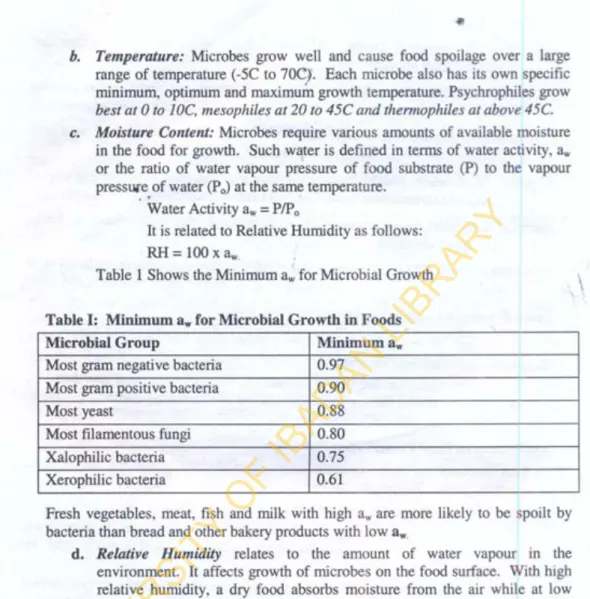
They are also present in the air, around raw foods, the soil on which they grew or on which they fell during harvest, water for washing food, on hands and utensils used in food handling and processing. Bacteria, yeasts, and molds of these microorganisms always cause food spoilage unless something is done to stop or slow down their activity in foods through food processing and preservation. Moisture content: Microbes require different amounts of available moisture in food to grow.
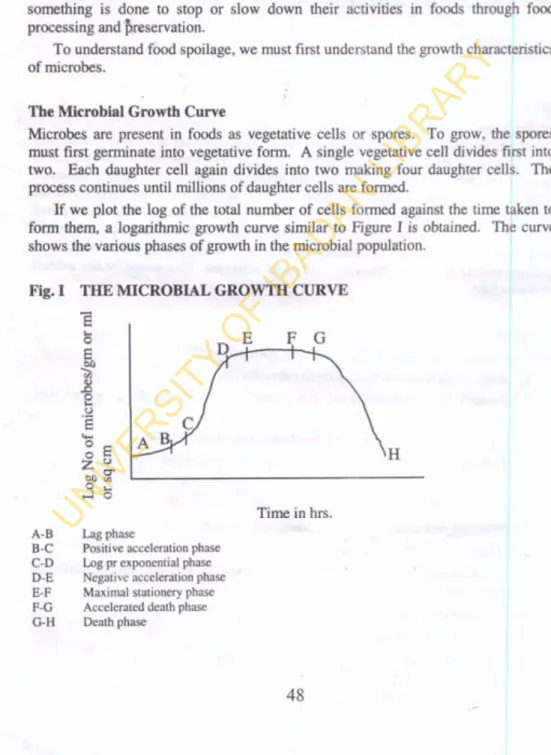
O xidation - R E d u ction P o te n tia l: Some microbes grow in the presence of oxygen (aerobic), in its absence (anaerobic), or under both conditions (facultative microbes). The unwanted products manifest as food spoilage and may include toxins that cause food poisoning and unpleasant taste, smell, color or texture in the food. In this lecture you were introduced to the concepts of the microbial growth curve and the generation or doubling interval.
Their chemical composition is lower and therefore their ability to support microbial activity is lower, since different spoilage organisms require different optimal factors for growth, reproduction or toxin development.
Principles of Pood Processing and Preservation (Part I)
- Prevention or Delay of Microbial Spoilage (a) By keeping out micro-organisms as in asepsis
- Prevention or Delay of Autolysis or Self Decomposition of Foods (a) By destmction or inactivation of food enzymes as by blanching
- Prevention of Damages by Insects, Animals and Chemicals
- Sterilization
- Canning
- Blanching or Scalding
The primary purpose of preservation processes is to create one or more barriers or hindrances that are detrimental to the activities of microbes or endoenzymes present in the food. By preventing or slowing down purely chemical reactions such as when using antioxidants to prevent oxidation. In the food industry, filtration through special filters helps remove microorganisms from fermented beer and wine.
Enzymes in foods are similarly inactivated and thus prevented from further metabolizing the food. Low temperatures are used to keep foods fairly fresh, as natural chemical reactions in foods are reduced. Therefore, there is a certain degree of sequence in the growth and death pattern of the various microbes present in food.
Therefore, refrigeration is an important factor in maintaining an efficient cold chain in the food industry, from the farm, through processing to the table.
Principles of Food Processing and Preservation (Part II)
Preservatives are chemical substances that, when present in food, help to slow or completely stop the growth of microorganisms in the food and prevent any other deterioration changes. These changes can occur as a result of the activities of micro-organisms enzymes that occur naturally in the food or through pure chemical reactions within the food. They are harmless to consumers at the level they are added to food (c) They are not inactivated or rendered useless by the food.
Intense excitation of water molecules present in the food causes high temperature in the food within seconds which kills microbes and deactivates enzymes. They kill susceptible microorganisms by ionizing water present in the food to release free radicals, which are destructive to the organism and by causing lethal mutations in the microbes. It is used to sterilize food packages, disinfect food processing equipment and in the treatment of drinking water and 'pure water'.
They are microbicidal or microbistatic. (b) Harmless at prescribed administration level. (c) Not rendered useless by the food. e) Does not cover up poor quality of food. f) Does not impart an unpleasant color, odor or taste to food. (g) Not a substitute for good hygiene.
Food Poisoning and Its Prevention
Shellfish or saxitoxin paralysis occurs when poisonous oysters and other seafood are eaten, for example in seafood dishes. True poisoning occurs when foods containing toxins produced by resident microbes are consumed. a) Botulism caused by toxin produced by the germination of spores of Clostridium botulinum in vacuum-packed or canned meat, fish, vegetables and other foods. These are produced by certain fungi in peanuts, wheat and various grains, ground beef peanut butter and whole wheat bread can cause illness or death in animals and humans. a) Aflatoxins produced by Aspergillus flavus and Aspergillus parasiticus. (b) Penicillic acid by Penicillium puberulum. Viruses do not grow in food, but food acts as a carrier for intestinal viruses.
Food contamination occurs when certain causative bacteria grow in food reaching a microbial load of 10 million or more viable organisms or colony-forming units (106 cfu) per gram or milliliter of food or per square cm of surface area. a) Salmonellosis* is caused by a large number of salmonella species, e.g. Salmonella typhimurium, Salmonella paratyphi which are responsible for typhoid fever, respectively paratyphoid. Scarlet fever and septic sore throat caused by beta hemolytic streptococci from nasal and oral discharge. True food poisoning is the ingestion of food that contains toxins produced in that food by certain classes of microbes eg.
Bacterial food poisoning (i) Botulism by C. ii) Staphylococcal food poisoning by S. ii) Penicillic acid poisoning by Penicillium puberulum Viral food poisoning by Hepatitis A virus. i) Quickly freeze pork and let it sit at -15C or less for at least 20 days. ii) Irradiate with 100 kilorad ionizing radiation. iv) Follow approved methods for drying, smoking and chilling processed pork, such as ham or sausage.
Sensory Qualities of Foods - Texture and Flavour
The textural properties of a food refer to the sensations experienced by the consumer through their fingers and mouth, as well as through their vision, regarding the physical appearance of the food, such as size. We often assess the quality of certain foods by touching and squeezing them with our fingers. A gas chromatography olfactometer or electronic nose or aroma scan is used to evaluate the odor or aroma characteristics of food.
They duplicate the human olfactory system using chemical sensors, which detect and quantify volatile odor components released by the food. Similarly, the electronic tongue assesses the non-volatile chemical components present in the food, thereby measuring sweetness, bitterness, salt and acidity. The food quality attributes are texture, color and flavor which is a composite of taste and aroma.
The textural properties of food are experienced with the finger, mouth feel or sight depending on the shape and size of the food.
Sensory Qualities of Foods - Colour
The wavelength of visible light extends from 380 mm to 770 mm, which covers the color of the visible rainbow. Here, the light pulses are converted into electrical impulses that are conducted through the optic nerves to the cerebral cortex of the brain for recognition. To fully understand the nature of light reaching the eye, we need to look at the characteristics of light.
If all the light reaching the surface of the object is reflected as a whole, the surface takes on a white color. the observed color is black. If all the colors of the visible spectrum are only partially absorbed to the same degree on the surface, then the color will be gray. If one primary color is reflected to a greater extent than the others, then the apparent color of the object will reasonably be that of the wavelength of the dominant color.
As the concentration of the pigment increases due to the richness of the color, the transmission of light through the extract decreases.
Determinants of Food Consumption Pattern
It is of great importance in agricultural crops and livestock through which we obtain all nutrients. For the same reason, most children would refuse to drink gari without sugar. g) Sensory qualities: Foods that have a captivating aroma, visual appeal, strong and desirable taste, and juiciness and tenderness characteristic of the food type are usually physiologically satisfying and therefore frequently eaten. In every society, certain foods like bread, rice, meat are loved and accepted by almost every member of the society.
In the same way, when people of the Muslim faith ask for rams during the Muslim festivals; The prices of rams are rising explosively. The current population figure is approximately 120 million, with almost 40% of the total population living in cities, many of which have at least half a million inhabitants. His food is therefore determined by the beliefs, hopes and fears of the society in which he lives.
Religion influencing the nature of food consumed in different ways. People of the Muslim faith would neither touch nor eat pork at any time, but would especially consume mutton from rams during the various Muslin festivals.