This has therefore resulted in the repeated poor performance of students in the West African Senior Certificate Examination in public secondary schools in Nigeria. This study therefore examined the relationship between resource mobilization, allocation and utilization as predictors of student achievement in public secondary schools in Nigeria from 2001 to 2005.
UNIVERSITY OF IBADAN LIBRARY
INTRODUCTION Background to the Study
To realize this lofty idea, Utomi (2008) called for a total overhaul of the Nigerian education system. Nigeria's education system has suffered innumerable difficulties as a result of underfunding the system.
Statement of the Problem
It is against this background that this study focused on fund mobilization, allocation and utilization as predictors of student performance in public secondary schools. It was against this background that this study examined the relationship between fund mobilization, allocation and utilization as predictors of student performance in public secondary schools in Nigeria between 2001 and 2005.
Research Questions
Similarly, Rao, Naidu and Rohana (2008) argued that it is not the size of the budget allocation that is relevant, but how the allocated fund is managed and utilized to achieve the desired outcome. Confirming Adedeji (1998) and Rao et al (2008) claims, Dahar et al (2010) argued that some principals have achieved impressive levels of success with limited resources at their disposal, while others have recorded low levels of success in schools with abundant financial resources .
Objectives of the Study
If financial allocation to secondary schools in Nigeria and fund utilization affects students' performance in public secondary schools in Nigeria;. This study will broaden the ideas of education planners and policy makers in the education sector about the need to allocate more funds to improve student achievement.
Scope of the Study
The result of the study would equally serve as an eye opener for secondary school principals in different ways to generate internal and external funds to improve student achievement in their respective schools. It would instruct all levels of government on the need to empower all leaders to explore the necessary avenues available to them to generate funds.
Operational Definition of Terms
CHAPTER 2
REVIEW OF RELATED LITERATURE
Studies on Fund Allocation in Education
Oni (1995) was of the opinion that resources are a very important factor in how the education system works. This problem, he argues, arose as a result of the perpetual neglect of the public school system through inadequate funding of education (Alani, 2005).
Studies on Fund Mobilisation
The researcher found that an increase in the revenue cap actually led to a slight decrease in student performance, as measured by the academic performance indicator score. The researcher found that financing influences student performance and that funding sources are more effective in achieving desired outcomes.
Studies on Students’ achievement
Ejiwe (1998) conducted a study on the impact of organizational quality on students' academic performance in Impact Statement. In his study, Gbadamosi (2000) found a significant relationship between resource availability, utilization and students' academic performance. The researcher found that students' academic performance in English Language and Mathematics is significantly related to.
The researcher found that the results of the study provided important evidence that school infrastructure has a critical impact on student achievement.
Fund Allocation and Students’ achievement
Farombi (1998) investigated the influence of concentration, utilization and management of resources on the achievement of students in Oyo State Secondary Schools and found that financial resources explained the largest percentage of variance among students. Heneyman and Loxley (1983) cited in Farombi (1998) investigated the effect of primary school quality on student achievement in 29 high- and low-income countries. Farombi (1998) found that financial resources explained 4.27% of the variance in students' attitude towards education, 15.79% in students.
It was observed that financial resources explained the largest proportion of variance in students' performance in SSCE than other two dependent variables (students' attitude towards education and students' performance in physics).
Fund Utilisation and Students’ achievement
The present study also found that expenses per student mostly had a negative impact on student achievement at the secondary level. Celeste, Heather, Amanda, and Catherine (2000) examined resource allocation practices and student achievement using MANCOVA, statistical tool. Sharp (1993) examined the relationship between Illinois school expenditures per student and the students' assessment results from the state.
The researcher used Pearson Product Moment correlation to determine if there was any significant relationship between school expenditures and student achievement scores.
Appraisal of the Literature
Pitt (1977), Okorie (1998), Fabunmi and Okorie (2001) and Ayanogu (2004) in their various studies reported a high positive relationship between financial efficiency and students' performance. However, all these factors may not likely lead to a strong relationship between resources and student performance. In his analysis, the researcher could not link higher expenditure to improvement in student performance.
In an educational setting, Hanushek theorized that increasing expenditures for teacher salaries and instructional materials should produce a corresponding increase in student achievement.
Theoretical Framework
Each part works together and is interdependent on the other parts and other systems around it. Closed systems are completely self-regulating, self-sufficient and do not interact with the environment. They interact and depend on the environment to provide input and dissipate their output.
There is a free flow of energy from the environment through the system itself and back to the environment.
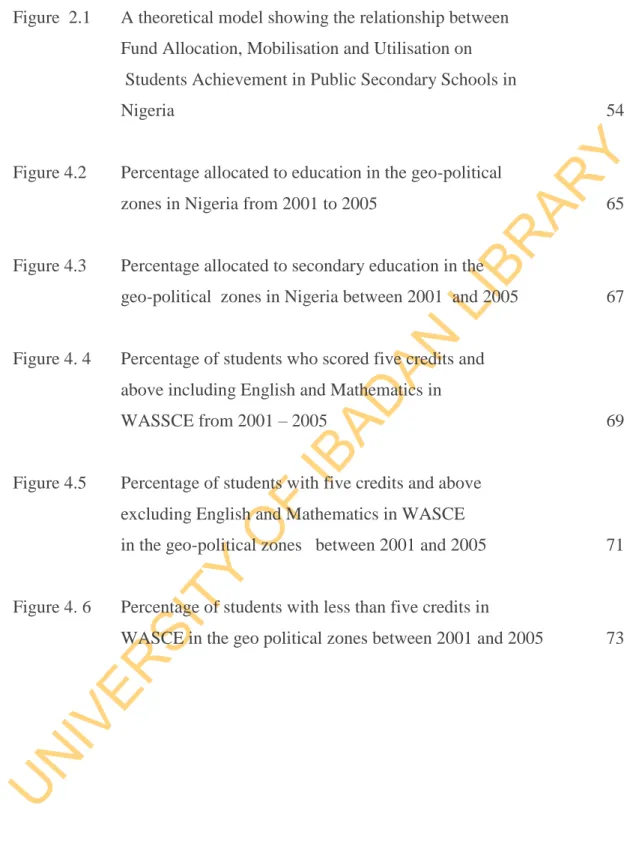
The Theoretical Model Showing the Relationships among Fund Mobilisation, Allocation and Utilisation on Students’ Achievement
The theoretical model showing the relationships between fund mobilization, allocation and utilization of student performance. The availability, efficient use or transformation of resources would result in good performance of students. However, if the input of resources into the system is inadequate but the transformation or use is effective, student performance is likely to be good.
Where the resource inputs are adequately provided, but the utilization or transformation is poor, the outputs are likely to be poor.

Research Hypotheses
CHAPTER 3
Research Design
This type of research is useful in trying to determine links between certain individual characteristics.
Study Population
Sample and Sampling Technique
The diagram showed the six geo-political zones in Nigeria and representative states: South-West was represented by Lagos State, North-Central was represented by Nassarawa State, South-South was represented by Akwa-Ibom State, North-East was represented by Bauchi- state , North West represented by Kano State and South East was represented by Enugu State. The 2006 population census showed that the total population of all the geo-political zones except the Federal Capital Territory while the total population for all the six states was represented with 145 Local Governments as well as 1,826 Public Secondary Schools in Nigeria.
Research Instruments
Validation of Instruments
CHAPTER 4
RESULTS AND DISCUSSION
Presentation of Results
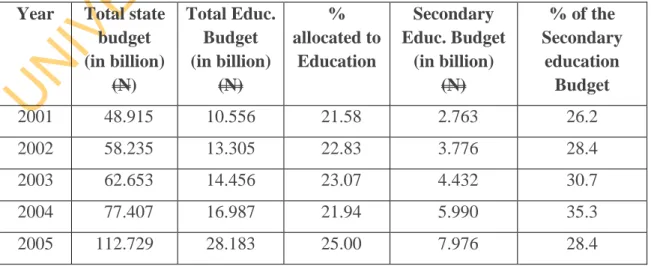
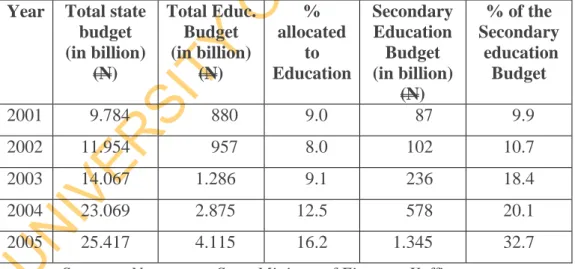
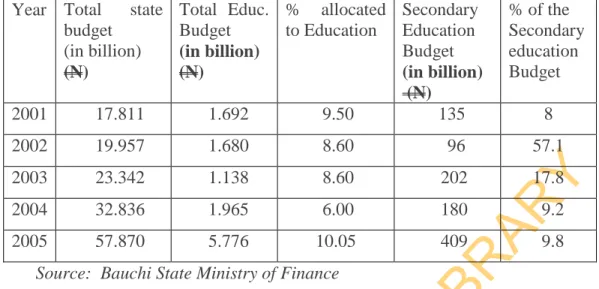
The tables on budget allocation to education in all the representative states of each of the geo-political zones answered research questions 1 and 2. The budget allocation to education in Lagos State revealed that 21.58% of the state budget was allocated to education in the year. 2001. It showed that there was no improvement in the trend in the annual budget allocation to education in the state.
The graph showed a continuous fluctuation in the financial allocation to secondary education from the total education budget between 2001 and 2005 in almost all geopolitical zones in Nigeria.
Research Question 3
The trend of decreasing funding for secondary education has resulted in inaccessibility of infrastructure, inadequate staff, delays in salary payments and constant agitation for a special pay scale, leading to a series of strike actions.

Research question 4
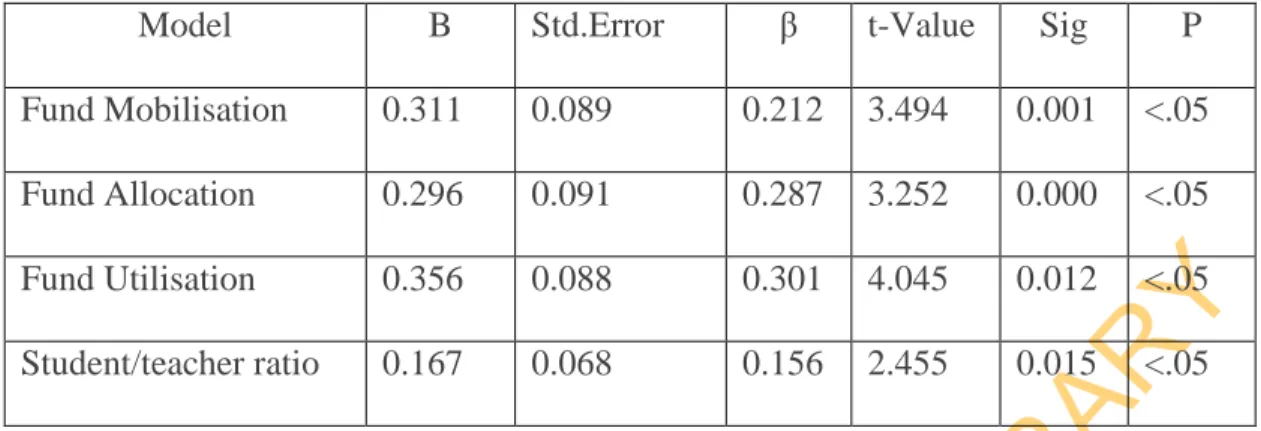
Allocation of funds is significantly related to student achievement in public secondary schools in selected states in Nigeria. The null hypothesis that there is no significant relationship between funding allocation and student achievement was rejected. Ho4: There is no significant relationship between the use of financial resources and student achievement in public secondary schools in Nigeria.
The null hypothesis that there is no significant relationship between student/teacher ratio and students' performance was rejected.
Discussion of Findings
The table indicated that there was a significant relationship between student/teacher ratio and student achievement; rP<0.05. In other words, student-teacher ratio was significantly related to student performance in public secondary schools in Nigeria.
The percentage of budgetary allocation to special education and general secondary education in the selected states in the six geopolitical zones in Nigeria was very poor and below 26% of the UNESCO recommendation. However, this was responsible for the variation in the academic performance of students in the West African Senior School Certificate Examinations generally across geopolitical zones in Nigeria. From 2001 to 2005, the overall performance of students in the West Senior Secondary Certificate Examination was very poor across all geopolitical zones.
In 2005, Lagos and Enugu states recorded the best performance of students in the examination with 34.2% and 22.6% respectively.
Fund Allocation, Mobilisation and Utilisation and students’
The above achievements were an indication that state governments must necessarily allocate a substantial portion of their annual budgets to secondary education so that more classrooms can be built, more qualified teachers can be hired and long-term advocacy for a special salary scale by the government can be sustained. teachers can be followed.
Fund allocation and students’ achievement
Utilisation of financial resources and students’ achievement
The result of this study negated the finding of Dahar, Arshad, Iqbal, Zafar and Dahar, Rashida (2009) who noted that per pupil expenditure mostly had a negative impact on students' performance at secondary level but argued that it was the misallocation, mismanagement and the misuse or exploitation of funds and resource inputs that were responsible for low students' academic performance.
Fund mobilisation and students’ achievement
Student/teacher ratio and students’ achievement
CHAPTER 5
Summary of Findings
Conclusion
Recommendations
Contributions to Knowledge
Lim itation of the Study
Suggestions for Further Studies
Effect of Institutional Resources, Student Characteristics on Student Performance in Secretarial Studies in a Nigerian Polytechnic. A study of the relationship between school building conditions and student achievement and behavior. Unpublished doctoral dissertation, Virgina Polytechnic Institute and State University. Impact of Per Pupil Expenditure on Student Achievement at the Secondary Level in Punjab.
A study on the impact of organizational quality on the academic performance of secondary school students in Delta State. The effect of the interaction between location, facilities and class size on the academic performance of secondary school students in Ekiti State, Nigeria. An examination of the relationship between financial efficiency, school size, academic achievement, and academic student achievement in selected Texas school districts.