PERCEPTION OF STUDENTS IN THE USE OF IMPROVISED INSTRUCTIONAL MATERIALS IN TEACHING BIOLOGY IN SENIOR
SECONDARY SCHOOLS IN EZEAGU L.G.A OF ENUGU STATE
UZODIAGU UJUNWA MAUREEN U16/EDU/BIO/029
DEPARTMENT OF SCIENCE AND VOCATIONAL EDUCATION, FACULTY OF EDUCATION
GODFREY OKOYE UNIVERSITY, UGWUOMU-NIKE, ENUGU
JULY, 2016
TITLE PAGE
PERCEPTION OF STUDENTS IN THE USE OF IMPROVISED INSTRUCTIONAL MATERIALS IN TEACHING BIOLOGY IN SENIOR
SECONDARY SCHOOLS IN EZEAGU L.G.A OF ENUGU STATE
UZODIAGU UJUNWA MAUREEN U16/EDU/BIO/029
DEPARTMENT OF SCIENCE AND VOCATIONAL EDUCATION (BIOLOGY EDUCATION), FACULTY OF EDUCATION GODFREY
OKOYE UNIVERSITY, ENUGU
A RESEARCH WORK SUBMITTED TO THE DEPARTMENT OF SCIENCE AND VOCATIONAL EDUCATION, FACULTY OF EDUCATION, GODFREY OKOYE UNIVERSITY, IN PARTIAL FULFILLMENT OF THE REQUIREMENT FOR THE AWARD OF
BACHELOR IN SCIENCE EDUCATION (B.SC. ED)
JULY, 2018
CERTIFICATION
Uzodiagu Ujunwa Maureen as a student in the department of science and vocational education (Biology/Education) in faculty of Education with registration number U16/Edu/Bio/029 have satisfactorily completed the requirement for the research work for the award of Degree in Bachelor of science in Education (B.Sc.
Ed). The work embodied in this project is original and has been submitted or presented elsewhere.
________________ ________________
Uzodiagu Ujunwa Maureen Date
U16/Edu/Bio/029
APPROVAL PAGE
This is to certify this research work titled “Influence of the use of improvised instructional materials in teaching and learning of Biology among senior secondary school students in Ezeagu Local Government Area of Enugu State” has been read and approved as meeting the requirement of the Department of science and Vocational Education, Faculty of Education Godfrey Okoye University. Ugwuomu Nike Enugu.
By
DR. V.C Ude
Project supervisor …………... ………
Signature Date
Prof. Agwagah UNV
Head of Dapartment ……… ………
Signature Date
Prof A.E. Eze
Dean of Faculty ……….. ………
Signature Date
External Examiner ……….. ………
Signature Date
DEDICATION
This project is dedicated to Almighty God for his infinite wisdom/mercy on me toward the completion of this work.
ACKNOWLEDGEMENTS
I hereby extend my thanks and deep appreciation to all those who provided helpful suggestion towards my studies in school.
I am especially grateful to my able supervisor Dr V.C Ude who in spite of the time constraints, worked tirelessly and guided me towards the success of this piece of work.
I will ever remain grateful to my loving parents, brothers and my sisters for their love, encouragement and unwavering support towards my study.
My sincere thanks to my brother Rev. Fr. Paulinus Okoli who has been providing all I needed during this course of study.
My profound gratitude goes to my friends especially those who showed me love, prayed for me, gave me advice and support towards my study. May God in heavens reward you all abundantly in Jesus name, Amen.
Immeasurable thanks must go to lecturers, Dr. V.C. Ude, Prof Onyegegbu, Dr Ezeugwu E.N, Mr. Nnaekwe Kingsley, Mrs. Justina Okoyeobalum (Enwe) secretary of the Department of Science and Vocational Education for their moral support and contributions to the completion of my study and this work.
I remain eternally grateful to my in-laws for their support towards my study.
Finally, to my God and creator I owe all my effort, who by his infinite grace and Mercy has kept me alive and enabled me to complete this study. I will praise him forever for his mercy, blessing, success, wisdom, prayer answered and good health. To him be thy Glory.
TABLE OF CONTENT
Title i
Certification ii
Approval Page iii
Dedication iv
Acknowledge v
Abstract vi
Table of Content vii
CHAPTER ONE: INTRODUCTION
Background of the Study 1
Statement of the problem 4
Purpose of the Study 5
Scope of the Study 6
Significance of the Study 6
Research Questions 7
Chapter two: Review of Related Literature 9
Meaning of Improvisation 9
Types of Improvisational 11
Role substitution of instructional materials 12
Need for Improvisation 14
Basic Consideration in Improvisation 15
Influence of Improvisation Materials in Teaching Biology 15
Advantages of improvisation 17
Disadvantages of Improvisation 17
Disadvantages of Improvisation 18
Theoretical Frame Work 18
Empirical Studies 19
Summary of the Literature Review 22
Chapter Three: Research Method 23
Research Design 23
Area of the Study 24
Population of the Study 24
Sample and Sampling Techniques 24
Instrument for Data Collection 24
Validity of Instrument 25
Reliability of the Instrument 25
Method for Data Collection 25
Method of Data Analysis 25
Decision rule 26
Chapter Four: Presentation of Results 33
Chapter five: Discussion, Conclusion, Recommendation and Summary 36
Discussion of the study 36
Conclusions 37
Implication of the findings 38
Recommendation 38
Limitation 39
Suggestion for Further Study 39
Summary of the Study 40
References 41
Abstract
The main purpose of this study is to find out the perception of students in the use of improvised instructional materials in teaching biology in senior secondary schools in Ezeagu Local Government Area, Enugu State. The researcher used descriptive survey research design for the study. The population of the study consisted 750 SSII biology students in 29 public secondary schools in Ezeagu Local Government Area. 10 public secondary schools out of 29 were sampled for the study and a sample size of 15 students each from the 10 schools were selected using purposive random sampling techniques. Three research questions rated on four scales were answered. The instrument was validated by three experts, 1 from Science and Vocational Education and 2 from Measurement and Evaluation, Godfrey Okoye University, Enugu. The questionnaire was administered to biology students and collected by the researcher. Mean and standard deviation was used to analyse the collected data. The result revealed that the use of improvised instructional materials in teaching biology enhance teaching, provides meaningful learning and makes teaching to be effective. The result also revealed that students have very positive attitudes towards the use of improvised materials while teaching. On the academic achievement, the result revealed that there was a significant effect on students’ academic achievement. Based on the findings and implications, it was recommended that teaching biology in secondary schools should be conducted in a manner that students will effectively understand and learn the concept taught. Teacher – student relationship should be boosted as it encourages teaching. Government, philanthropists and the PTA should contribute generously financially, to the promotion of improvisation in secondary schools in Ezeagu Local Government Area.
Seminars and workshops should be organized from time to time to teach on the importance of improvisation for effective teaching of biology in all the public secondary schools in Ezeagu Local Government Area. Beyond these, the researcher recommends that teachers’ training institutions should incorporate the use of improvisation in their curriculum.
CHAPTER ONE INTRODUCTION Background of the study
The importance of science in our daily activities can never be underrated.
Science has made numerous and unalloyed contribution to the realization and advancement of the contemporary world and it has been attributed as the foundation for technological breakthrough in this modern world. According to Ogunleye (2012), he defined science as a dynamic human activity concerned with understanding the workings of the world we live. This understanding helps man to know more about the universe. Without the application of science, it would have been difficult for man to explore his environment. The objectives of science education according to Maduekwe (2009) in Nigeria include the need to prepare students to observe and explore the environment, explain simple natural phenomena, develop scientific attitudes including curiosity, critical reflection and objectivity, apply the skills and knowledge gained through science to solve everyday problems in the environment, develop self-confidence and self-reliance through problems solving activities in science.
Biology is one of the science subjects offered at the senior secondary school levels in Nigeria secondary schools (NPE, 2004) Biology is a very important science subject and a requirement for higher learning in a number of science- related professional courses like medicine, pharmacy, agriculture. Biology is natural science that deals with the living world. How the world is structured how it functions and what these functions are: how it develops, how living things came into existence and how they interact to one another and with their environment (Umar 2011) It is a prerequisite subject for many fields of learning that contributes immensely to the technological growth of the nation e.g. nursing, medicine etc.
(Ahmed, 2008) According to Abuhu (2007) Biology is a natural science that
studies-living organisms (plants and animals). The study of biology generally is considered as basics for the preparation of every informed citizens and serves as gate way into numerous career choices in life. Nations that desire to forge ahead scientifically and technologically cannot afford to toy-with the biological knowledge of her citizenry. The basic tools science uses in the learning of science processes are the instructional materials. Instructional materials are essential and significant tools needed for teaching and learning of school subjects to promotes teachers efficiency and improve students performance. They make learning more interesting, practical realistic and appealing. They also enable both the teachers and students participate actively and effectively in lesson sessions. They give room for acquisition of skills and knowledge and development of self-confidence and self actualization.
However, studies have shown that the senior secondary school students are exhibiting low interest in biology (Esiobu, 2015). This low interest has been traced to poor achievement in Biology examinations. Poor achievement in biology can be attributed to many factors such as poor method of teaching, unavailability of laboratory facilities, lack of instructional materials, inadequate time allocation and large class size. Folorunso (2014) linked poor achievement trend in biology particularly to the lack of instructional resources in schools due to poor funding of schools which hinders the principals from providing teachers with adequate instructional materials. According to Etukudo (2009), poor achievement in biology is incontrovertibly attributed to poor instructional delivery approach adopted by teachers in schools. Poor teaching methods adopted by teacher at senior secondary school level in Nigeria have been identified as one of the major factors contributing to poor performance of students in biology (Ahmed and Abimbola 2011; Kareem 2003.
However, evidence from research has shown that instructional materials resources and equipment in teaching biology are in short supply and that some are completely lacking in schools to extent that most teachers end with verbs exposition of scientific principles, facts and concepts. The persistent use of this method makes students passive rather than active learners. It does not promote insightful learning and long-term retention of some abstract concepts in biology Ahmed & Abimbola 2011, and the only way out of this ugly situation is for the teacher to make the teaching of biology concept relevant through the use of necessary and adequate instructional materials in the teaching and learning process of biology in senior secondary schools. Therefore there is need for improvisation.
When the real materials that are the conventional instructional materials are not available or inadequate, they can be locally made by using resources in the environment as alternative.
The concept of improvisation, in science teaching has comes to stay with us.
No matter how generous and rich and education authority might be, they are generally not always in a position to provide their school with all they need.
Improvisation could be seen as the act of providing teaching materials from our locality when there is shortage or lack of the standard ones to enhance instruction.
Igwe (2013) defines improvisation as the making or inventing of a piece of science teaching equipment in emergency. It is an essential part of laboratory management for the purpose of maximizing the use of the available resources. In the science class, teaching aids are needed to supplement the teachers oral explanation with the students visible experiences. This is why Abdullahi (2012) stated that scientific materials used in teaching enable the students to become actively involved intellectually. Perceptually and physically in the learning process. Improvisation requires a considerable development through imaginative planning and good knowledge. Improvise instructional materials when effectively improvised and
utilized can turn a dull students intellect to a great academic achiever. This is because students learn best when the subject matter is brought practically to their senses since the more the senses are stimulated the more a person learns and the more he retains. In line with this, science teachers should exhibit resourcefulness by improvising materials in place of the standardized ones. Even the collection of these teaching materials by the students themselves is in itself rewarding and a stimulating learning source experience. Two much verbalism encourages authoritarian approach and makes learning difficult and uninteresting.
Statement of the problem
The performance of students in biology in SSCE over the past few years in the study area has not been impressive. Evidence from the studies reviewed shows that failure rate in biology at senior certificate examination is high. This could be caused by a number of factors. One of such factors is shortage or complete absence of instructional materials. In teaching and learning biology, instructional materials play a key role towards concretizing learning. It makes learning more meaningful and help to improve students academic achievement. However these advantages of instructional materials have reflected in the education system because of the dearth of these instructional materials in our schools. Hence, the need for alternative instructional materials called improvisation. Bassey (2008) pointed out a good relationship between the teaching of biology and using of instructional materials to enhance teaching and learning.
Biology is resource intensive, and in an era of poor funding or scarcity of resources, it may be difficult to find some of the original materials and equipment for the teaching of biology adequately in schools. The researcher feels that the teaching and learning of biology in secondary schools in Ezeagu. Local Government Area in Enugu state would be hindered seriously if improvisation of instructional materials were not encouraged. These observations then motivated the
interest of the researcher to examine the perception of students in the use of improvised instructional materials in teaching biology in senior secondary schools in Ezeagu.
Purpose of the Study
The main purpose of this study is to find out the perception of students in the use of improvised instructional materials in teaching biology in senior secondary schools in Ezeagu Local Government Area of Enugu State.
Specifically, the research will further look into the following specific purpose:-
1. Determining the extent of the use of improvised instructional materials by biology teachers in senior secondary schools in Ezeagu.
2. To investigate the attitude of biology students towards the use of improvised materials in teaching biology.
3. To determine the influence of the use of improvised materials on students academic achievement.
Scope of the Study
This research work is based on the perception of students in the use of improvised instructional materials in teaching biology in senior secondary school students in Ezeagu Local Government Area. The study is mainly limited to public secondary schools in Ezeagu Local Government Area, Enugu State.
Significance of the Study
This research aims at producing results and adding values to teachers, students, parents and the society at large.
On the part of the students, they will be in a better position to access the usefulness or otherwise of their involvement in the improvisation of teaching materials for biology lessons. This will go a long way to make them become more interested in the activities of improvisation and also be able to handle and preserve
improvised materials better. In addition, these findings will enable teachers and students appreciate the usefulness or otherwise of their environment as it concerns their performances in biology examination and total living.
On the part of the teachers, they will be in a better position to justify or otherwise the time, effort and even money they invest in improvising biology teaching materials. The finding will also guide their subsequent steps or strategies towards enhancing better biology teaching with regards to improvisation of teaching materials.
Parents will be better informed on how to encourage and help their words to produce improvised materials. This may be in form of sourcing local materials and providing fund for those that cannot be found in their environment.
The result of this study could provide information to researchers interested in working on student teachers generated improvised materials in other subject areas. This may help them to get more information on the efficacy if improvisation, especially researchers in the area of science and technology.
On the society at large, the findings of this study will enlighten the society on the value of the environment. This will enhance better preservation and protection of the environment. This finding of this study will review the usefulness and value things in the environment from what science teaching materials are improvised.
Generally therefore, the finding of this study will guide policy makers, educations curriculum planners and all concerned with biology education review, to reaffirm on withdraw their individual views or collective views about improvisation of biology teaching and learning materials.
Research Questions
The following research questions have been formulated to guide this study.
1. What is the extent of the use of improvised instructional materials by biology teachers in secondary school in Ezeagu Local Government Area?.
2. What is the attitude of students towards the use of improvised materials in teaching of biology?
3. What is the influence of the use of improvised materials on student academic achievement in biology?
CHAPTER TWO
REVIEW OF RELATED LITERATURE
This chapter deals on the review of related literature. The presentation of the work is made under the following sub headings:
Conceptual Framework
Meaning of Improvisation
Types of Improvisational
Role substitution of instructional materials
Need for Improvisation
Basic Consideration in Improvisation
Influence of Improvisation Materials in Teaching Biology
Advantages of improvisation
Disadvantages of Improvisation
Theoretical Framework
Bruner Learning Discovery
Ausubel Theory of Meaning of Learning Empirical studies
Summary of review of related literature
Conceptual Framework Meaning of Improvisation
The concept of improvisation in science teaching has come to stay with us.
According to Balogun (2012), no matter how generous and rich an education authority might be they are generally not always in position to provide their schools with all they need.
Improvisation of instructional materials in science teaching especially biology is an attempt to adapt and make use of local resources in the teaching/learning process, when the readymade materials are not available or are in short fall or not within the reach of the users. According to (Okebukola, 2012) improvisation is the making of substitutes when the real equipment or materials is not adequate or available. It is the art of providing and using alternative materials or resources in the absence of the real or factory made one. It is also defined as the art of using materials or equipment obtained from local environment or produced by the teacher, and with the assistance of the local personnel to enhance instruction. Ahmed (2010) claimed that instructional material ensure that the learners hear, feel, recognize, and appreciate as they learn utilizing almost all the five senses at the same time.
Improvisation is a teacher-oriented activity meant to effectively carry out the teaching learning process successfully. However, evidence from research as reported by Bassey (2009) has shown that material and equipment for teaching and learning of science especially biology are either not enough or are completely lacking in schools to the extent that most teachers end up with verbal exposition of scientific principles, facts and concepts. The verbal expositions do not promote skill acquisition development, objectivity, and critical thinking abilities that will enable the child to function effectively in the society. This makes the need for alternative sources of teaching materials and equipment inevitable. Etukudo (2010) reported that the use of improvised instructional materials make the teaching/learning process a result oriented exercise, and enhances students
achievement. According to Igwe (2013) improvisation is the making or inventing of a piece of science teaching equipment in emergency. It is essential part of laboratory management for the purpose of maximizing the use of the available resources.
Improvisation is describable in the following instances:
a. When the improvised materials would improve the lesson’s effectiveness.
b. When the locally available materials are available for use
c. When improvised materials would serve the same function as the standardized one
NTI (1990) sees improvisation as a technique of originating a totally new tool instrument, materials device or modifying an already existing one for a particular purpose. National Policy on Education (2004) stresses the need for science equipment development, maintenance, as well all the resourcefulness of the teacher. Teachers resourcefulness and skill for improvisation are therefore very important and relevant in the recent times for the purpose of enhancing teaching and learning biology.
Through exposure, students gain scientific skills which they will use in their future life for self-reliance.
Types of Improvisational
Ofoefund (2009), points out that we have two main types of improvisation. These are?
i. Improvisation by substitution, where an already existing local materials is used in place of equipment that is not available
ii. The other is improvisation by construction in this case, a teacher or the student constructs a new materials entirely to teach his lesson, when the required materials or equipment is not available.
Igwe (2009) while supporting improvisation went further to discuss the types of improvisation. In doing this, he said that the improvisation of the basic equipment for teaching biology can be through two main way:
By role substitution By role simulation
Role substitution of instructional materials
This method involves the slight modification or adaptation or the original subject in order to make it perform new function in the laboratory. Among the various example is the Bunsen burner, which could be substitute with the kerosene stove.
Old newspaper could also substitute the import plant press with a heavy support such as a weighty piece of wood or heavy metal incorporated to provide the desired pressure. Imported reagent bottles can be substituted with a clear colour less soft drink bottle with a plastic cork available in local market.
Role simulation
This involves the construction of items or apparatus. It is necessitated by an emergency or a need that cannot be met for reasons of cost and availability. This may be accomplished by using direct labour, locally available materials and skills.
In some cases, an apparatus has to be improvised if the specification of the conventional one does not serve the desired purpose of the experiment.
Factors influencing students’ performance
In the modern Nigerian Curriculum, great emphasis is being placed on science and technological development and also on achievement in examination in the science. As a result students are being encouraged to take up science related subjects one subject that is paramount is biology. Today biology as a subject pervades literally every field of human endeavour in relation to medicine pharmacy, agriculture, etc, and places a fundamental role in educational advancement. Unfortunately achievement of students at the end of secondary
school has not improved in the past decade (Umoingang 2009). However, the interest of students in Biology have been related to the volume of work completed, students task orientation and skill acquisitions students personality and self- concept, feeling of inadequacy, motivation self confidence, anxiety, shortage of qualified teachers (Aiken 2006) Poor facilities, equipment and instructional materials for effective teaching (Obogwu, 2014), use of traditional chalkboard and talk methods (Edward and Knight 2014), large students to teacher ratio (Williams 2014), over load curriculum (Okebukola 2012) poor delivery of content, etc.
Research results (Ajagu, 2009)) have shown that biology teachers continue to teach using the lecture method despite the recommended guided discovery/inquiry methods. The inability of biology teachers to apply guided inquiry/discovery approach and other modern methods of science teaching, might be hinged on some problems which include lack of laboratories, equipped with facilities in schools, large class size, lack of qualified teachers and incompetency arising from the training of science teachers.
In an effort to improve students’ cognition and effective outcomes in biology and/or school achievement, educational psychologists and science educators have continued to search for variables. (personal and environmental) that could be manipulated in favours of academic gains. Of all the personal variables that have attracted researchers in this area of educational achievement, motivation to improve instructional materials by students seems to be gaining more popularity and leading other variables (Tella, 2013). This study therefore will help to know if improvise instructional materials will improve on students achievement in biology Need for Improvisation
In an ideal world, all science students would be taught in small classes held in well – equipped laboratories. In the absence of those well –equipped laboratories, the place of practical activities cannot be over emphasized, yet those materials
required for teaching of science are very much in short supply as Adipere (2010) lamented ‘there is a total or practical absente’ inadequacy of the science teaching resources gross inadequate finances, most especially for the purchase of equipment, galloping inflation using enrolment of students, general down war trend in the nations economy, poor maintenance culture and at time attitudes of some school heads towards science and science equipment call for efforts at making science teaching and learning what is supposed to be. With all these heinous problems, it seems that the best option is the improvisation of science teaching materials in the classroom teacher and even students. Improvisation becomes imperative in a situation where there are scare resources and facilities.
The Nigeria school system today is experiencing a boost in population explosion, giving use to greater demand for classroom laboratory facilities and equipment with limited government resources, the teachers ingenuity to improvise becomes tasking for learning to be effective and productive for higher concentration and individualized approach to concept mastery. Therefore, for the teacher to teach biology and achieve technological excellence, he/she must be ready to realized our local ingenuity and explore it further through research. In addition, local skill and traditional practices, which have sustained people for life should not be downgraded but must be channeled and upgraded rationally.
Basic Consideration in Improvisation
On embarking on any improvisation in the teaching and learning process certain basic pedagical consideration are necessary. Some of these considerations according to Maduburm (2009) include:
1. What is to be taught
2. The objective of the lesson
3. The background knowledge of the learners 4. The durability of the improvised materials
5. The cost advantage of the improvised material
The degree of sophistication of the improvised materials will be determined by what is to be taught and the objective of the lesson.
Knowledge of the students academic background would provide the teacher with insight to whether the improvised materials would appropriate to learn the task at hand or not. It is also necessary to give consideration to the durability of the improvised materials. A durable material and a long-term basic reduces cost as well as saves time and labour in the cost advantage. It may be more beneficial to acquire an already existing cheaper factory made material than to spend time and labour to embark on the improvisation of such material.
Influence of Improvisation Materials in Teaching Biology
Improvisation becomes imperative in situation where there are scarce resources and facilities. The Nigerian school system today is experiencing a boost in population giving size to greater demand for classroom facilities and equipment.
With limited government resources the teachers ingenuity to improvise becomes tasking for learning to be effective and productive. According to Stan 40th anniversary conference preceding (1997) some influence improvised materials would have on biology teaching learning processes are:
i. Improvised materials provide a cognitive bridge between abstraction and reality to students.
ii. Improvised undertaken by the teacher enables him to thinks and research for cheaper, better and faster methods of making the teaching and learning process easier for students.
iii. Improvisation presents next to real situation to students in the absence of the real materials.
iv. Improvisation saves cost and in addition the teacher adds the student make positive effort towards effective instruction.
Advantages of improvisation
Advantages of improvisation according to Eya (2009) are:
1. It enables the learner and teachers make proper use of their environment that is because in improvisation we mainly make use of the available materials in the environment.
2. The use of local materials reduces cost in terms of financial expenditure in buying ready-made materials
3. The development of resource materials for instruction can lead to discovery of new knowledge.
4. When parent or learner or community members assist in improvising a resource materials such a donating personal materials, this will improve school-community relationship.
5. Improvisation helps to bridge the gap between theoretical knowledge and practicability.
6. When the teacher and learners succeed in improvising an instructional material, there is a high sense of achievement and they are encouraged to higher exploits
7. Talents in the students are discovered.
Disadvantages of Improvisation
A major problem militating against improvisation in Nigeria is lack of adequate professional training of staff Agusiobo (1996) noted that improvisation demands adventure creativity, curiosity and perseverance on the part of the teacher such skill are only realizable through well-planned training programmes on improvisation.
Another factor that would hinder the realization of the objectives of improvisation is lack of funds Yoloye (2009) noted that improvisation whether they cost less than standardized manufactured ones or not cost money. This money is usually not
readily available or teachers. Improvisation can also expose teacher and students to some-hazards.
Theoretical Framework
This research works is based on Bruner (1966) learning discovery and Ausubel (1963) theory of meaning of learning. Bruner proposes that learning is a highly complex activity which involve three major processes namely, acquisition of information, manipulation or transformation of this information into a form suitable for dealing with the task at hand and testing and checking the adequacy of this information. Igwe, Arop and Ibe (2013) suggested that students should be given opportunity to discover and invent things. This allows teachers to extend their lesson to a wider range of students and increase participation through individualized process.
Through this method, students are able to make personal connections to their own interest and are encouraged to express their own opinions (Berle 2009) Hence the teacher should allow the students to acquire skills that will make them learn on their own. The poor achievement of students in biology has continued to be a major cause of concern to all, particularly those in the mainstream of science education in Nigeria (Akpoghol, 2011).
While Ausubel proposes that learning is only meaningful to the extent to which the learner can integrate existing learning or knowledge with new ones. This theory emphasizes how prior knowledge affects the learning process of new learning task. To make learning more meaningful, lively, understandable and real, appropriate instructional methods must be applied (Harbor and Chukurdi, 2008).
Mboto, Ndem and Stephen 2011) added that the use of improvised instructional materials enhanced teaching of science and improved performance. It is being observed that memorization of facts have replaced experimentation in biology among students in secondary schools. This is sad because this subject is expected to a life science. Due to this attitude of biology students towards the learning of this subject, its advancement and break-through remains a hope of man decades to come. This study therefore attempts to find out the perception of students in the use of improvised instructional materials in teaching biology.
Empirical Studies
There are several related studies to the perception of students in the use of improvised instructional materials in teaching biology.
Shimbi Majo (2016) carried out a research on the factors influencing poor performance in science subjects in secondary schools in Shinjanga Municipal Council. The researcher used survey research design by applying quantitative technique. Six public secondary schools out of eighteen public secondary schools were sampled for the study. It involved 415 respondents. The form four National Examination result for the past five years in selected secondary schools were used to show trend of performance in science subjects. Structured questionnaires were used to obtain information and the criterion used in sampling was simple random method. The study found out that the factors influencing poor performance were:
Inadequate number of teachers, lack or shortage of teaching and learning materials, poor teaching methods (theory) and students attitudes towards science subjects.
The study found out that the suggested solutions to the problem of poor performance in science subjects in secondary schools in Shinyanga Municipal Council were: Presence of adequate teachers, availability of science teaching and learning materials.
The study conclude that scarcity of qualified science subjects teachers and learning materials are the major factors influencing poor performance in science subjects and secondary schools in Shinyanga Municipality. The study therefore recommends the following. The ministry should ensure enough availability of qualified science subjects teachers in secondary schools, and to make teaching and learning materials like books, teaching aids, specimens, chemicals and laboratory apparatus, with conducive learning and friendly environment at schools.
According to Otor, Ogbeba and Ityo (2015) conducted a study on the use of improvised instructional materials on the performance of chemistry students. They also examined the differential performance among male and female chemistry students when this method is used in teaching chemistry. Two research questions and two hypothesis guided this study. A descriptive survey design was used for the study. Data were collected from 150 senior secondary school chemistry students using simple random sampling procedure from eight secondary schools in Vandcikya Local Government Area of Benue State, Nigeria. Improvised Chemistry Teaching Aids Questionnaire (ICTAQ) developed by the researchers and validated by experts was used for data collection. The research question were answered using mean and standard deviation while the hypotheses were tested at 0.05 level of significance using Analysis of variance (ANOVA). From the result, it was found out that students taught using improvised instructional materials outperformed the counterparts taught with conventional lecture method. There was also a better performance among the male chemistry students when compared to their female counterpart. Based on the findings of the study, it was recommended among others that teaching of chemistry using improvised instructional materials should be encouraged since it facilitates the learning of this subject.
Stephen, Utibeabasi (2011) carried out a study on the effect of improvised material on the students’ academic achievement and retention on the concept of
radioactivity. The study adopted two pretest post test non-equivalent control group design and was carried out in Calabar Education Zone, Cross River State, Nigeria.
A total of two hundred and forty seven (247) senior secondary III physical students took part in the study. The Analysis of Covariance (ANCOVA), Multiple Analysis (MCA) and T-test were used to analyse the data. The results of the study showed a significant difference in academic achievement between the experimental and control groups in favour of the experimental group, a significant difference in the mean academic achievement between the male and female students in favour of the male students and a significant difference in the retention between the experimental and control groups in favour of the experimental group. The study recommends among others the use of improvised materials in the teaching of physics where the accredited ones are lacking.
Summary of the Literature Review
The concepts of improvisation have come to stay with us. According to Balogu (2012) no matter how generous and rich an education authority might be, they are generally not always in a position to provide their schools with all they need. Therefore the need for improvisation can never be underrated. Improvisation is the act of providing teaching materials from our locality when there is shortage or lack of the standard ones to enhance teaching and learning. The review also looked at the types of improvisation, Need for improvisation, Basic consideration in improvisation, influence of students poor performance in biology, Advantages and disadvantages of improvisation.
The theoretical framework were discussed which include Bruner (1966) learning discovery and Ausubel (1963) theory of meaningful learning. Bruner proposes that learning is a highly complex activity which involves three major processes: namely acquisition of information, manipulation or transformation of this information into a suitable for dealing with the task at hand and testing and
checking the adequacy of this information. Ausubel (1963) proposes that learning is only meaningful to the extent to which the learner can integrate existing learning or knowledge with new ones. This theory emphasizes how prior knowledge affects the learning process of new learning task. To make learning more meaningful, lively understandable, and real, appropriate instructional materials must be applied.
Ndem and Stephen (2011) added that the use of improvised instructional materials enhanced teaching of science and improve performance.
CHAPTER THREE RESEARCH METHOD
This chapter describes the methods the researcher used in carrying out the research work. These include the design of the study, area of the study, population of the study, sample and sampling technique, instrument for data collection, validation of the instrument, reliability of the instrument, method of data collection and method of data analysis
Research Design
The design adopted for the study is descriptive survey research design. It is a design which aimed at finding out the opinion of different people on the topic of the study. Ogunsanya (2009) Stated survey as a way of gathering information from different people on a particular topic.
Area of the Study
This study was carried out in public secondary schools in Ezeagu Local Government Area of Enugu State. There are 29 public secondary schools in Ezeagu Local Government Area and within the 29 schools, 10 schools were selected.
Population of the Study
The population of the study consists of all the 750 SSII Biology Students from the 29 public secondary schools in Ezeagu Local Government Area of Enugu State (PPSMB, Enugu 2017/2018)
Sample and Sampling Technique
Sample size of one hundred and fifty (150) SSII biology students were used for the study. The researcher used purposive random sampling techniques, selecting fifteen (15) students from each of the ten (10) selected public secondary schools in Ezeagu Local Government Area.
Instrument for Data Collection
The instrument for data collection was structured questionnaire. The questionnaire was made up of three sections. Section A, B and C. Section A is made up of letter to the respondent; Section B is made personal data which consist of four items and Section C is made up of fifteen items. The questionnaire has a rating scale of four (4) point scale. The research instrument were administered to the students in their respective schools by the researcher. In addition to the instructions written on the questionnaire that is VHE/SA (Very High Extent/Strongly Agree – 4 points); HE/A (High Extent/Agree – 3 points); LE/SD (Low Extent/Strongly Disagree – 2 points) and VLE/D (Very Low Extent/Disagree – 1 point). The students were given verbal instructions and clarifications where necessary.
Validation of the Instrument
The questionnaire was constructed on the research question and it consisted of one hundred and fifty (150) questions with alternative answers. The items in the questionnaire were face validated by two experts in measurement and evaluation and one expert in science and vocational education in order to ensure its validity.
Their corrections and suggestions were used to complete the final draft of the instrument.
Reliability of the Instrument
The reliability of the instrument was determined using Cronbach’s Alpha formula. The scores were used to calculate the variance. The reliability coefficient of 0.90 was determined which shows that the instrument was reliable.
Method for Data Collection
The questionnaire was administered by the researcher with the instructions carefully read out and explained to the understanding of the students. They were
given enough time to respond to the various questions after which all the questionnaires were collected back on the spot.
Method of Data Analysis
The data collected in this study were analyzed using mean and standard deviation.
The responses from the respondents were compared, classified to the number of items in the questionnaire for each research question.
Formula for mean: ∑ FXN Where ∑ = Sum of
F = frequency X = Nominal value
N = Total number of respondent
The mean was calculated by adding the nominal value of response mode thus.
Scale Nominal Value
Strongly Agreed 4
Agreed 3
Disagree 2
Strongly Disagreed 1
Total 10
Average Mean = 104 =2.5
Decision rule:
The decision rule was based on the values of the calculated mean of the response options numerical values.
Therefore any item of mean score which is 2.5 and above were agreed by the researcher as positive influencing the questionnaire items, while any point that is below 2.5 were disagreed by the researcher as negative influencing them.
CHAPTER FOUR
PRESENTATION OF RESULTS
The researcher analyzed and presented data collected from the respondents in this chapter using mean statistics. The fifteen questionnaire item developments from the three research questions presented in chapter one earlier are analyzed in tables below.
Research Question one: What is the extent of the use of improvised materials by biology teachers in senior secondary schools in Ezeagu LGA
Table 1: Mean score on the extent of the use of improvised materials by biology teachers in Ezeagu LGA of Enugu State.
S/N ITEMS 4
VH E
3 HE
2 VLE
1 LE
N ´x Decisio n 1 Teachers use improvised materials in
teaching biology
15 60
25 75
70 140
40 40
150 315
2.1 Disagree 2 Teachers are no longer anxious to teach
biology because of topics that require improvisation
45 180
60 180
30 60
15 15
150 435
2.9 Agreed
3 Teachers avoid topics that require the use of improvised materials
70 280
45 135
25 50
10 10
150 475
3.16 Agreed 4 Most teachers prefer standardized
materials than improvised materials
80 320
45 135
20 40
5 5
150 340
2.26 Disagree
5 Teachers are not conversant with standardized materials due to the use of improvised materials
30 120
15 45
70 140
35 35
150 340
2.26 Disagree
Total mean score 13.5
Grand mean 135
5 =2.7
Data in table 1 shows that high mean scores were obtained for three out of five.
Listed items, specifically, items 2,3, and 4 had the mean value of 2.9, 3.16, and
3.33 respectively. The values were up to 2.5 and above which was interpreted as agreed and therefore indicates that biology teachers do little use improvise materials in teaching biology. On the other hand, low mean score of 2.1 and 2.26 were obtained for items 1 and 5 respectively, indicating that biology teachers teach with lecture and theoretical method which seems to be easier than improvisation.
This poor conception of biology as a subject by the students leads to their failure in O’level examination.
Research question 2: What is the attitude of students towards the use of improvise materials in teaching of biology?
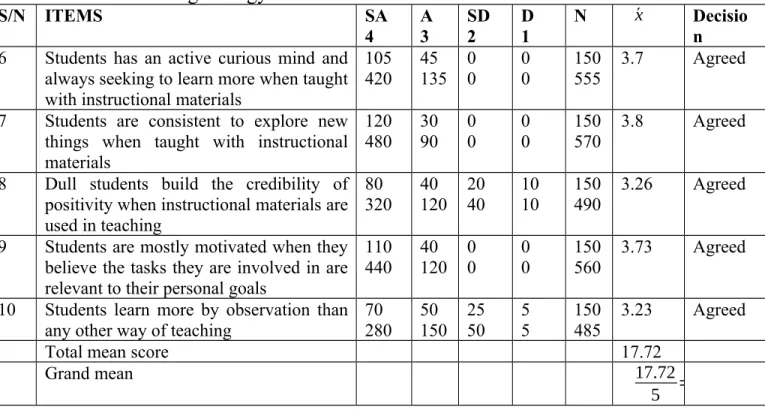
Table 2: mean score on the attitude of students towards the use of improvised materials in teaching biology
S/N ITEMS SA
4
A 3
SD 2
D 1
N ´x Decisio n 6 Students has an active curious mind and
always seeking to learn more when taught with instructional materials
105 420
45 135
0 0
0 0
150 555
3.7 Agreed 7 Students are consistent to explore new
things when taught with instructional materials
120 480
30 90
0 0
0 0
150 570
3.8 Agreed 8 Dull students build the credibility of
positivity when instructional materials are used in teaching
80
320 40 120 20
40 10
10 150
490 3.26 Agreed 9 Students are mostly motivated when they
believe the tasks they are involved in are relevant to their personal goals
110 440 40
120 0
0 0
0 150
560 3.73 Agreed 10 Students learn more by observation than
any other way of teaching
70 280
50 150
25 50
5 5
150 485
3.23 Agreed
Total mean score 17.72
Grand mean 17.72
5 =3.54
In table 2 above, the mean score are 3.7, 3.8 3.26 3.73 and 3.23. From the result it shows that students attitude towards the use of improvised instructional material when teaching is positively high as indicated by grand mean of 3.5 which is above 2.5 the decision rule. This means that the responses are of high agreement from the respondents that the use of improvised instructional materials while teaching has a significant influence on students attitude in Ezeagu LGA of Enugu State.
Research question 3: What is the influence of the use if improvise materials on students academic achievement in biology
Table 3: Mean score on the influence of the use of improvised materials on students academic in biology.
S/N ITEMS SA
4
A 3
SD 2
D 1
N ´x Decisio n 11 Improvise materials help students retain
the concept being taught
40 160
60 180
20 40
30 30
150 470
2.73 Agreed 12 The effective use of improvised materials
enhance students innovative and creative 70 280
65 195
15 30
0 0
150 505
3.36 Agreed 13 Use of improvised materials sparks the
students interest and makes student not to be absent in the class
25 100
45 135
60 120
20 20
150 370
2.5 Agreed 14 Students taught with improvised
materials perform highly well than their canter-part
65 260
45 135
20 40
20 20
150 455
3.03 Agreed 15 Improvise materials significantly increase
students’ academic achievement by supporting students learning
105 420
45 135
0 0
0 0
150 555
3.76 Agreed
Total mean score 15.38
Grand mean 15.38
5 =3.07
From item 11 – 15, the mean scores are 2.37, 3.36, 2.5, 3.03 and 3.76 respectively the result revealed that the use of improvise materials influences academic achievement of students as indicated by grand mean of 3.07 which is above 2.5 (the decision rule). From the table above, it has been seen that the responses have high level of agreement from the respondents that students taught with improvised materials performs academically well than their counter part.
CHAPTER FIVE
DISCUSSION, CONCLUSION, RECOMMENDATION AND SUMMARY
In this chapter, the researcher discussed the result of the findings, conclusion, implication of the study, recommendations of the study, limitations of the study, suggestion for further studies and summary.
Interpretation of Results
From the above analysis, it was revealed that:
1. There is high use of improvised materials by biology teachers in teaching of biology in Ezeagu Local Government Area.
2. The attitude of students towards the use of improvised materials in teaching has a positive outcome.
3. The influence of the use of improvised materials on students’ academic achievement facilitates and enhances effective teaching in biology.
Discussion of the Findings
The discussion will be focused on the research questions analyzed in table 1, 2 and 3 as presented in the chapter.
Research Question 1
What is the extent of the use of improvised materials by biology teachers in senior secondary schools in Ezeagu Local Government Area?
This research question was tested using items 1, 2, 3, 4, and 5 in the questionnaire. The findings revealed that there is high use of improvised materials by teachers in teaching biology in senior secondary schools in Ezeagu Local Government Area of Enugu State. This is because the grand mean of 2.93 obtained from the data is above the decision rule of 2.5. Bassey (2008) pointed out a good relationship between the teaching of biology and using of instructional materials to enhance teaching and learning.
However, the primary concern of all teachers is to teach. Teachers owe students their best effort in providing meaningful learning through the use of different types of materials while teaching.
This also affirmed the fact that for an effective teaching to take place, the theoretical aspect must go in line with the practical aspects so as to obtain positive behavioural change in the life of the learner(s). Students understand well when they are being taught with practicals.
Research Question 2
What are the attitudes of students towards the use of improvised materials in teaching of biology?
To answer research question two, items 6, 7, 8, 9, and 10 were used. The result got from the data obtained has a grand mean of 3.4, which proves that students have very high positive attitudes towards the use of improvised instructional materials while teaching. The use of instructional materials facilitates and enhances effective teaching and learning of biology in senior secondary schools in Ezeagu Local Government Area.
Research Question 3
What is the influence of the use of improvised materials on students’
academic achievement in biology?
To analyze this research question, items 11, 12, 13, 14 and 15 in the questionnaire were used.
The findings of this study showed that the use of improvised instructional materials while teaching have a significant effect on students’ academic achievement. The success of the fact is due to the use of improvised materials, which provides the students with concrete experience, which they need in order to develop their intellect. Oladele (2006) asserted that students comprehend and remember better when teaching materials are improvised. Low achievement trend in the science is due to non-availability of instructional materials in schools, thus, the need for improvisation.
Despite the importance of the use of improvised materials in teaching biology in senior secondary schools in Ezeagu Local Government Area, there are some problems that are still militating against it. The problems are: low level of standardized materials in biology classes, teachers incompetence on the use of improvised materials and students’ wrong attitude towards biology practicals, which lead to poor conception of the subject and their failure in O’Level examinations.
Conclusions
Based on the finding, the following conclusions were drawn:
1. Improvised instructional materials have a significant positive influence on the academic achievement of students in biology
2. The use of instructional materials facilitate enhance effective teaching increase knowledge and appreciation of the subject content.
3. Improvised materials should not only be used or encouraged as useful models were application depends on change and circumstances but should be justified a strategy in such difficult times such as the one in which it should be seen as a variable integral part of teaching even when the school budget is sufficient to cater for standardized materials
Implications of the Findings:
The educational implications from the findings are:
Since improvised instructional materials increases interest and high academic achievement of students in biology, it should be encouraged. Its effective in the teaching and learning process has created innovative skills, encourage team work, increase students’ attention in biology classes and active participation. All these help students to learn the concepts taught rather than abstract aspect of it, so for this reason, the use of improvised materials while teaching can never be over- emphasized.
On the part of the teachers’ improvised instructional materials, promotes teachers – students relationship, which implies that it is very good method for every teacher to understand his/her students very well.
On the parents, they will be better informed on how to encourage and help their words to produce improvised materials. This may be in form of sourcing local materials and provide funds for those that cannot be found in their environment.
Finally, the society at large will be enlightened on the value of the environment.
This will enhance better preservation and protection of the environment and review the usefulness and value of things in the environment from what science teaching materials are improvised.
Recommendation
From the result obtained from the data collected in this work, the researcher recommends that:
1. Teachers should make use of different instructional materials as long as they are relevant to their lesson content.
2. Teacher – Student’s relationship should be boosted as it encourages the leaner to rely and trust in the abilities of the teacher and also ready to open- up to him/her.
3. Seminars and workshops should be organized from time to time to teach or the importance of improvisation
4. The interest of the learner is captured and held during the process of improvisation and so will cause them to be able to create and improve on their own ideas so, improvisation of instructional materials should be done as often as possible.
5. Government, Philanthropists and the P.T.A should contribute financially generously to the promotion of improvisation in secondary schools in Ezeagy L.G.A
6. Education departments should set up workshops to train teachers in rural schools in the use of improvised instructional materials. Beyond these, the researcher recommends that teachers training institution should incorporate the use of improvisation in their curriculum.
Limitation
The following factors acted as constraints to this study were
1. Most students were not willing to fill the questionnaires given to them so I had to explain how important their responses were before they agree to fill.
2. Obtaining data from the state ministry of education was not very easy as it had to take days of come back today come back tomorrow
3. Finally, the work was a burden especially in distributing the questionnaires to different schools which are not closely situated.
Suggestion for Further Study
Since the scope of this research project only limited to Ezeagu LGA, it is therefore necessary for a further research work. On this nature to be carried out in a wider scope that will comprise all the public schools in Udi Local Government Area of Enugu State on the perception of students in the use of improvised instructional materials in teaching biology in senior secondary schools so as to present a holistic view and proper solutions that will cover the whole state.
Summary of the Study
The main purpose of the study is to find out the perception of students in the use of improvised instructional materials in teaching biology in senior secondary schools in Ezeagu L.G.A, Enugu State. Based on the analysis of data, the major findings of the study can be summarized as follows: that the extent of the use of improvised materials in teaching biology by teachers influences student’s academic achievement in biology positively in Ezeagu. L.G.A of Enugu State while teachers incompetency in Improvisation leads to negative or poor academic achievement in
biology within the area. The attitude of the students towards the use of improvisation while teaching has a very positive outcome in the academic achievement. Also improvisation of materials has a great influence on the students academic achievement in biology.
The recommendations include: teacher should make use of different instructional materials as long as they are relevant to their lesson. Biology concepts should be taught with practical activity so that the students will do science instead of learning about science. Teacher – students relationship should be boosted as it encourages the learners to rely and trust in the abilities of the teacher and also is ready to open – up to him/her. Government, Philanthropists and P.T.A should contribute financially generously to the promotion of improvisation in Ezeagu L.G.A of Enugu State. Seminars and workshops should be organized from time to time to teach teachers on the importance of improvisation for effective teaching and learning of biology in all the public secondary schools in Ezeagu L.G.A.
Furthermore education department should set up workshops to train teachers in rural schools on the use of improvised instructional materials. Beyond these, the researcher recommends also that teachers training institutions should incorporate the use of improvisation in their curriculum.
Some of the limitations involved in this study are: most students were not willing to fill the questionnaires so I had to explain to them on how important their responses were before they agree to fill. Obtaining data from the state ministry of education was very easy as it had to take days of “come back today, come back tomorrow. The work was a burden especially in distributing the questionnaires to different schools which are not closely situated.
Suggestion for further studies like: perception of students in the use of improvised instructional materials in teaching biology in senior secondary schools should be
carried out in other Local Government Area of Enugu State so as to present a holistic view and proper solutions that will cover the whole state.