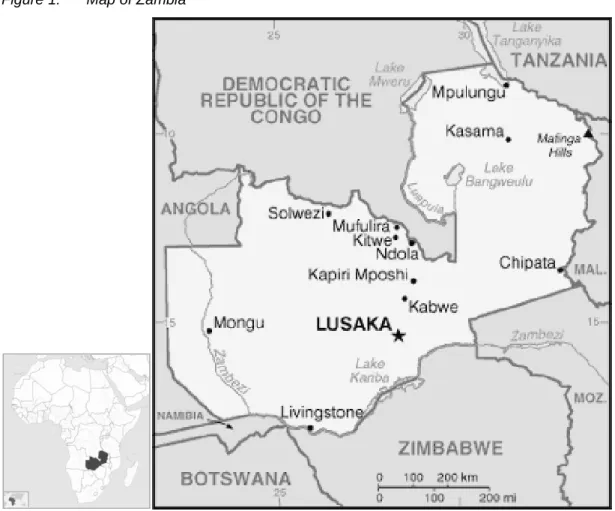
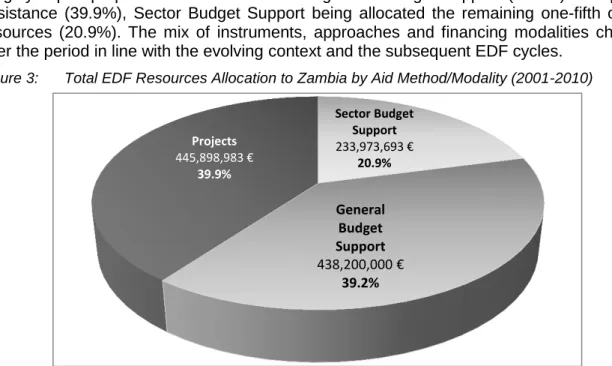
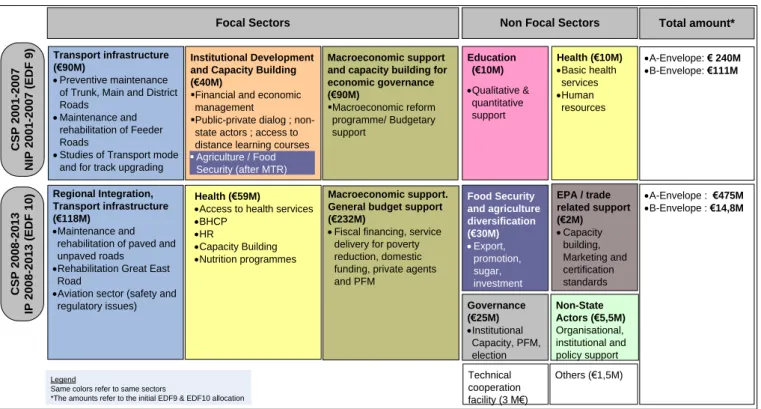
The EU response strategy was in line with the policy priorities of the Government of Zambia. The Commission's evaluation of the European Union's assistance to Zambia5 (Country-Level Evaluation) is part of the 2010 evaluation program adopted by the former Directorates-General for Foreign Affairs and Development (now DG DEVCO).
Framework of the evaluation
The scope of this evaluation covers the findings, conclusions and recommendations of the previous country-level evaluation (2006), in particular checking whether the EU has implemented its main recommendations. These objectives are understood in the context of the overall priorities of the EU Commission.
Overview of the evaluation process
Another issue addressed by this review is how synergies have been achieved and gaps filled between EU bilateral and regional EU strategies and programmes, in particular in the context of cooperation with the Intergovernmental Authority on Development ( IGAD) and the Joint Development Authority (IGAD). Eastern and Southern Africa Market (COMESA). It is therefore important that the evaluation strikes an appropriate balance between (i) comprehensive enough to meet the above accountability requirements; and (ii) specific enough to provide useful and relevant lessons that can be used by the EU and its partners to increase the results-oriented nature of its support.
Methodological approach
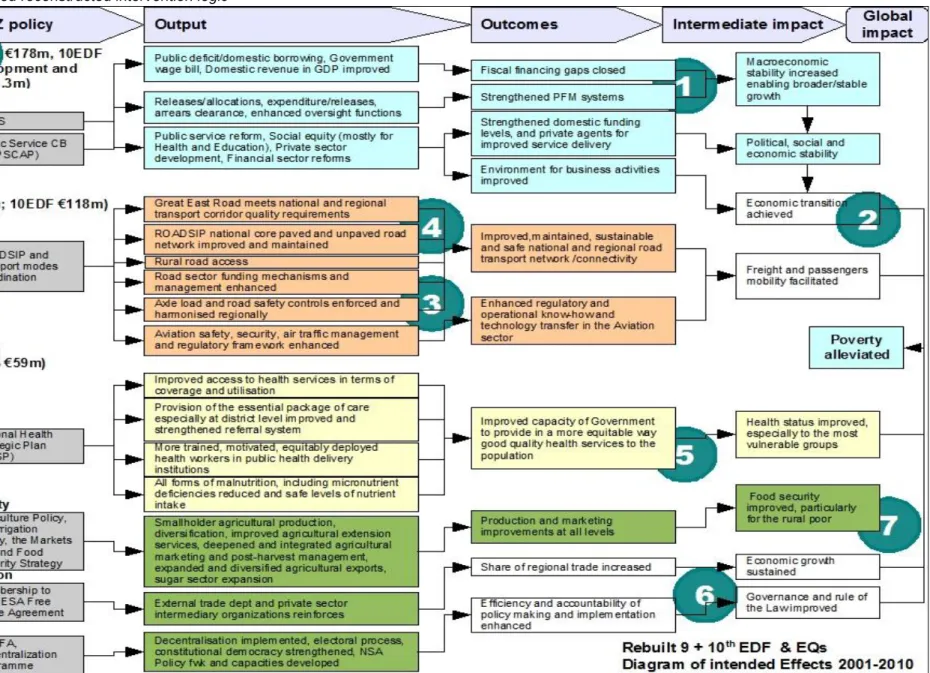
The EU has chosen three core sectors in each of the programming cycles covered by the reference period. The numbers in the circles represent the number of the evaluation question (cf. Chapter 5), their placement in the diagram shows their focus (strategy/sector) and level of analysis (activity/impact) in relation to the intended strategy.
Relevance and coherence
The NIPs of the ESA-IO region (including Zambia) have significant links with the RIP. So the Economy dimensions concentrate on the input level of the (logarithmic) result chain.
Direct and induced outputs of budget support
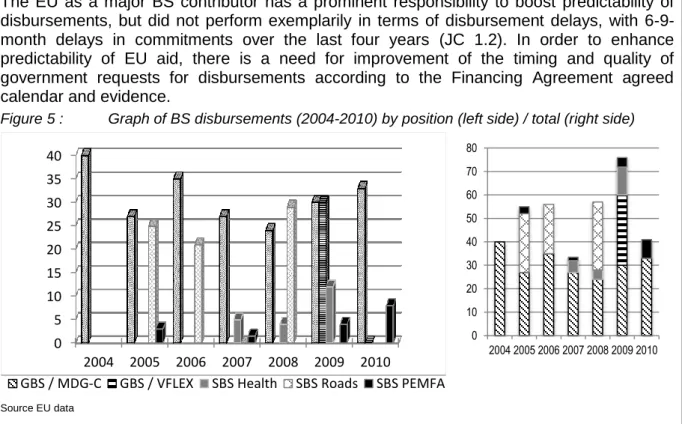
The EU has made an important contribution to the issue of predictability with the draft MDG-C. The role of the EU in policy dialogue is crucial, especially because of the importance that budget support plays in a country like Zambia. The EU was particularly involved in contributing, as part of the Collaborating Partners Group (CPG), to the discussions on the development of the Six National Development Plan (SNDP).
The EU's role in the dialogue on public financial management issues over the years has been widely recognized by both government and other cooperating partners as a driver of PFM reforms (PC 1.3). However, EUDel recommended adjusting the MDG-T for the period 2012-2014 from the annual entitlement of €7.07 million to €5.75 million based on PAF performance.
Shift towards private sector led development
The political dialogue during the design of the projects, especially the CBPSD, resulted in reforms in the political framework and institutional arrangements. This turned out to be a thorn in the side of the EU's ability to contribute to improving the private sector regulatory environment: after signing the financing agreements, both projects were hampered by various governance issues. The external audit of the Office of the Auditor General (OAG), although supported by the EU in a similar way, also had the support of Norway for its strategic approach.
This shortcoming was reinforced by the lack of interest of MKTI senior staff in the project, and even resistance to long-term TA management of the project. In summary, the private sector developed independently of EU interventions aimed at improving its enabling environment.
Transport system public management institutional reform
The EU helped to significantly strengthen the policy framework and programming of the roads sub-sector, based on SPSP1. An integrated approach to the transport sector was supported through the GRZ Transport Master Plan in the early stages of the reference period, but was ultimately not adopted by the EU. Early warnings for RDA planning and management, supported by the EU, ending with the 2009 OAG audit.
The design of the NRFA is not fully compatible with the second generation road fund as. By the end of the period under review, 92% of maintenance needs were financed by GRZ budget allocations (including inter alia EU financial inputs under SPSP), direct donor contributions and commercial loans.
Improved accessibility and mobility
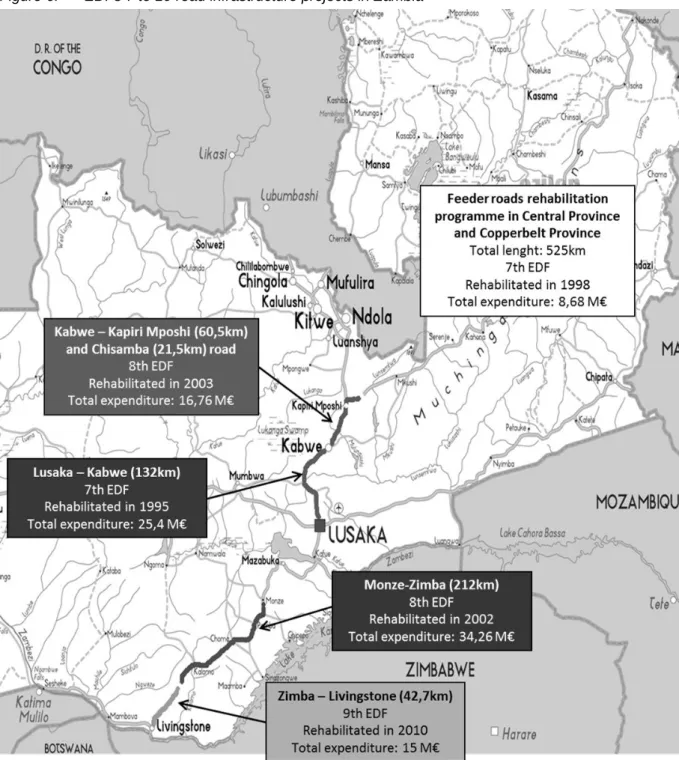
In the two transport sub-sectors supported by the EU during the reference period, the condition of the infrastructure improved significantly. The percentage of the total length of paved trunk roads and regional corridors of the CRN in good and fair condition increased from 79%. The capacity of the Livingstone and Lusaka airports (the main Zambian airports) has been adjusted to the traffic requirements and the GRZ pro-growth policy.
Rural access improved much less, with most of the road sub-sector budget allocated to paved CRN (I-4.2.1). Almost all of this support was provided in the last few years of the evaluation period due to procedural delays and contractual issues with contractors.
Population health status
While the disbursement of the EDF9 program was subject to the achievement of benchmarks set out in the Human Resources for Health strategic plan logframe, the conditions relating to disbursements under the EDF10 program (monitored in SBS PAF63) were set accordingly with the outcomes (monitored in GBS) PAF64). 66 A trend is also depicted in the Mid-term review of the Zambia National Health Strategic Plan (Nov. 2008). The recommendations of the 2008 MTR NHSP continue to be relevant today, favoring initiatives such as encouraging private investment in the country's health sector through PPP arrangements and work-based health and HIV/AIDS prevention and treatment programmes.
72 Also noted by the mid-term review of the Zambia National Health Strategic Plan (November 2008). For the healthcare sector, it was reported that virtually unqualified health workers were running 45% of rural health centers.
Democratic governance and Civil society
The design of the EU's response to the different actors in governance has been quite comprehensive, as it focuses on the main clusters of stakeholders and different actors, including the government, parliament, electoral processes, judiciary, police, civil society organizations, and so on. The interim evaluation of the EDF10 CSP-NIP reaches a broadly similar conclusion about the NSA/LA's involvement in policy dialogue. The cancellation of the comprehensive support program for civil society organizations under the EDF9 was a major setback for the institutionalization and mainstreaming of the civil society consultation process.
The government kept delaying the signing of the financing agreement, which eventually led to its termination. Overall, human resources are rated as the weakest aspect of OCD performance in Zambia; lack of institutional and management capacity is another cited weakness.
Food security and agriculture
The policy framework in the agricultural sector has improved significantly in recent years with the adoption of the National Agricultural Policy (NAP) in the mid-2000s and the Private Sector Development (PSD) agenda. These limitations are also related to the inability of the project to contribute to the development of a food security strategy, the lack of ownership of MACO staff and insufficient budget allocation for M&E (I-7.6.3). The inability of SADFSP Component 2 to improve the performance of MACO's extension services in pilot provinces implies that contributing to significant increases in production and productivity beyond that of participating farmers was beyond the scope of EU interventions.
Qualitatively, however, the positive trend was confirmed by farmers in the final evaluation of the program (I-7.2.3). EU contribution in pilot districts covered by the SAWDB was also limited by the component 1 failure to develop a task force and strategy as components 2 and 3 were linked by project design to the release of the food security strategy.
Aid modalities and Aid efficiency
Overall, M&E was rated as one of the weaker aspects of all aid modalities, and in particular general budget support. JASZ and related forums could not prevent the contamination of the entire political dialogue. 98 UMRI-IOB; Budget Support Assessment in Zambia - Synthesis Report; 2011: Main evaluation findings regarding collaborative knowledge management; p vii.
In the context of the Paris Declaration and Accra Agenda for Action on aid effectiveness, this is a sort of upside down situation. Since then, the EU has played a prominent role in the establishment of the JASZ and in its functioning.
Global conclusions
In addition, EU support facilitated the implementation of the FNDP through improved planning, accounting and reporting procedures for the Government regarding aid inflows. The government has often complained about the difficulties of accessing EU financial support, such as lengthy procedures, unilateral decision-making, cumbersome reporting and the packaging of politically sensitive issues with high transaction costs. However, there is generally a lack of consensus among cooperating partners, as well as between government and cooperating partners, on the appropriate size and substance of the PAF.
Institutional Support to Domestic Accountability – A major achievement of capacity building in PFM by the EU and other cooperating partners was the review in 2009 of the budget management cycle that had long been an obstacle to effective budget management in Zambia. While progress has been recorded in increased capacity and expansion of the Auditor General's office, there continues to be weak domestic accountability by government due to a lack of active participation by Parliament and CSOs in budget implementation.
Specific conclusions
- Relevance and coherence (EQ 9)
- Aid modalities and Aid efficiency (EQ 8)
- GBS, SBS and MDG contract (EQ 1)
- Private sector development (EQ 2)
- Transport (EQ 3 and 4)
- Health (EQ 5)
- Democratic governance (EQ 6)
- Agriculture and food security (EQ 7)
Impact of political dialogue - The actual impact of ongoing political dialogue on GRZ policies has not been measured. It contributed to (i) strengthened political dialogue between global and sectoral interests and (ii) improved monitoring of implemented national and sectoral strategies. Vulnerable groups – Joint EU/CP support has not elicited an adequate response to the persistent vulnerability of the population.
Participate in accelerated adaptation of the EU strategy in response to the steady decline in the leverage of the EU's financial input. Involves an accelerated adjustment of the EU strategy in response to the steady decline in the leverage of the EU's financial input.