I underestimated the time it would take to complete and overestimated how much personal acumen I could gain from reading sage books. I am similarly grateful to the other students in Cohort 5 at Athabasca University for their company on this long journey. In the end, I believe her calm acceptance of life's challenges has taught me almost everything I need to know about wisdom.
A total of 23 older adult men and women participated in a non-formal course delivered twice within two consecutive six weeks. Third, the forum comments from the first cohort of participants were made available to the subsequent cohort. This seemed to have had a positive effect on the second cohort of participants, who gained access to the previous knowledge.
Introduction
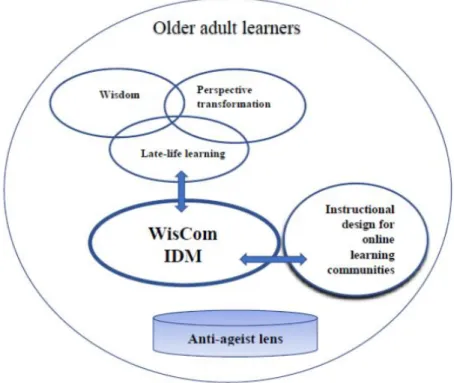
WisCom suspected that if an older adult experienced a perspective transformation, it could lead to wisdom development. In addition to the limited testing of WisCom, another issue underlying this study relates to the lack of literature on the older adult learner as a student in online learning. What happens in a discourse-based, online course created with the goal of developing a wisdom community for older adults.
Sub-Question 2: What evidence is there of transformative learning in this online community of older adult learners using Mezirow's (1978a, 1991) definition and description of the phenomenon. The first relates to the contextual aspect of the research, which concerns the scarcity of online courses specific to communities of older adult students in Canada. This first chapter described my research, which aimed to explore the experience of older adult participants taking an online, asynchronous course using the WisCom (Gunawardena et al., 2006) instructional design model.
Literature Review
On the surface, the format is similar to that of Egypt's The Maxims of Ptahhotep. Duke (n.d.), defending the Sophists against accusations that they were devious and morally suspect intellectuals, said: "The development of democracy made mastery of the spoken word not only a prerequisite for political success, but also. Perspectives of meaning are "the structure of assumptions within which one's past experience assimilates and transforms new experience" (Mezirow, 1990, p. 142).
Criticisms and alternative viewpoints. The most relevant critiques of transformative learning came from Hoggan (2016) who argued for understanding. The traditional appeal of retirement — the idea that it's possible to avoid strenuous exertion — has met with warnings from health professionals. Martinson and Minkler (2006) examined the volunteer ideal—the principle of unpaid work as an act of civic engagement and social responsibility—among older adults.
Rather than simply being the result of communication, it relates to "the sense of connection with another person and the 'reality' of this person". According to Gunawardena et al. 2006), "The emphasis moves from knowledge as distributed cognition created through the interaction between people and artifacts to knowledge as co-created commodity with a capacity for preservation and archiving" (p. 224).
Methodology
I will provide details about the course design and how the data was collected and analyzed. Miles and Huberman (1994) argued that ethnographic research is descriptive, develops or refines theory, and deals with “behavioral regularities in everyday situations” (p. 8). In my research, the research questions I posed were to (a) examine WisCom's ability to foster a collaborative, constructivist learning community and (b) examine the technical aspects of the design.
Cutts described plain language as "writing and presenting information in a way that gives a cooperative, motivated person a good chance of understanding the document on first reading" (1995, p. 3). Each of the six course modules concluded with two questions for discussion in the LMS forum. The organizing principle for the modules in the course was replication of the cycle of inquiry found in WisCom.
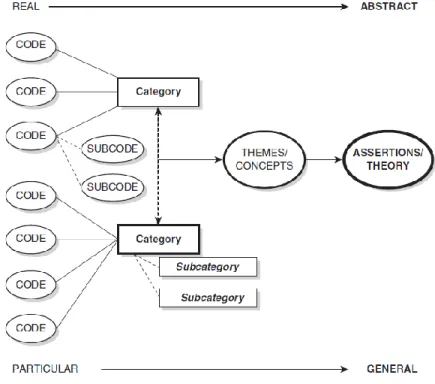
A central purpose of the analytical note is the achievement of "reflexivity on the data corpus" (p. 42). This seemed appropriate given the breadth of the research questions and sub-questions driving the study. According to Olive (2014), “the ethical perspective includes an external view of a culture, language, meaning associations, and real-world events” (p. 4).
Noting that culture is a process, she advised academics to “confront – not to avoid or erase, but to face – the biases in one's perspective, to be within. As Conrad (2002) suggested, I paid attention to “signature balance—the kind and amount of imprint my style left on the voice display” (p. 34). Unlike the original research, completion of the course did not result in credit toward a degree.
It is acknowledged that in the original WisCom research, the nature of the course (formal, credentialed) is likely to have influenced student motivation and therefore attainment.
Findings
There was generally a lack of collaborative learning in the first semester of the course. Another area where Semester 2 participants outperformed Semester 1 participants was the length of posts. In my course, some design tasks necessarily deviated from the model proposed by Gunawardena et al.
For example, recruiting mentors from previous cohorts of the course is recommended in step 3 of the inquiry cycle (Gunawardena et al., 2006). In the second half of the question, I invited participants to elaborate on the type of knowledge they had hoped to gain from the course. Six of the participants I spoke with offered that they had also answered the survey.
Emma's surprise with the discussion element of the course may indicate a change in perspective. The second part of the first question inquired if there was a piece of knowledge that the participants hoped to gain by enrolling in the course. Seven of the participants simply referred to wisdom as the general topic of interest that drew them to the course.
Commenting on one of the case studies, she said: “I still think about the story of the pirates. Deborah also claimed that this part of the course was more interesting. I asked for information about the changes the participants had experienced as a result of the course.
As with Lin, Deborah appeared to be still processing the information at the end of the course.
Discussion
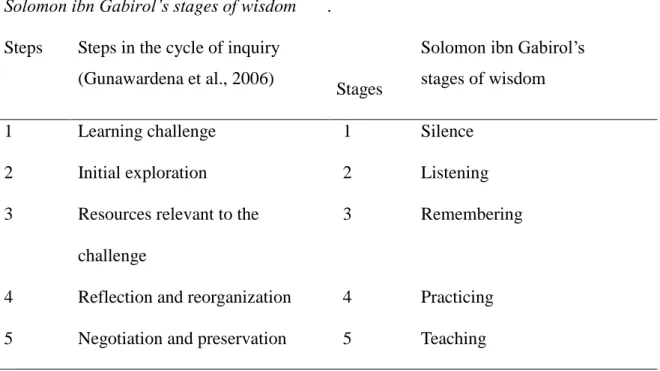
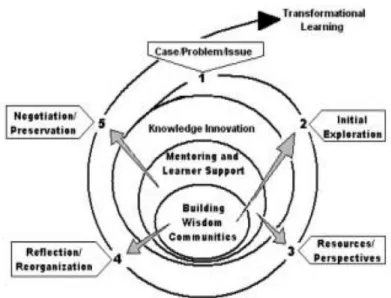
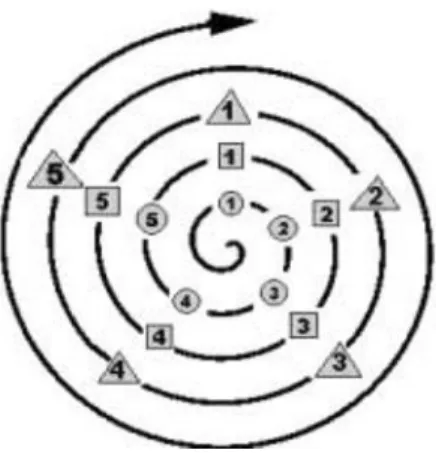
Therefore, I believe that the requirement to include tutors in the WisCom teaching planning model is an unnecessary and impractical aspect of planning. Although this notion was not mentioned in the 2019 update of the WisCom model, I have included the original diagram showing this movement through the program of study (Figure 5.1). Another reason I chose to use Gabirol's stages of wisdom is that they resemble the steps in the cycle of inquiry (Gunawardena et al., 2006).
Comparing the steps of Gunawardena et al. (2006) in the cycle of inquiry with the stages of wisdom of Solomon ibn Gabirol. Gabiroli's stage 1, silence, finds a parallel in step 1 of the cycle of inquiry, the learning challenge, which does not assign any action to the students. Gabiroli's stage 2, listening, finds a parallel in the cycle of inquiry step 2, initial exploration, where the students' shared identity is constructed.
I searched the forum for evidence of the development of wisdom through signs of reflection that led to new attitudes. I looked in the forum for signs that participants had been inspired in some way by the course discussion and for evidence that they could apply what they had learned outside of the course. Post-course interview responses indicated that participants were accustomed to taking a more passive role in the learning transaction.
In the WisCom model, collaborative inquiry using critical reflection is a central method of fostering a community of wisdom. The context of the dilemma was historical, and the victims in the narrative were women. In their 2019 WisCom update, Gunawardena et al. gave the following definition of a community of wisdom:.
Additionally, I noticed that transformative learning was misdefined in the original WisCom model experiment in 2006.
Conclusions, Recommendations, and Reflections
I find this particularly puzzling because one of the main reasons for offering online courses through this U3A was to provide social contact for isolated older adults (Swindell, 2002). Their lack of commitment to online discourse could also be interpreted as a limitation of the WisCom instructional design model when used in informal online courses. To some extent—though limited by the required brevity of Twitter—this practice could provide the archive of knowledge that Gunawardena and others advocate in the final step of the cycle of inquiry, which involves preserving the fruits of the student.
Conducting such a study would explain the navigational choices made by these students as they progress through an online course. Another direction that could be explored is the use of the Berlin Wisdom Paradigm in WisCom's vehicle. However, I am convinced that a non-formal learning environment such as a U3A would be the wrong place to mandate participation; rather, a formal course of study would be an ideal place for the principles of the Berlin Wisdom Paradigm to be incorporated with WisCom's instructional design model.
To borrow an analogy from Ardelt in 2005, discussion of perspectives on wisdom is like the Buddha's story of the blind men and the elephant. Each blind man who felt a different part of the gigantic being described a different piece of the whole, believing it to be the full reality. As a member of the demographic I studied, I am very aware of how cautiously an older adult student will move toward new ideas and new ways of thinking.
I end this research by disposing of the idea that wisdom and perspective transformation are suitable goals for a course of study. I also saw evidence of a respect for listening, which participants identified as the most important attribute of the sage. Using constructivism in technology-mediated learning: Constructing order out of chaos in literature.
Proceedings of the Sixth International Transformative Learning Conference, The Michigan Center for Career and Technical Education, East Lansing, MI, 29-34.