This leaves recent immigrants unable to independently make realistic, informed and suitable job choices necessary to integrate into the Canadian labor market. Many policy-oriented initiatives are continuously undertaken on a variety of issues regarding immigrant labor market integration. Labor market research consistently confirms that finding, securing, and maintaining appropriate employment [in the first four years] are key determinants of immigrant well-being and successful integration into Canada (Shields, Lo, Zikic, & Atlin, 2011).
One immediate intervention that remains underexposed concerns the provision of labor market information in the pre- and early post-arrival phases. This article provides an in-depth content analysis of information/resources before and after arriving in the Toronto job market.
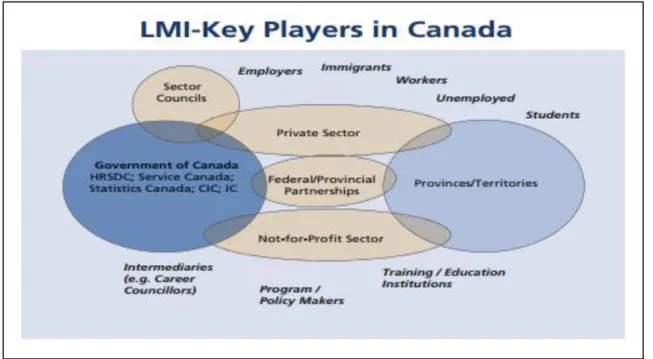
Defining Labour market information
Likewise, community-based service providers can be seen as an important provider of labor market information with individual and/or collective organizational capacities to collect, analyze and disseminate information needed to actively support job hunting for newcomers/immigrants. These concerns are often raised by Canada's settlement sector, which explains, “…[recent] immigrants need good, solid information to realistically assess their prospects, especially given the risks assumed in moving from their familiar homeland to a foreign country with a very different labor market" (Advisory Panel for Labor Market Information, 2009: 6). Information about occupations and skills needed in different cities and regions throughout the country and employment opportunities in their area before arrival can reduce labor market barriers faced on arrival (ibid).
The effective LMI system described here clearly advocates for a more worker-centered model of information delivery that is missing and needed in the current workforce development system (Labor Market Information Advisory Board, 2009: 64). However, greater emphasis on the collection, interpretation, analysis and dissemination of LMI among and for different groups of workers is recommended to ensure that market decisions/processes by key labor market policy makers and practitioners maintain the interests of all parties for economic development and workforce development (Labor Market Information Advisory Committee, 2009; Drummond, 2014; Criptoph 2003; Esses and Medianu, 2012; Sharpe and Qiao, 2006).
Canada’s labour force development framework: LMI provision
Nor is it conducive to informing and supporting labor market decisions in rapidly changing local labor markets. The most in-depth discussion of LMI was initiated in 2008 when the Forum of Labor Market Ministers (LFMM) commissioned an Advisory Panel on Labor Market Information (2009) to explore the provision of labor market information within the labor market system. Canada's workforce development. LMI from the City of Toronto, Toronto Workforce Planning Board (TWIG, 2013) and other official localized labor market players continuously.
This should be considered by Canada's workforce development actors when undertaking labor market research, analysis and dissemination. Addressing LMI provision from formal localized actors cannot fully resolve the informational issues regarding immigrant labor market integration.
2013 Employment Concentration, City of Toronto
Employment Districts, City of Toronto
Immigrant Labour market outcomes
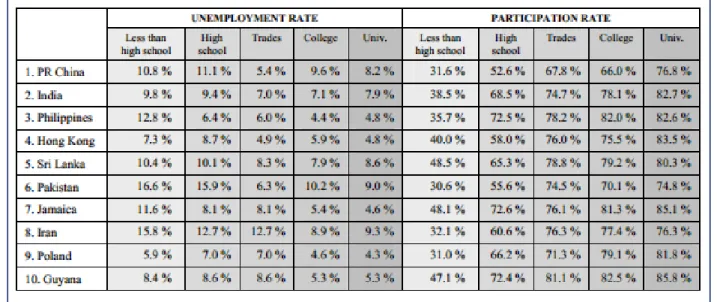
There is limited evidence to support that labor market information is used and influences labor market decisions and outcomes for Canadian workers and employers (Murray, 2010). Even fewer people are aware of the factors that influence newcomers' access to and use of information and the impact on their labor market outcomes (Caidi, Allard, Quirke, 2010; Esses and Medianu, 2012). However, labor market research consistently shows that there are differential labor market outcomes for immigrants based on race, class, gender, and immigration status (Galabuzi, 2006; Teelucksingh and Galabuzi, 2007; Rietz 2007).
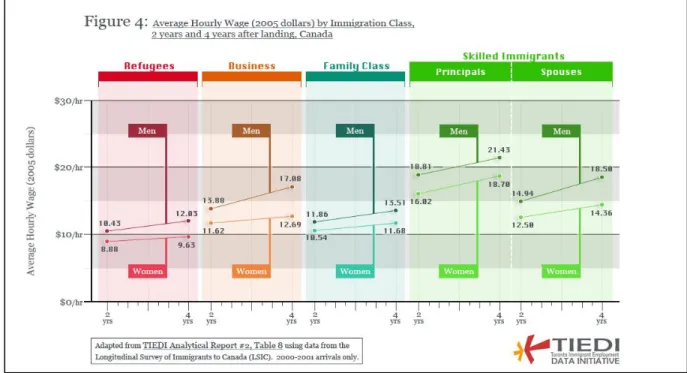
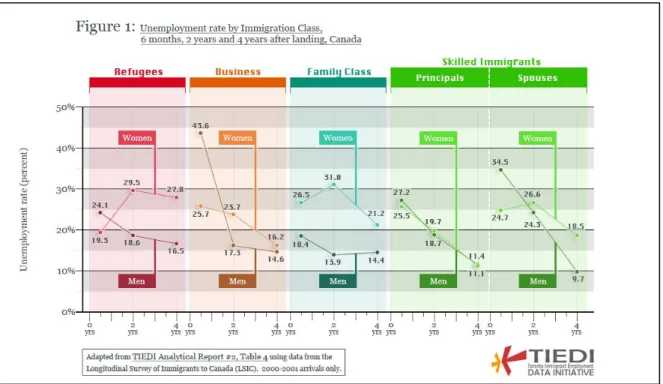
These findings suggest that the labor market information, tools and support currently available have not been effective in mitigating the many barriers recent immigrants face in the Canadian labor market. Figures 4, 5 and 6, adapted from the TIEDI Analytical Report 2, highlight overall differences in labor market outcomes by immigrant class and gender (ibid). Mainstream applicants in the skilled worker classes had better labor market outcomes with lower unemployment, less underemployment, higher earnings, and less time to find their first job than other immigrant classes.
Overtime, initial labor market outcomes remain relatively the same even after 10 years in Canada (Block and Galabuzi. 2011; Galabuzi, 2006; Teelucksingh and Galabuzi, 2007). However, country of birth and gender have become leading factors shaping the color-coded nature of the Canadian labor market (see Block and Galabuzi, 2011). Health and social assistance (11.3%), Accommodation and food (10.5%); and underrepresented by gender in construction-related occupations (0.9%) (ibid).
In her global city thesis, Sassen (2001) explains that this new hierarchy of services produces a “high-income dispossession” that intensifies labor market competition among all job seekers. By the nature of their recent entry into the market, "third world immigrants" are forced into low-wage service jobs, while native-born workers are underrepresented and benefit from higher-wage jobs ( Ibid). Chart 1, below presents the level of competition between all participants in the labor market for available employment opportunities in 2006.
Proportion of individuals by immigrant status employed in Entry-level job categories
Data collection
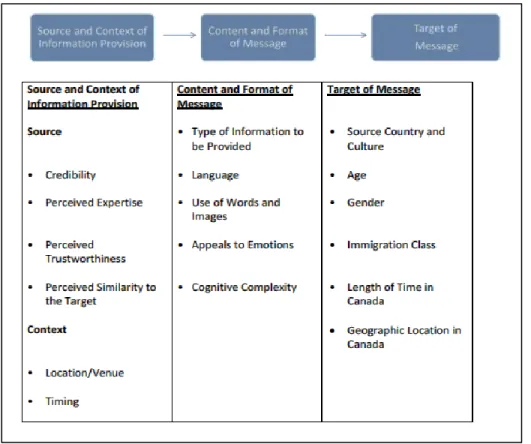
The total post-arrival sample consists of fourteen (14) selected sources including: municipal government providers (n=11), educational and training institutions (n=45), industrial and regulatory agencies (n=40), immigrant services agencies (n= 77), issue-based NGOs (n=116), multicultural NGOs (n=114) and universal service providers (n=19). It is important to note that the pre- and post-arrival samples created for this small-scale qualitative content analysis may not reflect the total number of online and in-person LMI portals available from formal providers in the Canadian workforce development system. The most detailed matrix has been developed to accurately identify and assess the types of labor market information offered in the content based on four fundamental employability dimensions.
The framework for four basic employability dimensions was developed by Patsula (1992), based on several themes raised in understanding and dealing with various issues in employment advice and has since been developed into an employability framework for HRSDC and other labor market players (Amundson, 2003). The four fundamental dimensions of employability are: 1) career decisions; 2) improving skills; 3) job search, and 4) employment retention (OCASI-LearnAtWork, 2014; Amundson, 2003; Redekopp, Hopkins, and Hiebert, 2013; White Mountain Consulting, n.d.). The nature of accessible education provision for formal providers remains highly fragmented, with varied coverage across basic employability dimensions. For a visual summary of the nature of the accessible education facilities in the pre- and post-arrival phases, see Tables 4 and 5.
The limited amount of time and resources to conduct this content analysis may not conclusively capture the full amount and quality of information publicly available for prospective and recent immigrants to obtain online and in person for both pre- and initial post-arrival stages . When examining the sources and context of information conveyed across four basic employability dimensions, the nature of LMI provision remains highly fragmented. Not all providers in a pre- and post-arrival stage cover all four basic employment dimensions.
The extent of coverage of activities varied by provider in both the pre- and post-arrival samples. At some stage after arrival, there was a greater amount of coverage from 10 of 14 personally selected sources. A variety of sources are consulted and/or recommended in LMIs obtained from pre- and post-arrival samples.
Target of Message
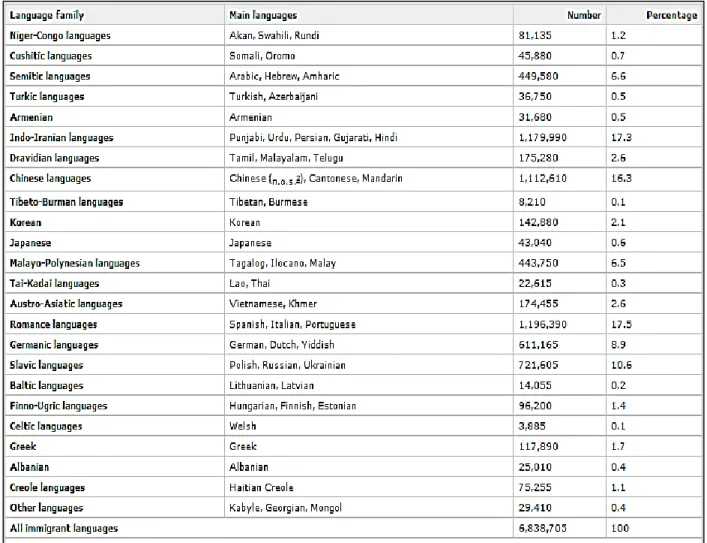
These are languages used to provide BMI and testimonials of recent immigrants and immigrants using available labor market information, tips and tools. This leaves the newest labor market entrants, recent immigrants, unable to independently make realistic, informed and suitable job choices necessary to more effectively integrate into the Canadian labor market. The absence of labor market supply/demand information available in person can be attributed in part to issues with data collection, interpretation and dissemination in Canada's workforce development system.
One LMI guide available to all job seekers in Ontario, "Guide to Using Labor Market Information in Ontario" maintained by the Ontario Ministry of Education, Colleges and Universities. This is likely to increase the difficulty for recent immigrants, or for any other newly recognized labor market entrant, when collecting and making sense of available LMIs from workforce development providers. However, discussions with Canadian settlement and career practitioners reveal that there are problems with employment services provided by the non-profit sector that may affect labor market outcomes for immigrants and other job seekers.
In addition, the individual knowledge and capabilities of employment counselors/job developers/career and information workforce specialists significantly shape the types of labor market information, support, and services that job seekers need (Occhiuto and Quintero, 2012; Redekopp, Hopkins, and Hiebert, 2013). The information issues uncovered in formal labor market information in Canada's workforce development system reinforce some questions raised by policy makers and practitioners about the absence of good, reliable, timely and accessible labor market information for all labor market participants, which include immigrants and service providers. providers (Advisory Panel on Labor Market Information, 2009; Drummond, 2014; Sharpe and Qiao, 2006). Combined, it presents a fragmented information system that fails to meet the fundamental dimensions of employability and largely inhibits the most recent labor market entrants, recent immigrants, from independently making realistic, informative and appropriate employment choices necessary to effectively integrate into the Canadian labour market.
There are a number of policy-based and practitioner-based interventions that need immediate intervention to ensure that recent migrants seeking work are equipped with the information, advice and tools needed to mitigate or alleviate barriers preventing access. and mobility in the Canadian labor market. Many of these recommendations echo those already made by the Labor Market Information Advisory Panel (2009), Drummond (2014), TIEDI (2012b), and the Toronto Workforce Planning Board (TWIG, 2013). First, more localized labor market information/data should be collected, interpreted and disseminated in official census data sets that specify the outcomes of particular groups in the Canadian labor market, particularly on the basis of education, gender, experience, immigration status and a variety. others.
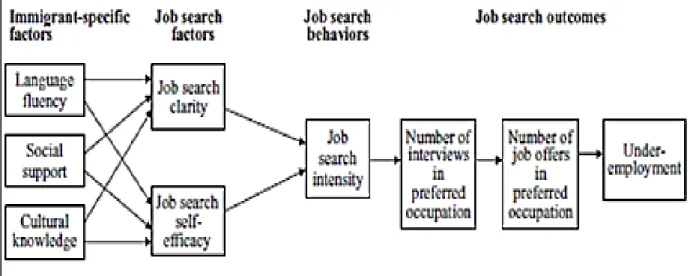
The informational perspective of how immigrants receive and understand labor market information to find employment is largely an understudied issue. (Caidi, Allard and Quirke, 2010). For example, job search behaviours, which are independent factors outside of LMI provision and which are also central in shaping employment outcomes, should be included more centrally in labor market analysis.
Content Analysis Selective Coding Guide
Retrieved from http://www.flmm-lmi.org/CMFiles/Publications/whatnew/LMI-Service-Guidelines-ENG-2.02.pdf. Presentation of Plenary Session 5 at the 2014 Canadian Immigration Conference: Improving Canada's Immigration System - From Invitation to Integration, Toronto, ON. Retrieved from http://www.ccdf.ca/ccdf/wp-. 2007) Immigrant Employment Success in Canada, I and II. part.