Cynthia, thank you for your encouragement, patience, persistence, positive outlook, and endless amount of happy face emoticons. Thank you for sharing your experience and giving me an insight into the person behind the position. I spent most of my post-secondary years thinking about what would eventually become my thesis topic.
Then, over the past two years, I was introduced to the phenomenological research process “up close and personal.” Thank you for starting this journey with me and seeing it through together. It was my desire to be both your mother and a student that led me to research this topic.
Keywords: women; mother; distance learning; collaborative group work; Forum; help and support; flexibility; organization; perseverance; personal life; professional life.
INTRODUCTION
During the interview process, the researcher asked Moustakas' (1994) key questions: “What did you experience in terms of the phenomenon. What contexts or situations have typically influenced your experiences with the phenomenon? to elicit responses from participants. The purpose of this study was to explore the phenomenon of mothers in distance learning, explore the essence of five mothers' experiences as distance learners, and identify any similarities in each of their unique experiences.
Sub-Question: Is there an essence to the lived experiences shared by mothers. Expressions that do not contain the moment of experience, which is a necessary and sufficient component for its understanding, are dropped. This study explored the essence of distance learning mothers' experiences, a phenomenon that could only emerge from the participants' reflections; therefore, phenomenology was chosen as the appropriate qualitative methodology.
Other qualitative methodologies were considered, but none sought to capture the essence of the experiences of distance learning mothers.
REVIEW OF RELATED LITERATURE
For this reason distance education is often touted as an ideal way of learning for non-traditional students. Faith and Coulter (1988) explain that distance education is often seen as “…especially suitable for women who. While distance education may make the educational goals of many women attainable (Kramarae, 2001; Müller, 2008), few researchers recognize that these goals remain difficult to orchestrate (Coulter, 1989; Moody, 2004) or to study the ways in which women cope with their many responsibilities.
In the absence of further research on mothers' experiences as distance learning students, postsecondary institutions are speculating about the needs of a growing group of potential students and playing what Paul (1990) calls “a game of roulette, an expensive, hit-or-miss approach.” (p. 85). Distance learning has long been touted as a viable option for women, especially mothers of young children. In the absence of further research on mothers' experiences as distance learning students, postsecondary institutions are forced to speculate about the needs of a growing population.
More research is needed to better understand the phenomenon and its implications for distance learning.
METHODOLOGY
The study is intended to discover and describe the elements (texture) and the underlying factors (structure) that comprise the experience of the researched phenomenon” (p. 444). Van Kaam's research approach makes use of a series of steps: "(a) the original descriptions are divided into units, (b) the units are transformed by the researcher into meanings that are expressed in psychological and phenomenological concepts and (c) these transformations are combined to create a general description of the experience”. In qualitative research, it is essential that the researcher is cognitively aware of the personal lenses or biases she brings to the research to ensure that she accurately and fairly reflects the participants' voices rather than her own (Blodgett-Griffin).
In addition, the researcher must also be aware of the level of immersion required by her topic and chosen method. Included below are my personal responses to the two main questions posed by survey participants. All applicants and subsequently all those selected to participate in the study were non-traditionally aged (or mature) students.
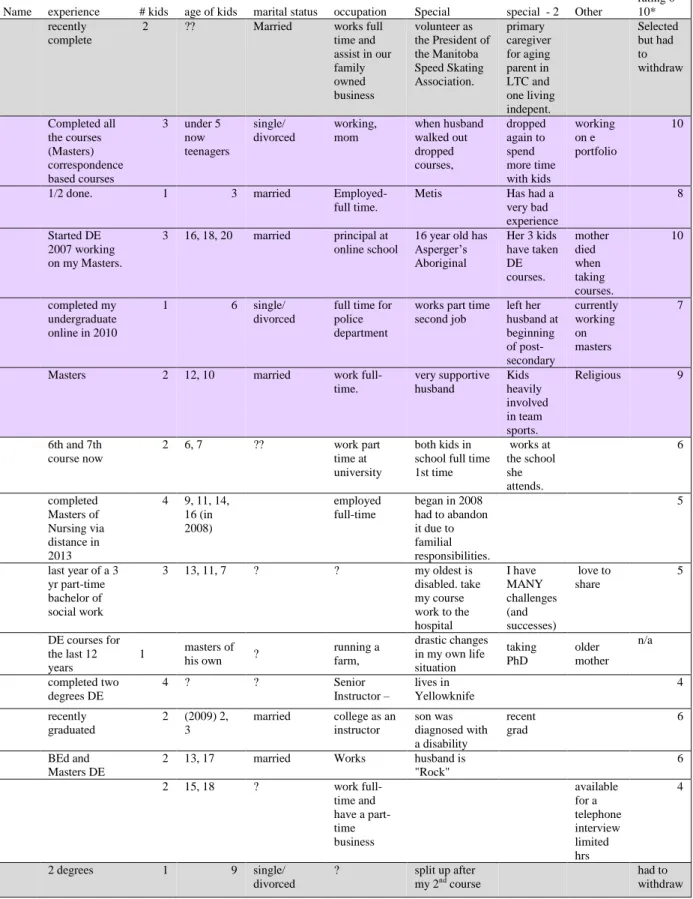
Included in the appendix is the Possible Participants table (see Table 5) created to catalog each of the thirty-four applicants who responded over a nine-day period. Using the interview questions as a template, the researcher answered all the questions asked of the study participants to make it clear to both myself and. Using this framework, the researcher explored the commonalities between the participants' experiences and relevant literature to identify the essence of the social phenomenon of mothers as distance learners.
To do this, she must reduce the stories to the essence of the phenomenon. This was done by bundling the invariant components of the experience that were related to each other into a thematic label. The researcher checked the invariant components and associated theme against the research participant's complete file to see if this was the case.
A structural description of the meanings and essences of experience that includes invariant components and themes. Does this gist include a description of the experience and the context in which it occurred. Prior to the interview process, the researcher provided study participants with an invitation to participate that described the nature of the study (Appendix A), a form explaining the researchers' obligations to them as participants (Appendix B), and a copy of the interview questions (Appendix B). Appendix C) and also a copy of her answers to these questions.
After analyzing the data, the researcher gave each of the participants a copy of her research findings and asked for their comments.
FINDINGS
When group work was a required part of the course, I tried to be in a group with only one other person. When you live in different parts of the country and different time zones, it's just easier to coordinate with one other person. And one of the girls was very clear when she signed up for all this group work, she wanted to get a lot done this week.
It's] been quite a solo effort outside of the emotional and practical support I've received from my husband. It was one thing for me to complain to my parents about how hard it was, but in the end they didn't get it. someone going through it we all took the same classes we were always you know going through the motions together. With the exception of Jennifer, all of the mothers in the study received physical assistance in some form, such as childcare, cleaning, meals.
It was during my last semester of undergrad that my ex-husband left... Of the married participants, Marnie was the only one who expressed that her husband did not support her being a student. I had to choose distance education because it was the only program in this country that had anything to do with education. it didn't require me to be present for work or part of the learning experience, and given that I have a whole life now, I'm no longer just a student, it was really my only option.
However, I spent my whole day there as a [distance learning] principal and I got sick of the room. I closed the door because the kids had the house going and I said, “Okay, I'm in my bed. I explained to my children that I had decided to drop one of the courses because it was a little too difficult to take at this time.
And even though I took two courses after that, I was very careful in talking to other students, researching course requirements before enrolling in them, because I also didn't want to be in a situation where I had to drop out again. My daughter was sitting on the office floor working on her distance education [high school material] and I was working at my desk on my distance education [graduate material]. Keeping school work and home life private was of great importance to all study participants.
This chapter includes comments from participants relating to each of the six themes identified in the previous chapter.
SUMMARY OF FINDINGS AND CONCLUSION
In contrast to Cragg, Andrusyszyn, and Fraser's study, where 71% of participants were married and only 48% had dependent children, all participants in this study were mothers of dependent children, and two were divorced single mothers. All participants have encountered at least one unsupportive friend, family member, or university teacher and instructor along the way. Regardless of the amount of help and support, each of the participants felt that the actual work of being a distance student was done alone.
The results of this study correlate with Hart's, as study participants persisted due to: proximity to program completion; flexibility of the online learning environment;. While such identity practices may help student mothers, they conform to prevailing expectations of the diligent student unwaveringly committed to her studies and the attentive mother whose time, energy, and money are devoted to raising her children. Lynch (2008) argues with considerable emphasis (p. 444). Paper presented at the meeting of the Midwest Research-to-Practice in Adult, Continuing and Community Education Conference, Michigan State University, East Lansing, MI.
Factors associated with student persistence in an online study program: A literature review. Mothers in academia: positioning and positioning within the discourses of the 'successful academic' and the 'good mother'. This study will investigate the social phenomenon of mothers in distance education, exploring the essence of.
On the next page you will find part of the potential participants table, which was created to catalog each of the thirty-four applicants who responded over a nine-day period. Does it contain a moment of experience that is a necessary and sufficient component for understanding it? Check the invariant components and the associated theme against the complete file of the research participant. a) Are they explicitly expressed in the full transcript?
Using the relevant validated invariant components and themes, construct for each co-researcher an individual textured description of the experience. Construct for each co-researcher an individual structural description of the experience based on the individual texture description and imaginative variation. Construct for each research participant a textural-structural description of the meanings and essences of the experience, which includes the invariant components and themes.
From individual textual-structural descriptions, develop a composite description of the meanings and essences of experience, representing the group as a whole (Moustakas, 1994, p.