ATHABASCA UNIVERSITY
AFFECT AS A PRESENCE IN THE COMMUNITY OF INQUIRY MODEL
BY
PRISCA CAMPBELL
A thesis submitted to the
Athabasca University Governing Council in partial fulfillment of the requirements for the degree of
MASTER OF DISTANCE EDUCATION
Athabasca, Alberta
ABSTRACT
This interpretive approach to a mixed-method study examines the likelihood that an awareness of the role of emotion as presented by Damasio and LeDoux enhances individual student participation in computer-mediated conferencing. Consideration is given to emotion as an element of social presence as defined in the community of inquiry conceptual model, proposed by Garrison, Anderson and Archer.
Respondents participated in an online workshop, during which they were asked how the role of emotion in cognition might be applicable to distance education. Surveys and interviews were conducted to determine the level of their knowledge of emotion and cognition at the outset. Transcripts of conference postings were examined for evidence that learning had or had not transferred. Exit interviews and surveys determined if the workshops had enhanced or not enhanced the experience of the participants in the computer-mediated conference. Three of twelve participants acknowledged that participation in the workshop did engender a positive change in their normal conference participation behaviour. Three of the remaining nine stated unequivocally that the workshop had no influence. The others were unable to contribute useful data due to technical difficulties or limited participation. Although data were insufficient to support the research question there was evidence that emotion should be a fourth presence – called emotional presence - defined as the extent to which participants in a community of inquiry are aware of and attend to overt feelings and covert emotions with the intention of facilitating learning. The community of inquiry model and the distinction between emotion and feeling need further study. The latter concepts require study in an online context.
ACKNOWLEDGEMENTS
The author gratefully acknowledges the financial support of the Centre for Distance Education, Athabasca University through the Graduate Student Research
Dissemination fund, and that of the Canadian Association for Distance Education through the Graduate Student Research Stipend. The author thanks the Centre for Distance Education and CADE for their acknowledgement of her work. The wise counsel of thesis advisor, Dr. Martha Cleveland-Innes, and members of the thesis committee Dr. Paul Jerry and Dr. Susan Moisey was invaluable during the collection of data and their interpretation. Particular recognition goes to Dr. Martha Cleveland- Innes, who from her first encounter with the author in St. John’s, attended to emotion and facilitated learning. Preliminary results of this study were presented during the Canadian Association for Distance Education annual conference in May 2005;
during a Canadian Institute for Distance Education Research online workshop in May 2005; and during the Distance Teaching and Learning Conference, Madison, WI, in August 2005.
TABLE OF CONTENTS
CHAPTER 1 – INTRODUCTION………1
Fear and Cognition………2
Need for the Study……….4
Statement of the Problem……….7
Research Question………8
Definition of Terms……….8
Limitations and Delimitations………9
Summary………...10
CHAPTER II – REVIEW OF THE LITERATURE………11
Historical overview………...11
Theory and Research: Flirting with Emotions………..14
Compartmentalizing Affect and Emotion in Online Research………...17
The Omnipresence of Emotion: The Integration Begins………19
Community of Inquiry Model………...20
Critique of the Validity of Appropriate Theory and Research Literature……..22
The Contribution this Study will make to the Literature………..23
CHAPTER III – METHOD………...24
An Interpretive Approach in a Mixed-method Research Strategy………24
Procedures………25
Research Sample……….28
Data Collection………..30
Treatment of the Data………32
Summary………..37
CHAPTER IV – RESULTS………38
Research Question……….38
Interview and Survey Evidence that Supports or Fails to Support the Research Question……….38
Fear and Cognition Redux……….48
Computer-mediated Conferencing Evidence that Supports or Fails to Support the Research Question………50
Summary of Findings………...60
CHAPTER V – DISCUSSIONS, CONCLUSIONS AND RECOMMENDATIONS…..62
Alternative Explanations for the Findings……….65
Impact of the Study in Terms of what was Learned………65
Unanticipated Findings………66
Strengths, Weaknesses, and Limitations of the Study………...67
Implications for Professional Practice………...69
Implications for a Scholarly Understanding………..69
Implications for Theory Building……….69
Recommendations for Further Research……….70
Recommendations for Change in Practice………...70
Recommended Modification in the Community of Inquiry Model……….70
Summary………71
REFERENCES……….72
APPENDIX A………..79 APPENDIX B………..85 APPENDIX C………..92
LIST OF TABLES
1. Participation by Volunteers in Study Activities………31
LIST OF FIGURES
1. Elements of an Educational Experience Model………..5
2. Volunteer Participation in Computer-mediated Conferences……….29
3. Participation by People who provided Secondary Data in Computer-mediated Conferences………29
4. Online Workshop Participation………31
5. Comparing Anticipated Feelings to Previous Face-to-face Experiences…….33
6. Feelings Compared to an Experience Online Learner………....33
7. Feelings Experienced in Comparison to Previous Face-to-face………34
8. Comparison of Experienced Feelings to Anticipated Feelings………..34
9. Occurrences of Criteria for the Presence of Emotion………..37
10. Evidence of the Presence of Emotion per Unit……….51
11. The Number of Times Criteria for the Presence of Emotion was Found…….,58
12. Proposed Revision to Elements of an Educational Experience Model……….70
CHAPTER I
INTRODUCTION
“By the time that half the introductions are done, I’m too intimidated to post my own intro.”
Volunteer 14f
Deconstructing the emotions experienced when faced with a blank screen and the obligation to write a graduate thesis is akin to analyzing an expensive perfume: The ‘top note’, the first impression, more often than not, is tension, a background emotion, a term defined by Damasio (1999, p. 52) as an emotion
observed by onlookers without a word being spoken. The visual cue could be a tight jaw, a nervous tick, a wringing of hands – or a combination of such things.
Presume that the ‘middle note’ in this scenario is pride – a social or
secondary emotion (Damasio, 1999, p. 51). It is just as likely that the social emotions of embarrassment, jealousy or guilt (p. 51) could be evident.
The long-lasting ‘bottom note’, a universal emotion (Damasio, 1999, p. 50), in this situation is fear: An emotion so universal that LeDoux (1996, p. 106) focused on it while researching the “neural basis” of emotion.
Emotions are redolent throughout the pursuit of a graduate degree. The blend of scents varies according to the circumstances. Occasionally a graduate student exudes happiness, another of the six universal emotions (Damasio, 1999, p. 50), or becomes aware through personal communications that online colleagues have perceived background emotions (p. 52) such as enthusiasm or discouragement.
While writing the thesis the full range of social emotions could be experienced (p.
inadvertently fail to cite the work of another; and jealousy – unrelated to the task at hand perhaps, but capable of impacting the process nonetheless.
For centuries the dispassionate thinker who applies logic and reason to pursue truth has been the ideal towards which learners are encouraged to strive.
Emotion is perceived, at worst, as a hindrance to learning, and, at best, a learning outcome in the affective domain. Dirkx (1997), in Nurturing Soul in Adult Learning, made a case for the integration of feeling into adult education. That impassioned argument was the impetus for this examination of the role of affect in online learning.
Fear and Cognition
Fear, observed LeDoux (2002) “is the emotion about which we know the most” (p. 212). Seventy-eight years prior to LeDoux’s observation, Jones (1924) reported a seminal study of the reversal of fear. A toddler, Peter, fearful of a white rat, involuntarily extended his fear “to a rabbit, a fur coat, a feather, cotton wool, etc.”
Fear had negatively impacted Peter’s interpretation of the world – his cognition.
Subsequent studies have shown that anxiety, a form of fear, also inhibits cognition. Titles such as Confessions of a Former Mathphobe (Carter, 2000), Running the Numbers – Fear of Mathematics (Stites, 1993) or Girls Lose their Fear of Math at CSUH Mega Camp (Velasquez, 2003) keenly illustrate that fear has a negative impact on math cognition – a perception that has been validated by researchers. When the search words mathematics and anxiety were entered at www.questia.com (2006) 1,036 journal articles were retrieved. When performance and anxiety were entered 6,322 journal articles were retrieved. The combination of
test and anxiety resulted in 7,167 journal articles retrieved. Using the spelling on-line plus anxiety resulted in 6,238 articles.
It is not merely the online learner, who experiences the impact of fear or anxiety. Those who facilitate online are affected also:
You are ready to teach. The first night of the new semester, you get into your sweat pants of pajamas and settle down (perhaps with a glass of wine) to get to know your students intimately. You log on to e-mail and are greeted by a hot blast of messages full of students' emotions--anxiety about their ability to handle the assignments or the software (usually from women) or anger at the course load or your policies (usually from men). This emotional outpouring is a new challenge to your teaching, and you sense danger [italics added]
ahead. (Halio, 2004, para. 2)
More than three-quarters of a century after Jones’ observations of Peter our understanding of fear has broadened dramatically. For example, it is now believed beyond a reasonable doubt that the region of the brain that processes danger is the amygdala (LeDoux, 2002, p. 213). Researchers accept that emotions amplify
memories (p. 222), and that emotional arousal influences “cognitive processing” (p.
225). Conversely, “cognition can be used to arouse an emotion” (Bower and Forgas, 2000).
In December 2002, researchers announced the discovery of the gene that
“encodes a protein that inhibits the action of the fear-learning circuitry of the brain”
(Howard Hughes Medical Institute, 2003). Rossi (2002) reported that as a result of the Human Genome Project “hundreds of the body’s own natural messenger molecules” have been identified that “modulate memory, learning [italics added], emotions, and behavior…” (p. 31). The release of stress hormones, for example, causes the encoding of “certain patterns of memory, learning [italics added], and
stressor is removed.” He observed that when stress is reintroduced, “the brain and body respond by releasing the hormones that re-evoke the state-dependent
symptoms.”
Regardless of theoretical predilection – behaviourist or cognitivist – consideration is routinely given to the impact of fear on cognition. Is it not
reasonable, then, to consider that emotions, other than fear, also impact cognition in some manner?
Need for the Study
The concept of affect as a learning outcome has been used by instructional designers (Dirkx & Prenger, 1997; Small, 1997; Smith & Ragan, 1999; Taylor,
Marieneau, & Fiddler, 2000) since Bloom et al. (Krathwohl, 2002) identified affect as a learning domain in the 1960s. Palloff and Pratt (2001, 2003) recognized that
emotion played a role in online communication. They advised the use of emoticons – participant generated symbols intended to represent emotions – as a tool to
compensate for the absence of tone of voice and body language during text-based Internet-mediated learning. However, the affective domain and emoticons address only indirectly the pervasive presence of emotion in online learning.
Goleman (1995, p. 27) was one of the first to describe the connection between emotion and cognition as a “battle” with the brain at the epicentre. One consequence of this battle was paradoxical noted by LeDoux (1996, p. 243) who stated: “Sometimes stress helps in formation of explicit memories but it can also devastate explicit memory.” The war analogy is particularly fitting when the assertion of Merriam and Heuer (1996) is considered. They noted that feelings of threat and
fear are an intrinsic part of learning. Dirkx (1998) continued the call for the integration of emotion into learning, observing that critical theory failed to
“adequately account for the emotional and spiritual dimensions” (p. 137) of learning.
The observations of Dirkx, Merriam and Heuer were in relation to face-to-face delivery. A few researchers conducted studies and advanced theory that related specifically to online learning. Conrad (2002) vividly recounted the tumult of feelings (including anxiety) that accompanied the online experience. Garrison, Anderson &
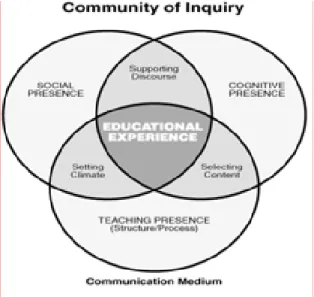
Archer (2000) proposed a theoretical construct for online learning (Figure 1) that entailed three “essential elements” (p. 88): cognitive presence, social presence and teaching presence. The trio posited that emotional expression is an inherent aspect of social presence. In their Community of Inquiry (CoI) model, emotion evolved from an outcome to an essential quality of online learning. Although the model is
intuitively satisfying, the position that emotion is merely a domain-specific component provided the impetus for this study’s research question.
Figure 1 Elements of an Educational Experience – Model designed by Garrison, Archer, Anderson (2000)
The possibility that emotion is the warp and rational thinking is the weft in the whole cloth known as cognition is woven into the literature of a different discipline – neuroscience. In the late 1990s when the discipline of education was considering the role of emotion in cognition, two neuroscientists (Damasio, 1994, 1995; LeDoux, 1996) independently studied emotion from a biological perspective.
Damasio (1994) suggested that emotion and cognition were innately
intertwined. His curiosity about the role that the brain plays in emotion was sparked by the classic case of Phineas P. Gage, who, due to an industrial accident, had an iron bar pass through his cheek, pierce the base of his skull and the front of his brain, exiting through the top of his head. Remarkably, to the surprise of all, Mr.
Gage lived for nearly two decades, although his “disposition, his likes and dislikes, his dreams and aspirations” (p. 6) had changed. The well-documented, post-injury life of Mr. Gage provided scientists with the first inkling that “there were systems in the human brain that were dedicated more to reasoning than anything else, and in particular to the personal and social dimensions of reasoning” (p. 10).
Damasio began to focus his attention on people who had experienced damage to the pre-frontal area of the brain. More than twenty years ago, he encountered a patient (Damasio, 1994, who displayed much the same shift in personality as Phineas Gage did. His observations of this patient, referred to as Elliot, led him to further narrow the focus of his studies: “I became intrigued with the possibility that reduced emotion and feeling play a role in Elliot’s decision-making failures (p. 45). Damasio made his life work the study of emotion and the human
brain, using as his subjects people whose brains were damaged through accident, surgery or birth.
LeDoux (1996) boldly suggested that “cognitive science is really a science of only a part of the mind, the part having to do with thinking, reasoning, and intellect. It leaves emotion out. And minds without emotions are not really minds at all” (p. 25).
He chose to study rats, because fear conditioning “can be applied up and down phyla” (p. 148).
Schutz and Lanehart (2002) pointed out that although other researchers had begun to build on the work of Damasio and his team, “inquiry has been slow to advance our understanding of emotions in education.” Those diverse points of view inspired the following goals for this study:
1) To contribute to the advancement of the understanding of the role of emotion in online learning, and
2) To further discussion about the applicability of the CoI model to online learning.
Statement of the Problem
A richer understanding of the role of emotion in cognition, as identified by Damasio (1994, 1995, 1999, 2003) and LeDoux (1996, 2002), resulted in a lived transformation by the researcher. This transformation involved the following outcomes: 1) online communication style improved, 2) emotions less frequently blocked learning, and 3) online learning deepened. That self-observation was the inspiration for the research question.
Research Question
In a community of inquiry (Garrison, Anderson & Archer, 2000), will exposure to the role of emotion in learning as defined by Damasio (1994, 1995, 1999, 2003) and LeDoux (1996, 2002) provide learners with a tool to enhance participation in computer-mediated conferences?
Definition of Terms
Enhancement. Enhancement is an identifiable transformation, based on the assumption that learning occurs when there is a measurable change in behaviour.
Enhanced participation is therefore either an observable change in behaviour or attitude, from which the researcher can reasonably draw the conclusion that participation in the conference was enriched for the respondent. How does one identify enrichment? Support for enrichment can be derived from 1) responses to survey questions; 2) a comparison of statements made in exit and entrance interviews; or 3) observed changes in CMC participation during the course.
Emotions. For the purposes of this study human emotions are divided into two categories as defined by Damasio (1994): primary emotions which are “innate” (p.
133); and secondary emotions, which are adult emotions that develop over time.
Emotions are a “collection of changes in body state that are induced in myriad organs by nerve cell terminals, under the control of a dedicated brain system, which is responding to the content of thoughts relative to a particular entity or event”
(Damasio, p. 139). Damasio (1995) and LeDoux (1996) are in agreement that human beings can experience emotions without being conscious of the fact – an assumption that is fundamental to this study.
Feeling. Furthermore, for this study the distinction made by Damasio that the word emotion and the word feeling are not interchangeable (p.143) is accepted. He suggested that feeling is “the process of continuous monitoring…of what your body is doing while thoughts about specific contents roll by” (p. 145). Human beings must be conscious to experience feelings.
Affect. Affect and emotion, although similar, are not synonymous. Affect implies influence or action in relationship to feelings and emotions. As stated
previously, emotions are states that arise spontaneously, of which we are unaware.
Feelings are the expression of emotion of which we are or become conscious.
Limitations and Delimitations
Participants in this study were drawn from one graduate level distance education (DE) media and technology course offered by a tertiary-level, open- learning institution. The learners, the majority of whom were mature, had varying degrees of course-related subject matter expertise. The online course, conducted in English, required that learners participate in text-based CMC. That combination of requirements may have been a challenge for students’ whose first language was not English. Therefore it is possible that course participation was exclusive rather than inclusive.
Tiangulation was a goal of this study. In the end the number of participants was too small to allow generalization to an adult population of learners.
This is a study of computer-mediated conferencing from a learner’s
perspective. However teaching presence contributes significantly to effective CMC according to the CoI model. Therefore the contributions of the facilitator/instructor,
and the facilitator/instructor’s interaction with the learners were included in the secondary data collection.
As the CoI construct is relatively untested, the validity of the model is subject to question. The subject of the study itself may be a limiting factor. The vulnerability that accompanies the disclosures of one’s feelings may have inhibited the volunteers from revealing the truth in interviews or surveys.
The theories of Damasio and LeDoux may be gaining acceptance, but they are not yet standard points of view. If one adheres to more traditional views about the biology of emotion then the results of this study could be called into question.
Summary
The lived experience, the feeling that there was a relationship between emotion and cognition, has been confirmed by rigorous replicable research in a number of disciplines: neuroscience, psychology, biology, cognitive science. For many Distance Educators, influenced heavily by the principles of instructional design, emotion is addressed merely as an affective outcome, something to
incorporate into instruction to motivate learners, or, as in the CoI model, to support cognitive and teaching presence. The author contends that when an interdisciplinary view is taken there is compelling evidence to support the need for exploratory
research in into the relationship between emotion and cognition in online learning.
CHAPTER II
REVIEW OF THE LITERATURE
“…the wiring of the brain at this point in our evolutionary history is such that connections from the emotional systems to the cognitive systems are stronger than
connections from the cognitive systems to the emotional systems.”
Joseph LeDoux (1996, p. 19)
Historical Overview
The exploratory review of the literature conducted in the development stage of this study suggested that true understanding could only be constructed through a multi-disciplinary approach. Therefore a review of the literature was conducted across a number of disciplines – psychology, neuroscience, adult education, online learning, and cognitive science.
A significant break from tradition occurred during the 1980s, when a group of psychologists (Gardner, Kornhaber & Wake, 1996) began to question the validity of standardized intelligent quotient (IQ) tests. One of them, Gardner conducted studies from which he developed the theory of Multiple Intelligences (MI theory) (Brualdi, 1996; Gardner, 1996, 1998).
Gardner identified seven intelligences. Two of these intelligences — Personal (PI) and Intrapersonal (II) — involved emotions. PI is the awareness of the feelings and intentions of others. II is the awareness of one’s own feelings and motivations.
Two decades later Gardner’s list of intelligences has changed, however, PI and II remain.
MI theory was embraced so enthusiastically by some educators that
eventually Gardner (1998) cautioned: “MI theory is best thought of as a tool rather
than as an educational goal.” Gardner had shifted emotion from a learning outcome to an essential quality. Denzin (1984), a contemporary of Gardner, concluded that emotion must not be “studied as a social fact that is episodic, accidental, or
incidental to social experience” but as a “lived experience” (p.11).
Nearly a decade passed before neuroscience provided evidence that
supported the view of emotion as an inherent part of cognition. The more persuasive studies were of individuals with neurological damage to specific brain systems. For example, Damasio (1994, 1995) studied Elliot, who although brain damaged, was capable of rational analysis. However, Damasio observed that his subject had lost his ability to draw conclusions. The portion of his patient’s brain that had been damaged was that which is known to process emotion. In his conclusion Damasio summed up the scientific view that emerged in the mid 1990s: “Emotion, feeling, and biological regulation all play a role in human reason” (Damasio, 1994, p. xiii).
LeDoux (1996), who concurrently studied fear in rats, defined emotion “as the process by which the brain determines or computes the value of a stimulus” (2002, p. 206). Like Damasio, LeDoux suggested that organisms are not always conscious of the role of emotions in their decision making.
Following the trail marked by Gardner (Krathwol, 2002), Damasio (1995), and LeDoux (1996), Goleman (1995, 1998) formulated the Emotional Intelligence (EI) theory for formal education. Goleman proposed an educational taxonomy whereby EI mattered more than IQ, suggesting that “emotional literacy programs improve children’s academic achievement scores and school performance” (1995, p. 284).
His work inspired numerous parent- and educator-led movements calling for the advancement of emotional literacy in the classroom.
A group called Antidote (2003) published The Emotional Literacy Handbook which captured the results of a six-year investigation into “how schools can use emotional literacy.” Recommendations addressed the needs of students and the adults who cared for them – teachers, other staff and parents. When a school
applied the recommendations six outcomes were anticipated: 1) a safe environment for the communication of feelings; 2) a clear understanding of what was to be done, how participants felt and what they thought; 3) acceptance of the individual; 4) an inclusive community capable of 5) actively listening; and 6) confident and competent educators, parents and students.
Unexpectedly the education taxonomy devised by Goleman was embraced by the corporate world (1998), changing hiring and training policies and practice.
Goleman and four colleagues (Cherniss, Goleman, Emmerling, Cowan, & Adler, 1998) estimated that American businesses would retain 5.6 to 16.8 billion dollars annually by improving the social and emotional competence of their workforces.
These savings could be achieved by implementing 22 guidelines, in four phases.
Assessed in the preparatory first phase are motivation, the needs of the
organization, and the strengths and limits of personnel. To engender motivation the quintet called for feedback presented with care; presenting participants with choice;
and linking learning to personal values. Training, the second phase, has nine
components that lead to learning. The third phase confirms the transfer of learning to the workplace, and provides maintenance of the competencies. Evaluation is
conducted in the fourth phase, the results of which are used to adjust the subsequent iteration of the program.
Callahan (2004, p. 82), citing Damasio and Dirkx, called for educators who espouse critical theory to “manage the emotions in their classrooms actively.” He pointed out that “the very praxis of critical theory relies on emotion as its catalyst” (p.
75). However, Dirkx, (Personal communication, 2005) questioned the “management”
of emotion. In reference to EI in the workplace, Fineman (2000) echoes Dirkx’
caution, “…the very technique or concept creates distinctions that immediately relegate…some people to a less worthy or less ‘competent’ personal condition” (p.
109).
Although none of the previously mentioned researchers applied their theory to distance education, their work has nevertheless informed the research of a number of DE practitioners. Of 28 scholarly works found that investigated aspects of affect and DE, 17 were journal articles, of which 15 were reports of original research. The remaining 11 papers were reports of conference proceedings, of which 10 reported original research. The papers were published between 1990 and 2005. Significantly, all but two appeared between 2000 and 2005. Apparently, distance educators did not pursue research into the role of emotion in online learning until relatively recently.
Theory and Research: Flirting with Emotion
Researchers have flirted with the subject of emotion, usually as a subset of some other concept. Kirkup and von Prummer (1990) examined the needs of female distance education students. The pair was interested in the significance of gender in
distance education, concluding that “pedagogic practices developed for the women’s studies classroom” (p. 29) had much to teach other disciplines. Although emotion underpinned their research and the report – they wrote of “the passionate knower”
(p. 29) and the “felt sense of isolation” – emotion was not addressed explicitly as an essential condition of learning.
Three reports (Luca and Tarricone, 2001; Leleu-Merviel and Labour, 2003;
Hao, 2003) examined EI in a distance education context. A fourth (Norris & Pan, 2003) described Project EMO “in which 18 in-service teachers became
knowledgeable” of “Social and Emotional learning and its relationship to academic achievement.” Although distance education per se was not an aspect of the project, Macromedia Flash and other multimedia tools were used by students to build “from virtual reality to a real-life project.” Their conclusion about the value of technology in a learning environment provides a perspective that DE practitioners may find useful for future research.
Luca and Tarricone (2001) used journals and student contracts online as tools during their study of the relationship between teamwork and EI. They
concluded that there was a “strong correspondence between students’ emotional intelligence and team harmony.” The online contract signed by all participants was an explicit commitment to the roles each would play; the amount of time each would invest; and what each was to deliver in fulfillment of the course requirements. The weekly online, yet confidential, journals completed by all students were used to demonstrate “success in completing tasks, as well as self/peer mark for all team members.” Of the twenty teams participating in the case study, two were chosen for
investigation: “one highly successful, and another, which had major collaboration problems,” which resulted in the second team splitting. The researchers reported that the successful team displayed awareness that uncontrolled emotions had negative consequences, and that, as members of a team, they had “responsibility towards the other members of the team.” Members of the unsuccessful team were not aware that their behaviour towards team members caused “a lack of team cohesion and cooperation,” and “a feeling of disempowerment.”
Leleu-Merviel and Labour (2003) published a case study that used the “the work of researchers, like Goleman” to determine the “pedagogical implications for educational courseware creation.” They concluded that e-learning could “transmit content” while satisfying “complex learning needs…particularly concerning the mastery of emotional intelligence in interpersonal communication.” They recognized that the current state of the Internet limited “the use of high quality audio-visual materials.” They suggested that poor transmission quality hindered the ability of learners to “observe non-verbal behaviour and language.” Leleu-Merviel and Labour expressed confidence that rapid technological change would eventually eradicate the limitations.
Hao (2003) explored the “…basic emotion set for online collaborative learning” from an instructional design and EI perspective, suggesting an area for further research: DE would benefit from knowing if a basic emotion set is culturally sensitive. The study participant was a female graduate student who contributed data by keeping a journal, and posting messages. Using grounded theory, Hao analyzed the qualitative data using open and axial coding. The research identified five
categories of emotion, some of which occurred “concurrently”: curiosity/fascination, confusion, motivation, frustration, and anger.
Compartmentalizing Affect and Emotion in Online Research
Prior to the invention of Magnetic Resonance Imaging (MRI), which permits non-invasive study of the physiological effects of emotion on the body, applying rigorous and replicable research methods to the study of emotion was extremely difficult. Concepts such as the affective domain, social presence, and learner motivation lent themselves to the traditional quantitative study design preferred by social scientists. The body of research that amassed as a result effectively
compartmentalized the role of emotion in cognition.
Several authors contributed to a body of work in reference to social presence and student interaction online, two aspects of affect that recur frequently in the literature. The most intensely studied aspect of affect – learner motivation –
occupied Miltiadou and Savenye (2003). Continuing in the traditional vein of affective domain outcomes, but from a workplace perspective, were Cleveland-Innes and Ally (2003a, 2003b), who reported the findings of their pilot study to determine the
effectiveness of “e-learning methods to foster online soft skills (2003a), and their comparison of WebCT and vClass, “synchronous versus asynchronous online
learning environments (2003b). Mahesh and Conlon (2003) suggested a relationship between affect and learning objects, in a paper explaining their practical approach to an “affective model” for instructional designers.
The DE studies listed below addressed emotion to some extent, but did not make reference to EI or neuroscience. Conrad (2002), Tu and McIsaac (2002) and
Oren, Miodusur and Nachmias (2002) addressed social presence. Anderson, Rourke, Garrison, and Archer (2001) investigated teacher presence online. Student interaction occupied Garrison, Anderson, and Archer (2000); Bonk, Olson, Wisher and Orvis (2002); Rourke and Anderson (2002) Foley and Schuk (1998); Brown (2001), Garrison (2000), Turk (2002) and Sherry, Crone, Rauscher and Obermeyer (2003).
The psychosocial aspect of online student support was of concern to Cain, Marrara, Pitre and Armour (2003), who studied graduate students’ perspectives.
Through qualitative analysis of interview data they identified three implications for practice; the second of which – the need for a “positive social environment among peers” – underscored the significance of social presence as defined by Garrison, Anderson, and Archer (2000). Scheer and Lockee (2003) also studied learner online support, choosing a wellness perspective, defined as “a balance of the body, mind, and spirit.” They based their research on a six-dimensional model posited by Hettler in 1980. One of the dimensions, emotional wellness, “includes the capacity to
manage one’s feelings and related behaviours….”
Smith, Murphy and Mahoney (2003) attempted to identify factors that influenced student “readiness for online learning” (p. 57). Emotion in the form of comfort was confirmed as a factor and was present in the questions included in the survey of participants. Questions 5 and 6 began with “I feel” (p. 62).
Conrad (2005), reporting observations from her ongoing research into the construction and maintenance of online communities, cited the community of inquiry
model, noting that study participants experienced community “affectively” (p. 16).
She observed that the learners used community “as a comfort” (p. 17).
The Omnipresence of Emotion: The Integration Begins
Nearly a decade after Damasio and LeDoux posited their theories, a few researchers in online learning, working independently, began to publish studies that were clearly influenced by this earlier research. The founding research of these neuroscientists, which is rigorous and has begun to be replicated, has given birth to a new sub-discipline- affective neuroscience (Davidson, 2003).
A few DE researchers have begun to incorporate affective neuroscience into their own research. The report of Glazer (2003a) did not specifically reference the work of Damasio, Gardner, Goleman, Denzin or LeDoux, although it posited a theory of distributed emotion, a concept supported by their research (Damasio, 1994, 1995, 1999, 2003; LeDoux 1996, 2002). This similarity provoked a further search that resulted in the retrieval of Glazer’s (2003b) dissertation which cites both Damasio and LeDoux. Thus providing reason to assume that their biological understanding of emotion informed her theory of distributed emotion that rests “on the same principles as distributed cognition” (2003a). She posited that emotion is distributed “across members of social groups;” and is “coordinated between external – material or environmental – structures” and that “emotion is distributed through time.”
O’Regan (2003), influenced by Damasio, Gardner, Goleman, Denzin and LeDoux, cited the work of each in his historical review of the perception of the place of emotion in learning. O’Regan “attempted to open up a field of enquiry into” …
“what emotions are associated with studying online,” the “teaching-learning contexts
of these emotions,” “how they related to student learning,” and the “implications for teaching and learning online” (p. 82).
The proceedings of the 21st annual Distance Teaching and Learning Conference included two reports (Stein and Wanstreet, 2005; Campbell and Cleveland-Innes, 2005) of original research both grounded in Garrison, Anderson and Archer’s (2000) community of inquiry model, only one of which (Campbell and Cleveland-Innes, 2005) cited the work of Damasio and LeDoux. Stein and Wanstreet used the CoI model to examine teaching and cognitive presence as well as “the ability of learners to perceive and establish social presence in group work.” They concluded that social presence supported cognitive presence in small work groups, yet undermined the ability of the whole class to construct meaning together due to the strength of the bonds formed in the work groups. Campbell and Cleveland-Innes reported the preliminary findings of the study reported here. Further integration of the findings of affective neuroscience into DE practice is a distinct possibility as supporting research accumulates. A third paper presented (Palloff and Pratt, 2005) referred to presence, but did not specifically cite the Garrison, Anderson and Archer model or the work of Damasio and LeDoux
Community of Inquiry Model
The computer-mediated conferencing theory (Figure 1) developed by Garrison, Anderson and Archer (2000) proposed a “conceptual framework” (p. 87) that identified what they referred to as “crucial prerequisites for a successful higher educational experience” that play out within a “community of inquiry” (p. 88). The inclusion of the “expression of emotion” (p. 99) as an element of one of the three
presences, and their conclusion that emotion is important to critical thinking made this model particularly appropriate for a study of emotion in cognition.
The trio suggested that the interaction of cognitive, social and teaching presence is essential to learning. Cognitive presence (Garrison, Anderson, and Archer, 2000) is the ability to “construct meaning through sustained communication”
(p. 89). Teaching presence applies to all who enable instructional design and facilitation. They defined social presence as “the ability of participants in the community of inquiry to project their personal characteristics into the community, thereby presenting themselves to other participants as ‘real people’” (p.89).
Within the model, cognitive presence and teaching presence are seen to be paramount, with social presence in a supporting capacity. However, Anderson, Rourke, Garrison and Archer (2001) assessing teaching presence in online learning, identified one need that has a biological basis in emotion, and called for further investigation – the need “to develop compensatory behaviours” (p. 14) for the lack of body language and tone of voice in text-based computer-mediated communication.
Kanuka & Garrison (2004) studied cognitive presence in online learning concluding that successful social presence is achieved through “effective teaching presence” (p. 4). Data was gathered during an interview with a focus group of
experienced online practitioners. Significantly “the triggering event” that they state is essential to cognition –defined as “a state of dissonance or feeling of unease [italics added] resulting from an experience” (p. 6) is impossible without invoking an
emotional response in the learner. They also mention (p. 10) that the respondents
identified an emotional response to facilitation that inhibits learning, for which, they believe, educators must compensate when teaching online.
The appropriateness of the CoI model for the development of this study was further strengthened by two reports of original research (Rourke, Anderson, Garrison and Archer, 2001) and (Garrison, Cleveland-Innes and Fung, 2004). The 2001 study tested a method of quantitatively measuring social presence in computer-mediated conferencing. In their conclusion, the authors called for further study to enable triangulation of “participant perception of social presence and its value (p. 16). The second study validated a measurement instrument for the community of inquiry model, designed to permit quantitative assessment of student “adjustment” (p. 71) to online learning.
Critique of the Validity of Appropriate Theory and Research Literature
The majority of the literature reviewed is from disciplines other than distance education, as no critical mass of research has as yet been conducted on the role of emotion in cognition in online environments. This dearth of research had a
constructive effect, however, inspiring a multi-disciplinary approach that sought concepts and observations in the complementary fields of adult education, face-to- face pedagogy, and neuroscience. These disciplines have large bodies of rigorous, replicable research. Whether these concepts are readily transferable to the online domain requires further study.
A hunt through the Internet using Google and the search-words ‘community of inquiry’ retrieved 3,990,000 Web pages in 0.10 seconds. A ‘Search within Results’
with the names of the authors of the CoI model reduced the pages retrieved to
3,580. A scroll through the first 20 links suggested that the concept has in the five years since its introduction become widely accepted as a basis for online research at North American tertiary level institutions. Some of the institutions represented were Georgia State University, Georgia Institute of Technology, Winthrop University (McKlin, Harmon, Evans and Jones, 2002); the State University of New York (Shea, 2003), Ohio State (Stein and Wanstreet, 2005), Athabasca University (Poscente, 2002; Campbell and Cleveland-Innes, 2005; Perry and Edwards, 2005); and the University of Calgary, where Garrison is Academic Director of the Learning Commons.
Finding studies that validated the model’s assumptions was a more difficult task. Boris and Hall (2004) presented “findings of a study conducted at the
University of South Dakota…which considered the importance of developing a
‘community of inquiry’…among online learners” using Garrison, Anderson and Archer’s concept. Perhaps, the fundamentally intuitive appeal of the model has precluded rigorous academic debate about its validity?
The Contribution this Study will make to the Literature
A review of the literature demonstrates that distance educators have
acknowledged that emotion has a place in cognition through the affective domain.
Only recently have they considered the possibility that emotion has a richer role in cognition. This study contributes to that nascent awareness, weaving a number of separate threads from the literature of various disciplines into whole cloth to suggest that a cross-disciplinary approach has value for future distance education research.
CHAPTER III
METHOD
“transparency builds trust”
Volunteer 24m
An Interpretive Approach in a Mixed-method Research Strategy
A condition of approval by the Research Ethics Board (REB) for this study was that respondents must be volunteers, making impossible random participation, thus eliminating the implementation of an experimental design method. A quasi- experimental method, in which randomness does not occur, could not be
implemented because qualitative analysis of transcripts of CMC postings was essential. Although, according to Creswell (2003), mixed-method research is still somewhat unusual in human science research, the mixed-method approach was used to “neutralize or cancel the biases of other methods” (p. 15), as well as triangulate data.
According to Merriam (2001) “education is considered to be a process and school is a lived experience” (p. 4), therefore, she continued, the interpretive approach is an appropriate choice for education studies. She concluded that interpretive studies are used to “…challenge theoretical assumptions held prior to the data gathering” (p. 38). The interpretive method was chosen, because this study of students of distance education questions prevailing assumptions about the role of emotion in cognition, and the CoI conceptual model.
The intent of the participatory learning module was to encourage participants to construct knowledge about the role of emotion in cognition. The entrance
interviews and surveys were intended to examine the entry state of the respondents:
How did they understand the role of emotion in cognition at the outset of the course?
The lived-experience unfolded through CMC transcripts: Was evidence found that demonstrated that they had applied their constructed knowledge to the CMC? The culminating inquiry into the respondents changed state at the end of the period of study was through exit interviews and surveys: How did participation in the online workshop enhance participation in the CMC? Responses from these three data gatherings were compared for consistencies and/or inconsistencies. In addition to being the primary data collector, the author interviewed, classified, analyzed and interpreted the data gathered, subsequently authoring this report of the findings.
Driving the research strategy was the need to create a feeling of safety that would make participants sufficiently comfortable to respond openly and honestly to questions about their personal feelings and emotions. Consequently, in the first round of data collection (entrance surveys and interviews), participants were asked to compare the feelings that they had experienced as face-to-face learners with their anticipated feelings as online learners. The presumption was that comparing the known to the unknown would reduce the feeling of vulnerability that exposing feelings and emotions can engender.
Procedures
For triangulation purposes, three sources of data – entrance and exit interviews, entrance and exit surveys, and data analysis of computer-mediated conferences – were included in the study design. The entrance survey and interview were intended to determine individual prevailing attitudes toward emotion in learning
at the outset. The entrance survey (Appendix A) was derived from an instrument designed by Garrison, Cleveland-Innes and Fung (2004). Concurrently, the
volunteers were asked to participate in a one-hour online workshop, developed by the author in conjunction with the technical professionals that support the Digital Reading Room (DRR) of the host institution, where the workshop was housed.
The Online Workshop. The workshop was an introduction to the evolving understanding of the role of emotion in cognition, culminating with the research of Damasio and LeDoux. There were 7 sections: Introduction, What Sex is your Brain, The Affective Domain, Multiple Intelligences, Emotional Intelligence, The Research of Antonio Damasio and Joseph LeDoux, and Concluding Remarks.
The introduction was procedural, containing information about what to expect and what to do. What Sex is your Brain was a four-minute interactive quiz designed to determine whether the participant’s computer system was configured properly. At the outset participants had the choice of skipping to the next segment, The Affective Domain, where participants had their choice of one of two quizzes: Disgust or Spot the Fake Smile. These were interactive online quizzes developed by the BBC for its Science and Nature: Human Body & Mind Web site.
The Multiple Intelligences segment was a straightforward, text-based introduction to the theories of Howard Gardner. In the Emotional Intelligence
segment, participants were asked to complete their choice of two quizzes: Emotional Intelligence in the Workplace or A more All-encompassing View of Emotional
Intelligence. These two quizzes were developed by private sector organizations as either a loss leader to tempt people to purchase in-depth analyses of their EI, or as a
value-added item on a Web site. The instructions for this segment informed participants that should they choose the second quiz they might be asked to purchase something, but were not obligated to do so.
Quotations from the writings of Damasio and LeDoux complemented a text- based introduction to the theories of the two neuroscientists. This segment was followed by a word of caution and the concluding activity; a request that participants reflect on how their theories might impact education, and distance education in particular.
A word of caution was included in the workshop, because the research presented was not conducted in a distance education context. A quotation from a paper by Adolphs (n. d) accompanied the caution: “little is known about the neural structures participating in recognition of emotion from other visual cues, such as body posture, from auditory cues, or from integration of cues from multiple sensory modalities”...and…“next to nothing is known about the neural basis of recognizing
‘social’ emotions.”
Throughout the workshop, participants voluntarily responded to questions that evoked qualitative answers. None of the questions were mandatory and all
responses were anonymous. The responses were forwarded by the DRR
Webmaster to the author by e-mail. The questions encouraged the participants to relate to their experience as online students to any understanding gained. The questions were not intended to produce data, rather to encourage deeper learning.
Computer-mediated Conferencing. The policy of the institution that sponsored the studied course is that computer-mediated conferences used for research are transcribed by a member of the support staff, who then deletes the contributions of those who declined participation, and changes the name of all other participants to an alphanumeric tag to protect the privacy of all. This blind transcript is forwarded to the researcher for analysis. The researcher is given a key to identify the postings of those who volunteered to participate in the study, and that of the facilitator. For analysis, postings from the learners who neither agreed nor declined to participate are secondary data. All contributors to the CMC were aware that the conferences were recorded, as it is the policy of the institution to inform students at the beginning of each term.
At the end of the term, documentary analysis of the transcript was conducted.
The goal of the analysis was to confirm that emotion was present, and to determine whether the learners who participated in the workshop had an enhanced CMC experience.
Research Sample
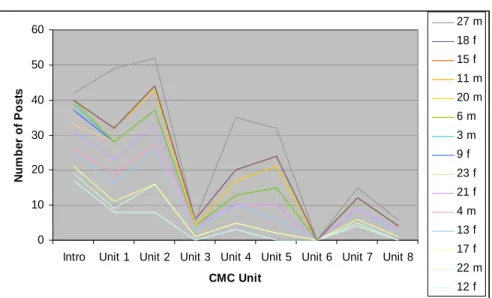
Students from a four-month online technology course at one tertiary level distance learning institution were invited to participate in the study. The course was chosen for the size of the enrolment (32 students) and because the course was not the subject of any other research project at the time. One student withdrew from the course, 4 declined to participate, 12 (Figure 2) accepted the invitation.
Figure 2 Volunteer CMC Participation
0 10 20 30 40 50 60
Intro Unit 1 Unit 2 Unit 3 Unit 4 Unit 5 Unit 6 Unit 7 Unit 8 CMC Unit
Number of Posts
V26m V25f V24m V19m V16f V14f V10f V8f V7f V5f V2f V1f
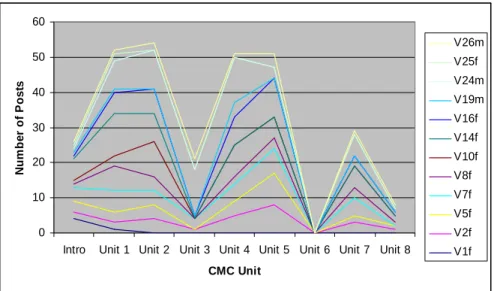
Conference postings of the 14 students who neither declined nor agreed to participate contributed secondary data (Figure 3). As stated previously, due to the significance of the role of the facilitator in the CoI model, the postings of the facilitator were also included in the secondary conference data.
Figure 3 Participation in CMC by People who Provided Secondary Data
0 10 20 30 40 50 60
Intro Unit 1 Unit 2 Unit 3 Unit 4 Unit 5 Unit 6 Unit 7 Unit 8 CMC Unit
Number of Posts
27 m 18 f 15 f 11 m 20 m 6 m 3 m 9 f 23 f 21 f 4 m 13 f 17 f 22 m 12 f
All but one of the 3 males and 9 females who volunteered to participate had undergraduate degrees, and some had already earned graduate degrees. All the
volunteers were mature students, with varying degrees of experience as online learners.
The alphanumeric method of tagging differentiated the participants by gender.
Therefore it was known that the secondary data group was comprised of 7 males and 8 females. Their postings implied that the majority were mature students, most indicated they were working in distance education. The postings of one member of the secondary data group suggested that she was a recent undergraduate, who had enrolled in a graduate course shortly after graduation.
Data Collection
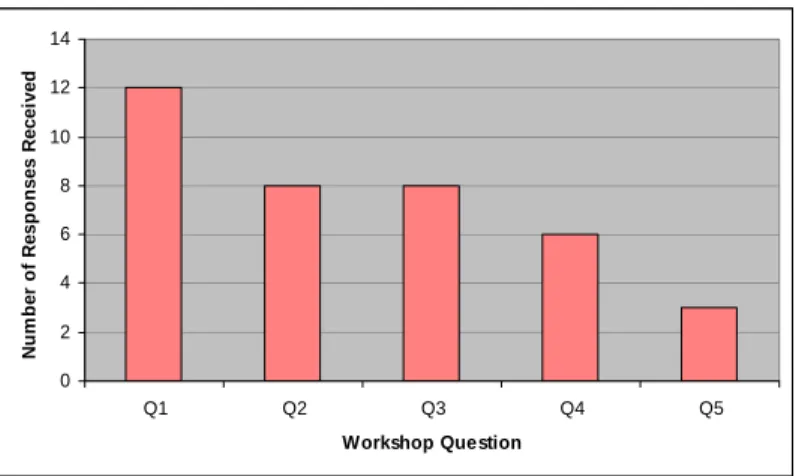
Participation in the online workshop was anonymous, but the author learned through the interview process that one volunteer had technical difficulties entering the workshop, so she failed to complete it. Tracking dates and times of responses to workshop questions appeared to confirm that 12 people did complete the workshop (Figure 4) in the first few weeks of the term. As it was possible for participants to repeat the workshop, repetition is one possible explanation for a participation of a dozen despite one volunteer stating categorically that she had not been able to participate.
Figure 4 Online Workshop Participation by Question
0 2 4 6 8 10 12 14
Q1 Q2 Q3 Q4 Q5
Workshop Question
Number of Responses Received
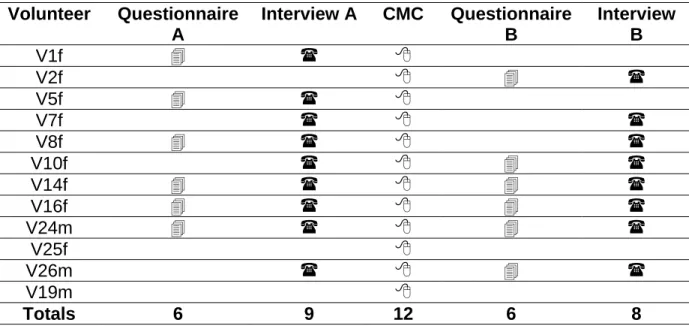
Of the 12 students, 3 participated in the study exactly as intended: completing entrance and exit surveys and interviews, plus participating in the CMC. Three volunteers participated in 3 of the 4 interview/survey collections; 4 participated in 2 of the 4 interview/survey collections. Two of 12 volunteers did not participate in any interview or survey. As participation in the computer-mediated-conference was mandatory, all 12 (Table 1) volunteers contributed postings in varying quantities.
Table 1 Participation by Volunteers in Study Activities
Volunteer Questionnaire A
Interview A CMC Questionnaire B
Interview B V1f
V2f V5f
V7f V8f
V10f V14f
V16f V24m
V25f V26m V19m
Totals 6 9 12 6 8
Treatment of the Data
As data were collected in units over a four-month period, with the largest unit, the transcript of the CMC, delivered at the end of the data collection process, initial analysis was segmented thusly: entrance surveys and interviews; exit surveys and interviews; followed by CMC transcript analysis. After segment analysis was
completed, the resulting data were examined for patterns, consensus and contradictions.
The Surveys. The entrance surveys were tallied by category for data that enabled the author to draw conclusions about the emotional expectations of the volunteers at the outset of the course with regards to CMC. To that end, a list of (Appendix A) feelings and emotions was provided to the participants. They had five different categories from which to choose in order to compare the feelings they were experiencing at the commencement of the course with those previously experienced in a face-to-face environment. Opportunities to contribute qualitative data were also provided. Finally demographic and background information were collected.
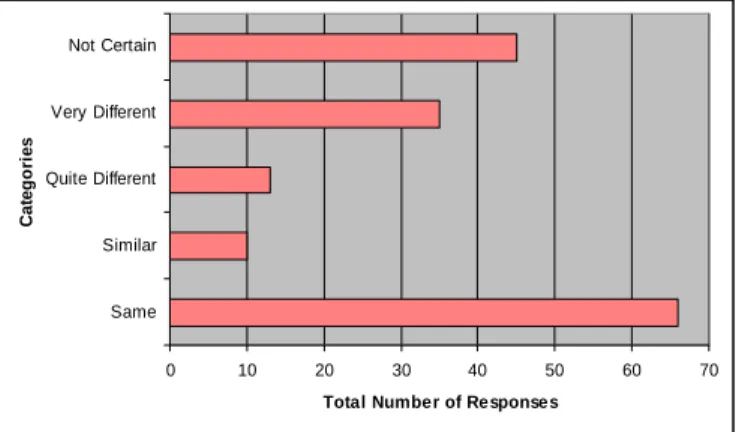
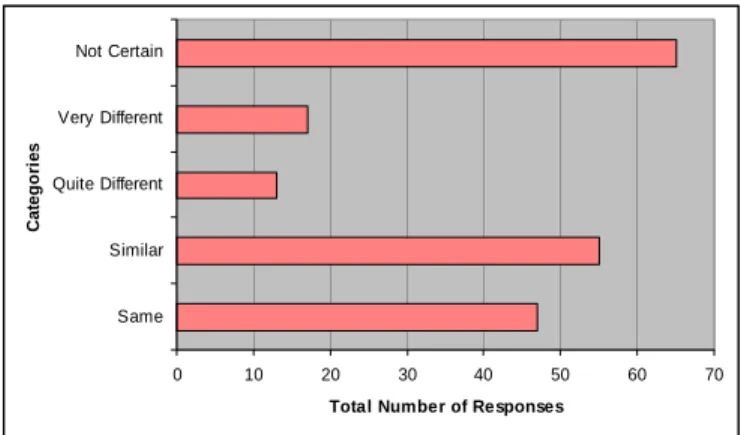
Six people provided a total of 169 responses to Section A of the entrance survey (Figure 5) with 45% of the responses indicating that the anticipated feelings experienced during the course would be ‘the same as’ or ‘similar to’ those
experienced as face-to-face learners. (Probable feelings were communicated by marking the appropriate column). Anticipation, curiosity, and motivation were the three predominant feelings, as each was marked by five students. The sixth
participant indicated that the experience of anticipation, curiosity, and motivation was
marked six times, making them the only other emotions to have been chosen by all respondents, although the experience of the feelings ranged across all five
categories.
Figure 5 Comparing Anticipated Feelings to Previous Face-to-face Experience
0 10 20 30 40 50 60 70
Same Similar Quite Different Very Different Not Certain
Categories
Total Number of Responses
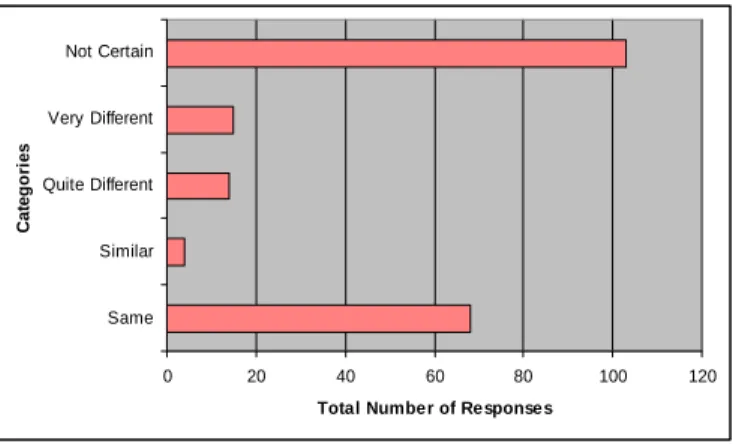
Six people provided a total of 204 responses to Section B of the entrance survey (Figure 6) with 50% of the responses being ‘uncertain/had no experience’ in terms of how feelings toward online learning compared to those of an experienced learner. Thirty-three percent of the responses anticipated the same feelings as experienced online learners.
Figure 6 Feelings Compared to an Experienced Online Learner
0 20 40 60 80 100 120
Same Similar Quite Different Very Different Not Certain
Categories
Total Number of Responses
The exit surveys (Appendix B) were tallied for data that would enable the
the respondents. To that end, the same list of feelings and emotions provided in the entrance survey was presented in the exit survey. The category choices also
remained the same, but the exit questions varied: The participants were asked to compare the feelings actually experienced during the course to 1) feelings
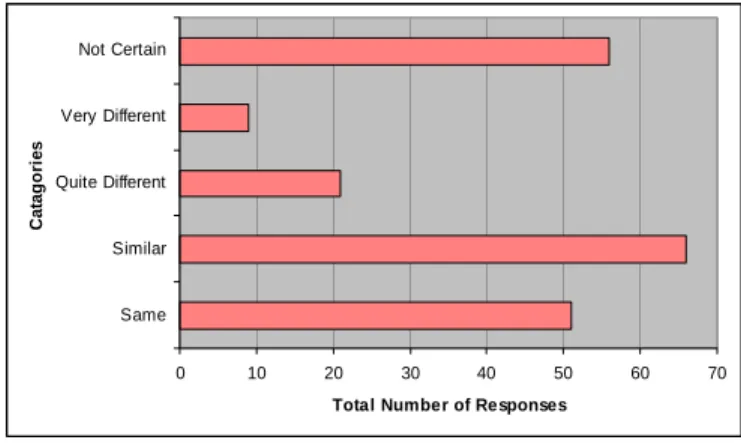
experienced in previous face-to-face learning (Figure 7) to those anticipated at the beginning of the class (Figure 8). Opportunities to contribute qualitative data were also provided. Finally demographic and background information were collected to corroborate data collected in the first round.
Figure 7 Feelings Experienced in Comparison to Previous Face-to-face
0 10 20 30 40 50 60 70
Same Similar Quite Different Very Different Not Certain
Catagories
Total Number of Responses
Figure 8 Comparisons of Experienced Feelings to Anticipated Feelings
0 10 20 30 40 50 60 70
Same Similar Quite Different Very Different Not Certain
Categories
Total Number of Responses
Five people provided 203 responses to Section A of Questionnaire B, with 58% of the responses indicating that the respondents experienced feelings “the same’ or ‘similar to’ previous face-to-face learning. Twenty-eight percent of the responses indicated that the respondents remained ‘uncertain/had no experience’ of the feelings presented as choices.
In addition, the qualitative responses on the exit surveys were reviewed for data that suggested the manner in which participation in the online workshop had impacted participation in the computer-mediated conferencing.
The list of emotions and feelings in both surveys was purposefully presented without pattern or categorization of ideas so as not to lead or bias the participants.
To reduce the error of assumption by the survey designer, the list presented was extensive -- so extensive that Volunteer 2F wrote, “I don’t understand how anger and many of the emotions given above could apply to an online distance learning course, so I felt these were very hard to answer with the options provided.” Her observation is in stark contrast to the anger vehemently expressed by Volunteer 10F – anger engendered by her online learning experience.
The Interviews. The entrance interviews (Appendix A) were comprised of open-ended questions designed to produce data from which the author could draw conclusions about the anticipated emotional experience of the volunteers in regards to CMC. The interviewees were asked to compare their face-to-face experience with their expectations of distance learning.
The exit interviews (Appendix B) were comprised of open-ended questions designed to produce data that supported or failed to support the data collected in the
entrance surveys, as well as produce data that would suggest the manner in which participation in the online workshop had impacted their computer-mediated
conferencing. Two variations were asked of the interviewees to corroborate the answer to this survey question: How did the introductory session on the role of emotions in learning support your online learning experience?
Transcript Analysis. The 298 postings that ranged from 3 to 56 per contributor were batched by unit: Introduction, Units 1, 2, 3, 4, 5, 6, 7, and 8. No postings were made during Unit 6, because, according to the data collected, the CMC for the unit had been cancelled by the facilitator.
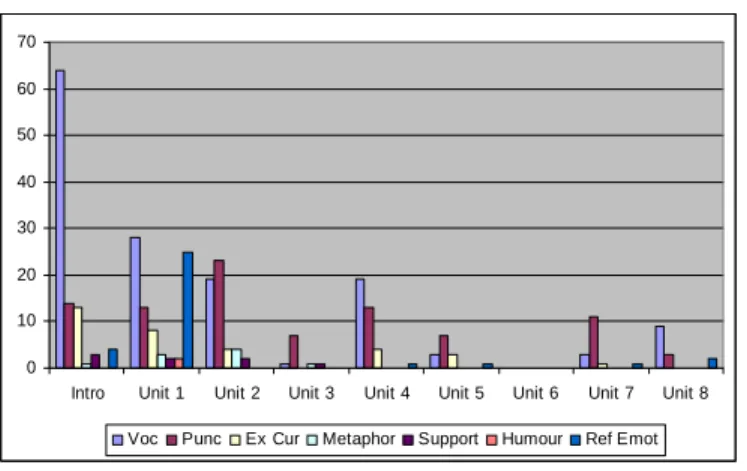
The posted threads for each unit were followed and examined for evidence that emotion was present, and for direct or indirect evidence that the volunteers who had participated in the online workshop had in some manner been transformed by the experience. The author used 7 criteria (Figure 9) to determine whether emotion (negative or positive) was present in postings: 1) choice of vocabulary (Voc), 2) the use of punctuation or emoticons (Punc), 3) expressed curiosity (Ex Cur); 4) the use of metaphor (Metaphor), 5) expressed support (Support), 6) humour (Humour), and 7) referenced emotion (Ref Emot), defined for these purposes as the use of
vocabulary to communicate unequivocal feeling.
Figure 9 Occurrences of Criteria for the Presence of Emotion
0 10 20 30 40 50 60 70
Intro Unit 1 Unit 2 Unit 3 Unit 4 Unit 5 Unit 6 Unit 7 Unit 8 Voc Punc Ex Cur Metaphor Support Humour Ref Emot
Summary
As the goal of this exploratory and interpretive study was to determine
whether a change in behaviour in the participants could be engendered that resulted in an enhanced CMC experience, a method was required that would disclose an emic perspective (Merriam, 2001). To determine if an insider’s view had been captured, the researcher identified what the respondents knew about emotion and cognition at the outset of the study. The intended catalyst for change was the online workshop. The CMC transcripts were the narrative from which inferences could be drawn. The exit surveys and interviews provided data which would deny or confirm that change had taken place.
CHAPTER IV RESULTS
“I also hoped the program would use multiple methods to deliver content as a way to show best practices.”
Volunteer 7F
Research Question
In a community of inquiry as defined by Garrison, Anderson and Archer (2000) will exposure to the role of emotion in learning as understood by Damasio (1994, 1995, 1999, 2003) and LeDoux (1996, 2002) provide learners with a tool to enhance participation in computer-mediated conferences?
Interview and Survey Evidence that Supports or Fails to Support the Research Question
Six of the 12 volunteer respondents completed the entrance survey (Table 1), while 9 granted entrance interviews. Six (not the same six) of the 12 volunteer
respondents completed the exit survey, while 8 (all of whom had granted an
entrance interview) granted an exit interview. All 12 participated to varying degrees in the CMC.
When all the data were collated it became apparent that presenting the results by individual would be most effective. The desire for triangulation and the subsequent design of the study were analogous to narrative. Each volunteer was the protagonist in his or her own story. The beginning of the story – the exposition – setting the scene for what was to come – was the entrance data. The CMC transcript
happened to the characters. The exit data delivered the denouement – the conclusion to the narrative.
Volunteer 24m. Volunteer 24M contributed the greatest number of posts (56, one more than the facilitator) to the computer-mediated conference. He participated in each of the 4 other collections, providing rich data for analysis.
His responses to the entrance survey questions indicated that at the
commencement of the course he anticipated experiencing “the same feelings” as if the course had been in a face-to-face mode. He used the word comfortable
repeatedly in the qualitative sections of the survey, underscoring his statement that he looked forward to “potentially stimulating social and learning experiences.”
When asked in the exit survey to compare the feelings he had actually experienced to those that he had anticipated experiencing at the outset of the course, he checked the column labelled similar to your expectations. He confirmed his initial expectations, and again used the word comfortable to describe the
experience he had had as a member of the online community.
The entrance interview corroborated the entrance survey data. Volunteer 24m did not think that he would have to make an emotional adjustment to learning in an online environment. He anticipated that if he were to get to know the emotions of his colleagues online he would merely “scratch the surface,” because the absence of body language eliminated opportunities to react to emotional cues.
During the exit interview he stated that the session on the role of emotion in learning merely “reinforced things I already knew.” When asked to describe an instance online when he used this reinforced understanding of emotion he told of