1 A REVIEW OF FORESTRY’S IMPACTS ON METHYLMERCURY IN AQUATIC
ECOSYSTEMS AND RECOMMENDATIONS FOR BEST MANAGEMENT PRACTICES IN ONTARIO’S BOREAL FOREST.
By
Peter Knudsen
An Undergraduate Thesis Submitted in Partial Fulfillment of the Requirements for the
Degree of Honours of Bachelor of Science in Forestry
Faculty of Natural Resources Management Lakehead University
April 2023
______________________________ ______________________________
Dr. Jian Wang, Major Advisor Dr. Robert Mackereth, Second Reader
2 LIBRARY RIGHTS STATEMENT
In presenting this thesis in partial fulfillment of the requirements for the HBScF degree at Lakehead University in Thunder Bay, I agree that the University will make it freely available for inspection.
This thesis is made available by my authority solely for the purpose of private study and research and may not be copied or reproduced in whole or in part (except permitted by the copyright laws) without my written authority.
Signature____________ Date: _____May 1st, 2023_____________
3 A CAUTION TO THE READER
This HBScF thesis has been through a semi-formal process of review and comment from at least two members of the faculty. It is made available for loan by the Faculty of Natural Resource Management for the purpose of advancing the practice of professional and scientific forestry.
The reader should be aware that opinions and conclusions expressed in this document are those of the student and do not necessarily reflect the opinions of the thesis, faculty or of Lakehead University
4 ABSTRACT
Knudsen, Peter. (2023). A review of forestry’s impacts on methylmercury in aquatic ecosystems and recommendations for best management practices in Ontario’s boreal forest. Undergraduate Thesis, Lakehead University, Thunder Bay, ON. 40 pp.
Keywords: Mercury, contamination, boreal, forest, methylmercury, forest harvesting, forest soils, fish, and aquatic contamination.
Mercury contamination in freshwater fish of Northern Ontario is exceeding levels safe for consumption and is negatively impacting remote communities. This literature review examines the impacts of specific forest operations on mercury contamination to aquatic communities. Literature was reviewed from online sources using peer reviewed journal articles that contained relevant information to mercury cycling or impacts of forest operations. The studies found that forest harvesting and site preparation were responsible for increasing soil concentrations of methylmercury (MeHg) between 100-500%. There were not subsequent changes in aquatic mercury concentrations if hydrological connections between soils and water were minimized.
Fire reduced overall mercury concentrations in the soil and lessened the impact of site disturbance on aquatic mercury concentrations. Current management practices in Ontario are insufficient at preventing significant mercury contamination to freshwater ecosystems. Incorporating more modern technology and harvesting practices, and management strategies that minimize movement of mercury from forest soils to waters should be the focus of future management directions.
5 ACKNOWLEDGEMENTS
The author of this thesis would like to thank Dr. Robert Mackereth and Dr. Jian Wang for their assistance and guidance in the writing of this thesis.
6 TABLE OF CONTENTS
ABSTRACT 4
ACKNOWLEDGEMENTS 5
TABLES 7
FIGURES 8
INTRODUCTION AND OBJECTIVE 9
MATERIALS AND METHODS 12
LITERATURE REVIEW 14
Biogeochemical Processes of Methylmercury 14
Methylation 15
Mobilization 16
Forestry's Impacts on Key Processes 18
Harvesting 18
Site Preparation and Machinery Operation 20
Other Forestry Operations 21
Effect on Aquatic Biota 23
RESULTS 24
DISCUSSION 28
Management Recommendations 30
CONCLUSION 33
LITERATURE CITED 34
7 TABLES
Table Page 1. A summary of mercury concentration changes across various treatments 25 2. A summary of forestry’s impacts on aquatic concentrations of mercury 26
8 FIGURES
Figure Page 1. A pie chart showing the proportion of each type of literature sourced 13
9 INTRODUCTION AND OBJECTIVE
The boreal forest is a vast terrestrial ecosystem that plays a crucial role in the global mercury cycle (Gauthier et al. 2015). Mercury is a naturally occurring heavy metal that exists in various forms throughout the globe. As a heavy metal, mercury is toxic in all forms and can have negative health effects if consumed in excessive
quantities. In recent decades, the concentration of mercury in freshwater ecosystems of Northern Ontario has increased. Mercury can be bioaccumulated in aquatic food chains, resulting in fish having levels of mercury beyond what is deemed safe for human
consumption. There is evidence to suggest that anthropogenic activities, including forest harvesting, are altering the concentrations of mercury in freshwater fish.
Mercury is released into the atmosphere following anthropogenic activities such as coal burning, metal refining, and other industrial activities. Mercury can then be transported long distances through the atmosphere before being deposited, often in remote locations. The build up of organic matter in boreal soils, often caused by cold and wet soil conditions, allows them to act as a sink for these depositions (Hobbie et al.
2002). Soil bacteria and microfauna which are important for soil processes, such as the decomposition of organic matter, exhibit reduced activity under these conditions which allows for the accumulation of material (Hobbie et al. 2002; Axelrood et al 2002). An important component of the soil is dissolved organic matter (DOM), which is a complex matrix of sediment, containing mostly decomposed organic material, and water
originating both terrestrially and aquatically (Ravichandran, 2004; Zsolnay, 2003).
DOM is significant to the cycling and distribution of mercury as it can form complexes
10 with trace minerals, act as a microbial substrate, influence aquatic food webs, and alter various other geochemical and physical processes (Charbonneau, et al. 2022; Laudon, et al. 2009).
Disturbances, such as wildfire or harvesting, are another important function of the boreal forest, and can impact the nutrient and chemical balance of the ecosystem (Foster and Bhatti, 2017). Disturbances often result in the loss or mobilization of soil nutrient stores. The majority of these nutrients will end up being deposited into adjacent catchment areas, resulting in higher concentrations within aquatic ecosystems
(Palviainen et al. 2022). Increased runoff and nutrient release following natural or anthropogenic disturbances have been shown to increase the mercury concentration in freshwater ecosystems (Garcia and Carignan, 2004; Desrosiers et al. 2014). But
disturbances not only increase export of mercury, but they also create site conditions that are more conducive to certain anaerobic microorganisms that play an important role in mercury cycling.
Methylmercury is an organic form that is mostly created as a product of the cellular respiration of anaerobic bacteria. These microorganisms live in the anoxic conditions present in many forest soils and waters. Disturbances have been known to create conditions that proliferate their populations, such as higher water table, increased solar radiation and greater access to organic carbon sources. Methylmercury is
bioavailable and can bioaccumulate within food chains, resulting in unsafe mercury concentrations in higher trophic levels. Methylmercury is also much more toxic, and can cause behavioral, neurochemical, hormonal and reproductive problems in wildlife
11 (Scheuhammer et al 2007). This increasing concentration of mercury is
disproportionately affecting certain human populations that still rely on freshwater fish as a major component of their diet. In Ontario, many First Nation communities still practice subsistence fishing practices, and this puts them at risk of suffering from mercury contamination. Many other northern residents consume freshwater fish regularly enough to cause negative health effects. Additionally, the degradation of the ecosystems threatens the health of a valuable sport fishing industry in Ontario, which is another major source of revenue for many remote communities (Conference Board of Canada, 2018).
Forest management is an important tool and revenue generator for this country.
However, balancing its impacts with its benefits is crucial to the long-term sustainability of the industry and the environment. Understanding how forest management is
impacting the concentrations of mercury in freshwater ecosystems is a crucial yet complex topic. Better understanding the implications of specific operations on mercury concentrations will allow for more robust management guidelines. This will allow the forest to continue to meet economic demands without sacrificing the sustainability of the greater ecosystem and its many services. The goal of this literature review is to analyze the evidence of forest management impacts on mercury levels in freshwater fish in the boreal forests. Then using all the best available scientific knowledge, we will create a series of best management practices that can be implemented in Ontario with the purpose of limiting forest management’s contribution to mercury contamination in freshwater ecosystems.
12 MATERIALS AND METHODS
Papers for this literature review were sourced and systematically selected using the Lakehead Library’s OMNI search engine and google scholar. Concerns around forestry’s impact on mercury contamination in the boreal forest is a phenomenon in the past two decades. However important research has been conducted on mercury
contamination in various environments since 1990, so this was the cut off for which papers were selected for this literature review. Published, peer-reviewed journal articles were the primary source of information for this project, however relevant dissertations, theses and independent research was also used. Mercury contamination affects forests around the globe, but the focus of this paper was on the boreal forest. Therefore, only literature that was relevant to the boreal ecosystem or boreal harvesting was considered.
Most research on the topic of mercury and forestry has been conducted in Fennoscandia or Canada, two regions with a high percentage of managed boreal forest. Key search terms included mercury, contamination, boreal, forest, methylmercury, forest harvesting, forest soils, fish, and aquatic contamination were used in different combinations to achieve search results. Initial search results from Google Scholar and OMNI resulted in approximately 12,300 results for mercury contamination forestry boreal. However, this was far too many results to be feasibly parsed, and after the first 50-100 papers the relevance quickly fell away. The primary method of sorting and analyzing the relevance of literature was based on title and abstract, selected works were then read in depth to confirm their application. Titles were selected for mentioning one of the key terms listed above, but more peripheral papers were also reviewed in case of relevant facts or
figures. After some initial searching, key researchers in the field of methylmercury and
13 forestry were identified. Their collections of articles were then reviewed for all
publications relating to my thesis. Ultimately, between 75-100 papers were reviewed in order to gain a solid understanding of the topic. To dissect the complexity of the topic, a framework of main factors was devised to help focus research and organize the relevant papers. These 4 categories were the mercury cycle, impacts of forest harvesting and fire, and effects on aquatic biota. For each of these framework elements, papers with a range of viewpoints and conclusions were sought after, although gaps in the research didn't always facilitate this. These elements were then broken down further into themes to help organize research and explain the impacts of forest harvesting on mercury levels in fish.
Figure 1. A pie chart displaying the proportion of each type of literature sourced.
Mercury Cycle
Impacts of Logging Impacts of Fire
Impacts on the Biota
LITERATURE BREAKDOWN
14 LITERATURE REVIEW
Biogeochemical Processes of Methylmercury
To create effective best management practices, a solid understanding of the processes responsible for the ultimate contamination of mercury into aquatic ecosystems is required. Unfortunately, many of the processes involved are still poorly understood and range in their complexity. To minimize confusion an overview of the more
complicated biogeochemical processes involved in mercury’s methylation and transport to aquatic environments will be provided. We will then examine the evidence of how various forest management practices are affecting these two key processes. People have been trying to manage the mercury contamination of freshwater ecosystems for decades now, but there were gaps in the understanding of how atmospheric depositions resulted in accumulation in freshwater fish. It wasn't until 2003 when Porvari et al. first began to uncover the impact that forest management was having on mercury levels of freshwater fish. Since then, many studies have been conducted throughout the managed forests of the boreal biome, largely in Fennoscandia, but also several important studies in Canada.
Although many aspects of forestry's impacts are still poorly understood, a review by Elkof et al. (2016) established two main categories of effects regarding mercury contamination 1. The increased mobilization of MeHg and THg from soils to surface waters and 2. Creation of environments of high Hg methylation. The increased
mobilization of MeHg and THg can also be broken down further into two major groups, the first being forestry's effect on hydrology, which includes changes in soil moisture, runoff amounts, groundwater levels and flow paths. The second group of effects is on
15 net methylation rate which includes changes in redox status, availability of electron donors or acceptors for methylating bacteria, and soil temperature (Eklof et al. 2016).
Furthermore, forestry can influence aquatic food webs by changing nutrients, light/
temperature regimes and erosion (Eklof et al. 2016). There are many factors at play that influence forestry's role in mercury contamination, including chemistry, biology, and geophysical factors such as hydrology.
Methylation
Methylation is a common biological and chemical process that alters the structure of a compound. In the case of mercury, this alteration of structure is what makes it more mobile, allowing it to enter the food chain and begin bioaccumulation. A review by Ma et al. (2019) determined that most of the mercury methylation is produced by anaerobic microorganisms. A study in the experimental lakes area found that bacteria were the primary culprit for mercury methylation in sediments and the water column (Acha et al. 2012). Although there is a wide variety of organisms capable of methylating mercury through various processes (Tang, et al. 2020), methylation usually occur in anoxic conditions such as benthic sediments, saturated soil, and stratified water columns (Hsu-Kim et al. 2013). The methylation of mercury by these various bacterial species is a cellular reaction that is precipitated by the presence of certain genes (Graham et al, 2012). Because methylation is a cellular reaction, various environmental factors such as pH, temperature, salinity, soil properties and DOM can all influence the rate of
methylation (Ma et al. 2019). For the cellular reaction to occur, there is a requirement for an electron donor, usually in the form of high-quality organic carbon, often from DOM (Drott et al. 2007). A portion of methylation is also completed through abiotic
16 chemical processes, but the percentages are difficult to quantify in the field and are generally thought to be low (Celo et al. 2006).
There is also the important process of demethylation, in which MeHg is degraded back into Hg, and potentially countering rates of methylation in some cases. Similarly, the demethylation process is highly complex and mediated by abiotic and biotic factors, namely bacteria and light (Huang et al. 2022). Making matter more complicated is the fact that many of the same microorganisms responsible for mercury’s methylation, are also involved in the biotic demethylation in soils (Huang et al. 2022).
Photodemethylation is an important process in surface waters, likely including pools of standing water created through forest operations (Barkay and Gu, 2021). Barkay and Gu.
(2021) also highlighted that there was a negative correlation between DOM content of the water and photodemethylation rates, elucidating how important DOM is to mercury contamination. Forestry is also much less likely to impact rates of demethylation, as opposed to impacts on rates of methylation.
Mobilization
The mobilization of mercury into the aquatic environment from the terrestrial is largely a result of hydrological connections. However, the loading of pollutants that may be associated with these connections are equally important. DOM plays a critical role in the connection between forestry and methylmercury in aquatic ecosystems. As discussed above, it is an important source of carbon to methylating bacteria, and its presence may influence production of MeHg. A study by Graham et al. (2012) found that MeHg production depended linearly on concentrations of DOM in a lab experiment. However, it is arguably more important as a transport medium for both THg and MeHg both in and
17 between terrestrial and aquatic ecosystems (Mangal et al. 2022). Up to 80% of DOM is made up of humic substances with various acid-base properties, and mercury along with other trace metals are bound at the acidic sites within the organic matter (Ravichandran, 2004). DOM mobilization is thought to be controlled primarily through runoff and lateral flow of saturated soil water to streams (Schelker et al. 2012). As riparian soils tend to have decreasing DOC with soil depth, the level of groundwater can be important to DOC transport (Laudon et al. 2009). A study by Braaten et al. (2016) found increased concentrations of MeHg at deeper soil levels in peatlands. This is consistent with the findings by Kaiser and Kalbitz (2012) that DOM tends to increase in concentration at lower horizons in certain soils. However, DOM quality is just as important in terms of transport potential, increasing superficial flow may increase contact with less degraded organic matter that has a higher potential to bind Hg. DOM inputs can also alter food web structures, and subsequent methylmercury bioaccumulation, as it is a key energy source for the biota of headwater streams (Charbonneau et al. 2022). Changes in quality and quantity of water as a result of disturbances can have an impact on the biota of aquatic features, such as the algae, Periphyton (Desrosieres et al. 2006), Zooplankton (Garcia 1999), and benthic macroinvertebrates (Charbonneau et al. 2022). These changes are important for the ultimate biomagnification within fish species.
Despite the wealth of evidence regarding the role/correlation of Hg transport and DOM, it doesn't tell the whole story. Several studies have shown inconsistent results around actual concentrations of THg and MeHg being significantly related to DOC concentrations (Lam et al. 2022 and others). The quality of the DOC plays an important role in its ability to mobilize mercury, as do other environmental factors. An important
18 consideration brought to light by Lam et al. (2022) is that landscape and hydrological indices also play an important role in ultimate concentrations through export levels. This includes soil type, and forest cover type. Forest cover that was characterized by wet soil moisture conditions, showed a moderately positive, significant relationship with THg and MeHg emerged. Conifer forests was also moderately positive and significantly related to THg and MeHg.
Forestry's Impacts on Key Processes
A study by Eklof et al. (2014), which compared the two most common forestry operations effects on MeHg, found that logging has a greater impact on the hydrology, and thus the mobilization of MeHg. Site preparation and driving of machinery tended to have a greater impact on methylation in soils and thus impacted concentrations.
Measures of both THg and MeHg are given in both loads and concentrations for various studies. Concentration is defined as the mass of the pollutant in a defined volume of water (typically ng per litre), whereas load is the mass of pollutant that is discharged into a waterbody over time (g per km2 per y).
Harvesting
Logging of forested environments often results in an increase in discharge rates to catchments (Sorensen et al. 2009). The reduction of vegetative cover results in less water leaving the site through transpiration, and more snow accumulates in the open areas (Sorensen et al. 2009). This can result in higher groundwater levels and more direct runoff into first order streams (Schelker et al. 2012). This increase in groundwater recharge rate leads to more superficial and lateral flows that reach into the carbon rich
19 upper soil layers. This increase in discharge rates may increase the amount of
contaminants being released from catchments (Desrosiers et al. 2006), but may also create water saturated soils with ideal conditions for methylators. A study by Kronberg et al. (2016) found that the largest difference in percent MeHg of Total Hg was related to an enhancement of soil water content. The organic horizon showed the greatest increase in water content, this water saturation created oxygen deficiencies that likely enhanced MeHg in the soil. This coupled with increased surface temperatures and the addition of organic carbon from the decomposition of logging residue can all contribute to the activity of these methylators (Sorensen et al. 2009). There have been several studies that show varying levels of THg and MeHg response to logging. Porvari et al. (2003) found 133% increase in MeHg concentrations in runoff after harvesting, and these levels persisted for 3 years after logging. Munthe et al. (2007a) found an 83% and 325%
increase in leaching coefficients for THg and MeHg respectively, when comparing them to a growing forest. The importance of vegetation cover to mercury contamination was highlighted in a study by Skyllberg et al. (2009) that showed there were significant increases of MeHg in streams in the 0-4 year range after clearcutting, but insignificant effects 4-10 years after clearcutting. These findings suggest that the gap between forest harvest and stand initiation is the primary temporal window in which mercury exports from forestry operations are felt.
Kronberg (2014) found that the methylation potential was increased in logged soils, and that subsequent increases in soil and stream water concentrations of MeHg were associated mostly with the additional methylation, and not just the mobilization of older MeHg pools.
20 Although many studies concluded that logging alone was responsible for a significant increase in mercury concentrations (Porvari et al. 2003; Munthe et al. 2007;
Skyllberg et al. 2009; Kronberg et al. 2016; and Eklof et al. 2012), other studies showed there was not an observable increase in either THg or MeHg concentrations in the catchment (Allan et al. 2009; Sorensen et al. 2009; de Wit et al. 2014; Eklof et al. 2014).
This range of response for THg and MeHg illustrates the variability in outputs from different catchments, based on the catchment conditions. The inconsistency of results highlights the complexity of Hg response to forest operations and indicate that there are many factors at play that influence the cycle.
Site Preparation and Machinery Operation
Site preparation is the act of creating a mechanical disturbance to forest soils prior to the planting or seeding of new trees. This process aims to expose the mineral soil by deep tillage which mixes the organic and mineral layers. Site preparation in addition to the driving of forestry machinery is the most common source of soil
disturbance and impacts soil properties, and subsequent hydrology and erosion (Cambi et al. 2015). Forest operations tend to increase the level of soil compaction, this
reduction of soil porosity tends to lower infiltration rates and alter hydrological flow (Poltorak et al. 2018). Rutting, like many site preparation techniques, creates trenches or furrows in the soil during wet conditions, these reduce the lateral flow of water and create localized rise in the water table, ultimately resulting in ponding (Poltorak et al.
2018). These flooded soils have the potential to act as methylation hotspots (Eklof et al.
2017). Hydrological connections either superficially, laterally or through groundwater flow have the potential to transport this MeHg load to aquatic ecosystems (Bishop et al.
21 2009). Increased levels of erosion are also commonplace following the operation of forestry machinery, this could increase the load of Hg to aquatic ecosystems through associated particles. During a study comparing the effects of logging and site preparation at the Balsjö catchment in northern Sweden, Eklof et al. (2014) found that logging had a minimal effect on the concentration of THg and MeHg. But they found that
concentrations increased about 30% for THg and 50% for MeHg after site preparation, compared with concentrations prior to any activity. A Study by Braaten et al. (2016) found that there was a weakly significant (p=0.07) and significant (p=0.04) difference between the MeHg concentrations and MeHg to THg ratios between soil samples taken from within and without wheel tracked areas. Therefore, there is a marked effect of soil disturbance on MeHg production, but this increase did not reflect in the concentrations of stream waters for either the disturbed or harvested catchment areas. These studies by Eklof et al. (2014), Braaten et al. (2016), and Poltorak et al. (2018) and Munthe and Hultberg (2004) highlight the importance of soil disturbance, from either site preparation or machinery driving, as one of the primary effects on MeHg concentrations in the environment. However equally important is the conclusion that no matter the
concentration of methylmercury, without a hydrological connection the impact of these disturbances on aquatic concentrations could be rather benign.
Other Forestry Operations
Other operations on which there is relevant information regarding impacts of mercury include biomass harvesting and ditch cleaning. Biomass harvesting is the removal of additional tree components aside from the stem, typically roots or logging residuals. Typically, these types of operations require additional machinery passes to
22 harvesting and site preparation, and result in higher levels of soil disturbance. Stump harvesting typically results in a similar level of disturbance to site preparation, this was reflected in two studies (Eklof et al. 2012, 2013) that found no significant increase in THg or MeHg in stream runoff when comparing site prep to stump harvest. Similarly, even though stump harvest operations tend to create methylation hotspots, without a strong hydrological connection to catchments there is no associated increase in mercury signals within runoff water (Eklof et al. 2017). Logging residues may be harvested for biomass processing but are often left within the block or used to protect soil from
driving damage, especially in cut to length harvesting operations. Logging residue left in the block or on forwarder paths may increase shading and reduce water loss through evaporation. This residue could also act as a high-quality source of carbon for methylators in the soil. Therefore, removal of logging residue has the potential to decrease the localized rates of methylation. On the contrary, without the protection of logging residue, there may be increased soil disturbance that could also result in
increased methylation rates. Ultimately these are complex interactions and there is much more research required in this area to truly understand its implications for mercury exports.
Although there have been no official studies regarding the impacts of thinning or partial harvesting on THg or MeHg runoff when compared to clearcutting, there was an important observation in the study by Eklof et al. (2014). The catchment area was treated with 5-10m riparian buffers and only 35% of 40ha area was harvested. When compared to the harvested catchment at approximately 64% harvesting intensity, there was a decreased MeHg response, whereas THg was similar between the two, otherwise both catchments were the same. Although the effect cannot be discerned between buffers
23 and harvesting intensity, the combined effect is an important consideration for
management directions.
Silvicultural system may play an important role in the regulation of mercury transport to aquatics. Selecting systems such as CLAGG or other partial harvest systems may leave enough forest cover to impact rates of mercury export or methylation,
especially given the importance of water table height to these processes (Kronberg et al 2016). Proulx et al. (2021) found that although partial harvesting did not directly affect daily water table variation, they did find that temperature exhibited a positive effect on both water table and stem diameter variation. This conclusion suggests that canopy openness and precipitation interception play an important role in regulation of the water table, at least in the short term. Regardless, the evidence that a partial harvest of 40%
basal area could reduce water table rise is an important consideration for developing best management practices. A study by Braaten et al. (2016) concluded that the most
important source of stream water MeHg was from peatland soils, as they exhibited the highest MeHg concentrations.
Effect on Aquatic Biota
Increasing concentrations of Hg in freshwater fish related to forest harvesting was first documented by Garcia and Carignan (2004). They compared several
unharvested catchments with those subjected to a clearcut, and they found that the levels of Hg in the top predators were elevated and remained high for several years after harvest, compared to other treatments. Other studies in the area also noted an increase in mercury concentration in zooplankton (Garcia and Carignan, 1999) and in the
periphyton (Desrosiers et al. 2006) following forest harvesting within the catchment
24 area. In 5 of the 8 lakes sampled the increases were statistically significant and ranged from a 0-8 factor increase. A study by Charbonneau et al. (2022) found a similar
increase in the concentration of MeHg for hydropsychids in the upstream and midstream sites for harvested catchments, when compared to references. The difficulty is that once the methylmercury has made its way into the environment, there is very little stopping it from bioaccumulating.
RESULTS
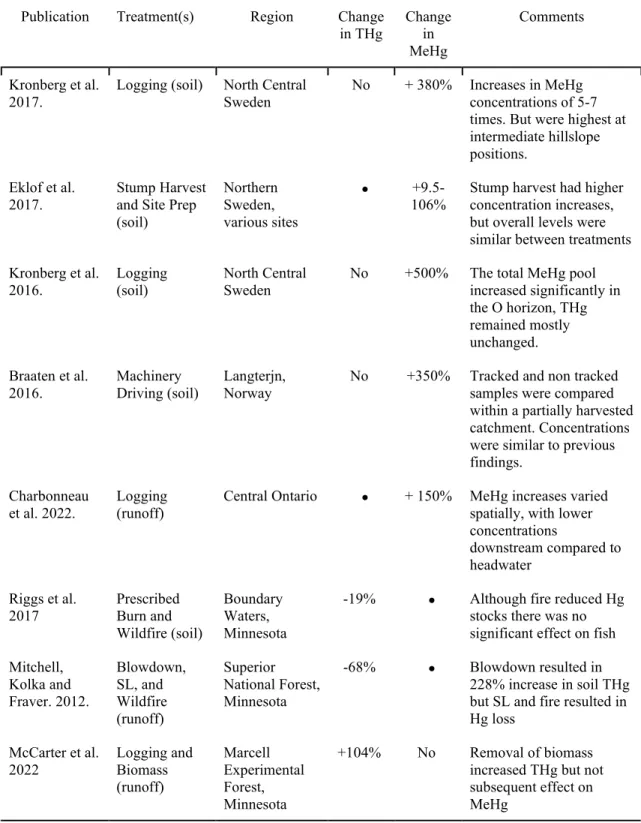
After collecting and reviewing the relevant papers, the data was analyzed to determine if there were any obvious trends. The results of this analysis are presented in Table 1. Most of the studies used were looking at changes in the soil concentration of THg and MeHg. Soil concentrations of THg did not change following most harvesting related treatments, including logging, site prep or machinery driving. However, these same treatments increased MeHg concentrations up to 500% in some cases. Only the study by McCarter found an increase in THg following biomass harvesting, but this study was looking at runoff concentrations and not soil concentrations.
The studies of wildfire or prescribed burnings impacts on mercury concentrations had different findings than those of harvesting. Riggs et al. (2017) found that the
prescribed burn reduced the soil concentration of THg, and that there was no significant increase in nearby aquatic communities. The study by Mitchell et al. (2012) found that following the blowdown event the soil concentration of THg increased by 230% but the
25 subsequent salvage logging and wildfire reduced the soil THg stocks by 68% from baseline levels.
Table 1. A summary of mercury concentration changes across various treatments Publication Treatment(s) Region Change
in THg Change MeHg in
Comments
Kronberg et al.
2017. Logging (soil) North Central
Sweden No + 380% Increases in MeHg concentrations of 5-7 times. But were highest at intermediate hillslope positions.
Eklof et al.
2017. Stump Harvest and Site Prep (soil)
Northern Sweden, various sites
• +9.5-
106% Stump harvest had higher concentration increases, but overall levels were similar between treatments Kronberg et al.
2016. Logging
(soil) North Central
Sweden No +500% The total MeHg pool increased significantly in the O horizon, THg remained mostly unchanged.
Braaten et al.
2016. Machinery
Driving (soil) Langterjn,
Norway No +350% Tracked and non tracked samples were compared within a partially harvested catchment. Concentrations were similar to previous findings.
Charbonneau
et al. 2022. Logging
(runoff) Central Ontario • + 150% MeHg increases varied spatially, with lower concentrations
downstream compared to headwater
Riggs et al.
2017 Prescribed
Burn and Wildfire (soil)
Boundary Waters, Minnesota
-19% • Although fire reduced Hg stocks there was no significant effect on fish Mitchell,
Kolka and Fraver. 2012.
Blowdown, SL, and Wildfire (runoff)
Superior National Forest, Minnesota
-68% • Blowdown resulted in 228% increase in soil THg but SL and fire resulted in Hg loss
McCarter et al.
2022 Logging and
Biomass (runoff)
Marcell Experimental Forest, Minnesota
+104% No Removal of biomass increased THg but not subsequent effect on MeHg
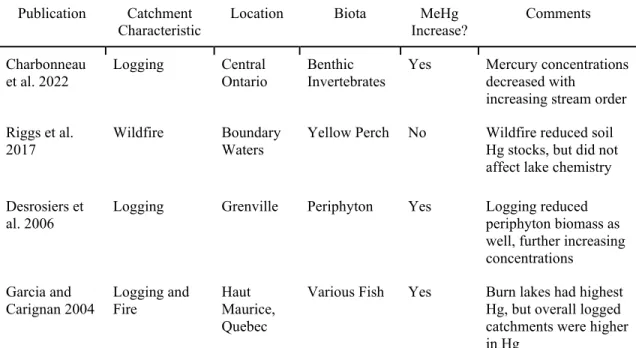
26 Increased soil MeHg concentrations following harvesting and site preparation activities has been established by the studies in Table 1, among others. A similar trend can be seen when examining subsequent increases in aquatic communities following these treatments. Table 2 shows whether various aquatic biota showed an increased in MeHg concentration following either logging or wildfire. Logging resulted in increased mercury concentrations across the food web, including algal communities, zooplankton benthic invertebrates, and fish. The two studies by Garcia and Carignan (1999, and 2004) examined the effects of fire and logging on different catchments and found that although fire did increase mercury concentrations in runoff, MeHg in runoff was higher from logged catchments. The study by Riggs et al. (2017) found that there was no significant increase in mercury concentrations following wildfire.
Table 2. A summary of forestry’s impacts on aquatic concentrations of mercury Publication Catchment
Characteristic Location Biota MeHg
Increase? Comments Charbonneau
et al. 2022 Logging Central
Ontario Benthic
Invertebrates Yes Mercury concentrations decreased with
increasing stream order Riggs et al.
2017 Wildfire Boundary
Waters Yellow Perch No Wildfire reduced soil Hg stocks, but did not affect lake chemistry Desrosiers et
al. 2006 Logging Grenville Periphyton Yes Logging reduced periphyton biomass as well, further increasing concentrations
Garcia and
Carignan 2004 Logging and
Fire Haut
Maurice, Quebec
Various Fish Yes Burn lakes had highest Hg, but overall logged catchments were higher in Hg
27 Garcia and
Carginan, 1999
Logging and
Fire Gouin,
Quebec Zooplankton Yes Higher MeHg levels in logged catchments, than in burned or control
We have come to a rudimentary understanding of the mechanisms through which forestry results in mercury contamination to aquatic ecosystems. The two main effects are increases in the rates of methylation, either in forest soils or adjacent waters because of forestry operations. The other is the export of Hg and MeHg from forest soil stores into the aquatic environment.
The primary impacts of forest harvesting are an increase in the water table and the addition of carbon sources to the soil, in the form of logging residue. Together these create conditions that proliferate the methylation of mercury by anaerobic
microorganisms that exist within the forest soils, resulting in increased concentrations of MeHg. Additionally, forest harvesting is known to impact rates of discharge from catchments, and the loading of solutes which can result in increased Hg and MeHg concentrations in aquatic environments.
Site preparation and the driving of machinery result in various levels of soil disturbance. Compaction from heavy traffic, and rutting tend to decrease soil drainage, and coupled with rising water table often results in ponding, especially in lowland organic soils. This can lead to more superficial flow, and a stronger hydrological connection between the forest and surrounding aquatic environments. Furthermore, the soil displacement during site prep often leads to higher levels of erosion, further increasing the amount of Hg and MeHg delivered to aquatics by site preparation.
28 Finally, other operations such as removal of biomass during preliminary studies have shown to increase concentrations of MeHg in the environment, but generally more research is required to fully understand the implications.
Fires decrease soil Hg stores because the intense heat will volatilize the Hg back into the atmosphere. Furthermore, fires will burn up much of the surface organic layer which is important for binding and storing Hg in the soil. This results in decreased export of Hg and less methylation at a local scale and has been proven to result in less contamination of fish in nearby waters (Riggs et al. 2017).
DISCUSSION
The conclusions from this research highlight the importance of conserving soil and water resources and minimizing site disturbance in mitigating the potential effects of forestry of mercury in freshwater ecosystems. Both Eklof et al (2016) and Bishop et al.
(2009), two of the more comprehensive studies on the impacts of forestry on mercury, provided recommendations for management practices. The recommendations provide some broad management directions, largely at the site level. This includes the protection of wetlands and riparian areas with buffer zones, minimize disturbance to peatlands surrounding aquatic features, avoid driving machinery in especially wet areas, protect the soil with logging residue or logging mats, site prep in a manner that minimizes erosion, and avoid site prep and stump harvest in sensitive soils.
These management recommendations from Sweden are mostly consistent with existing standards or BMPs in Ontario, based on the Stand and Site Guide for Ontario’s
29 Boreal Forest. Section 5.2 Soil and Water conservation already puts clear limits on the amount of rutting, compaction, erosion, nutrient loss, and hydrological impact. Relevant examples of standard include: No ruts permitted that channel water into, or within 15m of lakes, ponds, rivers, streams, woodlands pools or those portions of mapped non- forested wetlands dominated by open water or non-woody vegetation (SSG 5.2.1 rutting and compaction). There are no standards for erosion control, but guidelines suggest diversion of runoff water into surrounding vegetation, or to mitigate and rehabilitate areas of significant erosion that are transporting or likely to transport sediment into a water feature (SSG 5.2.2 Erosion). Although BMP’s present in the publication by Jelkum et al. (2003) may provide some more rigorous controls, the fact of the matter is that despite these current measures, mercury contamination as a likely result from forestry is still widespread.
Despite decreasing atmospheric emissions, mercury exports from boreal forests are expected to continue for many years to come. Their role as a buffer and collector of mercury depositions means that there is a lag time between atmospheric release and ultimate accumulation within freshwater ecosystems. And considering that forest management in the province is not expected to halt anytime soon, it is expected that mercury contamination will continue to be legacy of forest operations for the foreseeable future. Studies have provided evidence that concentrations of mercury in fish continue to increase for several years after harvest (Garcia and Carignan, 2004) and are related to percentage of catchment area harvested (Charbonneau et al. 2022). Given the prevalence of freshwater ecosystems in Ontario, avoiding high levels of catchment disturbance requires careful planning. The forest industry alone is not responsible for the epidemic
30 of mercury contamination, but it does have a key role to play in attempting to mitigate its effects, and a reckoning of management practices is required to address this issue.
Although much more research is required to truly create effective management practices, based on the currently available data there are some recommendations that might
improve mitigation. Any relevant practices already included in the SSG or BMP manual will not be included, to avoid redundancy.
Management Recommendations
The primary takeaway from the literature review is that minimizing hydrological connections is the best way to minimize mercury contamination at the site level.
Hydrological connections include surface runoff and groundwater flow paths, both of which are more prevalent at closer proximity to water features. More rigorous standards and recommendations around soil disturbance and managing of water tables and runoff are a priority then. The primary recommendation is to move to more cut-to-length harvest operations, utilizing smaller machines with less soil disturbance and greater mobility. Additionally, the usage of logging residue protected forwarding paths may minimize overall soil disturbance and limit the disturbance to hydrologically sensitive areas. Increasing logging residuals may have the adverse effect of facilitating
methylation by increasing amount of organic material available. However reduced disturbance to flow paths should limit export into waterways, overall limiting the increase in aquatic concentration.
The secondary recommendation is to strongly consider implementing more protection of advance regeneration, or partial harvest systems. The study by Skyllberg et
31 al. (2009) highlighted the importance of vegetation cover to the level of mercury export.
Minimizing the time to stand initiation, or maintaining some degree of stand structure over time, especially in wet areas will impact hydrology. Proulx et al. (2021) showed the impact of reduced harvest intensity on the water table, a key factor in hydrological connections. Reducing the water table will result in less anoxic conditions and limit the lateral flow between forest soils and aquatic features, theoretically reducing mercury export.
Prescribed burns on clear cuts with high levels of slash may be another effective way of reducing mercury export to catchments. The study by Riggs et al. (2017) found that a low to moderate severity wildfire decreased the Hg stocks of an upland organic soil layer by 19%. Furthermore, the redistribution of these Hg stocks did not result in a subsequent accumulation of Hg in young of the year Yellow Perch. The lake chemistry was a greater predictor of fish Hg levels, as opposed to severity of fire. These results are similar to the study by Carignan and Garcia. (2004) that found that dissolved organic carbon content was the greatest predictor of fish Hg concentration. Fires in addition to volatilizing Hg back into the atmosphere, will mineralize organics in the upper soil layers (Witt et al. 2009). This will reduce the organic carbon available to methylators in the soil and reduce the export of Hg and DOC through runoff and reduce methylation rates in the water column. Currently prescribed burns are an underutilized tool in the management of boreal forested ecosystems. Barriers to their implementation include poor social perception of prescribed burns and strict conditions in which burns are allowed to be carried out.
32 Improved planning at the landscape scale will be critical to minimizing the overall impact. Lam et al. (2022) highlighted that certain forest cover types intrinsically export more mercury even unharvested. The physical features of catchments are also key to levels of export, such as average slope, dominant soil types, and percent area of wetlands. Maintaining and restoring wetlands across the landscape is key for mercury demethylation, as is minimizing total levels of disturbance within catchments at any given time. The use of tools such as LiDAR and eFRI will improve the detail and efficiency of planning and allow for better implementation of practices as more data becomes available.
Leveraging the increasing power and accuracy of remote sensing techniques will be crucial to improving site level planning. Using LiDAR we have been able to create high resolution digital elevation models (DEM), which are capable of displaying even the smallest of drainage features. Kuglerova et al. (2017) highlighted how combining improved DEM with soil type mapping could help to locate areas of extensive groundwater connection to streams. These areas can often extend beyond riparian buffers, especially on small headwater streams. Logging in these areas could experience higher rates of methylation and export, due to increased hydrological connection through the groundwater. Mapping of these areas prior to harvesting operations could be integral to reducing mercury output to catchments. Machine trails could be pre planned to minimize crossing of these small flow paths or disturbance to groundwater recharge areas.
33 A final exciting new management possibility that warrants further study is the usage of bioremediation on helping to minimize mercury export. A recent study
conducted by Maillard et al. (2023) found that the mycelia of certain fungi present in the soil were capable of binding Hg from the soil. As the fungus died, this Hg was stored within the fungal necromass, and remained immobilized long term within the soil. After a 4-month incubation period, the fungi in this study were able to remove between 400- 4500 micrograms of Hg per kilogram of soil. This presents a new and ecologically sound way of reducing the available Hg stores of the forest soils. Finding ways to implement a large-scale inoculation of forest soils with the proper fungi remains challenging and may have unwanted ecological consequences. However, the potential to remove vast
quantities of Hg from the soil stores could have serious implications on the global mercury cycle.
CONCLUSION
The cumulative effects of forest operations on aquatic mercury concentrations are undeniable, though still poorly understood. Increases in rates of methylation and mobilization following forest harvesting and site preparation is site dependant but frequent. Logging tends to increase rates of methylation by raising water tables and adding sources of carbon to methylators. Site preparation increases mercury export by increasing soil disturbance and creating hydrological connections between soil and aquatic features. Wildfire and prescribed burns reduced soil Hg stores and have a lesser impact on aquatic concentrations then forestry. Minimizing hydrological connections between methylation in forest soils and aquatic features should be the focus of future management directions. Current practices in Ontario, such as riparian buffers, are
34 insufficient in reducing mercury contamination. Improved planning, changing harvesting methods and harvesting intensity are all plausible methods for reducing levels of
mercury contamination from forest operations. Further research is required to better understand the implications of these changes to management on overall mercury levels in aquatic communities. The protection of water quality and resources should be prioritized more heavily in Ontario’s forest management legislation, as its neglect is impacting both human and wildlife populations.
LITERATURE CITED
Acha, D., Hintelmann, H., and Pabon, C.A. 2012. Sulfate reducing bacteria and mercury methylation in the water column of the lake 658 of the Experimental Lake Area.
Geomicrobiology Journal 29: 667-674.
Allan, C. J., A. Heyes, and R. J. Mackereth. 2009. Changes to groundwater and surface water Hg transport flollowing clearcut logging: A Canadian case study. In Does forestry contribute to mercury in Swedish fish? Royal Swedish Academy of Agriculture and Forestry (KSLA) report, 148, 50–54, Stockholm.
Axelrood, P.E., Chow, M.L., Arnold, C.S., Lu, K., McDermott, J.M., and Davies, J. 2002.
Cultivation-dependent characterization of bacterial diversity from British Columbia forest soils subjected to disturbance. Canadian Journal of Microbiology 48: 643-654.
(Online)
Barkay, T., and Gu, B. 2022. Demethylation – The other side of the mercury methylation coin: a critical review. ACS Environmental 2: 77-97.
Bishop, K. et al. 2009. The effects of forestry on Hg bioaccumulation in nemoral/boreal waters and recommendations for good silvicultural practice. Ambio 38(7): 373-380.
35 Braaten, H.F.V., and Wilt, H.A.D. 2016. Effects of disturbance and vegetation type on total and
methylmercury in boreal peatland and forest soils. Environmental Pollution 218 (140- 149).
Cambi, M., G. Certini, F. Neri, and E. Marchi. 2015. The impact of heavy traffic on forest soils:
A review. Forest Ecology and Management 338: 124–138.
Celo, V., Lean, D.R.S., & Scott, S.L. 2006. Abiotic methylation of mercury in the aquatic environment. Science of the Total Environment 368: 126-137. (Online)
Charbonneau, K.L. et al. 2022. Are there longitudinal effects of forest harvesting on carbon quality and flow and methylmercury bioaccumulation in primary consumers of temperate stream networks. Environmental Toxicology and Chemistry 41(6): 1490- 1507.
Conference Board of Canada. N.d. The economic footprint of angling, hunting, trapping and sport shooting in Canada.
de Wit, H.A., A. Granhus, M. Lindholm, M.J. Kainz, Y. Lin, H.F.V. Braaten, and J. Blaszczak.
2014. Forest harvest effects on mercury in streams and biota in Norwegian boreal catchments. Forest Ecology and Management 324: 52–63
Desrosiers, M., Planas, D., and Mucci, A. 2006. Short term responses to watershed logging on biomass mercury and methylmercury accumulation by periphyton in boreal lakes.
Canadian Journal of Fish and Aquatic Science 63 (1734-1745).
Drott, A., L. Lambertsson, E. Bjorn, and U. Skyllberg. 2007. Importance of dissolved neutral mercury sulfides for methyl mercury production in contaminated sediments.
Environmental Science and Technology 41: 2270–2275.
Eklof, K., A. Kraus, G.A. Weyhenmeyer, M. Meili, and K. Bishop. 2012. Forestry influence by stump harvest and site preparation on methylmercury, total mercury and other stream water chemistry parameters across a boreal landscape. Ecosystems 15: 1308–1320.
36 Eklof, K., J. Schelker, R. Sørensen, M. Meili, H. Laudon, C. von Bromssen, and K. Bishop.
2014. Impact of forestry on total and methyl-mercury in surface waters: distinguishing effects of logging and site preparation. Environmental Science and Technology 48 (4690-4698).
Eklof, K., Lidskog, R., and Bishop, K. 2016. Managing Swedish forestry’s impact on mercury in fish: defining the impact and mitigation measures. Ambio 45(2): 163-174.
Eklof, K., et al. 2018. Formation of mercury methylation hotspots as a consequence of forestry operations. Science of the Total Environment 613-614: 1069-1078.
Foster, N.W., and Bhatti, J.S. 2006. Forest Ecosystems: Nutrient Cycling. Encyclopedia of Soil Science. 718-721.
Garcia, E. and Carignan, R. 1999. Impact of wildfire and clear-cutting in the boreal forest on methyl mercury in zooplankton. Canadian Journal of Fish and Aquatic Sciences 56 (339- 345).
Garcia, E., & Carignan, R. 2004. Mercury concentration in fish from from harvesting and fire- impacted Canadian Boreal lakes compared using stable isotopes of nitrogen.
Environmental Toxicology and Chemistry 24(3): 685-693.
Gauthier, S., Bernier, P., Kuuluvainen, T., Shivdenko, A.Z., and Schepaschenko, D.G. 2015.
Boreal forest health and global change. Science Magazine 349(6250): 819-822.
Graham, A.M, Aiken, G.R., and Gilmour, C.G. 2012. Dissolved organic matter enhances microbial mercury methylation under sulfidic conditions. Environmental Science and Technology 46 (2715-2723).
Hobbie, S.E., Nadelhoffer, K.J., and Hogberg, P. 2002. A synthesis: the role of nutrients as constraints on carbon balances in boreal and arctic regions. Plant and Soil 242: 163-170.
Hsu-Kim, H. et al. 2018. Challenges and opportunities for managing aquatic mercury pollution in altered landscapes. Ambio 47 (141-169).
37 Huang, H., Mangal, V., Rennie, M.D., Tong, H., Simpson, M.J., and Mitchell, C.P.J. 2022.
Mercury methylation and methylmercury demethylation in boreal lake sediment with legacy sulphate pollution. Environ. Sci: Processes Impacts 24: 932-945.
Jeglum, J.K., Kershaw, H.W., Morris, D.M., and Cameron, D.A. 2003. Best Forestry Practices:
A Guide for the Boreal Forest in Ontario. Ontario Ministry of Natural Resources, Sault Ste. Marie, Ontario. 110.
Kaiser, K., & Kalbitz, K. 2012. Cycling downwards – dissolved organic matter in soils. Soil Biology & Biochemistry 52: 29-32.
Kronberg, R.-M. 2014. The boreal journey of methyl mercury: From forest harvest to black alder swamps. Ph.D. Thesis. Umea˚: Swedish University of Agricultural Sciences
Kronberg, R.M. et al. 2016. Methyl mercury formation in hillslope soil of boreal forests: the role of forest harvest and anaerobic microbes. Environmental Science and Technology 50 (9177-9186).
Kronberg, R.M., Drott, A., Jiskra, M., Wiederhold, J.G., Bjorn, E., and Skyllberg, U. 2016.
Forest harvest contribution to Boreal freshwater methyl mercury load. Global Biogeochemical Cycles 30:825-843.
Kuglerova L., Hasselquist, E.M., Richardson, J.S., Sponseller, R.A., Kreutzweiser, D.P., Laudon, H. 2017. Management perspectives on Aqua incognita: Connectivity and cumulative effects of small natural and artificial streams in boreal forests. Hydrological Processes 31(23): 4238-4244.
Lam, W.Y., Mackereth, R.W., and Mitchell, C.P.J. 2022. Landscape controls on mercury and methylmercury export from small boreal forest catchments. Biogeochemistry 160: 89- 104.
38 Laudon, H., et al. 2009. Response of dissolved organic carbon following forest harvesting in a
boreal forest. Journal of Human Environment 38(7): 381-385.
Ma, M., Du, H., & Wang, D. 2019. Mercury methylation by anaerobic microorganisms: A review. Critical Reviews in Environmental Science and Technology 49(20): 1893-1936.
(Online)
Mailiard, F., Pflender, S., Heckman, K.A., Chalot, M., and Kennedy, P.G. 2023. Fungal necromass presents a high potential for Mercury immobilization in soil. Chemosphere 311: 1-5.
Mangal, V., Lam, W.Y., Huang, H., Emilson, E.J.S., Mackereth, R.W., and Mitchell, C.P.J.
2022. Molecular correlations of dissolved organic matter with inorganic mercury and methylmercury in Canadian boreal streams. Biogeochemistry 160:127-144.
McCarter, C.P.R., Eggert, S.L., Sebestyen, S.D., Kolka, R.K., and Mitchell, C.P.J. 2022. Effects of clearcutting and residual biomass harvesting on hillslope mercury mobilization and downgradient mercury accumulation. Journal of Geophysical Research: Biogeosciences 127: 1-21.
Mitchell, C.P.J., Kolka, R.K., and Fraver, S. 2012. Singular and combined effects of blowdown, salvage logging, and wildfire on forest floor soil mercury pools. Environmental Science and Technology 46: 7963-7970.
Munthe, J., and Hultberg, H. 2004. Mercury and methylmercury in runoff from a forested catchment – concentraitons, fluxes and their response to manipulations. Water, Air, and Soil Pollution: Focus 4: 607-618.
Munthe, J., S. Hellsten, and T. Zetterberg. 2007. Mobilization of mercury and methylmercury from forest soils after a severe storm-fell event. Ambio 36: 111–113.
Palviainen, M., et al. 2022. Water quality and the biodegradability of dissolved organic carbon in drained boreal peatlands under different forest harvesting intensities. Science of the Total Environment 806: 1-10.
39 Poltorak, B.J., Labelle, E.R., & Jaeger, D. 2018. Soil displacement during ground-based
mechanized forest operations using mixed-wood brush mats. Soil and Tillage Research 179: 96-104. (Online)
Porvari, P., Verta, M., Munthe, J., and Haapanen, M. 2003. Forestry practices increase mercury and methylmercury output from boreal forest catchments. Envrion. Sci. Technol 37:
2389-2393.
Proulx, S.R., Jutras, S., Leduc, A., Mazerolle, M.J., Fenton, N.J., and Bergeron, Y. 2021. Partial harvest in paludified black spruce stand: short term effects on water table and variation in stem diameter. Forests 12: 271-293.
Ravichandran, M. 2004. Interactions between mercury and dissolved organic matter – a review.
Chemosphere 55 (319-331).
Riggs, C.E., Kolka, R.K., Nater, E.A., Witt, E.L., Wickman, T.R., Woodruff, L.G., and Butcher, J.T. 2017. Yellow Perch (Perca flavescens) Mercury Unaffected by Wildland Fires in Northern Minnesota. Journal of Environmental Quality 46:623-631.
Schelker, J., Elkof, K., Bishop, K., & Laudon, H. 2012. Effects of forestry operations on dissolved organic concentrations and export in boreal first-order streams. Journal of Geophysical Research 117: 1-12.
Scheuhammer, A.M. et al. 2007. Effects of environmental methylmercury on the health of wild birds, mammals, and fish. Ambio 36(1): 12-18.
Skyllberg, U., Westin, M.B., Meili, M., and Bjorn, E. 2009. Elevated concentrations of methyl mercury in stream after forest clear-cut: a consequence of mobilization from soil or new methylation. Envrion. Sci. Technol 43: 8535-8541.
Sorensen, R., Ring, A., Meili, M., Hogbom, L., Seibert, J., Grabs, T., Laudon, H., and Bishop, K. 2009. Forest Harvest increases runoff most during low flows in two boreal streams.
Ambio 38(7): 357-363.
40 Tang, W.L. et al. 2020. Understanding mercury methylation in the changing environment:
recent advances in assessing microbial methylators and mercury bioavailability. Science of the Total Environment 714. (Online)
Zsolnay, A. 2003. Dissolved organic matter: artefacts, definitions, and functions. Geoderma 113(3-4): 187-209.