DOCUMENT DE TRAVAIL / WORKING PAPER No. 2019-06
Rules-Based Monetary Policy and the Threat of Indeterminacy When Trend Inflation is Low
Hashmat Khan, Louis Phaneuf et Jean Gardy Victor
Mars 2019
Rules-Based Monetary Policy and the Threat of Indeterminacy When Trend Inflation is Low
Hashmat Khan, Department of Economics, Carleton University, Canada.
Louis Phaneuf, Université du Québec à Montréal, Canada.
Jean Gardy Victor, Université du Québec à Montréal, Canada.
Document de travail No. 2019-06 Mars 2019
Département des Sciences Économiques Université du Québec à Montréal
Case postale 8888, Succ. Centre-Ville
Montréal, (Québec), H3C 3P8, Canada Courriel : [email protected] Site web : http://economie.esg.uqam.ca
Les documents de travail contiennent souvent des travaux préliminaires et/ou partiels.
Ils sont publiés pour encourager et stimuler les discussions. Toute référence à ces documents de travail devrait tenir compte de leur caractère provisoire. Les opinions exprimées dans les documents de travail sont celles de leurs auteurs et elles ne reflètent pas nécessairement celles du Département des sciences économiques ou de l'ESG.
Copyright (2019): Hashmat Khan, Louis Phaneuf et Jean Gardy Victor.
De courts
extraits de texte peuvent être cités et reproduits sans permission explicite des auteurs à
condition de référer au document de travail de manière appropriée.
Rules-Based Monetary Policy and the Threat of Indeterminacy When Trend Inflation is Low
⇤Hashmat Khan† Louis Phaneuf‡ Jean Gardy Victor§ March 8, 2019
Abstract
Indeterminacy in new Keynesian models with Calvo-contracts can occur even at low trend inflation levels of 2 or 3%. The interaction of trend inflation with nominal wage rigidity and trend growth in output causes large distortions in the steady state and expands the indeterminacy region.
Consequently, even interest rate rules with strong inflation responses may not be sufficient to ensure determinacy. A policy rule reacting to output growth but not to output gap significantly increases the prospect of determinacy. Although the threat of indeterminacy is less severe under Taylor- contracts, significant departures from the original Taylor principle are required for determinacy.
JEL classification: E31, E32, E37.
Keywords: Low trend inflation; Taylor rule; Output gap; Output growth; Sticky wages; Trend growth;
Determinacy.
⇤We acknowledge the Editor Yuriy Gorodnichenko and an anonymous referee for useful comments that have significantly helped improve the paper.
†Department of Economics, Carleton University, [email protected]
‡Department of Economics, Universit´e du Qu´ebec `a Montr´eal, [email protected]
§Department of Economics, Universit´e du Qu´ebec `a Montr´eal,victor.jean [email protected]
1 Introduction
In the wake of the Great Recession, stuck at the Zero Lower Bound (ZLB) on the nominal interest rate, the monetary authorities have been facing the challenge of implementing actions that would mitigate the severity and duration of the recession while speeding up the recovery. This probably led the Fed to deviate from the type of rule-based monetary policy many believe has contributed to greater macroeconomic stability during the Great Moderation.
What policy did the Fed follow during the Great Recession and after remains an open question.
However, many believe it has conducted unconventional policy. Evidence byWu and Xia(2016),Wu and Zhang (2017) and Debortoli, Gal´ı, and Gambetti (2018) supports the hypothesis of “perfect substitutability” between conventional and unconventional monetary policies. This hypothesis holds that unconventional policy at the ZLB produced outcomes similar to rule-based policy in the pre-ZLB period.1 Yet, another view is that the Fed has perhaps followed a rule requiring policy tightening only after reaching some specific thresholds about unemployment and inflation (Evans, 2012).
Notwithstanding any specific views about the Fed’s policy since the Great Recession, several economists, notably Volcker(2014),Calomiris, Ireland, and Levy(2015),Ireland and Levy(2017), andTaylor(2015), have advocated a return to more conventional rules-based monetary policy.2 To ease the return, prominent economists likeBlanchard, Dell’Ariccia, and Mauro(2010), Ball(2013) and Krugman (2014) have recommended a moderate rise in the inflation target from a rate of 2%
to 3% or 4% annually. Implementing this proposal would likely raise inflation on average.
Conventional wisdom holds that a moderate level of trend inflation is not expected to threaten determinacy insofar as the Fed adopts a “hawkish” stand in the fight against inflation. Contrasting sharply with this view, we show that setting monetary policy according to policy rules widely used in the literature could pose a threat to determinacy in a low inflation environment. We show that determinacy would then require large departures from the original Taylor Principle. At the same time, we ask if there exists a type of rule that would more safely guarantee determinacy.
To make these key points, we use a version of the medium-scale New Keynesian (MSNK) model as in Christiano, Eichenbaum, and Evans (2005), which includes nominal wage and price rigidities and real adjustment frictions like consumer habit formation, variable capital utilization and investment adjustment costs. Given the popularity of Calvo (1983) wage and price contracts in the broader macroeconomic literature, we use this type of contracts as our benchmark. But we also assess the sensitivity of our findings to having instead Taylor(1980) contracts.
To this relatively standard MSNK framework, we add positive trend inflation, trend growth in neutral and investment-specific technology (e.g. see Smets and Wouters, 2007;Justiniano and Primiceri,2008;Justiniano, Primiceri, and Tambalotti,2010,2011), and a roundabout production
1We do not have in normal times the counterfactual that the Fed followed unconventional policies with an outcome similar to the Great Moderation.
2“In many conversations with central bankers I hear nostalgia for what they call normal policy times, and I have urged policy makers to renormalize rather than a new-normalize policy—to return to a rules-based monetary strategy as soon as possible.”—John B. Taylor (2015)
structure (Basu, 1995).3 However, unlike most MSNK models after Christiano, Eichenbaum, and Evans(2005), our benchmark model does not include the automatic and full indexation of non-reset nominal wages and prices to past inflation and/or steady-state inflation. This is because indexation has been criticized on various grounds (Woodford,2007;Cogley and Sbordone,2008;Chari, Kehoe, and McGrattan,2009;Christiano, Eichenbaum, and Trabandt,2016). First, it is not tied to rigorous microeconomic foundations. Second, it counterfactually implies that all nominal wages and prices in the economy change every three months, which is inconsistent with micro-level evidence on the frequency of wage and price adjustments (Bils and Klenow, 2004; Nakamura and Steinsson, 2008;
Eichenbaum, Jaimovich, and Rebelo,2011;Barattieri, Basu, and Gottschalk,2014). Third,Ascari, Phaneuf, and Sims(2018) provide survey evidence that indexation is not supported empirically by U.S. and European data.
Given the lack of consensus about a policy rule implemented by the Fed during the postwar period, we look at the prospect of (in)determinacy under four di↵erent specifications found in the literature. One is the standard textbook Taylor rule stating that the central bank adjusts nominal interest rates in response to inflation and to the level of the output gap (Gal´ı,2008, Ch.
3).4 When used in a standard small-scale New Keynesian model with sticky prices and zero trend inflation, a rule complying with the Taylor Principle (coefficient on inflation greater than 1) will safely guarantee the existence of a locally-unique, bounded equilibrium around the target inflation steady state.
Another rule widely used after Smets and Wouters (2007) holds that the nominal interest rate reacts to deviations of inflation from target, to the level of the output gap and to output growth.
We refer to this policy rule as the mixed output gap-output growth rule ormixed rule for short.5 A third policy rule is a variant of the Smets and Wouters policy rule estimated by Coibion and Gorodnichenko (2011), wherein the nominal interest rate responds to inflation, to the level of the output gap and to output growth, with an interest rate smoothing of order two (hereafter, CG rule). Finally, a fourth rule is a policy rule abstracting from a reaction to the level of the output gap, but including one to output growth (Walsh,2003;Coibion and Gorodnichenko,2011).
Our approach is to search for the lowest possible response to inflation, denoted ↵⇡, consistent with determinacy. Other values assigned to parameters of the rule are broadly consistent with those in the literature (e.g. see Smets and Wouters, 2007; Justiniano, Primiceri, and Tambalotti, 2010,2011). The average waiting time between price and nominal wage adjustment assumed in the simulations is consistent with the micro evidence inNakamura and Steinsson(2008) andBarattieri, Basu, and Gottschalk (2014), and the macroeconomic estimates reported in Smets and Wouters (2007).
We first explore conditions leading to (in)determinacy under the mixed policy rule in our bench- mark model. We find that the smallest↵⇡-values consistent with determinacy deviate considerably
3Smets and Wouters(2007) consider only stationary version of these shocks.
4The output gap is the di↵erence between the current level of output and the level of output under flexible nominal wages and prices.
5See also Justiniano, Primiceri, and Tambalotti (2010,2011) andKhan and Tsoukalas(2011,2012). This sort of rule is also used byCoibion and Gorodnichenko(2011) to identify sources of (in)determinacy during the postwar U.S. period, and byCoibion, Gorodnichenko, and Wieland(2012) to study optimal inflation rate in the NK model.
from the original Taylor Principle. That is, achieving determinacy requires a minimum coefficient on inflation of 1.7, 3.5 and 4.8 for a trend inflation of 0, 2% and 3%, respectively. This finding sug- gests that the proposals to raise the inflation target are not independent of the systematic response of monetary policy to inflation.
Then, a question that arises naturally is the following: What are the main theoretical ingredients driving our (in)determinacy results? Our evidence suggests that the main factor driving our new results is the interaction between trend inflation, sticky wages and trend growth. If nominal wages are perfectly flexible, the lowest↵⇡-value consistent with determinacy drops to 1, 1.1 and 1.3 with 0, 2% and 3% trend inflation, respectively. These values are then much closer to the original Taylor Principle. Given that previous work on determinacy has largely focused on sticky-price models, it is not surprising that low trend inflation was not seen until now as posing a threat to determinacy.6 Our findings on determinacy complement those of Ascari, Phaneuf, and Sims(2018) and Pha- neuf and Victor(2018) on the welfare costs of inflation. These authors show that for an average rate of inflation of 4% or less (annualized), the distorting e↵ects of trend inflation are mostly generated by higher steady-state wage dispersion and wage markup, with steady-state price dispersion and price markup playing a negligible role.7
Economic growth is also important for our findings. Without trend growth, but with both sticky wages and sticky prices, the lowest↵⇡ consistent with determinacy falls to 1, 1.8 and 2.3 for an inflation trend of 0, 2% and 3%, respectively. Ignoring trend growth would thus significantly understate the prospect of indeterminacy.
This leads us to following question: Is there an alternative to the mixed policy rule that would raise the prospect of determinacy? To answer this question, we first remove output growth from the mixed rule, and assume that interest rates react to inflation and to the output gap. We find that the conditions leading to determinacy closely mimic those under the mixed rule. This suggests that reacting to the output gap is the main influence driving the prospect of (in)determinacy under the mixed policy rule.
Next, we borrow the post-1982 estimates of the mixed rule reported by Coibion and Gorod- nichenko (2011). Seen through the lens of our benchmark model, we find that their estimates would imply an indeterminate state, calling for even more aggressive responses of interest rates to inflation. Again the main reason for the large departure from the original Taylor Principle to achieve determinacy is the disproportionately large influence of the output gap relative to output growth on the prospect of determinacy.
But what happens if a policy rule omitting a response to the output gap is pursued instead? This has a large impact on the prospect of determinacy, which then improves considerably. Determinacy is achieved for↵0⇡sof 1, 1.1 and 1.1 for an inflation trend of 0, 2% and 3%, respectively.
6One exception where determinacy issues are addressed using wage contracts isSveen and Weinke(2007). But in their model, steady-state inflation is zero.
7While steady-state price dispersion depends on trend inflation, the Calvo probability of non-reset price and the elasticity of substitution between goods, steady-state wage dispersion is a more complex expression depending on trend inflation, the Calvo probability of non-reset wage, the steady-state growth rate of output, the elasticity of substitution between labor skills, and the inverse Frisch elasticity of labor supply (Amano et al.,2009;Phaneuf and Victor,2018).
Why does this type of rule widen the scope for determinacy? Walsh (2003) emphasizes the fact that a rule responding to output growth implies a policy reaction function which is history dependent due to the presence of lagged output. Using a simple New Keynesian Phillips Curve model, he shows that this type of rule increases the stabilizing powers of monetary policy. Sims (2013) argues that while conventional stabilization in the textbook NK price-setting model requires lowering interest rates when output is below potential, output growth by virtue of the natural rate property of the MSNK model tends to be high when the level of output is below potential, calling for higher interest rates which better ensure determinacy.
Despite the reservations noted earlier about indexation, one can wonder if some degree of wage and price indexation would lead to determinacy under the mixed policy and CG rules. It turns out that price indexation is simply irrelevant for our findings. And our main finding continues to hold for plausible degrees of partial wage indexation.
How would Taylor-contracts instead of Calvo-contracts a↵ect our main results? Taylor-contracts are generally seen as generating smaller steady-state distortions than Calvo-contracts. Conse- quently the determinacy problems may not be as severe under Taylor-contracts. This is indeed the case. But while the threat of indeterminacy is less severe, it nonetheless prevails. For example, under the CG rule, determinacy would require ↵⇡ values of 1.9, 2.1 and 2.3 for an inflation of 2%, 3% and 4%, respectively. With a value of 0.5 on the output gap in light of the study by Taylor(1999), determinacy would be achieved for ↵0sof 2, 2.3 and 2.7 for the same levels of trend inflation. Therefore, while it is true that distortions under Taylor-contracts are not as severe, they nonetheless imply significant departures from the original Taylor principle to be consistent with determinacy in a low inflation environment.
Our findings are also of interest in light of the debate on the optimal inflation rate which a vast literature seeks to estimate.8 Most of this literature provides estimates outside the ZLB which are either zero or negative. When accounting for the ZLB, the optimal rate of inflation is often found to be positive. Cochrane(2017) argues that the optimal inflation rate is “likely whatever the inflation target is ”. He then suggests that a target of 0%, 2% or 4% “would each likely work as well as the other”, as long as it remains fixed for a sufficiently long time, the role of target inflation being to anchor inflationary expectations. The main message of our paper is that whether a model includes or not the ZLB, one should be aware that the particular choice of a rule-based monetary policy can have important implications for macroeconomic stability. That is, the discussion on optimal inflation and raising the target should not be independent of the monetary policy rule. Should the central bank follow a rule with output growth, then a higher inflation target would be admissible without the threat of indeterminacy. But if it followed a conventional output-gap based rule, then a higher inflation target could very well lead to instability.
The rest of the paper is organized as follows. Section 2 describes our model. Section 3 explains our calibration. Section 4 presents and discusses our results under the mixed Taylor rule. Section 5 presents our findings under alternative policy rules. Section 6 looks at the e↵ects of indexation and Taylor-contracts on our determinacy results. Section 7 contains concluding remarks.
8See the exhaustive survey of these studies byDiercks(2017).
2 The Model
Our benchmark DSGE model builds on the Calvo specification of staggered wage and price adjust- ment based on the optimizing behavior of monopolistically competitive households and firms. It includes consumer habit formation, investment adjustment costs and variable capital utilization.
Inflation is positive in the steady state. Real per capita output growth stems from deterministic trend growth in neutral and investment-specific technological progress. The production structure is characterized by a degree of roundaboutness. Because we focus on determinacy issues, we only present the deterministic version of our benchmark model.
2.1 Gross Output
Gross output, Xt, is produced by a perfectly competitive firm using a continuum of intermediate goods,Xjt, j2(0,1) and the following CES production technology:
Xt=
✓Z 1 0
X
1 1+ p
jt dj
◆1+ p
, (1)
where p is the desired (or steady-state) markup of price over marginal cost for intermediate firms.
Profit maximization and a zero-profit condition for gross output leads to the following downward sloping demand curve for thejth intermediate good:
Xjt =
✓Pjt Pt
◆ (1+ p)
p Xt, (2)
and Pjt is the price of goodj, while Pt is the aggregate price index:
Pt=
✓Z 1 0
P
1 p
jt dj
◆ p
. (3)
2.2 Intermediate Goods Producers and Price Setting
A monopolist produces intermediate good j according to the following production function:
Xjt = max
⇢
gtA jt⇣
Kbjt↵L1jt ↵⌘1
⌥tF,0 , (4)
where jtdenotes the intermediate inputs,Kbjtrepresents capital services (the product of utilization ut, and physical capitalKt),Ljt the labor input used by thejthproducer andgAis the gross growth rate of neutral technology. ⌥t denotes a growth factor composed of trend growth in neutral and investment-specific technology. F is a fixed cost implying that profits are zero in the steady state and ensuring the existence of balanced growth path.
The growth factor is given by the composite technological process:
⌥t= gAt (1 )(11 ↵) gt"I
↵
1 ↵, (5)
whereg"I is the gross growth rate of investment specific technology.
Without roundabout production, = 0 and⌥treverts to the conventional deterministic growth factor with growth in neutral and investment-specific productivity. From (5), one sees that as gets larger, it amplifies the e↵ects of stochastic growth in neutral productivity on output and its components. Therefore, for a given level of stochastic growth in neutral productivity, the economy will grow faster the larger is the share of intermediate inputs in production.
The cost-minimization problem of a typicalj firm is:
min
t,Kbt,Lt
⇣Pt jt+RktKbjt+WtLjt⌘
, (6)
subject to:
gA jtt ⇣
Kbjt↵L1jt ↵⌘1
⌥tF
✓Pjt Pt
◆ ✓
Xt, (7)
where Rkt is the nominal rental price of capital services, and Wtis the nominal wage index.
Solving the cost-minimization problem yields the real marginal cost, mct= gAt(1 ↵)( 1)h⇣
rkt⌘↵
w(1t ↵)i1
, (8)
and the demand functions for the intermediate inputs and primary factor inputs,
jt = mct Xjt+⌥tF , (9)
Kjt=↵(1 )mct
rtk Xjt+⌥tF , (10) Ljt= (1 ↵)(1 )mct
wt Xjt+⌥tF , (11)
where ⌘ (1 ) 1⇣
↵ ↵(1 ↵)↵ 1⌘1
,rtk is the real rental price on capital services and wt is the real wage.
Intermediate firms allowed to reoptimize their price choose a price Pt⇤, and those not allowed to reset keep their price unchanged. The price-setting rule is hence given by
Pjt=
( Pjt⇤ with probability 1 ⇠p
Pj,t 1 with probability ⇠p . (12)
When reoptimizing its price, a firmj chooses a price that maximizes the present discounted value of future profits, subject to (2) and to cost minimization:
maxPjt
Et
X1 t=0
⇠ps s⇤t+s
⇤t [PjtXj,t+s M Ct+sXj,t+s], (13)
where is the discount factor, ⇤t is the marginal utility of nominal income to the representative household owning the firm,⇠Ps is the probability that a wage chosen in periodtwill still be in e↵ect in periodt+s, andM Ct+s is the nominal marginal cost.
Solving the problem yields the following optimal price:
E0
X1 s=0
⇠sp s rt+sXjt+s
1
p
✓ p⇤t
⇡t+1,t+s (1 + p)mct+s
◆
= 0, (14)
where rt is the marginal utility of an additional unit of real income received by the household, p⇤t = PPjt
t is the real optimal price and⇡t+1,t+s = PPt+s
t is the cumulative inflation rate betweent+ 1 and t+s.
2.3 Households and Wage Setting
There is a continuum of households, indexed byi2[0,1], who are monopoly suppliers of labor. They face a downward-sloping demand curve for their particular type of labor given in (19). Each period, households face a fixed probability, (1 ⇠w), that they can reoptimize their nominal wage. As in Erceg, Henderson, and Levin(2000), utility is separable in consumption and labor. State-contingent securities insure households against idiosyncratic wage risk arising from staggered wage-setting.
Households are then identical along all dimensions other than labor supply and wages.
The problem of a typical household, omitting dependence on iexcept for these two dimensions, is:
Ct,Lit,Kt+1max,Bt+1,It,Zt
E0 X1 t=0
t
✓
ln (Ct hCt 1) ⌘Lit1+
1 +
◆
, (15)
subject to the following budget constraint, Pt Ct+ It
g"tI
+a(ut)Kt 1 g"tI
!
+Bt+1
Rt WitLit+RktutKt 1+Bt+⇧t+Tt, (16) and the physical capital accumulation process,
Kt+1=gt"I
✓
1 S
✓ It It 1
◆◆
It+ (1 )Kt. (17)
Ct is real consumption and h is a parameter determining internal habit. Lit denotes hours and is the inverse Frisch labor supply elasticity. It is investment, and a(ut) is a resource cost of utilization, satisfyinga(1) = 0, a0(1) = 0, anda00(1)>0. This resource cost is measured in units of physical capital. Wit is the nominal wage paid to labor of type i,Bt is the stock of nominal bonds that the household enters the period with. ⇧t denotes the distributed dividends from firms. Tt is a lump-sum transfer from the government. S⇣
It
It 1
⌘ is an investment adjustment cost, satisfying S(.) = 0,S0(.) = 0, andS00(.)>0, is the rate of depreciation of physical capital.
2.4 Employment Agencies
A large number of competitive employment agencies combine di↵erentiated labor skills into a ho- mogeneous labor input which is sold to intermediate firms, according to:
Lt=
✓Z 1 0
L
1 1+ w
it di
◆1+ w
, (18)
where w is the desired (or steady-state) markup of wage over the household’s marginal rate of substitution.
Profit maximization by the perfectly competitive employment agencies implies the following labor demand function:
Lit=
✓Wit Wt
◆ 1+ w
w Lt, (19)
whereWit is the wage paid to labor of typeiand Wt is the aggregate wage index:
Wt=
✓Z 1 0
W
1
it wdi
◆ w
. (20)
2.5 Wage setting
The wage-setting rule is given by:
Wit=
( Wit⇤ with probability 1 ⇠w
Wi,t 1 with probability ⇠w, (21)
where Wit⇤ is the reset wage. When allowed to reoptimize its wage, the household chooses the nominal wage that maximizes the present discounted value of utility flow (15) subject to demand schedule (19). From the first-order condition, we have the following optimal wage rule:
Et X1 s=0
( ⇠w)s
rt+sLit+s
w
wt⇤
⇡t+1,t+s (1 + w)⌘Lit+s
rt+s
= 0, (22)
where⇠ws is the probability that a wage chosen in periodtwill still be in e↵ect in periodt+s, and w⇤t is the reset wage denoted in real terms.
2.6 Monetary Policy
We will consider four monetary policy rules. The first is the mixed output gap-output growth rule:
Rt
R =
✓Rt 1
R
◆⇢R⇣⇡t
⇡
⌘↵⇡✓ Yt
Yt⇤
◆↵y✓ Yt
Yt 1gY1
◆↵dy 1 ⇢R
"rt, (23) where R is the steady-state nominal interest rate, ⇡t is the rate of inflation in period t, ⇡ is the fixed inflation target or steady-state rate of inflation, Yt⇤ is the level of output at flexible nominal
wages and prices, gY is steady-state output growth,⇢R is a smoothing parameter, and↵⇡,↵y and
↵dy are control parameters. The second rule is one reacting to the level of the output gap but not to output growth (↵dy= 0).
The third one is the mixed policy rule with an interest rate smoothing of order two borrowed from Coibion and Gorodnichenko(2011):
Rt R =
✓Rt 1 R
◆⇢1✓ Rt 2
R
◆⇢2⇣⇡t
⇡
⌘↵⇡✓ Yt Yt⇤
◆↵y✓ Yt Yt 1
gY1
◆↵dy 1 ⇢1 ⇢2
"rt. (24) Finally, the fourth rule is one including a response of interest rates to output growth only (↵y = 0).
2.7 Market-Clearing and Equilibrium
Market-clearing for capital services, labor, and intermediate inputs requires Z 1
0
Kbjtdj =Kbt, Z 1
0
Ljtdj = Lt, and
Z 1
0 jtdj = t.
Gross output can be written as:
Xt=gtA t Kt↵L1t ↵ 1 ⌥tF. (25) Value added,Yt,is related to gross output,Xt, by
Yt=Xt t, (26)
where tdenotes total intermediates.
The resource constraint of the economy is:
Yt=Ct+ It
gt"I +a(ut)Kt
g"tI . (27)
(A full set of equilibrium conditions can be found in Appendix A).
3 Calibration
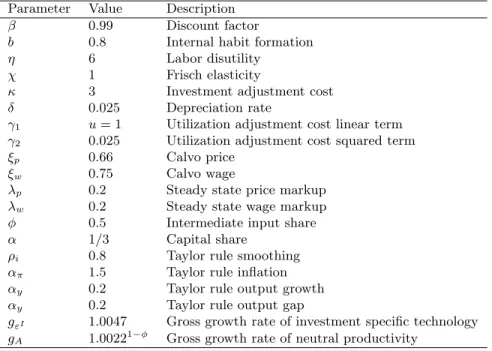
Some parameters are calibrated to their conventional long-run targets in the data, while others are based on the previous literature. The calibration is summarized in Table 1, with the unit of time being a quarter. Some parameter values like = 0.99, b= 0.8, ⌘ = 6, = 1, = 0.025 and
↵= 0.33 are standard in the literature and require no explanation.
Other parameters deserve some explanations. The parameter governing the size of investment adjustment costs is = 3, which is slightly higher than the estimate in Christiano, Eichenbaum, and Evans (2005), but slightly lower than the one in Justiniano, Primiceri, and Tambalotti(2010, 2011). The parameter on the squared term in the utilization adjustment cost is set at 2 = 0.025,
which is somewhat higher than the value chosen by Christiano, Eichenbaum, and Evans (2005), but somewhat lower than the estimate reported by Justiniano, Primiceri, and Tambalotti (2010, 2011).
p and w, representing the steady-state price and wage markups under zero trend inflation, are both set at 0.2 consistent with Rotemberg and Woodford(1997) and Huang and Liu (2002). The Calvo probability of price non-reoptimization ⇠p is 2/3, implying an average waiting time between price changes of 9 months. The Calvo probability of wage non-reoptimization ⇠w is set at 3/4, meaning that nominal wages remain unchanged for a year on average. These values are consistent with the micro evidence on the frequency of price changes in Nakamura and Steinsson (2008) and on wage changes in Barattieri, Basu, and Gottschalk (2014), as well as with the macro estimates inSmets and Wouters (2007).9
Our strategy being to search for the lowest interest rate response to inflation, ↵⇡, consistent with determinacy, the mixed policy rule parameters that must be calibrated are the interest rate smoothing parameter, ⇢r, which is set at 0.8, the coefficient on the output gap, ↵y, set at 0.2, and the coefficient on output growth,↵dy, also set at 0.2. These values are close to U.S. estimates obtained via Bayesian estimation. When using the CG rule with an interest rate smoothing of order two, we borrow the post-1982 contemporaneous policy rule estimates ofCoibion and Gorodnichenko (2011) (see p.356, Table 1) which are ⇢1= 1.12, ⇢2 = 0.18, ↵y = 0.44 and ↵dy = 2.21.
Mapping the model to the data, the trend growth rate of the IST term,g"I, equals the negative of the growth rate of the relative price of investment goods. To measure this in the data, we define investment as expenditures on new durables plus private fixed investment, and consumption as consumer expenditures of nondurables and services. These series are from the BEA and cover the period 1960:I-2007:III, to leave out the financial crisis.10 The relative price of investment is the ratio of the implied price index for investment goods to the price index for consumption goods.
The average growth rate of the relative price from the period 1960:I-2007:III is -0.00472, so that
g"I = 1.0047. Real per capita GDP is computed by subtracting the log civilian non-institutionalized
population from the log-level of real GDP. The average growth rate of the resulting output per capita series over the period is 0.005712, so that gY = 1.005712 or 2.28 percent a year. Given the calibrated growth of IST from the relative price investment data (g"I = 1.0047), we then pick g1A to generate the appropriate average growth rate of output. This implies gA1 = 1.0022 or a measured growth rate of TFP of about 1 percent per year.
The parameter , which measures the share of payments to intermediate inputs in total pro- duction, is set at = 0.5 followingBasu(1995),Dotsey and King(2006) andChristiano, Trabandt, and Walentin(2011).
9The estimates in Smets and Wouters are 0.65 for non-reset prices and 0.73 for non-reset wages.
10SeeAscari, Phaneuf, and Sims(2018) for a detailed description of how these data are constructed.
4 Rules-Based Monetary Policy and the Threat of Indeterminacy
Using the benchmark model laid out in Section 2, this section identifies the conditions leading to determinacy under the mixed policy rule. We find that achieving determinacy calls for large departures from the original Taylor Principle. Then, we identify the main factors driving our indeterminacy results under this type of rule.
4.1 Mixed Taylor Rule
Figure1presents the minimum response of interest rates to inflation required to achieve determinacy in our benchmark model when monetary policy is set in accordance with the mixed policy rule, and this for a level of trend inflation from 0 to 3%. We keep other parameters in the policy rule at their values assigned by our calibration.
Seen through our benchmark model, the basic Taylor Principle breaks down even for an inflation trend of zero, as we find that the lowest↵⇡-value consistent with determinacy is 1.7. This minimum requirement increases to 3.5 with an inflation trend of 2%, and 4.8 with a trend of 3%. These represent large departures from the original Taylor Principle, and are clearly outside the range of estimates found in the literature.
4.2 Factors Driving Indeterminacy Results Under the Mixed Rule
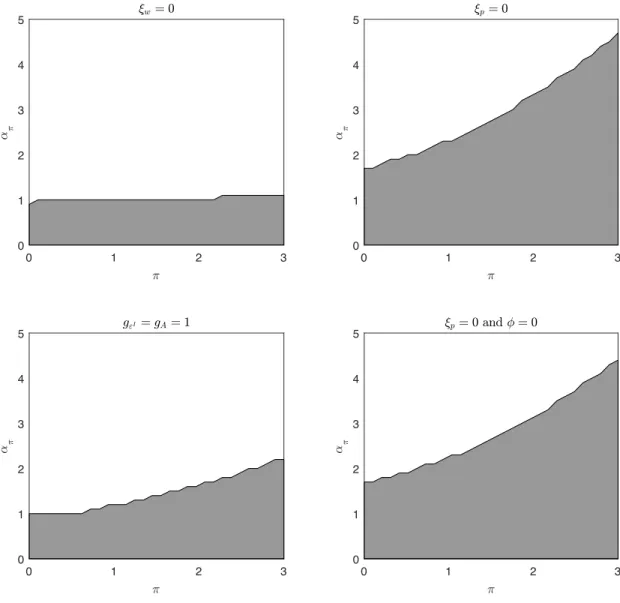
What are the key factors driving our indeterminacy results under the mixed rule? To answer this question, we consider how di↵erent model ingredients impact our results. These findings are presented in Figure 2 where some model features are shut o↵ in order to isolate their impact on determinacy regions. We focus on five di↵erent scenarios.
The first scenario is one where nominal wages are perfectly flexible (⇠w = 0). Should nominal wages be reset every period, the lowest ↵⇡-value consistent with determinacy would shrink to 1, 1.1 and 1.3 for a trend inflation of 0, 2% and 3%, respectively. Therefore, emphasizing sticky-price models to look at determinacy issues can be quite misleading since with 3% trend inflation, the lowest ↵⇡-value consistent with determinacy is nearly 4 times larger with both sticky wages and sticky prices than with sticky prices only.
The second scenario assumes that prices are perfectly flexible (⇠p = 0). Then, the lowest ↵⇡- values consistent with determinacy are only slightly di↵erent from those obtained with sticky wages, sticky prices and economic growth. This suggests that sticky prices are of secondary importance when sticky wages are included in the model.
The third scenario shuts o↵ economic growth from the model (g"I = gA = 1). The impact of economic growth on our determinacy results is also very significant. Without trend growth in neutral and investment-specific technology, ↵⇡ 1 will be consistent with determinacy with zero trend inflation. With 2% trend inflation, ↵⇡ must be at least 1.8 and with 3% inflation trend it must be 2.3 at a minimum.
The fourth scenario assumes flexible nominal wages (⇠w = 0) and no economic growth (g"I = gA= 1). The results are essentially the same as those obtained under the first scenario, so we do not formally report them.
The fifth and final scenario is one where sticky prices and roundabout production are both re- moved from our benchmark model (⇠p= 0 and = 0). The e↵ects on our results are non negligible.
In particular, with 3% trend inflation, the minimum ↵⇡-value consistent with determinacy drops from 5 in our benchmark model to 4.2. This is because the interaction between sticky prices and roundabout production acts as a multiplier of price stickiness as emphasized byBasu(1995), hence increasing the threat of indeterminacy.
5 Alternative Policy Rules
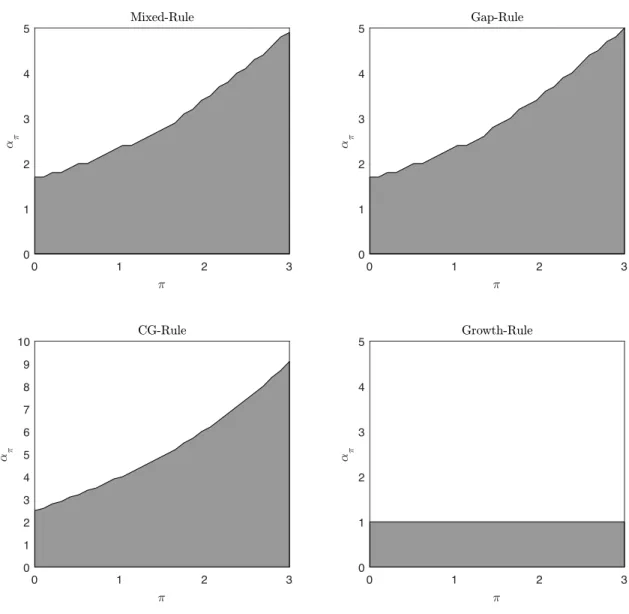
This section uses the model described in Section 2, but looks at the conditions leading to determi- nacy under three alternatives to the mixed rule, namelyi) a policy rule reacting to output gap but not to output growth,ii) the CG rule responding to output gap and output growth with an interest rate smoothing of order two, andiii) a policy rule responding to inflation and output growth but not to output gap. The results are presented in Figure3.
5.1 Policy Rule Reacting to Output Gap
The first thing we examine is whether a policy rule reacting only to the level of the output gap, and not to output growth, helps improving the prospect of determinacy. What is striking is the high similitude of results obtained under this type of rule and under the mixed Taylor rule. The conditions leading to determinacy with the policy rule reacting only to the level of the output gap are the similar to a first-order approximation to those under the mixed rule. This suggests that the indeterminacy results under the mixed policy rule are in a large part driven by the response to the output gap. In other words, the e↵ect of the output gap on the prospect of determinacy is disproportionately large relative to that of output growth.
5.2 CG Policy Rule
The second scenario is the following. We ask how the post-1982 estimates in Coibion and Gorod- nichenko(2011) of a policy rule reacting to the level of the output gap and to output growth would a↵ect our results? Their estimated control parameters are ↵⇡ = 1.58, ↵y = 0.44 and ↵dy = 2.21, while the interest rate smoothing parameters are ⇢1 = 1.12 and ⇢2 = 0.18. Based on these estimates, CG report that the U.S. economy was in a determinate state after 1982.
By contrast, our benchmark model implies an indeterminate state. Therefore, we search for the lowest↵⇡-value consistent with determinacy while keeping other parameters at their estimated values. With zero trend inflation, the lowest ↵⇡-value consistent with determinacy must be equal to 2.6, representing a huge departure from the original Taylor Principle. With a 2% trend inflation, the minimum ↵⇡-value consistent with determinacy rises to 6.1, while with 3% trend inflation, it increases to 9.
The problem in this case is that while the estimate of↵dy reported by CG is much higher than assumed by our baseline calibration (2.21 vs 0.2), the estimate of ↵y is also significantly higher (0.44 vs0.2). These findings confirm once more that responding to the level of the output gap has a disproportionately large influence on the prospect of determinacy.
5.3 Policy Rule Reacting to Output Growth
A final alternative to the mixed policy rule is one where the Fed sets nominal interest rates in reaction to inflation and output growth, but not to the level of the output gap. Adopting this policy rule has a huge impact on the prospect of determinacy. Then, we find that the conditions leading to determinacy are very close to the original Taylor Principle. That is, the lowest↵⇡-values consistent with determinacy are 1.0, 1.1 and 1.1 with levels of trend inflation of 0, 2% and 3%, respectively. These findings convey an overwhelming advantage to this policy rule over policy rules reacting to the output gap in ensuring determinacy.
6 Sensitivity of Results to Indexation and Taylor Contracts
6.1 Indexation
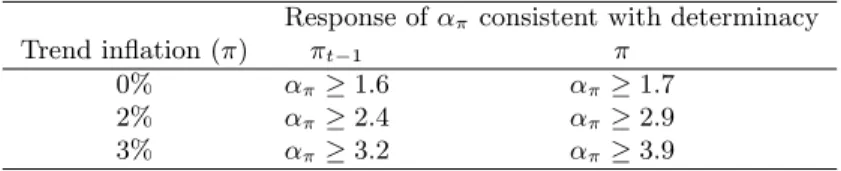
This subsection assesses the sensitivity of our results to indexing nominal wages and prices to infla- tion. Although we have provided compelling reasons for abstracting from the quarterly indexation of non-reoptimized wages and prices to inflation in our benchmark model, we now ask whether par- tial indexation can overcome our main results? We consider a 25% indexation of non-reset prices and wages to the previous quarter’s rate of inflation or to steady-state inflation. We do this for the mixed and CG rules and for a level of trend inflation of 3%.
When looking at the impact of price indexation assuming zero wage indexation, we find that price indexation essentially has no impact on our determinacy results, and this whether non-reset prices are indexed to past or steady-state inflation. Therefore, we do not formally report these results.
Panel A of Table 2 reports the results for the case of the mixed rule when nominal wages are partially indexed to the previous quarter’s rate of inflation (backward wage indexation) or to the steady state inflation. We find that the lowest ↵⇡-value consistent with determinacy at 3% trend inflation is 3.2. If wages are instead partially indexed to steady-state inflation, we find that the minimum↵⇡ required for determinacy at 3% trend inflation is 3.9.
Looking at Panel B of Table 2, we find that the lowest ↵⇡-values consistent with determinacy at 3% trend inflation under the CG rule and backward wage indexation is 5.5. The corresponding number for indexation to steady state inflation is 6.9.
Given the importance of this parameter for our results, it is helpful to consider empirical evi- dence on wage indexation. Using U.S. micro data relating to wage-setting, Barattieri, Basu, and Gottschalk (2014) report that the probability of a quarterly wage change for any reason lies be- tween 20 and 25 percent. While they are unable to distinguish between re-optimized wages and
wages mechanically adjusted due to indexation, their estimated hazard rate is not consistent with indexation being important. Rabanal and Rubio-Ram´ırez(2005) estimate a MSNK model in which non-reset wages are indexed to the previous quarter’s rate of inflation. They report a coefficient of wage indexation of 0.25 for the period 1960:I to 2001:IV.11 Therefore, we conclude that our main finding continues to hold for plausible degrees of wage indexation.
6.2 Taylor Contracts
It is believed that Taylor-contracts generate smaller steady-state distortions than Calvo-contracts.
For instance, evidence in Ascari(2004) suggests that the steady-state output losses resulting from positive trend inflation are much smaller under Taylor-contracts than Calvo-contracts. Coibion and Gorodnichenko (2011) find that determinacy is more easily achieved under Taylor-contracts than Calvo-contracts. Both papers utilize a NK model with sticky prices only.
What would be the impact on the prospect of determinacy of embedding Taylor-contracts in our expanded MSNK model? Before formally answering this question, we need to briefly discuss what is the appropriate basis of comparison between Taylor and Calvo models.
Here, we refer to works by Dixon and Kara(2006) andde Walque, Smets, and Wouters (2006), which emphasize that a proper comparison of the degree of price stickiness, and of the degree of wage stickiness in the context of our MSNK model, should be based on the average age of running wage and price contracts, rather than on the average frequency of nominal wage and price changes.
These authors show that in order to produce the same average contract ages as those implied by the Calvo parameters⇠p and⇠w, the Taylor-contract length needs to be 1+⇠1 ⇠pp periods for prices and
1+⇠w
1 ⇠w periods for nominal wages. With⇠p= 2/3 and⇠w = 3/4, this translates into a Taylor-contract length of 5 periods for prices and 7 periods for nominal wages. (A full set of equilibrium conditions can be found in Appendix B). Table3reports the results of the following experiments. Panel A of the table presents the lowest↵⇡-values consistent with determinacy under our baseline calibration of the mixed policy rule. This time, however, we consider trend inflation ranging from 0 to 4%.12 Note that with Taylor-contracts, the minimum value of ↵⇡ at zero trend inflation required to be consistent with determinacy deviates from the original Taylor Principle at 1.2, and that this value rises to 1.7 with 4% trend inflation. These are smaller, yet non-negligible deviations from the Taylor Principle. Note however that Bayesian estimates of the responses of interest rates to the output gap are generally lower than those obtained with alternative estimation methods.
For instance, Panel B reports results corresponding to the CG rule where ↵y = 0.44. In that case, the minimum requirements on↵⇡ to ensure determinacy are even higher at 1.4 for zero trend inflation and 2.3 with 4% trend inflation. Panel C considers setting the coefficient on the output gap at 0.5 followingTaylor(1999)). There, the↵⇡ consistent with determinacy ranges from 1.5 for zero trend inflation to 2.7 with 4% trend inflation.
11Rabanal and Rubio-Ram´ırez(2008) obtain a similar result using data for the Euro area.
12We did not have to do that with Calvo-contracts since departure from the original Taylor Principle was already high at 3% trend inflation.
We report the results of one final exercise. In a seminal paper,Clarida, Gali, and Gertler(2000) provide a wider range of estimates of the response of interest rates to the output gap conditioned on di↵erent sample periods, alternative measures of inflation, etc. They often report coefficients on the output gap which are quite high, and which sometimes exceed one. Panel D of the table, looks at the threat of indeterminacy that would pose setting↵y = 0.8, which is in the admissible range of values reported by Clarida, Gali, and Gertler(2000). In this case, achieving determinacy would require↵⇡ = 1.7 for zero trend inflation and↵⇡ = 3.8 with 4% trend inflation.
While Calvo-contracts clearly imply stronger steady-state distortions than Taylor-contracts, the threat to determinacy under Taylor-contracts remains, especially in light of the uncertainty surrounding estimates of the policy responses to the output gap in the broad literature. Since there is some uncertainty surrounding estimates of the coefficient on the output gap in the literature, we have considered di↵erent possibilities in section 6.2. Two conclusions emerge from the Taylor- contracts analysis. First, the threat of indeterminacy increases as policy response to the output gap rises, for a given trend inflation. Second, the threat of indeterminacy increases as trend inflation increases, for a given response to the output gap, which is consistent with the main message of our paper.
Meanwhile, the conditions leading to determinacy under a policy rule responding to output growth but not to output gap are basically the same under Taylor and Calvo contracts, so we do not explicitly report the results under Taylor-contracts.
7 Conclusion
A main point we have tried to make is that any explorations into what the average optimal rate of inflation is or by how much the inflation target can be raised, should not be done independently of the monetary policy rule. Should the Fed return to more conventional rules-based policies, we have shown that under a speed limit rule responding to output growth a higher inflation target would be admissible without the threat of indeterminacy. But if it followed a conventional output-gap based rule, then a higher inflation target could pose a threat to macroeconomic stability even faced with low inflation. Prior to our work, the answer was that a low level of inflation should never represent a threat to determinacy insofar as the Fed adopts a “hawkish” stand in the fight against inflation.
Given these findings, three questions may come to mind. A first question is: Why have these results been overlooked by the literature? The most obvious reason is that the literature on deter- minacy has mainly focused on the so-called “workhorse” New Keynesian model with sticky prices only. Another reason is that in MSNK models, non-reset nominal wages and prices are automat- ically indexed to inflation in a way that neutralizes the impact of positive trend inflation on the prospect of indeterminacy.
A second question is: Knowing that inflation has averaged nearly 4% during the postwar period and about 2% after 1990, would it be possible that the U.S. economy was always in a state of determinacy or indeterminacy during the postwar period? Under an output-gap based rule, the answer would be that economy was always in an indeterminate state throughout the postwar period,
something we find hard to believe. Thus, it is more likely that the Fed has followed a policy rule reacting to output growth but not to output gap, with the possibility that the economy has always experienced a determinate state during the postwar period.
A third question is: If the economy was always in a determinate state during the postwar period with the Fed adopting a policy responding to output growth, what explains the greater macroeconomic stability during the Great Moderation, since escaping self-fulfilling expectations would not be the explanation anymore? Answering this question would require estimating a MSNK model like the one we have proposed with the Fed conducting a policy rule with a response to output growth and no indexation of wages and prices.
References
Amano, Robert, Kevin Moran, Stephen Murchison, and Andrew Rennison. 2009. “Trend Inflation, Wage and Price Rigidities, and Productivity Growth.” Journal of Monetary Economics 56:353–
364.
Ascari, Guido. 2004. “Staggered Prices and Trend Inflation: Some Nuisances.” Review of Economic Dynamics 7:642–667.
Ascari, Guido, Louis Phaneuf, and Eric Sims. 2018. “On the Welfare and Cyclical Implications of Moderate Trend Inflation.” Journal of Monetary Economics 99:115–134.
Ball, Laurence. 2013. “The Case for Four Percent Inflation.” Central Bank Review 13 (2):17–31.
Research and Monetary Policy Department, Central Bank of the Republic of Turkey.
Barattieri, Alessandro, Susanto Basu, and Peter Gottschalk. 2014. “Some Evidence on the Impor- tance of Sticky Wages.” American Economic Journal: Macroeconomics 6(1):70–101.
Basu, Susanto. 1995. “Intermediate Goods and Business Cycles: Implications for Productivity and Welfare.” American Economic Review 85(3):512–531.
Bils, Mark and Peter J. Klenow. 2004. “Some Evidence on the Importance of Sticky Prices.”
Journal of Political Economy 112(5):947–985.
Blanchard, Olivier, Giovanni Dell’Ariccia, and Paolo Mauro. 2010. “Rethinking Macroeconomic Policy.” Journal of Money, Credit, and Banking 42(s1):199–215.
Calomiris, Charles W., Peter Ireland, and Mickey Levy. 2015. “A More E↵ective Strategy for the Fed.” Tech. rep.
Calvo, Guillermo. 1983. “Staggered prices in a utility-maximizing framework.”Journal of Monetary Economics 12 (3):383–398.
Chari, V. V., Patrick J. Kehoe, and Ellen R. McGrattan. 2009. “New Keynesian Models: Not Yet Useful for Policy Analysis.” American Economic Journal: Macroeconomics 1(1):242–266.
Christiano, Lawrence J., Martin Eichenbaum, and Charles L. Evans. 2005. “Nominal Rigidities and the Dynamic E↵ects of a Shock to Monetary Policy.” Journal of Political Economy 113 (1):1–45.
Christiano, Lawrence J., Martin S. Eichenbaum, and Mathias Trabandt. 2016. “Unemployment and Business Cycles.” Econometrica 84 (4):1523–1569.
Christiano, Lawrence J., Mathias Trabandt, and Karl Walentin. 2011. “DSGE Models for Monetary Policy Analysis.” In Handbook of Monetary Economics, chap. 7, Volume 3. San Diego CA, 285–
367.
Clarida, Richard, Jordi Gali, and Mark Gertler. 2000. “Monetary Policy Rules and Macroeconomic Stability: Evidence and Some Theory.” The Quarterly journal of economics 115 (1):147–180.
Cochrane, John. 2017. “The optimal inflation rate.” The Grumpy Economist .
Cogley, Timothy and Argia M. Sbordone. 2008. “Trend Inflation, Indexation and Inflation Persis- tence in the New Keynesian Phillips Curve.” American Economic Review 98 (5):2101–2126.
Coibion, Olivier and Yuriy Gorodnichenko. 2011. “Monetary Policy, Trend Inflation and the Great Moderation: An Alternative Interpretation.” American Economic Review 101 (1):341–370.
Coibion, Olivier, Yuriy Gorodnichenko, and Johannes F. Wieland. 2012. “The Optimal Inflation Rate in New Keynesian Models: Should Central Banks Raise their Inflation Targets in Light of the ZLB?” The Review of Economic Studies 79:1371–1406.
de Walque, Gregory, Frank Smets, and Rafael Wouters. 2006. “Firm-Specific Production Factors in a DSGE Model with Taylor Price Setting.” International Journal of Central Banking 2:107–154.
Debortoli, Davide, Jordi Gal´ı, and Luca Gambetti. 2018. “On the Empirical (Ir)Relevance of the Zero Lower Bound Constraint.” Working Paper 1013, Barcelona GSE.
Diercks, Anthony M. 2017. “The Reader’s Guide to Optimal Monetary Policy.” Federal Reserve Board, Monetary and Financial Market Analysis June 19.
Dixon, Huw and Engin Kara. 2006. “How to Compare Taylor and Calvo Contracts: A Comment on Michael Kiley.” Journal of Money, Credit and Banking :1119–1126.
Dotsey, Michael and Robert G. King. 2006. “Pricing, Production, and Persistence.” Journal of the European Economic Association 4 (5):893–928.
Eichenbaum, Martin, Nir Jaimovich, and Sergio Rebelo. 2011. “Reference Prices, Costs, and Nom- inal Rigidities.” The American Economic Review 101 (1):234–262.
Erceg, Christopher J., Dale W. Henderson, and Andrew T. Levin. 2000. “Optimal Monetary Policy with Staggered Wage and Price Contracts.” Journal of Monetary Economics 46:281–313.
Evans, Charles L. 2012. “Monetary Policy in a Low-Inflation Environment: Developing a State- Contingent Price-Level Target.” Journal of Money, Credit and Banking 44:147–155.
Gal´ı, Jordi. 2008. Monetary Policy, Inflation, and the Business Cycle: An Introduction to the New Keynesian Framework. Princeton University Press.
Huang, Kevin X.D. and Zheng Liu. 2002. “Staggered Contracts and Business Cycle Persistence.”
Journal of Monetary Economics 49:405–433.
Ireland, Peter and Mickey Levy. 2017. “A Strategy for Normalizing Monetary Policy.” Shadow open market committee meeting, E21 Manhattan Institute.
Justiniano, A. and Giorgio Primiceri. 2008. “The Time Varying Volatility of Macroeconomic Fluc- tuations.” American Economic Review 98 (3):604–641.
Justiniano, Alejandro, Giorgio Primiceri, and Andrea Tambalotti. 2010. “Investment Shocks and Business Cycles.” Journal of Monetary Economics 57(2):132–145.
———. 2011. “Investment Shocks and the Relative Price of Investment.” Review of Economic Dynamics 14(1):101–121.
Khan, Hashmat and John Tsoukalas. 2011. “Investment Shocks and the Comovement Problem.”
Journal of Economic Dynamics and Control 35 (1):115–130.
———. 2012. “The Quantitative Importance of News Shocks in Estimated DSGE Models.” Journal of Money, Credit and Banking 44 (8):1535–1561.
Krugman, Paul. 2014. “Inflation Targets Reconsidered.” Draft paper for ECB Sintra Conference.
Nakamura, Emi and Jon Steinsson. 2008. “Five Facts About Prices: A Reevaluation of Menu Cost Models.” Quarterly Journal of Economics 123 (4):1415–1464.
Phaneuf, Louis and Jean Gardy Victor. 2018. “Long-Run Inflation and the Distorting E↵ects of Sticky Wages and Technical Change.” Journal of Money, Credit and Banking. 51 (1):5–42.
Rabanal, Pau and Juan F Rubio-Ram´ırez. 2005. “Comparing New Keynesian Models of the Business Cycle: A Bayesian Approach.” Journal of Monetary Economics 52 (6):1151–1166.
———. 2008. “Comparing New Keynesian Models in the Euro Area: a Bayesian Approach.”
Spanish Economic Review 10 (1):23–40.
Rotemberg, Julio J. and Michael Woodford. 1997. “An Optimization-Based Econometric Frame- work for the Evaluation of Monetary Policy.” InNBER Macroeconomics Annual 1997, edited by Julio J. Rotemberg and B. S. Bernanke. Cambridge, MA, The MIT Press, 297–346.
Sims, Eric. 2013. “Growth or the Gap? Which Measure of Economic Activity Should be Targeted in Interest Rate Rules?” Mimeograph, University of Notre Dame.
Smets, Frank and Raf Wouters. 2007. “Shocks and Frictions in US Business Cycles: A Bayesian DSGE Approach.” American Economic Review 97 (3):586–606.
Sveen, Tommy and Lutz Weinke. 2007. “Firm-Specific Capital, Nominal Rigidities, and the Taylor Principle.” Journal of Economic Theory 136(1):729–737.
Taylor, John. 1980. “Aggregate Dynamics and Staggered Contracts.” Journal of Political Economy 88 (1):1–23.
Taylor, John B. 1999. “A Historical Analysis of Monetary Policy Rules.” InMonetary Policy Rules.
319–348.
Taylor, John B. 2015. “Getting Monetary Policy Back on Track.” InGetting Back to a Rules-Based Monetary Strategy. Shadow Open Market Committee Princeton Club New York City.
Volcker, Paul. 2014. “Remarks.” Tech. rep., Bretton Woods Committee Annual Meeting.
Walsh, Carl. 2003. “Speed Limit Policies: the Output Gap and Optimal Monetary Policy.” Amer- ican Economic Review 93(1):265–278.
Woodford, Michael. 2007. “Interpreting Inflation Persistence: Comments on the Conference ‘Quan- titative Evidence on Price Determination’.” Journal of Money, Credit, and Banking 39(2):203–
210.
Wu, Jing Cynthia and Fan Dora Xia. 2016. “Measuring the Macroeconomic Impact of Monetary Policy at the Zero Lower Bound.” Journal of Money, Credit and Banking 48 (2-3):253–291.
Wu, Jing Cynthia and Ji Zhang. 2017. “A Shadow Rate New Keynesian Model.” Tech. Rep. 16-18, Chicago Booth Research Paper.
A Set of Equilibrium Conditions for the Benchmark Model
This appendix lists the full set of equilibrium conditions for the benchmark model. These conditions are expressed in stationary transformations of variables, e.g. Xet= X⌥tt for most variables.
ert = 1
Cet hgY1Cet 1 Et h
gYCet+1 hCet (A1) e
rtk= 1+ 2(ut 1) (A2)
ert =µet 0
@1 k 2
Iet Iet 1
gY gY
!2
Iet Iet 1
gY gY
! Iet Iet 1
gY 1
A+ EtgY1µet+1 Iet+1 Iet
gY gY
! Iet+1 Iet
gY
!2
(A3)
gYg"Iµet= Etert+1⇣ e
rt+1k ut+1 ⇣
1(ut+1 1) + 2
2(ut+1 1)2⌘⌘
+ (1 )Etµet+1 (A4)
ert = EtgY1Rt⇡t+11 ert+1 (A5)
e wt⇤=
1 e w1,t
e
w2,t (A6)
e w1,t=⌘
✓wet e w⇤t
◆ (1+ )
L1+t + ⇠wEt⇡t+1(1+ )
✓we⇤t+1 e w⇤t
◆ (1+ )
gY(1+ )we1,t+1 (A7) e
w2,t=ert✓ e wt
e w⇤t
◆
Lt+ ⇠wEt⇡t+11
✓we⇤t+1 e w⇤t
◆
gY 1we2,t+1 (A8)
Kebt=g"IgY↵(1 )mct
e rtk
⇣
vtpXet+F⌘
(A9) Lt= (1 ↵)(1 )mct
e wt
⇣vtpXet+F⌘
(A10) et= mct⇣
vptXet+F⌘
(A11)
p⇤t = ✓
✓ 1 p1,t
p2,t (A12)
p1,t =ertmctYet+⇠p ⇡✓t+1p1,t+1 (A13) p2,t=ertYet+⇠p ⇡t+1✓ 1p2,t+1 (A14)