This is a true copy of the thesis, including any necessary final revisions, as accepted by my examiners. The work consists of an optimization algorithm for households to maximize the utilization of DER as the lower level of the envisaged two-level optimization technique, while an adapted game-theoretic optimization is used to optimize the turnover of utility providers for residential neighborhoods as the upper level.
- OVERVIEW
- OUTCOME
- CONTRIBUTIONS
- OUTLINE
The use of DER is receiving increasing attention because renewable energy (RE) plays an important role in the sustainability of the system. The final chapter, Chapter 9, presents the conclusions of the work and suggestions for future work in this area.
- OVERVIEW
- PROBLEM FORMULATION
- RESEARCH OBJECTIVES
- RESEARCH METHODOLOGY
- PROJECT DELIVERABLES
Effective and efficient use of DERs based on their availability, grid status and price signal, internal building demand and external condition. Derivation of objective functions based on requirements and assumptions taking into account the appropriate constraints for residential level.
SMART GRID
- FEATURES
- SUB-SYSTEMS
To fully utilize this capacity, the SG must be able to incorporate existing or new services under development to meet technical and managerial needs. This system must be able to meet the needs of the management layer in real time by analyzing the data from the end nodes and incorporating the necessary algorithms to determine the best scenario for fast and effective response.
![Fig. 3.1: Smart Grid sub-system sequence overview [11]](https://thumb-us.123doks.com/thumbv2/9docorg/12436385.0/39.918.296.605.127.833/fig-smart-grid-sub-system-sequence-overview-11.webp)
ADVANCED METERING INFRASTRUCTURE
- INTRODUCTION
- SUB-SYSTEMS
- SMART DEVICES
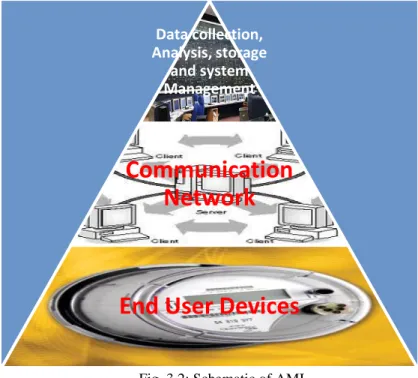
- COMMUNICATION
- DATA MANAGEMENT SYSTEM
AMI is not limited to electrical networks; Water and gas distribution networks are also part of ISHM. Quantitative measurement: the meter must be able to accurately measure the amount of the medium.

SUMMARY
- INTODUCTION
- DSM BACKGROUND, OBJECTIVES AND BOTTLENECKS
- DSM DEPLOYMENT
- DSM TECHNIQUES
- DSM APPROACHES AND IMPLEMENTATION
- DSM STRATEGIES
- DISTRIBUTION SYSTEM AUTOMATION (DSA)
- CONCLUSION
Although these programs are implemented on the end-user side, they all require a deliberate intervention in the market by the electricity provider to change the configuration or size of the load shape. The implementation phase will execute the program for specific end-use applications, promote the program to the target audience through marketing approaches such as advertisements, bills and posts, and focus group meetings as in the case of the industrial sector. As outlined in step 2 in section 4.3.2, based on the results of the load research in the supply, load form measures must be selected for the current situation.
![Fig. 4.2: Simplified form of load shape changes [24]](https://thumb-us.123doks.com/thumbv2/9docorg/12436385.0/62.918.131.784.340.686/fig-4-simplified-form-load-shape-changes-24.webp)
OVERVIEW
As a result of such a scheme, the metered load signature hides the actual load consumption in itself. The measured load signature in this case shows a softer signature compared to the actual device signature. Therefore, it will not be possible to find out which period coincides with the current operating time of the device.
DESCRIPTION OF THE IDEA
The advantages of the proposed idea are not limited to energy saving and cost optimization. The proposed idea will increase the security of data collection networks, especially AMI, by increasing the privacy of consumer data by moderating the upload signature. Thus, security is another functionality of the proposed system and protection of consumer data was another motivation for this work.
CONCLUSION
Canada accounts for 2.8% of the global smart building market, which translates to roughly $10 billion. Since the system effectively uses DER to meet the energy needs of consumers, manufacturers of solar panels or electric cars and all other companies involved in this sector can be part of the market covered by this system. The movement of occupants in the building and the operation of the system will not affect each other.
INTRODUCTION
This level of optimization will then be combined with optimization at higher levels of supply-demand cycle, namely at the community level (or substation level), later in this work to provide a unique solution to the demand-supply management problem defined as the primary objective of this work. By successfully implementing this approach, the utilization of DER will be maximized at the household level, the pressure on the grid will be reduced during peak periods, DSM implementation will be guaranteed, and the complexity of controlling centralized DER resources in SGs will be relieved.
PROBLEM FORMULATION
- PROBLEM DEFINITION
- WORKING SCENARIO
- MATHEMATICAL REPRESENTATION
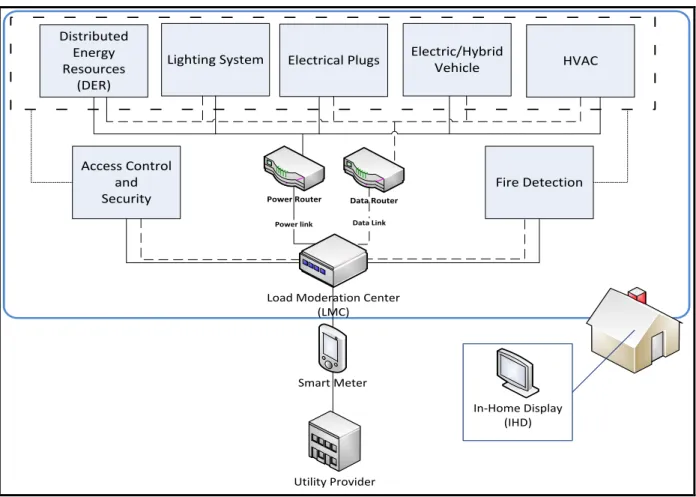
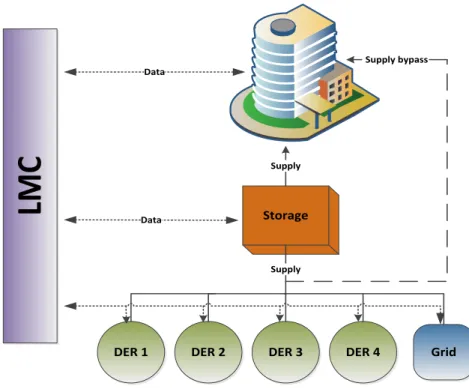
After the household demand is calculated and the market price is retrieved from the AMI, the inventory level will be communicated to the LMC, after which the optimization process is initiated. If demand exceeds the DER production rate, the storage and then the grid will contribute. This is in line with the consumer's intention to buy more power from the grid when the price is low for extra consumption or to charge the extra capacity of the storage.
OPTIMIZATION METHODS AND SIMULATION CASES
- MATHEMATICAL ANALYSIS OF THE EQUATION
- OPTIMIZATION METHODS
- GENETIC ALGORITHM
- FMINCON
- SIMULATED ANNEALING
- SIMULATION CASES
In our case, it is possible to use the Fmincon method and the negative of the objective function in Eq. To further simplify the cases, the maximum storage capacity is considered to be 100 units (KWh) to correspond to the threshold levels of 20%. The LMC must maintain the storage level at greater than or equal to 20% of the maximum capacity, so an additional 20 units must be added to the total demand.
SIMULATION RESULTS AND COMPARISON
- SIMULATION RESULTS
- COMPARABLE WORKS IN THE LITERATURE
- COMPARATIVE ANALYSIS
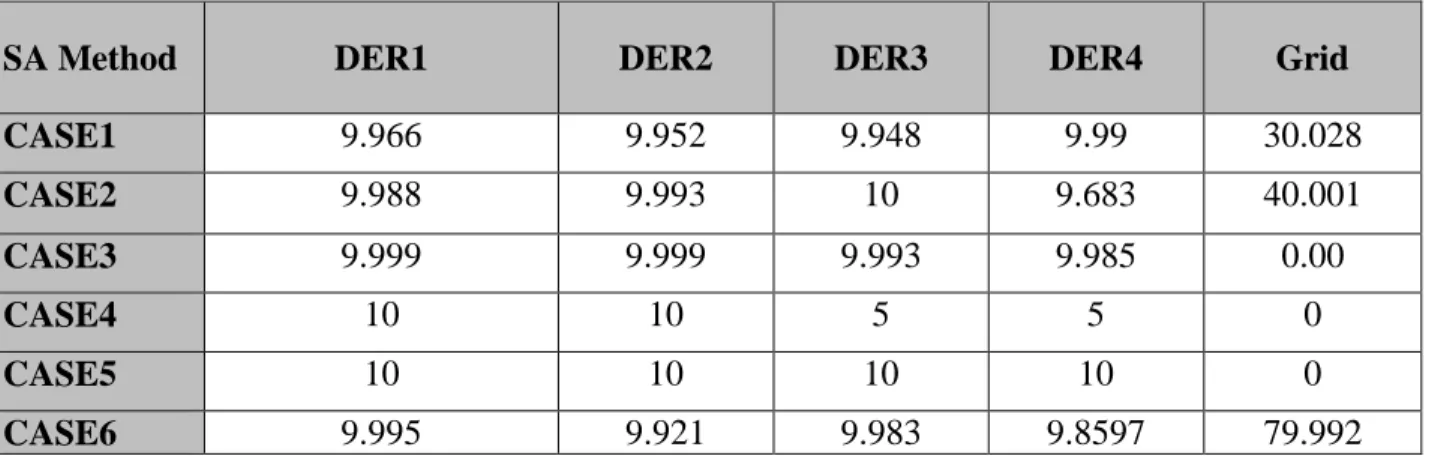
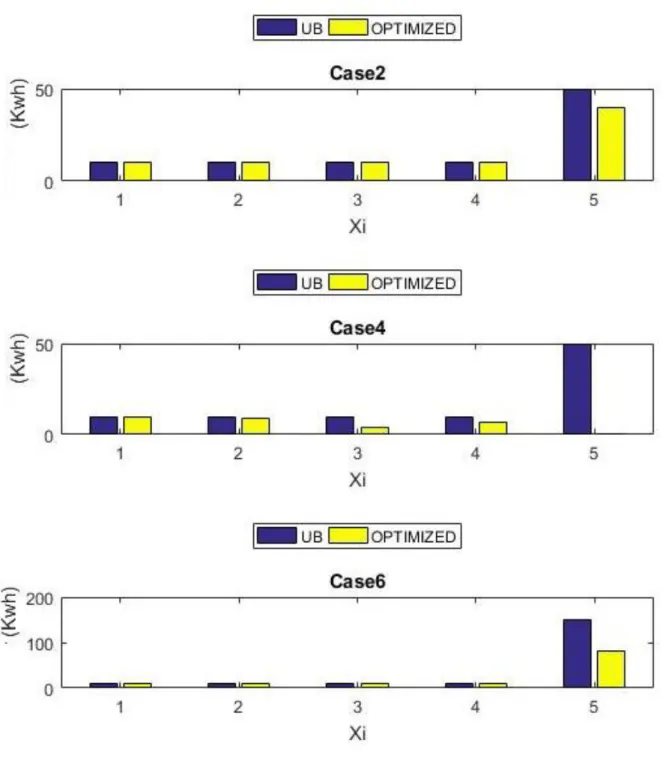
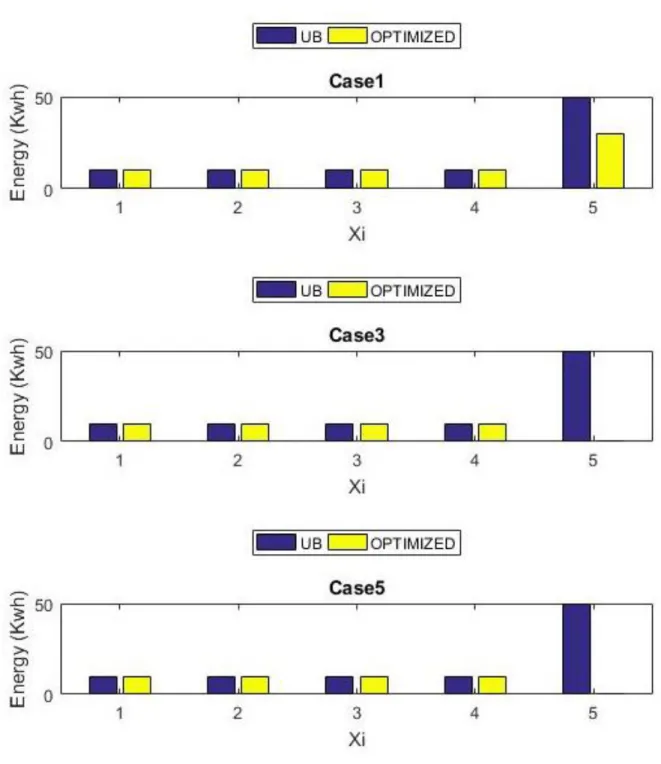
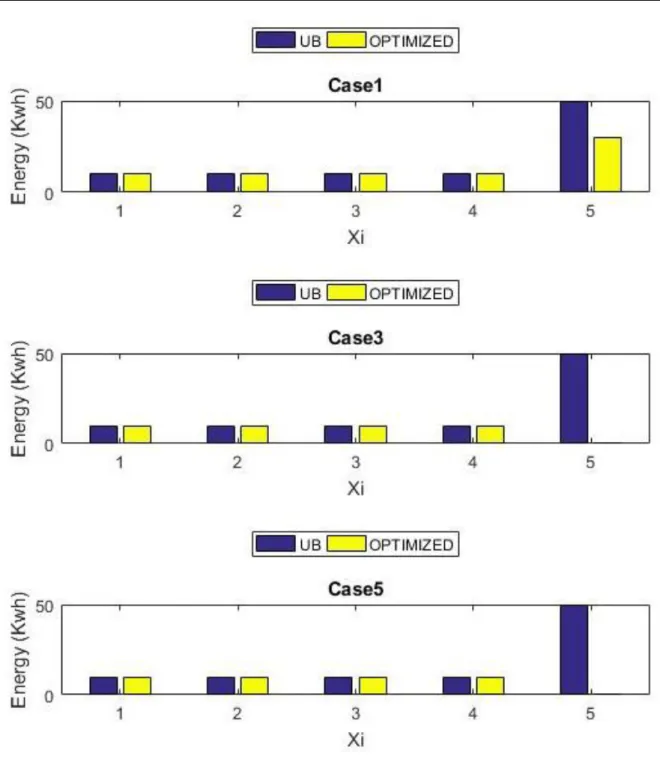
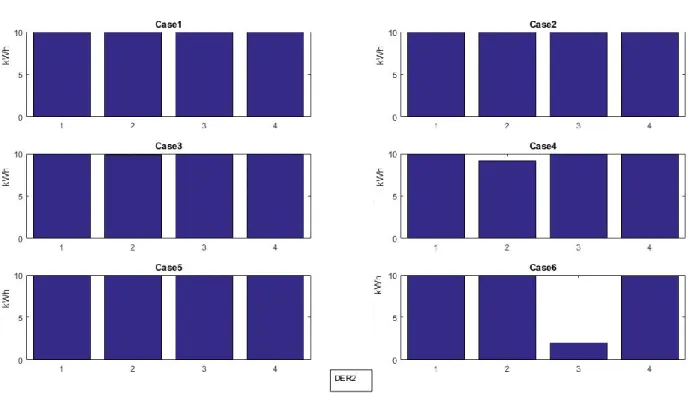
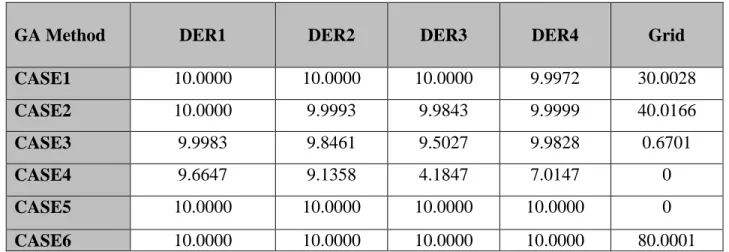
Our proposed scheme uses a storage strategically in conjunction with DER and grid to optimize the cost by optimizing the contribution of grid in the overall supply of the residential loads. In the next stage, the results for a single DER, for all 6 cases, obtained from GA, Fmincon and SA methods were compared with each other for a better understanding of the methods' suitability. In these images, column 1 in the X-axis represents the upper bound while columns 2, 3, and 4 represent the results obtained with GA, Fmincon, and SA methods, respectively.
CONCLUSION
The comparative study of the results presented in 6.4.3 reveals that GA and SA are better methods in terms of the accuracy of the results. Based on the results of this study, there is a trade-off between solution quality and execution time for both methods. Similar to Section 6.4.3, Figures 6.13 to 6.16 provide a comparative overview of cases using each of the GA and SA methods.

INTRODUCTION
In the conventional electricity market, a monopoly system was widespread among the utility companies and customers. 38] introduced an innovative approach to market structure remodeling combined with the advances in SG. The effects of the parameterized supply function model are also investigated in the work.
PROBLEM FORMULATION
- MATHEMATICAL REPRESENTATION
- THE GAME
The players in the game in the set scenario are the neighborhood and the grid. In order to maintain the stability of the distribution system and network and to avoid instantaneous changes in demand and supply, the auctions will take place one slot before the slot in which the trade will take place, i.e. determined by the auction held at (x-1) place. Let the grid set the price P1 for Q1 units of delivered electricity in the next time period.
SIMULATION CASES AND RESULTS
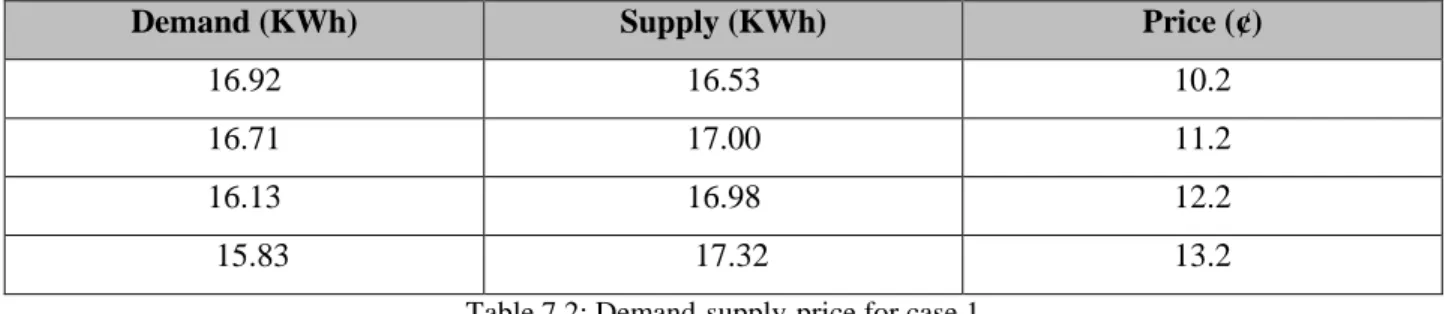
Since the buyer's claim has not been met, the buyer continues to request the new claim of 16.71 units. Similar to the process presented for Case 1, the equilibrium points for Case 2 are calculated to be 17.39 KWh and ¢ 15.08. The equilibrium points for peak load periods in a residential community in winter are calculated to be 20.64 KWh and ¢ 17.87.
ANALYSIS OF THE RESULTS
The majority of the works on auction strategy like double auction as the most widely used approach. 44] use a non-cooperative game and double auction for decision-making processes in a case where a number of plug-in hybrid electric vehicle groups seek to sell part of their stored energy in an electricity market. 46] is the work similar to our proposed solution, which provides a dual-auction mechanism for the allocation and pricing of energy resources that especially takes into account the specific requirements of energy producers and consumers.
CONCLUSION
Excessive cost reduction, on the other hand, can cause a drastic reduction in the seller's service function and result in lost revenue due to higher production costs. The buyer has the advantage of participating in the price planning process and in return adjusting its demand to meet the seller's generation constraints. For a system to be efficient, the time required to calculate this point must be much shorter than its duration.
OVERVIEW
Vertical integration refers to integration based on the functionality of subsystems where the subsystems are not at the same stage or level in that specific process; but they come together to realize a common goal. In horizontal integration, the goal is to improve the entire process by expanding the functionality of subsystems at the same level. Based on the explanation given, the integration used in this work is closer in meaning to vertical integration.

INTEGRATION RESULTS
Similar to the previous cases, the optimization process is independent of the units. The storage is considered to have a maximum capacity of 100KWh and its minimum should be kept at 20KWh (20%) at all times. If the DER generation is less than the demand, storage will begin. These conclusions are evident in Table 8.1, where the grid utilization has been limited to 5 time slots and the storage level remained at 76.5 KWh at the end of the day compared to its 20KWh at the beginning of the day.

CONCLUSION
It is also evident that due to the shortfall in DER generation and reduced grid capacity, the storage level has remained more or less at a minimum during the day.
CONCLUSIONS
Incorporating GTO, which is an optimization technique designed for demand and supply in different markets, will improve the precision of the optimization process at the community level. Consideration of practical constraints in electricity generation and transmission as well as storage systems that affect the implementation of the necessary actions derived from the proposed decision-making process. Examples include limiting the size of the storage system, rapid changes in bringing generators on or off-line, etc.
FUTURE WORKS
10] SAIC Smart Grid Team for the Energy Policy Initiatives Center, University of San Diego School of Law, “San Diego Smart Grid Study Final Report,” 2006. Available at: http://www.forbes.com/sites/reuvenkohen is -cloud-computing- really-cheaper, accessed September 2014. Available at: http://www.cisco.com/web/about/ac79/docs/innov/IoE_Economy.pdf, Accessed January 2014.