Otras secciones de este sitio:
☞ ☞ ☞ ☞
☞ Índice de este número
☞ ☞ ☞ ☞
☞ Más revistas
☞ ☞ ☞ ☞
☞ Búsqueda
Others sections in this web site:
☞ ☞ ☞ ☞
☞ Contents of this number ☞
☞ ☞ ☞
☞ More journals ☞
☞ ☞ ☞ ☞ Search Artículo:
Bacterial infections associated with hepatic encephalopathy: Prevalence and outcome
Copyright © 2003: Mexican Association of Hepatology
ANNALS OF HEPATOLOGY
Number 1 January-March 2003
Volume 2
E Strauss et al. Bacterial infections in severe liver disease 41
edigraphic.com
Original ArticleBacterial infections associated with
hepatic encephalopathy: Prevalence and outcome
Edna Strauss M.D.,1 Maria de Fátima Gomes de Sá Ribeiro M.D.1 Annals
of Hepatology
Abstract
Hepatic encephalopathy (HE) is a major sign of severe liver disease and the impact of associated bacterial in-fectious should be better evaluated. A retrospective cohort of 333 patients with cirrhosis and HE was ana-lyzed in three periods of time, from 1984 to 1998. Variance analysis, Wilcoxon, Chi-square and Fisher’s exact tests were used for statistical comparisons. Prev-alence of bacterial infections decreased along the time (p = 0.0029). Spontaneous Bacterial Peritonitis -SBP-(37%) and urinary tract infection (30%) were the more frequent types of bacterial infections. Early death was significantly higher in HE with infection (46,47%) and the calculated RR was 2.047. Prognosis was worse in septicemia (79%) and respiratory tract infection (50%) and better in urinary tract infection (27%). SBP lethality was reduced from 70% to 38% (p = 0.062). In conclusion, lower prevalence of bacteri-al infections, in severe liver disease, was achieved in the last decade, but short-term prognosis remains bad, varying according to the type of bacterial infection.
Key words: Cirrhosis, hepatic encephalopathy, spon-taneous bacterial peritonitis, urinary tract infection, prevalence of infections, lethality.
Introduction
Bacterial infection in cirrhosis often leads to hospital admissions and high mortality rates. Besides that, infec-tions in patients with liver disease have a different clinical
1Clinic of Gastroenterology, Heliópolis Hospital; School of Medicine
– University of São Paulo, Brazil.
Address for correspondence: Prof. Dra. Edna Strauss Divisão de Anatomia Patológica
Av. Dr. Enéas de Carvalho Aguiar, 155 - 10o. andar CEP: 05403-000 – São Paulo – Brazil
Tel.: 55-11-3085-2547 Fax: 55-11-3082-4923
E-mail: [email protected]
presentation, with few or no symptoms, requiring an ac-tive search, specially for spontaneous bacterial peritonitis and urinary tract infections.1,2 On the other hand, hepatic
encephalopathy (HE) a frequent and severe complication of cirrhosis, can be even more worrisome when associat-ed with bacterial infections. Survival of cirrhotic patients with HE has been investigated, confirming bacterial in-fections as a main cause of death, although types of infec-tion and their relainfec-tions to lethality have not been submit-ted to a thorough analysis.3
The pathogenesis of infections in cirrhosis is mainly related to the altered host defenses, including: decreased function of macrophages, neutrophils, monocytes and disturbed phagocytosis with less destruction of bacteriae. Both humoral and cellular immunity are usually altered, associated with impaired motility of the small intestines and bacterial overgrowth.4-6 Extrinsic factors such as
al-coholism, malnutrition, gastro-intestinal hemorrhage, in-vasive diagnostic/therapeutic procedures and altered per-meability of intestinal mucosa, also predispose to bacteri-al infections.7,8
During the last two decades we have published a series of papers dealing with both bacterial infections1,9 and the
treatment of Hepatic Encephalopathy,10,11 which enables
us to re-visit these data, collected within very strict meth-odological criteria. The main objective was to analyze in severe liver disease, namely cirrhosis associated with he-patic encephalopathy, both prevalence and outcome of different types of infection, occurring in three periods of time.
Patients and methods
The medical records from patients with cirrhosis, admit-ted due to HE or developing HE during the hospitalization at Heliópolis Hospital from 1984 to 1998 were reviewed, rep-resenting a retrospective cohort for the study of prevalence and outcome of bacterial infections. Most part of these pa-tients had been included in previous publications,1,9,11 and
Annals of Hepatology 2(1) 2003: 41-45
42
edigraphic.com
Diagnosis of cirrhosis was made either by hepatic biop-sy or by clinical and laboratorial data.12 On admission, all
patients were submitted to clinical evaluation for the pres-ence of fever, jaundice, anemia, ascites, gastrointestinal hemorrhage and encephalopathy. Laboratory tests included liver enzymes, bilirubins, protein eletrophoresis, prothrom-bin time, as well as serological markers for hepatitis virus-es: HBsAg and anti-HCV (ELISA-kits, Abbott).
Hepatic Encephalopathy was defined a spectrum of neuropsychiatric abnormalities seen in patients with liver dysfunction after exclusion of other known brain dis-ease.13 According to the Consensus of the Working Par-ty our cases were of overt HE associated with cirrhosis and portal hypertension, or type C.13
For evaluation of bacterial infections a protocol was followed. Blood samples for hemoculture and one sample for urine culture were routinely collected in the first 48 hours of admission. Blood as well as ascitic fluid, if present, were collected into blood culture bottles at bed-side (Runyon´s procedure), and incubated for 24 h at 37o. Diagnosis of spontaneous bacterial peritonitis was made when the ascitic fluid presented more than 250 neutrophils/ mm3 with clinical signs of SBP or more than 500,
irrespec-tive of the result of a posiirrespec-tive culture. The possibility of a secondary peritonial infection was always excluded and an-timicrobial prophylaxis of SBP had not been indicated for patients included in this study. Respiratory tract infection was diagnosed by clinical and radiological criteria. Urinary infections were mainly diagnosed by the isolation of bacteria in the urine culture above 106/mm3, but also by clinical
symptoms and leukocyturia according to Suarez and Pa-jares.14 For the diagnosis of sepsis, besides the isolation of
bacteria in the blood stream, clinical symptoms and signs of severe systemic infection were present, characterizing SIRS (Systemic Inflammatory Response Syndrome”. Other types of infection were diagnosed by specific methods in accordance with the infectious process.
The parameters submitted to comparative analyzes, in the three consecutive periods of time were: sex, age, etiology of cirrhosis and the prognostic classification of Child-Pugh.15
Although other precipitating factors of HE were collected in each patient, this article will focus only on bacterial infec-tions. All types of bacterial infections occurring in patients with HE were included, not necessarily preceding the neu-ropsyquiatric disorder, but sometimes following and compli-cating it. Besides comparing HE patients with and without infection, the site of the infectious process, its prevalence and the outcome of the patient, in terms of mortality during hospitalization or survival, were also analyzed.
Wilcoxon, Chi-Square and Fisher´s exact test were used for statistical comparisons and a p-value < 0.05 was considered significant. Estimates of the relative risk (RR) and maximum–likelihood analysis of variance were also performed to evaluate differences among groups and in survival along the time.
Results
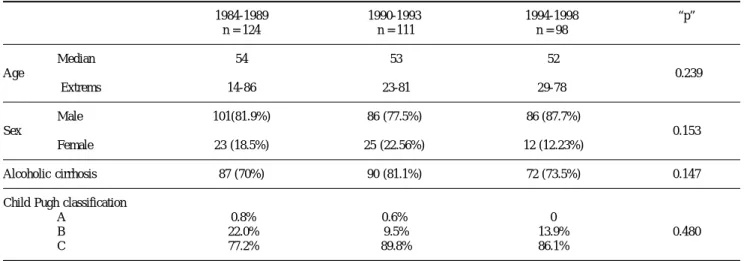
Demographic data regarding sex, age, etiology of cirrho-sis and Child-Pugh classification did not show statistical dif-ferences among infected and non-infected patients with cir-rhosis and HE, in the three periods of study (Table I). On the other hand, the prevalence of bacterial infections decreased
Table I. Demographic data of 333 patients with H.E. in three periods of study.
1984-1989 1990-1993 1994-1998 “p”
n = 124 n = 111 n = 98
Median 54 53 52
Age 0.239
Extrems 14-86 23-81 29-78
Male 101(81.9%) 86 (77.5%) 86 (87.7%)
Sex 0.153
Female 23 (18.5%) 25 (22.56%) 12 (12.23%)
Alcoholic cirrhosis 87 (70%) 90 (81.1%) 72 (73.5%) 0.147
Child Pugh classification
A 0.8% 0.6% 0
B 22.0% 9.5% 13.9% 0.480
C 77.2% 89.8% 86.1%
Table II. Prevalence of bacterial infectious associated with HE in the three periods of study.
Infection 1984-89 1990-93 1994-98 Total
Present 76 52 42 170
(61.29%) (46.85%) (42.85%)
Absent 48 59 56 163
(38.71%) (53.15%) (57.14%)
Total 124 111 98 333
edigraphic.com
significantly (p = 0.002) along the time, as shown in table II. When different types of infections were analyzed their rela-tive proportions have varied, but with no statistical differ-ences (p = 0.123), depicted in table III. Spontaneous Bacte-rial Peritonitis was the most frequent type of infection, fol-lowed closely by the urinary tract infection.
When short-term prognosis, meaning lethality during hospitalization was analyzed, there were 79 deaths (46.5%) among the 170 infected patients and 37 (22.7%) in the group of HE patients without infection. This differ-ence was statistically significant (p < 0.001), as shown in table 4 and the calculated risk factor (RR) was 2.047 with 95% confidence intervals of 1.478-2.836. The statistical analysis has also shown a significant interaction between infection and lethality. Probabilities of death in the groups have dropped from 0.5347 to 0.2291 and from 0.4285 to 0.1071, in the first and third periods, according to the status of being or not infected. In table 5 lethality according to the type of infection is depicted. We can
ob-Table III. Prevalence of the different types of bacterial infection in three periods of study.
SBP UTI SEP RTI DERM Others Total
1984-1989 34 23 4 8 4 3 76
44.74% 30.26% 5.26% 10.53% 5.26% 3.95%
1990-1993 13 14 11 10 4 0 52
25% 26.92% 21.15% 19.23% 7.69% 0.00%
1994-1998 16 14 4 4 2 2 42
38.10% 33.33% 9.52% 9.52% 4.76% 4.76%
Total 63 51 19 22 10 5 170
SBP – Spontaneous bacterial peritonitis UTI – Urinary tract infection
SEP – Septicemia
RTI – Respiratory tract infection DERM – Dermatological infection
Table IV. Comparison of lethality in H.E. patients with and without infection.
Infection Lethality
Present Absent Total
Present 79 91 170
46.47% 53.53%
Absent 37 126 163
22.70% 77.30%
Total 116 217 333
p = 0.001
Estimation of the Relative Risk (RR)
Type of Study Value 95%
Confidence Bounds
Cohort (Coll Risk) 2.047 1.478 2.836
serve that lethality due to SBP dropped dramatically from near 70% to less than 40%, although statistical signifi-cance was not reached (p = 0.062 ). For all other types of infection the outcome was similar during the whole peri-od of the study and it was possible to demonstrate that sepsis (mortality of 79%) and pulmonary infection (mor-tality of 50%) carried the worst prognosis, whereas UTI (mortality of 27%) presented the best prognosis.
Discussion
The results of the present study indicate that the prev-alence of bacterial infections, among cirrhotic patients with HE, has decreased in the last decades but is still very high. It is well known that the severity of liver dysfunc-tion found in cirrhosis leads to altered host defenses. The presence of HE in the course of cirrhosis is surely a mark-er of sevmark-ere hepatic dysfunction that may correlate with high prevalence of bacterial infections.
Our data, in terms of severity of liver disease, is com-parable to a recent study of the prognostic significance of hepatic encephalopathy,3 where Child C patients
account-ed for 69% of their cases and we had from 77.2 to 89.8%, with no differences in the periods of time evaluated. It was interesting to notice that demographic characteristics of our patients, as sex, age, etiology of cirrhosis and se-verity of liver damage have not changed in the last two decades, despite the significant decrease of prevalence of bacterial infections. Along the time, means of diagnosis have improved, new techniques developed and early di-agnosis was enhanced, specially for spontaneous bacteri-al peritonitis.16 Although new antibiotics and bacterial
re-sistance have been a continuous challenge in recent years,17,18 specific therapy for infections in patients with
cirrhosis has generally improved.19,20 Cost-analysis has
demonstrated that antibiotic prophylaxis for SBP is very cost-effective, when restricted to high risk groups.21
The prevalence of infection of the urinary tract was stable along the years, about 30% of all cases, whereas differences
Annals of Hepatology 2(1) 2003: 41-45
44
edigraphic.com
occurred for spontaneous bacterial peritonitis, the most prev-alent in two of the three periods. Urinary tract infection is the most frequent type of bacterial infection in cirrhosis, accord-ing to some authors,22 but not for others.1,2,8 According to this
study both types of infection are equally prevalent.
It is worthwhile to comment on the two exclusion cri-teria of our study, namely porto-systemic encephalopathy and hepatocarcinoma. Shunt surgery for portal hyperten-sion, almost abandoned in the last decade, is now consid-ered a valid option.23 In fact, it continued to be performed
for non-cirrhotic portal hypertension and in our experi-ence with proximal and distal spleno-renal shunts for hepatosplenic schistosomiasis, both may lead to HE.24
Nevertheless, cases of bacterial infections are casual, not related to shunt-induced HE. Metabolic coma, on the oth-er hand, may be related to hepatocarcinoma, motivating their exclusion, although prevalence of bacterial infec-tions in cirrhosis with or without hepatocarcinoma has not shown differences in a large Japanese study.25
Although it is well known that survival of cirrhotic pa-tients who have had an episode of HE will not be very long and they should be considered as candidates for liver trans-plantation, we were particularly interested in evaluating the short-term prognosis of these patients. Early death, during hospitalization, occurred in 22.7% of non-infected cirrhotics with HE and in 45.47% of the infected ones (p = 0.001). The mechanisms by which bacterial infections deteriorates he-patic function are of special interest nowadays. It is speculat-ed that it involves circulatory dysfunction.26 The release of
endotoxins as well as the induction of vasoconstrictor fac-tors as endothelin, prostacyclin and nitric oxide may play a major role, not only in the general circulatory function but specially in the renal and hepatic hemodynamics. According to some authors bacterial infections in patients with variceal hemorrhage may trigger more bleeding,27 being associated
with failure to control variceal bleeding.28 Renal
insufficien-cy, either progressive or transient is frequently observed fol-lowing bacterial infections, specially spontaneous bacterial peritonitis.29,30
Gathering the data of these 15 years of experience, it was also possible to distinguish different prognosis ac-cording to the type of infection. As expected, urinary tract infection had the lower mortality rates, around 25%, whereas sepsis carried the worst prognosis, with 80% mortality, similar to what is found in acute hepatic insuf-ficiency.31 Considering that half of the patients with
respi-ratory tract infections died during hospitalization, this type of infection is also severe. A reduction of lethality was detected only for SBP, most probably due to early di-agnosis and treatment of this condition with new antibiot-ics, particularly cephalosporines of third generation.
In conclusion, the very high prevalence of bacterial in-fections associated with HE has diminished along the time. Although multiple factors can be involved in the prognosis of hepatic encephalopathy, bacterial infection continues to be a very serious and life-threatening com-plication. Different types of infection carry different short-term prognosis. In the last decade, the early diagno-sis and adequate management of SPB has improved its survival rates.
References
1. Caly WR, Strauss E. A prospective study of bacterial infections in patients with cirrhosis. J Hepatol 1993; 18: 353-8.
2. Toledo CA, Flores CW, Sáenz MF, et al. Infecciones Bacterianas en la cirrosis hepática. Rev Med Chile 1994; 122: 788-94.
3. Bustamente J, Rimola A, Ventura PJ, et al. Prognostic significance of hepatic encephalopathy in patients with cirrhosis. J Hepatol 1999; 30: 890-5.
4. Rimola A, Soto R, Bory F, Arroyo V, Piera C, Rodés J. Reticuloen-dothelial system phagocytic activity in cirrhosis and its relation to bacterial infections and prognosis. Hepatology 1984; 4: 53-8. Table V. Comparisons of lethality in three periods of the study, according to the type of bacterial infection.
1984-1989 1990-1993 1994-1998 Total “p”
Types of Infection
N 34 13 16 63
SBP Death 23 5 6 34 0.062
% 67.6 38.4 37.5 54
UTI N 23 14 14 51
Death 9 1 4 14 0.146
% 39.1 7.1 28.6 27.4
N 8 10 4 22
RTI Death 4 5 2 12 1.00
% 50.0 50.0 50.0 50
N 4 11 4 19
SEP Death 4 8 3 15 0.773
% 100 72.7 75.0 79
SBP – Spontaneous bacterial peritonitis UTI – Urinary tract infection
edigraphic.com
5. Rajkovic IA, Williams R. Abnormalities of neutrophil phagocytosis, intracellular killing, and metabolic activity in alcoholic cirrhosis and hepatitis. Hepatology 1986; 16: 252-62.
6. Chang CS, Chen GH, Lien HC, Yeh HZ. Small intestine dysmotility and bacterial overgrowth in cirrhotic patients with spontaneous bac-terial peritonitis. Hepatology 1998; 28: 1187-90.
7. Mendenhall CL. Inmunity, malnutrition and alcohol. Alcohol Health
& Research World 1992; 16: 23-8.
8. Deschnes M, Villeneuve JP. Risk factors for the development of bac-terial infections in hospitalized patients with cirrhosis. Am J
Gastroenterol 1999; 94: 2193-7.
9. Strauss E, Costa MF. The importance of Bacterial Infections as Pre-cipitating Factors of Chronic Hepatic Encephalopathy in Cirrhosis.
Hepato-Gastroenterol 1998; 45: 900-4.
10. Strauss E, Santos WR, Silva EC, Lacet CMC, Capacci MLL, Bernardini AP. Treatment of hepatic encephalopathy: a random-ized clinical trial comparing a branched chain enriched amino acid solution to oral neomycin. Nutritional Support Services 1986; 6: 18-21.
11. Strauss E, Tramonte R, Silva EPS, et al. Double-Blind Randomized Clinical Trial Comparing Neomycin and Placebo in the Treatment of Exogenous Hepatic Encephalopathy. Hepato-Gastroenterol 1992; 39: 542-5.
12. Garcia-Tsao G, Groszmann RJ, Fisher RL, Conn HO, Atterbury CE, Glickman M. Portal pressure, presence of gastroesophageal varices and variceal bleeding. Hepatology 1985; 5: 419-24.
13. Ferenci P, Lockwood A, Mullen K, et al . Hepatic Encephalopathy -Definition, Nomenclature, Diagnosis, and Quantification: Final Re-port of the Working Party at the 11th World Congress of Gastroen-terology, Vienna, 1998. Hepatology 2002; 35: 716-21.
14. Suárez C, Pajares M. Epidemiología de las infecciones en la cirrosis hepática. Rev Clin Esp 1981; 160: 299-303.
15. Pugh RN, Murray-Lyon IM, Dawson JL, Pietroni MC, Williams R. Transection of the esophagus for bleeding esophageal varices. Brit J
Surg 1973; 60: 646-9.
1. Runyon BA. Spontaneous Bacterial Peritonitis: An Explosion of In-formation (Editorial). Hepatology 1988; 8: 171-5.
2. Westphal JF, Jehl F, Vetter D. Pharmacological, Toxicologic, and Microbiological Considerations in the Choice of Initial Antibiotic therapy for Serious Infections in Patients with Cirrhosis of the Liver.
Clinical Infectious Diseases 1994; 18: 324-35.
3. Ortiz J, Vila MC, Soriano G, et al. Infection caused by Escherichia coli resistant to norfloxacin in hospitalized cirrhotic patients.
Hepatology 1999; 29: 1064-9.
4. Navasa M, Rimola A, Rodés J. Bacterial Infections in Liver Disease.
Seminars in Liver Disease 1997; 17: 323-33.
5. Bernard B, Grange JD, Khac EN, Amiot X, Opolon P, Poynard T.
Antibiotic prophylaxis for the prevention of bacterial infections in cirrhotic patients with gastrointestinal bleeding: a meta-analysis.
Hepatology 1999; 29: 1655-61.
6. Das A. A cost analysis of long term antibiotic prophylaxis for spon-taneous bacterial peritonitis in cirrhosis. Am J Gastroenterol 1998; 93: 1895-900.
7. Navasa M, Fernandez J, Rodes J. Bacterial infections in liver cirrho-sis. Ital J Gastroenterol Hepatol 1999; 31: 616-25.
8. Rikkers LF. The changing spectrum of treatment for variceal bleed-ing. Ann Surg 1998; 228: 536-46.
9. Raia S, Da Silva LC, Gayotto LCC, Forster SC, Fukushima J, Strauss E. Portal Hypertension in Schistosomiasis: A Long-Term Follow-up of a Randomized Trial Comparing Three Types of Surgery.
Hepatology 1994; 20: 398-403.
10. Yoshida H, Hamada T, Inuzuka S, Ueno T, Sata M, Tanikawa K. Bacterial infection in cirrhosis, with and without hepatocellular car-cinoma. Am J Gastroenterol 1993; 88: 2067-71.
11. Arroyo V, Jimenez W. Complications of cirrhosis. II. Renal and cir-culatory dysfunction. Lights and shadows in an important clinical problem. J Hepatol 2000; 32: 157-70.
12. Goulis J, Patch D, Burroughs AK. Bacterial infection in the patho-genesis of variceal bleeding. Lancet 1999; 353: 139-42.
13. Goulis J, Armonis A, Patch D, Sabin C, Greenslade L, Burroughs AK. Bacterial infection is independently associated with failure to control bleeding in cirrhotic patients with gastrointestinal hemor-rhage. Hepatology 1998; 27: 1207-12.
14. Follo A, Llovet JM, Navasa M, et al. Renal impairment after sponta-neous bacterial peritonitis in cirrhosis: incidence, clinical course, predictive factors and prognosis. Hepatology 1994; 20: 1495-501. 15. Navasa M, Follo A, Filella X, et al. Tumor necrosis factor and
interleukin-6 in spontaneous bacterial peritonitis in cirrhosis: rela-tionship with the development of renal impairment and mortality.
Hepatology 1998; 27: 1227-32.
16. Rolando N, Harvey F, Brahm J, et al. Prospective Study of Bacterial Infection in Acute Liver Failure: An Analysis of Fifty Patients.