An Comparative Analysis of Different Models of Belief Revision using
Information from Multiple Sources
Luciano H´ector Tamargo Marcelo Alejandro Falappa Alejandro Javier Garc´ıa Consejo Nacional de Investigaciones Cient´ıficas y T´ecnicas (CONICET)
Laboratorio de Investigaci´on y Desarrollo de Inteligencia Artificial (LIDIA) Departamento de Ciencias e Ingenier´ıa de la Computaci´on - Universidad Nacional del Sur
Avenida Alem 1253,(B8000BCP), Bah´ıa Blanca, Argentina Tel: (0291) 459-5135 / Fax: (0291) 459-5136
{lt,ajg, mfalappa}@cs.uns.edu.ar
Abstract
In this work we analyze the problem of knowledge representation in a collaborative multi-agent system where agents can obtain new information from others through communication. Namely, we analyze several approaches of belief revision in multi-agent systems. We will describe different research lines in this topic and we will focus onBelief Revision using Information from Multiple Sources. For this, we are going to accomplish a comparative analysis of different models of belief revision that use information from multiple sources. Key words:Multi-Agent Systems, Revision, Plausibility, Comparison.
1
INTRODUCTION
The problem of belief revision (BR) has been widely discussed in the past twenty years [1, 2, 10]. In belief revision theory, new information must be adopted and some existing information will be dropped to accommodate it. However, many researchers argued that new information should not al-ways have the priority over the existing information and some non-prioritized belief revision methods have been proposed in which new information is not necessarily accepted [6, 8, 11, 15].
An essential skill an autonomous agent should possess is the ability to revise its beliefs in a coherent and rational fashion when it receives new information. Most BR research, however, has been developed with a single agent in mind,i.e., only one problem solver using the BR service.
Multi-Agent Systems (MASs) are distributed computing systems composed of a number of in-teracting computational entities. One important characteristic distinguishing MASs from traditional distributed systems is that both MAS and its components (agents) are intelligent. As MASs become increasingly attractive for solving larger and more complex problems, the need for adequate BR tech-nology in the MAS paradigm arises. Only a few BR frameworks are known that claim to be suited for MAS applications. There exist different fashions to cope to the consistency maintenance in MAS. In Section 2, a BR hierarchy is presented to clarify the terminologies adopted in resent research on Multi-Agent Belief Revision (MABR).
In this work, namely we are interested in the stages where several deliberative agents are involved in a MAS and they can receive new information from others through communication. Belief Revision
in this type scene is calledBelief Revision using Information from Multiple Sources(MSBR). More-over, recently we have presented an article [16] where we defined a new operator of Belief Revision which it is based on a credibility order among agents.
In this paper, we are going to accomplish a comparative analysis between our approach [16] and different models of MSBR. Specifically, we will compare our approach with one proposed by Dragoni in [4] and other proposed by Cantwell in [3].
This paper is organized as follows. Next section introduces an exhaustive analysis of the MABR approaches. In the third section a brief description of our revision operator will be given. Then, in the fourth section we will compare our approach with the presented by Dragoni. In the fifth section, the comparison of our proposal will be done with the Cantwell’s proposal. Finally, conclusions are included.
2
BELIEF REVISION IN MULTI-AGENT SYSTEMS
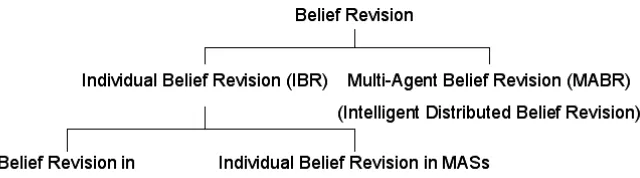
A variety of notations have been adopted by researchers investigatingBelief RevisioninMulti-Agent Systems. A good understanding of the relationships between these approaches is essential before carrying out any further research. In [13] an exhaustive analysis of these approaches is presented and a very interesting hierarchy is introduced (See Figure 1). Observe that in the hierarchy,Multi-Agent Belief RevisionandBelief Revision using information from Multiple Sourcesare distinguished.
As stated in [13], BR could be considered as part of the agent’s skills to maintain the consistency of its own epistemic state. In this case, an individual BR process is carried out in a multi-agent environment, where the new information may come from multiple sources and maybe conflict. BR in this sense is called MSBR by [5]. Cantwell [3] tries to resolve conflicting information by ordering the information sources on the basis of their trustworthiness. This could be served as a rational way of generating the new information credibility based on the source reliability using the terms of MSBR.
However, as discussed in [13], BR could also be used to achieve a society’s or team’s mutual belief goals (e.g. reaching consensus before carrying out plans). In this setting, more than one agent takes part in the process. In order to pursue the mutual goal, agents involved need to communicate, cooperate, coordinate and negotiate with one another. A MABR system is a MAS whose mutual goal involves BR.
MSBR studies individual agent revision behaviors,i.e., when an agent receives information from multiple agents towards whom it has social opinions. MABR investigates the overall BR behavior of agent teams or a society. MSBR is one of the essential components of MABR.
The AGM paradigm [2] has been widely accepted as a standard framework for BR. But it is only capable of prescribing revision behaviors of a single agent. The BR process is more complex in multiple agent case. Besides the Principle of Minimal Change, there exist other requisites due to the sophisticated agent interactions.
An agent is capable of carrying out Individual Belief Revision (IBR), while an agent society or team is capable of MABR. IBR in a single agent environment (Single Belief Revision, SBR) could be achieved using classical BR satisfying or adapting AGM postulates. IBR in a multiple agent environment is MSBR,i.e., a single agent will have to process information coming from more than one source.
Figure 1: Belief Revision Hierarchy
a tool to handle the heterogeneity issues so as to achieve the necessary reliable communication and system interoperability required by MABR.
In [12] research on MABR in the context of heterogeneous systems is initiated. The Private Domains (P Di) and the Shared Domain (SD) of the agent knowledge base are defined in order to
capture a general setting where each agent has private beliefs as well as beliefs shared with other agents. Under such knowledge structure, each agent may have its own perspective of the world but needs to coordinate (i.e.agree on) its belief on shared elements. The shared domain also defines the communication language for the agents.
In contrast to these last two proposals [13, 14, 12], in our approach [16] we have focused on MSBR, where agents maintain the consistence of their belief bases. Since an agent can receive infor-mation that is contradictory with its own beliefs, in order to maintain its belief base consistent, it has to decide whether to accept or reject the new information. If an agent decides to accept a new belief that is contradictory with its belief base, then it has to select some beliefs from its belief base in order to withdraw them and avoid the contradiction.
Similarly to Dragoni [4] and Cantwel [3], in our approach, informant agents can have different credibility and this credibility is used to decide which information prevails when a contradiction arises. However, there are differences with these authors, which will be analyzed in this work.
In our approach, a credibility order among agents was defined, and this order is used by all the participants of the multi-agent system. In [16] we have assumed that the credibility order among agents is fixed. To decide whether to reject or accept a new belief, a comparison criterion among beliefs was defined. As it will be explained in detail below, this comparison criterion (that we call plausibility) is based on the credibility order among agents.
3
NON-PRIORITIZED REVISION USING PLAUSIBILITY
This section gives a brief description of an operator that we have defined for multi-source belief revision (recently presented in NMR 2008 [16]).
3.1 Epistemic Model
In our approach [16], we considered a finite set of agents identifiers that will be denoted asAgents. Since agents can obtain information from other agents, agents’ beliefs are represented as tuples(α, A), whereA∈Agentsandαis a sentence of a propositional languageL.
LetK = 2L×Agents, each agentA ∈ Agentshas a belief baseK
A ∈ K. As stated above, in this
Definition 1 Acredibility order among agents, denoted by infix ‘≤Co’, is a total order overAgents,
where A1 ≤Co A2 means that A2 is at least as credible as A1. The strict relation A1 <Co A2,
representingA2is strictly more credible thanA1, is defined asA1 ≤Co A2andA2 6≤CoA1. Moreover,
A1 =Co A2means thatA1 is as credible asA2, and it holds whenA1 ≤CoA2andA2 ≤Co A1.
Example 1 Consider a set Agents = {A1, A2, A3, A4}where the credibility order is A1 ≤Co A2,
A2 ≤Co A3, A3 ≤Co A2, A3 ≤Co A4. Note thatA2 is as credible asA3. The belief base of the agent
A1 is KA1 = {(β, A1),(α, A2),(α, A3),(α → β, A2),(α → β, A4),(ω, A1),(ω → β, A4),(α →
δ, A2),(δ →β, A1),(γ, A2),(γ, A3),(γ →ǫ, A2),(ǫ→β, A2),(ǫ→β, A3),(ǫ→ β, A4)}. Observe
thatKA1 has three tuples with the sentence ǫ → β. Although this can be considered as redundancy,
each one comes from a different informant agent. The reasons for maintaining all of them will be explained below.
Besides, in [16] two auxiliary functions was introduced in order to obtain the set of sentences (resp. set of agents) that belong to a belief baseK ∈K.
Definition 2 Thesentence function, Sen : K 7→ 2L
, is a function such that for a given belief base
K ∈K,Sen(K) = {α: (α, A)∈Kfor anyAinAgents}.
Definition 3 The agent identifier function, Ag : K 7→ 2Agents, is a function such that for a given
belief baseK ∈K,Ag(K) = {A: (α, A)∈Kfor anyαinL}.
As stated above, agents can receive new beliefs from other informants. This new information can be contradictory with their current beliefs. For instance, consider again the belief base(KA1)of Example 1, where Sen(KA1) ⊢ β (observe that there are several derivations forβ). Suppose now that the agent A1 receives the input (¬β, A4). It is clear that adding (¬β, A4) to KA1 will produce an inconsistent belief base. Therefore, the agent has to revise its beliefs and decide whether it rejects (¬β, A4) or it withdrawsβ. The credibility order is used to decide which information prevails.
How-ever, since there can be several derivations ofβ, then we have to “cut” all of them. For doing that, all the minimal subsets ofKA1 that entailsβ will be obtained, using an extension ofKernel contractions. Kernel contractions introduced in [10] are based on a selection among the sentences that are relevant to derive the sentence to be retracted. In order to perform a contraction, kernel contractions use incision functions which cut into the minimal subsets that imply the information to be given up. We have adapted the notion of kernel contraction to our epistemic model. First, we will define the kernel set (Definition 4) and then we will present incision functions (Definition 11) that will cut beliefs according to their plausibility (Definition 8).
Definition 4 LetK ∈Kandα∈L. ThenH ∈K⊥⊥αif and only if
1. H ⊆K.
2. Sen(H)⊢α.
3. ifH′ ⊂H, thenSen(H′)6⊢α.
The set of minimal subsets of a belief baseK ∈Kthat implyα(denotedK⊥⊥α) is called akernel
set. Note that eachα-kernel (H ∈K⊥⊥α) is a set of tuples fromK.
The information (α, Ap) that an agent Ai receives from Ap could be consistent with its current
belief baseKAi ifSen(KAi)6⊢ αorSen(KAi)⊢ α. IfSen(KAi) 6⊢α, then it is clear that(α, Ap)is
increase (see Section 3.2). Therefore, a belief baseK ∈Kmay contain the same belief in two tuples with different agents identifiers (for instance,{(α, A1),(α, A2)} ⊆K). Thus, we may say thatKhas
redundant information or we may say that K is redundant. In Example 1 the sentenceǫ → β is in three tuples. From the tuples point of view there is no redundancy, due to each tuple represent to a different informant.
In the following section we will show how the new operator uses the additional information (agents identifiers) in order to guide the revision process. The plausibility of the sentences will be defined by using the agents identifiers stored in the belief bases of the agents and the credibility order among agents.
3.2 Sentences Plausibility
The agents identifiers (which are in the second field of the tuples) represent the information that will be used to compute the plausibility of the beliefs. That is, each agent’s belief will have an associated plausibility that will depend on the agent identifier and the credibility order among agents. The behavior of the plausibility is similar to the epistemic entrenchment defined in [9]. That is, ifαandβ
are sentences inL, the notationα¹K
A β will be used as a shorthand for “βis at least as plausible as
αrelative to the belief baseK of the agentA”.
One belief base K ∈ Kmay contain either explicit sentences or entailed sentences. As stated above, the explicit sentences are those contained in Sen(K). The entailed sentences are those such that they are not in Sen(K) but they are entailed by sentences in Sen(K). In order to obtain the entailed sentences from a belief baseK we are going to use the following function:
Definition 5 The belief function, Bel : K 7→ 2L
, is a function such that for a given belief base
K ∈K,K: Bel(K) = {α:α∈LandSen(K)⊢α}.
Note that alsoK may contain explicit sentences that are entailed byBel(K). Thus we will have several proofs for the same sentence inK. Therefore, to calculate the plausibility of a sentence (β) we should analyze all its proofs. In order to achieve this, we are going to use the kernels set. We consider that this calculation should be cautious. That is, from eachβ-kernel, we desire to obtain the less plausible tuples. This plausibility gives us the plausibility of each proof. Then, the plausibility of a derived sentence β will be the greater plausibility among the plausibilities of eachβ-kernel. In order to define that, two functions will be given next.
Definition 6 The less credible source function, min : K 7→ K, is a function such that for a given
belief baseK ∈K,min(K) = {(α, Ai) : (α, Ai)∈Kand for all(δ, Aj)∈K, Ai ≤CoAj}.
Definition 7 Themore credible source function,max:K7→K, is a function such that for a given
belief baseK ∈K,max(K) = {(α, Ai) : (α, Ai)∈K and for all(δ, Aj)∈K, Aj ≤Co Ai}.
Example 2 ConsiderAgents={A1, A2, A3}whereA1 ≤CoA2 ≤Co A3. LetKA1 ={(α, A1),(α, A2), (β, A1),(γ, A1),(α→γ, A3)}be the belief base ofA1. Then,
• Bel(KA1)will contain the sentences from Sen(KA1) plus the sentences derived by “⊢”. For
instance,α, β, γ, α∨β, α∨β∨γ, . . . ,and so on.
• min(KA1) ={(α, A1),(β, A1),(γ, A1)}.
Next, we will introduce a function that returns the plausibility of a sentence that can be explicitly inK or inferred fromK.
Definition 8 The Plausibility function, Pl : L×K 7→ Agents, is a function such that for a given
sentence α ∈ L and a belief base K ∈ K, Pl(α, K) returns lexicographically the lowest agent
identifier ofAg(max(S
X∈K⊥⊥αmin(X))).
It is important to note that if (γ, A1) ∈ KA1 then Pl(γ, KA1) could be different from A1. For instance, consider the Example 2, thenPl(α, KA1) =A2,Pl(β, KA1) =A1 andPl(γ, KA1) =A2.
Definition 9 Plausibility Criterion. LetKA∈ Kbe the belief base of the agentAand let {α, β} ⊆
Bel(KA), thenα¹KA βif and only ifPl(α, KA)≤Co Pl(β, KA).
The strict relationα ≺KA β, representing “β is more plausible thanα”, is defined as “α ¹KA β
andβ KA α”. Moreover,α≃KA βmeans thatαis as plausible asβ, and it holds whenα¹KA βand
β ¹KA α. From the previous definition we can observe that the plausibility of the sentences inherits
the properties of thecredibility order among agents(‘¹KA’ is a total order onL). Furthermore, note
that the relation ‘¹KA’ is only defined with respect to a given KA (different belief bases may be
associated with different ordering of plausibility, in Example 3 this situation is shown).
Example 3 Consider a set Agents = {A1, A2, A3} where the credibility order is A1 ≤Co A2,
A2 ≤Co A3. Suppose that the agentA2has the following belief baseKA2={(α, A1),(β, A2),(γ, A3)},
and suppose that the agentA3has the following belief baseKA3 ={(α, A1),(β, A3),(γ, A2)}. Then,
for both agents, β is more plausible than α(i.e., α ¹KA2 β and α ¹KA3 β). However, forA2, γ is more plausible thanβ (β ¹KA2 γ) whereas forA3,βis more plausible thanγ (γ ¹KA3 β).
In the following section, we will define a non-prioritized revision operator that uses the sentences plausibility in order to guide the revision process.
3.3 Non Prioritized Revision Operator Using Plausibility
In this section, the behavior of the revision operator presented in [16] will be shown. This operator is based on the sentences plausibility. In case that a belief baseK ∈Kis revised by a tuple(α, Ai)we will have two cases:
• α is consistent with Bel(K). This is the most simple case of characterizing from the logical point of view because it consists only in the addition of new tuples. In the limit case in which
α∈Bel(K)then this operation could increase the plausibility ofα.
• α is inconsistent with Bel(K), that is ¬α ∈ Bel(K). This case requires a deeper analysis because: a) it is necessary to determine when the sentence will be accepted; and b) if the input is accepted then it is necessary to erase some tuples ofK. For the second case we need to define an incision function on eachα-kernel.
We will adapt the incision function definition proposed by [10] to our framework.
Definition 10 Anincision functionσ forK ∈Kis a function such that for allα
1. σ(K⊥⊥α)⊆ ∪(K⊥⊥α).
The incision function selects sentences to be discarded. ContractingαfromKshould be equal to all the elements of the original setKthat are not removed by the incision function.
In the definition ofincision functionof Hansson’s work is not specified how the function selects the sentences that will be discarded of eachα-kernel. This can be solved with the sentences plausibility that we have defined above. The incision function σ will select the less plausible sentences of each
α-kernel. Hence, the new operator differs of the kernel revision operator defined by Hansson in the following issues:
1. The new operator will do an analysis to determine if the revision is necessary.
2. The sentences selection for the incision function will be defined.
According to 1, the new operator permits two options, completely accepts all the input, or com-pletely rejects all the input. For this reason the new operator is non prioritized. Some non priori-tized operators of the literature that completely accept or reject the input are Semi-Revision [11] and Screened Revision [15]. Another operators may partially accept the new information, for instance Revision by a Set of Sentences [7] and Selective Revision [8].
Next we will define a specific incision function, based on the beliefs plausibility, that will select the less plausible sentences of eachα-kernel (following the principle of minimal change).
Definition 11 σ↓is abottom incision functionforKifσ↓is an incision function such that,σ↓(K⊥⊥α) =
{(δ, Ai) : (δ, Ai)∈X ∈K⊥⊥αand for all(β, Aj)∈Xit holds thatAi ≤Co Aj}.
Example 4 Consider a set Agents = {A1, A2, A3} where the credibility order is A1 ≤Co A2,
A2 ≤Co A3. Suppose that the agent A2 has the following belief base KA2 = {(α, A3),(β, A2), (β →α, A1),(ω, A1),(ω →α, A3),(δ, A1)}. Then,KA⊥⊥2α ={Ha, Hb, Hc}where
Ha={(α, A3)},Hb ={(β, A2),(β →α, A1)},Hc={(ω, A1),(ω→α, A3)}.
σ↓(K⊥⊥
A2α) ={(α, A3),(β →α, A1),(ω, A1)}.
Now that we have given the necessary background on the behavior of the new operator, the Non-Prioritized Revision Using Plausibilitywill be defined.
Definition 12 LetK ∈K, letα∈L, letT opBasebe a maximum belief base function, and letK⊥⊥α
be the set ofα-kernels of K. Letσ↓ be a bottom incision function forK. The operator “◦”, called
Non-Prioritized Revision Using Plausibility, is defined as follow:
K◦(α, Ai) =
K ∪ {(α, Ai)} if¬α6∈Bel(K)
K if¬α∈Bel(K)andAi ≤Co Pl(¬α, K)
(K\X)∪ {(α, Ai)} if¬α∈Bel(K)andPl(¬α, K)<Co Ai
where: X ={(ω, Aj) :ω ∈Sen(σ↓(K⊥⊥¬α))and(ω, Aj)∈K}.
Example 5 Consider a setAgents={A1, A2, A3, A4, A5}where the credibility order isA1 ≤Co A2,
A2 ≤Co A3, A3 ≤Co A2, A3 ≤Co A4, A4 ≤Co A5. Suppose that the agentA1has the following belief
base KA1 = {(β, A1),(α, A2), (α, A3), (α → β, A2),(α → β, A4),(ω, A1),(ω → β, A4),(α →
δ, A2),(δ →β, A1),(γ, A2),(γ, A3),(γ →ǫ, A2),(ǫ→β, A2),(ǫ→β, A3),(ǫ→β, A4)}.
Further-more, we supposeA1 receives the tuple(¬β, A5). Then,A1 should reviseKA1 by(¬β, A5). Next we
• Step 1.Obtain the minimal subsets that deriveβ from belief baseKA1.
K⊥⊥
A1β ={Ha, Hb, Hc, Hd, He, Hf, Hg, Hh, Hi, Hj, Hk, Hl, Hm, Hn}where
Ha ={(β, A1)},Hb ={(α, A2),(α →β, A2)},
Hc ={(α, A2),(α→β, A4)},Hd={(α, A3),(α →β, A2)},
He ={(α, A3),(α →β, A4)},Hf ={(ω, A1),(ω→β, A4)},
Hg ={(α, A2),(α→δ, A2),(δ →β, A1)},Hh ={(α, A3),(α →δ, A2),(δ→β, A1)},
Hi ={(γ, A2),(γ →ǫ, A2),(ǫ →β, A2)},Hj ={(γ, A2),(γ →ǫ, A2),(ǫ→β, A3)},
Hk ={(γ, A2),(γ →ǫ, A2),(ǫ→β, A4)},Hl ={(γ, A3),(γ →ǫ, A2),(ǫ→β, A2)},
Hm ={(γ, A3),(γ →ǫ, A2),(ǫ→β, A3)}andHn={(γ, A3),(γ →ǫ, A2),(ǫ→β, A4)}.
• Step 2. Apply thebottom incision function“σ↓” to the set of minimal subsets ofKA1 to obtain
the less plausible tuples set of eachβ-kernel.
σ↓(K⊥⊥
A1β) = {(β, A1),(α, A2),(α → β, A2),(α, A3),(ω, A1), (δ → β, A1),(γ, A2),(γ →
ǫ, A2),(ǫ→β, A2),(ǫ→β, A3),(γ, A3)}.
• Step 3.Obtain from the tuples of the previous item, those tuples of greater plausibility with the
more credible source function“max”(max(σ↓(K⊥⊥
A1β))).
max({(β, A1),(α, A2),(α→β, A2),(α, A3),(ω, A1),(δ→β, A1),(γ, A2),(γ →ǫ, A2),(ǫ→
β, A2),(ǫ → β, A3),(γ, A3)}) = {(α, A2),(α → β, A2),(α, A3),(γ, A2),(γ → ǫ, A2),(ǫ →
β, A2),(ǫ →β, A3),(γ, A3)}.
• Step 4. Compare the agent identifier of the input tuple with the agent identifier of any tuple obtained from previous item (lets suppose(α, Aj)). IfA5 ≤Co Aj the operation has no effect,
the input is rejected, i.e., K ◦ (¬β, A5) = K. On the other hand, if Aj <Co A5 then K ◦
(¬β, A5) =K \ {(ω, Aj) :ω ∈Sen(σ↓(K⊥⊥¬α))and(ω, Aj)∈K} ∪ {(α, Ai)}.
KA1 ◦(¬β, A5) = {(ω →β, A4),(α →δ, A2),(¬β, A5)}.
Remark 1 Note that, since the belief base may be redundant, in step 4 of Example 5 if the revision gives rise to a contraction then we will discard fromK all those tuples whose sentences were selected by the bottom incision function without regarding the respective informants. Besides, note that our operator will never discard more plausible sentences than the input. This control can be seen in Step 4 of Example 5.
Remark 2 In this approach, we have assumed that the credibility order among agents is fixed. How-ever, this order may be replaced and this will not affect the behavior of the operator. If the credibility order among agents changes, then the plausibility of all sentences may also change without chang-ing the belief bases of the agents. This feature was one of the motivations for uschang-ing agent identifiers instead of representing explicitly the plausibility of sentences as a number. For instance, consider a set Agents = {A1, A2} where the credibility order isA1 ≤Co A2, KA
1 = {(α, A1),(β, A2)} and
KA2 = {(ω, A2),(γ, A1)}. Hence, α ¹KA1 β and γ ¹KA2 ω. If the credibility order changes to
3.4 Retransmission of Information
As stated above, each agent A ∈ Agents will have a belief base KA ∈ K, where K = 2L×Agents.
Hence, the agents store each belief with an agent identifier in tuples. When an agent sends information to other agent, it sends tuples. Consider for example an agent set {A1, A2, A3} ⊆ Agents where
A1 ≤Co A2 ≤Co A3. Suppose thatKA1 = {(α, A3)}then ifA1 wants to sendαtoA2, it has to send a tuple with an agent identifier. This identifier may be:
• the proper sender identifier (e.g.,A1), or
• the agent identifier stored with the belief in the sender’s base (e.g.,A3).
Here, we adopt the latter option. That is,A1 will send the tuple(α, A3)toA2. Thus, the receiver
agentA2will know the source from where the senderA1has obtained the information.
From the receiver point of view, when it receives fromA1 the tuple(α, A3)it may store:
• (α, A3),i.e., the agent identifier stored with the belief in the sender’s base, or
• (α, Ai)whereAiis the agent identifier more credible (according to the credibility order among
agents, Definition 1) that results of comparing theA1 andA3.
Here, we adopt the latter option. Thus, the agents will hold their beliefs with the more credible informant known. In this case, since A1 ≤Co A3, the receiver agent A2 will apply the new revision
operator over the tuple (α, A3).
4
DRAGONI’S APPROACH VS. OUR APPROACH
In this section a brief summary of the proposal of Dragini in [4, 5] will be given. Besides, we are going to do a comparison of this proposal with our approach.
In [4, 5] is considered that agents detect and store in tables the nogoods. Thenogoodsare the minimally inconsistent subsets of the agents’ knowledge bases. In contrast to this, agoodis a subset of the knowledge base such that: it is not inconsistent (it is not a superset of anogood), and if augmented with whatever else assumption in knowledge base it becomes inconsistent. Here, we can note the first difference. In contrast to our approach, they do not remove beliefs to avoid a contradiction, but, quite more generally, to choose which is the new preferredgoodamong them in knowledge base. In our model, we obtain the kernel sets to cut some sentences, thus we broke the contradictions if it is necessary.
That is, their strategy is similar to the proposal by AGM, “Maxichoice revision” [2]. The contrac-tions of the type maxichoice are contraccontrac-tions based on a selection operator that chooses one and only one element of the remains set. In [1], Alchourron and Makinson tried to give a more explicit con-struction of the contraction process, and hence also of the revision process via theLevi identity. Their basic idea was to chooseA - x as a maximal subset ofAthat fails to implyx. Contraction functions defined in this way were called “choice contractions” in [1].
is needed theplausibility functionshould be applied. As is shown in Example 6, given a sentence α
its plausibility depend on its proofs (α-kernels). Therefore, if one of the sentences of these proof changes, then the plausibility of α may change. Hence, if the credibility order is replaced, then the sentence plausibility may change without changing the belief base.
Example 6 Consider a set Agents = {A1, A2}where the credibility order is A1 ≤Co A2, KA1 =
{(α, A1),(α → β, A2)} andKA2 = {(α, A2)}. By Definition 8, Pl(β, KA1) = A1. Now, suppose
thatA1 receives fromA2 the beliefα. NowKA1 ={(α, A1),(α, A2),(α → β, A2)}andA1 has two
derivations forβ, hencePl(β, KA1) = A2. Observe that plausibility ofβis increased.
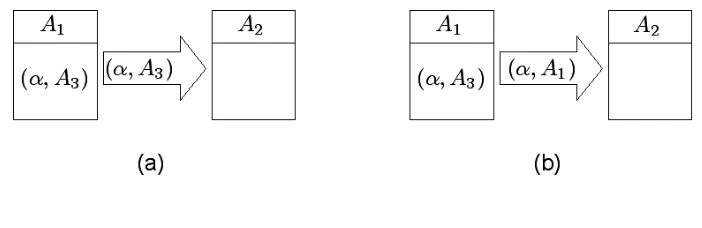
[image:10.595.121.472.323.437.2]The communication policy among agents is other difference that we can note with respect to us approach. The communication policy that we have showed in Section 3.4 differs from the one [4] where the agents do not communicate the sources of the assumptions, but they present themselves as completely responsible for the knowledge they are passing on; receiving agents consider the sending ones as the sources of all the assumptions they are receiving from them. In Figure 2 the difference is shown. In (a) is our approach and in (b) the Dragoni’s approach.
Figure 2: Communication policy
In (b) we can see that if an agent retransmits one belief, the original source is lost. In contrast to this, in our approach the agents hold their beliefs with the more credible informant known.
5
CANTWELL’S APPROACH VS. OUR APPROACH
In [3] Cantwell shows how a support ordering on the information can be generated and how it can be used to decide what information to accept and what not to accept. In this work, in contrast to our approach [16], ascenario(set of incoming information) presented by a source is treated as a whole and not sentence by sentence, and therefore, it can be inconsistent.
Besides, in [3] a relation of trustworthinessis introduced over sets of sources and not between single sources. Moreover, if two sources give the same piece of information φ, and a single agent gives ¬φ, then φ will be preferred, that is, the decision is based on majority. This is shown in the following example.
Example 7 LetA1, A2 andA3 be three sources that are more or less equally trustworthy, now ifA1
andA2 both give the piece of informationφ whileA3 gives the information¬φone would probably
be inclined towards accepting φ rather than ¬φ as the joint trustworthiness of A1 and A2 would
typically be greater than that ofA3. To capture this Cantwell introduced a relation of trustworthiness
not between single sources, but between sets of sources.
Example 8 Consider a set Agents = {A1, A2, A3} where the credibility order is A1 ≤Co A2,
A2 ≤Co A3, A3 ≤Co A2. Note that A2 is as credible as A3. Suppose that the belief base of A1
is empty. IfA1 receives the tuple(α, A2)and then receives(¬α, A3), then(¬α, A3)will be rejected.
However, if A1 first receives the tuple (¬α, A2) and then receives(α, A3), then (α, A3) will be
re-jected.
6
CONCLUSION
In this paper we have introduced an analysis of the different research lines of MABR based on the hierarchy presented in [13]. Namely, we have focused in MSBR and briefly we have described our approach recently presented [16]. Then, we have compared our approach with two other models (Dragoni’s approach [4, 5] and Cantwell’s approach [3]) that cope with Multiple Sources Belief Re-vision (MSBR). Like us, both consider that the reliability of the source affects the credibility of incoming information, and this reliability is used to decide whether a received formula is accepted or rejected. However, these two approaches differs from ours in several issues.
In [4, 5] is considered that agents detect and store in tables thenogoodsand thegood. In contrast to our approach, they do not remove beliefs to avoid a contradiction, but, quite more generally, to choose which is the new preferredgood among them in knowledge base. This strategy is similar to “Maxichoice revision” of AGM. In our model, rather than that, we obtain the kernel sets to cut some sentences, thus we broke the contradictions if it is necessary.
Like us, they propose to store additional information with each sentence. However, their tuples contain 5 elements: <Identifier, Sentence, OS, Source, Credibility>. In contrast to them, in our model a tuple only store a sentence and a source, but a tuple does not store the credibility. That is, in our model the plausibility of a sentence is not explicitly stored with it, as [4] does. Thus, when the plausibility of some sentence is needed theplausibility functionshould be applied.
The communication policy that we have showed in Section 3.2 differs from the one [4] where the agents do not communicate the sources of the assumptions, but they present themselves as completely responsible for the knowledge they are passing on; receiving agents consider the sending ones as the sources of all the assumptions they are receiving from them.
In [3], ascenario(set of incoming information) presented by a source is treated as a whole and not sentence by sentence, and therefore, it can be inconsistent. A relation oftrustworthinessis introduced over sets of sources and not between single sources. Besides, if two sources give the same piece of information φ, and a single agent gives ¬φ, then φ will be preferred, that is, the decision is based on majority. In his approach, the order in which the evidence is considered does not seem to be important. However, in our work, the order in which beliefs are considered is important: If an agent receivesαand then receives¬αand both have the same plausibility, then¬αwill be rejected.
REFERENCES
[1] Carlos E. Alchourr´on, Peter G¨ardenfors, and David Makinson. On the logic of theory change: Contractionfunctions and their associated revision functions. Theoria, 48:14–37, 1982.
[2] Carlos E. Alchourr´on, Peter G¨ardenfors, and David Makinson. On the logic of theory change: Partial meet contraction and revision functions. J. of Symbolic Logic, 50(2):510–530, 1985.
[4] A. Dragoni, P. Giorgini, and P. Puliti. Distributed belief revision versus distributed truth main-tenance, 1994.
[5] Aldo Franco Dragoni, Paolo Giorgini, and Marco Baffetti. Distributed belief revision vs. belief revision in a multi-agent environment: First results of a simulation experiment. InMAAMAW, pages 45–62, 1997.
[6] Marcelo A. Falappa. Teor´ıa de Cambio de Creencias y sus Aplicaciones sobre Estados de Conocimiento. Tesis Doctoral desarrollada en el Grupo de Investigaci´on en Inteligencia Ar-tificial en la Universidad Nacional del Sur, 1999.
[7] Marcelo A. Falappa, Gabriele Kern-Isberner, and Guillermo Ricardo Simari. Explanations, belief revision and defeasible reasoning. Artificial Intelligence, 141(1):1–28, 2002.
[8] Eduardo L. Ferm´e and Sven Ove Hansson. Selective revision. Studia Logica, 63(3):331–342, 1999.
[9] P. G¨ardenfors and D. Makinson. Revisions of knowledge systems using epistemic entrenchment. InProceedings of the Second Conference on Theoretical Aspects of Reasoning about Knowledge Conference, pages 83–95. Morgan Kaufmann, 1988.
[10] Sven Ove Hansson. Kernel contraction. Journal of Symbolic Logic, 59(3):845–859, 1994.
[11] Sven Ove Hansson. Semi-revision. Journal of Applied Non-Classical Logic, pages 151–175, 1997.
[12] Noa E. Kfir-Dahav and Moshe Tennenholz. Multi-agent belief revision. In Yoav Shoham, editor,
Theoretical Aspects of Rationality and Knowledge: Pro. of the Sixth Conf. (TARK 1996), pages 175–196. Morgan Kaufmann, San Francisco, 1996.
[13] Wei Liu and Mary-Anne Williams. A framework for multi-agent belief revision, part i: The role of ontology. InAustralian Joint Conference on A. I., pages 168–179, 1999.
[14] Wei Liu and Mary-Anne Williams. A framework for multi-agent belief revision. Studia Logica, 67(2):291–312, 2001.
[15] David Makinson. Screened revision.Theoria: Special Issue on Non-Prioritized Belief Revision, 1997.