ESCUELA DE CIENCIAS DE LA EDUCACIÓN MENCIÓN INGLÉS
MODALIDAD ABIERTA Y A DISTANCIA
A DESCRIPTIVE ANALYSIS OF ANGLICISMS
USED IN ECUADORIAN MAGAZINES
Research done in order to achieve the
Bachelor’s Degree in Teaching English as a Foreign Language
AUTHOR:
MERCHÁN TAMARIZ ANA MARÍA
ADVISOR:
PALADINES BENÍTEZ JHOANA MGS.
CENTRO UNIVERSITARIO QUITO
Certification
Mgs. Jhoana Paladines Benítez, Thesis Advisor,
CERTIFIES THAT:
This research work has been thoroughly revised by the graduation
committee. Therefore, authorizes the presentation of this thesis,
which complies with all the norms and internal requirements of the
Universidad Técnica Particular de Loja.
Loja, March 2011
Mgs. Jhoana Paladines Benítez
Contrato de cesión de derechos de Tesis de Grado
“Yo, Ana María Merchán Tamariz, declaro ser autora del
presente trabajo y eximo expresamente a la Universidad Técnica
Particular de Loja y a sus representantes legales de posibles reclamos
o acciones legales.
Adicionalmente declaro conocer y aceptar la disposición del
Art. 67 del Estatuto Orgánico de la Universidad Técnica Particular de
Loja, que en su parte pertinente textualmente dice: “formar parte del
patrimonio de la Universidad la propiedad intelectual de
investigaciones, trabajos científicos o técnicos y tesis de grado que se
realicen a través, o que el apoyo financiero, académico o institucional
(operativo) de la Universidad”.
Authorship
The thoughts, ideas, opinions, and the information obtained through
this research are the only responsibility of the author.
Date: March, 2011
Ana María Merchán Tamariz
Dedication
I dedicate this thesis to my Lord and Heavenly Father. He gave
me strength to continue when I was too tired or discouraged, and
increased my faith to believe that there was a greater purpose for me
at the age of fifty.
To my beloved husband Diego and my dearest son Juan Diego,
for their patience and help while I spent long hours reading,
analyzing, writing the drafts, and correcting the final report. I could
not have done it without their support and encouragement.
God bless you both!
Acknowledgement
I would like to thank the UTPL teachers who guided me every
step of the way and provided me their expertise and advice. I admire
and highly appreciate their commitment towards their work.
A special thanks to my thesis advisor, Mgs. Johanna Paladines
Benítez, for her patience, guidance, and valuable suggestions.
I would also like to thank my dear friends Sharon Stiff and
Kristen Boven, for taking time out of their very busy schedules to
help me with the editing of this thesis.
Table of Contents
Page
Abstract ... 1
Introduction ... 3
Methodology ... 7
DISCUSSION Literature Review ... 11
Results ... 31
Description, Analysis, and Interpretation of Results... 89
Linguistic Analysis ... 90
Comparative Analysis ... 112
Conclusions ... 118
References ... 122
Abstract
This is an investigation with a qualitative and quantitative
approach, carried out in Quito, Ecuador, from April 2010 to March
2011, to determine the linguistic phenomenon of anglicisms used in
Ecuadorian magazines. For this purpose, ten different magazines
edited and published in Ecuador between 2009 and 2010 were used
in order to collect the data collection, three different variables which
included cultural, scholarly, and general interest magazines, the ones
that better represented all types of the Ecuadorian population were
chosen. The data was analyzed in-depth linguistically and
comparatively, to determine the semantics, syntax, pragmatics, and
morphological aspects of the English words incorporated into the
lexicon of the Spanish language.
The final aim was to determine the frequency of anglicisms,
which variable contained the highest number, and which terms were
mostly used, to conclude if the use of anglicisms in Ecuadorian
magazines is a positive or negative addition to the language, and if
the language is being enriched or deteriorated by them.
This research demonstrates that the phenomenon of anglicisms
used in Ecuadorian magazines is a reality, and the frequency is high
but not as high as in the oral communication. The higher frequency
in the oral lexicon must be due to the fact that people are more
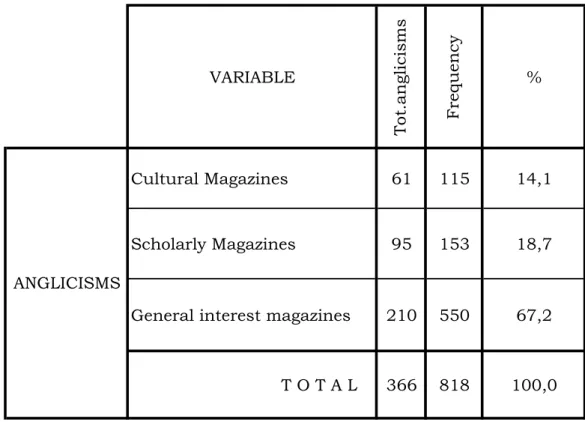
anglicisms extracted, 67% belonged to general interest magazines,
19% to scholarly magazines, and only 14% to cultural magazines.
This is due to the fact that in these types of publications the writers
try to use a more formal language. Also, anglicisms are used to
describe technical terms or devices, or they are words related to
business, entertainment, and fashion.
As conclusions it was found that the English Language and its
culture has a strong influence on the Spanish Language, and that the
number of anglicisms used depends on the age and area of interest.
Also, the anglicisms with the highest frequency of use were
blog/geros and internet, with 34 repetitions, followed closely by fútbol
Introduction
The use of anglicisms in the Spanish language has been a
concern since the mid-nineties. The first study was carried out in
Chile, in 1939, by a German female researcher who was preparing
her Doctors’ degree to become a professor at the University of Chile.
This investigation was based on newspapers and personal
correspondence of the author. After this study, several other studies
followed in Spain, some referring to anglicisms in the available
lexicon of different fields of interest, others expanding the research to
include not only anglicisms but also barbarisms, neologisms, and
false friends. Soon after, other studies of anglicisms were carried out
in other Latin American countries such as Argentina, Costa Rica,
Guatemala, Honduras, Cuba, among others, trying to understand the
origin and explain the extent of the use of anglicisms in the different
ways of communication (oral and written) as well as fields of interest.
Previous studies about the topic were carried out in the field of
technology, medicine, sports, food business, music, and other areas
of interest, but none included magazines edited and published in
Ecuador. Therefore, the topic was worth investigating to try to
determine the linguistic phenomenon of anglicisms in Ecuadorian
magazines, to determine if there was a high frequency in the use of
anglicisms, if Spanish words had been replaced by English words,
threat to deteriorate by the frequent use of anglicisms. Also, identify
the syntactic and lexical anglicisms most commonly used in Ecuador,
make a deep analysis regarding their syntax, semantics, and
morphological changes, and establish the most frequent anglicisms
comparing three different variables: cultural, general interest, and
scholarly magazines.
The study of anglicisms in Ecuadorian magazines, which is the
objective of this research, was carried out in Quito, Ecuador, and the
general approach was to collect, analyze, describe, and compare
anglicisms from three different variables: cultural, scholarly, and
general interest magazines. For this purpose, three samples of
cultural and scholarly magazines were used, and four samples of
general interest magazines, because the area of interest of this last
was the most extensive and this researcher wanted to include a more
representative sample.
The methods used were Qualitative and Quantitative. For the
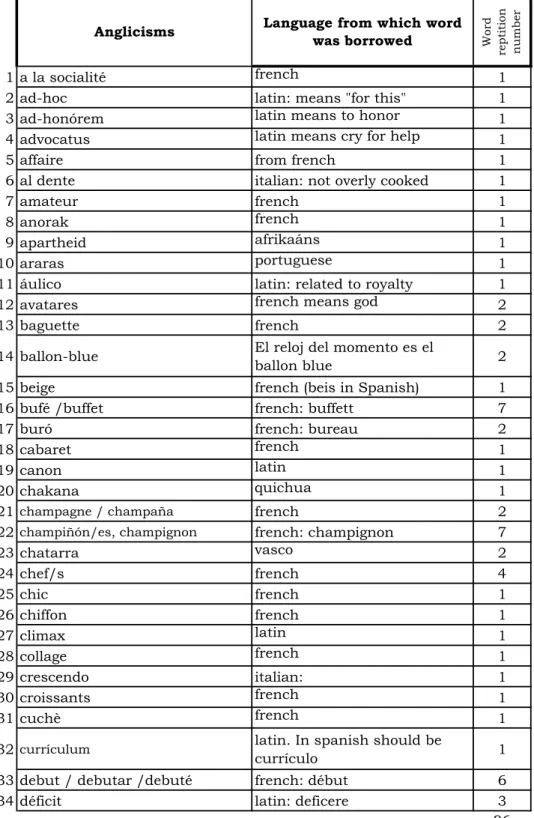
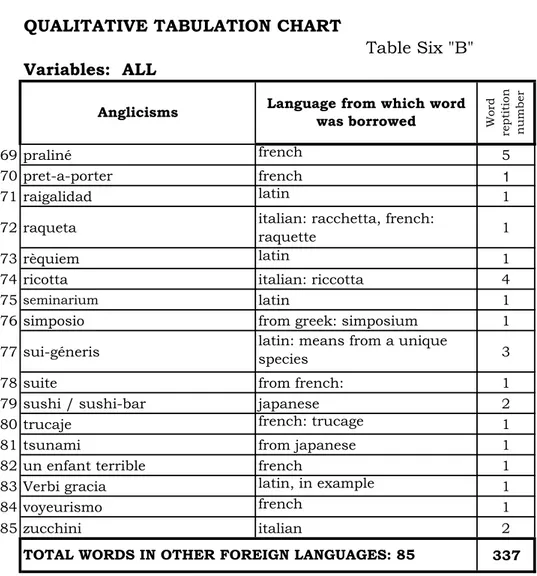
qualitative analysis the data was organized in tabulation charts,
which included lexical category and frequency as well as an example
in context of the anglicism. Qualitative charts also included a
reference and page number of where the anglicisms were found. For
the quantitative analysis, the data was ordered in alphabetically
order by frequency of word repetition, which made it easier to
This study is a pre-requisite for the graduation of at-distance
students of the “Universidad Técnica Particular de Loja”, UTPL, under
the English Education Program, to obtain their Bachelor´s degree as
teachers of English as a Foreign Language. It is important to point
out that the UTPL is an entity interested in all types of investigation
among which the linguistic research is one of them. The research
field is being strengthened and expanded through the research
studies that students have to complete before graduating.
The direct beneficiaries of this study would be the UTPL and its
students, as well as any other researcher who would like to refer to
the results of this study as a basis for future studies and
comparisons of anglicisms in the written form.
It is important to mention that one of the limitations to this
study was the difficulty to acquire cultural magazines, as these are
given for free by la “Casa de la Cultura Ecuatoriana”, so only one
magazine was received by month which prolonged the time originally
scheduled for the scanning of anglicisms.
Based on the experiences acquired during this study it is
believed that to improve future researches, more extensive studies
should be carried out expanding the variables and specifying the
fields of interest in each variable, so that the sample of the population
writing and reading the Ecuadorian magazines is more
In order to conclude if the objectives of this study were met or
not, it is important to remember that the main objective was to
determine all the aspects related to the phenomenon of anglicisms in
Ecuadorian magazines, gathering all the anglicisms found in the
chosen samples and determining which were the most frequent and
why. This was accomplished through the qualitative and quantitative
analysis.
Another objective was to perform an in-depth analysis of the 10
most frequent anglicims of each variable, to determine its syntax,
semantics, lexical category and morphological changes. All of the
above was accomplished in the linguistic analysis. The comparative
analysis determined not only the anglicisms most frequently used,
but which variable among the three chosen contained the highest
number of anglicisms and why.
Methodology
The research on the linguistic phenomenon of anglicisms in
Ecuadorian magazines was carried out in Quito, the capital of
Ecuador. The study started with the gathering of bibliography and
information about previous studies, to be able to understand the
extent of previous research and at the same time have an in-depth
understanding of the different areas that were going to be analyzed.
The forms to gather this information were designed using Microsoft
Excel.
This research used mainly two general approaches for the
analysis of the data: the quantitative and qualitative methods. The
data was collected from three different variables: cultural interest,
scholarly, and general interest.
For this study ten different magazines were chosen to be read
and scanned for anglicisms. The selection criterion was that they
had to be edited and published in Ecuador. From these, three were
magazines published by the “Casa de la Cultura Ecuatoriana”,
therefore belonged to the cultural interest variable. The readers of
these magazines are mainly intellectuals, men and women interested
in science, arts and culture. Two other magazines were aimed to
lawyers, and one for businessmen, so they were catalogued under the
the last a sports magazine. The sports magazine was chosen
specifically to determine the number of anglicisms in this field
compared to other areas of interest. The four general interest
magazines were carefully selected in order to have a more
representative sample of the Ecuadorian population for this variable,
and at the same time have a reference to compare the areas of
interest in which the anglicisms appear more frequently.
For the qualitative analysis, all ten magazines were read
carefully, using the techniques of skimming and scanning to identify
the anglicisms. Once identified, they were highlighted and then
transferred to the qualitative tabulation charts designed for this
research using Microsoft Excel. This software was used because it
allows the creation of worksheets, the formation of columns and cells,
the organizing of data in a hierarchical way, as well as addition of
frequencies. These charts included examples of how the anglicisms
were found in the general context, as well as their function (lexical
category) and the number of times they were repeated. Information
about where to find each anglicism, such as the bibliography and
page number was also included. Once all the words were tabulated in
these qualitative charts, they were organized in alphabetical order by
magazine and variable, to be able to find the anglicims more easily
during the description, analysis and counting.
With the data of the qualitative charts, additional charts were
charts and quantitative tabulation charts (tables four, five A and B).
The purpose of these charts was to determine the frequency of the
anglisms in each and all variables, as well as the number of word
repetition for each anglicism.
While reading and organizing the data in the qualitative charts,
notes were taken regarding the frequency of anglicisms, the areas of
interest, preferences, syntax, and morphological changes. This
information was used later, together with the quantitative and
qualitative charts, for the description, interpretation, and analysis of
the results, as well as to write the conclusions.
For the description, analysis and interpretation of the data, a
linguistic and comparative analysis was performed. For the linguistic
analysis only 32 anglicisms were chosen, following the criterion of the
most frequent anglicisms in all three variables, according to table
four. Each of these anglicims was analyzed in a syntactic and
semantically way, describing their meaning and function based on
three different dictionaries: The “Diccionario de la Real Academia de
la Lengua Española” (DRAE), the Webster Thesaurus Dictionary, and
the Merriam-Webster Dictionary. These three dictionaries were
chosen as the most complete and precise sources to determine the
origin, meaning, function, synonyms, and translations of the words.
The origin and morphological changes or adaptations of the
terms were described in detail, comparing the spelling of each word in
used, the way singulars and plurals were formed, as well as the
modification in function. The DRAE was consulted to verify if the
anglicism were accepted by the “Real Academia de la Lengua” (RAE)
or not, and both, the DRAE and Webster’s Dictionary provided the
equivalent of the words in Spanish.
For the comparative analysis the frequency of anglicisms in the
three variables was compared to the total of anglicisms, determining
the most frequent anglicisms in each variable and the most preferred.
Moreover, the magazines within each variable were also compared
among each other, to determine which magazine had more
anglicisms. Due to the fact that for the cultural interest variable
three different editions of the same publication were used, a
comparison of the amount of anglicisms between the first two
editions from 2009 and the last edition from 2010 was performed, to
determine if there was an increase or decrease in frequency.
To conclude, several suggestions for future research were
included in the conclusions, based on the observation of the high
frequency of words from other foreign languages and the presence of
DISCUSSION
Literature Review
For those interested in linguistics, the study of the evolution of
a language has been of great interest over a long period of time. It is
well known that most words from modern languages have their origin
in the ancient Latin and Greek languages. How a language evolves
and changes due to different factors, as well as what these specific
changes are and imply, help us understand and explain the “history
of a language” in close relation with its time, environment, culture,
and population.
A Spanish speaking country such as Ecuador, has been
strongly influenced by the language and culture of its neighbor at the
North, the United States, just as its Latin American neighbors from
Central and South America. All these countries would eventually
show signs of this influence in the language and behavior of its
people. The most important sign of influence is the use of anglicisms.
Referring to anglicisms, the field of study is so extensive that
this specific research will focus only on the use of words borrowed
from the English language and incorporated to the written Spanish
used in Ecuadorian magazines. The purpose would be to establish
the frequency of anglicisms in three different types of magazines:
determine if the Spanish of Ecuador is being enriched or polluted by
these anglicisms.
To have a clearer understanding of how a language changes
to fit the new environment and culture where it is being used, as well
as the population that is using it at that specific time, a researcher
must go back in time and try to get a general overview of how people
communicated in the past. According to Bloomfield and Sapir (1924),
Linguistics of the XX Century and leaders of a new school called
“Structural Linguistics”, words are independent structures that form
a language, and therefore their origin could be traced back in time
and related to other languages.
Once the historical background is established, a researcher
will then compare the oral and written language used in the present,
extracting specific words or sentences that are most commonly used,
for their corresponding analysis. All this falls into the field of
Linguistics, which the Columbia Encyclopedia defines as a “scientific
study of language”, and the Britannica Encyclopedia defines as “a
study of the nature and structure of a language”.
For this study, several branches of linguistics will help
acquire an in-depth vision of different aspects related to the new
words matter of this study, which are anglicisms. These subfields
are:
Synchronic Linguistics, which aims specifically at the language
Diachronic Linguistics, which studies the historical development
of a language, the origin of each word and how it has changed over
time until “adopted” by Spanish in the form of an anglicism;
Sociolinguistics, which according to the Columbia Encyclopedia
is “the relationship between linguistic variation and social
structures”, such as: gender, age, and social class including level of
education and culture;
Contact Linguistics, will help examine what happens when
speakers of two different languages, such as English and Spanish in
this case, get in contact, and will also try to find evidence of loan
words; and finally,
Etymology would be crucial to identify words that are a result
from linguistic contact.
For the purpose of understanding the analysis of the
anglicisms of this study, the definition of several terms should be
clear to the reader. Therefore, following is a brief explanation of each
of the terms that will be used, all considered fields of linguistics:
Morphology is the study of how words are formed and change
depending on how they would be used. This means morphology
analyzes the smallest units that form words, which are called
morphemes. According to Boeree (2003) the difference in a language
comes from its morphology. Languages can be in flexional if they
change at a phonemic level, agglutinating if they form morphemes by
words. Both the English and Spanish languages use all three
systems, but English is richer in affixes, roots and stems, so
linguistics consider it more an in-flexional language.
Semantics is the study of the meaning of words, how these
change in time or depending on how, when, where or why words are
used by specific people. Therefore, we can say that the social context
definitively affects the semantics. Moore (2000, p.1) says that “the
study of semantics includes the study of how meaning is constructed,
interpreted, clarified, obscured, illustrated, simplified negotiated,
contradicted and paraphrased”.
Pragmatics, is the study of how people comprehend and
communicate during a concrete situation, which is usually a
conversation. Leech, (1983), and Sperber & Wilson (1986) have
identified two intents while communicating verbally: the informative
intent and the communicative intent. According to Kasper (1997), pragmatic competence can be identified observing the ability to
comprehend, which would then lead to an act of communication.
Any communicative situation should take into consideration social
distance, social status and education of the speakers, and some
cultural knowledge such as rules of politeness.
Phonology, “is the study of how sounds are organized and
used in natural languages” (SIL International, 2004, p.1). This area
is very important for this study, as it becomes the basis for the
phonology is closely related to how people use and learned to use
their organs of speech. He also says that socio-linguistics must be
considered when analyzing phonology, as two social attitudes are
observed: accent and intonation.
Syntax comes from the Greek and means “arrange together”.
According to the Encyclopedia Britannica, it is the rules by which
words in sentences, clauses, and phrases are combined, as well as
their relationship. Chomsky (1971, p. 11) defined Syntax as “the
study of the principles and processes by which sentences are
constructed in particular languages”.
When analyzing syntax we necessarily have to focus on the
Lexical Categories also known as Parts of Speech, Word Class, or
Grammatical Category. These refer specifically to the words, more
precisely lexical units that form the sentences. These traditional
parts of speech, also known as “open word classes” are divided in two
main categories: major which are noun, verb, adjective, and adverb;
and minor which are pronoun, preposition, conjunction, and
interjection. Closed word classes include: auxiliary verbs, clitics
(contractions and abbreviations), determiners (articles, quantifiers,
demonstrative adjectives, and possessive adjectives), particles
(interjections, connectors, conjunctions, tags), measure words (count
nouns, cardinal numbers). (SIL International. 2004)
In order to identify what a Contact Languages is, I should
The Collins English Dictionary online (1985) describes it as: “...
the language of a particular nation or people” or “a form of a language
spoken in a particular geographical area or by members of a
particular social class or occupational group, distinguished by its
vocabulary, grammar, and pronunciation”.
The Oxford Dictionary online (1982) defines language as: “a
form of speech peculiar to a district or class; subordinate variety of a
language with non-standard vocabulary, pronunciation, or idioms”.
Sebba (1997) stated that “there is a close association
between language and nation, people, or country”. Sankof (2001)
added: “languages spoken by bilinguals influence each other in
various ways”. Therefore, the origin of a Contact Language is the
need of people to communicate, so they join the languages they are in
contact with to create a whole new language or variations of them
(dialects).
Language Vice refers to new words incorporated to the
language, but that are used incorrectly. Fleishman (1998) considers
it a bad habit in communication and something that is “learned” by
different types of experiences. However, once it is understood that
the language being used is not the appropriate one, and that it
generates negative reactions in other people, it can be changed
following certain rules to learn to communicate better.
Barbarism, as defined by MacArthur (1998) in his Concise
elements from different languages but when put together they either
do not combine or because of their odd combination, are considered
of “bad taste” or offensive.
The term barbarism has its origin in the Latin language. It
was first used in 1579 to refer to barbarian people who were ignorant
of the purity of the Latin language, by Aelius Donatus, and means
“the use of words or expressions not in accordance with the classical
standard of a language..." (Long, 2008)
To define Anglicisms I would use two definitions that Olivares
(2009, pp. 1-2) refers to: “an anglicism is a word or idiom that is
recognizably English in its form (spelling, pronunciation, morphology,
or at least one of the three), but is accepted as an item in the
vocabulary of the receptor language”. Görlach (2003, p. 1); “… a
linguistic element, or group of elements, used in the contemporary
peninsular Spanish, and that has its immediate source an English
model”. Pratt (1980, p. 115)
In general terms, anglicisms are words or phrases taken from
the English language and used in Spanish, either in its purest form or
in a variation of its original form. The extended definition by the
Webster´s online dictionary defines an anglicism as “a word borrowed
from English into another language. Speakers of the recipient
language usually consider an anglicism to be substandard or
According to Molina (2001), people use anglicisms without
even knowing that they are foreign words. He believes that even if a
word has been translated it can still be considered an anglicism
because its origin is still English. He mentions a very clear example,
which is the expression “on-line” to refer to communication through
computers. When translated, “on-line” is “en-línea”, a term that has
reproduced the meaning word by word.
Another type of anglicism is a word that adapts its
pronunciation to that of English but follows the Spanish rules for
writing. Some examples of this can be: fútbol (for football instead of
balón-pie), guachimán (for watchman) referring to the guard of a
construction, and sanduche (for sandwich).
Sáez (2005) mentions that English, contrary to Spanish, is a
language that is not concerned about its purity, as it is very open to
absorb terms considered useful or even interesting from other
languages. Such is the case of the words ketchup that comes from
the Malaysian, shampoo from the Hindu, and bungalow from the
Bengali. It is also a language that creates words faced with the need
to do it. This is why the great majority of technical terms come from
English, and all these words are then adopted by Spanish.
Borrowing used as a verb, refers to the act of “importing
features from other languages into the native language” (Sankoff
native as possible, others keeping the foreign pronunciation. If the
word borrowing is used as a noun, then it refers to a loanword.
Loans or loanwords are words borrowed from a language
considered the source language and that has a strong influence over
another language. In the case of our study, anglicisms are loans or
borrowings originated in the English language and incorporated into
the Spanish language. But according to Prof. Kemmer (2009) both
terms, borrowings and loans, are only metaphors because they do not
reflect what really happens to the borrowed or loaned words, as there
is no “lending”, on the contrary, the borrowing is permanent.
Corelli (1998, pp.1) believes that a language is made of
native and borrowed words, sometimes being the loans more than the
native words. For her, loans are “words taken from another language
and modified according to the patterns of the receiving language”,
and as time passes, the borrowed words are difficult to distinguish
unless an in-depth etymological analysis is performed. Corelli
explains that there is a difference between the origin and source of
the borrowing. The first is the language to where the loaned word
can be traced back in time, also known as indirect borrowing; the
second refers to a direct borrowing from the language from which the
word was immediately borrowed. Nunnemann (2010) believes that
when the need for a new term arises, it is rare to generate a
neologism or new term in the same language. Instead, if a foreign
The term magazine has its origin in the late 16th.century, from the Italian and French. The Oxford dictionary online defines
magazine as “a periodical publication containing articles and
illustrations, typically covering a particular subject or area of
interest”.
The description of a magazine in Wikipedia is “… a publication,
generally published on a regular schedule, containing a variety of
articles, generally financed by advertising, by a purchase price, by
pre-paid magazine subscriptions, or all three”.
Cultural magazines, specifically for this study, refer to
publications from la “Casa de la Cultura Ecuatoriana Benjamín
Carrión” (Ecuadorian House of Culture), written in a very formal
language. They include a wide variety of cultural and artistically
articles such as book reviews, literary pieces, and articles of common
interest. It is aimed to intellectuals, Ecuadorian men and women
interested in science, arts and culture.
Scholarly magazines refer to publications for professionals,
businessmen, and entrepreneurs. They include mainly articles and
editorials about law, economy, and compared rights, among others,
written by well-known professors, lawyers, and people working in the
mass media. The language used is formal, and they include a great
variety of legal terms.
General interest magazines refer to publications for a wide
levels of education. The articles included are: analysis of national
and international headline-news, interviews, sports, information
about the latest technology, books, health, tourism, fashion, movies,
decoration, among others. These magazines, depending on the
audience they aim for, use a formal or semi-formal language, as well
as vernacular terms, or terms related specifically to the topic
described in the different articles.
Previous studies about anglicisms have been carried out
both, in the oral and written form, and it gained interest over the last
10 years. The written publications that were used were: newspapers,
manuals, books, personal correspondence, food wrappings, as well as
music, science, and medical magazines. These studies were carried
out in Spanish speaking countries such as Chile, Argentina,
Costa-Rica, Guatemala, Cuba, and Spain, among others.
One of the first studies about anglicisms was carried out by
Schwarzhaupt (1940) in Chile, as mentioned by Saez-Godoy (1997) in
his study. The research was based on written material such as
newspapers and books of that time, but mostly the personal
correspondence of Schwarzhaupt with people and friends from Chile.
According to this research, in the middle of the last century, about 70
years ago, the UK and USA were the countries that had a greater
impact on the Chilean Spanish. The majority of anglicisms related to
sports, navigation, and clothing came from the UK, while foreign
came from the USA. Moreover, the use of anglicisms in South
America kept expanding rapidly into the areas of industry, commerce,
communication, and mass media.
There are two opposite points of view when evaluating the
impact of anglicisms in the Spanish language. Saez (2005) explains
that English speakers consider the importing of terms from other
languages“enrichment”, while Spanish speakers consider foreign
words “intruders”. Mallo (1954), a teacher of Spanish at the
University of Iowa, refers to anglicisms as a “plague” because the
influence of the USA on Spanish speaking countries is enormous.
This phenomenon of contact language produces a reciprocal impact,
which produces the “corruption” of one or both languages. According
to Mallo, the majority of anglicisms used by Spanish speakers in the
USA come from three sources: 1) newspapers and magazines in
Spanish but published in the USA; 2) poor translations of books and
magazines; 3) a lack of a high-quality teaching of the Spanish
language. It will be interesting to research if similar sources cause
the use of anglicisms in Ecuador.
According to Castro (2000), the use of terms borrowed from
other languages is increasing to such proportions that it can be
considered and “invasion” of the language that adopts them, and
foreign terms can eventually deteriorate the language they are
Delgado (2005) provides a description of the most frequent
anglicisms used in the written press in Costa Rica, analyzing their
lexicon, semantics and morphology, including the syntax in which
each anglicism is used. Delgado´s research uses a method similar to
the one that would be used in the study of anglicisms in Ecuadorian
magazines; therefore his results would be taken into account and
compared to those reached in this study. The study of Olivares
(2009) in particular, would be very valuable in the current research,
as it focuses on the study of anglicisms extracted from magazines,
and the method for the analysis of anglicisms is similar to the method
and analysis of this study.
González (2005), in her study about anglicisms used by
Costa Rican narrators of volleyball games, tried to establish if the
origin of these anglicisms could be found in the relationship
culture-language, which in the end she did prove. From the data analyzed
she could determine that the borrowings were very frequent in sports,
and that the Spanish language borrowed words from English to fill
the gaps needed for a fluent communication, therefore changing
constantly. González was not only interested in the origin but in
categorizing the terms by type of loan or borrowing depending on
their specific lexicon. Due to the great number of anglicisms found,
she even went further, having in mind to gather as many of these
anglicisms as possible to create a new Spanish dictionary, including
According to Sampedro (2000), most anglicisms used in the
world of computer science are technical words for which there is no
translation. When using the terms they are not always used in their
pure English form, but their phonology is adapted or they are used
within a different syntax, which turns the original technical terms
into “false friends”. To avoid this, Sampedro suggested the creation
of a set of lexical and syntax rules for when anglicisms needed to be
used, to avoid distortion of the main idea. Moreover, Sampedro
believes that even though there is a proper translation for many of
these technical terms, because translation varies depending on the
region or country, translations are not well accepted.
In the study about written anglicisms in the written press,
by Delgado (2005), it was determined that 45% of the anglicisms were
found in fashion and movies, 23% in sports, 18% in national news,
and contrary to what was expected, only 2% in the international
news. Among his conclusions, he stated that foreign terms are used
mainly to avoid confusion or misunderstandings when using
technical terms, as the great majority of people are already familiar
with the English terms. Delgado also believes that one of the reasons
for using anglicisms is that people want to show that they are
up-to-date or for “status”, so they are more respected. Based on his
findings, he reaches the conclusion that the Spanish language should
accept as many anglicisms as necessary to improve communication,
find the proper term in Spanish, which he considers an act of
“surrendering” to the English language.
Another researcher who used magazines as the source of her
data to study the lexicon of anglicisms in economic-scientific
magazines was Diéguez (2004). She used a descriptive analysis, both
quantitative (use and function within the context), and qualitative
(linguistic, descriptive and functional), with a multidisciplinary focus.
The analysis was based on written texts, mainly informative. For the
quantitative analysis, all anglicisms found in the text were organized
into lists, by groups. Within her results she concluded that articles
were used with anglicisms, first giving personification to objects, or
using the analogy of the article in Spanish. The percentage of
anglicisms not assimilated reached 95%, one-percent was partially
assimilated, and only 4% were totally assimilated. The reason for
such a high percentage of anglicisms that were not assimilated was
due to the lack of an equivalent of the word in Spanish, so the
English word was used in its original form. The variables of
"lexical-corpus" added up to 71.1%. She also found that the variables that
influence the use of anglicisms are: communication (type, situation,
speaker and audience), space, time, intention, pragmatic information,
and social distance. Anglicsms contribute to lexical cohesion, and
they are used to reinforce an idea. The increasing trend of using
anglicisms could be to "save" time by using one-syllable words, more
González & Orellana (2001) carried out research in a sample
of 400 pre-university students, in the Province of Cádiz, Spain, to
determine the frequency of the use of anglicisms in their oral lexical.
A test of mental association in 16 different areas of interest was taken
to gather the data, where the subjects had to write down as many
words as would come to their minds in two minutes. The conclusions
that these authors reached were that only 2.4% of the total of lexical
units analyzed were anglicisms, and were limited to sports and
games, which is minimum and not a threat to the purity of the
language. This study provides a starting point to compare the use of
anglicisms in the new continent and in the old continent, to try to
determine if the adoption of foreign words from the English language
is greater in Latin America than in a European country such as
Spain.
In the other hand, Laffar-Smith (2010) believes that the
world´s literacy is going backwards, because young people do not
appreciate the complexity and diversity of a language, but prefer
“speed and stylized text”, which are the consequence of the expanded
use of cell-phones and internet. A great majority of the abbreviations
used in this speed communication are anglicisms.
Other researchers who carried out a study of anglicisms in
medical magazines related to cardiology were Fijo & de la Torre
(2006), as an extension of previous studies that took place in
time to compare these two countries as the most representative of two
different continents, America and Europe. As González and Orellana
(2001) had determined before them, Fijo & de la Torre (2006) reached
the conclusion that anglicisms are less used in Spain, as Spaniards
are more aware of the need to preserve the purity of the Spanish
language. They also determined that there is a strong preference to
using the technical terms in their original language, English, but
analogies are used equally in both countries, as well as homophones,
which are words with similar sounds but different meanings.
Moreover, the diatopic or phonetic variation in the terms used
depends on the geographical location.
Ramírez & Pérez (2006) published their findings after a
survey of students from the University of Holguín, Cuba, to determine
the frequency of the use of anglicisms in the spoken language. The
students were asked to choose the terms they most commonly used,
among 40 sentences that included 50 anglicisms. Eighty-eight
percent of those interviewed said they used more than 25 anglicisms
when speaking. The subjects of this study stated that their main
reason for using anglicisms was that English was a “business”
language; therefore they had no choice but to follow the flow.
Ramírez & Pérez strongly support preserving the purity of the
Spanish language, and their findings were published as a warning to
prevent the expansion of what they considered a “risky and bad”
creation of a radio program, “Entre Palabras” (within words), to
motivate the people of the island to use Spanish without anglicisms.
Castro (2010) analyzed the wrapping of ten products from
local supermarkets in the city of San Carlos, Guatemala. This author
found that the majority of food wrappings include anglicisms, which
is the cause for the wide use of the new English terms instead of the
traditional Spanish ones. Moreover, the author also stated that the
mass media has an enormous influence on the language, but the
impact can either be positive or negative. Castro agrees with Ramírez
& Pérez (2006), when saying that the increase in the frequency of the
use of anglicisms is becoming a threat to the roots and purity of the
Spanish language, which could end in a poor ability to communicate,
or even worse, a loss of the identity of a culture.
In the field of music, Olivares (2009) carried out research to
determine the factors that determine the increase in the use of
anglicisms. This study used the data extracted from six issues of
musical magazines, and it focused on the lexicon as well as the
phonological, morphological, and syntax variations. Olivares went a
little deeper, analyzing style and socio-linguistic aspects. In her
opinion, the use of anglicisms is more frequent in young people
because of the wide exposure they have to the mass media, especially
radio and television. The other sources of exposure are the sections
of music and fashion in magazines of general interest, as well as all
to use anglicisms to “fit-in”, belong to a group, or to be able to
communicate with short words more easily, using abbreviations and
affixes that are more available in the English language.
Olivares (2009) agrees with González (2005) when she
suggests that the origin of anglicisms is a “trans-culture phenomena”,
which means that the permanent contact between cultures makes
both adopt certain features from the other; in this case, borrowed
words. While Castro (2010) and Ramírez & Pérez (2006) consider
anglicisms a threat to the purity of the language, Olivares believes
that a moderate use of anglicisms in Spanish can make the language
richer, as long as there is no abuse in their use. Olivares adds that
the borrowing of words from a foreign language has always existed, in
all languages, so it might as well be accepted.
Sebba (1997), in his paper “Contact Languages” says that it’s
a normal process for languages to incorporate new words into their
vocabulary, as a result of the contact with other languages, but the
“core elements” of its vocabulary remain. He believes that it is
impossible for a language to remain pure over time; therefore their
boundaries invade each other. This invasion produces consequences
such as: borrowing of vocabulary and grammar, code-switching
(changing from one language to another when speaking, which
involves a high degree of bilingualism), language convergence
(languages change becoming very similar but keeping their own
and change into a new version of both, like a dialect), and language
mixing.
The majority of studies agree that the majority of anglicisms
are “technical terms”, which either do not have a translation or are
terms created specifically to fill the need for words to identify new
areas and inventions. They also agree on the idea that the Spanish
language is constantly changing and adapting to the needs of the
present times, as new terms are created daily, especially in the area
of technology.
The extent of this study is somehow limited to written
Spanish in Ecuadorian magazines. However, future studies of the
Spanish of Ecuador in its oral and written forms will have to
determine if the use of anglicisms is a progress or a deterioration of
its language, if the evolution of the native language is a short or long
term phenomena, and whether it is moving towards a language loss,
Description, Interpretation, and Analysis of Results
This analysis will focus on 30 of the most frequent anglicisms
found within a total of 366, with a frequency of repetition of 818. The
words were collected from three different variables, cultural,
scholarly, and general interest magazines edited and published in
Ecuador. The criteria for the selection was anglicisms that were
repeated more than four times and that could provide a rich
background for their analysis. Each anglicisms was analyzed both,
linguistically and comparatively. The linguistic analysis included a
semantic-syntactic description including the function and meaning of
each term. If there was an equivalent of the anglicisms in the
Spanish language, based on the latest revision of the “Diccionario de
la Real Academia de la Lengua” (DRAE), the Websters dictionary
(WD) and the Merriam-Websters dictionary (MWD), it was also
included. If a spanish word was replaced by an anglicism, then a
morphological analysis of all the changes and adaptations of the word
through time was included as well.
The comparative analysis included frequencies, percentages,
and totals, as well as a comparison between variables, including
possible causes.
For a better organization, the most frequent anglicisms were
Linguistic Analysis:
Bar, its origin is Middle English, from early French “barre”,
which had the same meaning. The equivalent word in Spanish is
“barra”. It was found eight times, always as a noun. According to the
WB, it refers to a “counter where food and/or drinks are bought”, but
in the context found, “bar-abierto”, “sushi-bar”, “bar-58” it referred
more to a place or small restaurant not just a counter. It maintains
its English spelling and no examples were found in the plural form, in
order to determine if the plural is formed either with only an “s” or an
“es” following the Spanish rules for making plurals. The term has
been included in the DRAE as a word of English origin, and even
though there is an equivalent term in Spanish, the anglicism is
preferred.
Blog(s), according to the WD it is “a journal available on the web”. Its origin is American English and it maintains its original
spelling as observed in the example “en el blog del jugador”. It was
found 34 times with its different variations blogger, blogeros, and all three words are used as nouns in both languages. The word
blogger/os refers to the people who create, update and use the blogs. It was found twice as a noun, as in the example “a pesar de lo que piensa la respectable blogger”, “para el blogger P.H....”
Morphologically, an “s” is added to blog to make the plural, just
as in English, so blog and blogs was found 30 times. However, in
added at the end, as in the example “diseñador y bloguero”. If
applying the English rule it should be “bloggeros”, but instead it is
written only with one “g”, adapting the word to the rules of the
Spanish grammar to make plurals. The word is not included in the
DRAE yet, even though there is no equivalent of the word in Spanish
and the anglicism is frequently used.
Business is an anglicism very commonly used in its English form, refering to “a commercial or industrial enterprise” that offers
any type of good or service. Even though the equivalent of the word in
Spanish is “negocio”, it was found nine times as a noun, as in the
examples “business decision makers”, “... business review”,
“business solutions”. No adaptations in spelling or function were
observed for the word business, and it was only found in the
scholarly magazines. The anglicism is used mainly to refer to either
service providers from abroad, such as “Harvard or Toyota Business”,
or to specific business models imported from foreign models. The
word is not found in the DRAE and its origin is American English.
Champions league was found eight times, only one of the variables: a sports magazines, as it specifically refers to a football
competition for the UEFA title. It is a combination of noun-noun,
where the first noun is functioning as adjective. It is used in its
English form, and it can be considered a proper noun; however, it is
included in this analysis due to the frequency with which it is used,
Examples are: “partidos de la Champions League”, “hizo un gol en la
CL”, “piensan en ganar la CL”. Its translation to Spanish is “Liga de
Campeones”, but the translation is not used. The anglicism is not
written between quotes either. The combination of the two words is
found in the WD in its extended definition, describing it as the official
title of the European football competition. Neither champions nor
league is included in the DRAE.
Chat(s) is considered by the WD as an American-English term that refers to an informal conversation on line. The extended
definition describes it as a “real time on-line conversation” of one or
several people using a computer. In example: “se comunica con su
madre vía chat”, or “la aplicación preferida es el chat”. The plural
adding an “s” is also used in Spanish, as in “los chats eróticos son
líneas de fuga”. However, the verb “to chat” is conjugated using the
Spanish conjugation, adding the termination “ear”, chatear, refering to the act of having a conversation on the net. In example: “chatear y
compartir”. Both anglicisms are widely used in Spanish with no
translation. The word “chatear” appears in the DRAE as the action of
drinking chatos or wine in short-wide glasses usually used in
taverns. This definition does not agree with how the word is used
when reading “chatear y compartir en la net”, therefore the word was modified and adapted the need of describing the action of chatting.
However, the plural is made adding “es” following the Spanish rules
for making plurals, instead of only “s” which is the way how it would
be changed into a plural in English. In example: “es el torneo de
clubes más prestigioso”. This anglicism is included in the DRAE as
a word of English origin, with three definitions: “a society of people
with the same interests”, as in the example “clubes como el Espoli”,
“cine club”, “wellness club”. The word club also refers to a “place
where the people of these societies meet”, as in “este club está al
momento sin cancha”. A third definition is “a place where people
gather at night to eat, drink, dance and watch shows”, but no
examples were found using club with this meaning as the word “bar”
is preferred.
The WD includes more than twelve definitions for the word
functioning as noun, as an equal number for the word functioning as
verb; however, in the magazines used in this study club was never found used as a verb. The anglicism is used because such a short
word describes an entire place and what happens in it, instead of the
translation which will require one or two sentences.
Cocktail(es), with its alternative spelling cóctel, are included in the DRAE as a word from English origin. In example: “vestido de noche o de cóctel”. It is used as a noun, and refers to both: a party
where alcoholic drinks are served, such as in the example “ofreció un
cocktail in honor a...”, and a mixed sweet alcoholic beverage as well,
it as an “appetizer served as the first course of a meal”, or an
adjective when describing a “cocktail glass”. However, the five times
this anglicism was found in the variable of general-interest, it was
always used as a noun like in “sirvieron cocteles”, “ofreció un
cocktail”, or “vestido de cóctel”. Therefore, this word has
experienced several morphological changes from its original spelling
“cocktail”, to coktail, cóctel or coctel. The plural adding “es” as in
Spanish also varies from the English plural. The traslation of cocktail
would be “bebida combinada”, which if used would not be
understood; therefore the anglicism has been modified in its spelling
dropping the “k”, to be used in Spanish as a noun with the same
meaning than in English.
Cómic(s), according to the DRAE, is a word of English origin, but it has changed morphologically adding the graphic accent on the
“o” or adding “as” to the end like in cómicas, to give it a Spanish accent. The word is included in the DRAE as “cómic”, with two
definitions: a sequence of drawings with a narrative context, as in
the example: “creó un cómic”, and also a book or magazine made up
of this sequence of drawings, as in “sus cómics favoritos son...”. The
anglicism was found a total of eight times all as nouns. Some examples are: “cómics y ciencia-ficción”, “no habrá más cómics”,
and the plural of the word is made either adding only the “s” as in
English, in example “no más cómics retro”, or using two plurals
translation of the word would be “viñetas”, but the combination of
“tiras còmicas” is most frequently used, because “viñetas” is not a
term very well know or used for these type of drawings.
Email or mail in their singular and plural forms emails, mails, using the English spelling, was found seven times. Some examples
are: “envío de mails”, “videos, fotos, emails”. Neither mail nor email
is accepted by the RAE, but the WD includes the Spanish translation
as “correo electrónico”. Both, the anglicism and its equivalent in
Spanish are widely used and known, and they refer to a “system of
world-wide electronic communication”. The anglicism is used mainly
as a noun, such as in “...animado con las llamadas y mails”, but it
was also found functioning as an adjective in “correspondencia vía
email”. In English it can also be used as a verb, i.e. “I would email
you”, but the anglicism was not used as a verb in any of the variables
analyzed.
The word estrés has been added to the DRAE and is described as an extreme tension that can cause many types of psychological
and physiological negative effects. This word was found eight times,
with a morphological variation which was to add an “e” at the
beginning of the word. However, the English spelling stress is also
used. Some examples of how this word is used with both spellings
are: “...los niveles de estrés suben”, and “crema anti-stress”. In the
first example the word is used as a noun, but in the second it is used
conjugating the word following Spanish rules, as in the example,
“...muchos se estresan”. The DRAE only has one definition for the noun, but the WD has ten different definitions for the noun and
another ten for the verb. The equivalent in Spanish would be
“tensión”, which is also used, but the anglicism estrés is preferred because it describes an extreme condition of emotional strain, while
the Spanish word “tensión” describes more a temporary condition of
short duration and with no lasting side-effects.
Fashion(s), its origin Middle English, comes from the word facioun which means "shape, manner"; from early
French façon which had the same meaning, and from Latin faction
-factio which means "action of making", and from facere "to make, do"
.
The MWD describes the word as a noun and also as a transitive verb.
It also includes some synonyms for fashion such as: style, mode, vogue, craze, and defines these words as “usage accepted by those
who want to be up-dated”, but mentions that the word fashion is the term most used and of general acceptance. The WB includes seven
definitions for the word fashion as a noun, and six as a verb. In the example: “hasta llegar a los fashions de Miami...”, it is used as a
noun; however, the Anglicism is used mainly as an adjective, as in
the examples: “fashion-week”, “la joven más fashion”, referring to a
trend or “style of clothes, cosmetics, and behavior”, which is one of
the definitions included in the WD. This word has not been included
fails to describe such a high-quality trend which seems to be the
connotation of the word fashion in English. Therefore, the anglicism is more used in its original form, with no modifications or
morphological changes neither in singular nor in plural, and it is also
preferred in the “fashion world” of clothes and cosmetics.
Flash(es) is an anglicism recognized by the RAE, and included in the DRAE as a noun with three different definitions: a device that
produces light to take a photograph when there is not enough light;
the intense light produced by such device; and an urgent an brief
piece of news. However, the MWD includes 14 different definitions of
the word functioning as transitive and intransitive verb, eight
functioning as noun, and two functioning as adjective. The origin is
Middle English, from the word flaschen. The anglicism maintains its
English spelling and the plural is formed adding “es” as in English.
From the six times the word flash was found, four where functioning as nouns, such as in “sonrisa espontáneo y no de flash”, one as adjective as in “memoria flash”, and one as a compound word also functioning as noun, as in “... hago un flash-back”, referring to the action of bringing back a previous memory. The Websters dictionary
includes the equivalent of flash in Spanish, which is “destello” or “relampaguear”, however, the anglicism is preferred due to its
connotation of intensity.
futbolísticamente, it was repeated 45 times in the only sports magazine chosen for this research. The term fútbol is included in
the DRAE as a noun, with two different ways to spell it: fútbol with a
graphic accent, and futbol without it. The equivalent of this word in
Spanish is “balompié”, and it refers specifically to the game which in
North America is known as soccer and the the WD describes football
(fútbol) as “the game were two teams of eleven players kick or head a
ball into the opponents’ goal”. The word fútbol is mostly used as a noun, or with the combination noun-noun, where the anglicism
fútbol functions as an adjective as in “estrella del fútbol” or “institución del fútbol”. The word has changed morphologically from the original “football” in English, replacing the doble “oo” from “foot”
with the phonetical sound of the “u” in Spanish, and the second
syllable “ball” with “bol” as it sounds in Spanish. From this original
modification other variations have taken place as well: a fútbol player
is a futbolista instead of a “jugador de fútbol”; for the anglicism to function as an adjective as in “ìdolo futbolístico” or “carrera
futbolística”, the suffix “ístico/a” was added; and for the same word
to function as an adverb as in “nació futbolísticamente”, the
termination “ísticamente” was added.
Gay(s) is an anglicism used to refer to a homosexual or to anything related to or used by them. The term is included in the
DRAE as a noun and adjective. This anglicism was found 16 times,
gay”, and only one as a noun, “... dijo que era gay”. The WD describes the word gay as the colloquial use to describe a male homosexual or an adjective usually pertaining homosexuality.
However, the origin of this term is anglo-french, as it started
describing men who were too happy, showy or high-spirited,
characteristics more common in women than men. The equivalent of
the word in Spanish is “homosexual”, which was more frequently in
the past, however, the anglicism gay is preferred nowadays. The word maintains its English spelling even when using the plural, as
only an “s” is added, as in the example “atribuye parte de su éxito a
sus fans gays”, instead of an “es” which would be the best choice for
the plural in Spanish.
Gol(es) is an anglicism included in the DRAE, and that according to this source comes from the English word “goal” or
“meta” in Spanish. The anglicism refers to the action of the ball
entering the area where points are scored in European and Latin
America football or American soccer. Some examples of the Anglicism
found with this meaning are: “convirtió el único gol”, “primer gol
ganador”, “hizo un gol”, where the term was found always as a noun.
The equivalent of the word in Spanish, “meta”, is not used, as “meta”
refers more to the “finish-line” of a competition. The plural of the
anglicism is formed adding the suffix “es”, as in t he example:
“anotando goles en los primeros encuentros”, which is different from
term gol has also been modified adding the termination “eador”,
goleador/es, to change its meaning and describe the player who scores a goal, as in the examples “el goleador habló...”, “fue uno de
los goleadores”. The equivalent of gol in Spanish would be “tanto” o “anotación”, and “anotador” for goleador, however, due to the world-wide coverage and passion for football, and the shortness of the word
gol compared to its translations in Spanish, the anglicism is preferred and has totally replaced the Spanish word.
Light is a word from Old English, which comes from the word leoht that means "light which makes seeing possible". It is a
term for which the MWD includes 23 different definitions as noun,
adjective, transitive and intransitive verb. However, the DRAE only
includes three definitions, and all of them as adjectives. It´s origin is
English, therefore it is considered an anglicism. The term was found
five times, always as an adjective, four related with food, as in
“azúcar light” or “alimento light”. The DRAE describes it as “a type of food elaborated with less calories than usual”. Only in one case it
was used to describe an abstract term, as in “muerte de la literatura
light”. The DRAE also describes this terms as “something that has lost its essential characteristics”, and the MWD as “something pale”,
that has lost its intense coloring. Therefore, the use of the term light
in this last example might refer to a shallow literature, or more
precisely, a type of writting that is not as profound and elaborated
not very commonly used in daily life, is very frequently used in the
culinary world, or when refering to health, diet or beauty. The use of
the term in descriptions, literature or poetry is not common but it
happens.
Link(s), according to the WD functions as noun or verb, and includes 25 different definitions. The definition for the noun is the
connection between different channels or programs in the network,
therefore, it is considered a wordnet. The definition for the verb is “a
logical or causal connection” in the web. This word has not been
accepted by the RAE, but is commonly used in the word of computers
and technology. Based on the context of how this anglicism was
found in the different variables, it was always used as a noun, and
the closer definition found in the WD was “a bond or affinity” in the
example “...otros links con la sociedad”. For the example “...links a escuelas de negocios” the definition of the same WD “a channel for
communication between groups” could apply. The equivalent of the
word in Spanish would be “enlace”, “eslabòn”, “conexiòn”, however,
these words are seldomly used preferring the anglicism. The term
has not suffered any morphological changes, either in singular or
plural, from its original spelling.
Look(s) is a term accepted by the RAE and included in the DRAE as an anglicism. However, there is a proposal to remove it in