Influence of inharmonicity on the tone of a piano
PACS REFERENCE: 43.75.Mn
Choi, In Yong; Yoon, Sung Yong; Kim, Se Woong; and Sung, Keong-Mo Applied Acoustics Laboratory, Seoul National University
301 - 952-1. Seoul National Univ. Shillim-dong, Kwanak-gu, Seoul
South Korea Tel: +82-2-880-7263 Fax: +82-2-886-0791
E-mail: [email protected]
ABSTRACT To study the quantitative and objective relationship between the inharmonicity and
the tone of a piano, this paper introduces the synthesizing method to make realistic samples of piano sounds that have different amount of inharmonicity but the other factors of the tone controlled to be same. The synthesized samples are to be used for listening tests that contain questions with many adjective pairs describing the tone of a piano. The result of this listening test lets us have more detailed and objective information about influence of inharmonicity on the tone of a piano.
INTRODUCTION
Piano strings have high stiffness and it makes the partials of piano sounds slightly inharmonic. The amount of the inharmonicity of the nth partial can be written as
(1)
A
n
nf
I
n(
21
)
1
−
where
n
= partial number,f
1 = fundamental frequency.A
is called inharmonicity constant and its value is decided by characteristics of materials of strings.It is generally known that this ‘inharmonicity’ of a piano is an important character of the tone, but quantitative and objective relationship between the inharmonicity and the tone is not known in a satisfactory way. This is based on two problems. Firstly, the tone is very subjective topic and it is difficult to be discussed in scientific manner. The other problem is hardship of seeking samples of piano sounds which have different amount of inharmonicity but whose all other factors are same.
To solve the first problem we prepared some adjective pairs describing subjective impressions on tone of a piano and used them to carry out listening tests for trustworthy listeners. The adjective pairs were carefully selected not to be ambiguous and not to make listeners misunderstand.
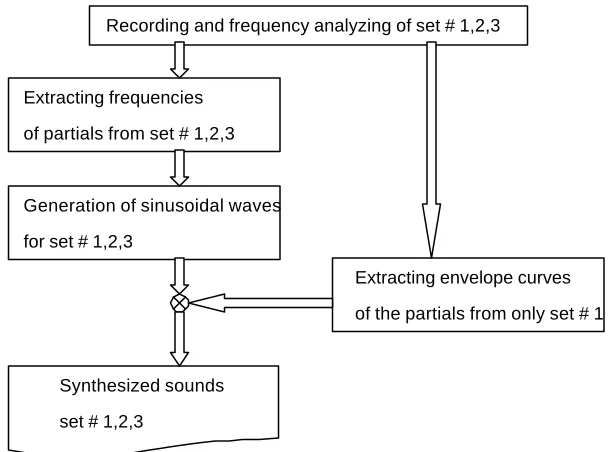
To make the samples of piano sounds having different quantities of inharmonicity, we passed a couple of steps. Firstly we recorded a grand piano while changing strings. As shown in the equation (1), quantities of inharmonicity only depend on characteristics of strings, and changing the strings lets us get different sounds with different quantities of inharmonicity. The purpose of this first step is acquiring the data of quantities of inharmonicity and models of envelopes of fundamentals and partials to be used in the next step – the synthesizing. We recorded sounds of three different strings for each note. One of them was designed to have standard amount of inharmonicity and the others to have bigger or smaller amount of inharmonicity as possible. In this process, we restricted the notes we were interested in to wrapped strings in lower region – key no.11 to no.28, because in this region the result of this study is more applicable. The second step was synthesizing using the data from the first step. Sinusoidal waves were made according to the seen frequencies of fundamentals and partials for the notes we need. Then a set of envelope curves extracted in the preceding step was multiplied to all the three sets of sinusoidal waves for each note. In this processes we can acquire three sets of sample sounds with different quantities of inharmonicity but all other same characteristics for each note.
1. ABSTRACTING INFORMATIONS THROUGH RECORDING AND ANALYZING
We selected 11th, 13th, 15th, 16th, and 20th key for measurement and synthesizing. (Table 1) For all pianos wrapped strings are used for lower 30 notes or so. They have solid steel wires in the center and wrapping brass wires. Through controlling the characteristics of the steel wires and wrapping wires and the number of wrapping, we can control the inharmonicity constant of strings. So these wrapped wires are easier to control the quantity of inharmonicity and inversely the results of this studying the relationship between inharmonicity and tone character are more applicable to that low region. This is the reason of our selection.
Set of
strings # 1 2 3
Key # Note D1 (mm) D2 (mm) D (mm) l
ρ
(kg/m) T (N) D1 (mm) D2 (mm) D (mm) lρ
(kg/m) T (N) D1 (mm) D2 (mm) D (mm) lρ
(kg/m) T (N)11 G1 1.175 1.600 4.183 0.0894 1131 1.075 1.450 3.801 0.0865 934 1.075 1.350 3.613 0.0740 845
13 A1 1.075 1.250 3.425 0.0536 920 1.075 1.175 3.284 0.0526 847 1.000 1.200 3.256 0.0512 831
15 B1 1.075 1.200 3.143 0.0471 935 1.075 1.100 3.068 0.0469 890 1.000 1.025 3.002 0.0452 854
16 C2 1.075 1.050 3.049 0.0458 965 1.075 1.050 2.974 0.0422 916 1.000 0.950 2.861 0.0414 852
20 E2 0.975 0.900 2.667 0.0323 1052 0.975 0.850 2.573 0.0308 980 0.975 0.800 2.479 0.0279 911
Table 1. Characteristics of strings.
Table 1 is the characteristics of 3 sets of strings of selected notes. In the table, D1 is a
diameter of a steel wire of center, D2 is a diameter of wrapping wire, D is a total diameter after
wrapping,
ρ
l is a line density of a string, and T is a tension.Strings were designed for a 161cm grand piano. A set of strings was tuned with a fine tuner that has 0.1cent of resolution just after installing a set of strings. The states of tuning of each note were checked again just before recording. The piano and recording equipments were set in a silent studio. Keys were stricken by dropping a weight and the sound was recorded at the sampling rate of 48kHz.
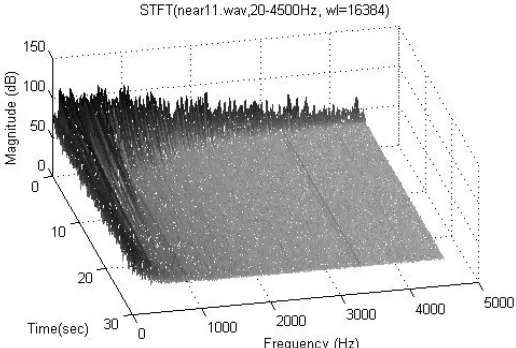
Recorded signals were frequency-analyzed. Fast Fourier transforms for 96k sample points were executed to measure the quantities of inharmonicity. As shown in Fig 1, the notes with set of strings #1 had the biggest amount of inharmonicity, while the notes with set #3 had the smallest.
0 5 10 15 20 25 30 0
20 40 60 80 100 120 140 160
Partial number
Inharmonicity (Hz)
[image:4.596.190.406.86.261.2]set #1 set #2 set #3
[image:4.596.169.427.307.481.2]Fig 1. Quantities of inharmonicity. (key #11)
Fig 2. STFT of key #11 of string set #1.
0 5 10 15 20 25 30 35 40 45 50 0
50 100 150 200 250 300 350 400
Sample number
Magnitude
2nd partial 8th partial
[image:4.596.186.400.534.708.2]2. SYNTHESIZING PIANO SOUNDS
Basically, the target of synthesizing was the creation of the same three sets of notes as recorded sounds. Of course the envelope curves of partials should be same for all three sets for each note. The first step of synthesizing was generation of sinusoidal waves. All waves were made to have the frequencies that were seen in the recording and analyzing process. Each wave was matched to an envelope curve as its partial number and the envelope curve was multiplied to the matched sinusoidal wave.
Recording and frequency analyzing of set # 1,2,3
Extracting frequencies
of partials from set # 1,2,3
Generation of sinusoidal waves
for set # 1,2,3
Extracting envelope curves
of the partials from only set # 1
Synthesized sounds
[image:5.596.145.449.212.438.2]set # 1,2,3
Fig 4. Summary of the synthesizing sequence.
3. COMPARISONS OF THE SOUNDS THROUGH THE LISTENING TESTS
Listening tests were carried out for 25 listeners with the synthesized sounds. 13 people of them were studying acoustics and the other 12 people were specialized in various musical instruments.
Firstly synthesized sounds were heard to listeners in the forms of individual notes. Then the superposed notes as some simple chords were heard to people and lastly the synthesized notes were sequenced as arpeggios and simple melodies and heard. After the listening, listeners were asked to divide the sets of synthesized sounds by following adjective pairs - clear/dull, brilliant/dull, sharp/blunt, cold/warm, wet/dry, tense/lax, and loud/small.
of comparisons was offered and it makes the deciding the rankings possible.
As the result of listening tests, we can consider the relationship between the quantity of inharmonicity and a tone of a piano as following.
The bigger the inharmonicity in the situation of some restriction exists, the sound is more brilliant, clear, brilliant, sharp, cold, and tense. Almost all people sympathized for these expressions but the questions of wet/dry and loud/small were proven to be vague and ambiguous questions because people did not answered consistently for the questions.
Making an additional remark, the pitch of the sound that has bigger inharmonicity feels like slightly risen. This phenomenon was more remarkable especially for the lower notes that have poor fundamental component.
CONCLUSION AND SUMMARY
Three sets of piano sounds that have different quantities of inharmonicity but same numbers of partials of same envelopes were synthesized to study the influence of inharmonicity on the tone of a piano. As the results of listening tests with them, we can say that the bigger quantity of the inharmonicity (in the situation of some restriction exists) the sound is more brilliant, clear, sharp, cold, and tense.
References
[1] T. D. Rossing, ‘The Science of Sound’, Addison Wesley, 1989.
[2] P. P. Vaidyanathan, ‘Multirate Systems and Filter Banks’, Prentice Hall, 1992
[3] J. Lattard, ‘Influence of inharmonicity on tuning of a piano – Measurements and mathematical simulation’, J. Acoust. Soc. Am., 94 (1), July 1993.