
Essays on Education Decentralization
179
0
0
Texto completo
(2)
(3)
(4) PhD in Economics Thesis title:. Essays on Education Decentralization PhD student:. Paula Salinas Peña Advisor:. Albert Solé Ollé Date: April 2014.
(5)
(6) To my grandparents, who always accompany me.
(7)
(8) Acknowledgements. Carrying out this PhD thesis would not have been possible without the support and help of those people that have accompanied me throughout this way, to whom I should like to address a few words of thanks. In the first place, I would like to extend my warmest thanks to my supervisor, Albert Solé, for his help and invaluable dedication to this project. Particularly, I would like to express my gratitude to him for giving me his support and for placing his trust in me again after the period of time during which I did not work on the thesis. I still remember our first meeting to talk about this project, and how I was astonished at the clarity of his ideas and his thorough knowledge of the subject. Looking back, I realize that thanks to have been working with him all this time I have learned to formulate questions and to try to find the best formula to answer them, to call into question everything I read or write and to overcome the difficulties. In short, it is thanks to him that I have learned how to conduct research. And it is thanks to him too that this project, that we initiated years ago, has been successfully completed. I am also very grateful to the rest of the people at the Barcelona Institute of Economics (IEB) for their support. My gratitude goes especially to Maite Vilalta for the invaluable trust she placed in me, which always helped me to have the strength to go on, and for helping me every time she had the opportunity to do so. Working with a great professional like her I had the opportunity to learn many important things that I will never forget, and to enjoy much appreciated moments. Deep gratitude also goes to Daniel Mas, with whom it has always been a great pleasure working, learning and sharing the good and the stressful moments. I am also very grateful to Martí Parellada, Núria Bosch, Marta Espasa, Pilar Sorribas, Santiago Lago and Susana Cobos for their kindness and continuous support. There are many other people to whom I feel indebted: the great colleagues with whom I had the pleasure to share the office during the first years at the IEB, especially Miriam Hortas, Pere Arqué, Jordi Jofre, MªÀngels Gómez and. v.
(9) José Polo; the colleagues that arrived later to the IEB, particularly Elena Costas and Gabrielle Pellegrino; the PhD courses classmates at the University of Barcelona, especially Diego Duarte, Rosa Vidal, Jenifer Ruiz and Pere Arqué; and the MSc classmates at the University College London, whom I do not mention here since it would be a long list of people that I really appreciate and of which I keep very good and special memories. I am very grateful to all of them for their friendship and for always being there, in the good and not so good moments. I have no words to express my gratitude to my family and the rest of my friends for their support and for the patience they have shown with me during all this time. Without them I would not have been able to achieve my goals. I am especially grateful to my parents, Maria Peña and Jorge Salinas; my brother, Sergi Salinas; my best friends, Vanesa García and Laia Obiols; and my love and best friend Giuseppe Praderio, to whom I will never be able to repay for his support, his great understanding and his love. Finally, I gratefully acknowledge the economic support from the Generalitat de Catalunya, the Ministerio de Educación y Ciencia and the Fundación Ramón Areces; and the academic, administrative and economic support of the IEB.. vi.
(10) Table of Contents. Chapter 1. Presentation 1. Introduction .......................................................................................................... 1 2. Background literature review .............................................................................. 6 3. Overview of the dissertation .............................................................................. 9 3.1. Filling the gaps ................................................................................................... 9 3.2. Dissertation structure ...................................................................................... 12 References ................................................................................................................ 14 Chapter 2. Partial Fiscal Decentralization Reforms and Educational Outcomes: a Differences-in-Differences Analysis for Spain 1. Introduction ........................................................................................................ 19 2. Literature Review ................................................................................................ 23 2.1. Theoretical background .................................................................................... 23 2.2. Related empirical studies ................................................................................. 24 3. The main features of the education sector in Spain ...................................... 26 3.1. Decentralization process .................................................................................. 26 3.2. Education system structure ............................................................................... 28 4. Methodology ........................................................................................................ 29 4.1. Empirical strategy ........................................................................................... 29 4.2. Estimation and identifying assumptions ............................................................ 31 4.3. Robustness checks ............................................................................................ 32 4.4. Data ................................................................................................................ 34. vii.
(11) 5. Empirical findings .............................................................................................. 36 5.1. Comparison group validation ........................................................................... 36 5.2. The effects of decentralization on promotion rates .............................................. 37 5.3. Robustness checks ............................................................................................ 40 6. Additional findings ............................................................................................ 41 6.1. The effect of decentralization on dropout and repetition rates ............................ 41 6.2. Heterogeneous effects of decentralization on promotion rates ............................... 43 7. Summary and concluding remarks .................................................................. 46 References ................................................................................................................ 48 Annex ........................................................................................................................ 51 Chapter 3. The Effect of Decentralization on Educational Outcomes: Real Autonomy Matters! 1. Introduction ........................................................................................................ 63 2. Literature Review ................................................................................................ 66 2.1. Theoretical background .................................................................................... 66 2.2. Related empirical studies ................................................................................. 68 3. Methodology ........................................................................................................ 69 3.1. Empirical strategy ........................................................................................... 69 3.2. Identification strategy ....................................................................................... 71 3.3. Measuring decentralization .............................................................................. 74 3.4. Data ................................................................................................................ 76 4. Empirical findings .............................................................................................. 78 4.1. The effect of education policy decentralization ................................................... 78 4.2. The effect of revenue decentralization on educational policy outcomes ................. 81 4.3. Robustness tests ............................................................................................... 84 5. Comparison of the effects of decentralization to regional and local governments ....................................................................................................... 86 6. Summary and concluding remarks .................................................................. 88 References ................................................................................................................ 89 Annex ........................................................................................................................ 93. viii.
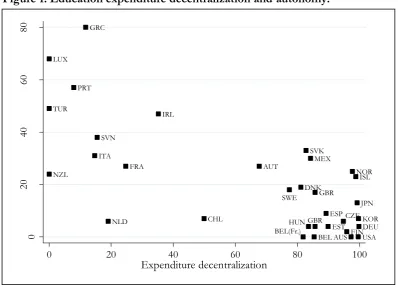
(12) Chapter 4. The Role of Teacher Quality as a Mediator of the Relationship between Decentralization and Educational Attainment 1. Introduction ........................................................................................................ 97 2. Educational attainment, teacher quality and decentralization .................. 101 2.1. The relationship between teacher quality and educational attainment .............. 101 2.2. The relationship between decentralization and teacher quality ......................... 103 3. Methodology ...................................................................................................... 107 3.1. Methodological framework ............................................................................. 107 3.2. Empirical strategy ......................................................................................... 109 3.3. Identification strategy ..................................................................................... 112 3.4. Allowing for heterogeneous effects of education decentralization ........................ 115 3.5. Data .............................................................................................................. 115 4. Empirical findings ............................................................................................. 117 4.1. Direct and indirect effects of decentralization on educational attainment .......... 117 4.2. Robustness checks .......................................................................................... 119 5. Comparison of regional and local decentralization .................................... 122 6. Summary and concluding remarks ................................................................. 125 References .............................................................................................................. 127 Annex ...................................................................................................................... 133 Chapter 5. Concluding Remarks .......................................................... 137 Annex I. PISA 2009 Database ............................................................... 143 References ............................................................................................. 157. ix.
(13)
(14) Chapter 1 Presentation. 1. Introduction In recent years, the most highly developed economies have seen their economic growth rates plummet, while most non-developed countries have failed to achieve their target of initiating economic growth. Drawing on these experiences, empirical research and economic policy have sought to identify the determinants of economic growth and the means for maintaining countries on the path of long-run growth. The importance attached to education in the economic literature derives, in fact, from the well-known theoretical relationship identified between human capital and economic growth (Romer, 1986, 1990). Growth theory is unequivocal in its claims that a country’s level of human capital contributes to economic growth and empirical evidence likewise lends support to this theory (see Hanushek and Woessman (2011) for a review of this field)1. More recent research shows that quality of schooling (and not just quantity) is also relevant in determining long-run economic growth (Hanushek and Kimko, 2000; Hanushek and Woessmann, 2007), since it helps increase labour force productivity, innovation and technical progress, which in turn influence growth rates (Barro and Sala-i-Martin, 2004). Given this evidence, there is a widely held consensus regarding the importance of investing in human capital, but also regarding the need to improve efficiency in the education process. In seeking to fulfil this objective, various The importance attached to education in economic literature also derives from its relevance to explain individual earnings, a relationship that started to be analyzed with the early contributions by Jacob Mincer and Gary Becker, and more recently, from its relevance to explain a variety of outcomes, such as health or life satisfaction (Salinas-Jiménez et al., 2014). 1. 1.
(15) Essays on Education Decentralization. countries have initiated educational reform programmes in recent decades, which range from measures aimed at improving schools’ resources (for instance, reducing class sizes) to those that seek to improve teacher incentives or levels of accountability in the education system. Among the advice emanating from the World Bank and other international agencies are recommendations to developing countries that they implement decentralization reforms in order to achieve these objectives. Decentralization has also been central in a number of OECD countries, especially at the end of the last century. For instance, Spain introduced a far-reaching process of decentralization in its education sector at the beginning of the eighties, the process being concluded at the end of the nineties; Denmark also decentralized its education policy to the local level at the beginning of the nineties; and Finland increased the autonomy with which subnational governments could allocate their educational resources, although a considerable share of subnational education expenditure is financed with specific grants. Today, OECD countries present considerable variation with regard to the degree of decentralization in their education sectors and the way in which such policies are implemented. Thus, while in some countries educational expenditure in lower-secondary education is highly decentralized to the subnational levels of government (this being the case, for example, in Germany, Finland and Mexico), in other countries most of this expenditure is the responsibility of the central level of government (the case, for example, of France and Italy). Likewise, the autonomy with which subnational governments implement their educational expenditure responsibilities is also highly varied in these countries. In Finland and Germany, for instance, 76 and 66 per cent of educational decisions, respectively, are taken at the subnational level of government. Since most of the other educational decisions are taken at the school level, the central government in these countries plays a highly limited role in regulating the educational system, as can be observed in Figure 1. By contrast, in Mexico only 50 per cent of educational decisions are taken at the subnational level of government, while the central government has the power to make 30 per cent of the decisions affecting education. Thus, as Figure 1 also shows, the percentage of educational decisions taken at the central level of government in countries with similar levels of decentralization in their education expenditure presents marked differences; or, expressed another way, the autonomy of subnational governments to regulate the main. 2.
(16) Chapter 1. Presentation. features of the education system presents marked differences between countries with similar levels of decentralization in their education expenditure.. 80. Figure 1. Education expenditure decentralization and autonomy. GRC. 60. LUX. PRT. 40. TUR. IRL SVN SVK MEX. ITA FRA. AUT. NOR ISL. 20. NZL. SWE. JPN ESP CZE KOR HUN GBR EST DEU BEL(Fr.) FIN BEL AUS USA. CHL. 0. NLD. 0. 20. 40. DNK GBR. 60. Expenditure decentralization. 80. 100. Notes: data compiled by author based on OECD publications (OECD, 2004, 2008, 2012) and OECD.Stat data. Expenditure decentralization is defined as the percentage of subnational governments’ expenditure in lower-secondary education related to general government’s expenditure in lower-secondary education. Decision-making centralization is defined as the percentage of decisions in lower-secondary education that are taken at the central level of government.. Cross-country variation is also considerable with regard to taxing autonomy, as Figure 2 highlights. For instance, in Germany, where the education policy is highly decentralized to the subnational level of government, the degree of tax decentralization is very low, as subnational governments are financed in the main with shared taxes and general transfers from upper tiers of government. By contrast, in Canada, Switzerland and Sweden, with a similar level of education expenditure decentralization to that in Germany, subnational governments have control over more than 30 per cent of the taxes collected in the country. Despite these differences between countries, we observe that, in general, the decentralization of taxing powers does not match the decentralization of expenditure and regulatory functions in most OECD countries (Bröchliger and Rabesona, 2009).. 3.
(17) Essays on Education Decentralization. Figure 2. Education expenditure decentralization and tax decentralization.. 40. CAN CHE. 30. Tax decentralization. SWE. DNK. 10. 20. FIN ESP. ITA NZL LUX. 0. TUR. 0. BEL (Fr.). FRA ISR. 20. IRL. 40. CHL. AUT. 60. Expenditure decentralization. USA AUS KOR NOR. BEL. HUN DEU GBR POL MEX SVK EST CZE. PRT. NLD SVN GRC. JPN ISL. 80. 100. Notes: data compiled by author based on OECD Fiscal Decentralization Database and OECD.Stat data. Expenditure decentralization is defined as the percentage of subnational governments’ expenditure in lower-secondary education related to general government’s expenditure in lower-secondary education. Tax decentralization is defined as the ratio of subnational own tax revenue (over which subnational governments have the power to define the tax base, the tax rate or both) to general government tax revenues.. Differences in the division of education responsibilities between tiers of government and in the degree of autonomy the latter have to take decisions and raise their own revenues could imply differences in the level of efficiency with which these responsibilities are carried out. It is worth noting that the countries with the highest student test scores in the PISA assessment (Korea and Finland) are in the group of countries with the greatest levels of decentralization in the education sector. However, as Figure 3 shows, there is no clear pattern in the relationship between education decentralization and educational outcomes. This is unsurprising, since many of the differences in educational attainment between countries can be explained by student, family and school factors. However, the countries’ institutional factors have recently been demonstrated as being relevant also in explaining differences between countries (Fuchs and Woessmann, 2007).. 4.
(18) Chapter 1. Presentation. 550. Figure 3. Education expenditure decentralization and reading test scores.. KOR FIN CAN JPN BEL (Fl.) AUS. 500. NLD. NOR. FRA. SCO ISL SWE DNK EST USA CHE POL ENG DEU HUN BEL (Fr.) ESP CZE SVK AUT. IRL. PRT ITA LUX. GRC SVN. ISR. 450. TUR CHL. MEX. 400. Reading test scores. NZL. 0. 20. 40. 60. Expenditure decentralization. 80. 100. Notes: data compiled by author based on OECD PISA Database and OECD.Stat data. Expenditure decentralization is defined as the percentage of subnational governments’ expenditure in lower-secondary education related to general government’s expenditure in lower-secondary education. Reading test scores are scaled to have an average mean equal to 500 and a standard deviation equal to 100 in OECD countries (see Annex I for details).. The aim of this study is, therefore, to analyze the effects of decentralization on the efficiency of educational policy, by examining the way in which different decentralization structures can have differential effects and by exploring the channels via which decentralization can affect educational outcomes. To achieve this, I first analyze the effects of a partial fiscal decentralization reform introduced in Spain at the beginning of the eighties, when educational responsibilities were devolved to regions that were not, however, granted any decision-making power for raising their own taxes. Second, drawing on crossnational data, I analyze the effects of decentralization on educational outcomes under different decentralization structures. That is, I analyze whether different degrees of subnational government autonomy, both on the expenditure and revenue sides, have the expected differential effects. Finally, it should be borne in mind that schools, and above all teachers, are likely to be the focus of most educational reforms aimed at improving educational outcomes. Thus, I conduct an additional analysis to determine whether teacher quality is affected. 5.
(19) Essays on Education Decentralization. by decentralization and the extent to which this effect accounts for the impact of decentralization on educational attainment. The rest of this chapter is organized as follows. In section 2, I review the literature examining the effects of decentralization. Here, fiscal federalism theory has advanced a number of arguments identifying both the benefits and drawbacks of decentralization, and these serve as the theoretical framework for most empirical studies that have sought to verify these claims. In section 3, I present the contributions of this dissertation to the extant literature and summarize the three analyses described above and which constitute the central chapters of this dissertation. 2. Background literature review There is a long-standing tradition of studies examining the effects of decentralization on the efficiency of public policies in fiscal federalism theory. The main argument in favour of a decentralized provision of public goods and services is that subnational governments have a better knowledge of local preferences and needs than the central government, and therefore the former might be better placed to match the provision of public goods and services with these preferences and needs (preference-matching argument). Thus, in the absence of externalities and economies of scale, the decentralized provision of public goods and services should always be preferable in terms of social welfare to that of a centralized provision (Oates, 1972). However, there is an implicit assumption in this proposition that should not be overlooked. These studies assume that governments are benevolent, in the sense that they act in the best interests of their citizens. Alternative theoretical models, in which governments seek to maximize their power or influence, began to be modelled in the public choice literature at the beginning of the eighties. In this context, where a government’s objective is to maximize the public budget, Brennan and Buchanan (1980) see fiscal decentralization as a mechanism for constraining the expansionary tendencies of government. However, the combination of the decentralization of expenditures and the centralization of tax collection means that subnational governments have an unclear perception of hard budget constraints, which results in them overspending and being inefficient (Bosch and Suárez-Pandiello, 1993; Wildasin, 1997; Rodden et al., 2001).. 6.
(20) Chapter 1. Presentation. The Second Generation Theory of Fiscal Federalism, which has relaxed some of the hypotheses in Oates’ theorem, seem to confirm Oates’ conclusion that decentralization is preferable when externalities are small and when there is a high degree of heterogeneity between regions (Lockwood, 2002; Besley and Coate, 2003). Within this branch of the literature several authors emphasize that governments might very well prioritise their own interests or be under the sway of lobbies and rent-seeking groups, resulting in reduced efficiency (Oates, 2005; Weingast, 2009). Seabright (1996), for instance, modelled the way in which decentralization can affect a government’s incentive to act in the best interests of its citizens. This author argues that government incentives depend on the degree of political accountability, defined as the probability that the welfare of a given region might determine the re-election of the government2. Since political accountability or the electoral control over incumbents is greater at the local level, decentralized governments will have more incentives than centralized authorities to act in accordance with the preferences of the population and, therefore, be less corrupt. Persson and Tabellini (2000) and Hindriks and Lockwood (2005) reach similar conclusions about the relationship between decentralization, political accountability and government behaviour. However, it has been argued that when subnational governments are highly dependent on intergovernmental fiscal grants to finance their expenditures they are not as accountable as they would be if they were financed by their own revenues, and their incentives to act in the best interests of their citizens could be undermined. Empirical studies that have sought to test this proposition conclude that a situation of vertical fiscal imbalance encourages subnational governments to overspend and generates unsustainable deficits and demand bailouts, since the costs of local programs are not apparent to the local electorate (Rodden, 2002, 2003). Despite this evidence, recent theoretical studies conclude that the provision of public goods and services in a situation of partial fiscal decentralization, where subnational governments are not granted powers to raise their own revenues and rely on intergovernmental transfers to finance their expenditures, can be preferable to both full central control and. Despite this definition of political accountability, the literature usually considers this term in a broader sense as the electoral rules and other institutional mechanisms that constrain the rent-seeking activities of office holders, such as the taking of bribes, the favouring of particular interest groups and insufficient innovation and effort (Lockwood, 2006). 2. 7.
(21) Essays on Education Decentralization. full decentralization, when per capita spending is held fixed (Brueckner, 2009; Borge et al., 2014). It has also been argued that when decentralization generates confusion in the assignment of responsibilities between levels of government, citizens’ control over incumbents can be misled (Lago-Peñas and Lago-Peñas, 2010). In addition, studies that have focused on the analysis of the relationship between decentralization and lobbying conclude that the effects of decentralization on corruption are ambiguous and context-specific, indicating the need for empirical studies (Redoano, 2010; Bardhan and Mookherjee, 2000, 2006). Thus, the theoretical effects of decentralization on the efficiency of public policies are ambiguous and empirical studies are needed in order to determine the circumstances under which a decentralization process might have beneficial effects. In the education context, the general approach adopted in analyzing the effects of decentralization has not sought to identify its impact through any of the specific channels discussed above. Rather, previous analyses have tended to examine the relationship between fiscal decentralization and educational attainment, measured at the individual level or aggregated at the regional or local levels. The most relevant contributions include Barankay and Lockwood (2007), who analyze the relationship between expenditure decentralization and educational attainment in Switzerland; Galiani and Schargrodsky (2002) and Galiani et al. (2008), who analyze the effects of the decentralization process on educational attainment in Argentina between 1992 and 1994; and Falch and Fischer (2012) and Díaz-Serrano and Meix-Llop (2012), who analyze the effects of decentralization on educational attainment for a set of countries. The general conclusion reached by these studies is that decentralization is positively related to educational outcomes, and that it is more beneficial when subnational governments have a low fiscal deficit (Barankay and Lockwood, 2007; Galiani and Schargrodsky, 2002) and when schools are located in non-poor municipalities (Galiani et al., 2008). While these studies have generated a good deal of useful information, there are a number of drawbacks that need to be addressed. First, the results of the studies focused on particular countries might not be extrapolable to other contexts. As we have seen in the previous section, there is a wide variation in the way in which countries have decentralized their education policies and in the way in which subnational governments are financed. As outlined above,. 8.
(22) Chapter 1. Presentation. different decentralization structures are liable to generate differential effects in terms of efficiency in the provision of educational services, so that more evidence is needed in order to assure that the effects of decentralization on educational outcomes are positive. Second, related to this, measuring the degree of fiscal decentralization is a complex task that requires identifying subnational government autonomy and discretion with regard to expenditure and revenue arrangements (Ebel and Yilmaz, 2002). Thus, measuring the degree of fiscal decentralization with a single variable falls short at providing a full picture of decentralization. However, to provide evidence of how different structures of revenue and expenditure decentralization could have a differential impact on educational outcomes, cross-national evidence is necessary, and the question has not been addressed in the existing literature. Finally, none of these studies has analyzed the process via which decentralization might affect educational outcomes. That is, they focus on analysing the effects of decentralization on educational attainment, without concerning themselves with the way in which subnational governments achieve the goal of improving these outcomes. Is it because there is an improvement in government and school incentives that educational resources are used more efficiently, or is it because there is a change in the level and allocation of these resources? I will focus my attention on these questions in the analyses conducted in this dissertation, which are summarized in the section below. 3. Overview of the dissertation 3.1. Filling the gaps As discussed above, the literature analyzing the effects of decentralization on the efficiency of education policy is scarce, and has tended to focus on the decentralization processes in particular countries. However, the autonomy of subnational governments to provide educational services and the way in which such governments are financed are likely to determine the efficiency with which public policies are provided at the subnational level; thus, the results in the countries analyzed in previous studies might not be extrapolable to the education systems operated in other countries. In addition, theoretical analyses do not allow us to predict the effects of decentralization in specific contexts. For instance, while some studies predict that when subnational governments are highly dependent on intergovernmental transfers decentralization will have. 9.
(23) Essays on Education Decentralization. a negative impact on the governments’ incentives to act in the best interests of their citizens and, thus, on policy outcomes, other studies conclude that positive effects of decentralization can also be observed in such a setting. The Spanish education decentralization reform introduced at the beginning of the eighties, which was a partial fiscal decentralization reform, allows me to empirically test these hypotheses in Chapter 2. I believe that the study reported in Chapter 2 makes a relevant contribution to the scarce empirical evidence gathered to date about the effects of decentralization on educational outcomes. First, this is the first study to analyze these effects in the context of a partial fiscal decentralization, which enables me to provide empirical evidence about one of the main points of debate in the fiscal federalism literature. Second, the way in which education policy has been decentralized in Spain, with a set of regions receiving educational powers at the beginning of the eighties and the remaining regions having to wait until the end of the nineties to receive the same powers, provides a unique benchmark against which to conduct a consistent identification of the effects of decentralization. Finally, I believe that the conclusions that can be drawn from this study are especially relevant at a time in which a process of recentralization of decision-making autonomy in the education sector in Spain is being undertaken. While the contributions I make to the literature are relevant, the conclusions drawn from this analysis cannot be generalized to other education systems. As I have shown above, today most subnational governments enjoy a certain degree of tax autonomy, which can vary substantially from one country to another. In addition, the autonomy of subnational governments to take education policy decisions also varies greatly across countries. These differences may well mean that effects of decentralization on educational outcomes differ markedly in each country. For instance, if subnational governments are responsible for providing educational services, but they are not granted powers to decide on the main features of the education system (including such elements as teaching methods, school inputs and the allocation of school resources), they are unlikely to be able to improve the levels of educational attainment. I address these questions in Chapter 3. The analysis in Chapter 3 contrasts with analyses reported in previous studies, since it draws on cross-national evidence to analyse the way in which different structures of expenditure and revenue decentralization have a differential. 10.
(24) Chapter 1. Presentation. impact on the efficiency of public education policies, a question hitherto unaddressed in this branch of literature. Thus, I am able to determine whether evidence previously reported for Switzerland, Argentina and Spain can be generalized to other countries, and I can provide evidence of the expected effects of decentralization when subnational governments enjoy different degrees of autonomy, both on the expenditure and revenue sides. In addition, in this study educational outcomes are measured with the PISA test scores, which have certain advantages with regard to the discussion of the economic implications of the results, as higher achievement on test scores is related to higher labour market returns (Bishop, 1992) and to higher productivity and national growth rates (Hanushek and Kimko, 2000; Hanushek and Woessmann, 2007). Thus, the analyses conducted in Chapters 2 and 3 provide evidence of the effects of decentralization on educational attainment, and they allow us to determine, as the theory predicts, whether these effects depend on the autonomy enjoyed by subnational governments to match policies with local preferences and needs and to raise their own revenues. However, these studies tell us nothing about the process via which the educational outcomes might vary depending on whether a country operates a decentralized or a centralized system. In Chapter 4 I provide a number of insights into this question, by analyzing the role of teacher quality in a decentralization process, that is, how teacher quality might be affected by decentralization and the extent to which this effect explains the effects of decentralization on educational attainment. The relationship between decentralization and teacher quality has received little attention in the literature and, to the best of my knowledge, the study in chapter 4 is the first attempt to empirically analyze it. In addition to the empirical analysis, an effort has been made in Chapter 4 to summarize the arguments that underpin the relationship between decentralization and teacher quality. Finally, this is also the first study that seeks to analyze the process via which decentralization might affect educational attainment. The methodology used in this study to address this question, which decomposes the total effect of decentralization into a direct effect and an indirect effect via teacher quality has not been applied before in the economics of education empirical literature, which has always tended to focus on the estimation of reduced-form equations of educational attainment. Here, however, I estimate a structural model in which teacher quality variables are also considered endogenous variables.. 11.
(25) Essays on Education Decentralization. 3.2. Dissertation structure The three analyses conducted in this dissertation are presented in Chapters 2, 3 and 4, and the conclusions are presented in Chapter 5. In Chapter 2 I analyze the effects on educational outcomes of the partial fiscal decentralization reform in Spain. The decentralization of education in Spain meant the devolution of most educational responsibilities to the regions (or Autonomous Communities) of Cataluña, País Vasco, Galicia, Andalucía, Comunidad Valenciana and Canarias at the beginning of the eighties. This reform was marked by the fact that the recently created regional governments were not granted any powers to raise their own revenues. The public services supplied by these regions were financed with general grants awarded by the central government. The regional governments were then free to allocate these grants as they saw fit to different uses and policies. An additional feature of this reform was that while these historic regions and islands were able to accede to all the powers not specifically assigned to the central government in the constitution at the beginning of the eighties, the other regions did not receive these powers until the end of the nineties. These circumstances provide a natural benchmark against which to identify the effects of the partial education decentralization reform in Spain, since the regions that did not receive these educational powers in each time period can be used as a comparison group. Given that the decision to decentralize educational policy to these regions was made on historical grounds, and as part of a broader decentralization process affecting other areas of expenditure policy, I do not expect the implementation of the reform to have been determined by the characteristics of the educational sector. Despite this, I estimate the effects of the reform on educational outcomes with a difference-indifferences approach, which allows me, on the one hand, to control for the temporary shocks that affect the outcomes of all the regions equally and, on the other, to control for the non-observable characteristics of the regions that might influence the evolution of their educational outcomes and which could result in differences between the treatment and comparison groups before decentralization. I conduct the analysis with a panel dataset containing information on the 50 provinces of Spain for the period 1977-1991. In Chapter 3, drawing on cross-national data, I examine the effects of decentralization on the efficiency of educational policies under different decentralization structures, with variables that measure the expenditure and. 12.
(26) Chapter 1. Presentation. revenue sides of decentralization. I conduct the analysis within the education production function framework, which considers the education process as analogous to a firm’s production process, where educational resources or inputs are transformed into educational achievement or outputs. Within this framework, the inputs to the educational process include student characteristics, family and school inputs and community and institutional factors, which include the country’s level of decentralization. For this analysis I use a huge dataset, which contains personal and academic information for 294,156 students, grouped in 10,871 schools and belonging to 33 OECD countries. Individual and school level data were obtained from the OECD PISA 2009 database, which provides internationally comparable information about students’ achievement and the relevant inputs to the educational process. By including detailed information about educational inputs, I can control for differences in the non-observable characteristics of countries that might affect educational outcomes via their effect on family inputs (for instance, out-ofschool lessons or preferences for private schools) and students’ characteristics (such as their interest in studying or expected level of education). In this way, the potential endogeneity of decentralization in a cross-sectional setting is addressed. I additionally test the robustness of the results by controlling for the observable and non-observable characteristics of countries that are common in countries which are close geographically and for countries’ observable characteristics, such as economic development and perceived corruption, which are likely to be related to both educational outcomes and decentralization policies. In Chapter 4 I seek to analyze the role of teacher quality in a decentralization process –that is, how it might be affected by decentralization and the extent to which this explains decentralization effects on educational attainment. In addition, I analyze whether these effects vary according to whether educational policy is decentralized to the regional or to the local level of government, and so take into account that the impact might depend on the size of the labour market in which subnational governments can hire teachers. Positive effects of decentralization on teacher quality derived from the better knowledge that subnational have regarding their population and their schools’ needs and from the improved accountability may be undermined if the labour market in which the decentralized government can hire teachers is small or if the shortened. 13.
(27) Essays on Education Decentralization. distance between policy-makers and schools makes school-based interest groups more influential, resulting in an increase in the level of corruption in the education sector. Evidence regarding which characteristics of teachers are relevant for teacher quality is mixed. While some studies conclude that attributes such as a teacher’s experience, knowledge and certification have a significant effect on student achievement (Wiswall, 2013; Metzler and Woessmann, 2012), other studies support the hypothesis that teachers’ unobservable characteristics might have a greater effect on student achievement (Hanushek et al., 2005; Rivkin et al., 2005). In this study, I take advantage of the detailed information provided by the OECD PISA database to define teacher quality in terms of those teacher characteristics that are thought to be conducive to educational achievement: teacher education, defined as the percentage of teachers holding a master’s degree in each school; teacher certification, defined as the percentage of teachers in each school that are certified by the competent authority; and disciplinary climate, which after controlling for students and schools’ characteristics, can be considered as a proxy for the teacher ability and incentives to create and maintain an effective learning environment in class. References Barankay, I. and Lockwood, B. (2007): “Decentralization and the productive efficiency of government: evidence from Swiss cantons”, Journal of Public Economics 91, 1197-1218. Bardhan, P. and Mookherjee, D. (2000): “Capture and governance at local and national levels”, American Economic Review 90(2), 135-139. Bardhan, P. and Mookherjee, D. (2006): “Decentralization, corruption and government accountability: an overview”, in International Handbook on the Economics of Corruption, S. Rose-Ackerman (Ed.), Edward Elgar Publishing, Northampton. Barro, R. J. and Sala-i-Martin, X. (2004): Economic growth, 2nd edition, MIT Press, Cambridge, MA. Besley, T. and Coate, S. (2003): “Centralized versus decentralized provision of local public goods: a political economy approach”, Journal of Public Economics 87, 2611-2637.. 14.
(28) Chapter 1. Presentation. Bishop, J. (1992): “The impact of academic competences on wages, unemployment and job performance”, Carregie-Rochester Conference Series on Public Policy 37, 127-194. Blöchliger, H. and Rabesona, J. (2009): “The fiscal autonomy of sub-central governments: an update”, OECD Working Papers on Fiscal Federalism 9. Borge, L.E., Brueckner, J.K. and Rattso, J. (2014): “Partial fiscal decentralization and demand responsiveness of the local public sector: theory and evidence from Norway”, Journal of Urban Economics 80, 153-163. Bosch, N. and Suárez-Pandiello, J. (1993): “Tamaño del sector público y descentralización fiscal”, Revista de Economía Aplicada 1(3), 181-193. Brennan, D. and Buchanan, J. (1980): The power to tax: analytical foundations of a fiscal constitution, Cambridge University Press, Cambridge. Brueckner, J.K. (2009): “Partial fiscal decentralization”, Regional Science and Urban Economics 39, 23-32. Díaz-Serrano, L. and Meix-Llop, E. (2012): “Do fiscal and political decentralization raise students’ performance? A cross-country analysis”, IZA Discussion Paper 6722. Ebel, R.D. and Yilmaz, S. (2002): “On the measurement and impact of fiscal decentralization”, WB Policy Research Working Papers 2809. Falch, T. and Fischer, J.A.V. (2012): “Public sector decentralization and school performance: international evidence”, Economic Letters 114, 276-279. Fuchs, T. and Woessmann, L. (2007): “What accounts for international differences in student performance? A re-examination using PISA data”, Empirical Economics 32, 433-464. Galiani, S. and Schargrodsky, E. (2002): “Evaluating the impact of school decentralization on educational quality”, Economía 2(2), 275-302. Galiani, S., Gertler, P. and Schargrodsky, E. (2008): “School decentralization: helping the good get better, but leaving the rest behind”, Journal of Public Economics 92, 2106-2120. Hanushek, E.A., Kain, J.F., O’Brien, D.M and Rivkin, S.G. (2005): “The market for teacher quality”, NBER Working Paper 11154. Hanushek, E.A. and Kimko, D.D. (2000): “Schooling, labor-force quality and the growth of nations”, American Economic Review 90, 1184-1208.. 15.
(29) Essays on Education Decentralization. Hanushek, E.A. and Woessmann, L. (2007): “The role of education quality for economic growth”, WB Policy Research Working Papers 4122. Hanushek, E.A. and Woessmann, L. (2011): “The economics of international differences in educational achievement”, in Handbook of the Economics of Education, E.A. Hanushek, S. Machin and L. Woessmann (Eds.), Vol. 3, Elsevier, Amsterdam. Hindriks, J. and Lockwood, B. (2005): “Centralization and political accountability”, CEPR Discussion Paper 5125. Lago-Peñas, I. and Lago-Peñas, S. (2010): “Decentralization and electoral accountability”, Environment and Planning C: Government and Policy 28, 318-334. Lockwood, B. (2002): “Distributive politics and the costs of centralization”, Review of Economic Studies 69, 313-337. Lockwood, B. (2006): “Fiscal decentralization: a political economy perspective”, in Handbook of Fiscal Federalism, E. Ahamad and G. Brosio (Eds.), Edward Elgar Publishing, Northampton. Metzler, J. and Woessmann, L. (2012): “The impact of teacher subject knowledge on student achievement: evidence from within-teacher withinstudent variation”, Journal of Development Economics 99, 486-496. Oates, W.E. (1972): Fiscal Federalism, Harcourt Brace Jovanovich, New York. Oates, W.E. (2005): “Toward a second-generation theory of fiscal federalism”, International Tax and Public Finance 12, 349-373. OECD (2004): Education at a glance 2004: OECD indicators, Organization for Economic Co-operation and Development, Paris. OECD (2008): Education at a glance 2008: OECD indicators, Organization for Economic Co-operation and Development, Paris. OECD (2012): Education at a glance 2012: OECD indicators, Organization for Economic Co-operation and Development, Paris. Persson, T. and Tabellini, G. (2000): Political economics: explaining economic policy, MIT Press, Cambridge, MA. Redoano, M. (2010): “Does decentralization affect the number and size of lobbies?”, Journal of Public Economic Theory 12(3), 407-435. Rivkin, S.G., Hanushek, E.A. and Kain, J.F. (2005): “Teachers, schools and academic achievement”, Econometrica 73(2), 417-458.. 16.
(30) Chapter 1. Presentation. Rodden, J. (2002): “The dilemma of fiscal federalism: grants and fiscal performance around the world”, American Journal of Political Science 46(3), 670-687. Rodden, J. (2003): “Reviving leviathan: fiscal federalism and the growth of government”, International Organization 57(4), 695-729. Rodden, J., Eskeland, G. and Litvack, J. (2001): Decentralization and the challenge of hard budget constrains, MIT Press, Cambridge, MA. Romer, P.M. (1986): “Increasing returns and long run growth”, Journal of Political Economy 94, 1002-1037. Romer, P.M. (1990): “Endogenous technological change”, Journal of Political Economy 98(5), 71-102. Salinas-Jiménez, M.M., Artés, J. and Salinas-Jiménez, J. (2013): “How do educational attainment and occupational and wage-earner statuses affect life satisfaction? A gender perspective study”, Journal of Happiness Studies 14(2), 367-388. Seabright, P. (1996): “Accountability and decentralisation in government: an incomplete contracts model”, European Economic Review 40, 61-89. Weingast, B.R. (2009): “Second generation fiscal federalism: the implications of fiscal incentives”, Journal of Urban Economics 65(3), 279-293. Wildasin, D.E (1997): “Externalities and bailouts: hard and soft budget constraints in intergovernmental fiscal relations”, WB Policy Research Working Papers 1843. Wiswall, M. (2013): “The dynamics of teacher quality”, Journal of Public Economics 100, 61-78.. 17.
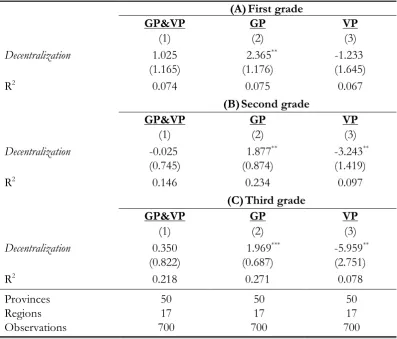
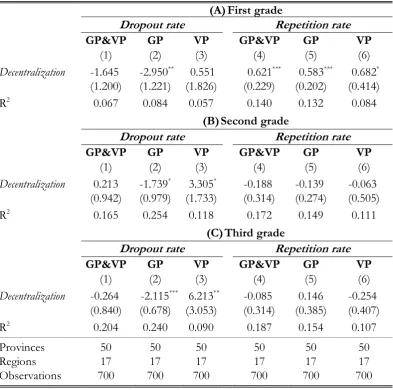
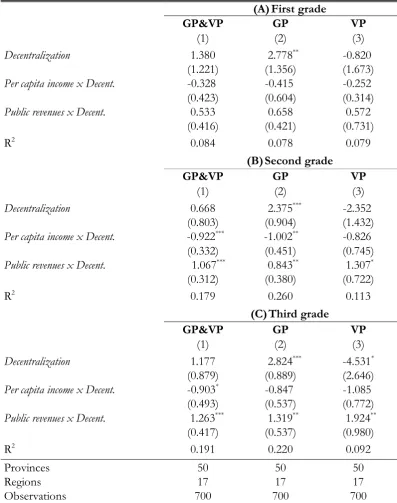
(31) 18.
(32) Chapter 2 Partial Fiscal Decentralization Reforms and Educational Outcomes: a Difference-in-Differences Analysis for Spain. 1. Introduction In the last three decades Spain has been involved in a far-reaching process of decentralization, to the extent that today it is one of the most decentralized economies in Europe. As a result of this process important areas of expenditure, such as education, health or social welfare, are nowadays devolved to the regional governments (Solé-Ollé, 2010). Focusing on the education policy area, we find that while regions with a historic regional status and islands were able to accede to the educational powers not specifically assigned to the central government in the Spanish Constitution (1978) at the beginning of the eighties, the other regions did not receive these powers until the final years of the nineties. This fact provides a benchmark that allows us to identify the effects of the education decentralization reform by using the regions that had not received the educational powers in each time period as the comparison group for the regions that had received them. Thus, the aim of this study is to evaluate the effects of the education decentralization reform in Spain on the efficiency of the educational policy. A characteristic of the decentralization reform in Spain at the beginning of the eighties is that it was a partial decentralization reform, that is, subnational governments were not granted any powers to raise their own revenues. Within this context, theory remains inconclusive regarding the effects of decentralization and empirical analyses are required (Weingast, 2009; Brueckner, 2009; Borge et al., 2014). Despite this need, empirical studies on the effects of decentralization have, until recently, been virtually non-existent. The. 19.
(33) Essays on Education Decentralization. general approach of the empirical literature to the analysis of the effects of decentralization on the productive efficiency in the provision of educational services has focused on estimating its effects on certain measures of policy outcomes in specific countries (Barankay and Lockwood, 2007; Galiani et al., 2008). Since the degree of autonomy of subnational governments in the countries analyzed in these studies (Switzerland and Argentina, respectively) was not the same as that in Spain at the beginning of the eighties, the results of these studies might not be extrapolable to the case of Spain. The effects of the decentralization reform in Spain in the educational sector have only been previously studied in Esteller-Moré and Solé-Ollé (2005), where the focus was specifically on the analysis of its effects on the allocative efficiency of education investment policies. That is, the authors analyze whether the decentralization reform in Spain had an impact on investment patterns and the extent to which these changes could be related to objective measures of needs. They concluded that the Spanish decentralization reform improved allocative efficiency in both education and road investment. In this study, we analyze the effects of the education decentralization reform occurred at the beginning of the eighties on educational outcomes with a difference-in-differences approach, using the regions that did not receive their educational powers during this period as the comparison group. Since the decision to decentralize educational policy to these regions was made on historical grounds, and as part of a broader decentralization process affecting other areas of expenditure policy, we can consistently estimate the effects of the reform on educational outcomes with this approach. We measure educational outcomes using the promotion rate by grade and educational programme in secondary (non-compulsory) education, defined as the proportion of students from a cohort enrolled in a given grade at a given school-year who study in the next grade in the following school-year (UNESCO, 2009). There are at least two reasons for our interest in the proportion of students who remain in full-time education after finishing compulsory education. First, in a country where enrolment rates in compulsory education are close to 100%, as it was the case in Spain, it seems appropriate to use a variable that measures the proportion of students that stay on at school after this period to measure educational outcomes. Second and most importantly, still nowadays each year a large number of young people in Spain fail to finish secondary education. As a consequence, upper-secondary. 20.
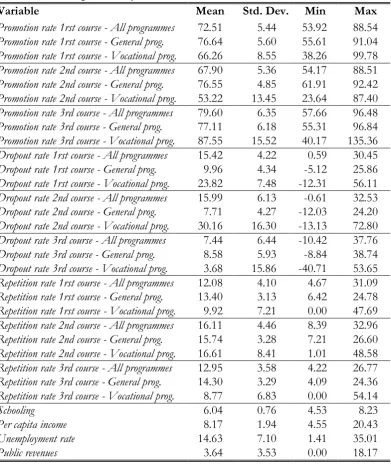
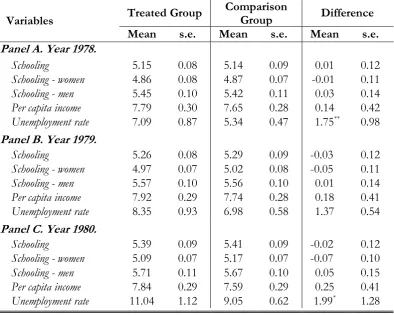
(34) Chapter 2. Partial Fiscal Decentralization Reform in Spain. graduation rates in Spain remain low in international comparisons and raising them is one of the main objectives facing the educational policy in Spain, as it was during the eighties. The evolution of the promotion rate can be explained both by the repetition rate and the dropout rate in each grade. Thus, in order to provide a full picture of the effects of the education decentralization reform in Spain, we also analyze the effects of decentralization on these two variables. Dropout rates might be understood as a process rather than the result of one single event, which might be influenced by socio-economic factors, but also by the performance of students at school. Although there is not clear evidence, grade repetition has often been signalled as one of the precursors to dropping out (Hunt, 2008). Thus, we find it interesting to analyze the effects of decentralization on these variables along the different grades and educational programmes of secondary education. Our results show that decentralization in Spain was followed by an increase in the promotion rates in all grades of the general programme of secondary education. However, it was also followed by a decrease in the promotion rates of the vocational programme. We find, though, that these negative effects disappear for cohorts that have been under a decentralized regime for five years or more. We also find that the effects of decentralization in Spain highly depend on the level public revenues of the regions. More specifically, we find that the positive effects of decentralization on the promotion rates in the general programme disappear in regions with a low level of public revenues, and the negative effects of decentralization on the promotion rates in the vocational programme disappear in regions with a high level of public revenues. Thus, the results in this study are highly conditioned by the fact that we are analyzing a partial fiscal decentralization reform, where subnational governments did not have the decision-making autonomy to raise their own revenues if they needed to do so. Finally, we find that variations in the promotion rates as a consequence of the decentralization reform are mostly explained by variations in the dropout rates and not in the repetition rates. We only observe a significant effect of decentralization on the repetition rates in the first grade, which is positive both in the general and the vocational programme. Thus, we can conclude that the observed increase in the promotion rates in the general programme was not achieved by means of decreasing educational standards. Given that the general. 21.
(35) Essays on Education Decentralization. programme is the chosen avenue into university for most students, and that the attractiveness of vocational education in Spain is much lower than that of this general programme, differences in the effects of decentralization on educational outcomes in the general and the vocational programmes might reflect a better match between population preferences and educational policies consequent upon decentralization. Within a context where the resources were scarce and subnational governments had not been granted powers to raise their own revenues, regional governments might have concentrated their efforts and resources on improving the outcomes in the general programme. To conduct the analysis, we constructed a panel data set containing information on the 50 provinces of Spain for the period 1977-1991, a period that includes the years before and after the education decentralization reform of the eighties. The reason to focus our study on this period is that a reform of the educational system that extended compulsory education from the age of 14 until the age of 16 was implemented at the same time that decentralization at the end of the nineties. In addition, during the nineties there was also a reform of the regional funding system, which implied a significant increase in the degree of taxing autonomy of regional governments (Bosch and Duran, 2005). As a consequence, it is difficult to disentangle the effects of the education decentralization reform during the nineties from the effects of the education and the funding system reforms. The rest of this chapter is organized as follows. Section 2 offers a review of the literature that has examined the effects of decentralization, including both theoretical and empirical analyses. Section 3 describes the main features of the educational sector in Spain, with particular reference to the education decentralization reform. Section 4 describes the empirical strategy, including a description of the variables that we included in the analysis and our data sources. Sections 5 and 6 present the results we obtain from the analysis, including different tests to corroborate the robustness of our results and the validity of our comparison group. Finally, the last section reports the conclusions that can be drawn from the analysis.. 22.
(36) Chapter 2. Partial Fiscal Decentralization Reform in Spain. 2. Literature Review 2.1. Theoretical background Fiscal federalism theory has traditionally presented decentralization movements as a trade-off between potential benefits, in terms of both productive and allocative efficiency, and possible drawbacks, that stem from the existence of spillover effects and economies of scale. The Decentralization Theorem (Oates, 1972) claims that, in the absence of externalities and economies of scale, the decentralized provision of public goods will always be preferable in terms of social welfare to that of a centralized provision. This is because it is assumed that regional governments are better informed about local preferences and circumstances than the central government is, and this ensures that they are more responsive to local needs and are better placed to match local preferences with the provision of public goods and services (preference-matching argument). However, there is an implicit assumption in this proposition that should not be overlooked. These studies assume that governments are benevolent, in the sense that they act in the best interests of their citizens. This hypothesis, though, has been called into question by more than one author in recent years, as governments might very well prioritise their own interests (Oates, 2005; Weingast, 2009) or be under the sway of lobbies and rent-seeking groups, resulting in reduced productive efficiency. Seabright (1996), for example, has modelled the way in which decentralization can affect a government’s incentive to act in the best interests of its citizens. This author argues that government incentives depend on the degree of political accountability, defined as the probability that the welfare of a given region might determine the re-election of the government1. Since political accountability or the electoral control over incumbents is greater at the local level, decentralized governments will have more incentives than centralized authorities to act in accordance with the preferences of the population and, therefore, be less corrupt (accountability argument). Persson and Tabellini (2000) and Hindriks and Lockwood (2005) reach similar conclusions about the Despite this definition of political accountability, the literature usually considers this term in a broader sense as the electoral rules and other institutional mechanisms that constrain the rent-seeking activities of office holders, such as the taking bribes, favouring of particular interest groups and insufficient innovation and effort (Lockwood, 2006).. 1. 23.
(37) Essays on Education Decentralization. relationship between decentralization, political accountability and government behaviour. However, some authors argued that the electoral control over incumbents might diminish under a decentralized system, when the assignment of responsibilities between levels of government is not clear to the electorate (Lago-Peñas and Lago-Peñas, 2010). In addition, studies that have focused on the relationship between decentralization and lobbying conclude that the effects of decentralization on corruption are ambiguous and contextspecific, indicating the need for empirical studies (Redoano, 2010; Bardhan and Mookherjee, 2000, 2006). It has also been argued that the combination of the decentralization of expenditures and the centralization of tax collection means that subnational governments have an unclear perception of hard budget constraints, which causes them to overspend and to be inefficient (Bosch and Suárez-Pandiello, 1993; Wildasin, 1997). More recent studies, though, show that under such a partial decentralization setting the subnational provision of public goods and services can also be preferable to the central government provision (Brueckner, 2009; Borge et al., 2014). Thus, theoretical analyses do not allow us to draw any definitive conclusions regarding the superiority of centralised or decentralised systems in terms of their respective economic efficiency. In addition, the net benefits of decentralization are likely to vary between policies and localities, and the choice between centralized and decentralized forms of government is highly sensitive and probably context-specific, which makes empirical studies necessary. 2.2. Related empirical studies The empirical literature examining the effects of decentralization on both allocative and productive efficiency has, until recently, been virtually non-existent and, indeed, continues to be somewhat scarce. On the one side, Faguet (2004) and Esteller-Moré and Solé-Ollé (2005) examine the influence of decentralization on the allocative efficiency of the educational policy by determining whether the process has had an impact on investment patterns (across Bolivian municipalities in the first instance and Spanish provinces in the second), and the extent to which these changes could be related to objective measures of needs. Both studies conclude that decentralization has led to a better adjustment between investment patterns and needs, providing evidence that corroborates one of the main theories of fiscal federalism.. 24.
(38) Chapter 2. Partial Fiscal Decentralization Reform in Spain. On the other side, the empirical literature analysing the impact of decentralization on the productive efficiency has not attempted to identify the particular channels discussed above. Rather, as discussed by Barankay and Lockwood (2007), the general approach has involved examining reduced-form equations, where educational outcomes are regressed on fiscal decentralization measures. For instance, Barankay and Lockwood (2007) analyze the effects of decentralization on educational attainment (measured using the maturité rate, defined as the ratio between the number of students obtaining the university entrance qualification and the number of 19 year olds in the population) in the Swiss cantons. The conclusion in this study is that decentralization is positively related to educational attainment, and that it is more beneficial when subnational governments have a low fiscal deficit. Likewise, Galiani and Schargrodsky (2002) and Galiani et al. (2008) report a positive impact of decentralization on educational outcomes in Argentina (measured using standardized test scores of Argentine students), but only in provinces that do not report a very large fiscal deficit and in schools in non-poor communities, respectively. However, as noted above, the effects of decentralization might be contextspecific, so that the results of these studies might not be extrapolable to the Spanish case. That is, the effects of decentralization are likely to depend on how subnational governments are financed and on the degree of political accountability in each country. The education decentralization reform in Spain was a partial fiscal decentralization reform, since subnational governments were not granted powers to raise their own revenues. In addition, democracy in Spain had just been established after a long period of dictatorship. Thus, we might not expect the effects of decentralization to be the same in this country than in Switzerland, with a long democratic tradition, or Argentina, where a far-reaching process of revenue decentralization had been implemented before educational competences were devolved to the provinces. Finally, the way in which the educational decentralization reform has evolved in Spain provides a unique benchmark where to consistently identify its effects. Given these arguments, and the fact that the case of Spain has only been analysed in Esteller-Moré and Solé-Ollé (2005)2, and then solely in terms of allocative The effects of decentralization in Spain have been analyzed in other contexts than education. For instance, Carrion-i-Silvestre et al. (2008) analyze its effects on economic growth for the period 1965-2000, concluding that the effect was positive for those regions with the highest levels of fiscal decentralization, but negative for those regions with the lowest levels of competencies.. 2. 25.
(39) Essays on Education Decentralization. efficiency of investment, we consider an empirical analysis of the effects of decentralization on educational outcomes in Spain to be of great interest. 3. The main features of the education sector in Spain 3.1. Decentralization process We can trace the process of decentralization in Spain back to 1978, when the Spanish Constitution was enacted. The 1978 Constitution clearly laid down the foundations that would enable Spain to become one of the most decentralized economies in Europe. That is, it established the grounds to create subnational autonomous regions (17 self-governing communities were formed) and specified the division of powers between the central government and the new regional governments. In the education sector, the Constitution upheld the central government’s power to define the main structure of the education system, to regulate the requirements for the obtaining, issue and standardization of academic degrees and professional qualifications and to establish the basic rules to guarantee the unity of the Spanish education system. In practice, that meant that the central government kept the decisionmaking power to define the programmes of study, the subjects to be taught and most of the course content. All other responsibilities in the sector, however, were provided for being devolved to the regional governments. For instance, decisions about assignment of students to schools, teaching methods and personnel management (except decisions about salary levels) were not specifically assigned to the central government in the Constitution. One of the main features of Spain’s process of decentralization has been the asymmetrical manner in which it has been conducted (García-Milà and McGuire, 2002). While historic regions and islands were able to accede to all the powers not specifically assigned to the central government in the Constitution (section 149) following the approval of their Devolution Statutes (that is, Cataluña, País Vasco, Galicia, Andalucía, Comunidad Valenciana and Canarias), the other autonomous regions had to wait five years following the approval of their Devolution Statutes to be assigned the same powers. In practice, however, these non historic regions were not able to receive these educational powers until the approval of the Acuerdos Autonómicos de ampliación de competencias in 1992, and the transfers were not made effective until the final years of the nineties. As a result, the decentralization process has taken place over almost two decades, but today all the regions enjoy the same powers in. 26.
(40) Chapter 2. Partial Fiscal Decentralization Reform in Spain. the education sector. Table 1 shows the year in which the individual Statutes of Autonomy were introduced in each region or Autonomous Community and the year in which educational powers were transferred to them. Table 1. Statutes of Autonomy and educational transfer decrees. Statutes of Autonomy Educational transfers Region Constitutional Laws decrees. Treated group. País Vasco Cataluña Galicia Andalucía Canarias C. Valenciana Navarra. 3/1979 4/1979 1/1981 6/1981 10/1982 5/1982 13/1982. 2808/1980 2809/1980 1763/1982 3936/1982 2091/1983 2093/1983 1070/1990. 2/1983 3/1982 8/1982 8/1981 3/1983 4/1982 4/1983 1/1983 9/1982 7/1981. 1876/1997 1826/1998 1982/1998 2671/1998 926/1999 938/1999 1340/1999 1801/1999 1844/1999 2081/1999. Comparison group Baleares La Rioja Aragón Cantabria Madrid Murcia Castilla y León Extremadura Castilla La Mancha Asturias Source: Boletín Oficial del Estado (BOE).. During the first years following the decentralization reform at the beginning of the eighties, the central government had to guarantee to the subnational governments the resources that were necessary to provide all the services that had been decentralized with general transfers. In practice, though, the difficulties to compute the level of resources that were needed to provide these services has been argued to lead to a shortage of subnational revenues in some regions and to the existence of relevant unbalances between territories with regard to their level of public revenues as compared to their needs. It was not until 1986 when a new regional funding system was defined, which started to be applied in 1987. However, the new funding system did not implied a relevant change in the fiscal autonomy of regional governments and it did not correct the unbalances from the previous period (Bosch and Duran, 2005). Despite the decentralization reform was partial, during all the period we analyze in this study (1977-1991) subnational governments had the decision-. 27.
Figure


+7


Documento similar
ABSTRACT Transformation of the Specialized Knowledge of Future Primary Teachers on Fraction Division
From the phenomenology associated with contexts (C.1), for the statement of task T 1.1 , the future teachers use their knowledge of situations of the personal
In the preparation of this report, the Venice Commission has relied on the comments of its rapporteurs; its recently adopted Report on Respect for Democracy, Human Rights and the Rule
Here, we perform a functional analysis of SlDLK2, a tomato gene highly upregulated in tomato roots colonized by AM fungi, which encodes an α, β-hydrolase gene
In the “big picture” perspective of the recent years that we have described in Brazil, Spain, Portugal and Puerto Rico there are some similarities and important differences,
To determine how public authorities should manage curbside and garage parking, Chapter 2 analyzes the impact of garage fee and curbside regulation characteristics (fee and types
The RT system includes the following components: the steady state detector used for model updating, the steady state process model and its associated performance model, the solver
Díaz Soto has raised the point about banning religious garb in the ―public space.‖ He states, ―for example, in most Spanish public Universities, there is a Catholic chapel
teriza por dos factores, que vienen a determinar la especial responsabilidad que incumbe al Tribunal de Justicia en esta materia: de un lado, la inexistencia, en el
