
Degree clauses in child Spanish: effects of locality on the interpretation of gaps and overt pronouns
30
0
0
Texto completo
(2) L i n g ü í s t i c a e n l a r e d . K o e l p u c s j s e q i l g r e 01 / 05 / 2017 vli uonebTeresa.Parodi–Elina.Vilar.Beltrá nvlinwyt imy University.of.Cambridge–Queen.Mary.Londonhñ bvotlaqwiopyjhwxbzcinzuucsjseqilgrawvkdoixñrtni. .artículo. Degree clauses in child Spanish: effects of locality on the interpretation of gaps and overt pronouns1. 1. Introduction One of the central questions in first language acquisition studies concerns the differences between the child and the adult grammar and how to interpret them. In this paper we will address this question by considering the nature of the resumptive and gap strategies in Null Operator Structures (NOS) in Spanish L1 acquisition. NOS are one of a range of structures that involve an operator, among which we count interrogatives and relatives, as well as Degree Clauses, and others. These structures share the property of forming a dependency between the embedded object with an argument (subject or object) in the matrix clause (Parodi & Tsimpli 2005). They have a range of syntactic properties that offer as many windows into language development. One of them is the presence and interpretation of a gap or an overt pronoun in the embedded clause. The specific interest of Spanish in this respect lies in its morphological properties, as the embedded degree clause can be finite or non-finite. In finite clauses all arguments are overt, while in non-finite ones it is possible to have a gap or a resumptive pronoun. Clearly it is worth considering the role of morphology, in particular related to finiteness, in the interpretation of gaps and resumptives. Additionally, locality should be taken into account, as it plays a role in the interpretation of long-distance dependencies. This is because although we are talking of long-distance dependencies, syntactic relations are local and they must be satisfied within the smallest possible configuration. Different local configurations will make it possible to establish a long-distance dependency or block it. The paper aims at shedding light on the routes Spanish-speaking children follow in the acquisition of degree clauses. We will start by summarising general syntactic facts crucial to our study and giving background information on the properties of Spanish degree clauses and on the syntax of NOS, followed by an overview of relevant acquisition studies. This will lead to the research questions, the methodology of the experimental study, and the presentation and discussion of the results.. 2. Background information 2.1. Spanish degree clauses Spanish degree clauses can be finite or non-finite. Finite degree clauses are introduced by the complementizer para que which selects a verb in the subjunctive, inflected for agreement, as illustrated in (1). Notice also that both arguments of the verb in the embedded clause are overt.. (1) El elefantei es muy travieso para que el burro The elephant is too naugthy for the donkey The elephant is too naughty for the donkey to teach him.. lei him. enseñe. teach.3s.subj. S ujilsi www.linred.com ixsdurpprtgoase hnvjvrhj eiutdsousfhaiou.Página2 s o n f t i e I . S . S . N . 1 6 9 7 - 0 7 8 0 r i a q u g d s p k g a o f d q ze r u x v f s l j g i u a p e k f s u v n ñ i a z q e o q.
(3) L i n g ü í s t i c a e n l a r e d . K o e l p u c s j s e q i l g r e 01 / 05 / 2017 vli uonebTeresa.Parodi–Elina.Vilar.Beltrá nvlinwyt imy University.of.Cambridge–Queen.Mary.Londonhñ bvotlaqwiopyjhwxbzcinzuucsjseqilgrawvkdoixñrtni. .artículo. Degree clauses in child Spanish: effects of locality on the interpretation of gaps and overt pronouns1. Non-finite clauses are introduced by the prepositional complementizer para. The non-finite option in (2a) has a gap in the object position in the embedded clause. In this case two interpretations are possible: PRO can be referentially coindexed with the matrix subject (2a) or it can have arbitrary reference (i.e. be interpreted as ´anyone´). There is a bias for the former option (´subject´reading), i.e. the elephant is also the one who teaches. Syntactically, this is favoured by the fact that infinitives are associated with identity between the matrix and the embedded subject. It is also possible to establish coreference between the matrix subject and the embedded object, but this has to be marked by an overt object clitic: consider (2b) In this case the elephant is the one who received the teaching (´object´reading). The overt pronoun in the object position of ´enseñar´agrees in person, number and gender with the matrix subject, with which it is coindexed. In this case the null subject PRO has arbitrary reference, i.e. ´anyone´, anyone can teach, or attempt to teach, the elephant. 2 (2a) El elefantei The elephant. es is. [DegP muy travieso [CP Opi PROarb/i para too naughty to. enseñar ei ]]. teach.. (2b) El elefantei The elephant. es is. [DegP muy travieso too naughty. enseñar- lei ]]. teach him.. [CP Opi PROarb para to. The choice of an overt element or an empty category in the object position is one of the basic language specific properties found in Null Operator Structures (NOS) and, specifically, in degree clauses. Languages with clitics, like Spanish, can use clitics in NOS whereas languages without clitics, like English, opt for an empty category. This choice appears to depend also on the finiteness of the subordinate clause in the NOS: pronominals are obligatory in finite clauses, as (1), but optional in non-finite clauses, as (2a-b) and required only in cases of potential ambiguity, i.e. (2b). No ambiguity should arise in finite clauses, given the explicitness provided by overt agreement on the verb and the (obligatory) pronominal3,4. Consider (3) in addition to (1), which would be ungrammatical without the clitic ´la´in the embedded clause. (3) La comida está muy caliente para que cualquiera The food is too hot for anyone. la it.f.s. coma. eat.3sg. subj.. 2. An anonymous reviewer observes that it would be easier to get the arbitrary reference of PRO with an inanimate subject, as in (i). This is true, but in order to test the alternative of the subject vs object reading, both subject and object should be suitable subjects and objects of the verb, i.e. the arguments have to be reversible. (i) el atún es poco adecuado para cocinar (´the tuna is not very suitable to cook´) 3 There is a similar structure in Spanish with the preposition de, as in ´este artículo es difícil de entender´(this article is difficult to understand). We don´t deal with de-structures here, as their properties differ from those with para, and they can´t be accommodated in one study. 4 As an anonymours reviewer aptly points out this holds of direct objects, which is the focus of the study, but not of oblique objects, where a pronominal is obligatory. Consider (i) and (ii): (i) *Juan es demasiado serio para salir (only subject coreference posible) (ii) Juan es demasiado serio para salir con él.. S ujilsi www.linred.com ixsdurpprtgoase hnvjvrhj eiutdsousfhaiou.Página3 s o n f t i e I . S . S . N . 1 6 9 7 - 0 7 8 0 r i a q u g d s p k g a o f d q ze r u x v f s l j g i u a p e k f s u v n ñ i a z q e o q.
(4) L i n g ü í s t i c a e n l a r e d . K o e l p u c s j s e q i l g r e 01 / 05 / 2017 vli uonebTeresa.Parodi–Elina.Vilar.Beltrá nvlinwyt imy University.of.Cambridge–Queen.Mary.Londonhñ bvotlaqwiopyjhwxbzcinzuucsjseqilgrawvkdoixñrtni. .artículo. Degree clauses in child Spanish: effects of locality on the interpretation of gaps and overt pronouns1. In theoretical terms, Romance subjunctives, possibly due to the binary distinction of tense-dependent clauses between subjunctive and infinitive (see Joseph 1983) are associated with disjoint reference between the matrix and the embedded subject (Picallo 1985, Terzi 1991). Infinitives, on the other hand, are associated with identity between the matrix and the embedded subject.. 2.2. Null Operator Structures and their syntax 2.2.1. On operators, traces and long-distance dependencies Degree clauses (4a-b) share with interrogatives (5a-b) and relatives (6a-b) the semantic and syntactic property of displaying a link between two related positions in the clause structure. In both cases we find a Determiner Phrase (DP) that is interpreted at one place but realised at another one. (4a) La comida está muy caliente para comer. (4b) La comidai está [DegP muy caliente [CP Opi PROarb para comer ei ]] (5a) ¿Qué compró _ Kim? What did Kim buy _ ? OP Quéi comprój [TP Kim ei (5b) [CP (6a) El coche [CP OP que [TP Kim compró _ (6b) The car [CP OP that/which [TP Kim bought. _i ]] _. ]] ]]. Let us consider how these clauses are analysed, starting with interrogatives and relatives. In (5) qué / what is assigned a thematic role as an argument of comprar / buy. The structure is very similar to that of relative clauses, as in example (6): in this case que in Spanish, as that or which in English, are also an argument of comprar / buy. In (5) and (6) the argument of comprar / buy does not appear in its canonical position, adjacent to the verb, as in a declarative clause as (7), but fronted to the beginning of the interrogative or of the relative clause. There is, however, a clear link between these two slots in the clause: qué / que / what / that / which depend on the verb comprar / buy for its interpretation. The dependency is not local, as in (7), where the argument un coche / a car is adjacent to the verb that subcategorises for it, and this is why it is known as a long-distance dependency. (7) Kim compró un coche. Kim bought a car. An apt question at this stage is how this dependency is established. Qué/ que in Spanish, as well as what/ that/ which in English, bind the phonetically empty slot for the nominal complement of the verb. In generative grammar a nominal element that enters into a long-distance dependency is called an operator; this is the case with what/ qué in example (5) and that/which/que in example (6).. S ujilsi www.linred.com ixsdurpprtgoase hnvjvrhj eiutdsousfhaiou.Página4 s o n f t i e I . S . S . N . 1 6 9 7 - 0 7 8 0 r i a q u g d s p k g a o f d q ze r u x v f s l j g i u a p e k f s u v n ñ i a z q e o q.
(5) L i n g ü í s t i c a e n l a r e d . K o e l p u c s j s e q i l g r e 01 / 05 / 2017 vli uonebTeresa.Parodi–Elina.Vilar.Beltrá nvlinwyt imy University.of.Cambridge–Queen.Mary.Londonhñ bvotlaqwiopyjhwxbzcinzuucsjseqilgrawvkdoixñrtni. .artículo. Degree clauses in child Spanish: effects of locality on the interpretation of gaps and overt pronouns1. Consider now (4a-b), where a similar case arises. In (4a) la comida (the food) is the subject of the main clause, but at the same time it is interpreted as the complement of comer (to eat) in the embedded non-finite clause. The verb comer requires a subject, but no overt subject is available. We know that the referents are anyone for the subject and la comida for the object. In these cases the corresponding nominal element that enters into the long-distance dependency between the embedded subject or object position and the matrix subject is not overt: this is what is called a Null Operator (NO). In (4a-b) the NO binds the object trace. Another question in this context relates to the traces left by the moved element in interrogatives, relatives and in a Null Operator Structure (NOS), such as the degree clause. Lasnik & Stowell (1991) establish a distinction between quantificational and non-quantificational operators. They observe important differences between operator-variable constructions, as in interrogatives and relatives on the one hand, and NOS. Consider (8a,b): (8a) No sé I don´t know. [CP Op qué libroi [CP Op which booki. PRO PRO. leer to read. ei ei. en el tren]. on the train].. (8b) Este libroi This booki. es demasiado largo [CP Opi PRO para leer ei en el tren]]. is too long [CP Opi PRO to read ei on the train]].. Lasnik & Stowell’s (1991) reasoning is that the operator in (8a) quantifies over a non-singleton set, while this is not possible in (8b), given that the null element is referentially bound to the antecedent. Hence, they characterise the operator in interrogatives and relatives as quantificational, and the one in the degree clause, a NOS, as non-quantificational. Identification is fulfilled in both cases by a binding relation with a DP, but the traces are of different types: only the trace bound by a quantificational operator is a variable. The trace in a NOS, such as the degree clause, is a referential (R) expression, a null epithet or, as Rizzi (1994/2000) calls it, a null constant; that is, the interpretation is referentially bound to a DP in the matrix clause.. 2.2.2. Locality Locality issues play an important role in these structures. This is because, although we are talking of longdistance dependencies, syntactic relations are local and they must be satisfied within the smallest possible configuration. Different local configurations will make it possible to establish a long-distance dependency or block it. It is important to bear in mind that locality is defined in hierarchical, rather than linear terms, the crucial relation being c-command. One of the most influential syntactic approaches to locality is that of Rizzi (1990) in his Relativized Minimality (RM). The approach is an attempt to define the conditions under which certain elements can or cannot be bound and it states that “in the configuration ...X...Z...Y... X and Y cannot be connected by movement (or other local relations) if Z intervenes between them, and Z is of the same structural type as X” (Rizzi 2013: 172). That is, the binding relation is impossible if there is an intervener (Z) of the same structural type as X. Consider example (9): the DP the chicken is bound to its trace in the complement position of the embedded verb kisses. However the embedded subject the cow is an element of the same structural type as the chicken and acts as an intervener.. S ujilsi www.linred.com ixsdurpprtgoase hnvjvrhj eiutdsousfhaiou.Página5 s o n f t i e I . S . S . N . 1 6 9 7 - 0 7 8 0 r i a q u g d s p k g a o f d q ze r u x v f s l j g i u a p e k f s u v n ñ i a z q e o q.
(6) L i n g ü í s t i c a e n l a r e d . K o e l p u c s j s e q i l g r e 01 / 05 / 2017 vli uonebTeresa.Parodi–Elina.Vilar.Beltrá nvlinwyt imy University.of.Cambridge–Queen.Mary.Londonhñ bvotlaqwiopyjhwxbzcinzuucsjseqilgrawvkdoixñrtni. .artículo. Degree clauses in child Spanish: effects of locality on the interpretation of gaps and overt pronouns1. In a recent version (Rizzi 2013) RM is formulated in terms of features: in this case, for Z to be an intervener it has to fully match the specification of X in the relevant features (Rizzi 2013: 179). Following this line of thought, a feature matching analysis will be relevant in the binding of an operator to different types of elements, namely, a variable or a null constant/null epithet. (9) The chickeni that the cow. kisses ti .. Locality has also been very prominent in psycholinguistic research. Of relevance for our study is research related to ambiguity resolution. Frazier (1987) focussed on well known garden-path effects, in sentences such as (10), where ´raced´ is momentarily interpreted as the main finite verb in the sentence, instead of ´fell´. On encountering ´fell´ the reader is forced to backtrack and revise the initial parse to arrive at the correct one, in which ´raced past the barn´ is in fact a reduced relative clause. In other words, on encountering a potential candidate the reader closes the parse, that is, an early closure that creates the simplest possible syntactic structure, a strategy known as minimal attachment. Clearly, the need for computational resources and working memory capacity would also favour early closure in a case like this, a point already raised by Gibson (1998). (10) The horse raced past the barn fell. Acquisitional studies have used both the status of pronouns as [+/-variable] as well as intervention effects in the explanation of long-distance dependencies, mainly with respect to interrogatives and relatives, as we will present in the following section.. 3. On the acquisition of gaps and resumption 3.1. Pronouns and variables The question of the distribution of gaps and resumptive pronouns in the acquisition of Spanish has been addressed, among others, in an influential article by Pérez Leroux (1995). This author observed productive use of non-target resumption in child Spanish relative clauses, which are a type of quantificational chain. See examples (11) and (12). Pérez Leroux (1995) takes such overproduction to be the consequence of an underspecified [+/-variable] value for the pronominal. While children master movement, they have not acquired the [-variable] value of pronominals. This means that children use pronominals as variables in quantificational chains (Lasnik & Stowell 1991), i.e. a syntactic representation that differs from the adult one. (11) The one that he lifted it.. (Lia, 4;5). (12) The one that the girl is sitting on it.. (Thomas, 3;7) (Pérez Leroux 1995: 122). S ujilsi www.linred.com ixsdurpprtgoase hnvjvrhj eiutdsousfhaiou.Página6 s o n f t i e I . S . S . N . 1 6 9 7 - 0 7 8 0 r i a q u g d s p k g a o f d q ze r u x v f s l j g i u a p e k f s u v n ñ i a z q e o q.
(7) L i n g ü í s t i c a e n l a r e d . K o e l p u c s j s e q i l g r e 01 / 05 / 2017 vli uonebTeresa.Parodi–Elina.Vilar.Beltrá nvlinwyt imy University.of.Cambridge–Queen.Mary.Londonhñ bvotlaqwiopyjhwxbzcinzuucsjseqilgrawvkdoixñrtni. .artículo. Degree clauses in child Spanish: effects of locality on the interpretation of gaps and overt pronouns1. This underspecification hypothesis gives rise to certain expectations. In the first place, in restrictive relatives, non-target like resumptives are expected in all contexts, i.e. subject, object, oblique. If, however, resumption appears only in oblique contexts, such as (12), this would be an indication that resumption is selective. A further expectation is that resumption should be productive in interrogatives, another long-distance dependency that involves a quantificational operator. In Alexopoulou, Parodi & Vilar Beltrán (2008b) we tested the existence of resumption in interrogatives in production and comprehension in children aged 3-6-years. The results show that children don’t produce resumptives, which can be taken as an indication that they know that pronouns are not variables and, as such, they are inappropriate in quantificational chains. On the other hand, children tend to accept pronominals in embedded positions (see (13a)). They also tend to accept pronominals if the wh-phrase is d-linked (13b), i.e. more in those that include ´cuál´ than in those that include ´qué´, which shows that they know discourse conditions on resumptives. This type of resumption is known as ´intrusive´ and is characterised by the appearance of a pronoun, where a gap is normally expected, only in certain discourse conditions, where these pronouns could ease processing. The acceptance of resumption in Alexopoulou et al´s (2008b) study gives a picture of intrusive resumption, not fundamentally different from what one can find in the adult grammar. (13) a.. b.. ¿A quién piensas que lo pusimos en la casita? A who think-2sg that it put-1pl in the house Who do you think we put in the house? ¿Cuál cochecito quieres cogerlo? Which car want-2sg take-inf-it Which car do you want to take?. With respect to the expectation of resumption across the board in relative clauses, McKee & McDaniel (2001) found that resumption in (child) English relative clauses is limited to non-argument positions only, disconfirming the expectation. In our study of Spanish relative clauses (Parodi & Vilar Beltrán 2011) we observed that Spanish children aged 3-6 do produce resumption, as opposed to adults, although to a very limited extent (namely 15% of the contexts) (see also Alexopoulou, Parodi & Vilar Beltrán 2008a). Furthermore, resumption and alternative strategies, such as reformulating the entire clause, are attested in oblique contexts only (locatives, possessives) and not in object contexts, in line with McKee & McDaniel’s results. See the examples (14) for an object relative with resumption and (15-18) for locative relatives with different strategies. As with interrogatives, the attested cases of resumption appear to be ‘intrusive’ resumption, in the sense of Sells (1984), i.e. a last resort strategy to overcome processing complexity. It is important to point out that the child participants in Parodi & Vilar Beltrán (2011) are the same that took part in the current study. (14) Object relative with resumption que loi está abrazando El elefantei The elephant that him is hugging. Christopher Robin. (A. 4yrs) Christopher Robin.. S ujilsi www.linred.com ixsdurpprtgoase hnvjvrhj eiutdsousfhaiou.Página7 s o n f t i e I . S . S . N . 1 6 9 7 - 0 7 8 0 r i a q u g d s p k g a o f d q ze r u x v f s l j g i u a p e k f s u v n ñ i a z q e o q.
(8) L i n g ü í s t i c a e n l a r e d . K o e l p u c s j s e q i l g r e 01 / 05 / 2017 vli uonebTeresa.Parodi–Elina.Vilar.Beltrá nvlinwyt imy University.of.Cambridge–Queen.Mary.Londonhñ bvotlaqwiopyjhwxbzcinzuucsjseqilgrawvkdoixñrtni. .artículo. Degree clauses in child Spanish: effects of locality on the interpretation of gaps and overt pronouns1. (15) Locative relative with gap La silla que se sentó The chair that sat. el pájaro. (A.P.5 yrs) the bird.. (16) locative relative with gap and pied piping La silla en que está sentado el pajarito. (S. 4yrs) The chair on which is sitting the little bird. (17) locative relative with resumptive NP La silla que el pajarito está The chair that the little bird is. en la silla. (V. 5yrs) on the chair.. (18) locative relative with operator donde La silla donde se ha puesto el pájaro (J. 5 yrs) The chair where has sat the bird.. 3.2. Locality in acquisition Studies of the acquisition of interrogatives by Spanish-speaking children (e.g. Pérez Leroux 1993) show that they acquire wh-movement very early, i.e. fronting the wh-word (to SpecCP) and subject-verb inversion (i.e. raising the finite verb to C), as in example (19) (Pérez Leroux & Dalious (1998): (19) [CP SpecCPOP ¿Dónde i Where is the little pencil?. C(es)tá j. [TP el lapicito. ei. ei ?] (Koki 1;11). It is of course worth asking what happens with long-distance questions of the type illustrated in (20), an issue studied by Pérez Leroux (1993). The question has two possible answers, given in (20a) and (20b). The answer ayer ´yesterday´reveals short-distance movement from the matrix clause to SpecCP. The answer al bajar ´when coming down´, on the other hand, points to long-distance movement from the embedded clause to SpecCP in the matrix clause. The interesting question here is the age at which children are sensitive to these options. Pérez Leroux (1993) tested Spanish-speaking children aged 2;10 to 6;6. They were read narratives supported by pictures followed by a question similar to those illustrated in (20). The answers show that the children, also the younger ones, are able to handle to long-distance movement of arguments (direct object, indirect object, subject). (20) ¿Cuándo dijo el niño que se cayó del árbol? (20a) ayer (short distance movement) (20b) al bajar (long-distance movement) As for relative clauses, it has often been observed that crosslinguistically subject relatives are acquired earlier and are easier to understand than object relatives. Recent studies of relative clauses point at locality effects as. S ujilsi www.linred.com ixsdurpprtgoase hnvjvrhj eiutdsousfhaiou.Página8 s o n f t i e I . S . S . N . 1 6 9 7 - 0 7 8 0 r i a q u g d s p k g a o f d q ze r u x v f s l j g i u a p e k f s u v n ñ i a z q e o q.
(9) L i n g ü í s t i c a e n l a r e d . K o e l p u c s j s e q i l g r e 01 / 05 / 2017 vli uonebTeresa.Parodi–Elina.Vilar.Beltrá nvlinwyt imy University.of.Cambridge–Queen.Mary.Londonhñ bvotlaqwiopyjhwxbzcinzuucsjseqilgrawvkdoixñrtni. .artículo. Degree clauses in child Spanish: effects of locality on the interpretation of gaps and overt pronouns1. the source of this well attested asymmetry between subject and object relatives in the acquisition of Hebrew (Friedmann, Belletti & Rizzi 2009) and Greek (Varlokosta, Nerantzini & Papadopoulou 2015), testing comprehension, or production in Italian (Guasti, Branchini, Arosio & Vernice 2012). Independently of the details, these studies show that locality and intervention effects are evident in structures that involve wh-movement in child grammars, as illustrated in the following summary of the study by Friedmann et al (2009). Friedmann et al’s (2009) study the comprehension of Hebrew relative clauses by children aged 3;7-5;0, focussing on the differences between subject and object relatives. The test included subject and object relatives with and without a resumptive pronoun, in sentences with lexically restricted (D NP) subjects. By lexically restricted the authors mean that the existence of a lexical overt noun phrase within the DP (Friedmann et al 2009: 74). Consider the example (21), repeated from (9) above. (21) . . . the chicken that the cow kisses... . . . D NP R D NP . . . * Subject relatives were comprehended well, but the performance on object relatives was at chance. The same difficulty is found whether there is a gap in the object position, as in the example given, or a resumptive. The authors attribute the comprehension asymmetries between subject and object relatives to an intervention effect. Their claim is that Relativized Minimality (RM) is violated in child grammar when the lexically restricted relative position crosses over another lexically restricted position, namely the subject position, and this is the source of the observed difficulties with headed object relatives. So the relevant factor seems to be that the target (the chicken in example (21)) and the intervener (the cow in the same example) cannot both contain a lexical NP restriction. In the current study the focus is on a related structure, namely, degree clauses, i.e. a structure that involves a Null Operator. The locality issue in this case arises in non-finite clauses. In a sentence like (2) above, repeated as (22) below, there are two gaps in the embedded clause, the subject and the object of ´enseñar´, respectively. In structural terms, the matrix subject can bind to either of them. Binding to the object, however, is more difficult if the subject gap is a suitable candidate, considering that syntactic relations have to be satisfied within the smallest possible configuration. (22) El elefantei The elephant. es is. [DegP muy travieso [CP Opi PROarb/i para too naughty to. enseñar ei ]]. teach.. 3.3. Studies of the acquisition of NOS, including degree clauses NOS and, among them degree clauses, the specific topic of our study, have not received the attention other areas of grammar (e.g. relatives or interrogatives) have. In the last 40 years NOS have appeared on and off in the research agenda, from C. Chomsky’s (1969) and Cromer’s (1970) work on tough movement to more recent work by Anderson (2005). These studies focus on the late acquisition of this structure, in particular with respect. S ujilsi www.linred.com ixsdurpprtgoase hnvjvrhj eiutdsousfhaiou.Página9 s o n f t i e I . S . S . N . 1 6 9 7 - 0 7 8 0 r i a q u g d s p k g a o f d q ze r u x v f s l j g i u a p e k f s u v n ñ i a z q e o q.
(10) L i n g ü í s t i c a e n l a r e d . K o e l p u c s j s e q i l g r e 01 / 05 / 2017 vli uonebTeresa.Parodi–Elina.Vilar.Beltrá nvlinwyt imy University.of.Cambridge–Queen.Mary.Londonhñ bvotlaqwiopyjhwxbzcinzuucsjseqilgrawvkdoixñrtni. .artículo. Degree clauses in child Spanish: effects of locality on the interpretation of gaps and overt pronouns1. to the interpretation of the gaps (i.e. subject vs. object reading); the question asked is whether the delay reflects a stage in syntactic development or has other sources, for example, phonological processing, as in Macaruso et al (1993). As far as we know, the great majority of these studies deal with English; there are no studies about Spanish. C. Chomsky (1969) and Cromer (1970) studied the acquisition of tough-movement structures of the type illustrated in (23) below and observed that English children allow for an interpretation of the object gap that deviates from the adult grammar. In current day English the subject gap can only be interpreted as PRO with arbitrary reference, while the object gap is interpreted as coindexed with the matrix subject, as paraphrased in (23a). In other words, the bird cannot be interpreted as the subject of ´catch´, as the one doing the catching; it can only be the object of ´catch´, as shown in the paraphrase in (23b). It has been found, however, that there is a developmental stage when children allow both for an object and a subject interpretation of the object gap. [OPi PRO to catch ti]. (23) The birdi is hard (23a) matrix subject coindexed with embedded object, PRO with arbitrary reading It is hard for anyone to catch the bird. (23b) matrix subject coindexed with embedded subject, i.e. ´bird´as subject of ´catch´ It is hard for the bird to catch something. Anderson (2005) deals with the acquisition of tough constructions in English, including purposive clauses, adjectival NOS (e.g. ´the bird is hard to catch´) and degree clauses. Out of this set, the most relevant structures for us are the subject and object degree clauses. In subject degree clauses, such as (24), the performance was adult-like from age 4; on the other hand, around 40% of the children age 3;00 to 3;11 failed such items. This means that a substantial proportion of the 3-year-olds do not have adult-like knowledge of the subject degree clause, which we take as an indication that they may not manage the degree clause in general. (24) The girl is too small to carry the box. Recall that in non-finite object degree clauses, as discussed above and illustrated in (2) and (22), ´el elefante es muy travieso para enseñar/ para enseñarle´, as well as in the English equivalent in (25), two readings are possible: one in which the matrix subject is interpreted as the subject of the embedded infinitive (i.e. (25b) the giraffe rides the pony), and another one in which it is interpreted as the object (i.e. (25a) the giraffe is too big for the pony to ride the giraffe). While both interpretations are target-like, the complete lack of object readings may point to an inability to parse this reading, which in turn is different from the adult grammar (Anderson 2005: 283). (25a) The giraffe was too big (for the pony) to ride. The giraffek was too big [OPk [PROi to ride tk]].. object reading. (25b) The giraffe was too big to ride (the pony). subject reading The giraffek was too big to ride [PROk to ride proi/the pony].. S u j i l s i w w w . l i n r e d . c o m i x s d u r p p r t g o a s e h n v j v r h j e i u t d s o u s f h a i o u . P á g i n a 10 s o n f t i e I . S . S . N . 1 6 9 7 - 0 7 8 0 r i a q u g d s p k g a o f d q ze r u x v f s l j g i u a p e k f s u v n ñ i a z q e o q.
(11) L i n g ü í s t i c a e n l a r e d . K o e l p u c s j s e q i l g r e 01 / 05 / 2017 vli uonebTeresa.Parodi–Elina.Vilar.Beltrá nvlinwyt imy University.of.Cambridge–Queen.Mary.Londonhñ bvotlaqwiopyjhwxbzcinzuucsjseqilgrawvkdoixñrtni. .artículo. Degree clauses in child Spanish: effects of locality on the interpretation of gaps and overt pronouns1. Consider (25a-b). Anderson (2005:283) found that up to age 6;05 children give object and subject readings, although the latter are not possible in the adult grammar. That is, two interpretations are available to the children: one involves a NO-gap dependency (25a) and the other one subject control of the embedded PRO (25b) (Anderson 2005: 368). From the age of 6;05, on the other hand, the children perform like the adults and disallow this latter option. Anderson (2005: 96) refers to the distinction between quantificational and nonquantificational operators proposed by Lasnik & Stowell (1991) and hypothesises that not all operator structures are necessarily acquired at the same time. Although the morphosyntactic properties of Spanish degree clauses are different from English, Anderson’s study sets an important point of reference for our study. We are not aware of studies of this domain in first language acquisition of Romance languages.. 3.4. Semantic and pragmatic factors In addition to the morphosyntactic factors our study focusses on, it is important to consider other factors that condition the understanding of degree clauses. Two relevant factors are: (1) the age at which children can understand and produce comparatives and scalar expressions and, (2) the age at which children can understand the use of the subjunctive to express non-actuality. These factors were not the object of our study, but we can refer to existing studies, summarised in the following two sections.. 3.4.1. The acquisition of comparatives and scalar expressions As a precondition for testing the syntactic properties of degree constructions we have to consider at which age children are able to handle these expressions. A relevant study in this respect is Mueller-Gathercole (2010), that addresses the acquisition of a set of English constructions that involve quantification and the expression of degree, among others, “too A to Y”. The study is based on spontaneous production from two children: Sadie (age from birth to 4;00) and Rachel (age 1;00-6;00). In semantic terms, the comparative expresses the relative position of an entity in relation to some other specified point of reference. The structure “too A to Y”, in turn, includes the reference to an upper limit on a specified range and expresses that that upper limit has been surpassed (Mueller-Gathercole 2010: 335-336): a certain degree of ´A´has been surpassed (too A) so that Y does not happen. That is, in the latter case there is a component of non-actuality as well. In cognitive terms, the structure is assumed to be more complex than a straightforward comparison, as it requires to judge the extent of a property and measure it against the specified range and its limits (Mueller-Gathercole 2010: 339-340).. S u j i l s i w w w . l i n r e d . c o m i x s d u r p p r t g o a s e h n v j v r h j e i u t d s o u s f h a i o u . P á g i n a 11 s o n f t i e I . S . S . N . 1 6 9 7 - 0 7 8 0 r i a q u g d s p k g a o f d q ze r u x v f s l j g i u a p e k f s u v n ñ i a z q e o q.
(12) L i n g ü í s t i c a e n l a r e d . K o e l p u c s j s e q i l g r e 01 / 05 / 2017 vli uonebTeresa.Parodi–Elina.Vilar.Beltrá nvlinwyt imy University.of.Cambridge–Queen.Mary.Londonhñ bvotlaqwiopyjhwxbzcinzuucsjseqilgrawvkdoixñrtni. .artículo. Degree clauses in child Spanish: effects of locality on the interpretation of gaps and overt pronouns1. In Rachel’s data occurrences of ´too A´ are attested with the meaning “can’t”, i.e. not adult like, up to the age of 3;00. Between 3;00 and 4;00 ´too A´ can also mean “very”. It is only between the ages of 5;00 and 6;00 that the scalar form ´too A´starts to develop, together with its scalar interpretation (see (26) Mueller-Gathercole 2010: 424). (26) ´Cause I´m too heavy for them. (R 2;8,11) (M-G 2010: 375). 3.4.2. The acquisition of the subjunctive and the notion of non-actuality Recall that the embedded finite degree clause in Spanish requires a verb in the subjunctive mood, as illustrated in (27). Clearly the acquisition of the subjunctive is a prerequisite for the comprehension and production of this type of clauses. The literature provides information about the age at which children acquire not only the subjunctive morphology, but also the specific interpretation the subjunctive has in degree clauses. (27) … demasiado travieso para que el burro le ...too naughty for the donkey him. enseñe. teach.subj.pres.3sg. As reported by Montrul (2004: 125ff), it has been shown (Aguirre 2000, López Ornat et al 1994) that subjunctive forms emerge by age 2, first in negative imperative contexts (e.g. no corras, ´don´t run´) and soon afterwards in adverbial clauses and verbs that subcategorise for the subjunctive, as shown in the example (28) from Lopez Ornat´s corpus. However, the acquisition of the subjunctive in different syntactic and semantic contexts takes up to six or seven years (Montrul 2004: 126). (28) Voy a dejar a la gente I am going to let A the people ´I´m going to let people come in.´. que that. entre. (María 2;11) come in. (subjunctive) (Montrul 2004: 126). Research in this domain has shown the relation between grammatical and cognitive development. In a study on the acquisition of Spanish relative clauses, Pérez Leroux (1998) focusses on the close connection between the use of subjunctive mood and the expression of non-actuality. The interpretation of an utterance expressing modality, namely, requires computation of the truth value of the utterance in various possible worlds other than the actual world. Pérez Leroux (1998) reports a study by Blake (1983) that deals with the production of subjunctive in a sentence completion task by Mexican children aged 4 to 12 compared to a control group of Mexican adults. As expected, the error rates improved with age and, interestingly, varied across different syntactic conditions. At the age of 4 error rates amounted to 11 % for adverbial clauses but to 50 % for some sentential complements. As Pérez Leroux points out, Blake's data on error rates can be seen in a developmental perspective if one considers when the errors disappear. Mood choice is appropriate for indirect commands and adverbial clauses first, followed by the subjunctive in relative clauses in NPs that refer to non-actual entities. Other contexts, such as sentential complements to verbs of doubt, assertion, attitude and complement clauses to factive verbs (e.g.. S u j i l s i w w w . l i n r e d . c o m i x s d u r p p r t g o a s e h n v j v r h j e i u t d s o u s f h a i o u . P á g i n a 12 s o n f t i e I . S . S . N . 1 6 9 7 - 0 7 8 0 r i a q u g d s p k g a o f d q ze r u x v f s l j g i u a p e k f s u v n ñ i a z q e o q.
(13) L i n g ü í s t i c a e n l a r e d . K o e l p u c s j s e q i l g r e 01 / 05 / 2017 vli uonebTeresa.Parodi–Elina.Vilar.Beltrá nvlinwyt imy University.of.Cambridge–Queen.Mary.Londonhñ bvotlaqwiopyjhwxbzcinzuucsjseqilgrawvkdoixñrtni. .artículo. Degree clauses in child Spanish: effects of locality on the interpretation of gaps and overt pronouns1. alegrarse, ´to be glad´), take years before they reach adult levels. This sequence can be summarised as follows (29): (29) indirect commands > adverbial clauses > relative clauses > sentential complements This acquisition sequence is confirmed in longitudinal studies, such as Hernández Pina (1984) and López Ornat et al (1994): in both of them direct and indirect commands are the first contexts in which the subjunctive is used appropriately. As Pérez Leroux (1998: 591) observes, the order cannot be attributed to patterns of optionality and obligatoriness in the input data: the obligatory selection of subjunctive in complements of factive emotive verbs is acquired later than the choice between subjunctive and indicative in relative clauses. She refers to the results of Pérez Leroux (1993), an elicitation study on relative clauses. In that study Spanish-speaking children aged 3-6 are shown to be able to produce the subjunctive, but fail to apply it to all contexts that require it in the adult grammar. One case in point is that of relative clauses that refer to a possible - not actual - event in a posible - not actual - world, as is the case in (30): the frame of reference includes a possible event in which this house happens to exist (Pérez Leroux 1993: 592). Crucially the younger children failed to provide the subjunctive in contexts in which it was clear that the object they were talking about did not exist. This leads Pérez Leroux to suggest that these younger children lack the capacity to express non-actuality, perhaps also related to the limitations in understanding false beliefs. (30) encontrar to find. una casa que tenga a house that has.subj.. paredes moradas walls purple (´a house that has purple walls´). Against the background of the language specific properties of Spanish degree clauses and the existing studies on the acquisition of English we can now formulate our research questions.. 4. Research questions NOS are reported, mainly in studies about English, to be relatively late acquired. Wexler (1992) links this delay to the lack of long-distance dependencies that have still to mature. On the other hand, it is clear that not all long-distance dependencies are acquired late: interrogatives and relatives are shown to have been acquired by age 3;5 at the latest (which holds for long-distance interrogatives). See de Villiers, Roeper & Vainikka (1990)). According to the results obtained by Parodi & Vilar Beltrán (2011) for the acquisition of Spanish relatives and interrogatives by children age 3;00-6;00, these long-distance dependencies are clearly available before age 5. The differences between the child and the adult grammar are shown to be related to the level of embedding or extraction site, characteristic of intrusive resumption, as in the adult grammar. We will now explore whether the similarities and differences with the adult grammar holds in the domain of degree clauses as well, by focussing on morphological properties of Spanish as well as on locality effects.. S u j i l s i w w w . l i n r e d . c o m i x s d u r p p r t g o a s e h n v j v r h j e i u t d s o u s f h a i o u . P á g i n a 13 s o n f t i e I . S . S . N . 1 6 9 7 - 0 7 8 0 r i a q u g d s p k g a o f d q ze r u x v f s l j g i u a p e k f s u v n ñ i a z q e o q.
(14) L i n g ü í s t i c a e n l a r e d . K o e l p u c s j s e q i l g r e 01 / 05 / 2017 vli uonebTeresa.Parodi–Elina.Vilar.Beltrá nvlinwyt imy University.of.Cambridge–Queen.Mary.Londonhñ bvotlaqwiopyjhwxbzcinzuucsjseqilgrawvkdoixñrtni. .artículo. Degree clauses in child Spanish: effects of locality on the interpretation of gaps and overt pronouns1. Our main question is how gaps and resumption contribute to the interpretation of degree clauses, and we will explore two aspects: 1. How does finiteness interact with gaps and resumption in the interpretation of degree clauses? Our expectations are that the comparison of finite and non-finite clauses should make clear what agreement morphology contributes to the interpretation. The expectation is that the interpretation should be easier in the finite condition, both for children and for adults, given that all information is explicit. As for the non-finite condition, the overt realisation of the embedded object as an overt pronoun, should override the bias for the subject reading and exclude the interpretation of the matrix subject as coindexed with the embedded one. This, in turn, should lead to more object readings in the test. 2. How does locality interact with gaps and resumption? Morphological explicitness is clearly not the only factor that contributes to the interpretation of long-distance dependencies. As discussed in an earlier section, locality also plays an important role, both in syntactic and in processing terms. In syntactic terms the first question is at what age Spanish-speaking children are able to establish a link between the matrix and the embedded clause, that is, a long-distance dependency. Existing studies show that the link is established very early in the case of interrogatives and relatives, that involve a quantificational operator. It has been observed, however, that in English NOS that involve a non-quantificational operator, as is the case in degree clauses, are acquired considerably later. Intervention effects and, in particular, the feature specification of the different elements in the dependency (target, operator, empty categories) have been assumed to play a role in well-attested asymmetries between subject and object relatives. The basic idea is that intervention effects obtain if the intervener and the target (in example (9) ´the cow´and ´the chicken´respectively) are of the same type. Existing studies of interrogatives and relatives have focussed on the properties of the target and the intervener (Friedmann et al 2009) taking into account lexical restrictions and phi-features. In a nutshell these studies show that in child grammars feature overlap blocks binding between a moved element and a target. Recall example (9), where the intervener (the cow) is of the same type as the target (the chicken), with overlapping features, namely both NPs (i.e. 3rd person) and both singular. (9) The chicken that the cow kisses. ti .. Degree clauses have not been considered in this respect. In our case the target is a full NP and the intervener an empty category, namely PRO. This means that there is no lexical restriction on the intervener (no full NP as in example (9)), identified as the cause of the intervention effect in Friedmann et al. From this point of view we don´t expect to find an intervention effect, but we do expect to see an effect of locality: in absence of a lexical intervener we expect to see a tendency to bind the matrix subject to the first matching gap, i.e. PRO.. S u j i l s i w w w . l i n r e d . c o m i x s d u r p p r t g o a s e h n v j v r h j e i u t d s o u s f h a i o u . P á g i n a 14 s o n f t i e I . S . S . N . 1 6 9 7 - 0 7 8 0 r i a q u g d s p k g a o f d q ze r u x v f s l j g i u a p e k f s u v n ñ i a z q e o q.
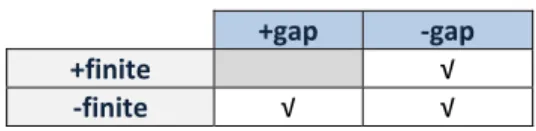
(15) L i n g ü í s t i c a e n l a r e d . K o e l p u c s j s e q i l g r e 01 / 05 / 2017 vli uonebTeresa.Parodi–Elina.Vilar.Beltrá nvlinwyt imy University.of.Cambridge–Queen.Mary.Londonhñ bvotlaqwiopyjhwxbzcinzuucsjseqilgrawvkdoixñrtni. .artículo. Degree clauses in child Spanish: effects of locality on the interpretation of gaps and overt pronouns1. In processing terms, the strategy known as early closure will lead to close the parse as soon as a potential candidate is encountered. In this case the first potential candidate is the subject gap. Closing the parses at that stage will also create the simplest possible syntactic structure. In addition, the computational resources and working memory capacity of young children may favour an early closure of an ambiguity.. 5. Methodology 5.1. The test In order to test our research questions we used a Truth Value Judgment task based on Crain & Thornton (1998) and Anderson (2005). A story was presented visually and aurally: it was acted out by the experimenter using toys and watched at the same time by a puppet. At the end of the story the puppet made a comment about what had happened in the story, i.e. uttered the test item. The participants´task was to evaluate whether the test item was adequate or not for the situation presented, i.e. evaluate their Truth Value. The puppet was introduced to the participants as someone who liked to talk but did not always pay attention, so that the comments about the situation depicted were not always right. The children were asked to help the puppet by telling it why it was right or wrong. The idea behind this is that children may find it easier to correct the puppet when necessary than to correct an adult. Both the ´right´/´wrong´ answer and the additional comments were taken into account, as they yielded an insight into both the truth value and the meaning assigned to the proposition. The test factors were +/- finiteness and +/- gap. The combination of these factors resulted in the item types shown in Table 1. We do not test the gap condition in finite clauses (-fin, +gap), which is ungrammatical in Spanish. Recall that in the finite condition, an overt pronominal is obligatory. The test did not include ungrammatical items, given that the issue was the interpretation assigned and not grammaticality. There were two items per condition, targeting the answers ´right´and ´wrong´respectively. The test included warm-up items and fillers. TABLE 1: Factors in the test +gap +finite -finite. √. -gap √ √. The examples under (31, 32a-b, repeated from 1 and 2a-b) illustrate these conditions. (31) +finite, -gap El elefantei es muy travieso para que el burro lei The elephant is too naugthy for the donkey him. ´The elephant is too naughty for the donkey to teach him.´. enseñe. teach.3s.subj. S u j i l s i w w w . l i n r e d . c o m i x s d u r p p r t g o a s e h n v j v r h j e i u t d s o u s f h a i o u . P á g i n a 15 s o n f t i e I . S . S . N . 1 6 9 7 - 0 7 8 0 r i a q u g d s p k g a o f d q ze r u x v f s l j g i u a p e k f s u v n ñ i a z q e o q.
(16) L i n g ü í s t i c a e n l a r e d . K o e l p u c s j s e q i l g r e 01 / 05 / 2017 vli uonebTeresa.Parodi–Elina.Vilar.Beltrá nvlinwyt imy University.of.Cambridge–Queen.Mary.Londonhñ bvotlaqwiopyjhwxbzcinzuucsjseqilgrawvkdoixñrtni. .artículo. Degree clauses in child Spanish: effects of locality on the interpretation of gaps and overt pronouns1. (32a) -finite, +gap El elefantei es The elephant. muy travieso para is too naughty. enseñar ei. to teach.. (32b) -finite, -gap El elefantei The elephant. es is. para to. muy travieso too naughty. enseñar- lei. teach him.. 5.2. The test items The test items focused on the structure “too ADJ to V”, e.g. “too naughty to teach”. The protocols included a fictitious situation with two participants: two toy animals that represented animate participants. Being animate, they were both in principle capable of carrying out the action expressed by the verb, i.e. the items were reversible. Thus, the distinction of agent and patient in the event has to rely on syntactic information, making it possible to isolate syntactic factors from semantic ones, such as animacy. The presence of a gradable predicative adjective is essential, given that we are testing degree clauses. The choice of the specific adjectives is guided by what 3yr olds can understand: grande (´big´), pequeño (´small´), rápido (´fast´), lento (´slow´). Examples of protocols are given in (33) and (34) below in their English translation. We offer one example with a target ´yes´answer (33) and one with a target ´no´answer (34). (33) The elephant is too naughty to teach: The donkey is trying to teach the elephant how to play on a slide. Half way through the process the elephant sees another friend and leaves. The puppet then utters the cue: Puppet: I know what happens in this story. The elephant is too naughty to teach. In this case the puppet is right: the donkey was unable to teach the elephant, who stopped paying attention and left with another friend. (34) The giraffe is too tall to kiss: In the situation presented a bird and a giraffe play together. The giraffe asks the bird for a kiss. The bird observes that the giraffe is very tall, but the giraffe points out that the bird can fly and get to the giraffe’s cheek, which the bird does. The cue uttered by the puppet, the giraffe is too tall to kiss, is wrong, as the bird was able to fly and kiss it, in spite of the giraffe’s tallness. Both the verbal and the non-verbal contexts favour the object reading. In one of the examples it is the donkey that is teaching and not the elephant; this means that ‘too naughty to teach’ can only refer to the elephant as a. S u j i l s i w w w . l i n r e d . c o m i x s d u r p p r t g o a s e h n v j v r h j e i u t d s o u s f h a i o u . P á g i n a 16 s o n f t i e I . S . S . N . 1 6 9 7 - 0 7 8 0 r i a q u g d s p k g a o f d q ze r u x v f s l j g i u a p e k f s u v n ñ i a z q e o q.
(17) L i n g ü í s t i c a e n l a r e d . K o e l p u c s j s e q i l g r e 01 / 05 / 2017 vli uonebTeresa.Parodi–Elina.Vilar.Beltrá nvlinwyt imy University.of.Cambridge–Queen.Mary.Londonhñ bvotlaqwiopyjhwxbzcinzuucsjseqilgrawvkdoixñrtni. .artículo. Degree clauses in child Spanish: effects of locality on the interpretation of gaps and overt pronouns1. receiver of the teaching. There is namely one event of teaching and the donkey is the teacher. Furthermore the donkey says “I’ll teach you”. In the second example the giraffe asks for a kiss and the bird kisses it, so the giraffe is the object of the kissing, in addition to the explicit mention of height and ability to fly. This explicit mention of the property of the animal in question should steer the test participants away from evaluating just the property and, instead, guide them to the evaluation of the event in relation to the property in question. There were practice items as well as fillers. The responses aimed for were ´yes´/´no´, ´right´/´wrong´, that is, whether the puppet’s comment was right or wrong in that situation. Additionally the test participants were encouraged to justify their answer. The cues targeted an equal amount of ´right´and ´wrong´responses.. 5.3. Participants The participants were 22 children aged 3;00 to 6;00 in three groups: 3;00 to 4;00, 4;00 to 5;00, 5;00 to 6;00, plus 8 adult controls. Table 2 illustrates the number and age of the participants. All the child participants come from the same school, a kindergarten and primary school in Madrid. Consent was obtained from the children’s parents; the children themselves were able to withdraw whenever they wanted. The adult participants were university students from Spain, who were tested in London and Cambridge when they were visiting. It is important to point out that we did not include any adult control who had spent more than a couple of weeks in an English-speaking environment, so as to minimise the potential influence of this language.. TABLE 2: Participants in the study group 3;00-4;00 4;00-5;00 5;00-6;00 adults. n 6 7 9 8. age range 3;00 – 3;08 4;00 – 5;00 5;02 – 6;02. 6. Results In this section we will evaluate the answer to the truth value question, i.e. whether the cue uttered by the puppet is right or wrong, and, thus, find out whether the participants establish coreference between the matrix subject and the embedded subject (subject reading) or the embedded object (object reading). As we have seen in the sections above, the structure we are studying is a multi-faceted one an requires we take into account a number of facts alongside the structure itself, as they have an impact on the interpretation of the test items by the participants and on our interpretation of the results.. S u j i l s i w w w . l i n r e d . c o m i x s d u r p p r t g o a s e h n v j v r h j e i u t d s o u s f h a i o u . P á g i n a 17 s o n f t i e I . S . S . N . 1 6 9 7 - 0 7 8 0 r i a q u g d s p k g a o f d q ze r u x v f s l j g i u a p e k f s u v n ñ i a z q e o q.
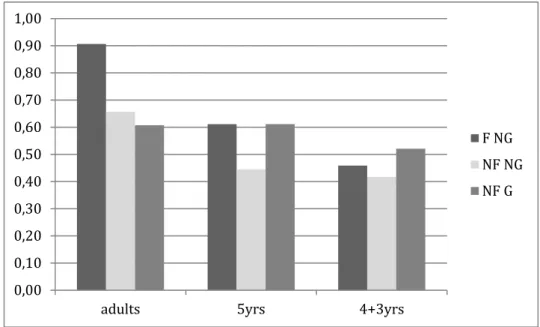
(18) L i n g ü í s t i c a e n l a r e d . K o e l p u c s j s e q i l g r e 01 / 05 / 2017 vli uonebTeresa.Parodi–Elina.Vilar.Beltrá nvlinwyt imy University.of.Cambridge–Queen.Mary.Londonhñ bvotlaqwiopyjhwxbzcinzuucsjseqilgrawvkdoixñrtni. .artículo. Degree clauses in child Spanish: effects of locality on the interpretation of gaps and overt pronouns1. The results are displayed in Figure 1 below. The columns represent the three conditions tested: finite clauses with an overt pronominal (F NG, finite, non-gap), non-finite clauses with and overt pronominal (NF NG, nonfinite, non-gap) and non-finite clauses with a gap (NF G, non-finite, gap). The figure shows 3 groups: adults, 5year-olds and the 4- and 3-year-olds in a group. The 4- and 3-year-olds were grouped together as no differences were found between them. The information on the figure is expressed in percentages, supported by statistical analysis 1,00 0,90 0,80 0,70 0,60. F NG. 0,50. NF NG. 0,40. NF G. 0,30 0,20 0,10 0,00 adults. 5yrs. 4+3yrs. FIGURE 1 Coindexation of the matrix subject with the embedded object in %. Overall the figure indicates that the adult controls perform best, i.e. get the higher proportion of object readings in the finite condition, when all information is explicit: the disjoint subject reference is overtly marked by a full DP and the embedded object is realised as a clitic. The adults´performance in the non-finite condition, on the other hand, is significantly worse, i.e. they get fewer object readings. These results were supported by statistical analysis. A Friedman test for related samples shows that for the adult participants there is an effect of condition (p = 0.04), clearly due to the high score for the finite condition. Follow-up comparisons using Wilcoxon Signed Ranks Tests confirm this (F NG vs. NF NG, p = 0.046, F NG vs. NF G, p = 0.041). There is, at the same time, no difference between the two non-finite conditions, with and without a gap. For the 5-year-olds, there is a noticeable difference between the non-finite, non-gap condition (NF NG) and the rest. The Friedman tests show indeed an effect of condition, p = 0.039. Follow-up Wilcoxon tests confirm that this is due to the lower score for the NF NG condition (F NG vs. NF NG, p = 0.034, NF G vs. NF NG, p = 0.10). As for the younger children, the 3- and 4yr olds, they perform best in the non-finite condition with a gap, i.e. it is in this condition that they achieve more coindexations of the matrix subject with the embedded object (Friedman test, p = 0.39). Recall, however, that, as mentioned above, they also appear to evaluate only the. S u j i l s i w w w . l i n r e d . c o m i x s d u r p p r t g o a s e h n v j v r h j e i u t d s o u s f h a i o u . P á g i n a 18 s o n f t i e I . S . S . N . 1 6 9 7 - 0 7 8 0 r i a q u g d s p k g a o f d q ze r u x v f s l j g i u a p e k f s u v n ñ i a z q e o q.
(19) L i n g ü í s t i c a e n l a r e d . K o e l p u c s j s e q i l g r e 01 / 05 / 2017 vli uonebTeresa.Parodi–Elina.Vilar.Beltrá nvlinwyt imy University.of.Cambridge–Queen.Mary.Londonhñ bvotlaqwiopyjhwxbzcinzuucsjseqilgrawvkdoixñrtni. .artículo. Degree clauses in child Spanish: effects of locality on the interpretation of gaps and overt pronouns1. matrix predicate; in other words, it is by no means clear that they are able to evaluate this long-distance dependency. Consider Tables 3 and 4 below. TABLE 3 Friedman test N chi-square df Asymp. Sig.. adults 8 6.333 2 0.042. 5yrs 9 6.5 2 0.039. 4 and 3yrs 12 1.862 2 0.394. TABLE 4 Wilcoxon signed-ranks test. Z Asymp.Sig.. Adults F NG – NF NG -1.994 0.046. F NG – NF G -2.041 0.041. 5yrs F NG – NF NG -2.121 0.034. NF G – NF NG -1.604 0.109. 6.1. Identifying confounding factors in the data In the first place we need to identify confounding factors, i.e. ´noise´, in the data. The aim of this section is not to provide an in-depth analysis of each of these points, but to show that we have considered these issues. The first point is, obviously, whether the answers given match the expected one or whether there is a generalised ´yes´ bias. The yes/no answer is accompanied in many cases by a comment on the situation observed, that can contribute to illuminate its interpretation. The next point is to observe how the participants evaluate the matrix predicate, an adjective (e.g. ´naughty´) or an adverb (e.g. ´far´), as well as the event in the embedded clause. The issue here is whether the participants understand both the matrix and the embedded clause and are able to establish a relation between them, rather than interpreting the adjective or adverb in the matrix clause as a property of the matrix subject. This will have an impact in the way they interpret the gaps or the resumptives in the embedded clause. Recall that the non-verbal context provided before presenting the critical item are biased towards the object reading. In the story in which the donkey teaches the elephant, this teaching is carried out, indicating that ´too naughty to teach´can only refer to the elephant as a receiver of the teaching.. S u j i l s i w w w . l i n r e d . c o m i x s d u r p p r t g o a s e h n v j v r h j e i u t d s o u s f h a i o u . P á g i n a 19 s o n f t i e I . S . S . N . 1 6 9 7 - 0 7 8 0 r i a q u g d s p k g a o f d q ze r u x v f s l j g i u a p e k f s u v n ñ i a z q e o q.
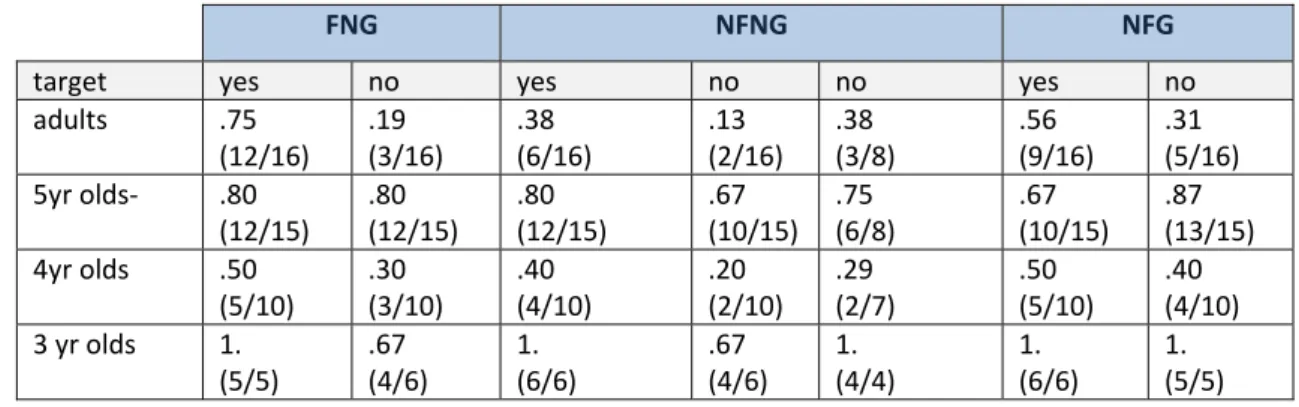
(20) L i n g ü í s t i c a e n l a r e d . K o e l p u c s j s e q i l g r e 01 / 05 / 2017 vli uonebTeresa.Parodi–Elina.Vilar.Beltrá nvlinwyt imy University.of.Cambridge–Queen.Mary.Londonhñ bvotlaqwiopyjhwxbzcinzuucsjseqilgrawvkdoixñrtni. .artículo. Degree clauses in child Spanish: effects of locality on the interpretation of gaps and overt pronouns1. 6.1.1. Is there a ´yes´ bias? Each of the test items targets the answer ´yes´or ´no´to the cue. Providing the target answer should indicate that the participant is establishing coreference between the matrix subject and the embedded object. However we need to ascertain whether the participants give differentiated answers as opposed to answering ´yes´ indiscriminately. The following table 5 indicates how often the participant answers ´yes´ in contexts where the target answer is ´yes´or ´no´, respectively.. TABLE 5: How often the participants answer ´yes´in ´yes´and ´no´contexts respectively. The information is given in percentages. The numbers in parenthesis are raw numbers. FNG target adults 5yr olds4yr olds 3 yr olds. yes .75 (12/16) .80 (12/15) .50 (5/10) 1. (5/5). no .19 (3/16) .80 (12/15) .30 (3/10) .67 (4/6). NFNG yes .38 (6/16) .80 (12/15) .40 (4/10) 1. (6/6). no .13 (2/16) .67 (10/15) .20 (2/10) .67 (4/6). NFG no .38 (3/8) .75 (6/8) .29 (2/7) 1. (4/4). yes .56 (9/16) .67 (10/15) .50 (5/10) 1. (6/6). no .31 (5/16) .87 (13/15) .40 (4/10) 1. (5/5). In the adult responses we can see some ´yes´-overextensions to ´no´-contexts, but no generalised ´yes´bias. However, such a bias can be observed in the children’s answers. This is particularly noticeable for the younger children, the 3- and 4yr olds. Obviously, it raises questions about the younger participants´understanding of the test items. It is therefore important to consider the comments the participants provide. Comments are provided by all participants, children and adults. Exceptions are the cases in which the answer seems too obvious to the participant to merit further explanation. (Or those in which they don’t understand and just say something, which particularly holds for some 3yr olds.). 6.1.2. The participants´ comments Some clues about how the participants understand the test items appear in the comments they make while performing the task. And the first point to take into account is whether the participants notice both the matrix predicate, realised as an adjective (e.g. naughty) or an adverb (e.g. far), and the event in the embedded clause. Noticing only the adjective means automatically that they are evaluating the adjective or adverb as immediately predicated of the matrix subject and, therefore, not establishing a relation with the event in the embedded clause. Consider example (35): if the participant only notices the adjective, s/he will evaluate whether the little pig is intrinsically small or not. If they also consider the event in the embedded clause, they will be able to. S u j i l s i w w w . l i n r e d . c o m i x s d u r p p r t g o a s e h n v j v r h j e i u t d s o u s f h a i o u . P á g i n a 20 s o n f t i e I . S . S . N . 1 6 9 7 - 0 7 8 0 r i a q u g d s p k g a o f d q ze r u x v f s l j g i u a p e k f s u v n ñ i a z q e o q.
(21) L i n g ü í s t i c a e n l a r e d . K o e l p u c s j s e q i l g r e 01 / 05 / 2017 vli uonebTeresa.Parodi–Elina.Vilar.Beltrá nvlinwyt imy University.of.Cambridge–Queen.Mary.Londonhñ bvotlaqwiopyjhwxbzcinzuucsjseqilgrawvkdoixñrtni. .artículo. Degree clauses in child Spanish: effects of locality on the interpretation of gaps and overt pronouns1. evaluate ´small´against the specific event, namely, there is a hungry lion looking for food. Only in the last case the answers will contribute to our research question. (35) El cerdito The little pig. es muy pequeño is too small. para comérse-lo. to eat it.. The participants’ interpretations are reflected in their comments. Consider the following example answers (36, 37, 38) to the item in (35). The item is true in the situation presented: (36) El cerdito es tan pequeño que el león se iba a quedar con hambre si se lo comía. The little pig is so small that the lion would still be hungry if he ate it. (C, adult) (37) Scar tiene hambre Scar is hungry. y no se lo puede comer porque le da pena. (Victor, 5yrs) and he can’t eat it (i.e. the pig) because he feels sorry about it.. (38) El cerdito es muy pequeño. (Sergio, 4yrs) The little pig is very small. The answers (36) and (37) indicate understanding of the predicate in the matrix clause and how it bears on the event in the embedded clause. It is clear that the participants interpret that the lion could have eaten the little pig but didn’t. The answer (38), on the other hand, only refers to the predicate as a property of the matrix subject and does not provide evidence on the interpretation of the embedded clause. Table 6 indicates if the participant notices and evaluates the event. In this case the distinction in yes/no contexts is irrelevant. What this table shows is that while adults and 5yr olds notice both the adjective/adverbial and the event, this holds to a much lesser extent of the 4- and 3yr olds. Particularly the 3yr olds tend to evaluate only the adjective, and there is little indication that they establish a relation with the embedded clause. This also holds of most – but not all - of the 4yr olds. (See example 38 above.) This is important because if the participants do not take into account the event in the embedded clause there cannot be a subject bias understood as coreference of the matrix subject with an argument in the embedded clause.. TABLE 6: Cases in which the participants evaluate the event. Information given in percentages. Numbers in parentheses are raw numbers. FNG adults 5yr olds 4yr olds 3yr olds. .78 (25/32) .73 (22/30) .65 (13/20) .45 (5/11). NFNG .82 (33/40) .53 (20/38) .58 (14/27) .42 (5/12). NFG .91 (29/32) .73 (22/30) .50 (10/20) .17 (2/11). Together .84 (87/104) .65 (64/98) .55 (37/67) .35 (12/34). S u j i l s i w w w . l i n r e d . c o m i x s d u r p p r t g o a s e h n v j v r h j e i u t d s o u s f h a i o u . P á g i n a 21 s o n f t i e I . S . S . N . 1 6 9 7 - 0 7 8 0 r i a q u g d s p k g a o f d q ze r u x v f s l j g i u a p e k f s u v n ñ i a z q e o q.
(22) L i n g ü í s t i c a e n l a r e d . K o e l p u c s j s e q i l g r e 01 / 05 / 2017 vli uonebTeresa.Parodi–Elina.Vilar.Beltrá nvlinwyt imy University.of.Cambridge–Queen.Mary.Londonhñ bvotlaqwiopyjhwxbzcinzuucsjseqilgrawvkdoixñrtni. .artículo. Degree clauses in child Spanish: effects of locality on the interpretation of gaps and overt pronouns1. 6.1.3. The subject bias Our next question is then whether there is a preference for interpreting the gap of the embedded subject as coreferent with the matrix subject. This is illustrated in Table 7, which does not distinguish between yes- and no-target contexts. TABLE 7: Cases in which the participants show a subject bias. Information given in percentages. Numbers in parentheses are raw numbers. FNG NFNG NFG adults 5yr olds 4yr olds 3yr olds. .19 (6/32) .10 (3/30) 0 (0/10) 0 (0/12). .23 (9/40) .10 (4/39) 0 (0/17) .25 (3/12). .22 (7/32) .13 (4/30) .33 (4/12) 0 (0/12). There is a measurable preference for the subject reading in the adult data and in those of the 5yr olds, but not in a generalised way. Notice also that the values do not change in different finiteness conditions or according to the occurrence of an overt pronoun vs. a gap. Remember that the group of 4yr olds and, particularly, the 3yr olds fail to evaluate the event in the embedded clause, which obviously entails that there cannot be a subject or an object reading. We hypothesise that the 3yr-olds cannot compute the embedded clause with respect to the matrix one. It is possible that they are not able to compute such a “large” structure, possibly due to a combination of syntactic complexity and working memory limitations. To sum up, if we consider just the yes/no answer, there is a ´yes´bias for the child participants, in particular for the 3- and 4yr olds. The picture is, however, different if we consider the additional comments the participants give; these comments show whether the participants are evaluating the entire utterance with respect to the complete situation or just the adjective or adverbial as a property of the figure in the act-out story. In a last step we controlled for a bias for the ´subject´-reading in the interpretation of these structures. We have carried out a distinction between "true" subject readings and those that come about because the participants fail to evaluate the structure as intended. The latter case holds for most of the 3yr- and 4yr-old participants.. 6.2. Back to the results Let us now return to the main results. With respect to the finiteness distinction we observe that only the adult participants display significantly different results in finite and non-finite contexts: they get more object readings in the finite condition. The fact that the children appear to be insensitive to finiteness distinctions cannot lie in lack of knowledge of finiteness, since the +/-finite contrast is acquired at around 18 months and subject-verb agreement is in place by 24 months on average. As for the non-finite conditions, the results for the gap condition are in line with the expected preferred interpretation of identity between the matrix subject and the subject gap in the embedded clause.. S u j i l s i w w w . l i n r e d . c o m i x s d u r p p r t g o a s e h n v j v r h j e i u t d s o u s f h a i o u . P á g i n a 22 s o n f t i e I . S . S . N . 1 6 9 7 - 0 7 8 0 r i a q u g d s p k g a o f d q ze r u x v f s l j g i u a p e k f s u v n ñ i a z q e o q.
Figure


+4


Documento similar
No obstante, como esta enfermedad afecta a cada persona de manera diferente, no todas las opciones de cuidado y tratamiento pueden ser apropiadas para cada individuo.. La forma
1. S., III, 52, 1-3: Examinadas estas cosas por nosotros, sería apropiado a los lugares antes citados tratar lo contado en la historia sobre las Amazonas que había antiguamente
In the previous sections we have shown how astronomical alignments and solar hierophanies – with a common interest in the solstices − were substantiated in the
Finally, experiments with solar [17–34], atmospheric [35–45], reactor [46–50], and long-baseline accelerator [51–59] neutrinos indicate that neutrino flavor change through
Díaz Soto has raised the point about banning religious garb in the ―public space.‖ He states, ―for example, in most Spanish public Universities, there is a Catholic chapel
teriza por dos factores, que vienen a determinar la especial responsabilidad que incumbe al Tribunal de Justicia en esta materia: de un lado, la inexistencia, en el
If the concept of the first digital divide was particularly linked to access to Internet, and the second digital divide to the operational capacity of the ICT‟s, the
In the “big picture” perspective of the recent years that we have described in Brazil, Spain, Portugal and Puerto Rico there are some similarities and important differences,
