Effects on anemia of drug adjustment in patients with chronic
hepatitis C during telaprevir-combined therapy
Akihiro Tamori,* Kiyohide Kioka,** Hiroki Sakaguchi,*** Masaru Enomoto,* Hoang Hai,* Etsushi Kawamura,* Atsushi Hagihara,* Hideki Fujii,* Sawako Uchida-Kobayashi,* Shuji Iwai,* Hiroyasu Morikawa,*
Yoshiki Murakami,* Yasuko Kawasaki,** Daisuke Tsuruta,**** Norifumi Kawada*
*Department of Hepatology, Osaka City University Graduate School of Medicine, Osaka, Japan.
**Department of Hepatology Osaka City General Hospital, Osaka Japan. ***Internal Medicine, Izumi Municipal Hospital, Izumi, Japan. ****Department of Dermatology, Osaka City University Graduate School of Medicine, Osaka, Japan.
ABSTRACT
Aim. Anemia is the most common adverse event in patients with chronic hepatitis C virus (HCV) treated with telaprevir (TVR) combined triple therapy. We examined the effects of drug dose adjustment on ane-mia and a sustained viral response (SVR) during combination therapy. Material and methods. This study en-rolled 62 patients treated with TVR (2,250 mg) for 12 weeks plus pegylated interferon-alpha-2b and ribavirin for 24 weeks. The patients were assigned randomly to the TVR-standard or -reduced groups before treat-ment. At the occurrence of anemia (hemoglobin < 12 g/dL), the TVR-reduced group received 1500 mg TVR plus the standard dose of ribavirin, whereas the TVR-standard group received the standard TVR dose (2,250 mg) and a reduced dose of ribavirin (200 mg lower than prescribed originally). The safety and SVR at 24 weeks were compared between the TVR-standard (n = 28) and TVR-reduced (n = 25) groups. Results. No differences in the proportion of patients who became HCV RNA-negative were detected between the TVR-standard and -reduced groups (72 and 72% at week 4, 79 and 84% at the end of treatment, and 76 and 80% at SVR24, respectively). Two groups had comparable numbers of adverse events, which led to the discon-tinuation of TVR in 14 patients of TVR-standard group and in 14 of TVR-reduced group. A lower incidence of renal impairment was observed in the TVR-reduced group (6%) than the TVR-standard group (11%, not statistically significant). Conclusions. TVR dose adjustment could prevent anemia progression without weakening the anti-viral effect during triple therapy in HCV-patients.
Key words. Adverse effects. Peg-interferon α2b. Ribavirin. Randomized control study. Sustained viral response.
Correspondence and reprint request: Akihiro Tamori, M.D., Ph.D.
Department of Hepatology
Osaka City University Graduate School of Medicine, 1-4-3 Asahimachi, Abeno-ku, Osaka 545-8585, Japan
Tel.: +81-6645-3811. Fax: +81-6-6646-1433 E-mail: [email protected]
Manuscript received: June 13, 2014. Manuscript accepted: July 26, 2014.
INTRODUCTION
Chronic hepatitis C (CHC) due to infection with the hepatitis C virus (HCV) affects ~170 million people worldwide and is the most common cause of chronic liver disease.1 Of HCV-infected individuals,
20 to 30% eventually develop liver cirrhosis or hepa-tocellular carcinoma (HCC). Elimination of HCV is important for preventing HCC, especially in elderly
patients with advanced fibrosis or CHC.2,3 A
combi-nation of pegylated-interferon (PEG-IFN) and riba-virin (RBV) completely eradicates HCV in up to 40-50% of treatment-naïve patients with high viral loads of HCV genotype 1b.4,5 Elongation of the
treatment period or retreatment improves the rate of sustained virological response (SVR) in some pa-tients with CHC, but not all.6,7
Telaprevir (TVR), a first-generation inhibitor of the NS3/4A serine protease, was approved as a direct-acting antiviral (DAA) against CHC.8,9 Previous
studies have demonstrated significantly higher SVR rates in both treatment-naïve and treatment-experi-enced CHC subjects with genotype 1 who were treat-ed with TVR-combintreat-ed triple therapy as compartreat-ed to those treated with PEG-IFN and RBV combination therapy.8-14 In Japan, TVR-based triple therapy was
considered an accepted standard of care in genotype 1 HCV-infected patients.15,16 However, severe anemia
and other serious adverse events (SAEs) can occur more frequently in patients with CHC undergoing TVR-combined triple therapy.10,11,17 Initially, the
rec-ommended pharmacological drug dose of TVR was 2,250 mg, and dose reduction was not adjusted for ad-verse events.18,19 By contrast, the recommended dose
of RBV was adjusted according to the body weight of patients; furthermore, a dose reduction was recom-mended in cases with anemia. After the approval of TVR combined triple therapy, the efficacy and safety of the TVR dose reduction to 1,500 mg was discussed in Japan. However, sufficient evidence was not avail-able to confirm the efficacy and safety of TVR dose adjustment therapy. The aims of the present study were to evaluate the anti-HCV effect and safety of TVR dose adjustment for anemia in patients with CHC treated with TVR combined triple therapy.
MATERIAL AND METHODS
Patients
This study enrolled adult patients, aged 20 to 70 years, who were chronically infected with HCV gen-otype 1 and had serum HCV RNA viral load > 5 log copies/mL at screening. Additional inclusion criteria were platelet count ≥ 90,000 mm3, and hemoglobin ≥
12 g/dL. Patients were excluded if they had a medi-cal contraindication to PEG-IFN or RBV, a history of drug use or documented cirrhosis, evidence of other significant liver diseases including hepatitis B virus, autoimmune liver diseases, alcohol liver dis-ease and HCC. No patients had evidence of human immunodeficiency virus infection. This study was conducted according to the guidelines of the 1975 Declaration of Helsinki (2004 version), and written informed consent was obtained from all patients pri-or to treatment. The study protocol was approved by the Ethics Committee in each hospital and by the Ethics Committee of Osaka City University Gradu-ate School of Medicine (No. 2212). The trial was reg-istered at UMIN (No. 000007071).
Study design
Patients from three hospitals were evaluated in a randomized two-arm study. The efficacy and safety of drug dose adjustment for patients with anemia were evaluated in patients receiving TVR (Telavic; Mitsubi-shi Tanabe Pharma, Osaka, Japan) in combination with PEG-IFN α2b (1.5 μg/kg/week Peg-Intron; MSD,
Tokyo, Japan) and RBV (Rebetol, MSD) for 12 weeks using the RBV clearance-based dosage20,21 as follows:
400 mg/day for patients with an oral clearance rate (CL/F) < 8 L/h; 600 mg/day for patients with CL/F ranging from 8 to < 15 L/h, 800 mg/day for patients with CL/F ranging from 15 to < 25 L/h, 1,000 mg/day for patients CL/F more than 25 L/h for 12 weeks, fol-lowed by PEG-IFN α2b and RBV for 12 weeks. TVR was initiated at a dose of 750 mg every 8 h (2,250 mg/ day). Before initiating treatment, enrolled patients were allocated randomly into two groups. At the oc-currence of anemia (hemoglobin < 12 g/dL), the TVR-standard group (group A) received the TVR-standard TVR dose (2,250 mg/day) and a reduced dose of ribavirin that was 200 mg lower than that originally prescribed according to the recommended guideline. The dose of TVR was reduced from 2,250 to 1,500 mg/day without reduction of RBV dose in the TVR-reduced group (group B). After the first reduction in the TVR dose, if the hemoglobin decreased to below 10 g/dL, 200 mg of RBV was reduced from the initiation dose according to the recommended guidelines. When other hematologic side effects occurred, the PEG-IFN α2b dose was re-duced according to the drug recommendations. During treatment, no patients received erythropoietin or gran-ulocyte-macrophage colony stimulating factor. For pa-tients with grade 1 (one or several sites affected) or grade 2 (diffuse skin eruptions involving up to 50% of the body surface) dermatological adverse events, medi-cal management was performed at the discretion of the physicians at each hospital. If a progressive grade 3 dermatological adverse event developed (rash with the appearance of substantial systemic signs or symptoms or involving more than 50% of the body surface), TVR was discontinued; however, the patients continued to receive PEG-IFNα2b and RBV if possible.
Virologic evaluations
HCV-RNA was determined using the TaqMan HCV assay (COBAS® TaqMan® HCV assay; Roche
Molecular Diagnostics, Tokyo, Japan) with a lower limit of quantification of 15 IU/mL and an upper limit of quantification of 6.9 x 10⁷ IU/mL (1.2-7.8 log
IU/mL). The HCV genotype was determined using a HCV genotype primer kit (Institute of Immunology Co., Ltd., Tokyo, Japan).
(breakthrough). Patients with HCV-RNA that re-mained detectable during treatment were defined as non-responders.
Assessment of treatment efficacy
Rapid viral response (RVR) was defined as unde-tectable serum HCV-RNA at week 4. End-of-treat-ment response (ETR) was defined as undetectable HCV-RNA at the end of therapy. SVR 24 was de-fined as undetectable HCV-RNA at 24 weeks after completion of treatment. All methods of assessing treatment efficacy were defined according to the guidelines.15 During the follow-up period, clinical,
biochemical and quantitative serum HCV-RNA as-sessments were evaluated at 1-3-month intervals.
SNP genostyping
We examined the genetic polymorphisms in the IL28B and ITPA genes only in patients who con-sented to genetic analysis.22,23 Whole blood was
col-lected from patients and centrifuged to separate the buffy coat. Genomic DNA was extracted from the buffy coat using a QIAamp® DNA Blood Midi
Kit (QIAGEN, Maryland, USA). The genetic poly-morphisms in IL28B rs8099917 and rs12979860 and ITPA rs1127354 were genotyped using the TaqMan SNP Genotyping Assay with the 7500 Fast Real-Time PCR System (Applied Biosystems, Foster City, CA, USA). All samples were also genotyped by direct sequencing to confirm the genotype. The primers and procedures used were described previously.7
Statistical analysis
Data analyses were conducted using the JMP soft-ware, ver. 9.0 (SAS Institute, Cary, NC, USA). Characteristics between groups were evaluated by Wilcoxon’s two-sample test for numerical variables or Fisher’s exact test for categorical variables. Vari-ables exhibiting values of p < 0.1 on univariate analysis were subjected to stepwise multivariate lo-gistic regression analysis. In the two-tailed test, p < 0.05 was taken to indicate statistical significance.
RESULTS
Patients
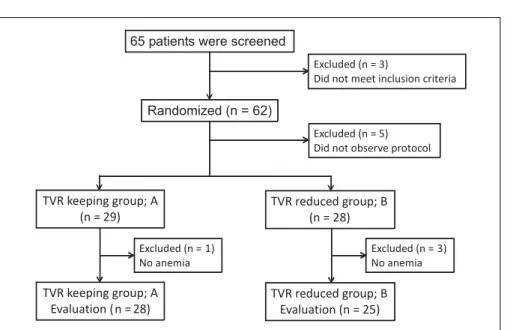
Sixty-five patients were screened for enrollment in this study: eight patients were excluded because
they did not observe the study protocol and 57 pa-tients were randomly allocated to two groups and followed-up until SVR determination. The TVR-standard group (group A) contained 29 patients, and it was necessary to reduce the RBV dose during treatment in 28 of these patients. The TVR-reduced group (group B) contained 28 patients, and it was necessary to reduce the TVR dose in 25 patients of these patients. Finally, we compared the efficacy and safety between 28 patients in group A and 25 patients in group B (Figure 1). The characteristics of the patients in groups A and B are shown in table 1. Group A contained 11 females and 17 males, and group B contained 12 females and 13 males (p = 0.356). The median age was 55 (range, 33-68) years in group A, and 61 (43-68) years in group B (p = 0.056). The patients in group B tended to be older than those in group A. The median body weight was 60 (range, 46-85) kg in group A and 61 (41-90) kg in group B (p = 0.63). Previous IFN-based therapies were performed in 12 patients (43%) in group A and 16 (64%) in group B. Group A had nine re-lapsers and three non-responders, whereas group B had 12 relapsers and four non-responders. No significant differences in hemoglobin level, plate-let count and white blood cell count were detected at baseline between groups A and B. The mean HCV-RNA level was 6.4 ± 0.6 log copies/mL in group A and 6.5 ± 0.6 log copies/mL in group B (p = 0.681). The IL28B and ITPA genotypes were examined in 45 (85%) and 34 (64%) patients, re-spectively. No differences in the distribution of the IL28B and ITPA genotypes were detected be-tween groups A and B.
Treatment responses in the TVR-standard and -reduced groups
Figure 1. Profile of the randomi-zed control study. TVR: telaprevir. Table 1. Baseline characteristics of patients with chronic hepatitis C virus infection allocated to the telaprevir (TVR) -standard
and TVR-reduction groups.
TVR-standard TVR-reduction p-value
(group A) (group B)
Patients (n) 28 25
Male/Female 18/10 13/12 0.356
Median age (range) years 55 (33–68) 61 (43–68) 0.056
Body weight 60 (46–85) 61 (41–90) 0.63
Body mass index 22.3 (17.7–29.8) 23.6 (16.4–27.8) 0.762
Previous IFN therapy (+/–) 12/16 16/9 0.124
Relapser/non-responder 9/3 12/4 1
Fibrosis stage (F0/F1/F2/F3/ND) 0/13/8/1/6 1/16/4/1/3 0.326
IL28B genotype (major/non-major) 18/4 16/7 0.34
ITPA genotype (major/non-major) 11/4 12/7 0.529
HCV RNA (log copies/mL) 6.4 ± 0.6 6.5 ± 0.6 0.681
WBC (mL) 5,436 ± 1,822 5,272 ± 1,595 0.624
Hb (g/dL) 14.6 ± 1.5 14.3 ± 1.0 0.412
Plt (x 104/mL) 17.3 ± 5.2 16.5 ± 4.8 0.515
ALT (IU/L) 60.8 ± 37.5 38.7 ± 17.1 0.036
γ-GTP (IU/L) 60.7 ± 57.6 65.0 ± 100.8 0.557
Cre (mg/L) 0.72 ± 0.15 0.71 ± 0.16 0.866
IFN: interferon. WBC: white blood cell. Hb: hemoglobin. Plt: platelet. ALT: alanine aminotransferase. γ-GTP: gamma-glutamyl transpeptidase. Cre: creatinine.
Adverse events and treatment discontinuation in the TVR-standard and TVR-reduced groups
In the TVR-standard group, 14 (50%) patients discontinued TVR treatment and 4 (14%) pa-tients stopped the combination therapy with PEG-IFN and RBV. In the TVR-reduced group, 14 (56%) patients discontinued TVR treatment, and 18 (72%) patients received reduced TVR dos-es (2250 mg reduced to 1,500 mg) between day 4
impair-ment in two, severe general fatigue in two, and ALT elevation and anemia in one patient each (Table 3). No difference in the incidence of
ad-verse events was detected between the two groups. However, renal impairment occurred more frequently during TVR 2,250 mg treatment (4/34; 11.7%) than during TVR 1,500 mg treat-ment (1/19; 5.2%), although the difference was not significant (p = 0.44). No patients in the present study died due to treatment-related ad-verse events.
Hemoglobin levels in the TVR-standard and TVR-reduced group
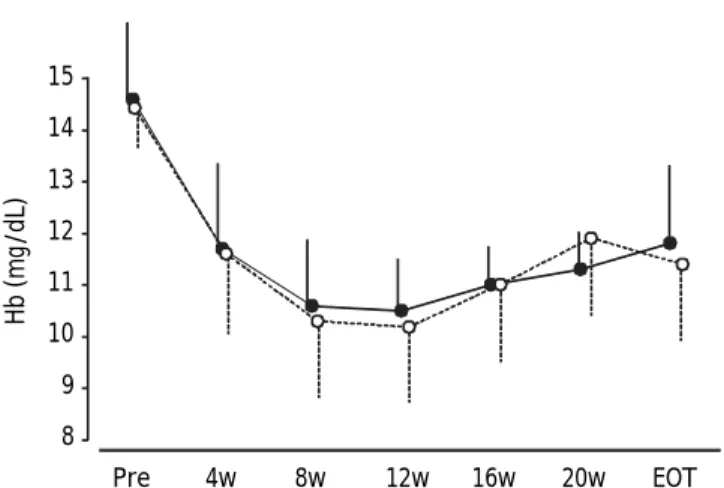
During treatment, the hemoglobin levels were re-duced continuously in all patients (Figure 3), with no significant difference in hemoglobin levels at any time between groups A and B.
Characteristics of patients without TVR and RBV drug dose reduction
Four patients who maintained the initiated TVR and RBV doses achieved SVR. These patients con-sisted of two females and two males (three treat-ment-naïve and one relapser) in the age range 31-60
Table 2. Adherence to drug treatments.
TVR-standard TVR-reduction p-value (group A) (group B)
Median TVR dose, g (range) 186.8 (2.25-189) 126 (6.75–174) 0.015 Median number of days of TVR administration (range) 80 (1–84) 75 (3–84) 0.945 Median day of TVR dose reduction (range) None 28 (4–63)
RBV adherence (%) 55 ± 30.4 61 ± 43.3 0.728
PEG-IFN adherence (%) 82.6 ± 31.9 80.4 ± 30.3 0.263
RBV: ribavirin. PEG-IFN: pegylated interferon.
Figure 2. Viral response rates at week 4 (RVR), the end of treatment response (ETR), and week 24 after treatment (SVR24). Gray bars show the rates in the TVR-standard group, and white bars the rates in the TVR-reduced group. No signifi-cant difference in the viral response rate was detected bet-ween the two groups.
Table 3. Adverse events necessary for TVR discontinuation or dose reduction.
TVR-standard (group A) TVR-reduction (group B)
(n = 28) TVR 2,250 mg (n = 6) TVR 1,500 mg (n = 19)
Anemia (Hb < 12 g/dL) 28* 6 18*
Anemia (Hb <10 g/dL) (55 y, 10 patients) (60 y, 12 patients)
12* - 8*
Anemia** (TVR discontinuation) (55 y, 6 patients) (58 y, 5 patients)
3 - 1
Skin rash (59 y, 3 patients) (57 y, 1 patient)
6 3 4
Renal impairment** (creatinine ≥ 1.6 mg/dL) 3 1 1
Fatigue** 2 1 1
ALT flare (> 150 IU/L)** 0 1 0
* Ribavirin was reduced by 200 mg (mean age, number of female patients). ** There was no statistical significant. 100
80
60
40
20
0
RVR ETR SVR 24
years, with body weights ranging from 54-85.5 kg, body mass index (BMI) ranging from 20.6-31.5, and baseline hemoglobin levels in the range 14.0-16.6 g/ dL. Three of the patients had the IL28B TT geno-type and one had the non-TT genogeno-type; three had the ITPA CC genotype and one had the non-CC gen-otype.
DISCUSSION
Drug adherence is one of the most important fac-tors in achieving SVR in patients treated with PEG-IFN and RBV.4,24 However, several adverse events
require drug dose reductions. Compared to PEG-IFN and RBV therapy, TVR combined triple therapy induced a greater variety of adverse events with more frequency. The TVR dose is recommended to remain at 2,250 mg for 12 weeks, and should not be reduced to protect against the emergence of drug re-sistance to protease inhibitors. To our knowledge, no studies of TVR drug adjustment in response to adverse events have been reported. Therefore, we conducted this prospective randomized study.
In this study, no significant difference was ob-served between the TVR-standard and -reduced groups in terms of RVR, ETR, SVR24 and the rate of
discontinuation of the study drugs in all cases. Sev-eral reports have evaluated the efficacy and safety in patients treated with 1,500 mg of TVR combined therapy. Suzuki, et al. reported that TVR 500 mg administered every 8 h (q8h) combined therapy
achieved similar SVR rates to those obtained using standard therapy with TVR 750 mg q8h.25
Addition-ally, the SVR rates were identical in both the TVR 750 mg q12h combined and q8h therapies.26 Our
re-sults were consistent with their reports.
In our study, hemoglobin levels showed similar patterns in both groups, suggesting that TVR dose adjustments had the same effect on the improvement of anemia as do RBV dose adjustments. The inci-dence of skin rash and general fatigue in the TVR-standard group was similar to that in the TVR-reduced group. However, the incidence of renal impairment was lower in patients in the TVR-re-duced group compared to those in the TVR-standard group. Sezaki, et al.27 reported that TVR 1,500 mg
combined therapy reduced anemia, but not renal im-pairment, compared to TVR 2,250 mg therapy. In comparison, other studies showed that TVR 1,500 mg therapy reduced the incidence of renal impair-ment.25,26 The treatment protocol in our study
dif-fered from those used in other studies. First, the initial dose of TVR was 2,250 mg/day in our study. Second, the patients were treated with a clearance-based dosage of RBV. These differences in treatment protocol might have influenced the occurrence of ad-verse events.
No adverse effects, including anemia occurred in one of the TVR-maintained group and three of the TVR-reduced group. These four patients who main-tained the initial doses of the three drugs achieved an SVR. It has been suggested that drug adherence is an important factor for SVR in TVR-combined therapy.13 However, there were few patients (4/55,
4%) in our study. By contrast, one patient in the TVR-reduced group showed HCV relapse after 24 weeks of combination therapy. The TVR dose in the triple therapy was determined by the dose-finding study, which showed that 2,250 mg of TVR achieved the greatest anti-HCV effect.28 However, it is not
clear whether TVR 2,250 mg is necessary during tri-ple combined-therapy for all patients such as older patients and those with lower body weight. Like-wise, it is not known whether TVR 1,500 mg is sufficient to achieve an SVR in all patients with HCV. We propose that TVR dose adjustments should consider individual patient’s characteristics and adverse events.
This study had several limitations. First, the small sample sizes in each subgroup hampered our capacity to draw conclusions. Second, our study co-hort was limited to Japanese CHC subjects with rel-atively low body weights or low BMI, who were infected predominantly with HCV genotype 1b, in
Figure 3. Mean hemoglobin levels during treatment. Error bars represent standard errors. Open circles with dotted li-nes represent hemoglobin levels in patients in the TVR-redu-ced group. Closed circles with solid lines represent hemoglobin levels in patients in the TVR-standard group. No significant differences in hemoglobin levels were detected at any time point between the two groups.
15
14
13
12
11
10
9
8
Pre 4w 8w 12w 16w 20w EOT
contrast to patients in Western countries.29,30
Hence, our results cannot be extended to patients with HCV genotype 1a or those of other ethnicities. Third, the latest guideline for HCV treatment rec-ommends sofosbuvir or simeprevir (SMV) combined with PEG-IFN plus RBV for HCV genotype 1, in-stead of TVR.31 Sofosbuvir combined with PEG-IFN
plus RBV therapy is not widely available in Japan. SMV is a second-generation inhibitor of the NS3/4A serine protease, which does not induce the addition-al adverse events in patients treated with PEG-IFN combined triple therapy.32-34 However, TVR has an
HCV drug resistance profile that differs from SMV.31
It has been speculated that TVR has a potential ef-fect on SMV-resistant HCV, Q80R/K or D168A/V/T/ H.35 Thus, larger prospective studies with cohorts of
various ethnicities will be needed to confirm these results.
CONCLUSION
The reduction of TVR dose to 1,500 mg prevented anemia progression without weakening the antiviral effect during triple therapy for patients with HCV. TVR dose adjustment might be an appropriate op-tion for preventing adverse events.
ABBREVIATIONS
• ALT: alanine aminotransferase. • HCV: hepatitis C virus.
• RVR: rapid viral responders. • ETR: end of treatment response. • NVR: non-viral responders. • PEG-IFN: pegylated interferon. • SVR: sustained viral response.
CONFLICT OF INTEREST
In the past year, Dr. Akihiro Tamori has received research funding from MSD K.K. Dr. Dr. Norifumi Kawada has consulted for MSD K.K. and Chugai Pharmaceutical Co., Ltd. and has received research funding from MSD K.K. and Chugai Pharmaceutical Co., Ltd. The remaining authors who have taken part in this study declared that they do not have an-ything to disclose regarding funding or conflict of interest with respect to this manuscript.
ACKNOWLEDGEMENTS
We would like to thank Ms. Yoko Yasuhara, and Ms. Sanae Deguchi for collecting data.
The English in this document has been checked by at least two professional editors, both native speakers of English.
REFERENCES
1. Pearlman BL. Protease inhibitors for the treatment of chronic hepatitis C genotype-1 infection: the new stand-ard of care. Lancet Infect Dis 2012; 12: 717-28.
2. Imai Y, Tamura S, Tanaka H, Hiramatsu N, Kiso S, Doi Y, In-ada M et al. Reduced risk of hepatocellular carcinoma af-ter inaf-terferon therapy in aged patients with chronic hepatitis C is limited to sustained viological responders. J Viral Hepat 2010; 17: 185-91.
3. Asahina Y, Tsuchiya K, Tamaki N, Hirayama I, Tanaka T, Sato M, Yasui Y, et al. Effect of aging on risk for hepato-cellular carcinoma in chronic hepatitis C virus infection. Hepatology 2010; 52: 518-27.
4. McHutchison JG, Manns M, Patel K, Poynard T, Lindsay KL, Trepo C, Dienstag J, et al. Adherence to combination ther-apy enhances sustained response in genotype-1-infected patients with chronic hepatitis C. Gastroenterology 2002; 123: 1061-9.
5. Coppola N, Pisaturo M, Tonziello G, Sagnelli C, Sagnelli E, Angelillo IF. Efficacy of pegylated interferon α-2a and α-2b in patients with genotype 1 chronic hepatitis C: a meta-analysis. BMC Infect Dis 2012; 12: 357.
6. Tamori A, Kioka K, Kurai O, Sakaguchi H, Enomoto M, Fujii H, Kobayashi S, et al. Favorable factors for re-treatment with pegylated interferon α2a plus ribavirin in patients with high viral loads of genotype 1 hepatitis C virus. Hepatol Res 2011; 41: 1169-77.
7. Hai H, Tamori A, Enomoto M, Morikawa H, Uchida-Koba-yashi S, Fujii H, Hagihara A, et al. Relationship between in-osine triphosphate genotype and outcome of extended therapy in hepatitis C virus patients with a late viral re-sponse to pegylated-interferon and ribavirin. J Gastroen-terol Hepatol 2014; 29: 201-7.
8. Hézode C, Forestier N, Dusheiko G, Ferenci P, Pol S, Goe-ser T, Bronowicki JP, et al. Telaprevir and peginterferon with or without ribavirin for chronic HCV infection. N Engl J Med 2009; 360: 1839-50.
9. McHutchison JG, Manns MP, Muir AJ, Terrault NA, Jacob-son IM, Afdhal NH, Heathcote EJ, et al. Telaprevir for pre-viously treated chronic HCV infection. N Engl J Med 2010; 362: 1292-303.
10. Jacobson IM, McHutchison JG, Dusheiko G, Di Bisceglie AM, Reddy KR, Bzowej NH, Marcellin P, et al. ADVANCE Study Team. Telaprevir for previously untreated chronic hepati-tis C virus infection. N Engl J Med 2011; 364: 2405-16. 11. Zeuzem S, Andreone P, Pol S, Lawitz E, Diago M, Roberts S,
Focaccia R, et al. Telaprevir for retreatment of HCV in-fection. N Engl J Med 2011; 364: 2417-28.
12. Buti M, Agarwal K, Horsmans Y, Sievert W, Janczewska E, Zeuzem S, Nyberg L, et al. Telaprevir Twice Daily is Nonin-ferior to Telaprevir Every 8 hrs for Patients with Chronic Hepatitis C. Gastroenterology 2014; 146: 744-53.
13. Furusyo N, Ogawa E, Nakamuta M, Kajiwara E, Nomura H, Dohmen K, Takahashi K, et al. Telaprevir can be success-fully and safely used to treat older patients with genotype 1b chronic hepatitis C. J Hepatol 2013; 59: 205-12. 14. Colombo M, Fernández I, Abdurakhmanov D, Ferreira PA,
15. Ghany MG, Nelson DR, Strader DB, Thomas DL, Seeff LB. An update on treatment of genotype 1 chronic hepatitis C vi-rus infection: 2011 practice guideline by the American As-sociation for the Study of Liver Diseases. Hepatology 2011; 54: 1433-44.
16. Editors of the Drafting Committee for Hepatitis Manage-ment Guidelines: The Japan Society of Hepatology Guide-lines for the Management of Hepatitis C Virus Infection. Hepatol Res 2013; 43: 1-34.
17. Ogawa E, Furusyo N, Nakamuta M, Kajiwara E, Nomura H, Dohmen K, Takahashi K, et al. Clinical milestones for the prediction of severe anemia by chronic hepatitis C pa-tients receiving telaprevir-based triple therapy. J Hepa-tol 2013; 59: 667-74.
18. Kumada H, Toyota J, Okanoue T, Chayama K, Tsubouchi H, Hayashi N. Telaprevir with peginterferon and ribavirin for treatment-naive patients chronically infected with HCV of genotype 1 in Japan. J Hepatol. 2012; 56: 78-84.
19. Hayashi N, Okanoue T, Tsubouchi H, Toyota J, Chayama K, Kumada H. Efficacy and safety of telaprevir, a new pro-tease inhibitor, for difficult-to-treat patients with geno-type 1 chronic hepatitis C. J Viral Hepat 2012; 19: e134-e142.
20. Kamar N, Chatelut E, Manolis E, Lafont T, Izopet J, Rosta-ing L. Ribavirin pharmacokinetics in renal and liver trans-plant patients: evidence that it depends on renal function. Am J Kidney Dis 2004; 43: 140-6.
21. Oze T, Hiramatsu N, Kurashige N, Tsuda N, Yakushijin T, Kanto T, Takehara T, et al. Early decline of hemoglobin correlates with progression of ribavirin-induced hemolytic anemia during interferon plus ribavirin combination thera-py in patients with chronic hepatitis C. J Gastroenterol 2006; 41: 862-72.
22. Tanaka Y, Nishida N, Sugiyama M, Kurosaki M, Matsuura K, Sakamoto N, Nakagawa M, et al. Genome-wide association of IL28B with response to pegylated interferon-alpha and ribavirin therapy for chronic hepatitis C. Nat Genet 2009; 41: 1105-9.
23. Fellay J, Thompson AJ, Ge D, Gumbs CE, Urban TJ, Shianna KV, Little LD, et al. ITPA gene variants protect against anaemia in patients treated for chronic hepatitis C. Na-ture 2010; 464: 405-8.
24. Shiffman ML, Di Bisceglie AM, Lindsay KL, Morishima C, Wright EC, Everson GT, Lok AS, et al. Peginterferon alfa-2a and ribavirin in patients with chronic hepatitis C who have failed prior treatment. Gastroenterology 2004; 126: 1015-23.
25. Suzuki F, Suzuki Y, Sezaki H, Akuta N, Seko Y, Kawamura Y, Hosaka T, et al. Exploratory study on telaprevir given every 8 h at 500 mg or 750 mg with peginterferon-alpha-2b and ribavirin in hepatitis C patients. Hepatol Res 2013; 43: 691-701.
26. Kawakami Y, Suzuki F, Karino Y, Toyota J, Kumada H, Chayama K. Telaprevir is effective given every 12 hours at 750 mg with peginterferon-alfa-2b and ribavirin to Jap-anese patients with HCV-1b IL28B rs8099917 TT. Antivir Ther 2013 [in press].
27. Sezaki H, Suzuki F, Hosaka T, Akuta N, Fukushima T, Hara T, Kawamura Y, et al. Effectiveness and safety of re-duced-dose telaprevir-based triple therapy in chronic hepatitis C patients. Hepatol Res 2013 [in press].
28. Reesink HW, Zeuzem S, Weegink CJ, Forestier N, van Vliet A, van de Wetering de Rooij J, McNair L, et al. Rapid de-cline of viral RNA in hepatitis C patients treated with VX-950: a phase Ib, placebo-controlled, randomized study. Gastroenterology 2006; 131: 997-1002.
29. McCurry J. Japan battles with obesity. Lancet 2007; 369: 451-52.
30. Examination Committee of Criteria for ‘Obesity Disease’ in Japan; Japan Society for the Study of Obesity. New cri-teria for ‘obesity disease’ in Japan. Circ J 2002; 66: 987-92.
31. AASLD and IDSA. Recommendations for Testing, Managing, and Treating Hepatitis C 2014. Available at: http:// www.hcvguidelines.org
32. Zeuzem S, Berg T, Gane E, Ferenci P, Foster GR, Fried MW, Hezode C, et al. Simeprevir increases rate of sustained vi-rologic response among treatment-experienced patients with HCV genotype-1 infection: a phase IIb trial. Gastro-enterology 2014; 146: 430-41.
33. Forns X, Lawitz E, Zeuzem S, Gane E, Bronowicki JP, An-dreone P, Horban A, et al. Simeprevir with Peginterferon and Ribavirin Leads to High Rates of SVR in Patients with HCV Genotype 1 Who Relapsed After Previous Therapy: a Phase 3 Trial. Gastroenterology 2014; 146: 1669-79. 34. Izumi N, Hayashi N, Kumada H, Okanoue T, Tsubouchi H,
Yatsuhashi H, Kato M, et al. Once-daily simeprevir with peginterferon and ribavirin for treatment-experienced HCV genotype 1-infected patients in Japan: the CONCER-TO-2 and CONCERTO-3 studies. J Gastroenterol 2014; 49: 941-53.