ii
The Impact of Michigan School
Librarians on Academic Achievement:
Kids Who Have Libraries Succeed
Marcia J. Rodney
Keith Curry Lance
Christine Hamilton-Pennell
Library of Michigan
Lansing, Michigan
iii
Table of Contents
Table of Contents ... iii
List of Tables ...v
Acknowledgements ... vii
Executive Summary ... ix
School Librarian Staffing... ix
Results by Level ... ix
School & Community Differences ... xi
How School Librarians Make a Difference... xii
The Heart of the School... xiv
Predictors of MEAP Reading Scores, 2002 ... xv
Brochure of Michigan Study Results ...xvii
Introduction...1
Review of the Literature ...3
Presence of a Library Media Center with a Professional Library Media Specialist ...4
Learning and Teaching ...5
Information Access and Delivery...15
Program Administration ...28
Summary...35
Methodologies ...36
Sample...36
Survey ...36
Available Data ...41
Statistical Significance...42
Bivariate Correlation ...43
Comparison of Means and t Test ...44
Multiple Regression Analysis...45
Findings ...47
Elementary School Level...48
Middle School Level...64
High School Level ...78
Comparison of Highest & Lowest Scoring Schools...91
Recommendations for Action...97
Appendices ... 100
iv
v
List of Tables
Table 1. Comparison of the Study Sample and the Universe of All Michigan Public Schools Serving Grades 4, 7 and 11, 2002 ...36 Table 2. Direct School Library Predictors of Reading Scores: Michigan, Grade
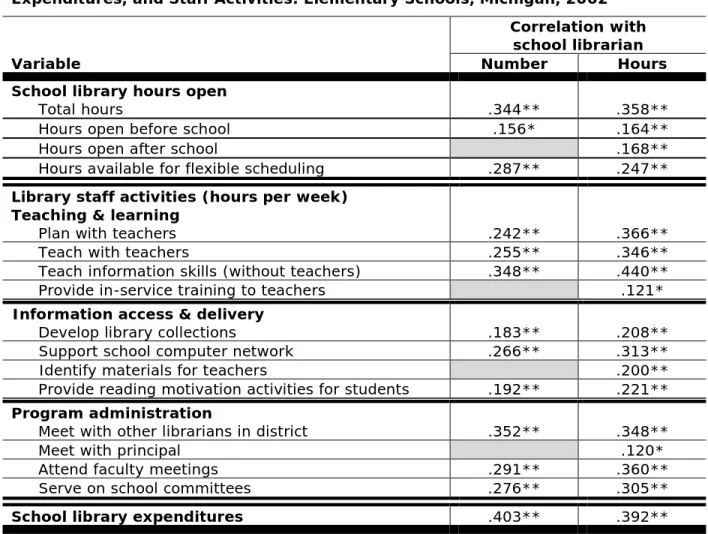
4, 2002 ...51 Table 3. School Librarian Staffing Predictors of School Library Hours,
Operating Expenditures, and Staff Activities: Elementary Schools,
Michigan, 2002 ...53 Table 4. School Library Staffing and Staff Activities Predictors of School
Library Operating Expenditures: Elementary Schools, Michigan, 2002..55 Table 5. School Library Predictors of Print Volumes in School Library
Collections: Elementary Schools, Michigan, 2002 ...58 Table 6. School Library Predictors of Library and School Computers:
Elementary Schools, Michigan, 2002 ...60 Table 7. Library Predictors of Library Visits & Circulation Per Typical Week:
Elementary Schools, Michigan, 2002. ...61 Table 8. Number of School Librarians with Master’s Degrees, Teacher
Certification, and Librarian Endorsement in Michigan Elementary
Schools, 2002...63 Table 9. Regression Analysis Results Identifying Predictors of Fourth Grade
MEAP Reading Scores, 2002 ...64 Table 10. Direct Library Predictors of Reading Scores: Michigan, Grade 7,
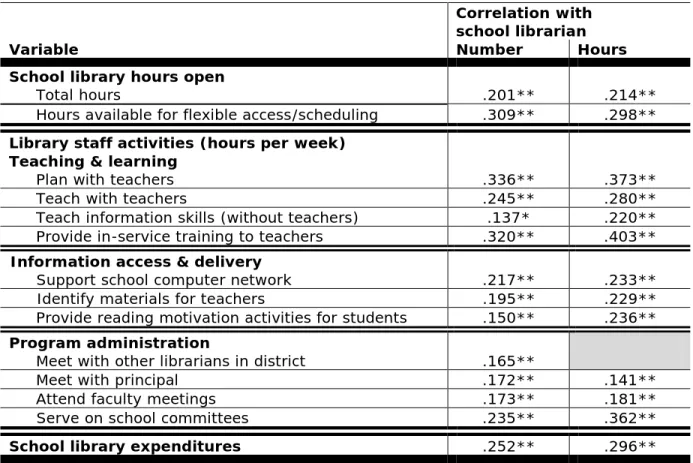
2002 ...67 Table 11. School Librarian Staffing Predictors of School Library Hours,
Operating Expenditures, and Staff Activities: Junior High/Middle Schools, Michigan, 2002 ...69 Table 12. School Library Staffing and Staff Activities Predictors of School
Library Operating Expenditures: Junior High/Middle Schools, Michigan, 2002 ...70 Table 13. School Library Predictors of Print Volumes in School Library
Collections: Junior High/Middle Schools, Michigan, 2002 ...72 Table 14. School Library Predictors of Library and School Computers: Junior
High/Middle Schools, Michigan, 2002...74 Table 15. Library Predictors of Library Visits: Michigan Middle Schools,
vi
Table 16. Number of School Librarians with Master’s Degrees, Teacher Certification, and Librarian Endorsement in Michigan Middle Schools, 2002. ...76 Table 17. Regression Analysis Results Identifying Predictors of Seventh
Grade MEAP Reading Scores, 2002...78 Table 18. Direct School Library Predictors of Reading Scores: Michigan,
Grade 11, 2002 ...80 Table 19. School Librarian Staffing Predictors of School Library Hours,
Operating Expenditures, and Staff Activities: High Schools, Michigan, 2002 ...81 Table 20. School Library Staffing and Staff Activities Predictors of School
Library Operating Expenditures: High Schools, Michigan, 2002 ...82 Table 21. School Library Predictors of Print Volumes in School Library
Collections: High Schools, Michigan, 2002...84 Table 22. School Library Predictors of Library and School Computers: High
Schools, Michigan, 2002 ...86 Table 23. Library Predictors of Library Visits: High Schools, Michigan, 2002.
...87 Table 24. Number of School Librarians with Master’s Degrees, Teacher
Certification, and Librarian Endorsement in Michigan High Schools, 2002. ...88 Table 25. Regression Analysis Results Identifying Predictors of Eleventh
Grade MEAP Reading Scores, 2002...89 Table 26. Statistical Comparison of Top and Bottom 25 Scoring Michigan
Elementary Schools on Fourth Grade MEAP Reading Test, 2002 ...92 Table 27. Statistical Comparison of Top and Bottom 25 Scoring Michigan
Middle Schools on Seventh Grade MEAP Reading Test, 2002...94 Table 28. Statistical Comparison of Top and Bottom 25 Scoring Michigan
vii
Acknowledgements
The Impact of Michigan School Librarians on Academic Achievement: Kids Who Have Libraries Succeed was a research project directed by the Library of Michigan to collect information on school library services and their
relationship to student achievement, specifically in the area of reading achievement in grades 4, 7, and 11.
We would like to thank and credit the staff of the participating schools who made the time in their busy schedules to collect, compile, and report data required to complete the 2002 statewide school library study. Without their efforts, this study would not have been possible.
State Librarian Christie Pearson Brandau and Sheryl Mase, Director of Library Development & Data Services, provided the leadership, foresight, and determination to make this study a reality. A special thanks to Kristine Tardiff, Library of Michigan Youth Services Specialist, for making sure all of our questions were answered, and especially for her enthusiasm.
Thanks are due to the Michigan Department of Education for providing the substantial amounts of data required related to the state’s public schools.
This project is funded with a Library Services and Technology Act grant from the Institute of Museum and Library Services, administered by the Library of Michigan.
The review of the literature contained here updates the comprehensive
review done for the original Colorado study. Indeed, it was produced by one of that review’s co-authors, Christine Hamilton-Pennell of Mosaic Knowledge Works. In addition to updating her earlier effort with Lynda Welborn, she also did an excellent job of relating previous research on this topic to the themes of Information Power. This focus improves the organization and readability of the literature review and makes it more relevant to the current context of library media development.
viii
For sidebar stories illustrating key findings of the study, we are indebted to Michigan’s school library media staff. The success stories from the trenches are probably the most significant evidence of all.
ix
Executive Summary
Michigan Educational Assessment Program (MEAP) reading test scores rise with the extent to which the state’s school library programs are headed by qualified school librarians. The relationship between school libraries and test scores cannot be explained away by other school or community conditions at any school level.
School Librarian Staffing
This study’s comparison of MEAP reading performance for Michigan schools with and without librarians indicates that the presence of a qualified school librarian can make a tremendous difference in the reading achievement of a school’s students. This difference ranges from eight percent for high schools to 35 percent for elementary schools. (See Table A.) For instance, schools with librarians have 35 percent more fourth graders who score proficient or above than schools without librarians.
Table A. MEAP Reading Performance for Schools With and Without Librarians by School Level, 2002
Average Percentage of Students Scoring Proficient or Above on MEAP Reading Test for Schools
School Level
With Librarians
Without Librarians
Percent
Difference* t
Significance of t
Elementary (4th) 66% 49% 35% 12.891 .000
Middle (7th) 64% 52% 23% 5.360 .000
High 11th) 77% 71% 8% 2.859 .005
*This is the percent difference, not the difference. For example, 66/49=1.35 This means that 66 is 135% of 49. Thus, 66 is 35% greater than 49.
Results by Level:
x
likely to score well on reading, compared with schools whose students are least likely to excel in reading.
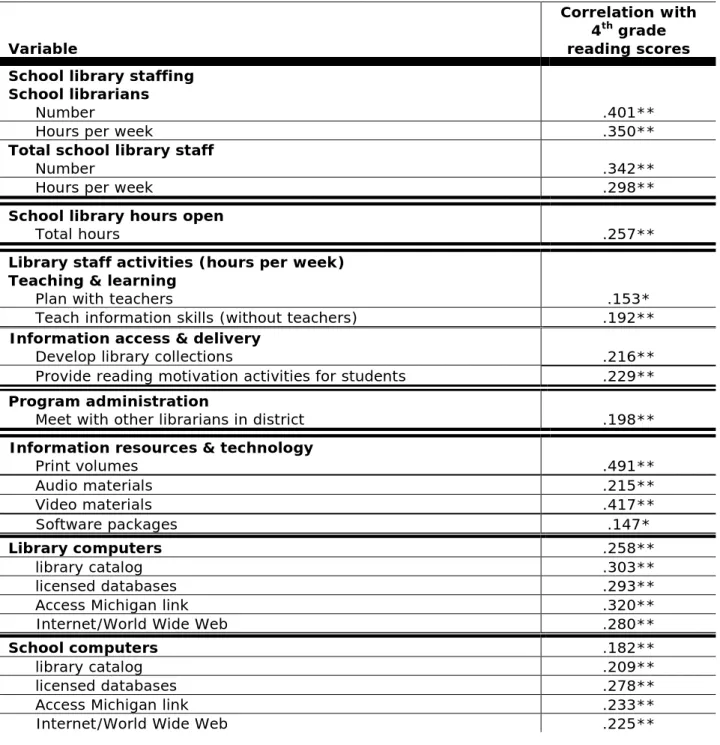
! Elementary: At Michigan elementary schools, reading test scores are likely to rise as students spend more time in the library and library staff spend more time teaching students, working with teachers and developing collections.
! Elementary: Fourth grade reading scores tend to be higher for Michigan elementary schools whose school libraries report:
! higher numbers and weekly hours of total library staff and librarians in particular;
! being open more hours per week;
! library staff spending more time on motivating readers,
developing collections, meeting with other librarians, teaching information literacy skills, and planning with teachers;
! larger collections of print volumes and video materials and, to a lesser extent, audio materials and software packages;
! more availability of computers—both in the library and
throughout the school—that provide links to Access Michigan, library catalogs and licensed databases, and the Internet and the World Wide Web;
! more group visits, more individual and group visits for
information literacy instruction, and higher circulation per week; and
! spending more on library operations. (See Table 2)
! Middle School: At Michigan middle schools, reading test scores generally rise as more computers throughout the entire school are networked to library resources, including Access Michigan.
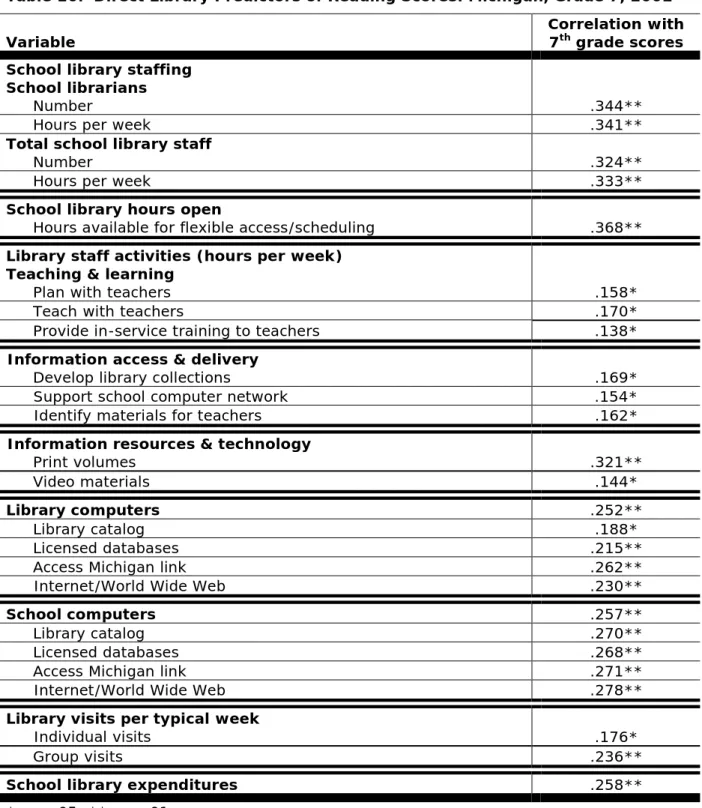
! Middle School: For Michigan middle schools, seventh grade reading scores usually rise as school libraries report:
! higher numbers and weekly hours of librarian and total library staff;
xi
! librarians spending more time planning and teaching
cooperatively with classroom teachers, and providing in-service training to teachers;
! larger collections of print volumes and video materials; ! access to more library and school computers that connect to
Access Michigan, library catalogs and licensed databases, and the Internet and the World Wide Web;
! more frequent individual and group visits to the library; and ! spending more on library operations. (See Table 10)
! High School: At Michigan high schools, reading test scores are likely to rise as the library is open more hours, with more professional staffing, more books, and more students visiting the library on their own.
! High School: Increases in eleventh grade reading scores are usually reported by Michigan high school libraries that have:
! higher numbers and weekly hours of librarian and total library staff;
! more total weekly hours of operation, and more weekly hours for flexible access/scheduling;
! librarians spending more time supporting school computer networks;
! larger collections of print volumes and video materials; and ! access to more computers—both in the library and throughout
the school—that provide links to Access Michigan, library
catalogs and licensed databases, and the Internet and the World Wide Web; and
! more frequent individual visits to the library; and ! more money for library operations. (See Table 18.)
School & Community Differences in Michigan
The impact of Michigan school libraries on academic achievement cannot be explained away completely by:
! school differences, including:
xii ! the teacher/pupil ratio, or
! community differences, including:
! the percentage of schoolchildren living in poverty,
! the percentage of schoolchildren belonging to racial/ethnic minority groups, and
! the percentage of adults in the community who graduated from high school.
When these other factors are taken into account, school library variables alone count for up to three percent of variation in MEAP reading scores. This figure takes into account community wealth or poverty, which alone can explain in excess of 60 percent of test score variation. While school
administrators cannot choose the level of poverty in their communities, they can choose to have well-staffed school libraries.
How School Librarians Make a Difference in Michigan
Qualified Michigan librarians strengthen school library programs in a variety of ways. For librarians to exert a positive influence on teachers and
students, they cannot work alone. Adequate levels of professional and support staff are essential to keep the school library open, to manage its collections and technology, to facilitate its use, and to help teachers to teach and students to learn.
Generally, better performing schools in Michigan have
! better developed school library programs—i.e., higher levels of staffing, collection development, and funding;
! library staff who spend more time engaged in activities that contribute to collaborative teaching and learning; and
xiii
Table B. School Library Predictors of MEAP Reading Scores by School Level
Variable Elementary Middle High
School Library Staffing
Librarian hours # # #
Total staff hours # # #
School Library Hours of Operation
Weekly library hours # #
Hours available for flexible scheduling # #
Library Staff Activities
Planning with teachers # #
Teaching with teachers #
Teaching information literacy #
Providing in-service training to teachers #
Reading motivation #
Collection development #
Managing computer networks #
Library meetings #
Information Resources
Print volumes # # #
Video materials # # #
Audio materials #
Computer software #
Information Technology
Library and school computers networked to library
resources # # #
School Library Usage
Individual library visits # #
Group library visits # #
Individual library visits for information literacy
instruction #
Group library visits for information literacy instruction #
Circulation #
Library Operating Expenditures # # #
xiv
THE HEART OF THE SCHOOL
It’s lunchtime, a busy time in the library. There is the usual group catching up on the daily news and a student telling me about his latest success in his genealogy research. Some are putting together the jigsaw puzzle while others compete in a friendly game of chess. The computers are filled with students printing assignments and searching the Internet. Someone checks out a paperback and another requests an interlibrary loan. It’s not quiet by any means! It’s a gathering place. It’s
comfortable and welcoming.
When I was hired five years ago I was coming from 22 years in the English classroom with no knowledge of how to run a library beyond my own use. With the promise that I would pursue my degree, I was hired and given the task of separating the existing collection into three libraries and reintroducing the concept of a library to the students and staff.
That year the school had undergone a major building project so I had a brand new high school library, a small elementary library, and the old library for the middle school. Prior to that, shortages had turned the library into a study hall and the librarian had no time or room to promote library skills and use. With study halls filling the room all day, teachers were not able to make use of the facility. We had seniors who had never checked out a book since leaving elementary. So I went to them, giving book talks in classrooms and staff meetings, taking books to teachers that they might like to use. A survey was given to the students and the next year I posted the survey results and displayed the books and magazines that had been added to our collection as a result. Reading month had activities for all three levels and Teen Read Week was added the following year.
Circulation has risen every year. Students stop me in the hall to discuss what they are reading. They don’t wait until the yearly survey to tell me about a new author or series they think we should add to our collection. Though I arrive at school 45 minutes before school starts, there are always students waiting to get in and an hour and a half after school I often have to send them home so I can lock up.
Has it made a difference in the students’ test scores? Studies indicate that it should. Has it made a difference in their school lives? I would like to think so.
Patti Colvin
xv
Michigan Educational Assessment Program (MEAP) Reading Scores
Grades 4, 7 & 11 (Percent Who Met Standards) Library Staffing
(hours per week)
! School Librarians
! Total School Library Staff
Library Staff Activities (hours per week)
! Teaching & Learning
! Information Access & Delivery
! Program Administration
Information Resources & Technology
! Print volumes
! Videos
! Library/school computers Library
Operating Expenditures Library Hours
! Total
! Before school
! After school
! Flexible
! Summer
Service Outputs
! Visits (individual, group; total, for information literacy)
! Circulation
1
Introduction
For many years, the deficient condition of libraries in many Michigan public schools—particularly the absence of qualified school librarians—has been a cause for concern to the State Library. As part of an effort to reverse this alarming trend, the State Librarian and others resolved to document the impact of school libraries and librarians in Michigan schools and to share this information with school decision-makers—school boards, superintendents, principals, teachers, even school librarians.
In 1993, the Library Research Service of the Colorado State Library published a landmark study, The Impact of School Library Media
Centers on Academic Achievement. Between 1999 and 2001, successor studies were completed in Alaska, Colorado, Iowa, Massachusetts, New Mexico, Oregon, Pennsylvania, and Texas. Realizing the potential for such a study in Michigan, the State Library designated funds from the Library
Services and Technology Act (LSTA) for this purpose.
In 2002, the State Library contracted for this study with RSL Research
Group, whose team of researchers includes those responsible for most of the other state studies: Marcia J. Rodney, Principal Analyst of RSL Research Group; Keith Curry Lance, the principal investigator for the original “Colorado study,” and Christine Hamilton-Pennell, President of Mosaic Knowledge Works and also a co-author of the original Colorado study.
In addition to confirming in Michigan the findings of the first Colorado study, this project also sought to explore several issues that were explored in the other recent state studies. Those issues included:
! identifying characteristics of school librarians and school library programs that affect academic achievement,
! assessing the contribution of collaboration between teachers and school librarians to the effectiveness of school library programs, and
2
On all three of those counts, this Michigan study was decidedly successful. This document reports comprehensively on the project, putting it into
3
Review of the Literature
This study aims to replicate and expand upon previous research showing a link between student academic achievement and the school library media program. With the move to standards-based education, which focuses on what students have learned (proficiencies or outcomes) rather than what is taught (coverage of content), the school library media specialist is in a
unique position to help students develop the information literacy skills which will enable them to achieve standards.
The new edition of Information Power: Building Partnerships for Learning (ALA, 1998), reflects a change in emphasis for school library media programs, from providing resources to students to creating a community of lifelong learners. Three overlapping roles are identified for school library media specialists (LMSs) in this document. The learning and teaching role supports the instructional goals of the school in both content (standards and subject curriculum) and process (information literacy skills). The information access and delivery role encompasses the more traditional responsibilities of the LMS, those of developing the media center's collection and services and providing access to them. A third role, program
administration, includes both management of the library media program and larger training and advocacy functions within the school community.
This review of the research organizes the research findings under the three roles identified for the LMS in Information Power (1998). Many of the research studies were conducted in the context of the earlier guidelines,
Information Power: Guidelines for School Library Media Programs
(ALA, 1988). Although some of the goals in the document have changed, the underlying mission statement remains the same:
The mission of the library media program is to ensure that students and staff are effective users of ideas and information. This mission is accomplished:
■ by providing intellectual and physical access to materials in all formats ■ by providing instruction to foster competence and stimulate interest in
4
■ by working with other educators to design learning strategies to meet the needs of individual students. (ALA, 1998, p. 1)
Presence of a Library Media Center with a Professional Library Media Specialist
Many studies conducted before the advent of the Information Power Guidelines dealt with the value of the mere presence of a library with a professional librarian, reflecting the lack of centralized library service, particularly at the elementary level. Willson (1965) showed that students demonstrated superior gains on the Iowa Test of Basic Skills (ITBS) in elementary schools with a centralized library and a professional librarian. Likewise, Becker (1970) compared ITBS scores between students in
elementary schools with and without libraries and found that the presence of a library and the guidance and function of a librarian appeared to exert
significant influence on pupil achievement in some information-gathering skills areas.
In the study by Hale (1969), SAT scores improved among students receiving library service from a professional. McMillen (1965) found that students in schools with good libraries and full-time librarians performed at higher levels in reading comprehension and in knowledge and use of reference materials than students in schools with minimal or no library service. Didier (1982) confirmed that student achievement in reading, study skills and use of newspapers was significantly greater at the seventh grade level in schools with professional library media personnel as compared to schools without them. Student access to the library media center was also significantly greater in schools with professional library media personnel than in schools without them.
Yarling (1968) found that the addition of a well-equipped and managed
centralized library had a significant impact on the performance of elementary school students in library-related skills, particularly outlining and note
5
elementary school with both a library and a librarian who conducted a strong library skills program were significantly higher than those of students who did not have these advantages.
Recent statistics show that public schools have moved in the direction of providing professionally-staffed library media programs at all levels. In a U.S. Department of Education-funded study conducted recently (Michie and Cheney, 2000), survey results indicate that as of 1997, 98 percent of public schools have a school library media center, and 78 percent of public schools have a state-certified library media specialist.
Learning and Teaching
Early Studies
Some research studies before the advent of Information Power
Guidelines in 1988 referred to various aspects of the LMS's teaching role. Aaron (1975) studied a group of eighth grade students who participated in a program in which a full-time media specialist was added to the teaching team. In addition to showing significant improvement in language arts, spelling, and math computation, the students in the experimental group experienced improvement in their self-concept. Bailey (1970) studied a group of disadvantaged first-grade students who participated in a library resource program over a 12-week period. The experimental group showed a significant increase in total language ability and the ability to express ideas over the control group of disadvantaged students who received no special treatment. DeBlauw (1973) examined the rate of cognitive growth of
students on achievement test batteries before and after implementation of a multi-media program. Elementary students showed significant gains, but the academic performance of high school students was unchanged by the program. A longer-term study of twelfth grade English students by Gilliland (1986) found that test scores on the study-locational portion of the
California Assessment Program improved during the years following implementation of a library review program.
6
classroom teacher and those who received additional instruction from an elementary school librarian. Findings showed that the mean score on a problem solving skills examination for the librarian-teacher instructed group was significantly higher than for the teacher instructed group. Hastings and Tanner (1963) looked at whether improved English language skills could be developed at the tenth-grade level through systematic library experiences rather than the traditional emphasis on formal English grammar. The group that eliminated all traditional emphasis on formal grammar and spelling and instead received systematic work in the use of library references was
significantly superior to the groups that emphasized traditional work in grammar and spelling.
In a study by Hutchinson (1982), English teachers gave tenth-grade students special library skills instruction and practice over a two-week period. Library usage among the students increased regardless of their academic grade point averages. Hale (1970) found that an experimental group of twelfth grade students who were given a variety of library services and resources and the opportunity to work independently under the
supervision of the librarian showed "remarkable enthusiasm" for learning. Barrilleaux (1965) focused on a comparison of the achievement of junior high school students in general science classes in which textbooks were used with students who used reference materials in the school library rather than a textbook. Results showed that for all investigated educational outcomes, the use of library materials without a basic textbook was the superior
method of instruction.
Instructional Role Since Information Power Guidelines
7
schools where the LMS played a vital instructional role, including planning instruction with teachers, providing information literacy instruction,
providing in-service training for teachers, and evaluating students' work.
Seven recent statewide studies reinforce the importance of the LMS
instructional role. A study conducted in Alaska (Lance, Hamilton-Pennell and Rodney, 2000) revealed that students' test scores tended to rise when
library staff spent more time teaching information literacy to students and planning instructional units with teachers. In Pennsylvania (Lance, Rodney and Hamilton-Pennell, 2000a), test scores increased as LMSs spent more time teaching cooperatively with classroom teachers and integrating information literacy skills into the school's approach to standards and curriculum. The second Colorado study (Lance, Rodney and Hamilton-Pennell, 2000b) concluded that reading test scores rise as LMSs plan cooperatively with teachers (at the 7th grade level), identify materials for teachers, and teach information literacy skills to students. A Massachusetts study by Baughman (2000) found that both elementary and middle school students tended to score higher on the Massachusetts Comprehensive Assessment System (MCAS) test when there was a library instruction program.
Likewise, in Oregon (Lance, Rodney, and Hamilton-Pennell, 2001), students tended to score higher on reading tests when their LMSs worked with
classroom teachers to identify materials to support and enrich instructional units, taught essential information literacy skills to students, and provided in-service training opportunities to classroom teachers. A recent study in Iowa (Rodney, Lance, and Hamilton-Pennell, 2002) revealed that 4th grade reading scores tend to be higher in elementary schools where LMSs spend more weekly hours planning and teaching cooperatively with teachers. In New Mexico (Lance, Rodney, and Hamilton-Pennell, 2003), 10th grade achievement scores tend to improve with the extent to which classroom teachers and library teach cooperatively, and 8th grade scores improve with increases in time spent by library staff on planning with teachers and
8
Gap Between Theory and Practice
Nevertheless, several researchers have identified a gap between theory and practice. Person (1993) found a discrepancy between the real and ideal role perceptions of LMSs. While they were aware of the roles identified in the
Guidelines, they didn't perform them as often as they would have liked. Pickard (1993) also studied the gap between theory and practice of LMSs performing the instructional role and found that less than 10 percent of her sample appeared to be practicing the role to a great extent. Angelo (1994) verified this finding in a study that showed that the majority of LMSs were performing duties of the traditional librarian, such as student orientation and assisting students and teachers in finding materials, while a low percentage were performing planning and consultation roles. Kuhne (1993) concluded that school libraries need to be more integrated into the curriculum and that the school librarian could play a much more distinctive teacher role than he or she does today.
McCarthy (1997) studied LMSs who were "well above average" in the New England region and found that 58 percent of them believed that
implementation of Information Power Guidelines was only somewhat realizable or not realizable at all. Jones (1997) examined the theoretical and actual curriculum development roles of LMSs in Georgia schools across all levels. She found that while there was widespread agreement among LMSs that participation in the curriculum development process as delineated in
Information Power (1988) was of critical importance, few were involved in the process to any appreciable extent. McCracken (2000), in a national survey of more than 500 LMSs, found that they perceived all the roles in
9
Level of LMS Collaboration with Teachers
Instructional collaboration has many levels, and research indicates that LMSs are most often involved in the less complex levels. Slygh (2000) reports on the difficulty of establishing exactly what is meant by the term
“collaboration.” She uses a definition by Van Deusen and Tallman (1994) that delineates an interdependent relationship between LMS and classroom teacher involving a continuum of five progressively complex levels of
instructional collaboration, from gathering materials to collaborating with a teacher to evaluate a unit. Slygh found that teachers in her sample of
Library Power schools indicated a greater frequency of collaborating with the LMS in planning and designing instruction than in delivering it.
A study by DeGroff (1997) compared the ideal roles of the LMS as laid out in
Information Power (1988) with the actual practice of these roles. She determined that the instructional consultant activities of LMSs were usually limited to gathering books for instructional units and seldom involved
participating with teachers in developing, carrying out, or assessing unit plans. Van Deusen and Tallman (1994) found that more than half of their sample of LMSs did not assess student work at all during the study period. Michie and Chaney (2000) found that the overall percentage of library media centers working with teachers on curriculum development, collaboratively teaching curriculum units with classroom teachers or collaboratively
evaluating curriculum units with classroom teachers ranged from two percent to 21 percent, depending on the subjects taught. The greatest amount of collaboration was with reading or English teachers.
Mosqueda (1999) studied the roles played by LMSs in 67 Florida schools named as National Blue Ribbon Schools. While the overwhelming majority of responding principals and LMSs agreed that the library media programs performed well in program administration and information access and
10
LMSs in exemplary schools perform the instructional role more often than their counterparts in less well-recognized schools.
Barriers to Collaboration
Barriers to LMSs practicing the instructional role include the attitudes of LMSs, teachers, and principals, as well as program limitations such as fixed scheduling, limited resources, and lack of technology. Lai (1995) found no significant differences between teachers' and media specialists' attitudes regarding the LMS's role in curriculum development, instructional
development and technology use. Both groups believed the LMS had only a marginal role in designing and producing materials for units. Beaird (1999) found that key barriers to collaboration were time, desire to maintain the status quo, and lack of resources. In a national survey of LMSs by
McCracken (2000), the biggest barriers cited to expanding their instructional role were lack of time and resources, specifically funding and clerical help.
Several researchers (e.g., Slygh, 2000; Beaird, 1999; DeGroff, 1997) point to role confusion or role conflict of LMSs themselves, as well as lack of understanding of the instructional role of the LMS among the teachers and administrators they work with, as inhibiting expanded collaboration
activities. A survey of 450 practicing Georgia LMSs (McCoy, 2001) was conducted to determine the job competencies they use and value most. Results showed that respondents placed administration, information access and delivery, and collection development at the heart of the school library media program. Kolencik (2001) studied 171 school districts in western Pennsylvania and found that principals rarely recognized the instructional role of the LMS. They believed the major role of LMSs was in reference and research services, while the LMSs indicated that their major role was
instruction in information literacy.
11
the classroom. The joint planning process that exists is limited and the
outcome of the curriculum activity tends to be measured in terms that relate only to the end product, not the skills that contribute to the end product, such as those learned in the SLRC. Likewise, a cross-country study of the role of the principal in an information literate school community (Oberg, Hay, and Henri, 2000), showed that participants in all five countries for which data was available—Canada, Australia, Scotland, South Korea, and Finland—acknowledged that teachers’ attitudes and beliefs constituted one of the major barriers to the integration of information skills across the curriculum.
Positive Effects of Flexible Scheduling
Giorgis (1994) discovered that the majority of elementary school teachers perceived the LMS as a resource person and only a few as a collaborator. Nevertheless, during the course of her study Giorgis found that these views changed. Through flexible scheduling and collaborative planning, the
perceptions of the LMS's role by classroom teachers, administrators, children and parents became one of teacher and collaborator.
Other researchers also attest to the positive effects of moving to flexible scheduling. Bishop (1992) found that the most significant changes in the role of the LMS occurred with the move to flexible scheduling and
curriculum-integrated instruction. Fedora (1993) compared two exemplary school library media centers, one with fixed and one with flexible scheduling and found that the LMS participated more often in planning with teachers and as an instructional consultant in the flexibly-scheduled program. Van Deusen (1993) and van Deusen and Tallman (1994) found that LMSs in schools that combined both flexible scheduling and team planning had significantly more curriculum involvement. Hughes (1998), in her study of four library media programs in schools implementing whole language
programs, found that all four LMSs moved to flexible scheduling in the LMC during the course of implementation and were able to provide leadership and direction in creating a library program that promoted the active construction of knowledge. Likewise, Beaird (1999) reported that one of the major
12
(2000) found that LMSs who use flexible scheduling perceived that they implemented the role of instructional consultant more than those who used fixed or combination scheduling.
Positive Effects of Collaboration
Research indicates that a collaborative environment begets more
collaboration. Beaird (1999) discovered that as a result of a first experience with collaboration with the LMS, teachers were made aware of the presence of another professional on their campuses who could engage in collaborative planning and teaching. LMSs became more aware of teachers’ needs as they provide for regular students as well as those with special needs. Straessle (2000), in her case study of a suburban junior high school, concludes that the more teachers and administrators understand and experience the role of the LMS as an instructional consultant, the more likely their perceptions will change and expectations increase, thus improving teacher instruction and student learning. Slygh (2000) reports that LMSs’ perceptions of the degree to which their school climate was a professional community affected the amount of instructional collaboration they performed.
Positive Effects of Technology
Technology can also support the instructional role. Everhart (1992) found that high school library media specialists with automated circulation systems spent significantly more time in instructional development and use of
technology than those without automated systems, although the actual time spent in development of the educational program was quite low. Van
Deusen (1996a) found that both flexible scheduling and library automation were positively related to the LMS performing an instructional consultation role, as well as providing electronic support for teachers using technology, providing individual assistance to students, and reducing the amount of time spent on clerical duties. Jones (1994) concluded that technology expands the teacher-librarian partnership possibilities in literature-based instruction. E. W. Smith (1998) studied the changes occurring in media centers in
13
both that the media center program was a viable component of the school's curriculum and that the media specialist's role as teacher, information
consultant, and information specialist had expanded.
Characteristics of Library Media Specialist
Perhaps the most important factor in successfully implementing the
instructional role is the characteristics and skills of the school library media specialist himself or herself. Yetter (1994) found that LMSs successfully involved in resource-based learning were energetic, healthy and
enthusiastic; showed leadership abilities; had theoretical understanding of resource-based learning; had the ability to translate theory into effective instructional plans; and were knowledgeable about specific learning
resources. These LMSs saw teaching as their primary function. As a result, the colleagues of these LMSs saw them as vital participants in the
instructional process. Esser (1999) interviewed 18 female LMSs in Kentucky to discover their initial motivations for entering the field and discovered that a desire for autonomy was high on the list. Her data suggested that these teacher-librarians achieve a greater degree of autonomy when they are collaborating with teachers, and they negotiate these relationships and create effective networks in order to carry out their work.
Farwell (1998) found that LMSs could play a pivotal role in the successful implementation of collaborative planning if they were knowledgeable about the curriculum, the library collection, information literacy instruction, and instructional design and delivery. They also needed to have good
interpersonal skills and be willing to act as change agents. Van Deusen's (1996b) case study of a school library media specialist involved in an instructional planning process showed that she contributed as a peer and helped to clarify, initiate, summarize and test the discussion ideas. DeGroff (1997) concludes from her survey data that the most important factors supporting opportunities for teachers and LMSs to work together effectively were the librarian’s knowledge, personality, and attitudes or interests.
14
portions of each day giving instruction, effectively managed class and teaching time, provided instruction related to the curriculum, and used innovative instructional methods. They also instructed different sections of the school community, ensured that their media center had resources to support the changing curriculum, and assisted teachers in planning classroom instruction. Gehlken (1994) studied the school library media programs in three blue ribbon high schools and came to similar conclusions. In all three schools, there was a cooperative relationship between the LMS and the faculty, with opportunities for collaborative planning and integrating information skills into the classroom curriculum. The students in all three schools overwhelmingly indicated that the most important service provided by the school library media program was help from the LMS in finding and evaluating information. Bell and Totten (1992) found that teachers
employed in academically successful schools tended to choose the library media specialist significantly more for cooperation on instructional problems than did teachers serving in academically unsuccessful elementary schools.
Other Aspects of the Instructional Role
Another aspect of the LMS's learning and teaching role identified in
Information Power (1998) is to encourage and engage students in reading, viewing, and listening for understanding and enjoyment. Yetter (1994) found that LMSs involved in resource-based learning were
enthusiastic about reading and books. Lai (1995) found that teachers and LMSs both strongly agreed that the LMS should work with teachers in helping students to develop the habit of reading.
In Australia, Todd, Lamb and McNicholas (1993) studied Year-Seven and Year-Eleven students and found that integrating information skills into subject content, with collaboration by classroom teachers and LMSs, had a positive impact on student learning, including better understanding of
15
The adoption of state content standards and the movement towards standards-based instruction and assessment is too recent to have a
substantial research base as yet. N. A. Alexander (1998) determined that standards policy is generally associated with improved student performance, although there are disturbing equity issues. In the school library field, a few research studies to date have looked at the connection between integrating information literacy skills into the curriculum and improved student learning. Grover and Lakin (1998) reported on the development and testing of a
Kansas model which integrates information skills into planning and assessing learning across the curriculum. Teachers and librarians who participated in the study indicated that the model facilitated student learning in all grade levels studied and for units of any length. The "integrated assignment" stage of the model was reported as a key to enhancing student learning.
In regard to standards-based education, one of the more interesting
developments of the past decade has been the elaboration and proliferation of the value-added assessment model originated in Tennessee by Sanders, et. al. (1997). This model is being considered in Colorado and other states as a method for evaluating the performance of both schools and teachers. In the author’s most authoritative account to date, he reports that the strongest predictor of year-to-year improvement in students’ test scores is teacher quality. To date, however, there have been no further reports from Sanders or others defining precisely what “teacher quality” means in
empirical terms. Decades of library media research findings indicate that one major factor that has demonstrated consistently a positive, strong, and statistically significant relationship to quality teaching is a close working relationship between the classroom teacher and the library media specialist.
Information Access and Delivery
The information access and delivery role includes providing quality resources and technology that support the curriculum, offering convenient and flexible access to the media center's resources and services, and providing a
16
Early studies focused on service level and collection size as predictors of academic achievement. Greve (1974) discovered that the most valuable predictor of student test scores was the number of volumes in the school library. Thorne (1967) examined the reading comprehension and library skills of students using the augmented services of a Knapp Project library versus the nominal services of a second junior high school library in a two-year study. Findings revealed a significant difference in the mean gains of the experimental group over the control group in reading comprehension and library skills.
Access to Print Resources
More recent studies have focused on the connection between students' achievement in reading and access to print resources, particularly in
libraries. The first Colorado study by Lance, Welborn and Hamilton-Pennell (1993) concluded that the size of a media center's staff and collection is the best school predictor of academic achievement. In that study, academic achievement was represented by reading scores, which were highly
correlated with scores in other areas, such as writing and research skills. Elley (1994, 1996) compared the scores of students from 32 countries on the 1992 International Association for the Evaluation of Educational
Achievements (IEA) Reading Literacy Study with data on the home
environment and school and public libraries. He concluded that access to print, and especially the size of the school library, was the strongest
predictor of reading achievement. Froese (1997) compared the IEA reading scores for British Columbia with variables related to school and classroom libraries and found that students who have the opportunity to borrow books from libraries have a considerable achievement advantage over those who cannot.
17
successful in language acquisition when they read more in the second language. Children get a substantial percentage of their books--from 30 to 90 percent--from school, classroom and public libraries. They also read more when they have a comfortable, quiet place to read, such as the school library. Ramos and Krashen (1998) concluded that simply providing
interesting books to children is a powerful incentive for reading, perhaps the most powerful incentive possible.
McQuillan (1997) drew similar conclusions. He found that access to print via the home, school and public library, and frequency of free reading accounted for nearly 80 percent of the variance in fourth grade reading test scores. He also reported a correlation between school and public library quality, library use, and amount of reading done by school children. In McQuillan's (1998) meta-analysis of literacy studies, there was considerable evidence that the amount and quality of students' access to reading materials is substantively related to the amount of reading they engage in, which in turn is the most significant determinant of reading achievement. More reading leads to better reading achievement.
Other researchers have also demonstrated a relationship between free
voluntary reading and academic achievement. Digiovanna (1994) found that the amount of recreational reading was positively correlated with higher academic achievement levels for third, fifth, and seventh graders. Halliwell (1995) demonstrated a relationship between eighth graders' self-perceptions of being free voluntary readers and the degree of their success on the
Missouri Writing Assessment. Lipscomb (1993) reported on the self-selected recreational reading of first through third-graders over a nine-week period in the summer and found that the total number of words read was a significant predictor of students' overall reading achievement and word recognition.
Access to print through public libraries has been shown to contribute to students' academic achievement. A Library Research Service study (no. 153, 1998) reported that in Colorado school districts scoring in the highest third on the 1997 Colorado State Assessment reading test, circulation of children's materials per capita by public libraries was 50 percent higher than in school districts scoring in the lowest. There were similar results for states scoring highest on the NAEP reading test. Ramos and Krashen (1998)
18
positive impact on students' reading. McQuillan (1997) found that SAT scores were positively correlated with per capita public library circulation.
An interesting study by Fisher, Lapp, and Flood (2001) examined the effects of elementary students’ access to print via a community library vs. an in-school library on reading achievement scores in a large urban in-school district. The community library group saw a 21% increase in students who tested “at or above grade level,” while the in-school group had a modest, but not
statistically significant increase in reading scores. Among the reasons they suggest for this finding is that the children’s librarian in the community
library was more knowledgeable about children’s books and used games and booktalks to interest children in reading, the community library had more total staff, and there was a larger collection and more new books in the community library than were available in the school library.
School-Public Library Relationship
A Library Research Service study (no. 150, 1998) reported that students are likely to earn higher reading scores if there is a relationship between the library media program and local public libraries. Such a relationship might include public library staff presenting booktalks at the school library, and the local public library providing a summer reading program. Similarly, Lance, Hamilton-Pennell and Rodney (2000a) found that Alaska students' test
scores tended to be higher when the LMC had a cooperative relationship with the public library. Michie and Chaney (2000) reported that 60 percent of LMCs participated in some type of cooperative activity with a local public library, including borrowing materials for teachers or the LMC, informing the public library of curriculum or homework needs, and coordinating class visits to the public library.
School Library and Equity Issues
19
and print resources at home. He concluded that school and public libraries could help increase access to print for low-income communities and schools, thus improving their students' reading achievement. The survey data
collected by Baughman (2000) suggest that children from a lower
socioeconomic stratum who have a school library program obtain a higher mean test score than similar children from schools without such a program.
A recent study of Texas school libraries (Smith, 2001) showed that
socioeconomic variables explained most of the variance in Texas Assessment of Academic Skills (TAAS) scores, but library variables explained a small but still very significant portion of the variance. Library variables accounted for 4% of the variance at elementary and middle school levels, and 8.2% at the high school level.
Halle, Kurtz-Costes and Mahoney (1997) reported that the number of books in the homes of low-income, African-American children was related to
children's reading scores at the end of the following year. They concluded that providing access to children's books through libraries may be one of the most important things disadvantaged communities and schools can do. McQuillan (1998a) studied the public library use of language minority
students and found that Spanish-speaking households are much less likely to have access to books, and, therefore, fewer opportunities to further literacy development. He concludes that both public and school libraries must make concerted efforts to reach out to language minority parents and their
children. Godina reports that Mexican-background students demonstrate different literacy practices in their homes and communities than those acknowledged at school, where they are viewed as having limited English proficiency and enrolled in low academic tracks. The local public library becomes an important locale for these students' literacy learning because it provides culturally-relevant reading materials.
Unfortunately, school libraries often appear to reflect the economic
20
the variations in access to books in school libraries in twelve high- and low-income neighborhoods. They discovered that high-low-income schools had 21.5 books per student, whereas the low-income schools had 15.4 volumes. They also discovered disparities in number of magazine subscriptions, size of
classroom libraries and access policies.
McQuillan, LeMoine, Brandlin and O'Brian (1997) studied access to school libraries and found that students in high-achieving schools serving largely middle-class children provided greater access to books, more time to read in school, and more liberal circulation policies than those from lower-achieving schools in largely low-income neighborhoods. Smith, Constantino and
Krashen (1996) found, not surprisingly, that school libraries in high income communities such as Beverly Hills had around three times as many books per student as school libraries in low-income communities such as Compton and Watts. Public libraries in high-income communities also had about twice as many books as those in low-income communities.
Similar conclusions were drawn by the William Penn Foundation (Neumann, 2002) in a five-year study of Philadelphia libraries in poor and middle-class communities. Researchers discovered that despite similarities in budget allocations, there were striking differences in the quality of school libraries. Children in poor areas had mediocre to poor school libraries, no librarian on site, and were closed more often during the week than libraries in middle-class schools.
Other studies reinforce these conclusions. Duke (2000) studied 20 first-grade classrooms from very low- and very high-socioeconomic status (SES) districts. Data indicated substantial differences between low- and high-SES classrooms in all major areas examined--amount of print experienced, type of print experienced, and number of print-related activities. Neuman and Celano (2001) focused on the neighborhood settings in which literacy begins for young children, and the extent to which literacy is a potential factor contributing to differences in achievement. What they found was striking. Access to print resources, including children’s books available for purchase, public areas where children might observe people reading, and the size and quality of book collections in local childcare centers, school and public
21
be deluged with a wide variety of reading materials, while children from poor neighborhoods would have to “aggressively and persistently seeks them out.” These children would have to rely on public institutions, which
provided unequal resources. School libraries in these neighborhoods were in serious disrepair.
A case study of a Library Power elementary school in Chattanooga (Oberg, 1999) shows that the library media program can make a difference in a income school. Lakeside Elementary School, largely composed of
low-income African-American children, improved LMC collections and facilities, developed collaborative planning between teachers and librarians through professional development; provided flexible scheduling to the LMC; and hired a full-time LMS. The school experienced dramatic improvements in student learning, as evidenced by scores on the TCAP (Tennessee
Comprehensive Assessment Program), that are attributable at least in part to the Library Power Initiative.
Size of Library Media Center Collection
Size of the school library collection has been shown to be a positive predictor of student academic achievement (Greve, 1974; Lance, Welborn and
Hamilton-Pennell, 1993; Elley, 1996). Baughman (2000) and Lance, Rodney and Hamilton-Pennell (2000b) found that the per pupil book count was
correlated with higher test scores. Studies in Oregon, Iowa, and New Mexico (Lance, et al, 2001; Rodney, et al, 2002; Lance, et al, 2003, respectively), revealed that achievement scores tend to rise with increases in the number of print volumes per student and the number of periodical subscriptions per 100 students. Furthermore, incremental improvements in staffing and collections yield incremental increases in reading scores. A Texas study (Smith, 2001) also found that the currency and size of the library collection are important factors in student achievement.
Krashen (1995) found that a significant predictor of NAEP reading
22
school library. Krashen and O'Brian (1996) did not find a significant
relationship between books per student and student achievement in the Los Angeles Unified School District. They postulated that the number of books in a school library has little effect on literacy if access to them is restricted, the books are badly out of date, and students do not know where they are, as was the case in many California school libraries.
Frequency of School Library Use
Frequency of library use has also been positively linked to student
achievement scores. Baughman (2000) found that students at each grade level score higher when there is increased use of the LMC and more open hours at the library. Koga and Harada (1989) investigated the attitudes of students in Australia, Japan, Korea and Thailand towards school libraries and found that students with a keen attitude toward learning tended to use the library more often and demonstrated better academic achievement. The LMS at Lakeside Elementary School, a Library Power elementary school in Chattanooga (Oberg, 1999), found a direct relationship between the number of times students had been in the library and the level of their test scores in reading comprehension and reference skills. A Library Research Service report (no. 149, 1998) showed that states with above average reading scores on the 1994 NAEP reading test have schools where students visit the school library media center more frequently and borrow more books and other materials.
Recent statewide studies support the link between amount of school library use and academic achievement. In Iowa (Rodney, et al, 2002), 8th graders tend to earn higher reading scores when the LMC is open longer hours
23
Flexible Scheduling
Flexible scheduling appears to support more frequent library use by
individual students. Fedora (1993) found that in a flexibly scheduled library media program, students have more frequent access individually and in small groups than in a fixed-schedule program, where nonscheduled use is rare. Van Deusen (1996b) reported that instances of the LMS providing individual assistance to students was higher in flexible than fixed schedule situations. Lance, Rodney and Hamilton-Pennell (2000b) found that middle schools with high test scores tend to have LMCs that report a higher number of individual visits to the LMC on a per-student basis.
The extent to which flexible scheduling occurs in library media centers varies by type of school and educational level. According to recent survey results (Michie and Chaney, 2000), 95 percent of public secondary school LMCs and 60 percent of public elementary school LMCs (70 percent total) report that they use flexible scheduling, although it is most often used in combination with regular scheduling as well. McCracken’s (2001) random sample of 500 LMSs from across the United States indicates somewhat lower figures. She found that fixed scheduling is dominant at the elementary school level, at slightly more than 50%, while flexible (48%) and combination (48%) scheduling predominate in middle schools, and flexible scheduling in high schools (84%).
Mosqueda (1999) found that 75 percent of the LMCs of the reporting National Blue Ribbon Schools operated on a flexible schedule. Abdoler-Shroyer (1999) reported that in her population of Missouri's combined K-12 schools, 88 percent of the districts responding used the LMC for teacher released time at the elementary level, with 87 percent seeing students on a fixed schedule. At the high school level, 83 percent scheduled high school classes on a flexible basis.
Role of Library Media Specialist in Program Development
24
(1997) found that, when school librarians provide reading guidance or a bibliography, reluctant fifth grade readers can be motivated. Other motivating factors included access to the library and books; an adequate collection of print and non-print materials; and an inviting environment. Martin (1996) found that as library services increased (including reference, information skills, curriculum integration, interlibrary loan, reading guidance, and technical assistance), third grade test scores also increased. She found a statistically significant relationship among all the library media center variables (collection size, expenditures for the collection, staffing, and
services) and overall achievement in grades 3, 5, and 11, indicating that the whole is greater than the sum of its parts.
A Library Research Service study (no. 150, 1998) reported that students are likely to earn higher reading scores if there is a collection development policy for the school library media center. Lance, Hamilton-Pennell and Rodney (2000) also found that Alaska students' test scores tend to be higher when the LMC has a strong collection development policy.
K. G. Alexander's (1992) study of four exemplary media specialists found that they all provided continuous access to their media centers; assisted individual users; designed flexible circulation policies; used innovative methods to promote their media centers; and developed media center collections which supported all areas of the curriculum. Gehlken (1994) reported that in all three blue ribbon high schools studied, the LMS flexibly scheduled classes; organized and cataloged the collection; provided an inviting climate conducive to learning; assisted students in traditional and electronic methods of information access; and involved faculty in the selection of materials. The media centers in all three schools were
organized, automated, easily accessible, and provided materials in a variety of formats across all levels and subject areas. The media center facilities were inviting, aesthetically pleasing, safe, and user-friendly.
Role of Technology in Student Academic Achievement
25
research, Sivin-Kachala, Bialo, and Langford (1997) concluded that using technology has a positive effect on student achievement, attitudes toward learning, and student self-concept. Silverstein, Frechtling and Miyaoka (2000) found that technology usage had a small but significant impact on Illinois students' achievement, particularly at the higher grade levels, specifically eleventh grade science. Paul, VanderZee, Rue and Swanson (1996) reported that using the Accelerated Reader technology-based literacy program had a positive affect on student academic performance and
attendance rates, especially for socio-economically disadvantaged children in urban areas. Peters (1998), on the other hand, found no significant
difference in reading achievement when students used the technology-based Electronic Bookshelf Program.
Wenglinsky (1998) found a positive correlation between computer use and academic achievement in mathematics, but only if computers were used to convey higher-order skills or engage in learning games. Use of computers for drill and practice, the lower-order skills, was negatively related to academic achievement for both fourth and eighth grade students. Significantly, disadvantaged groups had less access to those aspects of technology that positively affected educational outcomes. Page (1999) reported that the presence of classroom technology had a positive effect on the mathematics achievement of low socioeconomic elementary school students, although reading achievement remained inconclusive.
DeFrieze (1998) found that reading achievement appears to be more influenced than mathematics achievement by the use of computers, particularly in an unstructured environment. She speculates that in an unstructured environment teachers have more control over the programs each student accesses, which may be the key to influencing students' higher achievement in reading. A significant finding by Bohannon (1998) is that high frequency of school computer use results in students earning
26
Integrating Technology into the Library Media Center
There is perhaps no place where the library media specialist's role has changed more in the last ten years than in the integration of technology. Person (1993) reported that LMSs don't see a separate, organized
technological media role for themselves, but see technology as a means to accomplish the goals and missions of the media center program as
expounded in Information Power (1988). A Library Research Service report (no. 141, 1998) concluded that students earn higher reading scores if their school library media programs incorporate the latest information
technology. Such technology includes a district-wide catalog, access to online databases, resources available through a local-area network, and access to the World Wide Web and the statewide library network. Lewanski (1998) showed a statistically-significant correlation between the use of computer-assisted library research and improvement in overall critical thinking skills. The control group, using a traditional paper-based process did not show such a relationship.
Lance, Rodney and Hamilton-Pennell (2000a) found that Pennsylvania students' test scores increase as LMSs spend more time managing
information technology. Students also earn higher reading test scores in Pennsylvania, Colorado, and New Mexico (Lance, et al, 2000a; Lance, et al, 2000b; Lance, et al, 2003, respectively) where networked computers link school libraries with classrooms, labs and other instructional sites, enabling access to LMC resources, licensed databases and the Internet. Alaska
students' test scores tend to be higher when the LMC is equipped to provide access to the Internet (Lance, Hamilton-Pennell and Rodney, 2000). Fourth grade reading scores tend to be higher for both Iowa and New Mexico
elementary schools whose LMSs spend more weekly hours managing school computer networks (Rodney, et al, 2002; Lance, et al, 2003).
An Illinois study (Silverstein, Frechtling and Miyaoka, 2000) revealed that almost all Illinois schools are now connected to the Internet. McCracken (2000) found that 99% of high school LMCs, 95% of middle school LMCs, and 84% of elementary school LMCs had Internet access. Nevertheless, access to technology in school library media centers still varies widely. Powell's (1998) survey of 300 elementary and secondary school library