1
THE POSSIBILITIES OF APPLICATION SINGLE-DIRECTION
NEURAL NETWORKS IN AN EXPERT SYSTEM
FOR IDENTIFICATION OF DEFECTS OF THE INSULATION
SYSTEM USING THE EMISSION ACOUSTIC METHOD
S. Borucki1, A. Cichoń1, T. Boczar1
1
Opole University of Technology, Chair of Electrical Power Engineering Mikołajczyka 5, 45-272 Opole, Poland
[email protected], [email protected], [email protected]
Abstract
The subject matter of the paper refers to the evaluation of the application possibilities of a single-direction neural network in the expert system of the diagnostics of the insulation system condition. The paper presents theoretical and practical possibilities of building an expert system based on the acoustic emission method, assisting the diagnostics of insulation systems of high power transformers. The results presented in this paper show the recognition effectiveness of the PD forms under study (insulation defects), obtained by using a neural classifier as well as the evaluation of its application possibilities as an inferring mechanism of a computer diagnostic system.
Keywords: partial discharge, artificial neural network, expert system, insulation, power transformer.
1
Introduction
An operating power transformer is subject to many unfavourable factors which shorten its service life and may cause unexpected disastrous failures. An effective and systematic diagnostics may minimize often high costs incurred during the failure of such a power object as well as costs resulting from undelivered power and breach of contracts. Therefore we observe a dynamic development of diagnostic methods, which ensure higher operational reliability of power transformers installed in a system and prolong their service life. Power transformers are electric power appliances of great significance for the transmission – distribution system as the investment cost in relation to the total value of the elements for transmission and distribution of electric energy is as high as about 20%. Thus an emergency shutdown of a transformer unit may cause considerable economic loss, which in some extreme conditions may exceed the value of a new appliance by several times. Therefore wide diagnostic investigations are justified and their scope should be correlated with a technical and economic significance of the power object measured [1-2].
2
and technological progress, one of the main issues referring to the development and application of this method is not a correct measurement taking but, first of all, correct analysis and interpretation of the results obtained. The subject matter of this paper refers to the analysis of the AE signals registered and determining application possibilities of a single-direction neural network as the main element of the expert system aimed at supporting diagnostics of paper-oil insulation systems of high-power transformers.
2
The Model of the Expert System
Diagnostic systems are nowadays one of the most popular applications of computerized expert systems. The expert system (ES) is a program or a set of computer programs supporting the use of the knowledge accumulated, facilitating decision making and carrying out intellectual tasks. It means that such a system makes it possible to carry out the tasks it was charged with as well as a human being who is an expert in a given branch of science. The basic idea of the ES consists in transferring the knowledge of a human expert to a computer program equipped with a knowledge base, definite procedure rules and an interface making the communication with a user possible [3 - 4]. Fig. 1 shows a pictorial block diagram.
Variable data base
Knowledge base
1
Mechanizm wnioskowania
Knowledge base editor Explaining mechanism
User's interface
Expert system framework
Expert Knowledgeengineer User
[image:2.595.217.432.342.497.2]Inference mechanism
Fig. 1 Block diagram of the expert system [8]
3
3
Application Possibilities of the Acoustic Emission Method in Expert
Systems of Assessment of Insulation Systems of Power Transformers
Research work on the improvement of the AE method for assessment of the condition of insulation systems of power appliances have been carried out in many scientific centers for dozens of years. Current research investigations carried out in the Institute of Power Engineering of Opole Technical University are connected with determining the possibilities and indicating the range of an unequivocal identification of PD forms and connecting them with a given type of damage to paper-oil insulation of power transformers. The aim of the research work is building a computerized expert system, based on the AE method, making diagnostics of insulation of power transformers operating in industrial conditions possible. The implementation of such a system would make it possible to implement this method for about 250 high-power transformers operating in the Polish electric power system.
Many-year practical experience and theoretical knowledge of the employees of the Department of High Voltage, connected with work on registration, processing and analysis of the AE signals generated in systems modeling basic PD forms, constitute bases for creating catalogued reference standards, the so-called ‘fingerprints’ for each PD form under study. Hence, through registration of the AE signals coming from electric discharges on real power objects and their comparison with the AE signals generated by basic PD forms, it is possible to make an initial assessment of the degree of damage to the insulation system and to carry out a valuational prognosis of a failure-free operation of the appliance under study. Hence the catalogued standards of the AE signals constitute a knowledge base of the prospective expert system. This base contains main parameters of the time, frequency and time-frequency analyses of the AE signals, thanks to which PD forms are unequivocally determined and defined.
The process of building an effective expert system is a many-year engineering, scientific and research venture. The results of the research work on the development of the acoustic method of PD measurement, accumulated in the Institute of Power Engineering of Opole Technical University, make it possible to create such a diagnostic system based on the AE method. Fig. 2 shows one of the possible solutions of the expert computer system, which would be used for identification of basic PD forms occurring in insulation systems of real electric power objects.
4
The functioning of the system should be based on the analysis of the results obtained directly on the object diagnosed. The AE signals registered with a measuring system would be subjected to an analysis and digital processing to determine the descriptors that characterize them. The parameters calculated would be passed to the ES, where, based on the data base created and containing ‘fingerprints’ of the basic PD forms, the process of identification and classification of the signals registered, and in consequence, the assessment of the aging degree of the paper-oil insulation under study would take place. Neural networks or fuzzy logic could be used as an inference element. After the process of inference carried out by the ES, a used would obtain, on the screen, information on the kind of PDs occurring in insulation, and therefore on the degree of this insulation degradation [5].
4
The Assessment of Application Possibilities of the Neural Netrowr as the
Inferring Element of the Expert System
Authors suggested the use of a neural classifier, which was a multilayer neural network (ANN) for recognizing insulation system defects based on the analysis of the AE signals generated by the assumed for research purposes PD forms, modeled in laboratory conditions. A Program Matlab environment was used for implementation, teaching and testing the ANN. The architecture applied is a network of a three-layer structure of the type Feed–Forward Backpropagation Network, in which each neuron had a sigmoid activation function. The teaching process of the network applied was carried out based on supervised teaching, thus one part of the measurement files registered, containing information on the AE signals from PDs, were treated as vectors of the teaching sequence (CU), and the other part as vectors of the testing sequence (CT). The results of the frequency and time-frequency analyses of the AE signals registered, generated by basic PD forms [6-7] were suggested as CU and CT parameters during teaching and testing the ANN. The process of correction of the particular neuron weights that were parts of the network was based on one of the variations of backpropagation – Resilient Backpropagation algorithm, described by dependence (1):
(
(
)
)
sgn
)
(
)
(
)
1
(
( ) ( ) ( )) (
n
n
n
w
n
w
ijk+
=
ijk−
η
ijk∇
ijk , (1)where:
) (k ij
η - individual teaching coefficient for each weight,
) ( ) (
n
k ij
∇ - gradient component of the error function.
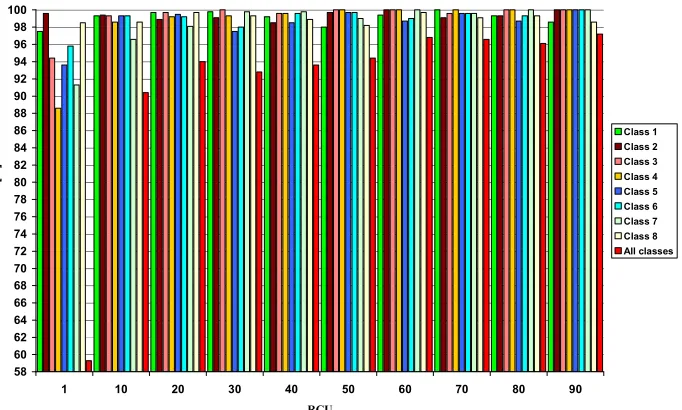
In order to systemize onomastics, the term of a ‘class’ was introduced, which defines a definite basic PD form – a modeled defect of an insulation system (the total of 8 various defects were modeled) [6]. The application of the frequency analysis results – power spectrum density (PSD) was the first parameter used for building teaching vectors of the ANN, describing each AE signal registered from the adopted classes.
5 58 60 62 64 66 68 70 72 74 76 78 80 82 84 86 88 90 92 94 96 98 100
1 10 20 30 40 50 60 70 80 90
[image:5.595.133.474.105.310.2]RCU S K U T [ % ] Class 1 Class 2 Class 3 Class 4 Class 5 Class 6 Class 7 Class 8 All classes
Fig. 3. Values of the recognition effectiveness of PDs by an ANN for the frequency analysis parameters
The other parameter for building teaching and testing vectors of an ANN was the use of the time-frequency analysis results using a short-time Fourier transform (STFT). Fig. 4 shows juxtaposition of the recognition effectiveness (SKUT) of each class considered. From the analysis of the per cent effectiveness shown below, it results that STFT time-frequency parameterization of the AE signals registered, carried out for the time window width dT = 0,4 ms, makes it possible to obtain satisfying results of recognizing by a network given defects of a paper-oil insulation system. The adoption of the architecture of 45 concealed neurons and training the ANN with size RCU = 20 ensures total recognition effectiveness at the level of 95%, which is a highly satisfying result from the diagnostic point of view.
50 52 54 56 58 60 62 64 66 68 70 72 74 76 78 80 82 84 86 88 90 92 94 96 98 100
1 10 20 30 40 50 60 70 80 90
RCU S K U T [ % ] Class 1 Class 2 Class 3 Class 4 Class 5 Class 6 Class 7 Class 8 All classes
[image:5.595.130.474.491.697.2]6
Based on the investigations carried out, it was proved that correct identification of the insulation system defects is possible only based on teaching an ANN with the results of the frequency and time-frequency analyses results. The adoption of a single-direction architecture of the neural network with 45 concealed neurons and teaching the neural classifier with the parameters of the frequency and time-frequency analyses makes it possible to obtain satisfying recognition effectiveness of each of the eight classes. Unfortunately, the processing time of time-frequency parameters by an ANN is almost three times longer than in the case of using the frequency parameterization for the same network configuration, but the effectiveness obtained in this case is slightly higher (even by 2%). Therefore, if during diagnostic measurements a relatively short recognition time of the insulation system defects is required, which is connected with worse per cent effectiveness, frequency parameters of the AE signals registered should be used during teaching a neural recognition tool. If, however, the value of the effectiveness obtained is more important, and the time needed by an ANN to process the data is less significant, the results of the time-frequency analysis should be used as parameters of the AE signals representing each class.
5
Conclusions
Analyzing the hitherto level of knowledge and the research work results, it can be stated that there exist real possibilities for implementing a computer expert system using the AE method for assessment of power transformer insulation systems. However, this kind of the project would require substantial financial outlays connected, first of all, with taking multiple measurements in industrial conditions on various kinds of power appliances operating in the Polish power system. The results obtained connected with the application of an ANN for effective identification of PD forms based on the frequency and time-frequency analysis indexes of the AE signals showed that there exists a potential possibility of using the neural classifier offered for building a computerized expert system based on the AE method, making insulation diagnostics of operating transformers in industrial conditions possible, The adopted architecture of a neural network might constitute one of the most significant elements of the future ES, namely its inference mechanism. The task of the neural network presented in this paper would be a continuous comparison of the measured and adequately parameterized AE signals with the stored in the knowledge base model indexes of basic PD forms. All operations would be performed in real time (on-line) during a regular operation of a transformer unit. Based on the results obtained from the inference mechanism, resulting from correlation between continuously measured AE signals and model signals from data base, detection and identification of hazard to an insulation system due to occurring and developing electric discharges would take place. The prospect of implementing such a system would make it possible to introduce to industry another diagnostic tool working on-line for monitoring the insulation condition of high-power transformers.
The research work has been financed with the means assigned for science as research-development project No. R01 006 01
References
[1] T. Bengtsson, K. Hakan, B. Jonssn: „Transformer PD Diagnosis Using AE Technique”, 10th Int. Symp. On High Vol. Eng., Montreal, Quebec, Canada, 1997, pp. 73 – 79.
[2] E. Grossman, K. Feser: „Online Pd-Monitoring on Transformers Using AE Techniques”, Int. Conf. APTADM’2001, Wrocław, 2001, pp. 264 – 268.
7
[4] J. Mulawka: „Systemy ekspertowe”, WNT, Warszawa, 1996.
[5] S. Borucki, T. Boczar, A. Cichoń, M. Lorenc, D. Zmarzły:„The possibilities of using the acoustic emission method in expert systems for the evaluation of insulation systems of power transformers”, Journal de Physique IV Proceedings, „35th Winter School on Wave and Quantum Acoustics”, November 2006, ISSN: 1155-4339, pp. 51 – 56. [6] S. Borucki, T. Boczar: „Skuteczność rozpoznawania przez SSN podstawowych form
WNZ przy wykorzystaniu wyników analizy czasowo - częstotliwościowej sygnałów EA”, Przegląd Elektrotechniczny –konferencje 1’2006, VIII Ogólnopolskie Sympozjum InŜynieria Wysokich Napięć, Poznań – Będlewo, 8 – 10 maja 2006, str. 41 - 44.
[7] S. Borucki, T. Boczar, A. Cichoń: „The application of the resilient backpropagation algorithm and power spectrum density for recognizing the acoustic emission signals generated by basic partial discharge forms using artificial neuron networks”, Quarterly Archive of Acoustics, Vol. 31, No. 4, Warszawa 2006, pp. 335 – 342.
![Fig. 1 Block diagram of the expert system [8]](https://thumb-us.123doks.com/thumbv2/123dok_es/5397941.103913/2.595.217.432.342.497/fig-block-diagram-expert.webp)