
Analysis of teachers training for ICT Higher Education
33
0
0
Texto completo
(2) Table of Contents. Pages Summary. 3. 1. An approach to the State of the art: Teachers’ Training for E-learning. 4. 2. Higher Education Teachers’ Competences. 9. 3. Higher Education Teachers Training: a theoretical and practical analysis. 16. 4. Conclusions. 27. References. 33. Acknowledgements (see attached documents). 2 Open University of Catalonia (UOC).
(3) Summary This paper wants to gather theoretical and practical contributions about teaching training practices that incorporate and promote the use of ICT in order to clarify, facilitate and make coherent the design of Higher Education Teachers Training with ICT. Its purpose is to find training alternatives that fulfil teacher’s educational needs, as well as to overcome or lessen the difficulties and/or unwillingness faced in the educational practice when introducing ICT applications. To elaborate this analysis two research procedures have been integrated (a) A systematised analysis of current theorists was made. These approach the issue of the academic training in the prevailing growing tendency to the introduction to ICT in teaching and learning environments of higher education (Chikering & Gamson, 1987; Fox & Helford, 1999) and, (b) an analysis of documentary sources on several university pedagogical environments was made in order to contrast such theoretical assumptions. They were referred to the design of pedagogical practices that are promoted. Also, the expectations and experiences of a significant number of academic staff have been analysed. We received 21 descriptions of teachers training practices, and 7 analyses of teachers training needs (focus group). In this sense, the logic followed in this previous investigation leads us to display the criteria in theoretical and practical principles, so that they can base and guide the training proposals for those university academic staff that participate, or wish to participate, in educational experiences enhancing ICT applications. The paper is structured in a first section, which presents an approach to how e-learning actions are conceptualised in Europe and which are the current ICT-based educational models at universities. This analysis emphasizes the need to train teachers to change their role. For this reason, the second section wishes to answer the question of which are the competences that HE teachers need to develop in order to integrate ICT in teaching and learning processes. The third section gathers a theoretic reflection of the principles that literature recognises as good practices for the teacher training, related to the analysis of the authentic training practices and training needs. Finally, we have identified several issues that can serve as a principles or criterion for design ICT-supported Higher Education Teachers Training. These criteria are referred to the principles that deal with two fundamental issues (a) Goals and purposes of teacher training and, (b) Instructional design of training practices. The ten criteria are enunciated of the following way: To develop a competency-based learning (cognitive role; social role and designer/planning role); to develop a technological competitive profile implicit in the teaching function; to be adapted to the different delivery systems; to take care of considering different teaching methodologies; to use scaffolding principles to encourage active learning; to create opportunities for high levels of interaction; to communicate high expectations; to give prompt feedback, and to respect diverse talents and ways of learning.. Key words: Teaching training practices; Teachers training needs; Teachers training for ICT; Instructional design; Higher Education. 3 Open University of Catalonia (UOC).
(4) 1. An approach to the State of the art: Teachers’ Training for Elearning. The most important official policies in e-learning in Europe have been developed by the European Commission (http://europa.eu.int/comm/index_en.htm). Particularly, in the last recent years, the eEurope Action Plan has tried to bring together a number of strategic action areas, defining for each of them the challenges and some proposed solutions. The eLearning initiative has been developed in this context. E-Learning does not open new or parallel processes, nor does it duplicate other initiatives. eLearning brought together the different education components of eEurope actions. In addition, eLearning was supposed to contribute to the effective integration of ICT in education and training. From the different particular challenges, as the innovation potential of the new technologies to work for the requirements of and quality in lifelong training, the development of teaching practices should be highlighted in our particular approach of study. From this perspective, eLearning should lead some main lines of action for the Knowledge-Based Society. To our interest, one of these lines is training at all levels, and it emphasises the pedagogical nature of the skills required and the aspects linked to the development and use of the new technologies in learning. As far as ICT are set to have an impact on organisation and methods, the structure and contents of education and training programmes, and to shape a new learning environment. So the use of the new technologies must be seen in the context of teaching practices. The training drive must also focus on the development of the skills required to use the new technologies. To this respect, it is the European Commission which emphasises the need of “Setting up a training network to provide trainers with expertise in the educational use of technologies; this would enable competent trainers to be trained to cater for present and future education and 4 Open University of Catalonia (UOC).
(5) training. requirements,. with a view both to the deficit in technical qualifications and to the use of the tools, technologies and teaching approaches needed for other education requirements and for the purposes of “learning to learn”. A network of this kind must incorporate the training of trainers, teachers and those in charge of education systems” (UE, 2000), highlighting the importance of teacher’s training in the use of ICT. To strength this believe, the European Commission launched the e-Learning Action Plan (2001) http://europa.eu.int/eur-lex/en/com/cnc/2001/com2001_0172en01.pdf, The initiative was adopted by the European Commission on 2001. Following up the conclusions of the Lisbon European Council, it set out the principles, objectives and lines of action of eLearning, defined as the use of new multimedia technologies and the Internet to improve the quality of learning by facilitating access to resources and services as well as remote exchanges and collaboration. The effectiveness of education systems depends entirely on the effectiveness of the approaches to teaching and learning. In order to be effective, the introduction of information and communication technologies will have to be accompanied by a far-reaching reorganisation of learning structures. The eLearning initiative is also of relevance for the candidate countries given the interest they have shown for the eEurope action plan. The purpose of this Action Plan, which covered the period 2001-2004, was to present ways and means of implementing the eLearning initiative. The intention was to involve education and training players, as well as the relevant social, industrial and economic players, in order to make lifelong learning the driving force behind a cohesive and inclusive society, within a competitive economy. The Action Plan sets out concerted key measures for each of its lines of action (Infrastructure, training, services and content, cooperation). From the teacher’s training point of view, we could particularly point out the measures we find in point 3.2.2. of the document (Training of teachers and trainers):. 5 Open University of Catalonia (UOC).
(6) “Lack. of. appropriate training for teachers and trainers is a major obstacle to the use of new technologies in education. Moves to train teachers or trainers in use of the new tools have not always been reflected in any significant progress in teaching practices. Strenuous efforts need to be made in this field. Mere training in use of the tools and technical know-how is not enough. It is also important to apply the new technologies to innovative practical teaching methods and incorporate them into different disciplines to promote an interdisciplinary approach. The non-technical aspects involved in effective use of the technologies – group work, planning of activities, networking, combining independent training with conventional courses, and teleworking with attendance at the workplace – also need to be considered.” To do that, a support to identify best practices in training for teachers and trainers and cooperation in this area has been given. In addition, efforts to develop studies and innovative approaches to improving training systems and generalisation of these best practices have also been done. Also through the Minerva Calls for projects, the pedagogical dimension of integrating new technologies into teaching and learning practices and the creation of a network linking the people responsible for training teachers, managers and decision-makers in the integration and appropriate use of new technologies have been taken into consideration. Nevertheless, most of the focus has been specifically developed on school education teacher’s training, so higher education teachers has still an important gap on training in ICT uses. However, most of the main aims have not succeeded. The ODL Liasion Committee presented a paper to the Commission complaining about the fact e-Learning has not been developed as foreseen. It is said that e-Learning has grown in practice but has decreased in policy discourse and support. Particularly, the paper asks for putting more emphasis on the integration of ICT in the Bologna process, also to enable European Higher Education to offer European education globally. At this stage, a new challenge has been launched from the European Commission: the eEurope 2005: An Information Society for All 6 Open University of Catalonia (UOC).
(7) (http://europa.eu.int/infor mation_society/eeurope/2005/index_en.htm), to make further progress to keep the development of the European policy agenda.. Current ICT-based educational models at universities Different conceptualisation of e-learning has been put into practice and assumed by the different educational agents. In fact, one of the first issues we should take into account is the different level of ICT-enhancement practices we can find at universities. There is no standard taxonomy with general agreement about the kinds of e-learning or ICT-enhanced educational practices. However, despite there are a number of them, some trends are shared. In fact, models of use of ICT at the university are directly related to the institutional strategy they realize ICT could help to the development of the university and the reasons they have to integrate it. Some recent surveys have given a simple but useful typology based on the “online presence” in the courses and programmes the universities offer: a) those which have no online presence; b) those which are complemented by some online support as lecture notes, e-mail or external links; c) those which requires being active through the Internet to go on with the course, i.e. online discussions, collaborative work, etc.; d) those which could be considered mixed because time devoted to face-to-face presence is considerably replaced by online activities; and e) Those that could be considered fully online or virtual. From traditional face-to-face universities to the new brand virtual distance teaching ones could be found in this typology. As a summary, we could consider as a model the face-to-face with ICT support model, the blended or mixed model and the fully online one. Curiously, the fact that integration of ICT has been increasing considerably in the last years and that it was supposed to be a paradigm shift (Barr and Tagg, 1995), does not mean learning 7 Open University of Catalonia (UOC).
(8) models. are. changing. (Coomey and Stephenson, 2001; Laurillard, 2002; Bates and Poole, 2003; Sangrà, 2003). Despite of the fact that constructivism is considered the most applied leaning model, there is no educational shift justified by the use ICT at the university. It seems to be so because most of the teachers need more training and support concerning the pedagogical and didactic aspects of elearning and ICT use in their teaching to be able to really change it (Laurillard, 2002:24). A survey funded by the European Union (PLS Ramboll, 2004) which analyses the virtual models of the European Universities concludes that there are a few universities which offer courses or support to their teachers: To all the teachers. 34% of universities. To the majority of teachers. 16% of universities. To a minority of teachers. 27% of universities. The rest of them are planning to do it, but they have not started yet. The most important shift we are facing is the change of the role of the teacher. And it is from this perspective where the use of ICT teacher’s training methods need to be updated and adapted to the real and current needs of the teachers. New technological developments and the ease of access to sources of information are changing the teacher's role. To manoeuvre and move in such a big volume of information, as we have said before, has become a search for success in a labyrinth. The risk of wasting time in useless searches is very high, so we need to differentiate the good from the bad. An appropriate and trusty filter is needed so this will be one of the most important teacher jobs. Probably, to train teachers to change their role and to develop it in different scenarios corresponding to different models, as we have seen, requires appropriate training models, adapted to each scenarios. In addition, the new teachers’ role requires new competences which have to be identified and developed, to respond to the new demands of the Information and Knowledge Society.. 8 Open University of Catalonia (UOC).
(9) 2.. Higher. Education Teachers’ Competences Which competences do teachers need to develop in order to teach in a learning environment with ICT applications? An asynchronous learning network (ALN) uses the Internet to deliverer a course, with an emphasis on student-student as well as student-teacher interaction. An ALN learning environment differs in terms of its communication dynamics, not only from the traditional classroom, but also from technology-enhanced classrooms where synchronous (same time) computer-mediated communication is used in conjunction with face to face interaction. In particular, the instructor must re-conceptualise their role as a teacher. What distinguishes elearning from previous paradigms of distance education is its ability to create critical communities of inquiry. That is, educators should be able to conduct collaborative learning regardless of time and place (Anderson; Randy; Andy; Garrison & Archer (2003); Moore & Anderson (2003). One challenge is to provide a theoretical framework to explain the new teacher’s role and competence. The theory outlined in this paper is intended to help understand the pedagogical, technological, and organizational functions open to the teacher in this educational paradigm, and from this analysis, to think about the formation needs that these changes involve. The new teacher roles and competences do not always appear as formally required in explicit terms: “The pressure for change often comes in an indirect way from reforms of school curricula and organisation, from in- service education themes selected for public funding, from evaluation criteria both of teachers/trainers centres, etc. It should be stressed, however, that the reports are not clear enough about the role of teacher/trainer education policies regarding the formal requirements of competences”. (Progress Report, European Commission for implementation of Education & Training 2010” work program, 2003, pp. 34) In everyday language we use the term “competence” in a broad sense. It is probably more frequently used as an individually-conditioned concept: people’s beliefs about their capabilities to produce effects (“self efficacy”, Bandura, 2000).. Other definitions of the term refer to 9. Open University of Catalonia (UOC).
(10) competence. as. a. socially-conditioned concept: ability to perform tasks and roles according to expected standards (Eraut, 2000). Many definitions of competence are available (Gonzi, Hager & Athanasou, 1993, Garrison, Eraut, 1998; Salmon, 2000, Goodyear, Salmon, Spector, Steeples & Ticner, 2001; Westera, 2001; Anderson; Randy; Andy; Garrison & Archer, 2003; Willian, 2003). We propose to adopt the following definitions: . Competence is a highly-valued qualification that accounts for the effective use of knowledge and skills in specific, usually complex, contexts (…) individuals should be able to select from their available knowledge and skills in such a way that efficient and effective behaviour occurs. (Westera, 2001, pp. 79).. In other words, the competences refer to a set of skills, knowledge, and attitudes that are needed to produce the desired outputs of the work place. These competences can be organized into distinguishable roles, albeit often with overlapping areas (William, 2003. pp.47). The consulted theoretical references single out, under different denominations, three basic teacher functions in an environment of learning with applications of ICT. The convincing and clear definitions for these functions are described in a recent study published by Coppola, , Starr & Rotter (2002). A review of this research shows that faculty roles that are enacted by instructors in traditional settings are also enacted in ALN environments, though each of these roles is transformed. Particularly faculty roles related to cognitive, affective, and managerial activities do change. The general competence assigned to these functions or roles are described in the report of investigation published by Williams (2003). It is important to emphasize that functions and roles are often overlapped. Any theoretical definition or classification is useful simply because it describes and specifies them with theoretical or practical operative aims. Therefore, in order to clarify the specific teacher functions on an eLearning environment, we have identified the following teachers’ roles: 1. Designer/planning role 10 Open University of Catalonia (UOC).
(11) Its roles include instructor behaviour in relation to course planning, organizing, leading and controlling. Course planning deals with the effort involved in getting the course online. Organizing deals with establishing relationships between the instructor and others in administration, between students and the instructor, and among students so that course goals can be achieved. Leading deals with instructor behaviours that reflect motivation and coordination of the students. Controlling deals with monitoring and evaluating student learning outcomes. For this role, eight basic competences are specified: organizational skills; planning skills; knowledge of intellectual property, fair use, and copyright regulations; public relations skills; consulting skills; project management skills; change agent skills and personal organizational skills. I.e. setting curriculum, design methods, establishing time parameters, utilizing the medium effectively, establish netiquette. This deals with class and course management, requires greater attention to detail, more structure, and additional student monitoring. 2. Social role: This role includes instructor behaviour related to influencing student’s relationship with the instructor and with the other students. Of particular importance is how the faculty are coping with this computer-mediated communication channel with respect to emotional expressions (nonverbal communication). This relates to influencing the relationships between students, the instructor, and the classroom atmosphere, which requires faculty to find new tools to express emotion, yet they found the relationship with students more intimate. For this role, basic competences are specified: Collaboration/Teamwork skill; Interpersonal communication skills; Group process skills; Negotiation skills; Questioning skill; Writing skill; Editing skills and English proficiency. i.e. Identifying areas of agreement/disagreement; seeking a consensus/understanding, encourage, acknowledging or reinforcing student contribution; setting climate for learning; drawing in participants; prompting discussion; assess the efficacy of the process. 3. Cognitive role: 11 Open University of Catalonia (UOC).
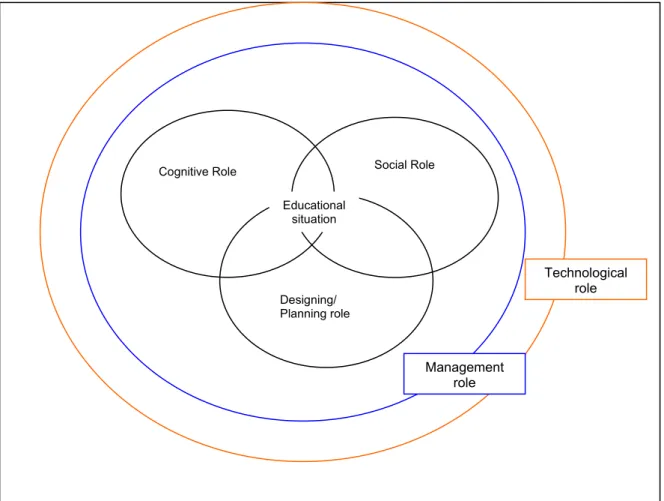
(12) This role relates to mental processes of learning, information storage, and thinking, shifts to one of deeper cognitive complexity. Important competences are attributed to this performance: Knowledge of distance learning field; knowledge of adult learning theory; presentation skills; facilitation (discussion) skills; feedback skills; skill in development of collaborative, student-focused, learning environment; Needs assessment skills and Evaluation skills. i.e. Present content/questions; focus the discussion on specific issues; summarize discussion; confirm understanding through assessment and explanatory feedback; diagnose misconceptions; inject knowledge from diverse sources (e.g., textbook, articles, internet, personal experiences); responding to technical concerns./ Finally, for learning environments that entail ICT applications, it becomes essential to define a fourth dominion, related to a technological profile of the teachers functions. The competences associated to this profile underlie all teachers performance in these learning environments. However, in order to distinguish between them it is worth stressing their differences. Therefore, global competence corresponds to this profile: knowledge of support services; multimedia knowledge; basic technology knowledge; technological access knowledge; software skills and data analysis skills. In the following chart we try to shoe the transversal function not only of this profile but also of the management competences in the development of the teachers’ role in eLearning environments.. 12 Open University of Catalonia (UOC).
(13) Social Role. Cognitive Role Educational situation. Technological role. Designing/ Planning role. Management role. Figure 1. Teachers’ roles in learning environments with ITC applications. This theoretical definition was contrasted with the analysis of educational practices for the qualification of professors in the direction pointed above. The annexed include a detailed list of practices received. 13 Open University of Catalonia (UOC).
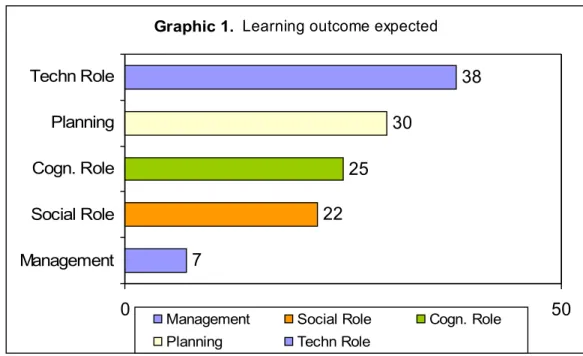
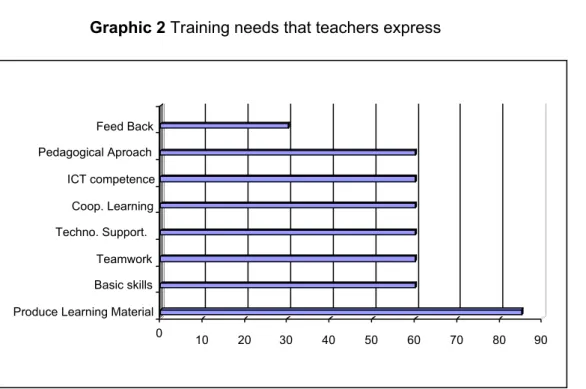
(14) When. analysing. the content of teachers training practices, learning objectives and tasks were categorised within the theoretical framework described above, which has been assumed as the starting point in this research (definition of roles and competences). The correspondence found between the statements from the practices referred to the learning goals (competences) and the theoretical definitions of role competence and tasks associated to these performances, is significant. Tables 1, 2 y 3 included in the Appendix 3 summarise the specific competences and tasks for each role. Nevertheless, a global practical vision of the teacher training practice review shows a significant difference among the frequency in which the different competences appear as an expected learning outcome. The practice favoured the learning of competences related to the designer/planning role, and improved technological profile. We focused on the knowledge of distance-learning education and management learning environment. In smaller proportion, competences related to teachers’ social role and management role were also referred to (See Graphic 1).. Graphic 1. Learning outcome expected. 38. Techn Role. 30. Planning. 25. Cogn. Role. 22. Social Role. 7. Management. 0. Management. Social Role. Planning. Techn Role. Cogn. Role. 50. On the other hand, this situation corresponds with the training needs that the teachers express. The annexed include a detailed list of discussions in focus groups that were organized 14 Open University of Catalonia (UOC).
(15) by. the. participant. universities of this project. Graphic 2 Training needs that teachers express. Feed Back Pedagogical Aproach ICT competence Coop. Learning Techno. Support. Teamwork Basic skills Produce Learning Material 0. 10. 20. 30. 40. 50. 60. 70. 80. 90. Paradoxically, in the practice the most frequent difficulties that the teachers recognized are the absence of competences that are expressed as needs of learning in smaller proportion (see Graphic 3). Graphic 3. Drawbacks for the use of ICT in the teaching and learning. Techn. Problems. Feedback. Management. 0. 20. 40. 60. 80. 100. 15 Open University of Catalonia (UOC).
(16) Therefore,. one. partial. conclusion is that the teacher training competences should be reformulations.. 3. Higher Education Teachers Training: a theoretical and practical analysis Higher education teachers often identify training, or updating and/or training in their specific field, with knowing what they have to explain (Solé, 2003). We consider that this is an indispensable element in teachers’ development (teacher expertise dimension), but we cannot forget a psycho-pedagogic dimension, that favours teachers’ reflection about the teaching and learning process; and also a technological dimension, about the use of technology that helps teachers create and implement learning environments for students to learn the knowledge domain, but also, that gives the teacher the abilities to teach within that learning environment (Gold, 2001). From those assumptions, we have related how literature conceptualises the best practices of teaching and learning processes that integrate or use ICT, and training practices and teaching training needs, in order to identify elements for the reflection about how should be ICT-supported Higher Education teachers training. The principles that we develop next are: active learning, scaffolding, interactivity, feedback, cognitive flexibility and respect diverse talents and ways of learning.. ACTIVE LEARNING: Teachers’ competences need to respond to changing roles in the knowledge society and society with greater social cohesion. These changes in their role are often not a simple additional enhancement of a professional task but a restructuring of the traditional dimensions of the teachers’ role. Mainly, the changes in the teachers’ role in the educational process demand a restructuring of the traditional way of planning, management, monitoring and evaluation of learning opportunities.. 16 Open University of Catalonia (UOC).
(17) The complex and changing character of teachers’ roles and tasks requires learning their professional practice comprehensively. They should be able to evaluate their own practice and identify their improvement needs. They have to be able to guide and promote their own professional development in a variety of learning situations. They need to be able to develop a professional knowledge based on teaching from their practice, as far as possible, in conjunction with research-based knowledge. This overview introduces the idea that learning in the work place is a necessity and an opportunity to improve (Eraut, 2000). Also this idea corresponds to the definition of active learning (Bonwell and Erison, 1991). Learning as it normally occurs is a function of the activity, context and culture in which it occurs (i.e., it is situated). These statements are what Lave & Wenger (1991) call the process of legitimate peripheral participation (situated learning). Situated learning is a general theory of knowledge acquisition. This learning approach has antecedents in the work of Vigotsky, (social learning) (Vigotsky, 1978, Wertch & Stone, 1985). Social interaction is a critical component of this approach. The basic concept is that the learning requires social interaction and collaboration, and knowledge needs to be presented in an authentic context, i.e. settings and applications that would normally involve that knowledge. Typically, it has been applied in the context of learning activities that focus on problem-solving. Jonassen (1994) defines situated learning as occurring when students work on authentic and realistic tasks that reflect the real world. The knowledge content is determined by its real world counterpart and context. A realistic learning environment is crucial. Knowledge is part of the environment and the learner’s interactions with the environment (McLellan, 1996). Active learning is not a new idea. All genuine learning is active, not passive. A working definition operatively refers to the fact that during a situation of learning ´the students are doing things and think about what they are doing´. It is a process of discovery in which the learner is the main agent, not the teacher. The Idea is that the teacher’s role is to “put it out” and the student’s role is to “get it” /”pick it up”. Learning is primarily an attitudinal thing – if learners don’t care, learners won’t learn (Bonwell & Eison, 1991). Using active learning models, well-structured tasks can be identified as those with straightforward operations for constructing a product, predictable evaluation, and agreed-upon standards for their products. At the beginning of a given task, learners are led to perceive various personal and contextual elements such as their abilities, the difficulty of the task, the. 17 Open University of Catalonia (UOC).
(18) degree of effort required, help available, and their possible success and failures (Winne,1995; Boekaerts, 2002). The key to the meaning of 'Active' lies in the much overused term 'Interactive' - the use of computer technology to encourage two way communication, student to student, tutor to student or computer program to student. Supporting a course with 'active' Web materials and applications usually requires a combination of internet technologies; perhaps Web pages for the content, a conferencing application for discussion and collaborative working, perhaps some interactive graphics and a computer aided assessment application.. In general, active learning supposes the design of situations of learning (activities) that are characterized by the following conditions (Billet, 1996; Eraut, 2000; Gulikers, Campbell, K.; 1998; Dodge, B., 2000, Bastian & Kirschner, 2004): 1. A prescribed learning framework, the purpose of the activity should be clear. (i.e. indicators of demonstration of competence). 2. Instructor should design activities asking learner to apply what they have learned (i.e. meaningfulness, typicality and relevance in the learners’ references). 3. An organised learning event or package, knowledge has been constructed through problem solving (. i.e. individual work or group or collaborative work/, decision making). 4. The activities should have more than one possible answer and perhaps more than one possible outcome (i.e. criterion situated at the learners’ level). 5. The presence of a designate teacher, tutor o guide that encourages learning and gives feedback. 6. The external specification of outcomes, the learner should know how they will use the results in their practice or in their work place (possibility to social transfer the learning). 7. The award of a qualification or credit, learner- designed activities could serve as a possible assessment.. 18 Open University of Catalonia (UOC).
(19) With regards to this definition, the consideration on this principle was evident in the design of the tasks we reviewed. Various examples extracted from our analysis illustrate the feasibility of implementation of this criterion in the teachers training practices1.. . Providing orientation and indications that allow a fast familiarity with the Virtual Campus, its educational spaces, applications and resources (Practice 20). . The teachers are also going to work with developing and production of the net-based course material as part of the competence development (Practice 18). . They end up with using ICT as a substitute for a book or a blackboard for instance. In this workshop teachers get some basic information on the principles of new learning supported by ICT. They can also experiment with an aspect of their own daily teaching practice (a part of an existing course for instance), to transform it into a new learning practice supported by ICT (Practice 9). . The learning methodology is problem based (Practice 17). . The participants design their own WebCT course structure during the course. Some participants acted as mentors in the following course as they presented their courses and important aspects of the designing process (Practice 4).. . From the two headings of an activity and from complementary documentation of the last semester to a subject, we proposed them to improve the headings and the documentation, taking account that it had to be a Personal planning and a group planning of the learning process (Practice 21).. 5. The presence of a designate teacher, tutor o guide that encourages learning and gives feedback.. . They provide the creation of an intermediate figure, the Tutor, able to collaborate in managing the teaching units by adapting them to the context of the school where he is working (Practice 1).. 6. The external specification of outcomes.. . The teacher introduced the main characteristic of each software and supported the participants as they. 1. A prescribed learning framework.. 2. Instructor should design activities asking learner to apply what they have learned.. 3. An organised learning event or package, knowledge has been constructed through problem solving.. 4. The activities should have more than one possible answer and perhaps more than one possible outcome.. 1. See Appendix 4 19. Open University of Catalonia (UOC).
(20) learned to use the software programs (Practice 5).. 7. Designed activities could serve as a possible assessment.. . Its aim is to enable teachers to follow a group of distance learners (Practice 8).. . The overall aim is to provide participants with ideas on how to use ICT in their own education and to apply innovative pedagogical principles in designing the teaching and learning process with ICT (Practice 9).. When analysing criteria which are defining good practices, we found an unbalanced performance, so this is one of the relevant points to take into account at the moment of designing teacher’s training activities. However, we could say the methodological principles are always, up to a certain level, enhanced to the practices, because constructivist conception of learning is usually underlying them and it leads to the development of competences, as wished. The following graphic shows the frequencies in which we find some of the criteria in the design of the analysed practices.. Graphic 4. Criteria frequency in the design of the analysed practices 100 80. Scaffolding Principles Active Learning. 60. Interaction. 40. Expectations. 20. Cognitive Flexibility. Feedback. 0. The whole analysis of the characteristics of the practices design shows that there are some methodological patterns that take into account this constructivist learning approach, also linked to the concept of active learning. Most of these practices respond to a three phases or levels of progression as follows: 1. Presentation and/or representation (Familiarisation) 2. Meaning construction (Initial knowledge transformation) 20 Open University of Catalonia (UOC).
(21) 3. Knowledge production (Applications and creations) In fact, even from the expectations and needs of teachers it is asked for an increasing number of teachers’ training practices based on practical and “real world-based” activities: Graphic 5. Preferred training activities and supports Free training actions. Central Support. Workshop. Seminars 0. 10. 20. 30. 40. 50. 60. 70. 80. 90. 100. A lot of evidences are found (90%) in the sense of encouraging active learning, mainly related to the use of problem-solving activities which require students to understand and manipulate course content and current or real content in its complexity.. SCAFFOLDING PRINCIPLES One of the difficulties of online instruction or ICT-supported teaching is not in the transfer of knowledge, but it is in facilitating the most appropriate learning environments for students to acquire knowledge (Gold, 2001). That means that teachers should be trained so that they can favour a shared learning space that facilitates learners understanding and also develop competences to facilitate adjusted helps to students. Barberà, Badia and Mominó (2001) emphasize that teachers have to act in a proactive way, in order that they get information to evaluate learners’ progress, and detect difficulties and misunderstandings, to offer feedback adjusted to that needs: new explanations, different kind of resources, activities, etc. 21 Open University of Catalonia (UOC).
(22) Planning activities in a virtual environment is one of the most important aspects to facilitate a high level of learning. It is necessary to clarify the expectations, and give clear guidelines for the development of the tasks that helps the learner during the learning process. There are evidences of that principle in teachers training practices analysed: i.e.: courses divided into different parts (orientation, designing, implementation & evaluation; tutoring support during training; different training phases (1-worshop, 2-discussion seminars, 3-specific training), activities with different demands and skills (previous activity; planning activity; development activity). It also appears in the analysis of teachers needs. Most of the teachers request the need of “sharing good and bad practices in a workshop with other teachers” where they can discuss their conception of teaching and learning with or throughout ICT; or, seminars adjusted to their needs (i.e. previous knowledge, socio-cultural aspects, ICT competences…). This principle, which responds to a constructivist conception of teaching and learning, is nuclear if we pretend to favour an active learning.. INTERACTIVITY From the constructivism point of view, interactivity2 is the concept that defines the communicative interchange between three agents of the educational process: teacher, student and content (Rogoff, 1990; Colomina, Onrubia, Rochera, 2002).This approach is very important to take in account when we are talking about teaching-learning environment supported by ICT because of the non attendance and asynchronous characteristics of the context. So, in this sense, HE teachers who would integrate ICT in their professional practices, have been competent to create opportunities for high levels of interaction and in this sense they have to acquire communication skills to emphasise the relationship and social atmosphere in the classroom, as well as the development of the educative activity. Four types of interaction which characterizes the educational experiences are defined by Barberà et al. (2001): between teacher-student, between students, between students and content and between teacher and content. We will pay attention only to the two first because teacher training practices reviewed are focused on them. On one hand: the interaction between trainer and learner (or interaction between teacher-student), that is, trainer adopts the facilitator 2. Interactivity concept is more general than interaction one (Coll, Colomina, Onrubia, Rochera, 1995) 22. Open University of Catalonia (UOC).
(23) role. and. accompanied. learner in his/her learning process. Trainer (or teacher) has to create the educational conditions that permit learner (or student) to be autonomous, more responsible and strategic in its own learning process, or what is the same: that the learner learns to regulate its own learning process. (Barberà, et al. 2001) On the other hand teachers training practices reviewed promotes the interaction between learners; as showed these practices, the main methodology, that educational agents have been using in teacher training practices supported by ICT, is the collaborative one. This collaborative methodology appears in different kinds of collaboration, i.e. between novices (learners that do not have a previous knowledge in using ICT, or learners that do not have previous knowledge as teachers in online context) and advanced learners (learners that use ICT, or learners that have studied in an online context before) in a peer learner support system (Deschenes, BeginLanglois, Charlebois-Refae, Cote, & Rodet, 2003), between learners that couldn’t share same time and space (participants from different universities), between learners that have different expertise roles (pedagogic expert, with technologic expert…). These kind of collaboration and interaction let learners learn about it and, after, transfer this knowledge to their teaching practice. Teacher training that emphasizes the didactical use of ICT needs to contemplate and emphasize the ICT use to promote the cooperation between teachers, in order to fulfil the need shown by themselves, to learn to collaborate and communicate with other education professionals in order to design courses, guide students, etc. Finally the interaction is too important when we are focused on a learning assessment field in online context (in general, all teaching-learning processes that integrate the ICT), because, mediated by interaction, teachers need to gather many evidences that the students are learning and constructing knowledge. How could they gather it? Giving feedback and accompanying students in their educational process.. FEEDBACK Feedback process is conceptualized from the formative and continuous assessment, that is, we understand it as the support and guidance that learner receives (Macdonald, J. 2001) and lets him/her to construct their knowledge and to be self-regulators of their own learning (Lou, Dedic & Rosenfield, 2003). It is coherent with the assessment functions: we are closer to psicopedagogic and regulation function –with the aim to give feedback to facilitate and adjust to 23 Open University of Catalonia (UOC).
(24) learning student- than to social or accredited one, which its main aim is to certificate if the student has acquired the proposed learning objectives (Coll & Onrubia, 2002). Technology potentialities would let us make this conceptualitzation and approach of the assessment easier. Related to the assessment functions, and focused in teaching training practices that develop in online teaching and learning environments, feedback results a key factor in order to collect evidences that corroborate that learner has learnt as much during teaching-learning process – formative side- and, like a traditional assessment process, as at the end of this process – summative side- but in both cases its function is to facilitate and scaffold the learning process in order to communicate and inform the learner what (content learning) he/she has been learning and from what he/she has to do to achieve learning objectives (Allal, 2000). In spite of the importance of the feedback process, nowadays, comparing with the other principles or conditions above underlined as effective teacher training practices with ICT, there is no more than a few real practices examples that do it. It could be caused by the recent methodological changes that arose in consequence of the incorporation of ICT and by changes that arose from the conditions of the instructional process (i.e. great number of participants of the course) which made it unlikely that feedback could be effective. But, if we attend training practices which offer feedback we could observe that it is showen up in a different forms: in some cases, trainer is the agent who gives feedback to their learners; in other kind of practices are learners among them who provide feedback, that is coherent with the collaborative methodology; and in other type of teachers training practices are the technology who give feedback to learners (this king of feedback is made conditional to the technologic potentialities of the platform). In this sense, teachers reclaim to be trained to acquire assessment competencies that let them give prompt feedback with the aim to help their students in their learning process and to create different kinds of assessment activities that promote in the students different cognitive strategies.. COGNITIVE FLEXIBILITY We start from the principle that the construction of the knowledge is stimulated by the fact of wanting to know or the necessity to know, that is, that there is a reason to know. This motivation can be promoted through different tools: to involve the learner in the creation of the 24 Open University of Catalonia (UOC).
(25) knowledge, to emphasize authentic activities usually through collaborative learning, etc. Technology is a tool that could emphasize that approach. Salomon, Perkins and Globerson (1991) described the computer as a “potencial partner in cognition”, and later, Jonassen and Reeves (1996) defended the concept of “mindtool”, as “computer applications that require students to think in meaningful ways in order to use the application to represent what they know”. Following Sugrue (2000), strategies for supporting the cognitive processing of the information “have to be embedded in either the structure of the hypertext or the activities that constrain and focus students’ exploration of information on the Web”, in order to favour a higher level of cognitive support. From this perspective, ICT could be a scaffolding of the process of knowledge construction, that is, a partnership of the learner to construct knowledge. Some of teachers training practices analysed in this document illustrate the use of different resources/tools in order to favour a cognitive support to learners (although from that perspective, not all would favour a cognitive complexity3): Tutorial, Learning monitoring, Learning Management System (LMS), Computer Supported Collaborative Learning (CSCL); Basic Support for Cooperative Work (BSCW); IQ Form; Question mark perception. The challenge is to design learning environments that integrate the technology in the process of teaching and learning, based in some of the principles that we describe in that section -that facilitates an active learning, interaction and collaboration with peers, adjusted guidance to learner, feedback tools, etc.; and consequently that ensures demands that develop a complex and critical knowledge.. RESPECT DIVERSE TALENTS AND WAYS OF LEARNING An important lack is found in most of the analysed practices. It is related to take care of diversity, in a wide sense of the word. As Bates said (Bates, 1999) when talking about merging people from different cultures and values in an e-learning experience “… the experiences are personal and may not apply to other teachers in other circumstances. They raise questions concerning values and beliefs that are not subject to empirical enquiry or offer definitive answers. It is also easy to adopt a high moral tone when discussing social and cultural issues. However, everyone who enters into the process of teaching has to operate on the basis of a set of values and ethics“. 3. We would need a deep analysis of tools and resources but is not the scope of that section. 25. Open University of Catalonia (UOC).
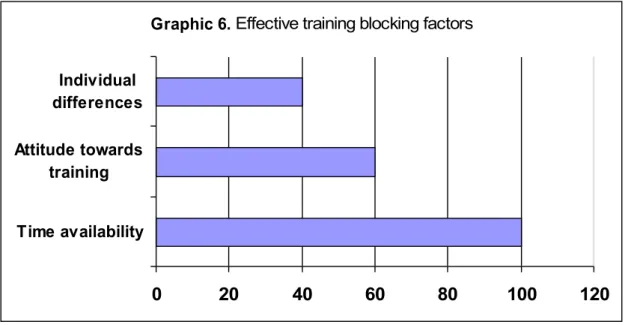
(26) However, differences are not only important regarding cultural and social issues, but also when talking about diverse levels of talent and different ways of learning.. Graphic 6. Effective training blocking factors Individual differences Attitude towards training Time availability. 0. 20. 40. 60. 80. 100. 120. As the previous graphic chart shows, from the analysis of teachers training needs (focus groups), most of the blocking factors for an effective training are related to people as individuals. From this perspective, and taking into account those reflections mentioned in the previous pages, teachers’ training activities should respond to a varied range of individual profiles and also to different ways of learning. Even if we agree with the Schön’s theoretical background (Schön, 1983), activities should be planned offering different paths and based on the kind of teaching it is supposed to develop afterwards. So, training ICT for teachers should be adjusted to their individual qualifications and sometimes integrated with the work of developing the whole course. It is also recommended to start from the teachers own situation, and use it to improve the quality of their performance. As it is mentioned in one of the practices, “one bearing principle is to let the participants reflect at the meta-cognitive level of the virtual learning process in view of the more understandable faceto-face learning situation. This meta-discussion is carried out both in the physical and the virtual room”.. 26 Open University of Catalonia (UOC).
(27) 4. Conclusions We have identified several issues that can serve as a principles or criterion for design ICTsupported Higher Education Teachers Training. These criteria are referred to the principles that deal with two fundamental issues: a) Goals and purposes of teacher training b) Instructional design of training practices In relation with the goals and purposes of teacher training, we considered that the main aims of the teachers training practices should be to develop a competency-based learning. Our own view is that the training teachers to be competent in the use of ICT or through the use of ICT must favour the development of the three roles (which are not exclusive with each other, but overlapped with each other in the academic practice): . Cognitive role (related to the development of the educational process). . Social role (which facilitates the necessary interactivity for the construction of the knowledge) . Designer/planning role (plan and management of the educational process) These three roles are cross-sectional related. We could also add two profiles that teachers must develop: a technological profile and a management one. Firs of all, we argued that each role is formed by a whole of necessary competencies to carry out the actions/tasks that each role demands and that would only have sense if they are related in a systematic form. We must bear in mind, though, that the competencies may vary according to the context in which they are applied. The second argument underline the idea that the learning of the competences that shape the technological profile in relation with the peculiarities and demands of teaching functions in pedagogical environments with ICT applications. The application of these competences is cross-sectional to all the practices of the academic staff with application of ICT; hence, it does not have to be learnt as an independent complement in the teaching function.. 27 Open University of Catalonia (UOC).
(28) Take into account this definition about the proposal of teacher training, we considered that the instructive design of training practices should be characterized for the principles of the active learning and instruction. That is: . To use scaffolding principles (intentional, guided and situated learning). . To encourage authentic learning (activities through the development of real tasks). . To create opportunities for high levels of interaction (interactive and collaborative processes; learning situation as a “social dialogue”). . To communicate high expectations (involve the student’s cognitive and affective processes). . To give prompt feedback (authentic assessment or formative assessment). . To respect diverse talents and ways of learning. Near the beginning of this paper we discussed the problem of teacher training in order to incorporate and promote the use of ICT in the teaching. We think that the explained criteria can be many benefits in order to clarify, facilitate and make coherent the design of Higher Education Teachers Training with ICT. Nevertheless, we underline the need to check these definitions, to enrich them or to modify them, according to note the analysis of needs and resource in the particularly educational context in that in that projects the teacher training. Practices should be adapted to the different delivery systems and should pay attention to use the appropriate ICT-based learning models (face-to-face, blended supportive, blended complementary, fully online), as far as an active learning is demanded, models of practice should respond to the learning models teachers are going to develop in the classrooms and should introduce the use of different technologies to give teachers the opportunity to choose those could fit better with their subjects and matters.. 28 Open University of Catalonia (UOC).
(29) References. Allal, L. (2000). Assessment of -or in- the zone of proximal development. Learning and Instruction, 10, 137-152. Anderson, T.; Randy, D.; Andy, D.; Garrison D. & Archer W,. (2003). Assessing Teacher Presence in a Computer Conferencing Context. Journal of Asynchronous Learning Networks 5(2), 117. Andersson, T & Fathi, E. (2004). Theory and Practice of Online Learning. (Athabasca, Canada, Athabasca University, Creative Commons). http://cde.athabascau.ca/online_book/pdf/TPOL_book.pdf Bandura, A. (2000). Cultivate self efficace for personal and organizational effectiveness. In E. A. Locke (Ed.), Handbook of principles of organization behaviour. (pp. 120-13). Oxford, UK: Blackwell. Barberà, E.; Badia, A. & Momino, J.M. (2001). La incógnita de la Educación a distancia. Barcelona: ICE-Horsori. Barr, R.; Tagg, J. (1995) “From teaching to learning –a new paradigm for undergraduate education.” Change, Nov-Dec., pp. 13-25. Bates, A.W; Poole, G. (2003) Effective Teaching with Technology in Higher Education. San Francisco: Jossey-Bass. Bates, Tony (A.W. ) Cultural and Ethical Issues in International Distance Education. Engaging Partnerships Collaboration and Partnership in Distance Education - UBC/CREAD Conference, Vancouver, Canada - September 21-23rd, 1999. Available at: http://bates.cstudies.ubc.ca/ Billet, S. (1996). Situated Learning: Bridging sociocultural and cognitive theorising. Learning and Intruction, 6 (3), 263-280. Boekaerts, M. (2002). Bringing about change in the classroom: strength and weakness of the selfregulated learning approach – EARLI Presidential Address, 2001. Learning and Instruction, 38 (6), 589-603. Bonwell C. & Eison J. (1991) Active Learning: Creating Excitement in the Classroom. Washington, DC: George Washington University. Campbell, K. (1998). The Web: Design for Active Learning. Introduction Interactivy. Academic Technologies for Learning (ATL). University of Alberta. Available on http://www.atl.ualberta.ca/documents/articles/activeLearning001.htm. Chickering, A, W. & Gamson, Z. F. (1987). Seven Principles for Good Practice in undergraduate education. AAHE Bulletin 39: 3-7. Available on http://www.utexas.edu/academic/cte/efc/efs2003/Rhodes.pdf Coll, C. & Onrubia, J. (2002). Evaluar en una escuela para todos. Cuadernos de Pedagogía, 318, 50-55. 29 Open University of Catalonia (UOC).
(30) Coll, C., Colomina, R., Onrubia, J. & Rochera, M.J. (1995). Actividad conjunta y hablar: una aproximación al estudio de los mecanismos de influencia educativa. En Fernández, P and Melero, A. La interacción social en contextos educativos. Madrid: Siglo XXI. Colomina, R., Onrubia, J., Rochera, M.J. (2002). Interactividad, mecanismos de influencia educativa y construucción del conocimiento en el aula. En Coll, C., Palacios, J., Marchesi, A. Desarrollo Pscológico y educación. Tomo II: Psicología de la educación escolar. Psicología y educación. Alianza Editorial. Capítol 17: 437-458. Commission of the European Communities (2001) Communication from the Commission. ELearning – Designing tomorrow’s education. Brussels. Coomey, M., and Stephenson, J., (2001), “Online learning: it is all about dialogue, involvement, support and control-according to research”. In Stephenson, J. (Ed), Teaching and Learning Online: Pedagogies for New Technologies, Kogan Page, London. Coppola, W.N., Starr, R. & Rotter. N. (2002). Journal of Management Informations Systems. 18(4), 169-189. Deschenes, A.J., Begin-Langlois, l., Charlebois-Refae, N., Cote, R & Rodet, J. (2003). Description of a peer learner support system and training for the advanced students. Journal of Distance Education. Revue de l’Éducation à Distance. 18,1, 19-41 Directorate for Education, Employment, Labour and Social Affairs Education Committee. DEELSA/ED/CERI/CD (2002)9. Definition and selection of competences (DESECO). Theoretical and conceptual foundations. Strategy Paper. Complete document available on OLIS in its original format. http://www.portalstat.admin.ch/deseco/deseco_strategy_paper_final.pdf Dodge, B. (2000). Active Learning on the web. Retrieved: February 22, 2001 from http://edweb.sdsu.edu/people/bdodge/Active/ActiveLearning.html Eraut, M. (1998). Concept of competence. Journal of Interprofessional Care. 12(2), 127-139. Eraut, M. (2000). Non formal learning and tacit knowlwdge in professional work. British Journal of Educational Psycology, 70, 113-136. European Commission. Directorate General for Education and Culture (2003). Implementation of “Education & Training 2010”. Work Programme. Working Group “Improvement Education of teachers and trainers”. Progress Report. European ODL Liaison Committee (2004) Distance Learning and eLearning in European Policy and Practice: The Vision and the Reality. Policy Paper. Fox, M. & Helford, P. (1999). Advancing the boundaries of Higher Education in Arizona using the World Wide Web. Interactive Learning Enviroments. 7(2-3), 155-174). Gold, S. (2001). A constructivist approach to online training for online teachers. JALN, 5, 35-57. Goodyear, P.; Spector, M; Steeples, C & Tickner, S. (2001). Competence for online teaching: A special report. Educational Technological, Research and Development, 49(1), 65-72. Gulikers,J., Bastian, J., & Kirschner, A. (2004): Perceptions of authentic assessment. Five dimensions of authenticity. Paper presented at the second biannual joint Northumbria/EARLI SIG assessment conference, Bergen. 30 Open University of Catalonia (UOC).
(31) Hillman, D.C., Willis, D.J., and Gunawardena, C.N. (1994). Learner-Interface Interaction in Distance Education: An Extension of Contemporary Models and Strategies for Practitioners. The American Journal of Distance Education, 8(2), 30-42. Jonassen, D. H. (1994). Thinking technology: toward a constructivism design. Educational Technology, 34 (4), 34-37. Jonassen, D. & Reeves, T.C. (1996). Learning with Technology: using computers as cognitive tools. In D.H.Jonassen (Ed.), Handbook of research for educational communications and technology (pp. 693-719). New York: Macmillan. Jonassen,D. , Peck, K. & Willson, B. (1999). Learning with technology. A constructivist perspective. Upper Saddle River, N,J: Merrill/Prentice Hall. Laurillard, D. (2002) “Rethinking teaching for the Knowledge Society”. EDUCAUSE Review, Vol. 37, No. 1, January/February 2002, pp. 16-25. Lave, J. & Wenger E. (1991). Situated Learning – legitimate peripheral participation. Cambridge. Cambridge University Press. Lou, Y., Dedic, H. & Rosenfield, S. (2003). A feedback model and successful e-learning. In S. Naidu (Ed). Learning & Teaching with Technology. Principles and Practices. (pp. 249-269). London: Kogan Page. Macdonald, J. (2001). Exploiting online interactivity to enhance assignment development and feedback in distance education. Open Learning. 16,2. McLellan, H. (1996). Situated Learning Perspectives. Englewood Cliffs: Educational Technology Publications. Moore, M & Anderson, W.G. (2003). A Theory of critical inquiry in online Distance Education. Handbook of Distance Education. (pp. 113- 127). London. LAE (Lawrence Erlbaum Associates). PLS Ramboll Management (2004) Studies in the Context of the E-Learning Initiative: Virtual Models of European Universities (Lot 1). Final Report to the EU Commission, DG Education & Culture. Rogoff, B. (1990). Apprenticeship in thinking: Cognitive development in social context. New York: Oxford University Press. Salmon, G. (2000). E-moderating. The key to teaching and learning on Line. Koganpage. Salomon, G.; Perkins, D. & Globerson, T. (1991). Partners in cognition: Extending human intelligence with intelligent technologies. Educational Researcher, 20 (3), 2-9. Sangrà, A. (2003) “La EAD como factor clave de innovación en los modelos pedagógicos”. En Discursos. Novos Rumos e Pedagogía em Ensino a Distância. Série Perspectivas em Educaçâo, núm. 1, Dezembro 2003. Lisboa: Universidade Aberta (ISSN 0872-0738). Schön, D. (1983). The Reflexive Practitioner: How professionals think in action. New York: Basic Books. Solé, I. (2003). El profesor universitario en el S. XXI. In: C. Monereo & J.I. Pozo. La universidad ante la nueva cultura. Barcelona: Ed. Síntesis. 31 Open University of Catalonia (UOC).
(32) Sugrue, B. (2000). Cognitive Approaches to Web-Based Instruction. In S.P. Lajoie, Computers as Cognitive Tools, Volume II: No more walls. London: LEA. Trill, J. (2001). Development of work based competence. ITSN. Supporting Learning and Teaching. Centre for Education in the Built Environment. Workshop. http://www.cebe.heacademy.ac.uk/learning/pdp/docs/trill.doc Vygotsky, Lev S. (1978). Mind in Society. Harvard University Press.. Wertch, J. & Stone, C. (1985). The concept of internalization in Vygotsky’s account of the genesis of higher mental functions. En J. Wertsch (Ed.). Culture, communication, and cognition: Vygotskian perspectives, London, Cambridge University Press, pp. 162-179. Westera, W. (2001). Competences in education: a confusion of tongues. Journal of Curriculum Studies. 33(1). 75-88. Williams, P. E. (2003). Roles and competences for Distance Education Programs in Higher Institutions. American Journal Education, 17(1), 45-57. Winne, P.H. (1995). Inherent details in self regulated learning. Educational Psychologist, 30 (4), 173-187.. 32 Open University of Catalonia (UOC).
(33) Acknowledgements. We want to thank you all Elene-TT project partners their contributions for the elaboration of that document, with bibliography, an extend selection of Higher Education teachers training practices, and the identification of teachers training needs in their institutions: Canege: Vidéoscop-UN2 (France), Politécnico di Milano (Italy), University of Bremen (Germany), University of Helsinki and Helsinki University of Technology (Finland), Umea University (Sweden), Utrech University (Netherlands) and Open University of Catalonia (Spain).. 33 Open University of Catalonia (UOC).
(34)
Figure

+3

Documento similar
