EXPERIMENTAL INVESTIGATION OF TRANSIENT NONLINEAR
PHENOMENA IN AN ANNULAR THERMOACOUSTIC PRIME-MOVER
PACS REFERENCE: 43.35.Ud
Guillaume PENELETa; Etienne GAVIOTa; Vitalyi GUSEVa,b; Pierrick LOTTONa; Michel BRUNEAUa
a
Laboratoire d’Acoustique de l’Université du Maine,UMR CNRS 6613 b
Laboratoire de Physique de l’Etat Condensé, UMR CNRS 6087 a,b
avenue Olivier MESSIAEN 72085 LE MANS Cedex 9 FRANCE
Tel: (33) 2 43 83 32 59 Fax: (33) 2 43 83 35 20
E-mail: [email protected]
ABSTRACT
Thermoacoustic engines have been subjected to numerous studies for the past ten years. Our current research focus on the transient regime in an annular thermoacoustic prime-mover. It appears that several phenomena can play a role in the amplification and saturation regimes. Indeed, we can quote acoustically induced conductivity, forced convection due to acoustic streaming, heat conduction in different parts of the thermoacoustic prime-mover, and saturation due to harmonic generation. The experiments presented here show for the first time a double-threshold phenomenon during the amplification regime. The first threshold, which corresponds to the setting of the thermoacoustic instability, is followed by a saturation regime. Then without any changes in the control parameters, a second threshold has been observed after a time delay, corresponding to an additional amplification. Other interesting results are also presented.
1. INTRODUCTION
The idea of a traveling-wave thermoacoustic engine was put forward more than 20 years ago [1]. However the first annular thermoacoustic prime-mover, which employs for the transformation of the thermal energy into mechanical energy a quasi-adiabatic interaction between an inhomogeneously heated stack of solid plates and resonant gas oscillations, was built only in 1997 [2]. Later a closed-loop thermoacoustic engine employing quasi-isothermal regime of sound propagation through the stack was reported [3,4].
streaming carrying a nonzero mass flow through each cross section of the device. This streaming provides convective heat transport in the inhomogeneously heated parts of the prime-mover, modifies temperature distribution in the system, and, as a result, influences the thermoacoustic amplification of sound. The first analysis of how a nonzero net time-averaged mass flow can arise in Stirling and pulse-tube cryocoolers whenever a closed-loop path exists for steady flow was proposed in 1997 [11], and the theory of the acoustic streaming in an annular thermoacoustic prime-mover was developed in 2000 [12]. The experiments [3,4,13] confirmed the existence of these circular (closed-loop) streaming. Moreover, it was demonstrated [4] that suppression of the streaming leads to a significant increase in the efficiency of the device performance. Different methods for streaming suppression were proposed [4,14]. Consequently acoustic streaming is an important nonlinear mechanism participating in the saturation of the thermoacoustic instability.
In the stationary regime of a prime-mover operation acoustic streaming acts in parallel with the other nonlinear phenomena. However in the transient regime the development of the different nonlinear phenomena should proceed differently (with different time scale). So the experimental investigation of the transient process of an annular thermoacoustic engine stabilization might provide information on independent (separated in time) influence of different nonlinear phenomena on thermoacoustic instability. It might help to identify the dynamics of acoustic streaming development, the dynamics of temperature field modification by streaming, and the characteristic times for the operation of this mechanism of acoustic wave self-action. This is a draft of a physical idea, which initiated our experiments. However, it should be mentioned as well that, surely, the investigation of transient processes is important for the applications (as ultimately we are interested in the creation of the thermoacoustic devices with the shortest possible turn-on time).
Though in all the experiments with thermoacoustic prime-movers the researchers inevitably observed transient phenomena, these observations are very poorly documented in the literature [6,10,15]. The “classical”-type observation for the standing-wave devices consists in the initial exponential growth of the acoustic wave amplitude (above the threshold of the thermoacoustic instability) with subsequent smooth (in time) saturation [10,14] (similar to the behavior presented in Figure 2 later here). However much more sophisticated transient regimes were also reported. In Ref. 6 (page 1555) the observation of the acoustic pressure amplitude oscillation with a long period and the possibility of exponential growth of the envelope of this oscillation (followed by the entire stop of the engine) were mentioned. The regime of the periodic turn on and turn off of the engine with a period of hours was also observed [6]. Note that all these observations were documented for the standing-wave devices only.
In the following we present what is, to the best of our knowledge, the first documentation of the transient processes observation in the annular thermoacoustic device. Our observations confirm the possibility of the regime of smooth stabilization and of the regime of long-time quasi-stable operation followed by a spontaneous turn off of the prime-mover (both were observed earlier in standing-wave devices). The unexpected and interesting observation is the existence of the regime where the exponential growth of oscillations (first threshold) is followed by an intermediate quasi-stabilization (with wave amplitude slowly growing in time), which before the final stabilization of the amplitude is followed by another exponential growth (second threshold). All these processes (including two subsequent instabilities) proceed in time one after another for the fixed control parameter (fixed temperature in the vicinity of the hot heat exchanger). We called the observed effect the double-threshold phenomenon. We have not found in the literature any reports on the earlier observations of this type of transient behavior in thermoacoustic devices.
2. EXPERIMENTAL APPARATUS
A schematic diagram of the experimental apparatus is shown in Fig. 1. The torus-shaped stainless steel tube of inner diameter R=53 mm and length L=2,24 m is filled with air at atmospheric pressure. The stack (length H=150 mm) is a ceramic porous material with square channels of cross section d×d (d=0.9 mm). Considering that the thermal boundary layer
δ
h=(2κ/ω)
1/2 thermal diffusivityκ=4
W.m
-1
speed c=342 m.s-1) is about four times smaller than d, the prime-mover employs a quasi-adiabatic regime. The cold heat exchanger is a copper circular shell set around the tube with flowing cooling water inside at temperature TC, and a copper wire mesh is in the tube, attached to the stack. The hot heat exchanger is an appropriate coiled stainless steel ribbon (width=25 mm) at a distance of 2 mm from the stack side, radially heated with electrical heat resistances soldered in a stainless steel block around it. The heating power can be adjusted to the wanted TH hot temperature, using a controller connected to a thyristor unit and a type K thermocouple fitted between the outer tube and the block.
The instrumentation of the device is schematically shown in Fig. 1. Two piezoresistive microphones allow the amplitude, frequency and relative phase measurements of the acoustic wave generated in the tube. Particular attention has been paid to the temperature distribution measurement along the stack. A total of 8 type K thermocouples (70 µm in diameter), sandwiched in copper strips are equally placed along the stack, and glued with a ceramic putty. The copper strips ensure an isothermal condition between the thermoelectric junctions and the stack surface with an acceptable response time (less than 5 seconds). In order to investigate the possible inhomogeneity in the radial temperature distribution, two additional thermocouples are placed in the stack at a distance x=4H/7 away from the x=0 cold end of the stack, and respectively at 10 mm and 20 mm from the median axis. All sensors are linked to an A/D converter for signal processing.
3. EXPERIMENTS
[image:3.596.303.515.405.565.2]For each measurement, the temperature difference (TH-TC) is set just below its critical value corresponding to the onset of the thermoacoustic instability. A 1 K increment on TH is then sufficient for the acoustic wave to be generated in the waveguide. Note that care has been taken before each measurement to wait for the temperature stabilization in the whole device.
Fig. 1. Schematic illustration of the experimental apparatus
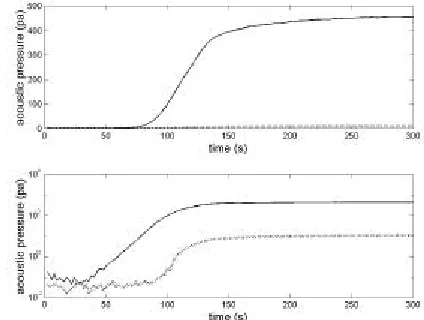
Fig. 2. Rms amplitude of acoustic pressure for the first (solid line) and the second harmonic (dotted line) at the onset of the thermoacoustic instability, in linear (top) and logarithmic (bottom) scales.
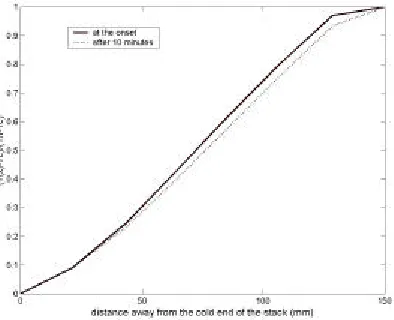
Fig. 3. Normalized temperature profile (T(x)-TC)/(TH- TC) along the stack, at two different moments in the transient regime. The X-axis corresponds to the distance away from the cold end of the stack.
Fig. 4. Rms amplitude of the first harmonic acoustic pressure during a double-threshold amplification regime, for different increments. Solid line: ∆T=7K; dotted line: ∆T=9K; dashed line: ∆T=12K, dash-dotted line: ∆T=14K
A more surprising result when a double threshold has been observed during the amplification regime, is shown in Fig. 4. A first exponential growth of acoustic oscillations is followed by an intermediate quasi-stabilization regime (with wave amplitude slowly growing in time), which is followed before stabilization by another exponential amplification regime. This double threshold phenomenon occurs only for small ∆T increments (less than 12 K), and characteristic times for the first and second amplification thresholds are increasing with diminishing ∆T.
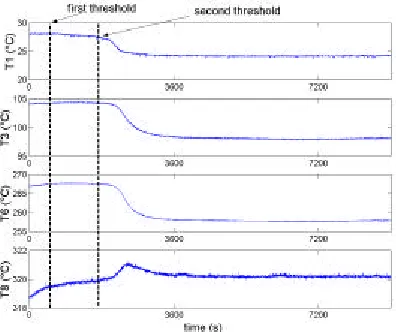
The stack instrumentation with thermal sensors has been justified by the results shown in Fig. 4. Therefore, this kind of regime was more difficult to observe after dismantling and reassembly of the device, since a ∆T larger than 2K could not allow the double threshold observation. At this stage of the work, we cannot control the parameters responsible for this difference. The temperature distribution evolution for a double threshold transient regime corresponding to a 1K ∆T increment is shown in Fig. 5. The transient regime duration is then up to 40 minutes. For a better readability, only four temperature signals are presented. The Y-axis T1, T3, T6, T8 respectively represent the measured temperatures at distances x=0, x=2H/7, x=5H/7, and x=H away from the cold end of the stack. The acoustically induced directional mass flow results in an important decrease of temperatures along the stack except for the sensor placed on the hot end of the stack. Indeed, this measured temperature increases by about 2K, whereas the initial ∆T increment was only 1K. Concerning the possible inhomogeneity in the radial temperature distribution, measurements show a 1 K difference between the thermocouple placed on the median axis (at a distance x=4H/7 away from the cold end of the stack) and the sensor placed at 20 mm from the median axis.
Fig. 5. Temperature evolution versus time during a double-threshold amplification regime.
Fig. 6. Temperature evolution versus time during an onset regime followed by a spontaneous turn off of the prime-mover.
4. DISCUSSION
Preliminary estimates demonstrate that the observed effects can not be entirely attributed to classical nonlinear acoustic and minor loss phenomena [6 – 9] even at the highest level of pressure oscillations in our experiments (i.e. above the second threshold). Energy dissipation due to superharmonics excitation (with their subsequent absorption) and due to vorticity generation (in the regions of the resonator cross section variation) is insufficient to compensate completely net thermoacoustic amplification. Additional mechanisms of the acoustic wave self-action should be taken into account. One of the possibilities is a modification of the temperature distribution in the resonator by the acoustic streaming [3, 4, 13], which might lead to diminishing of the thermoacoustic amplification and saturation of the instability. Transient changes in temperature distribution were observed in our experiments. The estimates indicate that this mechanism can provide contribution to transient processes near the second threshold and should play the major role near the first threshold, where the acoustic and minor loss nonlinearities are negligible. It should be mentioned as well that temperature distribution can be also modified directly by acoustic energy dissipation both in the boundary layers and in the regions of minor loss localization. This might provide an additional mechanism of the acoustic wave self-action.
Currently we believe that the observed intriguing double-threshold effect has an intrinsic link to the phenomena of bistability (and multistability) theoretically predicted for standing wave acoustic resonators with strong coupling between thermal and acoustic fields [16]. Bistability is a general concept for the description of any system possessing two different steady-state operation regimes for the same value of control parameter. The related to bistability phenomenon of the acoustic intensity self-oscillation was observed experimentally in the system filled with a fluid exhibiting strong dependence of sound velocity on temperature [17], and also in standing-wave thermoacoustic prime-mover [6]. The observation of the related to bistability phenomenon of hysteresis in turn-on and turn-off of the standing-wave thermoacoustic engine was also reported [18]. All these phenomena are finally due to inverse influence of temperature field on sound propagation and its attenuation/amplification, while the temperature field itself is modified by sound absorption and acoustic streaming. Note that in the resonators the temperature distribution and streaming also influence acoustic wave backscattering and, consequently, influence the coupling between acoustic waves travelling in opposite directions. This modifies the structure of the internal modes of the resonator.
ACKNOWLEDGMENTS
This work was supported by the Direction Générale de l’Armement (D.G.A.) under contract n° 99-34072/DSP. Stéphane Job has built the annular thermoacoustic prime-mover on which measurements have been made. The first author is gratefull to him for his usefull help concerning experiments on this device.
REFERENCES
[1] Ceeperley P. H., A pistonless Stirling engine – the traveling wave heat engine. J. Acoust. Soc. Am., 1979, 66, 1508-1513.
[2] Yazaki T., Iwata A., Maekawa T., Tominaga A., Travelling wave thermoacoustic engine in a looped tube. Phys. Rev. Lett., 1998, 81, 3128-3132.
[3] Backhaus S., Swift G. W., A thermoacoustic Stirling heat engine. Nature (London), 1999, 399, 335-338; A thermoacoustic-Stirling heat engine: detailed study. J. Acoust. Soc. Am.,
2000, 107, 3148-3166.
[4] Swift G. W., Gardner D. L., Backhaus S., Acoustic recovery of lost power in pulse tube refrigerators. J. Acoust. Soc. Am., 1999, 105, 711-724.
[5] Atchley A. A., Bass H. E., Hofler T. J., Development of nonlinear waves in a thermoacoustic prime mover. In Frontiers in Nonlinear Acoustics: Proceedings of the 12th ISNA, edited by Hamilton M. F. and Blackstock D. T., Elsevier Science, New York, 1990, pp. 603-608. [6] Swift G. W., Analysis and performance of a large thermoacoustic engine. J. Acoust. Soc. Am., 1992, 92, 1551-1563.
[7] Yuan H., Karpov S., Prosperetti A., A simplified model for linear and nonlinear processes in thermoacoustic prime movers. Part 2: Nonlinear oscillations. J. Acoust. Soc. Am.,
1997, 102, 3497-3506.
[8] Gusev V., Bailliet H., Lotton P., Bruneau M., Asymptotic theory of nonlinear acoustic waves in a thermoacoustic prime-mover. ACOUSTICA-acta acoustica, 2000, 86, 25-38.
[9] Khokhlova V., Sapozhnikov O., Kascheeva S., Lotton P., Gusev V., Job S., Bruneau M. , Effects of nonlinear saturation in propagation of acoustic wave in media with frequency-dependent amplification. Sov. Phys. Izvestia of Russian Academy of Sciences, 2001, 64, 2334-2337.
[10] Müller V. A., Lang E., Experimente mit thermisch getriebenen gasflüssigheits-schwingungen. J. Appl. Math. Phys. (ZAMP), 1985, 36, 358-366.
[11] Gedeon D., DC gas flows in Stirling and pulse-tube cryocoolers. In Cryocoolers, edited by Ross, R. G., Plenum, New York, 1997, vol. 9, pp. 385-392.
[12] Gusev V., Job S., Bailliet H., Lotton P., Bruneau M., Acoustic streaming in annular thermoacoustic prime-movers. J. Acoust. Soc. Am., 2000, 108, 934-945.
[13] Job S., Gusev V., Lotton P., Bruneau M., On the velocity of acoustic streaming in annular thermoacoustic prime-mover. J. Acoust. Soc. Am. (submitted).
[14] Olson J. R., Swift G. W., Acoustic streaming in pulse tube refrigerators: Tapered pulse tubes. Cryogenics, 1997, 37, 769-776.
[15] Wheatley J., Hofler T., Swift G. W., Migliori A., Understanding of simple phenomena in thermoacoustics with applications to acoustic heat engines. Am. J.Phys., 1985, 53, 147-162. [16] Bunkin F. V., Lyakhov G. A., Shipilov K. F., Thermal self-action of acoustic wave packets in a liquid. Physics – Uspekhi, 1995, 38, 1099-1118.
[17] Lyakhov G. A. et al., Acoust. Phys., 1993, 39, 158-164.