www.elsevier.es/rmuanl
medicina
universitaria
*Corresponding author: Servicio de Dermatología, Hospital Universitario “Dr. José Eleuterio González”, de la Universidad Autónoma de Nuevo León, Ave. Francisco I. Madero Pte. s/n y Ave. Gonzalitos, Col. Mitras Centro, C.P. 64460 Monterrey, Nuevo León, México. E-mail ad-dress: [email protected] (A.L. Tamez Peña).
REVIEW ARTICLE
Use of medications on the elderly
Alejandra Lorena Tamez-Peña,
a,* Héctor Eloy Tamez-Pérez,
bAnamaría Peña-Lazo,
cJorge Ocampo-Candiani,
aand Juan Francisco Torres-Pérez
daDermatology Services, “Dr. José Eleuterio González” University Hospital, Monterrey, Nuevo León, México bOfice of Research, School of Medicine, UANL, Monterrey, Nuevo León, México
cDermatology, Private Practice, Monterrey, Nuevo León, México
dGeriatrics Services, “Dr. José Eleuterio González” University Hospital, Monterrey, Nuevo León, México
Received: November 2013; Accepted: July 2014
KEYWORDS Elderly; Adverse effect; Medical prescription
Abstract
The elderly constitute a growing world population group, with more than 200 million people over 60 years of age. This fact has increased the detection of chronic-degenerative diseases, as well as the prescription and consumption of medicines. The elderly are particularly susceptible to adverse drug events or interactions with other drugs due to their physiological changes, ge-netic predisposition and environmental exposure. It becomes necessary to adapt the health systems with integral and multidisciplinary approaches suitable to this demographic change, as the knowledge about appropriate prescription, clinical pharmacology and medication use in the elderly has become essential.
It has been shown that about two thirds of elderly patients receive inappropriate drug doses, and a substantial percentage of their hospital admissions are associated with potentially pre-ventable toxic effects of drugs. To date, expert criteria, error detection tools and educational prescription plans have been developed by expert consensus for the safe use of drugs in the geriatric population. The objective of this study is a brief review of the principal physiological changes in an older adult, and summarize the contributions of the consensuses on prescription.
© 2014 Revista Medicina Universitaria. Facultad de Medicina UANL. Published by Elsevier México. All rights reserved.
Introduction
According to the World Health Organization (WHO), any in-dividual who is more than 60 years old is considered
el-derly or an older person. This deinition applies for most
industrialized countries and the UN.1 The number of el-derly is increasing worldwide with over 200 million older people, and an increase of 30% is expected in the next few years.1
In Mexico, in 2010 the National Institute of Statistics and Geography (INEGI by its Spanish acronym) recorded over 11 million elderly in its census,2 and according to the pro-jections by the National Population Council, by the year 2050 older people will represent 28% of the Mexican popula-tion, with approximately 36 million people.3 Nowadays, the elderly population is growing twice as fast as the country’s population growth rate.
The increase in life expectancy has an impact in terms of
health, which is relected in a substantial increase in chron -ic degenerative diseases, thus making the technolog-ical and economic development that this epidemiologic transition requires necessary, with a demand for multidisciplinary medical strategies. Prescription and consumption of medi-cations has increased among the geriatric population, hence the presence of adverse pharmacological events. The objec-tive of this document is to make a brief review of the main physiological changes of the elderly, as well as summarizing the contribution of consensuses about prescriptions in this population.
Pharmacology in the elderly
The elderly population presents physiological and pharma-cologic changes which make it especially susceptible to pre-senting secondary or adverse events to medications, even with commonly used pharmaceutics.4,5 The need to know about prescriptions, clinic pharmacology and use of medica-tion in the geriatric populamedica-tion becomes evident, in addimedica-tion to preparing social, economic and health systems for cur-rent and future population demographic changes.6-8 It is es-timated that people over 65 consume 25-50% of all prescribed pharmaceutics, and are responsible for 70% of the total pharmaceutical expenditure.9 Different studies have calculated that two thirds of geriatric patients receive an inappropriate dosage of medication, especially those with renal elimination.10-12 Moreover, the harmful effects of the pharmaceutics may have safety consequences and eco-nomically affect the health system.13
Approximately 30% of hospital admissions of older pa-tients is linked to the toxic effects of pharmaceutics. The related adverse effects of pharmaceutics have been associ-ated with preventable problems, like depression, constipa-tion, falls, immobility, confusion and hip injuries.13
In a study conducted in patients who live in retirement homes, it was proved that approximately two thirds of residents had an ADR in a period of four years and out of them 1 in 7 required hospitalization.14 In the US in 2012 problems related to medications caused 106000 deaths with a cost of 85 billion dollars. Other authors have calcu-lated the ADR-recalcu-lated expenditure to be $76.6 billion in outpatient care, $20 billion in hospitals and $4 billion in nursing homes.13,15
Physical changes in the elderly
Physiologically, the elderly is in a state characterized by a reduction in functional reserves and their ability to adapt,6,16-18 which suggests a different response to that of a young patient when dealing with a disease or the adminis-tration of certain medication. Proper knowledge of the changes in pharmacokinetics and pharmacodynamics in the elderly is necessary for a correct prescription, which mini-mizes or avoids adverse effects of medications.6,18-20
Variability in response to pharmacological intervention is conditioned by genetic factors, age, diseases, interactions and prescription compliance, which results in alterations in
the pharmacokinetics and pharmacodynamics proiles, in
addition to the frequent atypical presentations of diseases and the administration of multiple medications.21,22
Pharmacokinetics
Pharmacokinetics determine the relationship between a medication administration and the concentration which it reaches in the body with time (in relationship with the dos-age, presentation, frequency and form of administration), and despite the fact that many changes of these parameters have been described, inter-individual variability is the rule.6,18,19
Bioavailability refers to the proportion of the medication that reaches circulation, and it is a function of the form of administration, the chemical properties of the medication and the absorption and amount of dosage which is
elimi-nated through the hepatic metabolism of the irst step be -fore reaching circulation.6,17 Bioavailability is affected by age, because absorption becomes slower, increasing the necessary time to reach maximum concentration in plasma. Some medications require an acid environment for its ab-sorption, like ketoconazole, ampicillin or iron, and may have a decline of their bioavailability from 5 to 10%, as a result of hypochlorhydria secondary to atrophic gastritis or treatment with H2 antagonists and proton-bomb inhibi-tors.17-19 In the elderly, the hepatic metabolism of the irst step is diminished, and oral medication bioavailability which goes through this process is greater.17,18
Distribution volume depends on the plasma’s union to pro-tein, on water and lipid proportion and on tissue perfusion. The latter may decrease with age, causing a slower distribu-tion, and a reduction of the dosage load with most medica-tions should be considered.17,18 Concerning water and lipids proportion, body fat in the elderly is considered to increase between 20 and 40% and corporal water decreases by 10 to 15%, leading to an increase in concentration of water-solu-ble medications and a slower elimination of fat-soluwater-solu-ble medications.18-21
Some medications which present a lower distribution vol-ume in the elderly are digoxin, cimetidine, gentamicin, phenytoin and theophylline, among others, and this trans-lates to high plasmatic levels of the medications.18
oc-curs with medications like acetaminophen, amitriptyline, barbiturates, ibuprofen, lidocaine, prazosin, propranolol, salicilates and warfarin, among others.18
Pharmacodynamics
Pharmacodynamics describes the effects of medications in tissue (what medications cause in the body).6-18 Although it can be altered by age, these changes have not been thor-oughly studied. Almost every action of the medications are mediated by a interaction of medication molecules with tis-sue receptors, and these can be altered by hormones, neu-rotransmitters and transportation systems, among others, and the central nervous and cardiovascular systems play a very important role.6
Pharmacogenetics
Genetic variation is one of the causes of versatility in re-sponses to medications and is estimated to contribute be-tween 20 and up to 95%, even though the genetic expression can also be related to age and environmental factors.6 The aging process itself and the presentation of diseases have polygenic causes, thus the response to many medications can also be altered by polymorphisms in genes that may not be responsible for the pharmacokinetic or are not its direct target.6 In table 1 there is a summary of the main physiolog-ical changes linked to age.
Adverse effects of the use of medications
in geriatrics
Prescription errors in the elderly population are generally related to pharmacological changes, inadequate orientation
about dosage modiication, and lack of recommendations or
guides about safety of some medications in the geriatric population.21,22
Sometimes, randomized and controlled studies do not in-clude patients over 65 years, consequently the results on the safety of some medications cannot be generalized to this population. Adverse effects of medications include ad-verse reactions and prescription errors. An adad-verse medica-tion reacmedica-tion (AMR) is defined as any undesired sign or symptom which appears after medication administration at therapeutic doses. A severe or extremely severe AMR is one which requires hospitalization or causes irreversible damage including death.1,6,18 Adverse reactions are classiied based on their relation with a medication in five groups (A-E). Type A is linked to the medication’s pharmacologic action,
predictable or dosage-associated (pharmacokinetic chang-es, medication, food or medication-disease interactions), and represent most of the adverse effects. In group B there is no relation with pharmacologic actions and are independent of dosage, these are less fre-quent but more severe (allergic reactions, cytotoxic, idio-syncratic, etc.), and are unpredictable.22,23 The reactions of group C are related to prolonged and continuous use of a medication, such as dependency reactions or tachyphylaxis. Group D refers to late or long-term reactions like teratoge-nicity, and carcinogesis and group E is produced when a medication is suspended (“rebound effect”).
However, there are many classification systems. Mallet et al suggest a simple approach to the problem, and summa-rizes it in three categories, which are adverse reactions by pharmacologic interactions; patients who consume multiple medications and/or have multiple diseases (nine or more
medications and ive or more comorbidities); and the “pre -scription cascade” phenomenon, where the adverse effect of a medication leads to the prescription of another agent which at the same time causes a new secondary effect which would add a new medication.23-25 Most adverse reactions to medica-tions in hospitalized elderly are type A and therefore repre-sent predictable reactions and are potentially preventable.26,27 The medications that relate the most to adverse reactions and events are medications used to treat cardiovascular dis-eases, followed by rheumatologic and endocrinological medications, and this corresponds with the frequency and morbidity of these diseases in Mexico.27
Polypharmacy
The use of concomitant medications is justiied in the treat -ment of multiple chronic diseases. Polypharmacy is a term which describes patients who receive multiple medications, and in the elderly, this represents the rule rather than the exception.16,17
According to data from population studies in the United States, 90% of the elderly consume at least a weekly medi-cation, over 55% of women and 44% of men of advanced age
consume ive medications or more, and 40% of residents in
nursing homes consume over eight weekly medications.4,5,16 With this practice the risk of AMR increases drastically, because on many occasions, there are duplicates of the same kind of medication, and the adverse effects are not
identiied, leading to a prescription cascade.23-25,28
Adverse reactions may be dificult to detect in elderly pa -tients because they frequently have atypical presentations, like lethargy, confusion, falls, constipation and depression.
Table 1 Principal physiological changes in the elderly
Absorption Decrease of absorption surface, alteration in
gastrointestinal motility, decrease of splenic low
Distribution Decrease of total body water and muscular mass, decrease of albumin, altered protein binding
Greater concentration of hydrosoluble pharmaceutics, increase in elimination of liposoluble pharmaceutics
Metabolism Reduction of hepatic mass and low, decrease of type I
metabolism
Decrease of irst step metabolism
Nursing homes residents are the most vulnerable of this group.28
An appropriate use of medications
in geriatrics?
With the purpose of minimizing the problems that emerge as a consequence of inappropriate prescription of medica-tions in the elderly, consensus criteria have been developed in order to improve safety among this population.
Beers criteria
Beers et al,28 in 1999, supported by a group of experts in geriatrics, geriatric pharmacology, psychopharmacology and pharmacoepidemiology, in addition to the revision of
scien-tiic literature, developed a consensus of medications used
in the elderly and their frequent adverse effects. Criterion were developed which have been widely used to describe treatment patterns and educate and inform clinical doctors. A revision of these criteria was made in 199729 and later in 200330 to reevaluate new products, to reassess the severity assigned to each medication and to identify new situations or major considerations. The application of these criteria have allowed an improvement of pharmacological therapy
safety, since it identiies risk factors associated with pre -scription and suggests safety improvement programs.
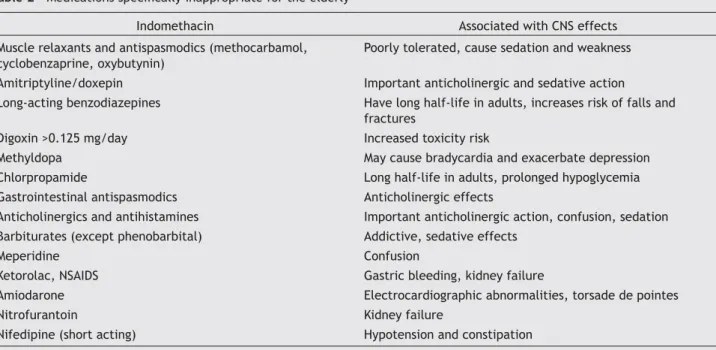
Beers’ criteria grouped medications into two groups; med-ications which should be avoided by the elderly because of their inefficacy or representation of an unnecessary risk, having other alternatives (table 2), and those medications which should not be used in the elderly even when they
meet speciic medical requirements (table 3). Moreover it
stresses the importance of identifying prescription cascade.13
Table 3 Medications speciically inappropiate for the elderly by clinical diagnosis
Diagnosis Medication Effect
Cardiac failure Disopyramide Negative inotropic effect
Urinary obstruction with overlow Anticholinergics and antihistamines, muscle relaxants
Urinary retention
Urinary incontinence due to stress Alpha blockers, anticholinergics, tricyclic antidepressants, doxepin, benzodiazepines
May cause polyuria and worsen urinary incontinence
Arrhythmias Tricyclic antidepressants Pro-arrhythmic effects
Parkinson’s disease Metoclopramide Cholinergic, antidopaminergic effects
Depression Benzodiazepines Exacerbates depression
Adapted from Fick et al.13
Table 2 Medications speciically inappropriate for the elderly
Indomethacin Associated with CNS effects
Muscle relaxants and antispasmodics (methocarbamol, cyclobenzaprine, oxybutynin)
Poorly tolerated, cause sedation and weakness
Amitriptyline/doxepin Important anticholinergic and sedative action
Long-acting benzodiazepines Have long half-life in adults, increases risk of falls and fractures
Digoxin >0.125 mg/day Increased toxicity risk
Methyldopa May cause bradycardia and exacerbate depression
Chlorpropamide Long half-life in adults, prolonged hypoglycemia
Gastrointestinal antispasmodics Anticholinergic effects
Anticholinergics and antihistamines Important anticholinergic action, confusion, sedation Barbiturates (except phenobarbital) Addictive, sedative effects
Meperidine Confusion
Ketorolac, NSAIDS Gastric bleeding, kidney failure
Amiodarone Electrocardiographic abnormalities, torsade de pointes
Nitrofurantoin Kidney failure
Nifedipine (short acting) Hypotension and constipation
CNS: central nervous system; NSAIDS: non-steroidal anti-inlammatory drugs.
Medications mostly implicated in adverse events are cardiovascular, antibiotics, diuretics, anticoagulants, hy-poglycemiants, steroids, opiates, anticholinergics,
benzo-diazepines and non-steroidal anti-inlammatory, among
others.
While Beers’ criteria is very useful, there are some limita-tions in their use. Some medicalimita-tions listed as inappropriate, may have acceptable applications; likewise, there are med-ications which are not included and may confer risk with their use.7,31,32
The InterRAI Corporation is a network of researchers and clinics from 30 different countries around the world, and it has developed and standardized instruments for geriatric care currently being used in many countries. These instru-ments provide valid scales in geriatric patients, important in clinical practice, which may have a positive effect on in-dividual care and treatment.7,33
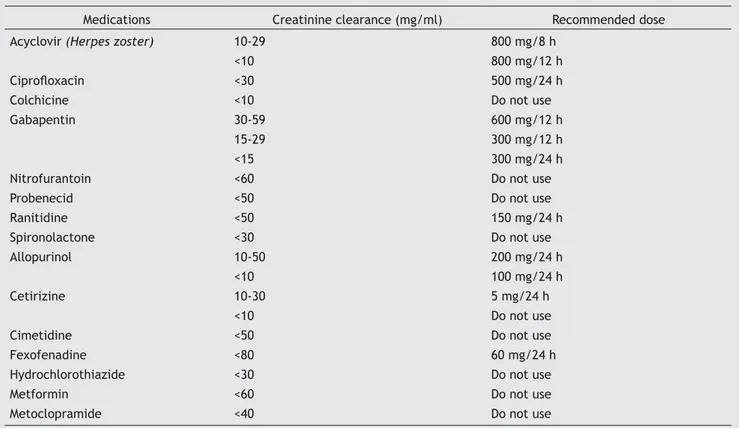
In 2009, Hanlon et al conducted a consensus in order to establish guidelines for the use of oral medications with re-nal elimination used in the elderly. The obtained results were in the form of two recommendations, medications which should be avoided in patients with a renal function of <30 mL/min like chlorpropamide, colchicine, cotrimoxa-zole, glyburide, meperidine, nitrofurantoin, probenecid, propoxyphene, spironolactone and triamterene; and those which require dosage reduction or a more ample
adminis-tration interval, like acyclovir, amantadine, ciproloxacin,
gabapentin, memantine, ranitidine, rimantadine and vala-cyclovir. Frequently used medications which require renal adjustment can be found in table 4.
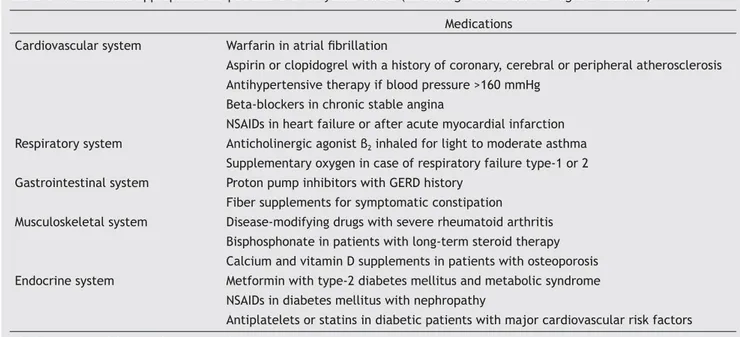
Two identiication tools to identify mistakes in prescrip -tions for the elderly were developed with the use of the Eng-lish acronyms STOPP (screening tool of older persons’ prescription) and START (screening tool to alert to right treat-ment); identifying those medications which should be avoid-ed, as well as those appropriate in the treatment of the elderly. The most commonly used medications are mentioned in tables 5 and 6.34 These studies proved that the potential omission of adequate medications in the elderly is as preva-lent as the inclusion of inappropriate medications which should be avoided.5,34 A multidisciplinary team allows for a better quality in the attention of the elderly, and adequate prescriptions and an optimal control with a decrease of AMR.
Education for prescriptions and general
standards
The challenge in prescribing medicine
to the elderly
The elderly have approximately 3 times more prescriptions than younger people. While the metabolism characteristics of geriatric patients which affect medication pharmacology
are not modiiable, the choice of medication, length of the
treatment and dosages are decisions which depend on the doctor, and are factors which can be optimized with the right knowledge and proper training in the treatment of ge-riatric patients.
Every new medication must be evaluated in the following contexts: pharmacokinetic, pharmacodynamics and changes
Table 4 Commonly used medications that require renal adjustment
Medications Creatinine clearance (mg/ml) Recommended dose
Acyclovir (Herpes zoster) 10-29 800 mg/8 h
<10 800 mg/12 h
Ciproloxacin <30 500 mg/24 h
Colchicine <10 Do not use
Gabapentin 30-59 600 mg/12 h
15-29 300 mg/12 h
<15 300 mg/24 h
Nitrofurantoin <60 Do not use
Probenecid <50 Do not use
Ranitidine <50 150 mg/24 h
Spironolactone <30 Do not use
Allopurinol 10-50 200 mg/24 h
<10 100 mg/24 h
Cetirizine 10-30 5 mg/24 h
<10 Do not use
Cimetidine <50 Do not use
Fexofenadine <80 60 mg/24 h
Hydrochlorothiazide <30 Do not use
Metformin <60 Do not use
Metoclopramide <40 Do not use
related to age regarding body composition and physiology.28 While on occasion there are differences between geriatric guidelines and clinical practices from country to country, and the prescription is strongly influenced by feedback strategies and national forms, it is important to harmonize
clinical and political recommendations as well as effective measures applied to our population in order to improve medical prescription.
Planning of an integral systemic approach to the elderly and teaching strategies for continuous medical education, Table 5 Medications inappropriate for patients over 65 years, STOPP (Screening Tool of Older Persons’ Prescription)
Cardiovascular system Digoxin at a dosage >125 mg/day with creatinine clearance <50 mL/min
Increases toxicity
Loop diuretics as a irst-line monotherapy
for HAS
Better, safer, and more effective options
Loop diuretics for leg edema without heart failure
No evidence of eficacy
Thiazide diuretics with a history of gout May exacerbate gout Nonselective beta blocker with COPD May cause bronchospasm Calcium channel blockers with constipation May exacerbate constipation Verapamil or diltiazem with congestive
cardiac failure class III o IV (NYHA)
May worsen cardiac failure
Aspirin or warfarin without gastric protection agents
Risk of gastric bleeding
Aspirin without a history of peripheral arterial, coronary or cerebral disease
Not indicated
Central nervous system Tricyclic anti-depressants with:
Dementia Risk of worsening cognitive state
Glaucoma Exacerbates glaucoma
Abnormalities of cardiac conduction Pro-arrhythmic effects History of urinary retention Risk of urinary retention
Neuroleptics >1 month con Parkinson’s Worsens extrapyramidal symptoms Long-term neuroleptics or benzodiazepines Likelihood of confusion, prolonged
sedation, extrapyramidal effects, falls Anticholinergics to treat extrapyramidal
side effects secondary to other medications
Risk of anticholinergic toxicity
Prolonged use (>1 week) of irst-generation
antihistamines
Risk of sedation and anticholinergic effects
Gastrointestinal system Loperamide, diphenoxylate, codeine phosphate for the treatment of diarrhea with an unknown cause
Risk of constipation, diarrhea overload, or toxic megacolon
Respiratory system Antispasmodic anticholinergics with chronic constipation
Exacerbates constipation
Theophylline monotherapy for EPOC There are safer options Musculoskeletal system Nebulized ipratropium con glaucoma May exacerbate glaucoma
NSAID with a peptic ulcer Bleeding
NSAID and HAS or cardiac failure May exacerbate HAS Urogenital system NSAID or colchicine for gout (when there is
no contraindication to allopurinol)
Prophylactic allopurinol as a choice in patients with gout
Endocrine system Antimuscarinics with dementia, glaucoma May exacerbate constipation or prostatism
Glibenclamide or chlorpromazine in type-2 DM
Risk of prolonged hypoglycemia
Estrogens with a history of breast cancer or thromboembolism
Risk of recurrence
Estrogen without progesterone in nulliparous patients
Risk of endometrial cancer
COPD: chronic obstructive pulmonary desease; NSAID: non-steroidal anti-inlammatory drug; NYHA: New York Heart Association.
represent an essential component of a quality medical edu-cation.35-36 Some important points to consider, with the pur-pose of improving the quality of prescriptions in the geriatric population, are: to conduct an integral assessment of pa-tients, in the medical, functional, mental and social
as-pects; to use medications of proven eficacy, known toxicity
and with experience of use in the geriatric population, to periodically review medications prescribed by different doctors, including dosage and length; to avoid unnecessary medication; periodical monitoring and evaluation of thera-peutic objectives and whether or not these are properly be-ing met; prescribe medications with fewer adverse reactions and interactions; choose medications with easily recogniz-able presentations and administration intervals which allow for adequate compliance; search for the minimum effective dosage and increase progressively if necessary, as well as educate the patient and personnel responsible for their care on the proper administration, which avoids self-medica-tion.8-9, 24, 35,36
Conclusions
The elderly present physiological changes which affect the pharmacology of the medications used. Pharmacological studies cannot always extrapolate a medicine’s effect on the elderly, thus the most important challenge is to achieve optimal pharmacotherapy individualization.
The application of consensus criteria during prescription helps the clinic in the decision-making process and func-tions as a tool to minimize problems associated with the use of medications. Prescription must be based on general stan-dards or principles of the use of medications in the elderly, whose main objective is to decrease the use of multiple medications and increase safety and treatment adhesion.
Table 6 Medications appropriate for patients over 65 years. START (Screening Tool to Alert to Right Treatment) Medications
Cardiovascular system Warfarin in atrial ibrillation
Aspirin or clopidogrel with a history of coronary, cerebral or peripheral atherosclerosis Antihypertensive therapy if blood pressure >160 mmHg
Beta-blockers in chronic stable angina
NSAIDs in heart failure or after acute myocardial infarction Respiratory system Anticholinergic agonist β2 inhaled for light to moderate asthma
Supplementary oxygen in case of respiratory failure type-1 or 2 Gastrointestinal system Proton pump inhibitors with GERD history
Fiber supplements for symptomatic constipation
Musculoskeletal system Disease-modifying drugs with severe rheumatoid arthritis Bisphosphonate in patients with long-term steroid therapy Calcium and vitamin D supplements in patients with osteoporosis Endocrine system Metformin with type-2 diabetes mellitus and metabolic syndrome
NSAIDs in diabetes mellitus with nephropathy
Antiplatelets or statins in diabetic patients with major cardiovascular risk factors
NSAID: non-steroidal anti-inlammatory drug.
Adapted from O’Mahony et al.34
Physicians who attend the elderly should integrate their individual clinical experience with the best external evi-dence and comprehensible information in prognosis, limita-tions, preferences, family support and cost of treatment. A multidisciplinary approach and assistance coordination are indispensable in order to optimize this process.
References
1. Organización Mundial de la Salud (OMS) [cited Aug 7, 2013]. Available from: http://www.who.int/es/
2. INEGI (Instituto Nacional de Estadística y Geografía) Censo Na-cional de Población 2010 [cited Aug 15, 2013]. Available from: http://www.inegi.org.mx/
3. CONAPO, Consejo Nacional de Población. México. Proyecciones de Población 2000-2050 [cited Aug 15, 2013]. Available from: http://www.conapo.gob.mx/
4. Hayes BD, Klein-Schwartz W, Barrueto F Jr. Polypharmacy and the geriatric patient. Clin Geriatr Med. 2007;23:371-90. 5. Kaufman DW, Kelly JP, Rosenberg L, et al. Recent patterns of
medication use in the ambulatory adult population of the Unit-ed States: the Slone survey. JAMA. 2002;287:337-44.
6. Hilmer SN, Ford GA. General principles of pharmacology. In: Halter J, Ouslander J, Tinetti M, Studenski S, High K, Asthana S, editors. Hazzard’s geriatric medicine and gerontology. 6th ed. New York: McGraw-Hill; 2009. p. 103-22.
7. Fialová D, Onder T. Medication errors in elderly people: con-tributing factors and future perspectives. Br J Clin Pharmacol. 2009;67:641-5.
8. Population and development: programme of action report of the International Conference on Population and Development. Cairo, 5-13 September 1994. ST/ESA/SER.A/149. Sales No. E.95.XIII.7. New York: United Nations Publications, 1999. 9. Milton JC, Hill-Smith I, Jackson SH. Prescribing for older
10. Hanlon JT, Aspinall SL, Semla TP, Weisbord SD, Fried LF, Buena CB, et al. Consensus guidelines for oral dosing of primarily re-nally cleared medications in older adults. J Am Geriatr Soc. 2009;57:335-40.
11. Wong NA, Jones HW. An analysis of discharge drug prescribing amongst elderly with renal impairment. Postgrad Med J. 1998;74:420-2.
12. Papaioannou A, Clarke JA, Campbell T, Bédard M. Assessment of adherence to renal dosing guidelines in long-term care facili-ties. J Am Geriatr Soc. 2000;48:1470-3.
13. Fick DM, Cooper JW, Wade WE, Waller JL, Maclean JR, Beers MH. Updating the Beers criteria for potentially inappropriate medication use in older adults: results of a US consensus panel of experts. Arch Intern Med. 2003;163:2716-24.
14. Cooper JW. Adverse drug reaction-related hospitalizations of nursing facility patients: a 4-year study. South Med J. 1999;92:485-90.
15. Perry DP. When medicine hurts instead of helps. Consultant Pharmacist. 1999;14:1326-30.
16. Hayes BD, Klein-Schwartz W, Barrueto F Jr. Polypharmacy and the geriatric patient. Clin Geriatr Med. 2007;23:371-390, vii. 17. Chutka DS, Takahashi PY, Hoel RW. Inappropriate medications
for elderly patients. Mayo Clin Proc. 2004;79:122-39.
18. Beyth RJ, Shorr RI, Duthie EH, Kratz PR, Malone M. Duthie: Prac-tice of Geriatrics. 4th ed. Philadelphia: Saunders; 2007. p. 17-32. 19. Delafuente JC. Pharmacokinetic and pharmacodynamic
altera-tions in the geriatric patient. Consult Pharm. 2008;23:324-34. 20. Bowie MW, Slattum PW. Pharmacodynamics in older adults: a
review. Am J Geriatr Pharmacother. 2007;5:263-303.
21. Corsonello A, Pedone C, Incalzi RA. Age-related pharmacoki-netic and pharmacodynamic changes and related risk of ad-verse drug reactions. Curr Med Chem. 2010;17:571-84.
22. Mallet L, Spinewine A, Huang A. The challenge of managing drug interactions in elderly people. Lancet. 2007;370:185-91. 23. Juurlink DN, Mamdani M, Kopp A, Laupacis A, Redelmeier DA.
Drug-drug interactions among elderly patients hospitalized for drug toxicity. JAMA. 2003;289:1652-8.
24. Rochon PA, Gurwitz JH. Drug therapy. Lancet. 1995;346:32-6.
25. Rochon PA, Gurwitz JH. Optimising drug treatment for elderly people: the prescribing cascade. BMJ. 1997;315:1096-9. 26. Puchea E, Lunab JD, García J, Góngora L. Reacciones adversas
a medicamentos de pronóstico grave en ancianos institucional-izados. Rev Esp Geriatr Gerontol. 2003;38:193-7.
27. Chan M, Nicklason F, Vial JH. Adverse drug events as a cause of hospital admission in the elderly. Intern Med J. 2001;31:199-205.
28. Gallagher P, Barry P, O’Mahony DJ. Inappropriate prescribing in the elderly. Clin Pharm Ther. 2007;32:113-21.
29. Beers MH, Ouslander JG, Rollingher J, Reuben DB, Beck JC. Ex-plicit criteria for determining inappropriate medication use in nursing home residents. Arch Intern Med. 1991;151:1825-32. 30. Beers MH. Explicit criteria for determining potentially
inappro-priate medication use by the elderly. Arch Intern Med. 1997;157:1531-6.
31. De Smet PA, Denneboom W, Kramers C, Grol R. A composite screening tool for medication reviews of outpatients: general
issues with speciic examples. Drugs Aging 2007;24:733-60.
32. Gallagher P, O’Mahony D. STOPP (Screening Tool of Older Per-sons’ potentially inappropriate prescriptions): application to acutely ill elderly patients and comparison with Beers’ criteria. Age Ageing. 2008;37:673-9.
33. Hirdes JP, Ljunggren G, Morris JN, Frijters DH, FinneSoveri H, Gray L, et al. Reliability of the interRAI suite of assessment in-struments: a 12-country study of an integrated health informa-tion system. BMC Health Serv Res. 2008;8:277.
34. O’Mahony D, Gallagher P, Ryan C, Byrne S, Hamilton H, Barry P, et al. STOPP & START criteria: A new approach to detecting po-tentially inappropriate prescribing in old age. Eur Geriatr Med. 2010;1:45-51.
35. Odegard PS, Breslow RM, Koronkowski MJ, Williams BR, Hudgins GA. Geriatric pharmacy education: a strategic plan for the fu-ture. Am J Pharm Educ. 2007;71:47.