POLICY DEPARTMENT C: CITIZENS' RIGHTS AND
CONSTITUTIONAL AFFAIRS
LEGAL AFFAIRS
The Implementation of the Mediation
Directive
WORKSHOP
29 November 2016
Compilation of In-depth Analyses
Abstract
The workshop, organised by the Policy Department for Citizens' Rights and Constitutional Affairs upon request by the JURI Committee, will provide an opportunity to discuss the state of implementation of the Mediation Directive (2008/52/EC), in the light of the recently published European Commission report on the application of the Directive (COM (2016) 542) and in view of the European Parliament's Implementation Report. The papers included in this compilation examine the application of the Mediation Directive in the Member States, as well as its relationship with both judicial proceedings and other forms of alternative and online dispute resolution. The papers propose possible avenues to improve the situation, in particular by promoting a better use of mediation and ADR and facilitating the intra-EU recognition of settlements.
This research paper was requested by the European Parliament's Committee on Legal Affairs and commissioned, overseen and published by the Policy Department for Citizens’ Rights and Constitutional Affairs.
Policy departments provide independent expertise, both in-house and externally, to support European Parliament committees and other parliamentary bodies in shaping legislation and exercising democratic scrutiny over EU external and internal policies.
To contact the Policy Department for Citizens’ Rights and Constitutional Affairs. or to subscribe to its newsletter please write to:
Research Administrator Responsible
Rosa RAFFAELLI
Policy Department C: Citizens’ Rights and Constitutional Affairs
European Parliament
B-1047 Brussels
E-mail: [email protected]
Editorial Assistant Monika Laura LAZARUK
LINGUISTIC VERSIONS
Original: EN
Manuscript completed in November, 2016
© European Union, 2016
This document is available on the internet at:
http://www.europarl.europa.eu/supporting-analyses DISCLAIMER
CONTENTS
Achieving a Balanced Relationship between Mediation and Judicial
Proceedings
4
Prof
Giuseppe
DE
PALO
Dr Leonardo D’URSO
The Relationship between Formal and Informal Justice: the Courts and
Alternative Dispute Resolution (ADR)
31
The Rt. Hon Sir Geoffrey VOS
The Relationship between Mediation and Other Forms of Alternative
Dispute Resolution
4
3
Dr Felix STEFFEK
Mediation and private international law: improving free circulation of
mediation agreements across the EU
70
Prof Dr
Carlos ESPLUGUES
Prof Dr Jose Luis IGLESIAS
Online mediation and dispute resolution: legal and practical issues
9
5
Achieving a Balanced Relationship
between Mediation and Judicial
Proceedings
Prof
Giuseppe DE PALO
Professor of ADR Law and Practice, Mitchell Hamline School of
Law
Dr
Leonardo D’URSO
ADR Center, Co-founder and CEO
IN-DEPTH ANALYSIS
Abstract
CONTENTS
LIST OF ABBREVIATIONS
LIST OF TABLES
LIST OF FIGURES
EXECUTIVE SUMMARY
1.
INTRODUCTION
1.1. Context
1.2.
Objectives
1.3. Methodology
2.
A PROPOSED CLASSIFICATION: FOUR MEDIATION MODELS USED IN
IMPLEMENTING THE DIRECTIVE
2.1. Full Voluntary Mediation
2.2. Voluntary Mediation with Incentives and Sanctions
2.3. Required Initial Mediation Session
2.4. Full Mandatory Mediation
2.5.
The Four Mediation Models used in the Member States
2.6. Conclusion
3.
THE NEED TO MEASURE THE BALANCED RELATIONSHIP BETWEEN
MEDIATION AND COURT PROCEEDINGS
3.1. The Matrix as a Tool to Measure the Effectiveness of a Mediation Model
3.2. Applying the indexes to new cases, pending cases and different types of
disputes
3.3. Conclusions
4.
EIGHT YEARS AFTER THE MEDIATION DIRECTIVE
5.
CONCLUSIONS AND RECOMMENDATIONS
LIST OF ABBREVIATIONS
ADR
EC
EU
Alternative Dispute Resolution
European Commission
European Union
LIST OF TABLES
TABLE 1
Commercial and Civil Law Disputes
TABLE 2
Family Law Disputes
TABLE 3
Labour Law Disputes
TABLE 4
Italian Example
TABLE 5
Romanian Example
TABLE 6
Greek Example
LIST OF FIGURES
FIGURE 1
The Mediation Effectiveness Matrix
FIGURE 2
EXECUTIVE SUMMARY
Mediation relieves overburdened courts and enhances citizens’ access to justice by helping them resolve disputes without the enormous costs and prolonged trials and appeals that characterise court procedures. It has also been shown that the savings across the EU for increasing numbers of mediations would be significant. The main aim of this briefing note is to analyse whether the purpose of the 2008 Directive on Mediation as stated in Article 1 has been achieved, i.e., “a balanced relationship between mediation and judicial proceedings”. As the starting point of our analysis, we believe that there is a clear need to first describe the main legislative models used by the Member States in implementing the Mediation Directive. For example, national legislations as well as the public and academic discourse use the general terms “mandatory mediation” and “voluntary mediation” without specifying their different characteristics and applications. Too often, the policy debate on mediation has been focused on the choice of voluntary vs. mandatory models, with only a general knowledge of these two options. In fact, we have identified four distinct mediation models that Member States have used in implementing the Directive: Full Voluntary Mediation; Voluntary Mediation with Incentives and Sanctions; Required Initial Mediation Session; and Full Mandatory Mediation. These four models have been applied differently throughout the EU, in different types of disputes. An analysis of the four models described above, based on their actual effects in reaching the Mediation Directive’s main goals, shows that the Required Initial Mediation Session combines the most effective elements of both the voluntary and the mandatory models.
In order to measure the effectiveness of the different mediation models, two indexes should be taken into consideration: the numbers of mediations in relation to the number of cases in court and the mediation success rate. Following this methodology, the aim of the authors is to both measure and visualize – in a scientific and statistically sound way – how far most Member States are from achieving the balanced relationship between mediation and court proceedings and, at the same time, provide a methodology for mediation researchers when more data is available. At the present time, only Italy has official data on mediations. With the few data available, a first tentative attempt to apply the two above-mentioned indexes has also been proposed for Romania and Greece. Using the proposed methodology, further analysis is necessary to cover the remaining EU Member States in order to measure with accuracy the achievement of the goal of the Directive in each Member State.
There is no doubt that the 2008 Mediation Directive has been a major milestone in the European mediation movement. There is also no doubt, however, on the basis of the methodology proposed, that the key goals of the Directive remain far from being achieved. Indeed, the intention behind the Directive was to encourage more people and businesses to use mediation and to establish a balanced relationship between mediation and judicial proceedings. Eight and a half years after the adoption of the Directive, as all available statistics confirm, in the majority of the Member States mediation is on average still used in less than 1% of the cases in court: 1 mediation for each 100 cases in court. The only exception is the result of the Required Initial Mediation Session used in Italy in a small portion of civil cases, which is emerging as a best practice.
•
The first and most effective of these options would be to strengthen Article 5(2) of the Directive by requiring, not just allowing to require, the parties to go through an initial mediation session with a mediator before a dispute can be filed with the courts in all new civil and commercial cases, including certain family and labour disputes where the parties’ rights are fully disposable. This has been shown to have a significant impact in achieving a balanced relationship between mediation and judicial proceedings. The CJEU’s Alassini1 case establishes clear guidelines for requiredelements in ADR at the EU level.
A proposed rewrite of article 5(2) could read as follows:
“Member States shall ensure that a mediation session is integrated into the judicial process for civil and commercial cases, except for such cases as Member States shall determine are not suitable for mediation. The minimum requirements for such a mediation session are that the parties must meet together with a mediator, subject to the condition that the procedure shall be non-binding and swift, suspend the period for time-barring of claims, and be free of charge or of limited cost if any party decides to opt out at the initial session.”
•
As an alternative, the EU should press all Member States to use the current version of Article 5(2) to a greater extent.In particular, in its implementation resolution, the Parliament should consider asking that the Commission send a letter to each EU Government asking them (a) to measure the balanced relationship using the indexes proposed in this briefing note and (b) to explore the reasons for the failure to achieve the balanced relationship, which is the objective of the Mediation Directive.
Failure to respond and to achieve the balanced relationship could lead to the evaluation of an infraction procedure for failing to comply with the Directive.
In December 2014, in her message for the EUROCHAMBRES' conference "Mediation for Growth", Commissioner Jourová defined as “impressive” the results of the study on “Rebooting the mediation directive” produced for the European Parliament. In particular, she focused on the striking difference, in average cost and time, between mediation and litigation. The indications are that further in-depth economic research will show that achieving a balanced relationship between mediation and court proceedings could save billions of euros and millions of days of unnecessary litigation, every year.
The proposals presented in this briefing note appear in line with those of the experts’ report produced for the Commission. This apparent consensus, and the extraordinary potential of requiring reasonable efforts at mediation, point to the need for the EU institutions to act on these recommendations, and to make the Member States act. If they do so, one year from now, the EU could start counting, and celebrating, the social and financial benefits of a greater use of mediation.
1.
INTRODUCTION
1.1. Context
On 21 May 2008, the European Parliament and the Council approved Directive 2008/52/EC on certain aspects of mediation in civil and commercial matters.2 The main goal of the
Directive was to encourage the use of mediation by “ensuring a balanced relationship between mediation and judicial proceedings” as stated in Article 1. The application of the Directive was limited to cross-border civil and commercial disputes, including under EU law, family and labour disputes.
All Member States transposed the Directive into national laws by 21 May 2011. Although the Directive contains few compulsory rules, which all Member States complied with, many took further actions to promote mediation and all but three of them also applied the Directive to domestic disputes. The national laws on mediation enacted in the Member States vary greatly in the use of different models, in legal provisions, and above all, in final results with respect to the number of mediations generated.3
Eight years after the approval of the Directive and five years after its transposition into national law, the Committee on Legal Affairs of the European Parliament (JURI) has asked for an analysis to determine which national mediation model – among the many existing ones - is working most effectively towards the achievement of the real goal of the Directive, that is, increasing the number of EU people and businesses using mediation.
1.2. Objectives
Given the context above, this briefing note addresses the following objectives: 1. Describe how the Mediation Directive is applied in practice;
2. Analyse the relationship between mediation and court proceedings;
3. Examine the potential advantages and disadvantages of the adoption of any given scheme to promote mediation;
4. Determine what a balanced relationship between mediation and court proceedings would be;
5. Identify best practices that have been used in the Member States to ensure that such a balanced relationship is achieved.
The final goal of this briefing note is to contribute to the discussion on the review of the Directive, as provided by its article 11.4
1.3. Methodology
In order to achieve the abovementioned objectives and propose some recommendations, the following step-by-step methodology has been adopted in this briefing note:
1. Classify the principal mediation models adopted by the Member States;
2. Propose two indexes to measure the balanced relationship between mediation and judicial proceedings;
2 Directive 2008/52/EC of the European Parliament and of the Council of 21 May 2008 on certain aspects of mediation in civil and commercial matters
http://eur-lex.europa.eu/LexUriServ/LexUriServ.do?uri=OJ:L:2008:136:0003:0008:En:PDF
3 Study for an evaluation and implementation of Directive 2008/52/EC – the Mediation Directive, European Commission – Updated version 16/3/2016.
3. Apply the formula to the models used in several Member States where statistics are available and identify best practices and ineffective ones;
2.
A PROPOSED CLASSIFICATION: FOUR MEDIATION
MODELS USED IN IMPLEMENTING THE DIRECTIVE
KEY FINDINGS
•
In the application of the Directive, four different models of mediation appear to exist: Voluntary Mediation; Voluntary Mediation with Incentives and Sanctions; Required Initial Mediation Meeting; and Full Mandatory Mediation.•
These four models have been applied differently throughout the EU, in different types of disputes.•
From an analysis of the four models, it has emerged that the Required Initial Mediation Session combines the most effective elements of both the voluntary and the mandatory models.As the starting point of this briefing note, we believe that there is a clear need to identify the main legislative models used by the Member States in implementing the Mediation Directive. For example, both in legislation and common legal jargon, the general terms “mandatory mediation” and “voluntary mediation” are used without specifying their characteristics and applications. Too often, the policy debate on mediation has been focused on the choice of voluntary vs. mandatory models with only a general knowledge of the two.
In fact, we have identified four distinct mediation models that Member States have used in implementing the Directive. The goal of such a taxonomy is to identify both best and ineffective practices that emerged after the implementation of the Directive. The four models are:
1. Full Voluntary Mediation: the parties can engage a mediator to facilitate the resolution of any dispute that they have not been able to settle by themselves. In this case, a mediation legal framework is not even required.
2. Voluntary Mediation with Incentives and Sanctions: the parties are encouraged to have recourse to mediation, thus fostering the practice. This model requires a mediation law in place.
3. Required Initial Mediation Session: the parties are required to attend an initial meeting with a mediator, free or at a moderate fee, to establish the suitability of mediation. This model, too, requires a mediation legal framework.
4. Full Mandatory Mediation: the parties must attend and pay for a full mediation procedure as a prerequisite to going to court. The mandatory aspect applies only to attending the full procedure, while the decision to reach a settlement is always voluntary.
2.1. Full Voluntary Mediation
Furthermore, data has shown that voluntary mediation does not generate a meaningful number of mediations, neither does it appear to contribute significantly to creating a culture of mediation.5 Although a voluntary mediation model may result in a very high success rate,
the number of mediations is extremely low. Much of this, as noted, can be attributed to the difficulty of getting both parties and their attorneys to agree to start mediation. The social dynamics at play in a dispute that has escalated to litigation are not naturally conducive to mediation. When a dispute arises, litigants and their lawyers are frequently concentrating on legal posturing and do not often take the opportunity for everyone to meet together and discuss the pros and cons of starting a mediation with a neutral third party. In a fully voluntary system, the parties need to opt in by signing a contractual agreement to start a mediation case. They also need to cooperate to select a mediator and pay his or her fees without the guarantee that the dispute will be resolved. Further, it is usual for the defendant not to have any motivation to resolve the dispute at the beginning and, following human nature in reaction to a heated dispute, he or she may tend either to fight back or to opt for flight. Without guidance or substantial encouragement, it is not at all surprising that disputing parties rarely resort to mediation.
This model, where litigants can voluntarily agree to pay a third-party neutral mediator to try to resolve their disputes, was in place in the majority of the Member States before the 2008 Mediation Directive. Clearly, there is no need of a detailed legal framework to use this mediation model, based on the fundamental principle of freedom of contract.
2.2. Voluntary Mediation with Incentives and Sanctions
Since the 2008 Mediation Directive, the majority of Member States have adopted the voluntary mediation model with the addition of various benefits and sanctions in order to incentivize parties to resort to mediation. Without being exhaustive, the main incentives and sanctions adopted are the following.
Incentives. These benefits are often in the form of financial incentives for the parties coming to an agreement after mediation, such as reimbursement of court fees in Slovakia and Estonia, or the refund of a stamp duty as in Bulgaria and Latvia.6 Other fiscal advantages
adopted have been tax credits for the mediation fees paid, for instance in Italy up to € 500. Many Member States also allow for legal aid to be applied to mediations.
Another incentive adopted is the recognition of the mediation agreement as an enforceable title, either after a fast-track authorization by the competent judicial authority or automatically – as in Italy – with just the signature of the two lawyers and the mediator.
Sanctions. Several Member States also provide for sanctions for the breach of different mediation obligations, such as an unreasonable refusal to consider mediation, as in Ireland and in Italy, if parties do not fulfil the requirement to attend an initial mediation session and go instead straight to court.7
An unreasonable refusal by one party to participate in the introductory session describing the benefits of mediation is sanctioned in the Czech Republic by limiting the costs awarded by the court if it decides in favour of that party. Similar sanctions can be found in Slovenia. In Romania, the sanction used for non-compliance with mandatory information sessions
5 “Rebooting” the Mediation Directive: Assessing the Limited Impact of Its Implementation and Proposing Legislative and Non-Legislative Measures to Increase the Number of Mediations in the EU”, page 163.
regarding mediation benefits is the inadmissibility of the court case. In Hungary and the United Kingdom, before filing a court case, the parties must show that they have tried to settle the dispute – directly, or with the assistance of a mediator - and party that fails to bring proof of such efforts may bear the court fees of the other party, regardless of who wins in the litigation process.
2.3. Required Initial Mediation Session
This model stands somewhere between voluntary mediation and full mandatory mediation: it combines the advantages of both the mandatory and voluntary models while minimizing the burdens. Italy adopted this model on 20 September 2013 as a “pilot law project” (the law will sunset on 21 September 2017 if not renewed before then). In about 8% of all civil and commercial cases, litigants will not have direct access to the Italian courts if they cannot prove that they have attended an initial mediation meeting.8 While there may be many
variations, a system requiring such a mediation session includes ensuring the following three key elements:
1. The effective beginning of a mediation procedure by requiring an initial mediation session with a mediator, at a very low cost, with possible sanctions in the subsequent court proceedings if a party does not attend this initial session in good faith;
2. The quality of the procedure by having the initial mediation session administered by a professional mediator and/or a dedicated mediation service provider; and 3. The possibility of easily declining to proceed with the mediation process at the
end of the initial session without any subsequent sanctions or other negative consequences at trial.
Element 1: Ensuring the effective beginning of the mediation procedure by requiring an initial mediation session. A required initial mediation information session with a mediator is the key element of this mediation model. Whether required by law as a pre-filing requirement or ordered by a judge in a pending case, this session is a unique opportunity for the parties and their legal counsels to meet with a professional mediator in a neutral place and learn about the mediation process if they are not familiar with it, talk about the actual dispute and explore opportunities of whose existence the parties and their legal representatives may not be aware. Often, the conflict has escalated into a legal dispute because the parties and their lawyers have never taken the opportunity to start discussing the true merits of the case, let alone in a neutral environment.
At this initial session, the mediator clarifies the function of and the process for conducting the mediation and asks the parties and their lawyers to comment on the possibility of continuing with a mediation effort in the dispute at hand. If the parties are amenable, mediation can often start right away. If the parties, however, decide not to proceed with mediation, they may decline to go on with the procedure and will have fulfilled the requirements of the law or the judge’s order.
The first session is extremely important in that it helps to resolve two of the main barriers inherent in the voluntary mediation model. The first is the natural human-reaction paradigm in a heated dispute—the fight or flight response. When suing, or being sued, the immediate,
natural instinct of parties is typically not to mediate and try to achieve consensus but rather to fight and take the dispute to court. The second main barrier is the location of the parties. Unless parties are physically in the same place, as they are in an initial mediation session, the difficulty for a mediator to secure the signatures of all parties to a mediation agreement often precludes mediation altogether. For these reasons, it is very important that this initial session be held in person.
To avoid concerns about access to justice, the initial mediation session should be held within a reasonably brief period of time—for example, 60 days or less from the submission of a request from a party—and its cost should either be covered by the State (and consequently free for the parties) or be set at a minimal fee.
The requirement of an initial mediation session should come with meaningful consequences for parties failing to participate. This may be in the form of a fine established in the law/regulations or set by the referring judge. The fine should be meaningful in relation to the size of the conflict to discourage parties from ignoring the requirement. Other potential consequences could be procedural determinations that work against the non-compliant party, such as reduced or extended time frames, without violating basic rights. It is important that the consequences bear a reasonable relationship to the nature of the breach and that neither party is denied access to justice through heavy penalties. Unduly heavy consequences could severely damage confidence in the mediation process and undermine its inherently voluntary nature.
Element 2: Ensuring the quality of the procedure by having the initial mediation session administered by a professional mediator and/or a dedicated mediation service provider. The requirement of meeting with a certified professional mediator is critical to this process. Some Member State systems require an information meeting where the parties may be advised about mediation and its benefits but which is not conducted by an experienced mediator. Court clerks or other civil servants sometimes function as a mediation counsellor in these sessions. This kind of meeting may be useful to the parties in an informational sense but it lacks the benefit of the skills of an experienced mediator in identifying typical communication obstacles and potential dispute resolution strategies and tactics.
A professional mediator is able to assuage the initial, natural tendency to refuse mediation, and to provide reassurance to the parties that mediation is not only a faster method of resolving the dispute, but that proceeding with mediation will also be beneficial to them. The same results will not be achieved if the parties are required only to state that they tried to solve the dispute themselves or if the parties are required only to meet with a mediation counsellor or if at the session, the attorneys are present but the parties themselves are not. These sessions should be conducted by a certified, professional mediator who has met the requirements established in the Member State for mediators.
satisfaction of this requirement, the mediator usually issues a certification that the parties have satisfied the requirement of an initial session.
2.4. Full Mandatory Mediation
The terms "mandatory" and “compulsory” have often stoked opposition when applied to mediation because the concept of mandatory mediation seems to contradict a central tenet of the mediation process—that mediation is a voluntary process. Moreover, some cases are inappropriate for mediation and are recognized as such by judges. Those cases are, however, less common than most people imagine.9 In this context, it is extremely important to
emphasise that a requirement to attend a mediation session is not a requirement to resolve a case through mediation. Reaching a mediation settlement is always on a voluntary basis. The main problem of the full mandatory mediation model is that the parties are obliged to participate in good faith in a full mediation proceeding, and normally to agree to pay mediation fees in full even when it is clear that the dispute will not be resolved.
The main aspect of the top-down mandatory model, imposed either by law or by court order, is that parties are required to attend and participate in a complete mediation process. Self-determination is one of the cornerstones of mediation and many critics of mandatory mediation argue that this model violates that very principle.
Furthermore, critics of the model argue that the full mandatory mediation model may act as an obstacle to justice owing to its lower success rate. This appears to be particularly the case when parties are obliged to attempt mediation even when they have no intention whatsoever to settle their dispute, and yet are required to pay for the costs of mediation. While it could be possible for the State to assume a portion of the cost by paying the mediation fee, this may place a significant burden on the State budget and could have the further disadvantage of lowering the quality of services.
The full mediation model was used in Italy as a prerequisite to access to court for some civil and commercial dispute matters for almost two years – with fierce opposition from the legal community – between the beginning of 2011 and the end of 2012.10 However, a good
example of this model remains in use in Italy for small claims disputes between consumers and telecom operators. These mediations, free for consumers, have been proven to reach a stunning mediation success rate.11
2.5. The Four Mediation Models used in the Member States
With the caveat that deeper analysis is needed and national legislations change rapidly, below is a tentative ordering of the mediation legislations in civil and commercial, family and labour disputes, based on the proposed classifications of the four main models of mediation legislations and in the three main fields of disputes. It is worth noting that most Member States have two or three models in place at the same time, depending on the kind of dispute.
9 The classic discussion is Frank E.A. Sander & Stephen B. Goldberg, “Fitting the Forum to the Fuss: A User-Friendly Guide to Selecting an ADR Procedure,” 10 Negotiation Journal 49 (1994); see also “Fitting the Forum to the Fuss: Factors to Consider When Selecting an ADR Procedure, 12 Alternatives 48 (April 1994).
10 On 21 October 2012, the Italian Constitutional Court declared unconstitutional the full mandatory mediation model, but simply because the mediation requirement was introduced via a governmental decree, not via a parliamentary statute. Hence, the court did not address the issue of whether or not the full mandatory mediation model, per se, was compatible with the principle of access to justice in Italy.
Table 1: Commercial and Civil Law Disputes
Mediation Model Member State
Full voluntary
Austria, Belgium, Cyprus, Estonia, Finland, France, Germany, Latvia, Lithuania, Luxembourg, Netherlands Portugal, Romania, Spain, Sweden, United Kingdom
Voluntary with incentives and/or sanctions
Croatia, Estonia, Greece, Hungary, Ireland, Italy (in 92% of civil and commercial dispute matters), Malta, Poland Slovakia, Slovenia
Required initial mediation session
Czech Republic, Italy (in 8% of civil and commercial dispute matters)
Full mandatory mediation NONE
Table 2:Family Law Disputes
Mediation Model Member State
Full voluntary
Austria, Belgium, Croatia, Cyprus, Czech Republic, Estonia, Finland, France, Germany, Greece, Hungary, Ireland, Italy, Latvia, Malta, Netherlands, Poland, Portugal, Romania, Spain, Sweden
Voluntary with incentives
and/or sanctions Slovakia, Slovenia
Required initial mediation
session Lithuania, Luxembourg, United Kingdom
Full mandatory mediation Croatia, Hungary
Table 3: Labour Law Disputes
Mediation Model Member State
Full voluntary
Belgium, Cyprus, Czech Republic, Estonia, Finland, France, Germany, Hungary, Ireland, Italy, Latvia, Luxembourg, Netherlands, Poland, Portugal, Romania, Slovakia, Slovenia, Spain, Sweden, United Kingdom
Voluntary with incentives
and/or sanctions Greece
Required initial mediation
session NONE
2.6. Conclusion
Member States have transposed the Mediation Directive in very differing ways and for different kinds of disputes.12
3.
THE NEED TO MEASURE THE BALANCED RELATIONSHIP
BETWEEN MEDIATION AND COURT PROCEEDINGS
KEY FINDINGS
•
To measure the effectiveness of the success of a mediation model in a given jurisdiction, both the numbers of mediations and their success rate must be taken into consideration.•
The goal of an effective balanced relationship should be to have concurrently: more than one mediation for every two cases in court (the index would be above 50%) and more than a 50% success rate for mediations.•
The balanced relationships present in a given Member State can be visualized with the proposed matrix.In order to achieve the main goal of this briefing note, we need to find and propose a method to measure the balanced relationship between mediation and judicial proceedings.
While a lot of data could be collected regarding factors relating to mediation systems, we believe that just two data points can serve as effective performance indicators of a national mediation system. Considered together in a visual matrix format, these two data points generate a powerful indicator to help evaluate whether a particular system serves, and to what extent, any public mediation policy.
Indicator 1: Balance Relationship Index (Mediations / Cases in Court). In a given mediation model, it is suggested that one index of effectiveness can be the ratio between the number of mediations and the number of judicial proceedings in court.
Number of Mediations
Balanced Relationship Index = _________________________ x 100 % Number of Judicial Proceedings
In an ideal effective model, this ratio might be at least 50% with one mediation every two cases in court. We note, however, that a more effective public policy goal could aim to have a majority of disputes resolved out of court with this index counting more than 100% in order to ensure that the scarce resources of judges and courts are dedicated only to disputes needing a court decision.
Indicator 2: Success Mediation Rate. Numbers of mediations are not, alone, sufficient to evaluate a system. On a system-wide level, an effective mediation policy should also take into account that unsuccessful mediations are a burden on the parties and delay them from accessing the courts.
Number of Successful Mediations
Success Mediation Index = ___________________________ x 100 % Number of Mediations
personal index above 70%. However, apart from the personal skills and capabilities of the mediators, this rate also depends on the willingness of the parties to start a mediation procedure and their decision that a settlement is better than the alternative of risking a drawn-out court proceeding.
3.1. The Matrix as a Tool to Measure the Effectiveness of a Mediation
Model
A system’s performance according to these two indicators can be assembled in matrix form in order to evaluate the effectiveness of the system—both in terms of how many cases are generated by the system and how successful these cases are.
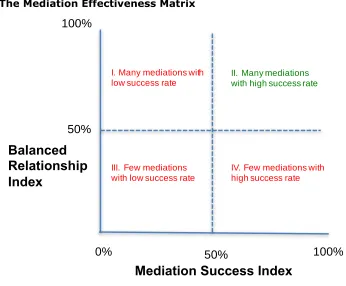
[image:21.595.126.472.389.675.2]In presenting the mediation matrix visualization tool in this note, some target performances are suggested for each of the indicators (balance index and success index) to serve as “high/low” minimum performance dividing lines. These targets are not arbitrary, but rather should reflect what is realistically possible in mediation systems today. As systems improve, policymakers may choose to set more ambitious targets. When viewed in graphic form, these dividing lines comprise a matrix with four performance quadrants. Considering the current low use of mediation and being conservative, we suggest that an effective mediation model should be positioned in the second quadrant with at least 50 mediations for every 100 court proceedings and at the same time a success rate of at least 50% of mediated cases. The visualization is set out in the figure below:
Figure 1: The Mediation Effectiveness Matrix
The matrix provides a useful visual tool for understanding mediation performance. The “X” axis represents the Mediation Success Index, while the “Y” axis sets out the Balanced Relationship Index of Mediations to Court Cases. The matrix thus generates four performance quadrants:
Mediation Success Index
Balanced
Relationship
Index
100%
50%
100%
0%
IV. Few mediations with high success rate III. Few mediations
with low success rate I. Many mediations with low success rate
II. Many mediations with high success rate
Quadrant I: Many mediations with low success rate. This quadrant visually represents the main concerns about full mandatory mediation systems. The concern is that mandatory systems may seek to generate high numbers of mediations through compulsion without sufficient attention being paid to providing effective, high-quality services, and without filtering to avoid mediating inappropriate cases. This may be the result when the focus is purely on increasing the number of mediated cases without investing in quality control. In addition, systems that fall into this category may indeed not be adequately balancing mediation with access to justice.
Quadrant II: Many mediations with high success rate. This quadrant represents peak performance: a high number of mediations, a large percentage of which is successful. High scores in this quadrant can be expected to go hand in hand with a noticeable decrease of cases in court, relieving the court system of unnecessary caseloads. In an ideal jurisdiction, the two indexes should be above 100% (more than one mediation for each case in court) with a conservative average success rate above 50%.
Quadrant III: Few mediations with low success rate. Performance in this quadrant represents the lowest effectiveness. Low numbers of mediations suggest low levels of awareness among parties, while low success rates suggest very low capacity to deliver effective services. In these systems, we would expect to see that there has been very little investment in the mediation infrastructure on either the supply or the demand side.
Quadrant IV: Few mediations with high success rate. This is a typical result of a completely voluntary mediation system or an “opt-in” system, which achieves a high mediation success rate—above 70%—but with a very low number of mediations. The 2014 “rebooting” study of the European Parliament unveiled a surprising, disappointingly low number of mediations in the EU Member States as compared with cases in court: mediations did not even reach 1%. We can conclude from the findings of the “rebooting’’ study that, in the absence of public policy measures to strongly encourage or require parties to at least attempt mediation, low numbers of mediations will result. Furthermore, they are essentially spontaneous mediations, which statistically have high success rates owing to the high level of engagement of voluntary participants and their confidence in the success of mediation.
3.2. Applying the Indexes to New Cases, Pending Cases and Different
Types of Disputes
There are currently no comprehensive, comparable data on mediations, either domestic or cross-border, for the European Union as whole. Additionally, almost no Member State has an official count of mediations; as a result, it is difficult to obtain reliable data on the impact of mediation in the EU. However, as part of the 2014 “rebooting’’ study, a total of 816 EU experts responded to a questionnaire, in which respondents were asked to estimate the number of mediations in their country. The estimates provided by the respondents (which were in fact rather consistent) were averaged for each Member State, with results varying greatly across the EU. In 2014, only four countries – Germany, Italy, The Netherlands and United Kingdom – reported more than 10,000 mediation cases per year. The majority of the Member States reported less than 500 cases per year.
implementation, is of great concern. Only Italy has consistently registered high numbers of mediations, close to 200,000 in recent years.
As a step towards developing effective use of mediation models, the authors of this briefing note present below the application of the indexes described in the preceding paragraphs in three Member States. National policymakers, legislators and experts in the ADR field may wish to consider this approach as a practical method of measuring the effectiveness of mediation models, with the ultimate goal of achieving the balanced relationship mentioned in Article 1 of the 2008 Mediation Directive.
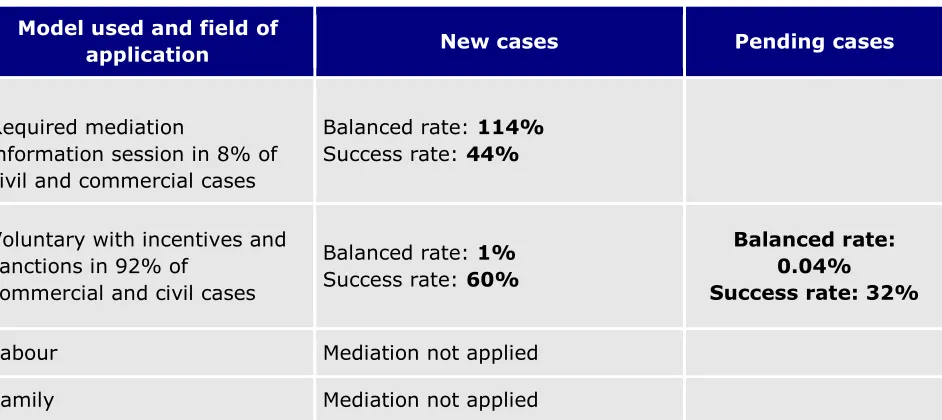
[image:23.595.74.545.287.497.2]Italy: As noted above, Italy is adopting two models at the same time in commercial and civil cases: the required initial mediation model in 8% of the cases, and the voluntary mediation model with incentives and sanctions in the remaining 92% of the cases. No specific mediation requirement was introduced in labour and family disputes.
Table 4: Italian Example
Model used and field of
application New cases Pending cases
Required mediation
information session in 8% of civil and commercial cases
Balanced rate: 114% Success rate: 44%
Voluntary with incentives and sanctions in 92% of
commercial and civil cases
Balanced rate: 1% Success rate: 60%
Balanced rate: 0.04% Success rate: 32%
Labour Mediation not applied
Family Mediation not applied
In 2015, the total of the new civil and commercial cases filed in first instance courts was 1,748,384,13 where 8% of these new cases filed (139,870 cases) are subject to the required
attempt to mediate and the remaining 92% (1,608,513 cases) are subject to voluntary mediation. In 2015, there were 196,24714 mediations, 81.6% due to the required attempt
(160,137 required mediations) with an average success rate of 44% and 8.3% voluntary mediations (16,288 voluntary mediations) with an average success rate of 60%. Thus, the balance rate in new disputes where it is required to attempt mediation is 114% (160,137 mediations/139,870 cases) while the balance rate in the cases where mediation is voluntary is 1% (16,288/1,608,513). In cases already pending in courts in 2015 when mediation is first attempted, the balance rate is even lower, at 0.04%: 18,062 mediation referrals against some 4,500,000 pending cases in courts, and a success rate of 32%.
13 From slide 14 of a presentation of the Minister of Justice, Mr. Andrea Orlando https://www.giustizia.it/giustizia/protected/1214925/0/def/ref/NOL1214730/
14 From slide 2 and 3 of a presentation of the Statistical Department of the Italian Minister of Justice
Figure 2: The Mediation Effectiveness Matrix applied to the two Mediation Models adopted in Italy for civil and commercial cases
The figure above gives a clear illustration of the extremely different results of two mediation models in place in the same jurisdiction with the same citizens, same companies, same lawyers, same mediators and when the same mediation rules are in play. It is evident that almost all EU Member States are placed in quadrant IV, as we will briefly illustrate with the following examples in Romania and Greece.
Romania:15 Romania has currently adopted a voluntary mediation model with incentives and
sanctions, following a legislation model based on mandatory information sessions for the plaintiff, with a related sanction of case inadmissibility, which was found unconstitutional by the Romanian Constitutional Court in 2014.16 The only statistics relating to the number of
cases that were mediated in relation with the courts system can be found in the reports of the Superior Council of the Judiciary on the “State of Justice”.17 The 2013 report was the
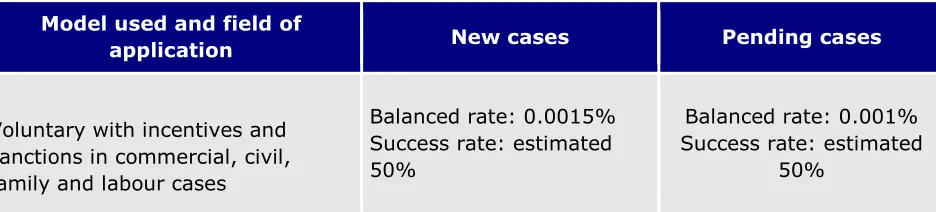
latest report that actually looked into this, finding a total of 1,749 civil, labour and family cases that were settled by means of mediation. Considering an estimated overall 50% settlement rate,18 there were 3,498 cases being mediated in 2013 in relation to a judicial
system that processed 2,266,090 new cases of a pending total of 3,337,426 cases. Interestingly, the Romanian Mediation Council, established by law in 2006, has not yet developed a statistics mechanism relating to the use of mediation, success rates and user satisfaction.
15 This section was completed by Constantin Adi Gavrila, General Manager of Craiova Mediation Center, established as a pilot mediation centre by the Romanian Minister of Justice’s Order no. 1391/C/2003
16 See Romanian Constitutional Court’s Decision no 266/2014
17 See Romanian Council of Magistracy, “2013 State of Justice Report”, http://www.csm1909.ro/csm/linkuri/08_05_2014__67235_ro.pdf
18 This is our estimate; it could have been between 25% and 75%
Mediation Success Index
Balance
Relationship
Index
100%
50%
100%
0% 50%
◼
Italy with the Required Mediation Attempt Model (114% - 44%)◼
Italy with the Voluntary Mediation Model with Inc. & Sanct. (1% - 60%)I
II
Table 5: Romanian Example
Model used and field of
application New cases Pending cases
Voluntary with incentives and sanctions in commercial, civil, family and labour cases
Balanced rate: 0.0015% Success rate: estimated 50%
Balanced rate: 0.001% Success rate: estimated
50%
Greece:19 Greece has adopted a voluntary mediation model with incentives only, but no
sanctions. It is quite well known that the Greek judicial system suffers from a backlog problem20, which, apart from the inconvenience caused to citizens, also has broader financial
consequences. According to data from the World Bank21, Greek courts take an average of
1,580 days or 52.7 months to reach a final ruling in a case. This places Greece in the 155th
position in the world among countries as regards the length of trials. At the same time, the practice of mediation is extremely weak despite the fact that apart from law 3898/2010, which transposed the EU Directive into the Greek legal system, the choice to opt for a mediation process was later included in the latest amendment of the Civil Procedural Code - but once again, on a purely voluntary basis.
There is no official statistical record or system that gives a clear view of the number of mediations conducted on a yearly basis other than some sporadic data coming from the Registries of the Regional Courts of First Instance, where mediation agreements are filed upon successful conclusion22. A rough estimate of the cases mediated in Greece for 2016 would not exceed the total number of 100 mediations for the year 2015 (judicial mediations included).
According to the 2016 EU Justice Scoreboard23, which gives a comparative overview of the efficiency of Member States’ justice systems for 2015, Greece is second to last with an average of 6.2 new cases / 100 habitants for incoming civil and commercial cases24.
19 This section was drafted by Dr. Elena Koltsaki, Co-Founder of the Greek Mediation Institute, Member of the Mediators’ Accreditation Committee of the Greek Ministry of Justice.
20 Data from the MoJ project an increase in the pending cases in the peace courts (for the period from 2012 to 2015) reaching 73.35% in Athens courts and 83.87% in the rest of the country.
21 http://www.worldbank.org/en/about/annual-report
22 Αccording to the statistical data in the Court of First Instance in Athens and with regard to judicial mediation, which was introduced in May 2012, there were 31 cases in 2012 (14 settled); 94 cases in 2013 (42 settled); 82 cases in 2014 (35 settled); 63 cases in 2015 (35 settled); and just a handful of cases in 2016 owing to the prolonged strike of lawyers. Settlement rates therefore give an estimate of 50%. Based on unofficial statistical data, the number of settlement agreements reached through voluntary (private – not judicial) mediation and filed by the court were 4 in 2013, 14 in 2014 and 25 in 2015.
23 http://ec.europa.eu/justice/effective-justice/files/justice_scoreboard_2016_en.pdf
Table 6: Greek Example
Model used and field of
application New cases Pending cases
Voluntary with incentives and sanctions in commercial and civil cases (labour and family included)
Balanced rate: 0.0014 Success rate: 50%
Balanced rate: N/A Success rate: N/A
3.3. Conclusions
In order to measure the effectiveness of different mediation models, both the number of mediations in relation to the number of cases in court and the total success rate must be considered. With the proposed methodology, the aim of the authors is to both measure and visualize – in a scientific and statistically sound manner – how far most Member States are from achieving the balanced relationship between mediation and court proceedings and, at the same time, provide a methodology for mediation researchers when more data is available.
4.
EIGHT YEARS AFTER THE MEDIATION DIRECTIVE
KEY FINDINGS
•
The 2008 Directive was instrumental in fostering the “ADR movement” in Europe.•
Member States have not implemented the Directive in a homogeneous manner, adopting different models and regulatory frameworks.•
Not all Member States have implemented the Directive in cross-border family and labour matters, even in cases where the rights are at the parties’ disposal.•
Despite the lack of consistent statistics, in the five years of implementation of the Directive several best practices (together with ineffective ones) have clearly emerged.•
After eight years, the 2008 Directive seems to have exhausted its capacity to foster the use of mediation and to have a continuing impact on national legislations.Mediation relieves overburdened courts and enhances citizens’ access to justice by helping them resolve disputes without the enormous costs and prolonged trials and appeals that characterise court procedures. It has also been shown that the savings across the EU for increasing numbers of mediations would be significant, in the tens of billions of euros every year.25
There is no doubt that the 2008 Mediation Directive has been a key milestone in the European mediation movement. There is also no doubt, however, that the key goals of the Directive remain far from being achieved. Indeed, the intention behind the Directive was to encourage more people and businesses to use mediation and to establish a balanced relationship between mediation and judicial proceedings. Eight and half years after the Directive, as all available statistics confirm, mediation is on average still used in less than 1% of the cases in court.
The “rebooting” study, conducted in 2014, showed that ensuring quality, confidentiality and enforceability in mediation are necessary but not sufficient conditions. These legal features are in any case already in the Directive and need no revision. The legal mechanism capable of increasing the number of mediations is also already in the Directive, but so far most Member States have not used it: it is Article 5(2), allowing national legislation to require the use of mediation, provided that the right of the parties to access the judicial system is preserved.
The Member State that has made greater use of Article 5(2) today is Italy, where 8% of all civil cases must go through mediation first. That means over 200,000 mediations per year, or 20 times more mediations than any other country in the EU.
Six years ago, the Court of Justice of the European Union clarified how to make the mediation requirement compatible with the right of access to the judicial system.26 According to the
CJEU, the process must be non-binding and fast, it must suspend the statute of limitations and be inexpensive. The Court further wrote that mediation efforts not only can, but should be required for a dispute resolution system to be efficient.
25 Eurochambres, based on the survey data of the 2014 study on “Rebooting’’ the Mediation Directive, estimated potential savings in the 15-40 billion Euros range, per year. See: http://www.eurochambres. eu/custom /Position _Paper_B2B_mediation_2014_V1.0_2-2014-00240-01.pdf
In light of all this, it is surprising that some people still appear to consider a required mediation effort to be in conflict with Article 47 of the Charter of Fundamental Rights. This mistaken view appears to be losing supporters, however, as a growing number of countries now require some efforts at mediation before litigation begins. In fact, a recent study conducted for the Commission recommends the introduction of “an obligatory preliminary court procedure whereby a mediator assesses whether the dispute could be better dealt with in the context of mediation rather than judicial proceedings” (Study for an evaluation and implementation of Directive 2008/52/EC – the ‘Mediation Directive’).27 This recommendation
is worthy of endorsement because it correctly distinguishes between the perfectly legitimate obligation of the parties to meet with the mediator, in order to assess the suitability of mediation, and any obligation to settle the dispute through mediation, which would be a legal monstrosity.
The recommendation also suggests that the assessment as to whether or not mediation can resolve a particular case is best done together by the parties and their mediator. It should not be carried out by somebody else, in the context of a separate and generic “mediation information session”, to be possibly followed by the actual mediation.
In essence, this mediation model represents a “mediated solution” between two competing principles: on the one hand, the absolute freedom of the parties to decide whether or not to settle a case and, on the other hand, the demonstrated necessity to require a concrete mediation effort, which is nonetheless inexpensive in terms of time and money. Some argue that introducing any kind of mediation requirement will generate opposition from the legal profession. Five years ago, for example, lawyers in Italy went on strike against that requirement. Today, virtually nobody there challenges it.28 In fact, less than two months ago,
the Italian Bar Association devoted its national congress to alternative dispute resolution and, in the final motions, formally asked the Italian Parliament to further incentivize and strengthen mediation.
There is no guarantee that the same U-turn will happen in other Member States, once mediation will be required and, as a result, practiced on a larger scale. Still, Italy is not the first country where lawyers have gone from being at first the strongest opponents, to later among the strongest supporters of mediation.
This leads to the issue of the absence of a “culture of mediation” in the EU. A large number of people argue that this is the key reason why mediation is not being used enough. Consequently, they recommend greater investments in awareness and education as the key solution to generate more mediations.
Obviously, beneficial behaviours, such as mediating more legal disputes, should be publicly promoted and incentivized. The main issue, however, is whether promotion and incentives are enough, and how fast they can produce tangible results. Certain behaviours are so important that, when promotion and incentives prove not to accomplish results, the legislator has the power – actually, the duty – to require those behaviours. To illustrate further, nobody
27 Available at
http://bookshop.europa.eu/en/study-for-an-evaluation-and-implementation-of-directive-2008-52-ec-the-mediation-directive--pbDS0114825/. The study was updated in 2016 and the updated study is available at
http://bookshop.europa.eu/sl/study-for-an-evaluation-and-implementation-of-directive-2008-52-ec-the-mediation-directive--pbDS0216335/.
would imagine that public campaigns for health, safety and education, for example, would be enough to prevent the majority of people from smoking in public places, or would make them use seatbelts in cars, or send their children to school or get them vaccinated.
For people in a dispute, the decision as to whether or not to mediate is a very difficult one. Among other disciplines, neuroscience has recently contributed to our better understanding of why humans tend not to make smart decisions when involved in a dispute. An important factor to consider here is that litigants in the EU pay on average only 24% of the court budget costs through their tax and court fees.29 The balance, 76%, is paid by those who do not go
to court. The majority of the people have the right to require that the minority use judicial resources smartly.
A useful illustration of the relationship between mediation culture and mediation legislation comes from Italy. As noted, almost 200,000 disputes are mediated there every year. Still, 81.6% of those come from cases where the law requires mediation (such as in banking and insurance disputes, for example). Voluntary mediations account for only 8.3% of the cases. Nevertheless, the same citizens, same companies, same lawyers, same mediators and the same mediation rules are in play. With time, the practice of mediation will support the culture of amicable settlement of disputes – not the opposite. However, the culture of mediation will still have to be started, and be sustained, by effective mediation legislation.
5.
CONCLUSIONS AND RECOMMENDATIONS
There is no doubt that the Mediation Directive has brought about significant changes in the European Union and has encouraged the debate on alternative dispute resolution; however, there is also no doubt that the fundamental goals of the Directive are far from being achieved. It has been shown many times that the current regulatory elements have no impact on the numbers of mediation, resulting in only one country even coming close to a balanced relationship – and yet still only representing 8% of cases.
The authors propose that the Mediation Directive needs to be changed, not because it is flawed in any way, but because it has exhausted its ability to bring about change. The Directive, while promoting significant progress in creating a functional environment for mediation, has not enabled Member States to achieve a balanced relationship as required by Article 1.
There appear to be two main options to reach a balanced relationship between mediation and judicial proceedings.
•
The first and most effective of these options would be to strengthen Article 5(2) of the Directive by requiring, not just allowing to require, the parties to go through an initial mediation session with a mediator before a dispute can be filed with the courts in all new civil and commercial cases, including certain family and labour disputes where the parties’ rights are fully disposable. This has been shown to have a significant impact in achieving a balanced relationship between mediation and judicial proceedings. The CJEU’s Alassini30 case establishes clear guidelines for requiredelements in ADR at the EU level.
A proposed rewrite of article 5(2) could read as follows:
“Member States shall ensure that a mediation session is integrated into the judicial process for civil and commercial cases, except for such cases as Member States shall determine are not suitable for mediation. The minimum requirements for such a mediation session are that the parties must meet together with a mediator, subject to the condition that the procedure shall be non-binding and swift, suspend the period for time-barring of claims, and be free of charge or of limited cost if any party decides to opt out at the initial session.”
•
As an alternative, the EU should press all Member States to use the current version of Article 5(2) to a greater extent.In particular, in its implementation resolution, the Parliament should consider asking that the Commission send a letter to each EU Government asking them (a) to measure the balanced relationship using the indexes proposed in this briefing note and (b) to explore the reasons for the failure to achieve the balanced relationship, which is the objective of the Mediation Directive.
Failure to respond and to achieve the balanced relationship could lead to the evaluation of an infraction procedure for failing to comply with the Directive.
In December 2014, Commissioner Jourová defined as “impressive” the results of the Parliament’s “rebooting’’ study.31 In particular, she focused on the striking difference, in
average cost and time, between mediation and litigation. Further in-depth economic research would show that achieving a balanced relationship between mediation and court proceedings might save billions of euros and millions of days from unnecessary litigation, every year. The proposals presented in this briefing note appear to be in line with those of the experts’ report submitted to the Commission. This apparent consensus, and the extraordinary potential of requiring reasonable efforts at mediation, require the EU institutions to act on these recommendations, and to make the Member States act. If they do so, one year from now, perhaps in this very venue, the EU could start counting, and celebrating, the social and financial benefits of a greater use of mediation.
REFERENCES
•
Canetta, E. and Kaltsouni, S. (2016) Study for an evaluation and implementation of Directive 2008/52/EC – the ‘Mediation Directive, European Commission.•
De Palo, G., Trevor, M. et al (2014) “Rebooting’’ the Mediation Directive: Assessing the Limited Impact of its Implementation and Proposing Measures to Increase the Number of Mediations in the EU, available athttp://www.europarl.europa.eu/RegData/etudes/etudes/join/2014/493042/IPOL-JURI_ET(2014)493042_EN.pdf.
•
European Commission (2016), Report from the Commission to the European Parliament, the Council and the European Economic and Social Committee on the Application of Directive 2008/52/EC of the European Parliament and of the Council on Certain Aspects of Mediation in Civil and Commercial Matters, Brussels.The Relationship between Formal and
Informal Justice: the Courts and
Alternative Dispute Resolution (ADR)
The Rt. Hon Sir
Geoffrey VOS
Chancellor of the High Court, England & Wales
IN-DEPTH ANALYSIS
Abstract
CONTENTS
INTRODUCTION
1.
THE EXISTING EU INSTRUMENTS
2.
TYPES OF DISPUTE RESOLUTION
3.
THE THINKING BEHIND THIS PROJECT
3.1.
The risk that persons will be denied an independent judicial determination
3.2.
The risk that persons will settle their disputes without having first had
access to independent legal advice
3.3.
The risk that decision-makers or mediators in processes are inadequately
qualified
3.4.
The risk that individual parties have an inadequate understanding of the
available methods of dispute resolution
3.5.
Risks of the ombudsman process and of decision-making by an unidentified
online decision-maker
3.6.
The risk that mediation is under-used, because of its voluntary nature and
an absence of quality assurance
3.7.
The risk of abuses of the power of large governmental or commercial
entities as the opposing party
4.
A PRELIMINARY CONSIDERATION OF THE OUTCOMES THAT THE
PROJECT MIGHT ACHIEVE
INTRODUCTION
A joint project was established in early 2016 between the European Network of Councils for the Judiciary (“ENCJ”) and the European Law Institute (“ELI”) to consider the concerns that have arisen in Europe as a result of the exponential growth of numerous different forms of alternative dispute resolution (“ADR”). Even the terminology is confusing. It includes various types of mediation, early neutral evaluation, arbitration, online dispute resolution (“ODR”), and ombudsman determinations.
The term ADR is used in this paper generically and for simplicity. In some contexts, it will, viewed strictly, be inaccurately used.
This paper focuses on the interface between court-based dispute resolution processes (“DRPs”) and ADR processes. In short:
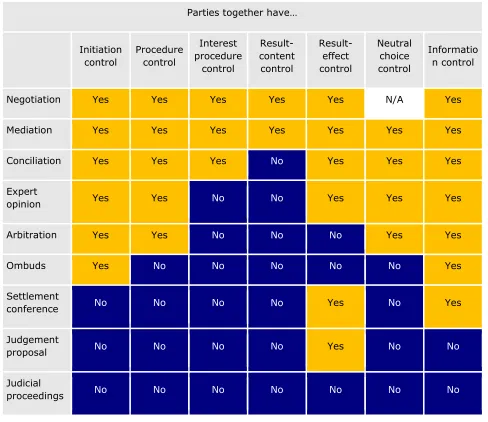
How should courts and judges behave when requiring or recommending ADR?
How should ADR providers behave when requiring or recommending court-based DRPs?
What is the best model or models for DRPs, acknowledging the diversity of solutions adopted across Europe?
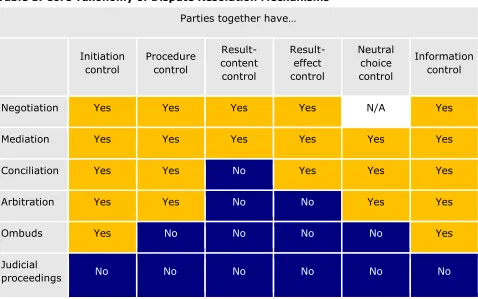
There are currently three EU instruments that address the situation, but none has achieved any meaningful harmonisation of the practices adopted in EU Member States. Moreover, there are concerns about vulnerable parties, whether consumers, ordinary citizens, small businesses, or family litigants, feeling pressured to agree to ADR or to accept mediated solutions without a proper understanding of their legal rights.
The ENCJ/ELI project looks towards three main prospective outcomes:
A statement of European best practice in relation to the approach that courts and judges should adopt in interacting with all types of ADR processes, to include guidelines as to the preliminaries and procedures that should be adopted in referring cases to mediation or other ADR processes, and how risks of injustice can be reduced or eliminated.
A statement of European best practice in relation to the approach that those responsible for all types of ADR processes should adopt in interacting with courts and judges, to include guidelines as to the preliminaries and procedures that should be adopted in referring cases which are the subject of an ADR process to a court, and how risks of injustice can be reduced or eliminated.
Recommendations as to the best European models of ADR processes for different types of disputes that can be developed and applied, and towards which Member States may wish to progress.