Xjenza Online - Journal of The Malta Chamber of Scientists www.xjenza.org
DOI: 10.7423/XJENZA.2016.1.07
Research Article
Dativizable or Non-dativizable: That is the question?
A
syntactic-semantic analysis of English (non)-dativizable constructions in the
production of a set of 2L1 English/Spanish simultaneous bilingual
twins
Silvia S´anchez Calder´on∗1 and Raquel Fern´andez Fuertes1
1University of Valladolid, Plaza Campus Universitario, Valladolid 47011, Spain
Abstract. This paper analyzes the syntactico-semantic factors which trigger Dative shift in English dativizable verbs, i.e. those verbs that allow alternation between double object and prepositional complement construc-tions. It also focuses on non-dativizable verbs that re-strict their subcategorization framework to either double object or prepositional complement constructions. This syntactico-semantic relation between dativizable and non-dativizable structures is addressed in acquisition by ex-amining the incidence for the two verb types in a set of English/Spanish 2L1 bilingual twins. Our results show that the syntactic and semantic features that dativizable and non-dativizables present go hand in hand with the age of first occurrence and the language development of the participants. Hence, dativizable to-dative double object constructions (DOC) are the utterances produced the earliest at the age of 2, as opposed to dativizable to/for-datives and non-dativizable constructions, which begin to emerge at around the age of 3. Finally, our results also suggest that the high adult input frequency explains the twins’ early production of dativizable struc-tures and that, in the same way, the children’s low ex-posure to non-dativizable utterances correlates with the later occurrence in the twins’ spontaneous production. Keywords: dativizable, non-dativizable, DOC, to/for-dative, bilingual acquisition, L1 English
1
Introduction
Over the last few decades, the so-called (non)-dativizable constructions have been broadly studied from different syntactico-semantic perspectives. As illustrated in (1), the verbal subcategorization of these structures can
pro-ject their arguments as double obpro-ject complements (i.e. indirect object (Oi)-noun phrase (NP) along with a dir-ect objdir-ect (Od)-NP), or as an objdir-ect complement fol-lowed by a prepositional object preceded by the prepos-ition to or for, as shown in (2). Despite the fact that dativizable verbs have both verb complementation pos-sibilities, there are some others, as shown in (3), that lack this syntactic alternation (non-dativizable verbs, henceforth).
(1) a. He bought me a beer
(dativizable for-dative double object) b. They offered her
some food
(dativizable to-dative double object)
(2) a. He bought a beer for me
(dativizable for-dative)
b. They offered some food to her
(dativizableto-dative) (3) a. He told me that
story
(non-dativizable double object) b. The teacher
ex-plained it to his stu-dents
(non-dativizable to-dative)
c. I thanked her for her help
(non-dativizable for-dative)
sub-categorization framework, as either DOCs or preposi-tional structures, they lack a dativizable counterpart.
In view of the potential argument alternation or dat-ive shift of some verbs, semanticists have also posed some issues concerning the meaning that dativizable and non-dativizable constructions convey. Some lin-guists claim that there is no difference in the meaning when verbs allow argument alternative choices (Aoun & Audrey Li, 1989; Hale & Keyser, 2002; Krifka, 2003; Levin, 1993; Oehrle, 1976; Pinker, Lebeaux & Frost, 1987; Pylkk¨anen, 2002) unlike others who ar-gue that there are semantic distinctions between dativiz-able DOCs and dativizdativiz-able prepositional constructions (Green, 1974; Krifka, 2003; Greenbaum, Leech, Svartvik & Quirk, 1985).
Taking these syntactico-semantic issues into account, the aim of this study is to disentangle the syntactic and semantic dichotomies that exist in the literature of Eng-lish dativizable and non-dativizable constructions by looking at their production in spontaneous speech. The participants of this research are a set of English/Spanish simultaneous bilingual twins, Simon and Leo. As men-tioned above, only one of the L1s of these children is examined, namely, English.
This paper is organized as follows: section 2 reviews previous works both from the side of linguistic the-ory discussing the factors governing the syntax and se-mantics of these constructions, as well as those from the point of view of the acquisition of dativizable and non-dativizable constructions. Section 3 includes the hypotheses that guide this study. Data selection and classification criteria are presented in section 4. The data analysis is developed in section 5 on the basis of the following variables: (a) age, (b) MLUw, and (c) in-put. Section 6 presents the conclusions and points to directions for further work.
2
Theoretical background and previous
acquisition studies
2.1 Syntactic approach to (non)-dativizable constructions
The so-called dativizable constructions have led to a di-chotomy as far as their syntactic derivation is concerned. Some linguists (Aoun & Audrey Li, 1989; Snyder & Stromswold, 1997) claim that dativizable double object constructions are the basic structure from which dativiz-ableto/for-datives derive. Alternatively, there are those who argue that dativizable DOCs are syntactically gen-erated fromto/for-dative structures (M. C. Baker, 1997; Chomsky, 1955; Larson, 1988, 1990).
Regardless of the semantic principle of Uniformity of Theta Assignment Hypothesis (M. C. Baker, 1988, UTAH,) which states that “identical thematic relations between items are represented by identical structural
re-lations between these items at D(eep)-structure”, the un-derlying symmetry of thematic roles between dativiz-able DOCs and dativizdativiz-able to/for-datives is not dis-played in their S(urface)-structure. According to Larson (1988),to/for-dative constructions are the basic dativiz-able constructions from which dativizdativiz-ableto/for-dative DOCs derive. The verbal head in dativizable to/for-datives subcategorizes for a prepositional phrase (PP), headed by the preposition to or for. As illustrated in (4), the verbal headofferedtriggers head-to-head move-ment and rises to the specifier of the higher V’ in order to meet Case and theta requirements, leading to what Larson terms the non-shifted version. In turn, Larson claims that dativizable DOCs derive from dativizable to/for-datives in a passive-like process, shaping, what he terms, the shifted version. More specifically, and as shown in (5), the prepositionto, which is a case assigner in the non-shifted version in (4), absorbs its case be-ing assigned to its prepositional complementher. This absorption of Case triggers NP-movement ofher to the specifier of the lower VP. Similarly, the verbal head rises into the specifier of the higher V’ in order to assign Case and theta role to its adjacent argumenther. Due to this verbal movement, the Od in the non-shifted version is caseless; hence, it reduces its argument position to a non-thematic adjunct position, analogous to passive by-phrases, as depicted in (5).
(5) They offered her some food (dativizable DOC)
Alternatively, it has been argued that dativizable to/for-datives are derived from dativizable DOCs by a passive-like process, where, as opposed to the pre-vious argument, the Oi occupies an adjunct position via NP-movement (Aoun & Audrey Li, 1989; Snyder & Stromswold, 1997). Hence, example (4) derives from (5). In fact, as will be discussed in section 2.3, Snyder and Stromswold (1997) argue that the lexical item to is the factor delaying the acquisition of dativizable to-dative constructions.
Unlike dativizable verbs whose arguments can be projected as double object complements or as ob-jects followed by prepositional complement construc-tions headed by the lexical itemto/for, non-dativizable DOCs and non-dativizable prepositional verbs do not have the syntactic strength to trigger dative shift. As illustrated in (6a), the non-dativizable verbexplain can only subcategorize to-dative complements, hence the ungrammaticality of (6b).
(6) a. The teacher ex-plained it to his stu-dents
(non-dativizable to-dative)
b. *The teacher ex-plained his students it
(ungrammatical non-dativizableto-dative)
Larson (1990) accounts for the argument restrictions of non-dativizableto-dative verbs as the impossibility of the oblique preposition to undergo case marking.
Con-sequently, unlike his argument concerning the derivation of dativizable DOCs (Larson, 1988), the absorption of the prepositionto in prepositional non-dativizables via a passive-like process would violate the recoverability of deletion or Dative shift.
Furthermore, the syntactic alternation of non-dativizable constructions is mainly restricted in the lex-icon. Thus, verbs of Latin origin, as exemplified in (8) with the verbdonate, can only take an [NPto-NP] com-plement. Furthermore, this factor that prevents the al-ternation of non-dativizable structures is also linked to verbal semantics. In particular, only morphologically native verbs, as illustrated in (7), are capable of trigger-ing dative shift (Mazurkewich & White, 1984; Green, 1974; Oehrle, 1976).
(7) a. He gave me $50 (DOC dativizable nat-ive verb)
b. He gave $50 to me (to-dative dativizable native verb)
(8) a. He donated $50 to me
(non-dativizable to-dative Latinate verb)
b. *He donated me $50
(ungrammatical non-dativizable DOC, Lat-inate verb)
2.2 Semantic approach to ditransitive construc-tions
Regarding semantic factors in (non)-dativizable ditransitive constructions, different studies have pointed out that there are divergences in meaning between both structures (Aoun & Audrey Li, 1989; Hale & Keyser, 2002; Krifka, 2003; Levin, 1993; Oehrle, 1976; Pinker et al., 1987; Pylkk¨anen, 2002). These denotative differ-ences, as will be shown below, do not go hand in hand with the syntactic derivation of both structures argued in section 2.1. Nevertheless, there are arguments that point to a common underlying semantic ground between dativizable and non-dativizable constructions (Green, 1974; Krifka, 2003; Greenbaum et al., 1985).
(9) a. They offered her some food (dativizable DOC) b. Casual agent possessor/goal possessum/theme thematic roles
c. ‘X causes Y (to HAVE) Z’ semantic structure
It should be noted that the possession transfer rela-tionship in dativizable DOCs does not infer that the Oi ends up possessing the Od (Aoun & Audrey Li, 1989; Hale & Keyser, 2002; Krifka, 2003; Levin, 1993; Oehrle, 1976; Pinker et al., 1987; Pylkk¨anen, 2002). As illus-trated in (10), the causal agent I sends a letter toBill but we cannot guarantee thatBillwill receive it. Thus, even though dativizable DOCs imply a possession rela-tion, the fact that the possessor ends up possessing the theme is not always accomplished.
(10) I sent Bill that letter (but he never got it)
On the other hand, dativizable to/for-dative con-structions are claimed to denote literal or metaphor-ical motion towards a goal (for example, they express a mental movement as in the verbsshow ortell). In other words, they suggest a cause-GO/cause-GOAL relation between the cause/patient and the path/goal them-atic roles. As exemplified in (11), the causal agent they caused the cause/patient some food to go to the path/goalher.
(11) a. They offered some food to her (dativizable DOC)
b. Casual agent cause/patient path/goal thematic roles
c. ‘X causes Y (to GO to) Z’ semantic structure
There are also arguments that point to a common underlying semantic ground between dativizable struc-tures (Bruening, n.d.; Green, 1974; Krifka, 2003; Rap-paport Hovav & Levin, 2008; Greenbaum et al., 1985). Hence, dativizable DOCs and dativizableto/for-dative constructions are equally regarded as verbs of transfer of possession (cause-HAVE relation) and verbs of motion (cause-GO/cause-GOAL). As depicted in (12), where John givesMary a book, a twofold explanation can be given: (a) the book is moved from John’s possession into Mary’s possession (transfer of possession meaning, taking into account dativizable DOCs as the basic se-mantics) or, (b) possession of the book was transferred from John to Mary (cause-Go/cause-Goal relation, tak-ing into account dativizable to/for-datives as the se-mantic referential point).
(12) a. John gave Mary a book b. John gave a book to Mary
Non-dativizable semantic restrictions are correl-ated with their corresponding dativizable counterparts (Comrie, Malchukov & Martin H., 2010; Oehrle, 1976). More specifically, non-dativizable DOCs are rooted in the absence of motion along some path in the same way as non-dativizableto/for-dative constructions lack a transfer of possession meaning. As can be seen in (13), the causal agentJohncauses the patient theta roleMax to metaphorically possessa kick (path/goal).
(13) a. John gave Max a kick (non-dativizable DOC)
b. Causal agent cause/patient path/goal thematic roles
Thus, the compositional semantics of the verbal phrase (VP) in non-dativizable DOCs is not compat-ible with the direction/path feature encoded in dativiz-ableto/for-dative constructions. In other words, the ex-ample in (14) cannot be understood, according to Mal-chukov and Oehrle’s principles, as John’s causing a kick to go to Max; thus its ungrammaticality.
(14) *John gave a kick to Max
(ungrammatical non-dativizable DOC)
2.3 Previous studies on the acquisition of (non)-dativizable constructions
A small number of studies have been carried out in order to examine the order of acquisition of dativiz-able structures. Gropen, Pinker, Hollander, Goldberg and Wilson (1989) analyzed the spontaneous speech of 5 L1 English children in the Brown corpus in CHILDES (MacWhinney, 2000, Child Language Data Exchange System,). They found out that children start pro-ducing dativizable DOCs and dativizable prepositional constructions simultaneously in the second year, with neither structure subsequently uttered after the other. However, Snyder and Stromswold (1997) replicated Gropen et al.’s study including more participants and proposed that dativizable DOCs and dativizable to-datives depend on two parametric properties: property A allows the grammar to produce dativizable DOCs as opposed to dativizable to-datives which merge the property of dativizable DOCs with another property, termed by Snyder and Stromswold as property B. Tak-ing these observations into account, they implemented a study of the data from L1 English children to ana-lyze the correlation in the acquisition of both struc-ture types. Their results showed that dativizable DOCs are crucially acquired before dativizable to-datives as indicated by a sign test (p = .00098) and a t test (t(11) = 4.15, p = .002). However, this order effect in acquisition did not correlate with the children’s input.
The acquisition of the dative alternation has also been correlated with the presence or the lack of negative evid-ence of these structures in the child’s input (C. L. Baker, 1979; Gropen et al., 1989). In particular, C. L. Baker (1979) claims that children are conservative in their pro-ductions since their output will be affected by the input they have received. Hence, non-dativizable construc-tions like those in (15a) will be generalized as dativiz-able structures (see example (15b)) because the child has heard non-dativizable utterances less frequently in his/her input. In other words, children are not aware of non-dativizable verbal constraints in their emerging lan-guage development since children apply them to verbs that do not allow dative shift in the adult grammar (Mazurkewich & White, 1984).
(15) a. I donated a book to the library
(non-dativizable to-dative) b. *I donated the
lib-rary a book
(ungrammatical non-dativizable DOC)
Viau (2007) carried out a study dealing with the se-mantics of dativizable structures in L1 English acquis-ition. He attempted to demonstrate that dativizable DOCs denote transfer of possession by analyzing the correlation in acquisition between dativizable DOCs and have (the verb of possession par excellence), between prepositional constructions and the verbgo(the verb of motion par excellence) and between dativizable DOCs and dativizable prepositional constructions and causat-ive verbs. His results showed that dativizable DOCs convey transfer of possession since they are concurrently acquired with the verbhave, in the same way as dativiz-able prepositional constructions denote motion shown in the correlation in acquisition with the verb go. In turn, dativizable DOCs and dativizable prepositional constructions display a correlation in acquisition with causative verbs. Despite the latter results, dativizable prepositional structures were acquired later than da-tivizable DOCs.
It should be noted that there is not much research on the acquisition of non-dativizable constructions. Thus, further investigations should be carried out in order to fill the gap of studies that deal with this type of con-structions.
3
Hypotheses
Taking into account these previous studies on the lin-guistic description of the structures under analysis, as well as those on their acquisition, the following possible scenarios might be postulated in the acquisition data of (non)-dativizable constructions:
• Hypothesis 1: If dativizable to/for-datives are transformationally derived from dativizable DOCs via a passive-like process, then dativizable to/for-datives are expected to be acquired later than da-tivizable DOCs.
• Hypothesis 2: If, on the contrary, dativizable DOCs are transformationally derived from dativiz-ableto/for-datives via a passive-like process, then dativizable to/for-dative are expected to be pro-duced earlier than dativizable DOCs.
ob-ject dativizable constructions as they are able to trigger dative shift resulting in DOCs.
• Hypothesis 4: If dativizable to/for-dative con-structions require a lexical item to/forin order to meet semantic motion requirements (cause-GO), then it is expected that children acquire them at a later stage, as opposed to dativizable DOCs, which, in contrast, do not require an additional constituent to accomplish the semantic attribution of transfer of possession (cause-HAVE).
• Hypothesis 5: If semantics plays a role, despite restrictions in the subcategorization framework of non-dativizable constructions, a correlation in ac-quisition is expected between those constructions that share a semantic analogy, i.e., between da-tivizable and non-dada-tivizable DOCs, as they have a cause-HAVE relation, and between dativizable and non-dativizable to/for-datives, as they imply a cause-GO relation.
• Hypothesis 6: If non-dativizable constructions are subject to syntactic and semantic constraints, then a later acquisition is expected for non-dativizable constructions as opposed to dativiz-able structures, which do not offer any limitations in their subcategorization framework or in their semantics.
• Hypothesis 7: If input is taken into account, the order of acquisition will correlate with the fre-quency with which a child is exposed to (non)-dativizable constructions.
Thus, the acquisition data, which revolve around the above-mentioned hypotheses, aim at shedding some light on the actual analysis of (non)-dativizable struc-tures. That is, the results of this study will reflect how acquisition data can explain the syntactic and semantic properties of those constructions.
4
Methodology
4.1 Data selection
In order to provide an answer regarding the relat-ive order of production of English dativizable and non-dativizable DOCs and non-dativizable and non-non-dativizable to/for-dative constructions, we have extracted child data from the FerFulice corpus available in the CHILDES project (MacWhinney, 2000, Child Language Data Exchange System,). More specifically, we have conducted our study by analyzing the production of a set of Spanish/English simultaneous bilingual twins, who were born and raised in a Spanish geographical background. Parents address children using the one-parent one-language strategy (Melanie, the mother, en-gages in conversations with the children in English as she is an English native speaker, whereas the father, Ivo, addresses them in Spanish as he is a Spanish
nat-ive speaker) (Fern´andez Fuertes & Liceras, 2010, more information on the children’s background as well as on the data collection process appears in). It should be noted that the analysis of this study has focused on the spontaneous production of English (non)-dativizable ut-terances so that only one of the L1s of these children is analyzed, i.e. English. The age range that covers this longitudinal corpus ranges from 1.0 to 6.5 years old and for this study the corpus has been analyzed in its en-tirety.
The search for both dativizable and non-dativizable ditransitive instances has been manually done by taking into account the following patterns of subcategorization: (a) S+V+NP+NP (for (non)-dativizable DOCs) and (b) S+V+NP+to/for-NP (for (non)-dativizable to/for-dative constructions). We have implemented the same process for the twins and for the child-directed speech (to analyze the adult input).
4.2 Data classification
Data have been classified regarding the type of par-ticipant, the children’s age and the Mean Length of Utterance measured in words (Brown, 1973, MLUw;). Besides, concerning the type of construction, we have considered those structures which trigger Dative shift (i.e. dativizable structures), classifying them as those verbs which subcategorize for an Od along with a for-dative PP and, which are dativizable as DOCs, as shown in (16). Similarly, we have also taken into account da-tivizable constructions which allow for ato-dative PP in their subcategorization framework, and which, in turn, trigger Dative shift of their arguments as dativizable DOCs, as depicted in (17).
(16) a. He bought a house for me
(dativizable for-dative)
b. He bought me a house
(dativizable for-dative DOC)
(17) a. He gave a present to me
(dativizable to-dative)
b. He gave me a present
(dativizableto-dative DOC)
(18) a. I have something for you
(non-dativizable for-dative)
b. He said that to the mice
(non-dativizable to-dative) (19) They called her Snow
White
(non-dativizable DOC)
In our data classification, we have discarded the fol-lowing cases: (a) utterances whose to/for-PP denotes a locative or temporal meaning, as in (20) and (21), respectively, (b) passive idiomatic expressions such as those in (22), since they are fixed expressions that lack an active counterpart, (c) DOCs which are para-phrazable as one single verb, as in (23), where the con-stituentgive it a try can be paraphrased asto try since they have a monotransitive nature, (d) for-PPs with a proxy meaning, i.e., those constructions where the pre-position for is paraphrazable as in exchange for, such as those in (24) since the PP lacks a recipient connota-tion, (e) those constructions which do not show a ca-nonical SVOO or SVO+to/for-PP order, as in example (25), which illustrates a non-canonical word order DOC whose wh-Od has undergone wh-movement for syntactic reasons; (f) ditransitive structures which subcategorize afrom-PP, such as those in (26). These structures have been discarded since the PP denotes a source meaning, contrary to the recipient theta role patterns that (non)-dativizable prepositional constructions present in their PP.
(20) *SIM: he drives her to the car (21) *MEL: who came for your birthday? (22) *LEO: I am used to it
(23) *MEL: give it a try
(24) *MEL: you traded the plane for the little blue pistol
(25) *MEL: what did he tell you?
(26) *EMM: you learn that from mommy, don’t you?
5
Results and Discussion
In order to analyze the relative order of acquisition between dativizable and non-dativizable constructions, we have taken into account three variables, as follows: (a) age of production, (b) language development as measured in terms of MLUw, and (c) the effect of adult input.
5.1 Age of onset of production
This section discusses three different analyses: (a) the age of onset production that the participants display regarding dativizableto/for-dative constructions as op-posed to dativizable DOCs, (b) the results obtained concerning the first occurrence of non-dativizable
struc-tures, and (c) it offers comparative findings between structures that trigger dative shift (i.e., dativizable ut-terances) and non-dativizable constructions.
It should be highlighted that in order to determine the age of onset of production, we have taken into account the first clear use of dativizable and non-dativizable con-structions.
5.1.1 Age of onset of production: dativizable constructions
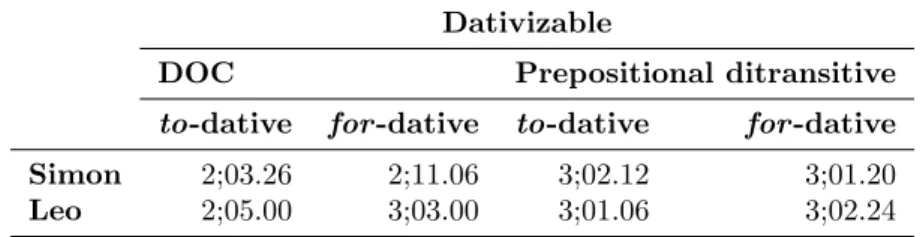
As illustrated in Table 1, Simon and Leo start produ-cing dativizableto-dative DOCs at around 2 years old. In particular, Simon begins to utter them at 2;03.26 as opposed to Leo, whose first constructions appear one month later, that is to say, at 2;05.00.
Examples in (27) show Simon’s and Leo’s first utter-ances, both produced with the verbgive, the ditransitive verb par excellence. Notice also that the twins have not realized the head of the D(eterminer) P(hrase) encoded in the Od.
(27) a. *SIM: Give me tv (Simon, 2;03.26) b. *LEO: Give me farmer (Leo, 2;05.00) By focusing on the first occurrences of dativizable DOCs which trigger for-dative shift, Simon and Leo, and particularly the latter participant, present a diver-gent age of acquisition. They start producing dativiz-ablefor-dative DOCs at 2;11.06 and 3;03, respectively, with a four month difference between them. Examples (28a) and (28b) illustrate the twin’s early production of prepositional ditransitives headed by the preposition for.
(28) a. *SIM: do you make me a cake?
(Simon, 2;11.06) b. *LEO: who brought me
this?
(Leo, 3;03.00)
(29) a. *SIM: to make the honey just for me
(Simon, 3;01.20) b. *LEO: take it and
the baby for you
(Leo, 3;02.24) (30) a. *SIM: we bought
that to you
(Simon, 3;02.12) b. *LEO: give it to the
zoo
(Leo, 3;01.06)
When focusing on the age of early utterance of da-tivizable to-dative and dativizable for-dative preposi-tional constructions, our findings show that their age of onset production is at around the age of 3. Des-pite the fact that Simon and Leo start uttering dativiz-able prepositional structures at around the same age, they show different ages of onset for each construction. As illustrated in (30a), Simon’s early dativizable for -dative prepositional ditransitives are initially uttered at 3;01.20, preceding his first production of dativizable to-dative prepositional constructions at 3;02.12, as illus-trated in (31a). Alternatively, Leo shows a reverse or-der of acquisition between dativizableto/for-dative pre-positional utterances since he starts producing dativiz-ableto-dative prepositional constructions at 3;01.06, as exemplified in (31b), one month earlier than his early utterance of dativizable for-dative at 3;02.24, as can be seen in (30b). Thus, the production of dativizable to/for-datives goes hand in hand as syntactic analogous prepositional constituents, confirming our H3, as will be discussed in section 6.
(31) a. *SIM: do you make me a cake?
(Simon, 2;11.06) b. *SIM: give me tv (Simon, 2;05.00)
In particular, Simon’s early production of dativizable to/for-dative DOCs, as illustrated in (29a), repeated as (31a) and (27a) repeated as (31b), respectively, has been observed at around the age of 2, one year earlier than his onset production of non-dativizable DOC at 3;05.12 (example in (32)). It is worth standing out that Simon’s early production of dativizablefor-dative DOCs is found one year later than the utterance of his early dativizable to-dative DOC, as discussed in section 5.1.2.
(32) *SIM: we call them blue
(Simon, 3;05.12)
However, Leo’s production of dativizable for-dative DOCs and dativizableto-dative DOCs shows a different time frame since he starts uttering the former construc-tions at 3;03 (as shown in (28b), repeated below as (33a), one year later than his first occurrence of to-dative DOC at 2;05 (as illustrated in (27b), repeated below as (33b)). (33) a. *LEO: who brought me this? (Leo, 3;03)
b. *LEO: give me farmer (Leo, 2;05) All in all, and as illustrated in Table 1, dativizable to/for-dative DOCs are the dativizable structures pro-duced the earliest by the twins at the age of 2, preceded by the first occurrence of dativizable prepositional ut-terances, displayed at the age of 3.
Table 1: Age of onset production of dativizable constructions.
Dativizable
DOC Prepositional ditransitive
to-dative for-dative to-dative for-dative
Simon 2;03.26 2;11.06 3;02.12 3;01.20
Leo 2;05.00 3;03.00 3;01.06 3;02.24
5.1.2 Age of onset of production: non-dativizable constructions
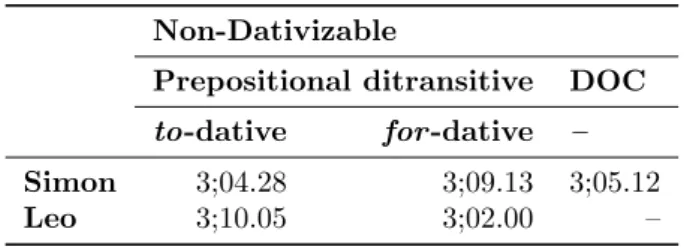
As illustrated in Table 2, non-dativizable construc-tions, regardless of their type, begin to be produced at the age of 3. Thus, the age of onset production of dativizable prepositional ditransitives correlates with the early production of non-dativizables. Nevertheless, for the twins non-dativizable prepositional ditransitives
struc-tures at 3;02.00, eight months earlier than his first non-dativizable to-dative construction (i.e., at 3;10.05). As displayed in Table 2, there has not been any utterance found concerning non-dativizable DOCs across Leo’s corpus.
Table 2: Age of onset production of non-dativizable construc-tions
Non-Dativizable
Prepositional ditransitive DOC
to-dative for-dative –
Simon 3;04.28 3;09.13 3;05.12
Leo 3;10.05 3;02.00 –
Despite the fact that dativizable prepositional ditransitives and non-dativizables start being uttered at around the age of 3 (compare Tables 1 and 2), Si-mon and Leo display subtle differences in their order of first production. As example (34) shows, dativizable for-dative utterances are the first prepositional ditrans-itives produced by Simon at 3;01.20, as opposed to Leo, who starts uttering dativizable to-dative constructions at 3;02.24, as illustrated in (35).
(34) *SIM: to make the honey just for me
(dativizable for-dative; Simon, 3;01.20)
(35) *LEO: give it to the zoo
(dativizable to-dative; Leo, 3;01.06)
Likewise, non-dativizable constructions reflect differ-ences in the twins’ order of first occurrence. Thus, as exemplified in (36), Simon begins to produce non-dativizable to-datives at 3;04.28, preceding the age of onset production of dativizable DOCs and non-dativizable for-datives, as can be seen in (32), repeated here as (37) and (38), respectively.
(36) *SIM: why is the cat saying that to the mice
(non-dativizable to-dative; Simon, 3;04.28)
(37) *SIM: we call them blue
(non-dativizable DOC; Simon 3;05.12) (38) *SIM: I want one for
myself
(non-dativizable for-dative; Simon, 3;09.13)
On the contrary, as exemplified in (39), non-dativizablefor-dative constructions start being uttered by Leo at 3;02.00, preceding the first production of non-dativizableto-datives at 3;10.05, as shown in (40).
(39) *LEO: thank you for my playdough
(non-dativizable for-dative; Leo, 3;02.00) (40) *LEO: you have
some-thing to the toad
(non-dativizable to-dative; Leo, 3;10.05)
As shown in Table 2, non-dativizable DOCs are not reflected in Leo’s data, hence comparative results cannot take place regarding these structures in the twins.
In view of the above-mentioned results, dativiz-able constructions (i.e. prepositional ditransitives and DOCs) are produced earlier than constructions which do not trigger dative shift (i.e. non-dativizables). More specifically, the relative order of early occurrence of both structures in Simon and Leo is illustrated in (41a) and (41b), respectively.
(41) a. Dativizable to-dative DOC > dativiz-ablefor-dative DOC>dativizablefor-dative > dativizable to-dative > non-dativizable to-dative > non-dativizable DOC > non-dativizablefor-dative
(Simon’s relative order of first production of (non)-dativizableto/for-datives)
b. Dativizable to-dative DOC > dativizable to-dative > non-dativizable for-dative > da-tivizable for-dative > dativizable for-dative DOC>non-dativizableto-dative
(Leo’s relative order of first production of (non)-dativizableto/for-datives)
5.2 Language development
The Mean Length Utterance measured in words (MLUw) has also been used in this study, along with the chronological age, in order to address the twins’ language development in correspondence with their pro-duction of (non)-dativizable constructions.
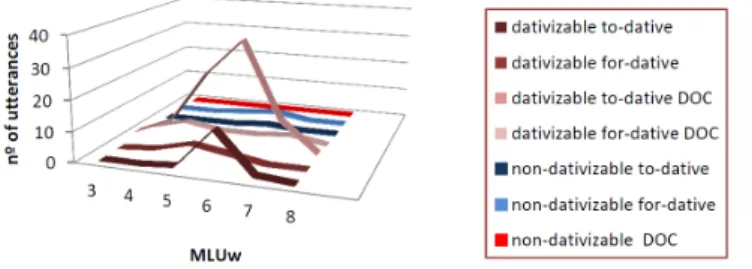
As depicted in Figure 1, Simon’s first utterances start being developed with an MLU of 3 words, where he produces dativizable to-dative DOCs. In fact, as the MLUw of these constructions rises, the production of dativizable to-dative DOCs increases, being his most productive stage with MLUw of 4 and 5. Furthermore, although in a less prolific production, Simon also begins to utter dativizable for-dative DOCs and dativizable to/for-datives. Regarding Simon’s linguistic develop-ment of non-dativizable constructions, our results show that even though the number of occurrences of non-dativizableto/for-datives are not significantly product-ive, Simon starts producing them with an MLUw of 4. Moreover, as illustrated in Figure 1, no non-dativizable constructions appear in Simon’s production.
Figure 1: Simon’s MLUw of (non)-dativizable constructions.
As shown in Figure 2, Leo starts developing dativiz-ableto-dative DOCs which with an MLUw of 3, display-ing a correlation with Simon’s finddisplay-ings (see Figure 1). Unlike Simon, Leo begins to produce dativizable for -dative DOCs and dativizableto-datives with an MLUw of 4 and dativizable for-datives arise in Leo with an MLUw of 5.
Figure 2: Leo’s MLUw of (non)-dativizable constructions.
It must be also noted that Leo has productively uttered non-dativizable to and for constructions with an MLUw of 5 and 6, respectively. Nevertheless, the number of utterances of these two types of ditransitives is not highly productive.
Overall, and similar to the results found in Simon’s production, there was a lack of occurrences regarding non-dativizable constructions in Leo’s data.
Therefore, Simon and Leo correlate in the early pro-duction of dativizable to-dative DOCs with an MLUw of 3. Similarly, the twins show a concurrent lack of productivity in their data concerning non-dativizable DOCs. Despite these correlative results, the early oc-currences of dativizable for-dative DOCs, dativizable to/for-datives, non-dativizable to/for-datives and non-dativizable DOCs have shown differences in the twins’ production from the point of view of the MLUw (com-pare Figures 1 and 2).
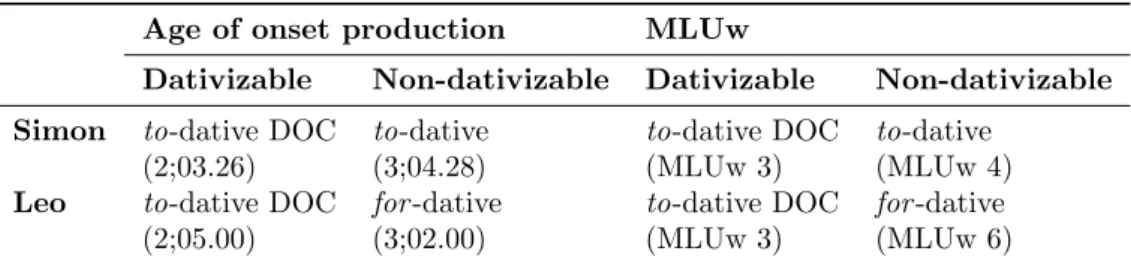
Table 3 summarizes the linguistic development in both children taking into account the variables of the age of onset production and the MLUw.
Table 3: Simon and Leo’s language development of (non)-dativizable utterances
Age of onset production MLUw
Dativizable Non-dativizable Dativizable Non-dativizable
Simon to-dative DOC to-dative to-dative DOC to-dative
(2;03.26) (3;04.28) (MLUw 3) (MLUw 4)
Leo to-dative DOC for-dative to-dative DOC for-dative
(2;05.00) (3;02.00) (MLUw 3) (MLUw 6)
Conversely, our results cannot correlate the twins’ age of first production and their language development as far as the production of non-dativizable constructions is concerned. Simon starts producing non-dativizable to-dative utterances with an MLUw of 4, whereas Leo be-gins to utter non-dativizablefor-datives with an MLUw of 6. Furthermore, this lack of correlation goes hand in hand with the type of non-dativizable structure pro-duced the earliest. Thus, even though the syntactic status of the PP is shared in the first occurrences of non-dativizable constructions in the twins, the age of produc-tion and the MLUw differ between the participants.
Therefore, the MLUw only differs from the age of acquisition in the production of non-dativizable struc-tures. Conversely, the first production of dativizable structures (i.e. dativizable to-dative DOCs) has dis-played a correlation between the age of onset production and the MLUw.
5.3 The effect of input
The twin’s input frequency could determine the twins’ relative order in the production of (non)-dativizable constructions. In other words, child-directed speech could shape the children’s output. A total of 1233 (non)-dativizable occurrences have been analyzed in the adults’ speech as opposed to 102 and 110 (non)-dativizable utterances in Simon’s and Leo’s data, re-spectively.
As illustrated in Figure 3, the high input frequency shown in the production of dativizableto-dative DOCs by the adults (48.26% out of the total of (non)-dativizable utterances) is projected in the twins’ high output of these structures (that is to say, 54.9% in Si-mon and 70.0% in Leo). Regarding Leo’s production of dativizable to-dative DOCs, we observe that, com-pared to the adult input frequency, he shows a higher frequency in the production of these structures.
Figure 3: Children’s (non)-dativizable utterances and their in-put.
In turn, Simon and Leo also display a correlation between the relatively high adult input of dativizable to-dative constructions (i.e. 16.95%) that they receive and their relatively high output (i.e. 17.65% in Simon and 17.27% in Leo). Similarly, the low adult frequency that the twins receive regarding dativizable for-dative DOCs and dativizable for-datives goes hand in hand with the twins’ low or null incidence of these structures. More specifically, 7.38% occurrences are observed in the adults’ production of dativizable for-datives in corres-pondence to 1.05% and 6.36% in Simon’s and Leo’s out-put, respectively. Similarly, in correlation to the low adult input frequency of dativizable for-dative DOCs (i.e. 8.84%), Simon and Leo display 0.65% and 3.64% structures, respectively.
As far as the output of non-dativizable construc-tions is concerned, we can point out that low adult input frequency observed in these structures correl-ates with the children’s low output. In fact, the low rate being observed in the adult input regarding non-dativizableto-datives (4.46%) and non-dativizable for-datives (4.87%) corresponds with the twins’ low and null incidence in their output (i.e. Simon has dis-played 2.94% and 0.98% occurrences of non-dativizable to-datives and non-dativizablefor-datives, respectively, as opposed to Leo, who shows a rate of 0.98% occur-rences for non-dativizableto-datives and a rate of 1.82% utterances of non-dativizablefor-datives).
6
Conclusion
This paper presents the differences that English da-tivizable and non-dada-tivizable constructions display in the production of English/Spanish simultaneous bilin-gual children. Our results indicate that Simon and Leo show a tendency toward uttering dativizable to-dative DOCs at an earlier stage. In particular, Simon starts producing them at 2;03.26, two months earlier than Leo, who generates his early dativizable to-dative DOC at 2;05.00.
However, there are divergences in the twins’ first oc-currence of dativizable prepositional production in com-parison with their early utterance of dativizable DOCs (both to and for dative DOCs) (see Table 1 in section 5.1.1). On the one hand, Simon starts uttering dativiz-ableto/for-dative DOCs at around the age of 2, one year earlier than dativizableto/for-datives. Simon’s findings confirm hypothesis 1 in that the later production of da-tivizable to/for-datives suggests that these structures could be transformationally derived from dativizable to/for-dative DOCs via a passive-like process (Aoun & Audrey Li, 1989; Snyder & Stromswold, 1997). On the other hand, Leo’s production of dativizableto/for -datives arises earlier than dativizable to-dative DOCs. However, the delay in Leo’s production of dativizable for-dative DOCs at 3;03.00 in relation to the first oc-currence of dativizable to-dative DOCs at 2;05.00 and dativizable to/for-datives (at 3;01.06 and 3;02.24, re-spectively) illustrates contradictory results with Simon’s data. In other words, Leo’s results suggest that dativiz-able to/for-dative constructions are derived from da-tivizableto-dative DOCs via NP-movement, supporting hypothesis 1, as well. Nevertheless, Leo’s correlation in the production of dativizable to/for-datives and da-tivizable for-dative DOCs at around the age of 3 in-fers that dativizable for-dative DOCs and dativizable to/for-datives are derived from dativizable to-dative DOCs via a passive-like process. Hence, due to the dif-ferences observed in the twins, further research is re-quired to investigate the syntactic derivation of dativiz-ablefor-dative DOCs.
Furthermore, our findings have displayed a correla-tion in the first produccorrela-tion of dativizableto/for-datives at the age of 3 (see Tables 1 and 2). Despite the fact that previous works have considered to-PPs andfor-PPs as having an argument and an adjunct status respectively (M. C. Baker, 1997; Chomsky, 1955; Hudson, 1997; Lar-son, 1988, 1990), our results confirm our hypothesis 3 in that both PPs are regarded as a syntactic block of prepositional object constructions.
Taking into account the semantic status of dativizable utterances, Simon and Leo’s later production of dativiz-ableto/for-datives at around the age of 3 as opposed to their earlier utterance of dativizableto-dative DOCs at
around the age of 2 confirms hypothesis 4 in that the delay in generating dativizable prepositional construc-tions may go hand in hand with the requirement of an additional constituent (mainly, the lexical itemto/for) in order to meet semantic motion requirements (cause-GO). However, Leo’s first occurrence of dativizable for-dative DOCs cannot support hypothesis 4, as opposed to Simon’s data, because Leo starts uttering cause-HAVE structures headed by the preposition for (i.e., dativiz-ablefor-dative DOCs) at around the age of 3, showing a correlation with his early production of dativizable to/for-datives (or cause-GO structures). Hence, despite Leo’s performance of dativizable for-dative DOCs, we can observe that, as shown in the results confirmed in hypothesis 1 and 4, the later production of dativizable to/for-datives could determine that they are syntactic-ally derived structures from dativizable to/for-dative DOCs and along with their intrinsic semantic condi-tions.
Likewise, semantics plays a role in the first occur-rence of dativizable and non-dativizable constructions that share a semantic analogy. We have observed in our results a correlation between the early production of da-tivizable and non-dada-tivizable to/for-datives at around the age of 3, which confirms our hypothesis 5. Thus, we can claim that (non)-dativizableto/for-datives are con-sidered as a semantic block, implying a cause-GO rela-tion. On the other hand, the differences observed in the age of first production between (non)-dativizable to/for-dative DOCs suggests that non-dativizable DOCs can-not be treated as a semantic block as of constructions which denote a cause-HAVE relation. However, because of Leo’s absence of evidence of non-dativizable DOCs in his production, it leads to inconclusive results regarding the semantic categorization of (non)-dativizable DOC structures.
Moreover, we cannot firmly assert that non-dativizable constructions are produced later than da-tivizable structures since the twins have displayed dif-ferences in their production. In particular, only Simon’s data can confirm hypothesis 6 in that he starts utter-ing dativizables earlier than non-dativizables. However, Leo cannot support this hypothesis because the produc-tion of his first non-dativizablefor-dative is found earlier than his first production of the two types of dativizable constructions, mainly, dativizable for-datives and da-tivizablefor-dative DOCs.
to/for-datives, dativizable for-dative DOCs and non-dativizables reflects their low productivity in their out-put.
All in all, this study of the first occurrence of (non)-dativizable constructions suggests that (non)-dativizable to-dative DOCs are the dativizable utterances produced the earliest. They start being uttered by Simon and Leo at around the age 2 with an MLUw of 3. In turn, adult input also correlates with the variables of age of onset and language development; hence, the twins’ high exposure to dativizable structures along with the twins’ low input frequency of non-dativizable constructions can also explain their output.
The analysis of a broader selection of corpora (both English/Spanish bilingual and monolingual data) is, therefore, necessary so that more standing conclusions can be drawn. Moreover, constructions which are gen-erated by the same syntactic process as dativizable con-structions (e.g. passives and DOCs) need further re-search from the point of view of acquisition.
Acknowledgements
Preliminary data were presented at the Linguistics Circle hold at the University of Malta on July 3rd 2015. We thank Marie Alexander, Albert Gatt, Ray Fabri, Natalie Schembri, Lonneke van der Plas for all their valuable comments. We thank Jimmy Moran for the data classification procedure. Financial support was provided by the Castile and Le´on Regional Government (Spain), ORDEN EDU/1083/2013, 27 December, co-funded by the European Social Funding and the Uni-versity of Valladolid (Spain).
References
Aoun, J. & Audrey Li, Y.-h. (1989). Scope and Con-stituency. Source: Linguistic Inquiry, 20(2), 141– 172.
Baker, C. L. (1979). Syntactic Theory and the Projec-tion Problem.Linguistic Inquiry,10(4), 533–581. Baker, M. C. (1988).Incorporation: A Theory of
Gram-matical Function Changing. London: The Univer-sity of Chicago Press.
Baker, M. C. (1997). Thematic Roles and Syntactic Structure. In Elements of Grammar (pp. 73–137). Dordrecht: Kluwer.
Brown, R. (1973). A first language: The early stages. London: George Allen & Unwin.
Bruening, B. (n.d.). Double Object Constructions and Prepositional Dative Constructions are Distinct: A Reply to Ormazabal and Romero. Pre-publication draft accessed 10/07/2015 at http : / / udel . edu /
∼{}bruening/Downloads/RDativeRevisited3.pdf.
Chomsky, N. (1955).The Logical Structure of Linguistic Theory.
Comrie, B., Malchukov, A. & Martin H. (2010). Ditrans-itive Constructions: A Typological Overview. In Studies in Ditransitive Constructions: A Comparat-ive Handbook(pp. 1–65). Berlin: Walter de Gruyter. Fern´andez Fuertes, R. & Liceras, J. M. (2010). Cop-ula omission in the English developing grammar of English/Spanish bilingual children.International Journal of Bilingual Education and Bilingualism, 13(5), 525–551.
Green, G. M. (1974).Semantics and Syntactic regular-ity. Bloomington: Indiana University Press. Greenbaum, S., Leech, G., Svartvik, J. & Quirk, R.
(1985).A Comprehensive Grammar of the English Language. Great Britain: Longman.
Gropen, J., Pinker, S., Hollander, M., Goldberg, R. & Wilson, R. (1989). The Learnability and Acquisi-tion of the Dative AlternaAcquisi-tion in English.Language, 65(2), 203–257.
Hale, K. & Keyser, S. J. (2002).Prolegomenon to a The-ory of Argument Structure. Cambridge, Massachu-setts: MIT Press.
Hudson, R. (1997). Double Objects: Grammatical Rela-tions and Proto-Roles. InUCL Working Papers in Linguistics (pp. 331–368). London: University Col-lege London.
Krifka, M. (2003). Semantic and Pragmatic Conditions for the Dative Alternation.Korean Journal of Eng-lish Language and Linguistics,4, 1–32.
Larson, R. (1988). On the Double Object Construction. Linguistic inquiry, 19(3), 335–391.
Larson, R. (1990). Double Object Revisited: Reply to Jackendoff.Linguistic Inquiry,21(4), 589–632. Levin, B. (1993).English Verb Classes and Alternations:
A Preliminary Investigation. Chicago & London: The University of Chicago Press.
MacWhinney, B. (2000). The CHILDES Project: Tools for Analyzing Talk (3rd). Mahwah, NJ: Lawrence Erlbaum Associates.
Mazurkewich, I. & White, L. (1984). The acquisition of the dative alternation: Unlearning overgeneraliza-tions.Cognition, 16(3), 261–283.
Oehrle, R. T. (1976). The Grammatical Status of the English Dative Alternation (Doctoral dissertation, MIT).
Pinker, S., Lebeaux, D. S. & Frost, L. A. (1987). Pro-ductivity and constraints in the acquisition of the passive.Cognition,26(3), 195–267.
Pylkk¨anen, L. (2002).Introducing Arguments (Doctoral dissertation, MIT).
Snyder, W. & Stromswold, K. (1997). The Structure and Acquisition of English Dative Constructions. Linguistic Inquiry,28(2), 281–317.