of oil and grease in palm oil refinery effluents
Bayron Agualimpia, José Vicente Otero,
German Zafra
Grupo de Investigación en Ciencias Básicas y Aplicadas para la Sostenibilidad, CIBAS, Facultad de Ciencias Exactas, Físicas y Naturales, Universidad de Santander UDES Campus Lagos del Cacique, Calle 70 No. 55-210, Bucaramanga, Santander, 680003, Colombia [email protected]
ABSTRACT The use of novel mixed microbial consortia composed of native yeast and bacteria was evaluated for the treat-ment of palm oil mill effluents (POME) from an oil refining process. For this purpose, 31 native yeast and bacteria isolates demonstrating the ability to remove fats, oils and greases were evaluated, either as single organisms or mixed inocula, for the treatment of POMEs. Molecular and biochemical characterizations revealed that iso -lates corresponded to Candida, Bacillus and Pseudomonas genera. Seven mixed inocula, containing the 6 most degrading isolates, were established and tested for the removal of palm oil in liquid culture, achieving 68 to 84 % removal after 48 h. The inoculum constituted by all of the isolates produced the best results with an over -all COD reduction from 1840 to 260 mg/L (84 %), evidencing a synergic effect of the microorganisms. The use of the same inoculum for the treatment of a palm oil mill effluent led to a removal of 75 % organic matter and 72 % oil and grease after 48 h. Our results demonstrated the ability of these isolates to use palm oil as sole car -bon source and effectively decrease the concentration of pollutants in palm oil mill effluents in a short period of time. The use of these microorganisms may provide adaptive advantages that could improve POME remediation processes, especially with mixtures of native bacteria and yeast able to degrade palm oil as sole carbon source.
Keywords: bioremediation, microbial degradation, wastewaters, oil and grease, palm oil mill effluent, native microorganisms
Biotecnología Aplicada 2016;33:1221-1226
RESUMEN
Evaluación de microorganismos nativos para la biodegradación de grasas y aceites en efluentes de la refinación de aceite palma. En este trabajo se evaluaron 31 aislados microbianos nativos con habilidad de re -mover grasas y aceites para el tratamiento de efluentes de la refinación de aceite palma (POMEs), usándolos como organismos simples o consorcios. La caracterización de los microorganismos mostró que éstos correspondían a los géneros Candida, Bacillus y Pseudomonas. El uso de siete inóculos mixtos, conformados por diferentes combinaciones de los seis aislados con mayor actividad degradadora, condujo a una remoción del 68 al 84 % de aceite de palma en medio líquido después de 48 h de tratamiento. El inóculo constituido por todos los aislados produjo los mejores resultados con una reducción de la DBO de 1840 to 260 mg/L (84 %), evidenciándose un efecto sinérgico entre los microorganismos. El uso del mismo inóculo para el tratamiento de POMEs llevó a una remoción del 75 % de la materia orgánica y 72 % de grasas y aceites después de 48 h. Nuestros resultados demuestran la habilidad de estos aislados para utilizar aceite de palma como única fuente de carbono y disminuir eficientemente la concentración de contaminantes en los POMEs en un periodo corto de tiempo. El uso de estos microorganismos puede proveer ventajas adaptativas que podrían mejorar el tratamiento de los POMEs, especialmente cuando se usan mezclas de bacterias y levaduras con capacidad degradadora.
Palabras clave: biorremediación, degradación microbiana, aguas residuales, aceites y grasas, efluente de molida de aceite de palma, microorganismos nativos
I
ntroduction
Palm oil has become a major global agricultural prod-uct, which is used for food and non-food applications, the manufacturing of value-added products, and more recently, a promising feedstock for biofuel production [1]. Currently, there are about five million hectares of palm planted in the world, representing 16 million tons of annual production. Colombia is the largest producer of palm oil in the Americas and the fourth largest in the world after Malaysia, Indonesia and Ni-geria [2]. Much of this oil is obtained from the African oil palm (Elaeis guineensis Jacq.) and hybrids with other species as well.
Despite the economic importance of the oil palm industry, it has also contributed to environmen-tal pollution as a consequence of the production of
large amounts of by-products from the oil extrac-tion process. In particular, the palm oil mill effluent (POME), is a thick brownish wastewater generated from palm oil milling activities, which produces large amounts of methane gas from its anaerobic process, and this gas is known to exert over 20 times the Global Warming Potential (GWP) of other gas-ses [3]. Importantly, POME frequently has high amounts of oil and grease (O&G), total suspended solids (TSS), chemical oxygen (COD) and biochemi-cal oxygen demand (BOD) which counts for most of the contaminant effects on watercourses due to their highly polluting properties and acidic nature. The discharge of these effluents into water bodies may produce important effects such as an alteration of
1. Aluyor EO, Obahiagbon KO, Ori-jesu M. Biodegradation of vegetable oils: A review. Sci Res Essays. 2009;4:543-8. 2. USDA. Oilseeds: World markets and trade. Washington, DC: United States Department of Agriculture Foreign Agri
-cultural Service; 2015. p. 38.
3. Choi W-H, Shin C-H, Son S-M, Ghor
-pade PA, Kim J-J, Park J-Y. Anaerobic treatment of palm oil mill effluent using combined high-rate anaerobic reactors. Bioresource Technol. 2013;141:138-44.
pH, or an increase in the BOD and COD. In addition, water contamination could prevent the passage of light and oxygen, negatively affecting the photosyn-thetic processes and generating eutrophication and potentially, toxic compounds [4-6]. Thus, treatment of POME is essential to avoid environmental pollu-tion in water bodies.
An interesting option for the management of POME and other liquid wastes relies on biological treatment, which allows the degradation of the organ-ic contaminants present in effluents, while generating organic sludge that can be later exploited for the pro-duction of compost [7]. Bioaugmentation, or the ad-dition of exogenous bacteria, has been demonstrated to be an efficient method for the reduction of organic pollutants in POME, enhancing the overall degrada-tive performance by adding microorganisms with high degradation ability of specific environmental pollutants [8-10]. Previous studies have shown that bioaugmentation facilitates the degradation of high amounts of grease and other organic contaminants present in effluents via addition of POME-isolated microorganisms demonstrating lipolytic activity isolated from the POME such as aerobic bacteria Pseudomonas spp. and Bacillus spp. or yeasts such as Candida spp. and Yarrowia spp. [11].
While several microbial species with the ability to remediate POME have been identified, there are few studies on the ability of environmental consortia to de-grade these wastewaters, whether through use of using native aerobic microbial enrichments, or constructed consortia consisting of microorganisms isolated from highly polluted wastes. In this study, we focused on the use of mixed microbial consortia composed by yeast and bacteria. The use of this type of uncommon mixed cultures would be beneficial, as POME is com-posed of heterogeneous matrices containing complex combinations of organic compounds, which can be co-metabolically degraded by a community of aerobic or-ganisms belonging to different domain ranks and taxa [12]. Moreover, the use of native microorganisms for the remediation of POMEs would improve the ability of microorganisms to adapt, survive and degrade ef-fluents containing high amounts of organic suspended solids, O&G, COD and BOD. Thus, this study was aimed to isolate native microorganisms with the abil-ity to metabolize O&G and evaluate their potential, either as single organisms or mixed inocula, for the treatment of POME from palm oil refining processes.
M
aterials and methods
Samples from O&G-containing wastes
Solid and liquid wastes (POME) from a grease trap of a palm oil refining process, conducted at C.I Sa-ceites S.A.S. (Santander, Colombia), were used in this study. Waste composite samples of either two liters or two kilograms were obtained using 250 mL Win-kler amber flasks (Witeg, Germany) at different points and depths across the oil trap. Samples were stored at 4 °C until use. A physicochemical characterization was conducted for all POME samples, consisting of the measurement of pH, COD, TSS and O&G content according to EPA methods 150.0, 410.4, 340.2, and ASTM Soxhlet method D5369, respectively.
Isolation and selection of native microorganisms
Microbial isolation from liquid and solid oily wastes was carried out in several successive steps. First, a non-selective pre-enrichment was performed by add-ing 10 g or 10 mL (dependadd-ing on the sample) to 70 mL of Basal Saline Medium (BSM; 3 g/L (NH4)2SO4; 0.9 g/L K2HPO4; 0.6 g/L KH2PO4; 0.2 g/L MgSO4; 0.5 g/L CaCO3; 0.1 g/L yeast extract). Flasks were incubated with constant agitation at 150 rpm at 30 °C until turbidity in the medium was observed. Subsequently, a selective step was performed by diluting 10 mL from the pre-enrichment culture in 90 mL of modified BSM using 0.05 % palm oil as sole carbon source, using the same conditions de-scribed above. For isolation, 1 mL of enrichment culture was streaked onto solid modified BSM and incubated at 30 °C for 96 h. Individual colonies were picked and transferred to new plates of BSM con-taining palm oil as carbon source, and the process repeated. Macroscopic and microscopic morphologic features of colonies were verified, providing a basis for the establishment of pure cultures. Each pure cul-ture (from a single colony) was considered an indi-vidual microbial isolate.
Screening of microbial O&G-degrading potential
The oil-degrading potential of isolated microorgan-isms was assessed by observation of differences in their growth using palm oil as sole carbon source in liquid culture. Each isolate was used to inoculate 2 mL of liquid BSM containing 0.05 % (w/v) palm oil, and incubated at 30 °C and 150 rpm for 48 h. Changes in culture medium such as turbidity increase, color variation and oil disappearance were evaluated quali-tatively. Isolates showing presumable lipolytic activ-ity were identified using API® 20E, API® 20NE and API® 20C AUX systems (Biomerieux, USA) and by PCR amplification and sequencing of the prokaryotic 16S rRNA and eukaryotic ITS1, ITS2 and 5.8S rRNA regions, according to previously reported primers and conditions [13]. BSM tubes without palm oil were in-oculated with each isolate, as well as non-inin-oculated BSM tubes containing 0.05 % oil, were included as controls.
Evaluation of microbial antagonism
To determine if any negative interspecies interaction occurred between isolates, the in vitro evaluation of bacteria to bacteria, yeast to bacteria and yeast to yeast antagonism of isolates showing the highest O&G re-moval ability was carried out in plate assays accord-ing to the disk method described by Bauer et al. [14]. Isolates were grown in 50 mL of liquid BSM medium (containing 20 g/L glucose), at 30 °C with constant agitation at 200 rpm until cultures reached an optical density of 0.14 at 600 nm (comparable to a MacFar-land standard No. 0.5). Subsequently, 100 μL of each culture (approximately 1.5 × 10⁷ c.f.u.) were spread over the surface of BSM2 plates with 1.5 % agar, and 5 mm diameter nitrocellulose discs (Millipore, USA) impregnated with 50 μL of 24-h culture supernatants of the other isolates were placed onto the surface. Plates were incubated at 30 °C and the inhibition
4. Bhumibhamon O, Koprasertsak A, Funthong S. Biotreatment of high fat
and oil wastewater by lipase producing
microorganisms. Kasetsart J (Nat Sci). 2002;36:261-7.
5. Oswal N, Sarma PM, Zinjarde SS, Pant A. Palm oil mill effluent treatment by a tropical marine yeast. Bioresour Technol. 2002;85:35-7.
6. Rupani PF, Singh RP, Ibrahim MH, Esa N. Review of current palm oil mill effluent (POME) treatment methods: vermicom
-posting as a sustainable practice. World Appl Sci J. 2010;11:70-81.
7. Roig A, Cayuela ML, Sánchez-Monede
-ro MA. An overview on olive mill wastes and their valorisation methods. Waste Manage. 2006;26:960-9.
8. Bala DJ, Lalung J, Ismail N. Biodegra
-dation of palm oil mill effluent (POME) by bacterial. Int J Sci Res Pub. 2014;4(3):22-6. 9. Abd El-Gawad HS. Oil and grease
removal from industrial wastewater
us-ing new utility approach. Adv Env Chem. 2014;2014:1-6.
10. Ojonoma O, Udeme I. Bioremediation of palm oil mill efluent (POME) polluted soil
using microorganisms found in organic
wastes. Int J Biotechnol. 2014;3:32-46. 11. Vijayaraghavan K, Ahmad D, Ezani Bin Abdul Aziz M. Aerobic treatment of palm oil mill effluent. J Environ Manage. 2007;82:24-31.
12. Nwoko C, Ogunyemi S. Effect of Palm Oil mill effluent (POME) on microbial
characteristics in a humid tropical soil
under laboratory conditions. Int J Env Sci Dev. 2010;1:308.
13. Zafra G, Absalón AE, Cuevas MC, Cortés-Espinosa DV. Isolation and selection
of a highly tolerant microbial consortium
with potential for PAH biodegradation from heavy crude oil-contaminated soils. Water Air Soil Poll. 2014;225:1826.
halos were measured every 24 h for 2 days. Discs without culture supernatants were used as controls. Assays were performed in triplicate.
Determination of COD
The degradation of O&G was indirectly measured by means of the COD removal, as it allows the quanti-tation of organic matter in liquid samples (including O&G). COD values were determined in triplicate ac-cording to method HACH 8000 [15]. Controls con-sisted of non-inoculated BSM flasks under the same conditions described for the inoculated ones. The in-direct measurement of the degradation was calculated by the equation:
Where CODi was the initial concentration of COD and CODf the final concentration of COD in mg/L. This was corroborated through a standard curve, in which solutions with different palm oil content gave a correction factor of 1.25 (1.25 mg/L palm oil corres-ponded to 1 mg/L COD).
Evaluation of isolates and constructed consortia for O&G removal in liquid culture
The ability of selected isolates to degrade palm oil were tested in BSM tubes containing 2000 mg/L palm oil. For this, 20 mL of 109 c.f.u./mL lag-phase cultures from each isolate were inoculated into glass flasks containing 200 mL BSM plus palm oil and incubated at 27 ± 3 °C with constant aeration. The degrading ability of individual isolates was determined by the decrease in O&G content (measured as COD) during 48 and 72 h with respect to controls. Subsequently, to test for possible synergistic effects between isolates, consortia were constructed using combinations of yeasts and bacteria.
O&G removal from POME by mixed inocula in a batch reactor
To determine the capacity of constructed consortia to degrade O&G in a batch reactor, a mixed inocula demonstrating lipolytic activity was generated using palm oil-degrading bacterial and yeast isolates that exhibited no negative interaction as outlined above. O&G degradation of this consortium was evaluated in a 4-L bioreactor using 3 L of POME from the palm oil refining process. Microbial isolates were grown separately on BSM with 0.05 % (v/v) palm oil, and used to inoculate in the bioreactor at a final concen-tration of 109 c.f.u. each (1:1 ratio) and the volume adjusted to four liters with POME. The process was carried out for 48 h at 27 ± 3 ºC with constant aeration. O&G removal activity was determined by means of the O&G and COD decrease at the end of the process. O&G determinations were performed according to the ASTM Soxhlet method D5369. Assays were carried out in triplicate.
Experimental design and statistical analysis
The experimental consisted of a random 2×2 facto-rial design. Data from COD measurements were analyzed by analysis of variance (ANOVA) followed
by a Bonferroni multiple comparison test with the SPSS Statistics Software version 14 (IBM), consid-ering statistically significant differences those with a p < 0.05.
R
esults and discussion
The isolation of native microorganisms with potential to degrade oily wastes is a key step for providing safer and faster methods for the remediation of effluents from the refinement of palm oil. In this study, we used liquid and solid wastes from palm oil refinement as a reservoir of microorganisms with potential to degrade O&G and other pollutants at high loadings, while evaluating them for the treatment of POME.
Physicochemical characteristics of oily wastes
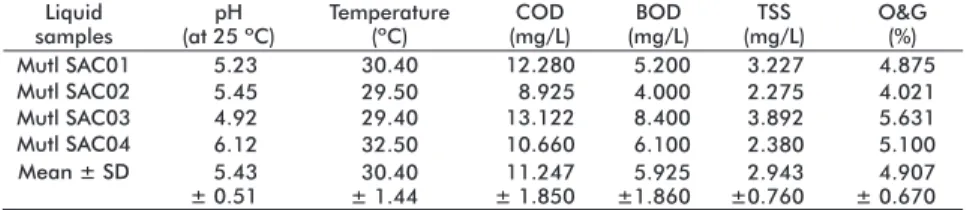
As shown in table 1, POME samples used for mi-crobial isolation showed slightly acidic pH values (5.43 ± 0.51), whereas for solid samples were closer to neutrality (6.20 ± 0.36). TSS, COD and O&G lev-els were variable with mean values of 2943 ± 0.76), 11 247 ± 1.85 and 4907 ± 0.67 mg/L, respectively. These findings are in agreement with previous stud-ies showing low pH values (3.8 to 4.7) and high val-ues for solids (18 000 mg/L), COD (50 000 mg/L) and greases (7000 mg/L) in wastewaters and POMEs from palm oil refining processes [6, 15]. These high levels are thought to be a consequence of the free fatty acids produced during oil treatment, which can vary according to the type of fruit processed, its age and the method employed for oil extraction, whiles gums, proteins and microbial biomass present during the process contribute as well [17]. In practice, this also increases the chances of isolating microorgan-isms able to degrade elevated concentrations of these compounds. That is, the complex nature and high amounts of organic pollutants present in the wastes could favor the adaptation and survival of microor-ganisms with the ability to tolerate and use them as a substrate for its growth [13, 18].
As reported previously, a prior exposure to high concentrations of free fatty acids largely determined the type and number of O&G-degrading organisms found in POMEs, which in turn strongly influenced the degradative ability of the native microorganisms [19].
Isolation and screening of O&G-degrading microorganisms
A total of 31 microbial isolates, corresponding to 17 yeast and 14 bacteria, were obtained from liquid and solid samples based on their ability to use palm oil as sole carbon source in solid medium. Only 11 out of these 31 microbial isolates showed visible
15. HACH. DR/4000 - Procedure oxygen demand, chemical; 2003.
16. Salihu A, Alam Z, AbdulKarim MI, Salleh HM. Suitability of using palm oil mill effluent as a medium for lipase production. Afr J Biotechnol. 2013;10:2044-52. 17. Wu TY, Mohammad AW, Jahim JM, Anuar N. Pollution control technologies for the treatment of palm oil mill effluent (POME) through end-of-pipe processes. J Environ Manage. 2010;91:1467-90. 18. Wu L, Ge G, Wan J. Biodegradation of oil wastewater by free and immobilized
Yarrowia lipolytica W29. J Environ Sci. 2009;21:237-42.
19. Hinga KR, Batchellor A. Waste Pro
-cessing and Detoxification. In: Hassan RM, Scholes R, Ash N, editors. Ecosystems and human well-being: current state and trends: findings of the Condition and Trends Working Group of the Millennium Ecosystem Assessment. Washington, DC: Island Press; 2005. p. 917.
O&G removal (%) = × 100CODf – CODi CODi
Liquid
samples (at 25 ºC)pH Temperature (ºC) O&G (%)
Table 1. Physicochemical characterization of liquid wastes from a grease trap of a palm oil refining process
COD: Chemical oxygen demand. BOD: Biological oxygen demand. TSS: Total suspended solids. O&G: Oil and grease.
5.23
4.92 5.45
6.12 5.43 ± 0.51 Mutl SAC01
Mutl SAC03 Mutl SAC02
Mutl SAC04 Mean ± SD
30.40
29.40 29.50
32.50 30.40 ± 1.44
5.200
8.400
3.227
3.892 4.000
6.100 5.925 ±1.860
2.275
2.380 2.943 ±0.760
4.875
5.631 4.021
5.100 4.907 ± 0.670
COD
(mg/L) (mg/L)BOD (mg/L)TSS 12.280
lipolytic activity evidenced by changes in the tur-bidity, color and a reduction in the palm oil layer present in MBS tubes. Initially, the API biochemical characterization suggested that isolates corresponded to Yarrowia, Candida, Bacillus and Pseudomonas genera. However, molecular characterization of 16S rRNA and ITS1, ITS2 and 5.8S rRNA sequences con-firmed that isolates actually corresponded to Candi-da palmioleophila, Bacillus sp. and Pseudomonas sp. (Table 2).
This group of microorganisms have been pre-viously described to transform and degrade vege-table, animal and mineral O&G, mainly due to the production of lipases and other enzymes capable of completely or partially metabolize these compounds [20]. Fakharedine et al. [21] described the isola-tion of lipolytic strains of Candida wickerhamii and Candida boidinii from wastes derived from olive oil production, and Pseudomonas sp. and Pseudomonas aeruginosa have been also reported as producers of lipases in tributyrin agar [22, 23]. Since POME and other palm oil-derived wastewaters mainly contain fatty substances, organic compounds and proteins, an inoculum composed by Pseudomonas, Bacillus and Candida species could be a good option to enhance the degradation of such wastewaters due to a comple-mentary action of their enzymatic mechanisms and long term survival [24].
In order to evaluate the degradation potential of these microorganisms, we screened their ability to metabolize O&G in liquid medium containing palm oil as carbon source and all of the 11 isolates show-ing lipolytic activity produced a substantial decrease in O&G concentrations in liquid MBS cultures. Five yeast (CL01, CL05, CL08, CL09, CL11) and one bacterial (CB10) isolates promoted more than 50 % O&G removal after 48 h, and the highest after 72 h with (CL11, 79 %; CL08, 78 %; CL05, 77%; CL09, 76 %; CB10, 67 %; CL01, 66 %) (Figure 1), with no significant differences between them. A different be-havior was observed in the case of isolates CL04 (C. palmioleophila) and CB02 (Bacillus sp.), which re-moved O&G in a lower extent achieving only 37 and 49 % removal, respectively, being significantly lower than the other six isolates (p = 0.04 and p = 0.049, respectively).
In general, individual yeast isolates were more effective than individual bacterial isolates for O&G removal, even when the latter grew faster in culture tubes (data not shown). This could indicate a higher activity or secretion of lipases by these Candida iso-lates, even though some Bacillus lipases have been reported to have advantages over yeast lipases, such as the ability to maintain activity over broad tem-perature and pH ranges [25, 26]. There is also the possibility of the secretion of other fungal and bac-terial hydrolytic enzymes useful for the degradation of O&G, such as cellulases, proteases, laccases and catalases [27].
O&G removal in POMEs by mixed inocula
Our results indicated that all of the evaluated isolates were suitable to construct mixed inocula, since an-tagonism tests did not show any inhibitory effects between yeast and bacteria. Additionally, comparison
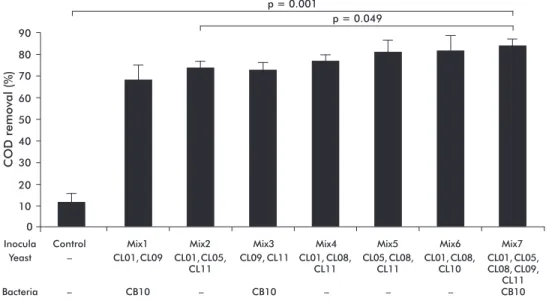
of the growth curves showed that bacterial isolates, particularly Bacillus sp. CB02, presented the highest growth rate in presence of 0.05 % palm oil whereas yeast isolates showed the lowest (data not shown), and it may be possible that the combined activity of these two groups of microorganisms could improve overall degradation. Thus, based on the observed re-sults from the lipolytic screening, growth behavior and the lack of major antagonistic effects, six iso-lates (CL01, CL05, CL08, CL09, CB10 and CL11) showing the best O&G removal results were selected to develop seven different mixed inocula combin-ing bacterial and yeast strains (Figure 2) and one of them included all the six individual isolates showing higher O&G removal rates. O&G removal tests in liquid culture by the seven established mixed inocula
20. Lotti M, Alberghina L. Lipases: Molecu
-lar structure and function. In: Polaina J, MacCabe A, editors. Industrial Enzymes: Springer Netherlands; 2007. p. 263-81. 21. Fakharedine N, Ouadghiri M, Amar M, Winterton P, Hafidi M, Ouhdouch Y. Isolation and identification of a yeast strain involved in the degradation of Marrakech olive mill wastewater. Eurasia J Biosci. 2011;5:127-37.
22. Kiran GS, Shanmughapriya S, Jay
-alakshmi J, Selvin J, Gandhimathi R, Sivaramakrishnan S, et al. Optimization of extracellular psychrophilic alkaline
lipase produced by marine Pseudomo-nas sp. (MSI057). Bioproc Biosyst Eng. 2008;31:483-92.
Figure 1. Oil and grease (O&G) removal expressed as chemical oxygen demand (COD) by single microbial isolates in liquid basal saline medium (3 g/L (NH4)2SO4; 0.9 g/L K2HPO4; 0.6 g/L KH2PO4;
0.2 g/L MgSO4; 0.5 g/L CaCO3; 0.1 g/L yeast extract) medium with 0.05 % palm oil. Isolates CB02
and CB10 correspond to Bacillus sp. isolates, and CB07 to Pseudomonas sp. The other isolates
correspond to Candida palmioleophila. Control: non-inoculated liquid MBS medium plus 0.05 %
palm oil.
Isolate Closest related
microorganism
(DNA sequencing)
Candida palmioleophila
Bacillus sp.
Candida palmioleophila
Candida palmioleophila
Candida palmioleophila
Candida palmioleophila
Candida palmioleophila
Candida palmioleophila
Pseudomonas sp.
Bacillus sp.
Candida palmioleophila
Macroscopic and microscopic characteristics
Table 2. Molecular and biochemical identification and morphological description of
microbial isolates obtained from palm oil-derived wastes showing lipolytic activity
CL01
CL06 CL03
CL08 CB02
CB07 CL04
CL09 CL05
CB10
CL11
White-colored, smooth, irregular margin colonies.
Gram-positive oval budding yeasts
White-colored, elevated, mucoid colonies.
Spore-forming Gram positive rods
Cream-colored, smooth, butyrous , regular margin
colonies. Gram-positive oval budding yeasts White-colored, smooth, irregular colonies.
Gram-positive cylindrical yeast
White to cream-colored, smooth, butyrous, regular margin colonies. Gram-positive oval budding yeasts Cream-colored, smooth colonies. Gram-positive
oval budding yeasts
White-colored, elevated, mucoid colonies.
Gram-negative rods
Cream-colored, elevated, butyrous, irregular
mar-gin colonies. Gram-positive oval budding yeasts White-colored, smooth, regular margin colonies.
Gram-positive oval budding yeasts
White-colored, elevated, mucoid colonies.
Spore-forming Gram positive rods
Cream-colored, elevated, mucoid, irregular margin
colonies. Gram-positive oval budding yeasts
Closest related microorganism
(API® test)
Candida sp.
Bacillus sp.
Yarrowia sp.
Yarrowia sp.
Yarrowia sp.
Yarrowia sp.
Yarrowia sp.
Pseudomonas sp.
Candida sp.
Candida sp.
Bacillus sp.
COD removal (%)
Isolates 0
10 20 30 40 50 60 70 80 90
Control
48 h 72 h
p = 0.001
demonstrated similar degradation levels, ranging from 68 to 84 % after 48 h (Figure 2). No significant differences were observed between Mix5, Mix6 and Mix7 (p = 0.1), but interestingly, the inoculum consti-tuted by six yeast/bacterial isolates (Mix7) produced the best results with an overall COD reduction from 1840 to 260 mg/L (84 %), evidencing a synergistic ef-fect between microorganisms. O&G removal in non-inoculated controls (12 %) was significantly lower (p = 0.001) than inoculated treatments.
As Mix 7 showed the highest degradative rates in flask experiments, and it also included the six isolates producing the best degradation results, the evaluation of O&G removal in POME in a batch reactor was carried out using this mixed inoculum. In addition, previous studies have suggested an additive effect of individual degrading microorganisms in a mixed con-sortia, in which the microorganisms better adapted to the new pollution conditions gradually displaces and replace those organisms less well adapted. Toxic ef-fects of POME are effective in the selection of more adapted strains, and enrichment occurs when micro-organisms are able to use the pollutant as a source of carbon and energy, so having more individual strains in a consortium would increase consortia stability and survival when used in POMEs [28-30].
As observed in table 3, O&G and COD removal was high, reaching a 75 % COD reduction (3588 mg/L removed) and 72 % O&G degradation (809 mg/L) after 48 h. Comparatively, a non-inoculated control showed a COD reduction of 51 % (1600 mg/L) and 50 % O&G degradation (809 mg/L), and thus inoculation with the constructed community described here rep-resented respective increases for COD reduction and O&G removal of 225 and 144 %, respectively. These removal levels in control could be attributed to native microorganisms already present in palm oil-waste-waters, which in fact contains most of the isolated
microorganisms described in this study. In spite of the increased O&G degradation, a 20 % increase in TSS was observed. This may have occurred as a consequence of the increase in microbial biomass, produced in turn by the degradation of organic mat-ter. Notably, the results from O&G quantitation us-ing COD durus-ing POME treatment corresponded with those obtained with the Soxhlet method (51 vs. 50 % and 75 vs. 72 %), evidencing a good correlation be-tween the two methods.
Overall, O&G removal by the constructed consor-tia described here was shown to be higher and faster than with other reported mixed inocula. For example, a mixed inoculum composed by one strain of Candida cylindracea and three of Yarrowia lipolytica decreased 30-70 % COD after 100 h of treatment [31]; Bala et al. [32] also described the removal of 90 % COD in POME samples only after 5 days treatment using a consortium composed by two Bacillus strains. Similar results were obtained by Prasad and Manjunath [33] and Bhumibhamon et al. [4] using a mixture of P. ae-ruginosa, Pseudomonas sp., Bacillus sp. and Acineto-bacter calcoaceticus after 12 days treatment of POME samples [4, 33]. Additionally, the results presented here are consistent with previous reports showing an enhanced degradation in POME by bacteria-yeast co-cultures, reaching up to 72 % O&G and 80 % COD reduction [4]. This highlights the advantage of using
23. Ruchi G, Anshu G, Khare SK. Lipase
from solvent tolerant Pseudomonas ae-ruginosa strain: Production optimization
by response surface methodology and
application. Bioresour Technol. 2008;99: 4796-802.
24. Gunasekaran V, Das D. Lipase fer
-mentation: Progress and prospects. Ind J Biotechnol. 2005;4:437-45.
25. Gupta R, Gupta N, Rathi P. Bacterial lipases: an overview of production, puri
-fication and biochemical properties. App Microbiol Biotechnol. 2004;64:763-81. 26. Thakur S. Lipases, its sources, prop
-erties and applications: A review. IJS
-ER;2012;3:1-29.
27. Mendes AA, Castro HFd, Pereira EB, Furigo Júnior A. Application of lipases
for wastewater treatment containing high
levels of lipids. Quim Nova. 2005;28: 296-305.
28. Gadd GM. Fungi and industrial pollut
-ants. In: Kubicek CP, Druzhinina IS, editors. Environmental and microbial relationships, volume 4. New York: Springer Berlin Hei
-delberg; 2007. p. 69-84.
29. Gloer JB. Applications of Fungal ecol -ogy in the search for new bioactive natural
products. In: Kubicek CP, Druzhinina IS, editors. Environmental and Microbial Re
-lationships volume 4. New York: Springer Berlin Heidelberg; 2007 p. 257-83.
Figure 2. Oil and grease (O&G) removal as chemical oxygen demand (COD) by seven mixed microbial inocula in liquid MBS medium (3 g/L (NH4)2SO4; 0.9 g/L K2HPO4; 0.6 g/L KH2PO4; 0.2 g/L MgSO4; 0.5 g/L CaCO3; 0.1 g/L yeast extract) plus 0.05 %
palm oil after 48 h of treatment. CB10 corresponds to a Bacillus sp. isolate. The other isolates correspond to Candida
palmio-leophila. Control: non-inoculated liquid MBS medium plus 0.05 % palm oil. Mix1, Mix3 and Mix7 comprised yeast and bacteria
isolates, while Mix2, Mix4, Mix5 and Mix6 inocula were only composed of yeast isolates. Mixes 4 to 7 showed statistically not significant differences between them (ANOVA followed by Bonferroni multiple comparison test, p < 0.05).
COD removal (%)
0 10 20 30 40 50 60 70 80 90
Control Mix1 Mix2 Mix3 Mix4 Mix5 Mix6 Mix7
Yeast
Bacteria Inocula
CL01, CL09 CL01, CL05, CL09, CL11
CL11 CL01, CL08,CL11 CL05, CL08,CL11 CL01, CL08,CL10 CL01, CL05,CL08, CL09, CL11 CB10 – CB10
– –
– – – CB10
Treatment O&G (COD)
(mg/L) O&G (Soxhlet)(mg/L) (mg/L)TSS pH
Table 3. Palm oil mill effluent (POME) treatment with and without bioaugmentation with the mixed inoculum Mix7, before and after 48 h in a 4-L bioreactor
O&G: Oil and grease. COD: Chemical oxygen demand. Soxhlet: ASTM Soxhlet method D5369. TSS: Total suspended solids.
Control Control Control Control
1520 568 825 5.7
–51 –50 –12 +1.1
1172 319 1974 6.6
–75 –72 +20 +0.8
3120 4760 1128 1128 935 1648 4.6 5.8
Mix7 Mix7 Mix7 Mix7
After Before
D (%)
Received in March, 2016. Accepted in June, 2016.
3643 isolated from Palm Oil Mill Effluent (POME) dump sites using OFAT method. Res J Microbiol. 2015;10:38-53.
36. Kato MT, Field JA, Lettinga G. Anaerobe
tolerance to oxygen and the potentials of anaerobic and aerobic cocultures for
waste-water treatment. Braz J Chem Eng. 1997;14. doi: 10.1590/S0104-66321997000400015. 37. Hamzah A, Phan C-W, Yong P-H, Mohd Ridzuan NH. Oil palm empty fruit bunch and
sugarcane bagasse enhance the
bioremedia-tion of soil artificially polluted by crude oil. Soil Sediment Contam. 2014;23:751-62.
mixed cultures for the bioremediation of POMEs, which could confer several improvements such as an increased co-metabolism and better tolerance to pH and temperature variations [34].
Additionally, most of the microbial lipases are in-ducible and secreted as extracellular enzymes upon induction with fatty acids [35]. Therefore, the use of yeast-bacteria mixed inocula would also improve the degradation of high molecular weight greases by yeast after the induction of the bacterial enzymes able to degrade low molecular weight molecules. Also, this type of metabolism could be effectively used for the degradation of other related pollutants. In fact, an in-creased co-metabolic degradation of total petroleum hydrocarbons in soil has been achieved by the same microorganisms able to remediate POMEs [36, 37].
C
onclusions
The results of this study showed that the bioaugmen-tation using native microorganisms isolated from oily residues, either single or mixed, can be efficiently
used to greatly improve the removal of grease, oils and organic matter present in wastewaters from palm oil extraction. Our results demonstrated the abil-ity of these isolates to use palm oil as sole carbon source and effectively decrease the concentration of organic compounds in POME, including O&G, in a short period (48 h). The use of these microorganisms may provide adaptive advantages that could improve POME remediation process, especially when lipolytic mixtures of native bacteria and yeast are used. Further studies would be necessary in order to clarify the role of each isolate in the mixed inoculum during the deg-radation of O&G in POMEs, as well as to test the po-tential to produce and secrete lipolytic enzymes and other oxidoreductases.
A
cknowledgements
This work was supported by the Universidad de Santander grant 017-11. The authors would like to thank Dr. Eric Charles Peterson for critical reading of the manuscript.
30. Vandecasteele F, Hess T, Crawford R.
Constructing microbial consortia with
mini-mal growth using a genetic algorithm. In: Raidl G., et al., editors. Applications of evolutionary computing: EvoWorkshops 2004. New York: Springer Berlin; 2004. p. 123-9.
31. Gonçalves C, Lopes M, Ferreira JP, Belo I. Biological treatment of olive mill wastewater by non-conventional yeasts. Biore
-source Technol. 2009;100:3759-63. 32. Bala JD, Lalung J, Ismail N. Studies on the
reduction of organic load from palm oil mill
effluent (POME) by bacterial strains. Int J Recycl Org Waste Agricult. 2015;4:1-10.
33. Prasad M, Manjunath K. Comparative study
on biodegradation of lipid-rich wastewater
using lipase producing bacterial species. Ind J Biotechnol. 2011;10:121-4.
34. Boopathy R. Factors limiting bioreme
-diation technologies. Bioresource Technol. 2000;74:63-7.