E
C
O
N
O
M
Í
A
SE RIE DOCUME NTOS
No. 31, noviembre de 2002
Industrialization and Industrial Policy in
Colombia: A Tale of E conomic Development
Carlos Pombo Vejarano
BORRADORE S DE
INVE STIGACIÓN BORRADORE S
DE
I
NDUSTRIALIZATION ANDI
NDUSTRIALP
OLICY INC
OLOMBIA:
A T
ALE OFE
CONOMICD
E VE LOPME NTC
ARLOSP
OMBO*capombo@ claustro.urosario.edu.co
A
BSTRACTThis paper analyzes the main features and historical factors that played a central role for the industrialization process in Colombia during the twentieth century. The document surveys the legislation and policy instruments used in the programs of import substitution industrialization, nontraditional export promotion, and economic openness.
Key words: Colombia, Industrialization, Industrial Policy.
JE L Classification: N66
R
E SUME NE ste documento analiza las principales características y hechos históricos que jugaron un papel determinante en el proceso de industrialización en Colombia durante el siglo X X . E l documento revisa la legislación e instrumentos de política usados en los programas industrializados por sustitución de importaciones, promoción de exportaciones no tradicionales y apertura económica.
Palabras clave: Colombia, industrialización, política industrial.
Clasificación JE L : N66
I. I
NTRODUCTIONLikewise other Latin American countries, Colombia followed a policy of import substitution industrialization (ISI) since the 1930s. This strategy was inward-oriented influenced by historical constraints in the international and domestic markets. This paper reviews the main features of Colombia’s industrialization process during the twentieth century, as well as the changes in in-dustrial policy. The aim of this overview is to provide the historical and institutional background to have a better understanding of the origins of industrial structure that we have today. The paper is organized in five short sections according to the main phases of Colombia’s industrialization during the twentieth century.
II. T
HEP
IONE E RINGY
E ARS: 1900-1930
The Colombian industrialization process during the twentieth century has had three main phases up to 1967.1 The 1900-1930 period is considered as the pioneering years in which the
bases for modern manufacturing activities took place. Several forces converged and contributed to establish the necessary conditions for industrialization. The following ones had a central role: i) the booming coffee exports, ii) railroad construction, iii) modern exploitation in gold mining, iv) the electrification of the main cities v) the strengthening of the centralist state, and vi) the entrepreneurs (human capital).
The development of the coffee sector has been the bases of Colombia’s modern economy. Coffee exports represented Colombia’s the insertion into international markets based on an efficient industry. Its production structure broke the traditional hacienda system into many independent medium and small-size coffee growers. It also represented for the nation’s foreign trade a decline in its dependence on foreign revenues from the enclave production of primary commodities associated to foreign capital, such as fine metals mining and banana plantations, forest product extraction such as natural rubber,2 and on traditional landlords or renters in the
production of tobacco. The coffee sector also generated supplementary manufacturing activities such as the production of manual pulping machines and jute bags. The production and diffusion of pulping machines across coffee farms was the most important technological innovation in this period because it was the first capital-good ever produced by local foundries. According to Ocampo [1989], 97% of the coffee farms in Antioquia and 80% in Caldas had already introduced
1 For more details on the history of Colombia’s industrialization, see the work of Berry (1983), Chu (1983), Mayor-Mora (1989), Ocampo (1987, 1991, and 1994), Ospina-Vasquez (1955), Poveda (1970 and 1979), Weiss (1980), and Wogart (1978). The work of Botero (1985) and Montenegro (1984) offer a comprehensive analysis on the origins and development of the textile industry in Antioquia since 1900. Finally, the work of Ordoñez (1995) and Becerra (1993) are two novel studies about the manufacturing entrepreneurial history in the cities of Cali and Manizales. The former covers the years of 1910-1945, while the latter starts in 1950.
pulping machines in the post-harvest process by 1925. These two departments counted for 47% of Colombia’s coffee production by 1932. Coffee roasting was a complementary industry that grew locally with the expansion and consolidation of Colombia as coffee exporter. This manufacturing industry by the twenties was located mainly in the cities of Medellín (Antioquia) and Cali (Valle del Cauca). The roasting shops or trilladoras employed 36% of manufacturing workers recorded in Medellín in 1923 [Botero (1984)], and this share was around 32% in 1924 for Cali [Ordoñez (1995)].3 Coffee exports during this period multiplied by four in terms of volume.
In particular, for the 1900-1904 period the quantity exported was 0.5 millions bags4 while for
1925-1930 this number rose to 2.4 millions bags [Ocampo (1994)]. This expansion also reflected the substantial gain of Colombia in international markets. The share of Colombia in U.S coffee imports was on average 5.2% during 1905-1909 period, while for 1925-1929 period it was 18.4% [Ocampo (1984)].5 Hence, coffee became Colombia’s main export product, whose share of
total exports moved from 30% 1908 to 78% by 1925. The booming of the coffee industry was therefore the necessary and sufficient condition to consolidate a monetary economy that generated i) the capital accumulation to finance local manufacturing activities, ii) a prosperous retailer class, and iii) fiscal revenues coming from import tariffs.
Colombia on the eve of the twentieth century was a fragmented territory without transportation infrastructure that connected the main urban centers. This constraint had two opposite effects for industrialization. The positive effect was that it created a natural protection for the small local producers of consumer goods such as candles, soaps, matches, oil derivatives and the artisan yarn-shops. The negative effect was that isolation of the main cities made the expansion of the domestic market for local manufactures impossible. A feature that promoted market integration during this period was railroad construction. The railroad network expanded from 565 in 1904 K ms to 2549 K ms by 1930. Although, the construction of railroads was meant for the transportation of coffee to the sea ports, and that network never connected the main cities [Bogotá -Medellín -Cali -Barranquilla], freight transportation of manufactured goods represented around 40% of total railroad cargo for 1927-1935 period [Ramirez (1998)].6
Gold mining was an important export sector during the 19th century. It was a source of capital accumulation, especially in the region of Antioquia in which extraction was never slavery based as in the other regions, such as Cauca and Chocó. There were two types of gold mining in Antioquia by 1900. The first one was capital intensive through mechanical dredging run by British and Colombian companies. Modern mining produced spillovers through human capital formation, because these companies by law sponsored the National School of Mining. This institution, founded in 1879 trained the first groups of civil, hydraulic, metallurgic and electrical engineers whose skills were later demanded for the design and equipment installation in new factories, especially in the
3 The annals of statistics of Medellín (1923) recorded eighteen coffee roasting-shops, which employed 1409 workers. Similarly, the statistical bulletin of Cali (1925) recorded seven coffee-roasting shops that employed 615 workers. See the work of Botero (1984) and Ordoñez (1995) for more details.
4 The unit of measure is 1 bag = 60 kg of green coffee.
5 The U.S market represented on average 90% of Colombia’s coffee exports during that period.
textile and beverage industries in Medellín. The second type of mining was labor-intensive, run by hundreds of independent miners, known as mazamorreros. They played a crucial role in the industrialization of Antioquia, sometimes underestimated by historians. In particular, they exchanged gold for food and clothing in the grocery shops. This relation, reinforced by the coffee expansion, resulted in the formation of a local retailer class as a new economic elite. They accumulated capital that allowed the financing of industrial projects either through direct investment or loans made through commercial banks. In fact, commerce houses founded the first commercial banks in Antioquia during the second half of the 19th century. These companies were linked to trade in imports of manufactures or exports of coffee and gold. Moreover, the founders of the first large textile mills in Antioquia during the teens and twenties came from owners of traditional commerce houses from Medellín. For instance, this was the case of enterprises such as Compañía Colombiana de Tejidos [COLTE JE R (1907)], Tejidos Rosellon (1915), and Fábrica Colombiana de Tejidos del Hato [FA BRICA TO (1920)]. Despite of the importance of the family structure in the managing of such enterprises, they rapidly became corporate companies that underwrote shares in the stock market to finance the imports of new capital equipment.7
The creation of power utilities in the largest cities in Colombia had a positive effect on the industrialization process. By 1925, fourteen major cities already had electric utility companies. Entrepreneurs who previously had invested in electric utilities built new industries, such as Bogota’s the first cement factory, Cemento Samper (1909), Tejidos Obregón (1910) in Barranquilla, and the brewery Cervecería A ntioqueña (1905) in Medellín [Botero (1984), Mayor-Mora (1989)].
At the turn of the 20th century, Colombia was involved in a civil war that lasted until 1902.8 This
war ended with a negotiated peace that was consolidated with the election of General Reyes [1904-1909]. Thereafter, a series of conservative administrations ruled the country for almost three decades. During this period, the country enjoyed a political peace that consolidated the centralism political model, and brought on relative economic stability, which helped to boost private investment in manufacturing. The economic policy of this period was oriented to the reconstruction and expansion of public infrastructure, to consolidate the tax structure, and to organize a monetary system through a Central Bank (1923) able to regulate the financial market and the gold standard exchange rate regime. Although there was no formal industrial policy, there was some protectionism to promote new domestic manufacturing activities. The Reyes administration followed the Mexican model based on a system of concessions, monopoly grants, direct state subsidies to enterprises, and tariff protection.9 After 1910, preferential instruments were gradually suppressed and the protection
policy relied exclusively on tariffs. Tariff policy provided the necessary nominal protection for domestic manufactured goods to survive. In this sense, specific tariffs were raised mainly for processed
7 The E chavarria’s commercial house was the major shareholder in both Fabricato and Colteger. As other commerce houses, these companies became specialized in the exports of coffee. In 1942, Tejidos Rosellon merged with Colteger. For more details about the history of Antioquia’s corporate enterprises, see Botero (1985). To promote the development of corporate companies, the stock market of Bogotá was founded in 1935. The government issued the law of corporate societies in 1932.
8 This civil war is known as the One Thousand Days War.
foods [grain mills, beer, chocolate, sugar], textiles and inputs to the cotton weaving industry [raw cotton, rayon and yarn]. However, the implicit ad-valorem tariff10 fell on average from 50% in 1910 to
32% in 1930, reflecting the change in import composition toward intermediate materials and capi-tal equipment with low import duties [Montenegro (1984)]. Two elements besides tariff protection favored new domestic industry: i) the First World War and ii) the acceleration of public investment in transportation infrastructure. The war resulted in a scarcity of manufacturing goods that caused an absolute reduction in the quantum of imports, especially those coming from Europe. The acceleration of government spending since 1922 was financed with foreign debt and resources coming from the American indemnity. The public foreign debt rose from 0.04 of GDP in 1923 to 0.12 of GDP by 1928. This fiscal policy increased aggregate demand, expanded the size of the domestic market, and boosted urban housing construction. Together, all these elements favored the effective demand for manufacturing goods.
Entrepreneurs’ human capital played an important role during the first industrialization phase. Some studies of Colombia’s industrialization history have collected partial data on the participation of foreign entrepreneurs [Chu (1983), Lipman (1966)]. These studies support the conjecture that foreign immigrants were important for the supply of managerial skills. For instance, Chu found that 30% of his sample of entrepreneurs that were managing large-firms during the twenties and thirties were foreigners with college education. Lipman’s study of Bogotá found that 41% of the industrial entrepreneurs were foreign born who arrived in the thirties, most of them from Europe.11
Besides the above statistics, one can figure out the entrepreneur’s profile based on founders’ biographical information of the most important manufacturing firms in that period. For example, Santiago E der founder of L a Manuelita [1901], the first sugar refinery in Colombia, was an American immigrant (born in the Baltic) that attended law school at Harvard. Another pioneer entrepreneur in Cali was A ntonio Dishington. He was born in Norway and studied mechanical engineering at Oxford. He founded L a Garantía in 1915 in Cali, which became the largest textile mill by the fifties. The Germans set up the brewery industry in Bogotá. The founder of Bavaria(1899) brewery was L eo Kopp. Six years later, a former German technician of Bavaria, Rudolph Kohn, set up his own factory Cervecería Germania (1905). The Colombian entrepreneurs were also well educated since they belonged to the traditional elite families. One of the most important entrepreneur names in Antioquia was the former president of Colombia Pedro Nel Ospina [1922-1926] who studied metallurgical engineering at Berkeley. He was an associate of the Ospina brothers, a commercial house with investments in banking, coffee exports, foundries, breweries, gold mining, railway contracts, and cattle raising [Palacios (1980)]. One of the cofounders of COLTEGER, V icente V illa, studied electrical engineering at MIT and economics at Columbia. He also founded the Medellín Telephone Company. The first soft-drink factory - Compañía de Gaseosas Posada y Tobón [POSTOBON (1904)] -was founded in Medellín. One of its cofounders [Valerio Tobón] had studied chemistry in the US.12
10 Dividing custom duties over total import values gives the implicit ad-valorem tariff. The ad-valorem system was adopted in 1951.
11 The sample size is 61 entrepreneurs. The sample size of Lipman’s study was 461 industrial leaders that were members of the National Association of Industrialists (A sociación Nacional de Industriales - A NDI) in Bogotá. 12 For more details on the biography about these and other pioneer entrepreneurs in Medellín and Cali, see
The schools of engineering in Colombia contributed to human capital formation to the first and second generations of the industrialists. By 1930, there were three established undergraduate programs: i) The School of Mathematics and E ngineering (Bogotá), ii) The National School of Mining (Medellín), and iii) The Cauca University School of E ngineering (Popayán) [Bateman (1986)].
Summing up, during the fist three decades of the 20th century the bases of the manufacturing industry were set up. In this phase import substitution was a private project, financed with domestic savings that came from the accumulation of capital in the coffee industry. Import substitution focused in food, beverage, tobacco, apparel, footwear, and foundry products. By 1930, the manufacturing industry also showed an interregional specialization: Medellín in texti-les, Cali in sugar refineries, and Bogotá in brewery and cement industries.
III. T
HEE
ARLYI
MPORTS
UBSTITUTINGI
NDUSTRIALIZATION:
1930-1945
The second industrialization phase in Colombia took place from 1930 to 1945. During this period manufacturing experienced one of the highest growth rates observed since 1925. Total manufacturing value added grew on average 8.1% per year while total GDP grew at 3.3% per year. Industrial deepening kept going despite of the external shocks that the country had to face during those years. The country started a process of import substitution in manufactured raw materials, such as rubber, chemical products, and steel. Several factors contributed to that dynamism in manufacturing: i) natural protection, ii) the relative industrial backwardness, iii) the increase of domestic consumption of manufactures, and iv) favorable economic policy.
large factories.13 The growth of consumption of manufactured goods and the relative industrial
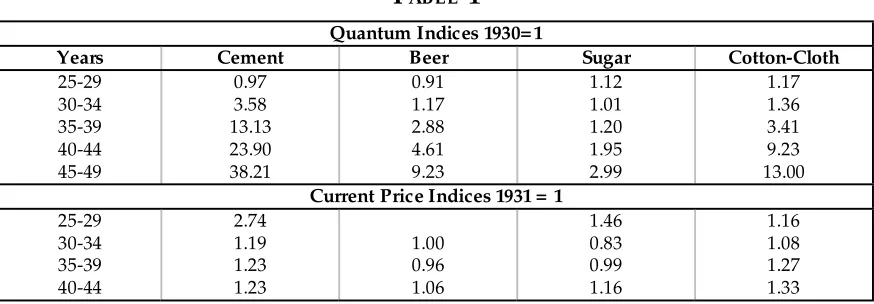
backwardness also explain the industrial expansion during that period. The country was experienced fast urbanization process. According to population census statistics, the share of urban population was 12.4% in 1918, 17.5% in 1938, and 42.6% in 1951. The four largest cities passed from 0.3 to 1.5 million people from 1918 to 1951. Per-capita income rose from $359 in 1930 to $440 dollars at 1990 prices. That is, real purchasing power grew at 1.4% per year. Both elements expanded the domestic market for consumer goods. The urbanization process in turn implied a change in the pattern of consumption toward manufactures and a demand increase for construction materials. Regarding the degree of industrialization, Colombia lagged with respect to other Latin American economies. The share of manufacturing industry in total GDP was 6.6% by 1930, in contrast to 22% in Argentina, 11.7% in Brazil, and 14.2% Mexico [Ocampo (1984)]. This meant that i) the supply of domestic manufactures was too small relative to economy’s apparent consumption and ii) manufacturing was an infant rather that a mature industry. Thus, there was enough room to enhance import substitution industrialization.
T
ABLE1
Quantum Indices 1930=1
Years Cement Beer Sugar Cotton-Cloth
25-29 30-34 35-39 40-44 45-49 0.97 3.58 13.13 23.90 38.21 0.91 1.17 2.88 4.61 9.23 1.12 1.01 1.20 1.95 2.99 1.17 1.36 3.41 9.23 13.00 Current Price Indices 1931 = 1
25-29 30-34 35-39 40-44 2.74 1.19 1.23 1.23 1.00 0.96 1.06 1.46 0.83 0.99 1.16 1.16 1.08 1.27 1.33
Sources: Volumes: Banco de la República (1993),
Poveda (1979), Montenegro (1984); Prices: Ocampo and Montenegro (1984).
The economic policy during 1930-1945 period was favorable to ISI. Three policy measures helped the economic recovery of the thirties and to sustain economic growth during the Second World War years. First, the tariff reform of 1931 [Law 62] increased import duties of all import-competing goods, raising on average the levels of effective protection [Berry (1983)]. Second, the shocks in the international capital markets forced the government to adopt exchange rate controls and to abandon the gold standard regime. Thus, in 1933 the peso was pegged to the dollar. These measures implied a devaluation of the real exchange rate in 68% from
[image:9.612.89.526.318.470.2]1933 to 1935, which significantly increased the relative price of imports.14 Third, a counter
cyclical macroeconomic policy was implemented. In general, the Central bank - Banco de la Repú-blica - reduced the discount rate, increased the discount credit-limits to commercial banks, and approved credits to the central government as advance payments for the rents of the salt concession just transferred to Banco de la República. In addition, new financial institutions were founded in the thirties as result of the policy of mortgage reduction and the diversion of new loans to the agricultural sector. The increase in military spending due to the conflict with Peru in 1932 and the new policy of public investment in road construction increased public spending.15
F
IGURE1
T
OTAL ANDC
APITALG
OODSI
MPORTSQ
UANTUMI
NDICE S(1928=1)
0,0 0,5 1,0 1,5 2,0
15 20 25 30 35 40 45 50
year
in
d
e
x
tot capG
Sources: 1916-1930: Anuarios E stadísticos, Contraloría 1931-1945: Montenegro (1984)
1945-1950: Banco de la República (1993)
Summing up, during the 1930-1945 period there was a strong expansion of the manufacturing industry in which external shocks had a central role. According to the 1945 industrial census there were 7,853 manufacturing plants that employed 115,517 workers and 19,883 administrative employees. This number includes cottage-shops that had a high share in foodstuffs, beverage, tobacco, leather and apparel industries. E xcluding cottage-shops, the sample size reduces to 3,572 manufacturing plants. In addition, the census recorded 6,250 establishments that were founded after 1930 that is 80% of the total establishments.
14 The nominal exchange rate was $1.05 in 1932 and $1.78 in 1935.
IV. T
HEL
ATES
UBSTITUTION: 1945-1967
The third industrialization phase took place during in 1945-1967 period. Import substitution focused on the establishment of late industries.16 The industrial policy switched toward the promotion
of capital intensive industries, such as petrochemicals, chemical products, plastics, paper, rubber, basic metals, machinery, and transportation equipment. The political economy of ISI was based on the dependency theory, which stated that the historical pattern of international division of labor had ended up in a center-periphery relationship between the industrialized economies and the developing world. The nature of such relation caused an increasing technological gap explained the poverty traps and the deterioration in the terms of trade observed in the periphery. To break and reverse these trends it was necessary to promote an inward development able to consolidate an industrial base that could not be attained by relying on market forces. These ideas influenced Latin American political circles during the post World War II years. They saw in ISI as the path to economic development. Thus, trade and non-trade barriers, domestic credit, state promotion, and foreign investment, became central ISI policy instruments.
The official program of ISI in Colombia since the fifties relied on the massive use of quantitative restrictions on imports (QRs) by means of import licenses and prior import deposits. For instance, the proportion of imports under the prior licensing regime was 21% between 1950 and 1954, while it was 78% during the 1965-1969 period. The value of prior deposits as a percentage of total imports rose from 4.8% in the early fifties to 25% by the end of the sixties [Ocampo (1991)]. Tariff protection also increased during the postwar years. There were three main tariff reforms in this phase worth mentioning 1950, 1959, and 1964.17 The ad-valorem tariff system was introduced for
80% of the tariff schedule in the 1950 reform. The 1964 reform abolished the specific tariff system. Nominal protection increased from 40% in 1950 to 65.6% in 1964 [Martinez (1986)]. The tariff structure led to asymmetric levels of effective protection. The rate of effective protection was estimated for total manufacturing in 53.3% in 1969. However, examining individual sectors reveal that the rate fluctuated from negative protection of -26% for rubber products to outliers of 319% in transportation equipment or 668% in electrical machinery [Diaz-Alejandro (1976)].
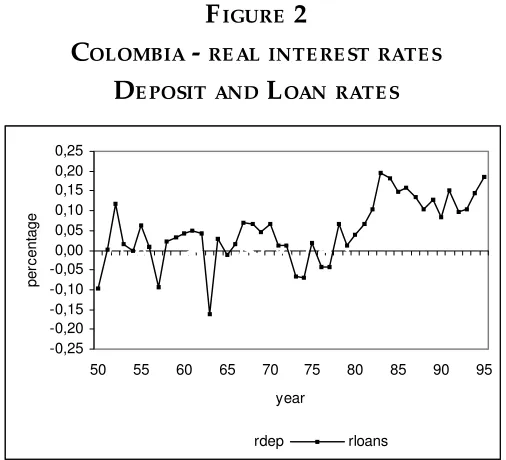
Stock issues and profit reinvestments were the financing mechanisms for capital accumulation in the industrial sector until the mid-1950s. Thus, industrial financing came from domestic savings as in previous decades. After 1955, new instruments to channel private capital and long-term finance to manufacturing were developed. Investment banks - Corporaciones Financieras - were created in 1957 to provide long-run private credits. Later, the Fondo Financiero Industrial was funded in 1967. This was one of the sectoral development funds administrated by the Central Bank. The financial sources of such funds came mainly from forced investments imposed on financial intermediaries. These elements changed the financial structure of corporate firms, discouraging the issue of new stocks and promoting firms’ external indebtedness. The permanent control over the interest rate during the sixties created a price distortion that turned real interest rates negative, in this way encouraging the demand for credit [figure 2]. Because of the subsidized
16 L ate industries under the ISI context are petrochemicals, chemicals products, plastics, machinery, housewares, and transportation equipment industries.
credit, firms chose for buying liquid assets and, to engage in either vertical or horizontal mergers. This process increased industrial concentration and the formation of industrial conglomerates. In fact, the four-digit concentration ratio for total manufacturing was on average 0.52 in 1970.18
The Instituto de Fomento Industrial (IFI) was founded in 1940. This public institution became a strategic tool for state promotion industrialization. The institute’s objective was initially to advance risk capital to industrial investment projects. The role of IFI in creating new manufacturing enterprises located in late industries was central during the fifties and sixties. Today’s largest private capital enterprises in steel, chemicals, paper, fertilizer, metalworking, and automobile were former IFI’s associated companies. The IFI projects were oriented to capital-intensive industries, producers of intermediate materials and capital goods. Some projects were criticized because of their high welfare costs in terms of production efficiency and consumption. In some cases, the domestic market was too small to generate productivity gains due to scale economies. Thus, economic viability was artificially sustained by granting subsidized credits, and increasing tariff protection to guarantee firms’ monopolistic position. In contrast, other projects proved to be successful as time passed by, such as the automobile industry. IFI’s involvement was crucial in the consolidation of that industry in Colombia.19
Foreign investment was another instrument used for the government to promote ISI in intermediate materials and capital goods industries. Foreign investment in Colombia’s manufacturing sector did not have the weight that it had in other Latin American economies. Today Multinational enterprises dominate the pharmaceutical, food processing, paper, and automobile industries.
Summing up, the third industrialization phase focused on the development of capital and technology intensive industries in which there was not a domestic supply. The industrialization tools relied on protection and state promotion. The result was an industrial deepening that increased manufacturing share in total GDP from 0.14 in 1945 to 0.22 in 1967,20 and a steady
growth rate of 8% for the sector during the whole period.
18 The formation of economic conglomerates came also from the predatory behavior of the banking sector. The 1982 financial crisis was caused mainly by the bankruptcy of the Grupo Gran-Colombiano, which was the conglomerate of the largest private commercial bank in the seventies - Banco de Colombia -. See chapter 4 for more details about the measurement and evolution of the Herfindal concentration indices since 1970. 19 IFI sold all its shares of commercial and industrial enterprises between 1993 and 1994 in accordance to
government’s privatization program. Perhaps, the major IFI failures were the steel mill Paz del Rio and the shipyard CONA STIL. The former project was criticized since 1950 when the World Bank mission headed by professor Currie did not recommend the set up of an integrated steel mill. Today in 1998, the plant is almost shut down after many attempts of financial restructuring. The latter ran in constant operational losses that finally ended up in its sale in 1993. In the automobile sector, IFI was an associate of multinationals to build up the assembly plants. These were the cases of Sofasa-Renault (1969) and Compañia Colombia A utomotriz CCA -(1973). In the eighties the CCA was acquired by Mazda corporation [DNP (1993)].
F
IGURE2
C
OLOMBIA-
RE AL INTE RE ST RATE SD
E POSIT ANDL
OAN RATE S-0,25 -0,20 -0,15 -0,10 -0,05 0,00 0,05 0,10 0,15 0,20 0,25
50 55 60 65 70 75 80 85 90 95
year
pe
rc
ent
age
rdep rloans
Source: Banco de la República - GRE CO
IV. T
HE MIXE D STRATE GY: 1967-1989
The year 1967 was a turning point in Colombia’s foreign trade and exchange rate policies. The nation was experiencing a balance of payments crisis because of the economy’s foreign sector vulnerability to coffee prices and real exchange rate cycles. Indeed, during the fifties and sixties the country experienced several booms and depressions of coffee prices, as well as under and overvaluation of the peso [figure 3 and 4]. The industrial deepening of the sixties generated a major dependency on capital good imports, making import demand more price-inelastic. The share of capital goods in total imports changed from 13% in 1945 to 44% in 1967. To face the crisis and to avoid a maxi-devaluation of the peso, which would have been too harmful to the manufacturing industry, the government issued decree-law 444 on March of 1967. The authorities decided to implement stringent controls on capital flows, to adopt a crawling peg exchange rate regime, to increase the QRs on imports, and to follow an export diversification strategy. Four main policy instruments were used to promote manufacturing exports: i) a tax rebate certificate, ii) tariff exemptions for imports used in the production of nontraditional exports, iii) the prefinancing of exports free of exchange rate risks, and iv) export financing through PROEXPO.21 Thus, since
1967 the government followed a mixed strategy of ISI, direct export promotion and active exchange rate management [Ocampo and Villar (1992)]. The results of this policy were positive until the mid-seventies. Total GDP growth was 6% while manufacturing value added growth was 7.8% per year during the 1967-1974 period. Real manufactured exports grew at 30% per year in that period,
[image:13.612.178.431.85.315.2]one the highest recorded since 1950. Its share in total exports rose from 14% in 1967 to 46% in 1974. On the ISI side, the major innovation of the industrial policy was the introduction of the assembly regime in 1969. This instrument was a concession granted on the basis that the assembler would rise domestic components and provide technical assistant to local suppliers of parts and accessories. This regime covered mainly the automobile and electrical appliances industries.
F
IGURE3
C
OLOMBIAR
E ALE
XCHANGER
ATEB
USINE SSC
YCLE(D
E VIATION OVE R THE TIME TRE ND)
-0,60 -0,40 -0,20 0,00 0,20 0,40 0,60
19 26 33 40 47 54 61 68 75 82 89 96
year
Y
b
a
r-Y
dtrend
Source: Own estimations based on Banco de la República
F
IGURE4
R
E ALC
OFFE EP
RICE SI
NDICE S1988=1
(I
NTE RNATIONAL ANDDOME STIC)
0,00 0,50 1,00 1,50 2,00 2,50 3,00
5 15 25 35 45 55 65 75 85 95
year
in
d
e
x
int dom
Industrial policy from 1975 to 1989 was passive in contrast to previous decades. This shift was a consequence of the macroeconomic disequilibria rather than a change in the development strategy. The government faced the largest boom of coffee prices in this century during 1977-1979 period [figure 1.4], the closure of private foreign credit due to the debt crisis in the region since 1982, the increase of the external debt service pushed by the rise of international interest rates, the domestic financial crisis of the early 1980s, and the macroeconomic adjustment program monitored by the IMF in 1984.22 Afterwards, the macroeconomic equilibrium was restored and the mixed strategy
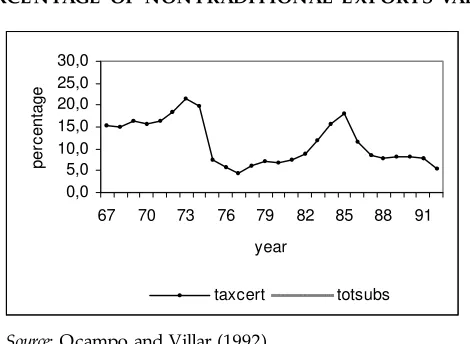
with crawling peg system continued in a lesser way. In fact, the costs of the adjustment were high since the economy reached an unemployment rate of 14.5% in June of 1985, the highest since 1950. Macroeconomic policy was oriented to control the fiscal deficit and to normalize the flows of foreign loans to finance public investment. Consequently, all export promotion subsidies were drastically reduced. In particular, the overall export subsidy as a percentage the value of nontraditional exports fell from 27% in 1984 to 7% in 1992 [Figure 5]. Moreover, the ratio of PROEXPO’s credits to nontraditional exports value dropped from 47% in 1983 to 14% in 1992 [Ocampo and Villar (1992)].
V. E
CONOMICOPE NNE SS: 1990
AFTE RWARDSThe Colombian government under the Gaviria administration in 1990 undertook an ambitious economic liberalization program that implied a major shift in the development strategy. The economic openness package included major structural reforms in the i) foreign trade policy, ii) exchange rate regime, iii) capital flow controls, iv) central bank independence, v) privatization programs, vi) job market legislation, vii) foreign investment legislation, and vii) social security and pension regimes. Regarding the industrial policy, all sectoral instruments were gradually abolished, such as the assembly regime, IFI’s direct promotion, export subsidies, and non-trade barriers. The role of public invest-ment switched toward those areas that can improve overall input’s efficiency. Thus, the plan emphasized in prioritizing investments in physical infrastructure, education, and social spending.23
In that sense, a new technological policy was proposed to substitute the traditional instruments. A national network of science and technology was established through the law 29 of 1990, and created the National Council of Science and Technology as the institution in charge of implementing the technological policy. The network is flexible because it works through basic programs. In addition, it is open because the universities and research institutions, along with the president’s cabinet, have equal voting participation. There are seven programs, divided according to science and sectoral production areas: i) basic sciences, ii) social sciences, iii) quality and technological industrial development, iv) agricultural sciences, v) health sciences, vi) biotechnology, marine biology and environmental sciences, and vii) educational sciences. On the other hand, the Colombian Fund of Science and Technology - COL CIE NCIA S - became the Council’s technical secretariat.
22 For details of the main macroeconomic episodes during the seventies and eighties, see Cuddington (1986), Garay and Carrasquilla (1987), and Lora (1994).
F
IGURE5
C
OLOMBIA- N
ONTRADITIONAL E XPORT POLICYT
OTAL SUBSIDIE SANDTAX CE RTIFICATE RE BATE S(P
E RCE NTAGE OF NONTRADITIONAL E XPORTSVALUE)
24 The Servicio Nacional de A prendizaje - SE NA - is a public institution for labor training programs. They honor several programs for technical formation in diverse areas. There are 13 SE NA centers with specialized equipment for labor training programs. Most the equipment of those centers have been donated or sponsored by foreign governments.
25 See DNP: CONPE S document 2848 - May 29 of 1996. 26 This data is for 1988, see IDB (1988).
0,0 5,0 10,0 15,0 20,0 25,0 30,0
67 70 73 76 79 82 85 88 91
year
pe
rc
en
tage
taxcert totsubs
Source: Ocampo and Villar (1992)
The first step of the quality program and industrial development was to update the legislation concerning intellectual property rights (Decree 117/1994) and technical standardization, quality certifications and measuring norms (Decree 2269/1993). The second step was oriented to the provision of technological services. To this end the program has been focused on two working areas: i) the expansion and financial funding to all existing and new technological development centers, and ii) the decentralization of the management of all training centers belonging to the SE NA24 network. For that purpose, these centers are now able to sign contracts for the provision
of technological services with private firms. Thus, the above measures aim at rationalizing the supply of technological services available for the private sector. A follow up evaluation of the technological policy was done in 1996.25 In that year there were 22 private technological centers
engaged in the provision of technological services and, in a lesser way doing some applied research. The main drawback from the numbers recorded in such report is that the science and technology policy has been too modest in terms of public funding. In fact, public investment in R&D was around 0.3% of GDP, and the per-capita R&D spending was 7.1 dollars [table 1.2]. These numbers are below to those recorded from other Latin American countries. For instance, the per-capita public R&D investment is 19.6 dollars in Argentina, 11.4 dollars in Mexico, and 10.7 dollars in Venezuela.26 For the OE CD members the average of public R&D investment as
[image:16.612.190.425.152.324.2]domestic resources (national budget) and international loans. The IADB has approved US$ 140 millions for loans to science and technology since 1991.
In sum, industrial policy since 1990 had a major shift in its orientation. The technological policy looks for the formation of human capital, research networks, R&D infrastructure, and to supply technological services, seems to be the correct strategy to improve and sustain steady growth rates in total factor productivity. Increasing overall input efficiency is a necessary condition for the viability of an outward oriented strategy and for the successful insertion of the economy into the international market. Thus, the challenge for industrial restructuring will be to raise firms’ efficiency through the modernization of capital equipment and the absorption of human capital, in order to diversify the sector and to increase manufacturing exports in the coming decades. To this end, both the public and private sectors will have to make an effort at increasing their current investments in research and development activities.
T
ABLE2
C
OLOMBIA- R&D I
NDICATORSP
UBLIC INVE STME NT INR&D
1994 1995 1996
R&D/PIB R&D $US mil R&D per-capita $US
0.0025 252.1
6.62
0.0030 287.0
7.39
0.0033 291.3
7.37
Source: Own estimates based on DNP (1996)
VI. S
UMMARY AND FINAL RE MARKSThe twentieth century was a century of major social and economic structural transformations for Colombia. The country became an urban economy that could develop a domestic capital market, the manufacturing industry and the service sector. In addition, the regulatory instruments regarding the coffee industry, the labor market and social security, the foreign sector, and recently the science and technology sector were instituted. The nation was able to modernize its public institutions and consolidate a democratic regime with periodical elections since 1912, with the exception of the 1957-1960 military regime. In the social area, the country’s basic indicators improved substantially, at least up to 1990. The consolidation of the outward development strategy along with a closure of the technological gap is therefore the main challenge for the Colombian society for the coming decades.
R
E FE RE NCE SBateman A. (1986), “La ingeniería, las obras públicas y el transporte en Colombia”, en Historia E xtensa de Colombia, Vol. X X I, Bogotá, E diciones Lerner.
Becerra M. (1993), E l empresario industrial del V iejo Caldas, Bogotá, Universidad de los Andes.
Botero, F. (1984), L a industrialización en A ntioquia, Medellín, CIE , Universidad de Antioquia.
Chu, D. (1983), “The Great Depression and industrialization in Colombia”. In Berry A. (ed.), E ssays on Industrialization in Colombia, Temple, Arizona State University.
Cuddington, J. (1986), “Bonanzas de productos básicos, estabilización macroeconómica y reforma comercial en Colombia”, E nsayos sobre Política E conómica 10: 45-100.
Departamento Nacional de Planeación (1991a), L a revolución pacífica, Plan Nacional de Desarrollo 1990-1994, Bogotá, DNP.
____________ (1991b), Modernización y apertura de la economía, Vol. I, Bogotá, DNP.
____________ (1993), Nuevos espacios para la inversión privada en Colombiua, Documento Conpes-2648, Bogotá.
____________ (1996), Seguimiento a la política nacional de ciencia y tecnología, Documento Conpes-2848, Bogotá.
Díaz, Alejandro C. (1976), Foreign Trade Regimes and E conomic Development: Colombia, New York, NBE R.
E der, P. (1959), E l fundador: Santiago M E der, Bogotá, Antares.
Garay, L. y Carrasquilla, A. (1987), “Dinámica del desajuste y proceso de saneamiento económico en Colombia en la década de los ochenta”, E nsayos sobre Política E conómica 11: 5-71.
Inter-American Development Bank (1988), E conomic and Social Progress in L atin A merica -1988 Report, Baltimore, MD, Johns Hopkins University Press.
Lipman, A. (1966), E l empresario bogotano, Bogotá, E diciones Tercer Mundo.
Lora E ., J. A. Ocampo y R. Steiner (eds.) (1994), Introducción a la macroeconomía colombiana, Bogotá, Tercer Mundo E ditores.
Martínez, A. (1986), L a estructura arancelaria y la estrategias de industrialización en Colombia, 1950-1982, Bogotá, CID, Universidad Nacional.
Mayor-Mora, A. (1989), “Historia de la industria Colombiana”, en Nueva Historia de Colombia, Vol. 5, Planeta, Bogotá.
Montenegro, S. (1984), “E l surgimiento de la industria textil en Colombia”, en Ocampo J. A y Montenegro, S., Crisis mundial protección e industrialización, Bogotá, Cerec.
Ocampo, J. A. (1984a), Colombia y la economía mundial, 1830-1910, Bogotá, Siglo X X I.
____________ (1984b), “La economía colombiana en la década del treinta”, en Ocampo J. A y Montenegro, S., en crisis mundial, protección e industrialización, Bogotá, Cerec.
____________ (ed.) (1987), Historia E conómica de Colombia, Bogotá, Siglo X X I.
Ocampo, J. A. (1991), “The transition from primary exports to industrial development in Colombia”. In Diverging Paths, Blomstrom M., & Meller P. (eds.), Johns Hopkins University Press.
____________ (1994), “Trade policy and industrialization in Colombia, 1967-1991”. In Helleiner G. (ed.), Trade policy and Industrialization in Turbulent Times, London, Routledge.
____________ y Lora, E . (eds.) (1988), Colombia y la deuda externa, Bogotá, Tercer Mundo E ditores.
____________ y Montenegro, S. (1984), “La crisis mundial de los años treinta en Colombia”, en Crisis mundial protección e industrialización, Bogotá, Cerec.
____________ y Villar, L. (1992), Colombian Manufacturing E xports, 1967-1991, Fedesarrollo, Bogotá, mimeo.
Ospina-Vásquez, L. (1955), Industria y protección en Colombia, 1810-1930, Medellín, E ditorial Santa Fe.
Ordóñez, L. (1995), Industrias y empresarios pioneros, Cali 1910-1945, Cali, Universidad del Valle.
Palacios, M. (1980), Coffee in Colombia, 1850-1970, Cambridge University Press.
Poveda, G. (1970), “Historia de la industria Colombiana”, A NDI Revista Trimestral 11: 5-97.
____________ (1979), Políticas económicas desarrollo industrial y tecnología en Colombia, Bogotá, Colciencias.
Ramírez, M. T. (1998), On infrastructure and Growth, Ph.D. Unpublished Thesis, University of Illinois at Urba-na-Champaign.
Weiss A. (1980), Antecedentes del desarrollo industrial colombiano, Documento 20, Departamento de Sociología, Universidad Nacional, Bogotá.