UNIVERSIDAD AUTÓNOMA DE NUEVO LEÓN
FACULTAD DE CIENCIAS QUÍMICAS
BROMATE AND CHROMATE REMOVAL FROM WATER BY
DOUBLE LAYERED HYDROXIDES
POR
CECILIA PATRICIA VILLANUEVA RANGEL
COMO REQUISITO PARCIAL PARA OBTENER EL GRADO DE
MAESTRÍA EN CIENCIAS CON ORIENTACIÓN EN
PROCESOS SUSTENTABLES
UNIVERSIDAD AUTONOMA DE NUEVO LEÓN
FACULTAD DE CIENCIAS QUÍMICAS
BROMATE AND CHROMATE REMOVAL FROM BY WATER
DOUBLE LAYERED HYDROXIDES
POR
CECILIA PATRICIA VILLANUEVA RANGEL
COMO REQUISITO PARCIAL PARA OBTENER EL GRADO DE
MAESTRÍA EN CIENCIAS CON ORIENTACIÓN EN PROCESOS
SUSTENTABLES
iii
BROMATE AND CHROMATE REMOVAL FROM WATER BY DOUBLE-LAYERED HYDROXIDES
THESIS AUTHORIZATION:
Advisor: Dr. Refugio Bernardo García Reyes.
Co-Advisor: Dr. Juan Jacobo Ruiz Valdes.
Reviewer: Dr. Eduardo Soto Regalado.
Reviewer: Dra. María Teresa Garza González.
iv
CRÉDITOS
Esta tesis fue elaborada en la Escuela de Graduados en Ciencias de la Facultad de Ciencias
Químicas de la Universidad Autónoma de Nuevo León, bajo la dirección del Dr. Refugio
Bernardo García Reyes.
Durante la realización de la investigación el autor recibió una beca académica del Consejo
Nacional de Ciencia y Tecnología (CONACYT) y de la Facultad de Ciencias Químicas de la
Universidad Autónoma de Nuevo León.
El autor de esta tesis recibió recursos financieros por parte del Consejo Nacional de
Ciencia y Tecnología para llevar a cabo una estancia de investigación en The University of
v
DEDICATORIAS
Dedico este trabajo a Dios, que siempre me ha llevado de su mano y me ha dado todo lo
que tengo; porque me ha regalado la vida, una familia extraordinaria, amigos para toda la
vida y nunca me abandona.
A mi mamá, Patricia Rangel Muñiz, por todo el amor que me ha dado, que ha sido y
seguirá siendo ejemplo y pilar en mi vida; por ser mi fortaleza, mi guía, mi amiga, por
sufrir conmigo y también por las veces que ha sufrido en silencio para que yo no sufriera.
Te quiero con todo el corazón.
A mis hermanos, José y Kary, que de cada uno tengo un pedacito; que de ellos he
aprendido desde que nací y que son los mejores y más buenos hermanos que alguien
pudiera tener y los quiero con todo mi corazón.
A mis sobrinas, Andrea y Sofía, que con sus sonrisas, abrazos o simplemente con su
presencia me alegran hasta los días más difíciles y que aunque estén pequeñitas siempre
encuentran la manera de hacerme sentir querida.
A mi papá, José Luis Villanueva Hinojosa, que aunque no lo tenga físicamente conmigo, no
me olvido de él ni un solo día, y que en cada paso que doy lo recuerdo, y lo extraño.
A mis amigos fuera y dentro de la escuela: Gama, Fer, Gera, Christopher, Meli, Fanny,
Aarón, Pablo, Jessica, Fabián, Jacinto y todos aquellos que aunque no estén nombrados
aquí han ayudado a cumplir esta meta y además compartir momentos importantes en mi
vi
AGRADECIMIENTOS
´
Le doy gracias a Dios, por poner en mi camino a tantas buenas personas, que con su amabilidad, tiempo e inteligencia me han dado la oportunidad de mejorar y también porque con cada cosa que existe me hace saber que siempre estará conmigo.
Al Dr. Refugio Bernardo García Reyes por darme la oportunidad de trabajar con él y su grupo de investigación, por sus enseñanzas, paciencia, sus consejos y por compartir con nosotros su tiempo, su casa y su amistad.
Al Dr. Juan Jacobo Ruiz Valdés, por todo su tiempo, consejos, su disponibilidad y ganas de escucharme y apoyarme siempre.
Al Dr. Purnendu Dasgupta, por la gran oportunidad que me permitió al trabajar con él y su grupo de trabajo tan acogedor, por todas las enseñanzas que compartió y su hospitalidad. Nunca olvidaré todo lo que viví al estar con ellos.
A la Dra. Teresa Garza González, por su gentileza, sus detalles, sus consejos y correcciones para mejorar este trabajo y por el tiempo que nos ha dado a todos.
Al Dr. Eduardo Soto Regalado que con sus correcciones, su tiempo, con su amabilidad y su interés este trabajo se ha enriquecido mucho.
A la Dra. Aracely Hernández Ramírez, por su comprensión, disposición, interés, y ayuda para este proyecto.
A Rocío Giselle Espinosa Silva, Alan Enrique Jasso Ríos, Roberto David Rentería Escamilla porque además de ayudar en la experimentación de esta tesis, compartimos muchos momentos juntos y siempre me dieron un apoyo que por el cuál siempre les estaré agradecida.
A Martín Garza que a pesar de la distancia, supo ayudarme siempre y me libró de dificultades.
Le agradezco a la University of Texas at Arlington por la infraestructura, equipos, reactivos facilitados para concluir las pruebas de esta tesis y a toda la gente que me dio su tiempo para compartirme sus enseñanzas, consejos y también escuchar todas mis dudas. Gracias a Brian, Philip, Akinde, Min, Chuchu, Hongzhu, Huang, Jacklyn, Mousavi y Nouroozi, por toda su paciencia, amabilidad, enseñanzas, consejos, y amistad, nunca los olvidaré.
Finalmente, le agradezco a la División de Posgrado de la Facultad de Ciencias Químicas por la infraestructura facilitada para la realización de esta investigación y a todos quien lo hacen posible.
vii
TABLE OF CONTENTS
CRÉDITOS ... ii
DEDICATORIAS... v
AGRADECIMIENTOS... vi
LIST OF TABLES ...x
LIST OF FIGURES ... xi
ABSTRACT ... Error! Bookmark not defined. 1. Introduction ... 1
1.1 Bromate in drinking water ... 1
1.2 Chromate in drinking water ... 2
1.3 Water treatment processes ... 2
1.3.1 Coagulation-flocculation ... 3
1.3.2 Ion exchange ... 3
1.3.3 Reverse osmosis ... 4
1.3.4 Adsorption processes ... 4
1.4 Adsorbents ... 9
1.4.1 Activated carbon ... 9
1.4.2 Zeolites ... 11
1.4.3 Polymer resins ... 12
1.4.4 Biosorbents ... 13
1.4.5 Clays ... 13
2 Background... 19
2.1 Bromate removal methods ... 19
2.1.1 Bromate determination methods ... 20
2.2 Chromate removal methods ... 20
2.2.1 Chromate determination method ... 21
2.3 Double-layered hydroxides structure ... 21
2.4 Legal framework ... 22
3 Research motivation ... 23
viii
5 Objectives ... 23
5.1 General objective ... 23
5.2 Specific objectives ... 24
6 Methodology ... 24
6.1 Synthesis of Mg-Al Double-layered hydroxides with carbonate as the exchanging anion24 6.2 Characterization of Mg-Al Double-layered hydroxides with carbonate as exchange anion 25 6.3 Synthesis and characterization of Mg-Al Double-layered hydroxides with chloride as the exchanging anion ... 26
6.4 Characterization of Mg-Al Double-layered hydroxides with chloride as exchanging anion 26 6.5 Calcination of Mg-Al Double-layered hydroxides ... 26
6.6 Characterization of calcined Mg-Al Double-layered hydroxides. ... 26
6.7 Screening adsorption and desorption tests ... 26
6.8 Additional characterization ... 27
6.9 Chromate isotherms ... 27
6.10 Bromate isotherms ... 28
6.11 Chromate kinetic studies... 28
6.12 Bromate kinetic studies ... 29
6.13 Packed bed column tests ... 29
6.14 Waste disposal ... 29
7 Results ... 30
7.1 Synthesis of Mg-Al Double-layered hydroxides ... 30
7.1.1 DLH with carbonate as exchanging anion ... 30
7.1.2 DLH with chloride as exchanging anion ... 31
7.2 Characterization of Mg-Al Double-layered hydroxides ... 32
7.2.1 X ray diffraction (XRD) ... 32
7.2.2 Thermogravimetric analysis ... Error! Bookmark not defined. 7.3 Calcination of Mg-Al Double-layered hydroxides ... 36
7.4 Characterization of calcined Mg-Al Double-layered hydroxides. ... 38
7.5 Screening adsorption and desorption tests ... 40
7.6 Additional characterization ... 42
ix
7.6.2 Scanning electron microscopy ... 43
7.6.3 XRD after chromate adsorption ... 45
7.7 Chromate isotherms ... 46
7.8 Bromate isotherms ... 50
7.8 Chromate kinetic studies... 53
7.9 Bromate kinetic studies ... 62
7.10 Packed bed column tests ... 63
8 General conclusions ... 67
9 References ... 68
x
LIST OF TABLES
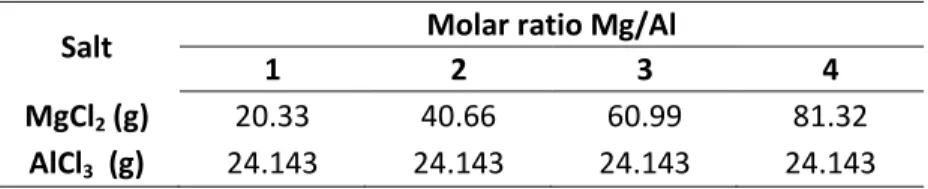
Table 1 Bromate and chromate maximum allowed level on drinking water by EPA, WHO and NOM. 23 Table 2 Mass quantity per molar ratio of Mg: Al for 100 mL of water. 24 Table 3 Phases present in each sample of Mg-Al double layered hydroxides by XRD. 32
Table 4 Weight loss of DLH after calcination. 37
Table 5 Phases present in each sample of Mg-Al double layered hydroxides by XRD. 38
Table 6 Screening chromate adsorption tests. 41
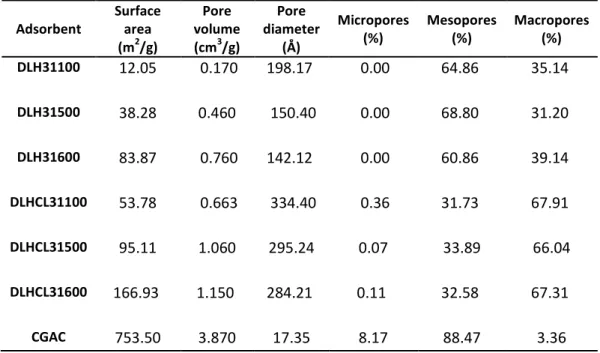
Table 7 Surface area values for the selected DLH. 44
Table 8 Weight and atomic percent for the selected DLH after chromate adsorption. 45 Table 9 Maximum adsorption capacities of chromate on the selected DLH adsorbents and CAGC at different pH values.
50
Table 10 Maximum adsorption capacity of bromate on calcined DLH and activated carbon at different pH values.
51
Table 11 Maximum adsorption capacity of bromate onto raw (CGAC) and modified activated carbon (MAC) at pH 6, 7 and 8.
52
Table 12 Number, quantity, and time of the aliquots taken in kinetic studies. 53 Table 13 Values of adsorption capacity (qe) and Ce/Co at 100, 200, and 300 rpm. 55 Table 14 Values of adsorption capacity (qe) and Ce/Co for the oscillatory, magnetic, and intermittent
mixing systems.
60
xi
LIST OF FIGURES
Figure 1 Chromium speciation diagram. 2
Figure 2 Schematic of an adsorbent particle depicting the surroundings stagnant fluid film. 7 Figure 3 Sodium Zeolite A, an example of a common zeolite structure. 12 Figure 4 Brucite sheet section showing Mg2+ centers coordinated with six hydroxyl anions and each
hydroxyl anion with three Mg2+ cations; also two brucite sheets which thickness corresponds to
basal space.
15
Figure 5 Structure of Mg/Al double-layered hydroxides with carbonate as the exchanging anion. a) View from plane a, b) view from plane b, c) view from plane c and d) random view [2].
22
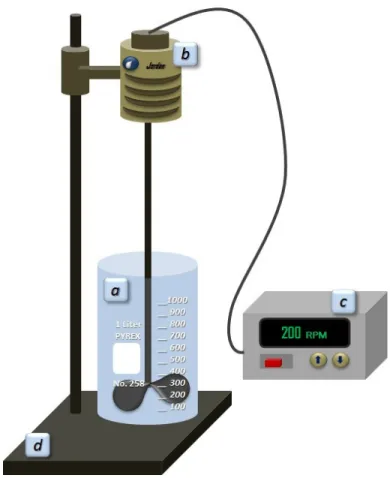
Figure 6 Kinetic studies mixing system. A) solution container (1 L beaker), b) vertical hollow shaft motor with 3 prop propeller of 3.5 cm each one, c) mixing speed controller (10-500 rpm) and d) 60 cm metallic motor holder.
29
Figure 7 Mg-Al double-layered hydroxides with carbonate as exchanging anion with four different molar ratios. a) DLH1100 b) DLH21100 c) DLH31100 and d) DLH41100.
30
Figure 8 Mg-Al double-layered hydroxides with chloride as exchange anion with best molar ratio (DLHCL31100).
31
Figure 9 X-ray diffractograms of dried Mg-Al double layered hydroxides at different Mg/Al molar ratio (1 to 4) with carbonate and chloride as exchanging anions.
33
Figure 10 Water and exchanging anions bonded to DLH sheets. 35 Figure 11 Thermogravimetric analysis of DLH21100, DLH31100 and DLHCL31100. 36 Figure 12 Mg-Al double-layered hydroxides at 400, 500 and 600 °C. a) DLH21400, b) DLH21500, c)DLH21600, d)DLH31400, e)DLH31500, f) DLH31600, g) DLHCL31400, h) DLHCL31500 and i) DLHCL31600
37
Figure 13 X-ray diffractograms of Mg-Al double layered hydroxides at different Mg/Al molar ratio (1 to 4) with carbonate and chloride as exchanging anions at 400, 500 and 600°C.
40
Figure 14 SEM images for a) DLH31100 b) DLH31500 c) DLH31500 after chromate adsorption. 45 Figure 15 XRD diffractogram for DLH31500 after chromate adsorption at pH 6. 46
Figure 16 Chromate anion bonded to DLH sheets. 47
Figure 17 Chromate adsorption isotherms for DLH31500 at pH 6, 7 and 8 and activated carbon at pH 6.
48
xii
pH 6.
Figure 19 Chromate adsorption isotherms for DLHCL31500 at pH 6, 7 and 8 and activated carbon at pH 6.
49
Figure 20 Chromate adsorption isotherms for DLHCL31600 at pH 6, 7 and 8 and activated carbon at pH 6.
49
Figure 21 Bromate adsorption isotherms for selected double-layered hydroxides (DLH31500) at pH 6, 7 and 8 and activated carbon (CGAC) at pH 6.
51
Figure 22 Modified activated carbon adsorption isotherms at pH 6, 7 and 8 for bromate removal. 52 Figure 23 Adsorption kinetics of chromate onto DLH31500 at pH 6 at 100 rpm. 54 Figure 24 Adsorption kinetics of chromate onto DLH31500 at pH 6 at 200 rpm. 54 Figure 25 Adsorption kinetics of chromate onto DLH31500 at pH 6 at 300 rpm. 55 Figure 26 XRD diffractogram for DLH31500 at 100 and 400 rpm. 57 Figure 27 Adsorption kinetics of chromate on DLH31500 with magnetic-stirred system. 58 Figure 28 Adsorption kinetics of chromate on DLH31500 with oscillatory-stirred system. 59 Figure 29 Adsorption kinetics of chromate on DLH31500 with intermittent-stirred system. 59 Figure 30 Adsorption kinetics of chromate on DLH31500 for no-air intermittent-stirred system. 61 Figure 31 Bromate adsorption kinetics for DLH31500 for no-air intermittent-stirred system. 62 Figure 32 Packed bed column tests for chromate adsorption. 64 Figure 33 Packed bed column tests for bromate adsorption. 65 Figure 34 Packed bed column with DLH31500. A) Packed bed column (5 mL pipette tip), b) peristaltic pump (0.3 µL/min to 30 mL/min), c) 1 Liter plastic initial solution container, d) 60 cm metallic column holder, and e) 50 mL plastic final concentration container.
xiii
ABSTRACT
CECILIA PATRICIA VILLANUEVA RANGEL
Graduation Date: September, 2015
Universidad Autónoma de Nuevo León
Facultad de Ciencias Químicas
Thesis title: BROMATE AND CHROMATE REMOVAL FROM WATER BY DOUBLE-LAYERED HYDROXIDES
Number of pages: 73 Candidate for the Master Degree in Sciences with Orientation in Sustainable Processes Study area: Sustainable Processes.
Purpose and method of study: To remove bromate and chromate from water, common methods include ion exchange, coagulation-flocculation processes, reduction-precipitation, etc., but these strategies can present some important disadvantages like incomplete removal, high cost, continuous use of reagents, and high energy costs. One of the most promising removal methods is the adsorption processes because of its high efficiency and low cost. In this study, double-layered hydroxides (DLH) of aluminum and magnesium were synthesized at different Mg/Al molar ratios with Cl- and CO3-2 as the exchanging anions in
order to remove bromate and chromate from water by adsorption processes. The synthesized materials were calcined at 400, 500, and 600°C to evaluate the effect of this treatment on the adsorption of the target pollutants.
xiv
but after thermal treatment this structure is disassembled. Nevertheless, DLH layers reassemble after chromate adsorption, forming again the characteristic layers of a DLH (i.e. a
memory effect). In conclusion, DLH is a promising adsorbent for the removal of bromate and chromate pollutants from aqueous solutions.
1
1.
Introduction
Water is one of the most used resources on earth for humans and living beings. Because of its high demand, this natural resource had been seriously affected by pollution since long time ago, when the wastewater of industries or home activities, were irresponsibly disposed of into potential drinking water sources such as rivers, lakes, seas and oceans [1]. Once ecology and environmental education started, wastewaters began to be used into irrigation processes and drains. Nowadays with the population growth, it is necessary to treat polluted waters to use them in high quality processes and also to offer safe drinking water to reduce the impact on population’s health [2]. Water and wastewater management must assure the collection, the treatment and the correct distribution of both drinking water and wastewater to guarantee the health and welfare of society [3].
1.1
Bromate in drinking water
There are some traditional methods to clean and disinfect drinking water, like chloration, but studies proved that the disinfection method can produce trihalomethanes and haloacetic acids [4]. An alternative method for chloration is the ozonation [5], which is one of the most promising disinfection methods for water.
Even though ozonation is an effective disinfection method, it can produce byproducts highly toxic like bromate [6]. Bromate ions are not commonly found in drinking water, but if water contains bromide ions (from exchange ion resins used in water softening, or by seawater intrusion in aquifers) while ozonation process is running, bromide ions are oxidized to bromate.
Studies of bromate removal have been of great relevance in health area around the world because bromate had been considered in Group 2B or “Possible human carcinogen” for the IARC (International Agency for Research on Cancer) [7]. Available information shows some of the consequences of bromate poisoning, one of the most serious is the growth of cancerous tumors in liver, kidneys and thyroids, also can cause nervous system weakness, kidney failure, and severe gastrointestinal irritation [8].Some other toxic effects of bromate salt (NaBrO3 and KBrO3) when
1.2
Chromate in dr
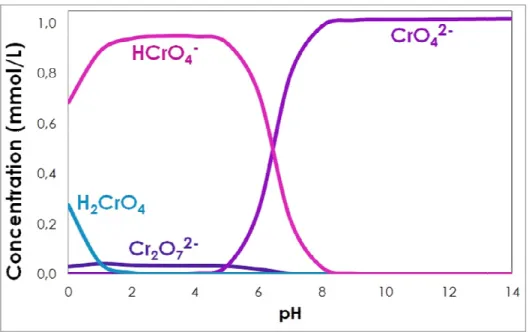
Several metals (like chromium, am and other species’ metabolisms toxicity, persistence in nature, bio can be found in water by industri textile industry, metal plating, an forms of chromium can vary. Cr HCrO4- or Cr2O72-, depending on bo
Experimental studies in chromium because chromium had been rep immune system [11]. Also, the ex internal hemorrhage, nausea, dia [9, 11, 12].
Figu
1.3
Water treatmen
A number of methods have been such as heavy metals, natural or etc. For metal-containing wast precipitation, coagulation-floccula and adsorption [12]. The most c
2
drinking water
, among others) are toxic and can cause several damag s. The removal of these metals has a great impact , bio-accumulation tendency, etc. In the case of chrom
strial effluents from different processes as: tannery, , and some others [10]. According to the pH and conc . Cr (IV) can form several species, namely Cr (IV) is fo n both pH and total Cr (IV) concentration as is shown in
ium removal had had huge impact in both scientific an reported as a possible carcinogen, causing problem e exposure to hexavalent chromium causes liver and ki diarrhea, dermatitis, internal hemorrhage, and respira
Figure 1 Chromium speciation diagram.
ent processes
een developed to remove several pollutants from aque organic matter, solvents, dyes, bromate and chroma wastewater, researchers have tried processes such cculation, ion exchange, reduction by UV radiation, rev
st common methods used to reduce the quantity of
mages to humans pact due to their romium (Figure 1) y, metal finishing, concentration and is found as CrO42-,
n in Figure 1.
c and health areas lems with human d kidney damage, piratory problems
3
chromate species in water are coagulation-flocculation [13, 14], ion exchange [15, 16], reverse osmosis [17], and adsorption process [7, 10, 18, 19]. In the following section, these methods are discussed more in detail.
1.3.1 Coagulation-flocculation
Water can contain particles that can be separated by gravity or dispersed particles that do not easily sediment (commonly known as colloids). Colloids are particles that are stabilized in water by a series of charges of the same sign in all the surface, making that if one particle is close to another one they will repel each other; so, this will avoid the collision of particles and no coagulates can be formed and no precipitation will exist. The coagulation-flocculation processes destabilize the colloids and sedimentation can be reached by adding chemicals and mixing.
The first step is the coagulation which is the destabilization of colloid particles produced by the elimination of electrical layers around them by the coagulant addition (aluminum or iron sulfate or chloride salts). The second step is the flocculation process (enhanced by an organic polymer as the flocculant) where an agglomeration of destabilized particles is carried out first as microflocs and then as more voluminous flocs, which being heavier can sediment and be separated from the aqueous solutions in a clarifier and/or by filtration.
1.3.2 Ion exchange
This is a process of exchange of ions between two electrolytes or between an electrolyte solution and a complex. Most of the times this term is used to designate a purification process, separation, or refinement of ion-containing solutions with solid polymeric or mineral ion exchangers. Some of the most typical ion exchangers are ion exchange resins, zeolites, clays, and some others.
Ion exchangers are either cation exchangers that exchange positively charged ions or anion exchangers that exchange negatively charged ions. Amphoteric exchangers are able to exchange both cations and anions simultaneously, but this can be more efficient in mixed beds that contain a mixture of anion and cation exchange resins.
Ion exchange materials can be unselective or have preferences for certain ions, depending on their chemical structure. This can be dependent on the size of the ions, charge, or their structure.
4 1.3.3 Reverse osmosis
Reverse osmosis is a water purification process where a semipermeable membrane is used. In reverse osmosis, an applied pressure is used to break the osmotic pressure, a colligative property that is driven by chemical potential.
This process can be used to remove many types of molecules and ions from solutions and, for this reason it is used in both industrial effluents and drinking water treatment. The result is that the solute is retained on the pressurized side of the membrane and the pure solvent is allowed to pass to the other side. Selectivity is reached by a membrane that does not allow large molecules or ions through the pores, but should allow smaller components of the solution to pass easily.
1.3.4 Adsorption processes
The adsorption process is a mass transfer operation in which a selective removal of species of interest (adsorbate) exists and it can be present in gas or aqueous fluid over a solid surface (adsorbent) having a high affinity for the specie of interest [20].
Adsorption can be classified in two kinds: physical or chemical adsorption, depending on the force nature between adsorbates and adsorbent. Physical adsorption implies relatively weak forces; it is a rapid process caused by non-specific mechanisms such as binding by van der Waals forces and, therefore, it is reversible. Thus, desorption of the adsorbed solute can occur. The physical adsorption occurs at low temperatures and it is not site-specific. It is the most common mechanism for adsorbates removal in water treatment [21].
In chemical adsorption, a chemical bond is formed in the adsorption process, and usually occurs at high temperatures, as long as it form chemical bonds, it is irreversible and also it is site-specific.
Adsorption is a promisor removal process highly efficient with low costs of invests in energy and capital and the possibility of reuse adsorbents in multiple adsorption cycles, also this process do not generated sludge or a constant use of reagents.
1.3.4.1 Physical adsorption factors
The affecting factors to the physical adsorption are temperature, nature of the solvent, surface area of adsorbent, pore structure, solution pH, competition with other species, etc. [21].
5
important effect since it competes with the surface in attracting the solute that wants to be removed.
Likewise, the surface area is very important to the physical adsorption as it is the possible place where adsorption can occur, but it is necessary always to consider the size of the solute molecules. Furthermore, the pore structure is important because of pore diameters, which range can be less than 10 to 100,000 Å which size of molecules can pass in them [22].
The pH effect is extremely important when the adsorbing species are capable of ionizing in response to the pH. It is well known that substances are poorly absorbed when they are ionized. When pH is such that an adsorbable compound exists in ionized form, adjacent molecules of the adsorbed species on the adsorbent surface will repel each other, because they carry the same electrical charge, so the adsorbing species cannot pack together very densely on the adsorbent surface and the adsorbate uptake is low. When the adsorbing species are not ionized, no electrical repulsion exists, and the packing density on the adsorbent surface can be higher [23].On the other hand, under acidic conditions, the surface of adsorbent becomes highly protonated and favors the adsorption of anions and with the increased in the pH the degree of protonation of the surface reduces gradually and adsorption is decreased [24]. Furthermore, as pH increases there is competition between OH- and the anions in the aqueous solution. The net positive surface potential of sorbent decreases, resulting in the weakening of electrostatic forces between sorbent and sorbate, which ultimately leads to reduced sorption capacity [25].
Adsorbents have specific surface area which means that the presence of other adsorbates will imply competition for available adsorption sites, but as long as some adsorption sites can absorb only certain solutes, not all solutes compete for the same sites [21], but to know how much of an adsorbate can be adsorb by a adsorbent material, batch tests have to be perform so a maximum adsorption capacity (for a specific adsorbate) can be calculated.
1.3.4.2 Batch adsorption tests
Having a quantity of adsorbent in contact with a given volume of a liquid containing an adsorbable solute, adsorption will occur until equilibrium is achieved. The equilibrium state has certain solute concentration in the adsorbent (qe) and a final solute concentration in the liquid phase (Ce).
There are two different batch adsorption methods, in the first one, the adsorbent mass is fixed and the initial adsorbate concentration is varied in each experiment. In the second method, the initial adsorbate concentration is fixed and the quantity of adsorbent added to each batch experiment is varied.
6
The amount of solute adsorbed per unit mass of adsorbent (adsorption capacity as mg/g, mmol/g, etc.) is obtained by using the next mass balance expression:
= ( ) (1)
Any consistent unit set can be used for the quantities in this mass balance, one set might be: Qe is
the adsorption capacity (mg/g), Co and Ce are the initial and equilibrium concentrations (mg/L)
respectively; V is the solution volume (L) and m the dry mass of adsorbent (g).
Temperature (T) and pH conditions have to be specified to make comparisons of adsorption capacities among several combinations of conditions.
With the adsorption capacity calculated, isotherm as Langmuir and Freundlich models could be used to adjust the experimental data.
1.3.4.3 Isotherms models
An adsorption isotherm equation is an expression of the relation between the amount of solute adsorbed and the concentration of the solute in the fluid phase, at a specific pH and temperature.
When a solution is contacted with an adsorbent and the system is allowed to attain equilibrium, the rate at which molecules are absorbing to the surface is equal to the rate at which molecules are leaving the surface.
1.3.4.3.1 Langmuir isotherm
Langmuir adsorption isotherm implies the adsorbent surface as homogeneous, assumes also that all the adsorption sites have equal adsorbate affinity, adsorption allows accumulation only up to a monolayer and adsorption at one site does not affect adsorption at adjacent sites. The Langmuir isotherm can be represented by the following expression:
=
(2)
Where Qe is the adsorption capacity (mg/g), Qmax is the maximum adsorption capacity (mg/g), b is
1.3.4.3.2 Freundlich isotherm
The Freundlich adsorption isother not assume monolayer capacity, a
=
Where Qe is the adsorbate quant
constants related to the adsorpti equilibrium concentration (mg/L).
The Freundlich model does not constant value corresponding to form shows that Qe can continue
Freundlich equation should fail a pollutants concentration in the ad
1.3.4.4 Kinetic studies
Figure 2 shows a theoretical par surface, even though, real adsorb particle is initially solute-free, an well-mixed liquid having an initial
As shown in Figure 2, the adsorb with a specific thickness. The tran be by molecular diffusion. If the t external mass transfer resistance,
Figure 2 Schematic of an adso
7
ch isotherm
therm describes the equilibrium on heterogeneous sur ity, and it is represented as:
antity adsorbed per unit mass of adsorbent, k and n a rption capacity and adsorption intensity, respectively, g/L).
not impose any requirement that the coverage mus to one complete monolayer as Ce gets higher. Indeed
tinue to increase without bound as Ce increases, whic
ail at high Ce values; however, most real systems do
e adsorption step, so the values when Freundlich fail ar
ies
particle of adsorbent, visualized as spherical shape, w sorbent do not present perfect spherical forms. It is as
, and that at zero time it is tossed into a relatively la itial solute concentration Co.
orbent particle can be set with an immobile film of th transfer of solute through the liquid film surrounding th the thickness of the liquid film wants to be reduced, to
nce, the intensity of mixing has to be increased.
adsorbent particle depicting the surroundings stagnant
surface and does
(3)
n are Freundlich vely, and Ce is the
must approach a eed, the equation which means that do not have high il are not found.
, with a smooth is assume that the y large volume of
f the liquid phase g the particle can to decrease the
8
Being a complex situation by all the zones which coexist in an adsorbent particle when it is in a liquid solution, the situation is simplify by establish only two zones; first, a stagnant region of a specific thickness in which all of the mass transfer resistance lies and, second, a homogenous region outside of that, in which no mass transfer resistance exists.
When the adsorption process starts, eventually a solute molecule reaches the pore at the surface and then it will diffuse through the liquid which pass in a tortuous network made of interconnected pores until each molecule finds a site to be adsorbed. The process to cover all the possible surface sites in a particle is a slow one.
So, there are two major resistances to mass transfer: the external resistance in the liquid phase and the internal resistance in the solid phase. Mass transfer through the surrounding film is modeled with the linear driving force (LDF):
=
( −
)
(4)
Where ! is the average solute concentration in the solid, C is the uniform concentration of solute in the liquid bulk far from the surface, Ci is the solute concentration in the liquid at the
particle/liquid interface, So is the surface area of adsorbent particle per unit volume of the
adsorbent particle and kf is the film mass transfer coefficient.
The model for the solid phase is the homogeneous solid diffusion model (HSDM) which models mass transfer in the solid as diffusion in an amorphous and homogenous spherical particle.
HSDM model considers a mass transport mechanism across the hydrodynamic boundary layer surrounding the particle (adsorbent) and also an intraparticle resistance inside the adsorbent (surface diffusion).
"# =$% $&'()*+ $,- (5)
The term on the left represents the accumulation of the adsorbate in the pore surface. On right the surface diffusion is represented. The initial and boundary conditions for equation 5 are:
. = 0 0 ≤ ' ≤ 1 ! = 0
. > 0 ' = 0 3!3' = 0
. < 0 ' = 0 "#*+563!3'78
$9:= ;( − +)
9
1.3.4.5 Packed bed columns
Chemical engineering operations commonly use packed beds. These are devices in which a large surface area of contact between a liquid and a gas, or a solid and a gas or liquid is obtained to achieve rapid mass transfer and chemical reactions.
Packed bed column is a cylindrical column packed with certain packing material. The packing can be randomly filled with small objects like Rasching rings or material that can be a specifically designed structured packing. Several chemical engineering unit operations such as absorption, adsorption, distillation and extraction are carried out in packed bed columns. These packing materials develop a higher surface area available for transfer operations. Packed columns are also used for heterogeneous catalytic reactions [27].
In adsorption processes, packed bed columns are used to treat water in continuous mode. For screening tests, the packed bed column volume and a flow rate have to be fixed, and the pH has to be specified for results comparisons. To select the best values of column volume and flow rate, the empty bed contact time (EBCT) established an optimal working range (1-20 min) to assure the best column use. The EBCT is a measure of the time during which a water to be treated is in contact with the treatment medium in a contact vessel, assuming that all liquid passes through the empty vessel at the same velocity [20].
1.4
Adsorbents
An adsorbent is a solid material with the capacity of holding a substance on its surface and pores from gaseous or aqueous phases, and it is characterized by a high specific surface [28].
Adsorbents are commonly used in water treatment to remove pollutants; the most common adsorbents include activated carbon, zeolites, polymeric resins, and biosorbents, among others. Adsorbents can be synthesized or modified to be used in water and wastewater treatment in batch or continuous systems for the removal of pollutants at trace concentrations. In the following sections, a number of adsorbents are discussed in detail.
1.4.1 Activated carbon
10
The use of activated carbon in water treatment can involve either granular or powdered carbon. If the activated carbon is used in granular form, it is placed inside a vessel with screens in top and bottom to confine the material as a packed bed. If the carbon is used in powdered form, it is added to a stirred tank in which the water to be treat is contained.
As above-mentioned, activated carbons can be produced with most of the carbonaceous materials, but the activated carbon properties will vary with the precursor material [30]. Once that the starting material is chosen, a process to make the material to an activated carbon has to be selected. However, most of the processes consist of the pyrolysis followed by a stage of controlled oxidation to activate the carbon [29].
After the carbonation and activation processes, each material will develop specific physical properties. Activated carbons can contain inorganic constituents derived from the source material or added chemicals during manufacture. Some of the most important properties that have to be specified are: ash content, moisture, density, particle size, hardness, pore-size distribution, surface area, etc. [20, 30]
1.4.1.1 Physical properties
The ash content consists of the residue remaining when a sample of carbon is heated in an oxidizing atmosphere at 950 °C for about three hours. Ash contents range typically from 3 to 10 % of the original carbon weight. The ash extraction can be done by an acid washing step [31].
The density can be divided into three different densities: bulk density, particle density and real density. Bulk density is the weight per unit volume of a dry carbon in a packed bed, particle density is the density of a single particle, and the real density is that of the solid carbonaceous material alone after a displacement with helium is done.
The pore-size distribution represents the total volume of the pores in carbon particles per unit of weight of the carbon. The pore-size distribution depends on the precursor materials and also the activation methods. Pores are often classified as macropores (greater than 500 Å in diameter), micropores (less than 20 Å), and mesopores (between 20-500 Å) [32].
11
1.4.1.2 Standard adsorption tests
Some of the adsorption tests used to characterize the activated carbon, based on its ability to adsorb different kinds of molecules, are: iodine number, molasses number, methylene blue number, and carbon tetrachloride activity [29].
The iodine number is the amount of iodine adsorbed by activated carbon in equilibrium with a solution of I2-KI and it indicates the surface area which exists in pore diameters greater than 10 Å.
The molasses number is a degree of decolorization of a standard molasses solution that has been diluted and standardized against standardized activated carbon. Due to the size of color bodies, the molasses number represents the potential pore volume available for larger adsorbing species.
Methylene blue number shows the adsorption capacity of activated carbon to adsorb molecules of that size and it is presented as the milligrams of methylene blue adsorbed by one gram of activated carbon.
The carbon tetrachloride activity is a good indicator of the total pore volume, because carbon tetrachloride (CCl4) is a small molecule that can enter in very small pores.
1.4.2 Zeolites
Zeolites are microporous aluminosilicate minerals with well-defined structures commonly used as adsorbents. Their adsorbing properties were found out when the material was being heated and large amounts of steam were generated from all the adsorbed water. Generally they contain silicon, aluminum and oxygen in their framework and cations, water and/or other molecules within their pores. Many occur naturally as minerals, and are extensively mined in many parts of the world. Other kinds of zeolites are synthetic and are made commercially for specific uses, or produced by research scientists.
Because of their unique porous properties, zeolites are used in a variety of applications with a global market of several million tons per year. Zeolites are widely used as ion exchange beds in water treatment, softening, and other applications [33]. Furthermore, zeolites have the potential of providing precise and specific separation of gases including the removal of H2O, CO2 and SO2
from natural gas streams. Other separations include noble gases, N2, O2, Freon and formaldehyde
[34].
Synthetic zeolites are widely used as catalysts in the petrochemical industry in fluid catalytic cracking processes [35]. Zeolites confine molecules in small spaces, which cause changes in their structure and reactive activity. The specific activation modality of most zeolite catalysts used in petrochemical applications involves quantum-chemical Lewis acid site reactions, among other uses [33].
Zeolites have a porous structure that can hold a wide variety of cations, such as Na+, K+, Ca2+, Mg2+
12
in a contact solution. Some of the more common mineral zeolites are analcime, chabazite, clinoptilolite, heulandite, natrolite, phillipsite, and stilbite [36].
Also, zeolites are the aluminosilicate members of the family of molecular sieves, which refers to a particular property of selection molecules based on a size exclusion process. This is because of their regular pore structure, as can be seen in Figure 3. The maximum size of the molecular or ionic species that can enter the pores of a zeolite is controlled by the dimensions of the channels. These are conventionally defined by the ring size of the aperture.
Figure 3 Sodium Zeolite A, an example of a common zeolite structure [37].
1.4.3 Polymer resins
Macroporous polymers are based on synthetic polymers joined with divinylbenzene, phenol-formaldehyde or acrylic ester. The union delivers high surface area as well as the firmness and mechanical strength [38].
The polymeric matrices can be functionalized with a variety of functional groups which give cation or anion exchange properties to the resins [39]. For example, polystyrene can be sulfonated with sulfuric acid resulting in a −SO3−H+ group attached to the benzene ring, and the proton can be
easily exchanged with other cations. Likewise, attaching nitrogenous groups result in anion exchange resins, etc. [40].
13 1.4.4 Biosorbents
Biosorbents are materials with the capacity to remove organic or inorganic substances from aqueous solutions. Biosorbents are made of biological materials like living or dead biomasses [41].
Biosorption is used to describe a system where an adsorbate interacts with a biosorbent resulting in an accumulation at the solute-biosorbent interface, and then a reduction in the adsorbate concentration in solution is reached. Now-a-days, many biosorbents are investigated to remove pollutants from aqueous solutions, like seaweed, living or dead microorganism biomass, lignocellulosic materials, etc. [41, 42].
1.4.5 Clays
It is one of the oldest building materials on earth, among other ancient, naturally-occurring geologic materials such as stone and organic materials like wood. Between one-half and two-thirds of the world's population, in traditional societies as well as developed countries, still live or work in a building made with clay as an essential part of its load-bearing structure. Also a primary ingredient in many natural building techniques, clay is used to create adobe, cob, cordwood, etc., structures and building elements such as daub, clay plaster, clay render case, clay floors and clay paints [43].
Clays, from the geological point of view, are inorganic minerals with particle size equal or less than 2 µm. Chemical compositions can be varied, but most common ones are aluminosilicates which are characterized by crystalline laminar morphology. The sheets can be staggered forming a new type of structure which presents strong chemical bonds in two of their dimensions (crystallographic axis “a” and “b”) but they have weak interactions and their third dimension (crystallographic axis “c”) [44]. This results into molecules with unique physical and chemical properties like the capacity to adsorb ions in the interface.
A way to classify the laminar clays is with their function as ion adsorbent and related to this, the net charge that metallic sheets have. There are some clays (neutral clays) that do not present ability to adsorb ions [45]. If the net charge of the sheet is negative, in the interface will be cations equilibrating the charges (cationic clays), likewise, the sheets with positive charges will hold anions balancing the charges of the clay (anionic clays).
14
Hidrotalcite is the most representative anion clay. It is a natural clay resulting of the isomorphic variations of brucite sheets [Mg(OH)2] when Mg2+ cations are substituted with Al3+ cations and
with this substitutions the net charge of the sheets turns positive.
In hidrotalcites, the predominant anion is carbonate. Double layered hydroxides are synthetic compounds with analogous structures to hidrotalcite. In literature, double-layered hydroxides are known as hidrotalcite-like compounds, anionic clays or synthetic clays [46].
1.4.5.1Double-layered hydroxides
Double-layered hydroxides (DLH) are synthetic structures comprising hydroxylated layers with positive electrostatic charges stabilized by interlayer anions. The anion exchange capacity can be tuned during the synthesis unlike natural anion exchangers like clays. The hydroxyl groups that cover the surfaces of layers are reactive to a wide range of organic molecules allowing the design of new materials through functionalization reactions for biological, catalysis or even environmental applications.
Double-layered hydroxides are one of the most important clays because of their adsorption capacity, functionalization, chemical stability, easy and economic synthesis, great biocompatibility, and therefore, a wide spectrum of possible applications.
Taking into account the principles of clays, double-layered hydroxides are a good option for bromate and chromate removal from aqueous solution, since both pollutants are found as oxyanions in water [47].
1.4.5.1.1 DLH Structure
From the materials chemistry perspective, the structure of double-layered hydroxides can be described from the magnesium hydroxide structure, commonly named as brucite. In brucite structure the basic units are sheets with Mg2+ cations placed in the middle and octahedrally
coordinated by six hydroxyl groups. According with the second principle of Pauling, each Mg2+
cation shares its charges with six anions which provides +2/6 = +1/3 of charge; while each coordinated hydroxyl with three magnesium centers will provide -1/3 = -1/3 which results in a neutral overall electrostatic charge (+1/3-1/3=0) (see Figure 4) [1].
Double-layered hydroxides are the result of an isomorphic substitution of an “x” fraction of magnesium cations from a trivalent cation, thus generating positive charges in the sheets, which are offset with an interlayer anion. The general formula of double layered hydroxides is [M2+
1-x
M3+x (OH)2]x+ (An-)x/n∙mH2O; where M2+ is a divalent cation (Ca2+, Mg2+, Zn2+, Co2+, Ni2+, Cu2+, Mn2+),
ClO4-, CO32-, SO42-). Cations used i
divalent or trivalent anions, mon (such as Ti4+, Zr4+ and Si4+), but thi
The x fraction of the trivalent c natural clays have a fixed value o to 0.33. Even though double-layer it is more probable that they have
The x value affects also the interl radios of M2+ and M3+ is an im
because the isomorphic substitu similar cationic radii. Double-laye with a variation in ionic radio fro become unstable when the ionic metal cation such as Ca2+ the arra
For hydrocalumite, the large diff strong distortions in the octahed arrangement. For M3+, large ca
arrangement or even prevent this
In the interlayer space, in addition sheets and interlayer anions by hy also water molecules are in a cons the interlayer zone is an extremel
Figure 4 Brucite sheet section sho hydroxyl anion with three Mg2+
basal space [1].
Mg2+
15
ed in synthesis of double-layered hydroxides are not li onovalent cations can be used (such as Li+) and tetra
t thinner sheets structures are obtained than those with
nt cation determines the electrostatic charge of the ue of x=0.33, although the structure can be stable at va layered hydroxides can be synthesized with x values out ave a different arrangement and also a decrease in cry
terlayer distance and the ion exchange capacity. The s important parameter in the double-layered hydrox titutions are ruled by ionic size and they also contai
layered structures are flexible enough so any trivalen from 0.67 Å (Al3+) to 0.93 Å (In3+) can be in the struc nic radii of divalent metal cation is less than 0.6 Å. For arrangement turns to a hydrocalumite structure [48].
difference of ionic radii (Ca2+, 1.14 Å; M3+, 0.56 a 0.
hedral arrangement of a double-layered hydroxide to cations like Y3+ (1.04 Å) can be also destabilize th
this formation [49].
ition to anions, water molecules are present and conne y hydrogen bonds, which are continuously breaking an constant state of flux confirmed by nuclear magnetic re mely complex region.
showing Mg2+ centers coordinated with six hydroxyl an 2+ cations; also two brucite sheets which thickness c
OH-
ot limited only by etravalent cations with Mg/Al [47].
the sheet. Some at values from 0.2 out of this range, crystallinity [46].
he size of cationic droxide synthesis ntain metals with ent metal cation tructure, but they For a big divalent
0.64 Å) leads to to a heptahedral e the octahedral
nnected to both g and mending,
ic resonance, so
16
1.4.5.1.2 Properties of DLH
Chemical stability is of great concern for most double-layered hydroxides purposes. The stability increases in the next order Mg2+< Mn2+< Co2+≈ Ni2+< Zn2+ for divalent cations and Al3+< Fe3+ for
trivalent cations. This is consistent with pKps of metal hydroxides being Mg(OH)2 smaller than
Zn(OH)2. Double layered hydroxides containing Mg results more alkaline in aqueous solutions than
double-layered hydroxides containing Zn [50].
The double-layered hydroxides thermal stability has been studied because most of the products obtained after thermal treatments are widely used in catalysis, biochemistry, water treatment, etc. even though a great number of metals can be used to synthesize double-layered hydroxides all of them have a similar behavior: 1) dehydration of interlayer water molecules, 2) chemical decomposition, losing hydroxyl groups attached to laminar cations and decomposition of interlayer anions, forming a mix of oxides, and 3) crystallization of the metal oxides. Researches have reported that thermal stability increases in the following order: Co/Al< Zn/Al≈ Cu/Al< Mg/Fe≈ Ni/Al< Mg/Al≈ Mg/Cr. Thermal decomposition in the oxides is moderately affected by the nature of the ions and interlayer molecules [51].
It has been tested that some anions turn double-layered hydroxides more stable in the dehydration step, while some organic molecules turn the sheets of a double-layered hydroxides to more expand or contracted ones in the same dehydration step [52].
1.4.5.1.3 Synthesis of DLH
Hidrotalcite is not a common structure in nature, but at laboratories and industries its synthesis is simple and low cost. Some of the used methods to synthesize double-layered hydroxides are the co-precipitation, urea method, memory effect, induced hydrolysis, sol-gel technique, electrosynthesis, and hydrothermal treatment methods, ultrasound and microwave, but one of the most practical methods is co-precipitation method.
Co-precipitation starts with the gradual and drop wise addition of an alkaline solution (NaOH, NH4OH, or KOH) into a solution with two metal salts with a common anion. The most important
parameters are pH, concentration of metal salts, washing, drying, and calcination temperature.
Some studies such as Crepaldi et al. showed that materials prepared by co-precipitation method developed a high crystallinity grade, low particle size, high surface area and high porous diameter, being important qualities for many technological applications [53].
17
chemical or thermal treatments. The preferential order for inorganic anions to be in the interlayer zone is: NO3-< Br-< Cl-< F-< OH-< MoO
42-< SO42-< CrO42-< HAsO42-< HPO42-< CO32-. Double-layered
hydroxides have more affinity for multivalent or with more charge density anions because of great electrostatic interactions [1]. For this reason, the carbonate anion is strongly held by double-layered hydroxides. The ion exchange reactions are very simple and they consist in adding the double-layered hydroxides in a solution with the new anion, but it is necessary to have in solution an anion with more affinity than the original one. If the carbonate anion is not used in the synthesis, it is important to isolate the test so contamination with carbon dioxide which is oxidized to carbonate and create a competition with the rest of the anions. Both, co-precipitation and ion exchange methods are very simple and have a high efficiency in the incorporation of interlayer species [54].
1.4.5.1.4 Characterization of DLH
a) X Ray Diffraction (XRD)
Being a solid material, double-layered hydroxides can be study with different techniques to know their composition, properties and general characteristics. But, the most essential technique to obtain information about structure is XRD. A typical diffractogram where the small-angle reflection (2θ) corresponds to the reflection of basal plane (003), defined as the distance between two sheets analog to plane (001). The basal reflection (003) is the most intense one and if the double-layered hydroxide is very crystalline, it will be seen harmonic reflections at (006), (009),…, (00n), being n a multiple of 3; so, if the reflection (003) appears at 4 grades (2θ), the next reflections will appear at 8, 12,16, etc. [55].
The equation that shows the relation of the basal reflection with the distance between sheets is the Bragg equation [50]:
<=>? = @A/2DE@F (6)
If the value of basal distance is known, the interlayer space can be calculated if the thickness of a sheet is subtracted from the basal distance. The quality of sheet stacking can be observed in the reflections at 35 grades (2Theta) corresponding to plane (012), where the reflection is asymmetric and sometimes shows a sawtooth shape, this shows that when sheets are stacking they suffer a rotation over the c axis; but when the double-layered hydroxides are synthesize with a high crystalline quality, it can be observed that after 60 grades are one or two reflections in the diffraction profile, this one or two reflections are (110) and sometimes (113), which are equivalent to the distance between metal cations inside the sheets and the “a” cell parameter. With the distance of this plane the molar ratios can be verify, as the size of the crystallite by Scherrer equation:
18
Where K is a dimensionless shape factor, with a value close to unity. The shape factor has a typical value of about 0.9, but varies with the actual shape of the crystallite, G is the mean size of the ordered (crystalline) domains, which may be smaller or equal to the grain size, λ is the X-ray wavelength, N is the line broadening at half the maximum intensity, after subtracting the instrumental line broadening, in radians. This quantity is also sometimes denoted as Δ (2O), and O
is the Bragg angle.
Other characterization techniques are elemental analysis, differential thermal analysis (DTA), thermo-gravimetric analysis (TGA), nuclear magnetic resonance (NMR), and scanning electronic microscopy (SEM), among others. The selected techniques will vary depending of the information that wants to be obtained [56].
b) BET analysis
In physical gas adsorption, an inert gas (typically N2) is adsorbed on the surface of a solid material.
This occurs on the outer surface and, in case of porous materials, also on the surface of pores. Determination of the BET surface area by gas adsorption is well known. Adsorption of nitrogen at a temperature of 77 K leads to an adsorption isotherm, sometimes referred to as BET isotherm, mostly measured over porous materials.
The monolayer gas formation of molecules on the surface is used to determine the specific surface area, while the principle of capillary condensation can be applied to measure the presence of pores, pore volume and pore size distribution. Prior to the measurement, the sample is pre-treated at elevated temperature in vacuum or flowing gas in order to remove any contaminants [57].
c) Thermo-Gravimetric Analysis (TGA)
Thermo-gravimetric analysis (TGA) is a technique in which the mass of a substance is monitored as a function of temperature or time as the sample specimen is subjected to a controlled temperature program in a controlled atmosphere .TGA measures a sample’s weight as it is heated or cooled in a furnace and it consists of a sample pan that is supported by a precision balance which resides in a furnace and is heated or cooled during the tests. The mass of the sample is monitored during the experiment. A sample purge gas controls the sample environment. This gas may be inert or a reactive gas (commonly N2 or O2) that flows over the sample and exits through
19 d) Scanning Electronic Microscopy (SEM)
A scanning microscope is provided for producing a scan image at high three-dimensional resolution and in a low acceleration voltage area. An acceleration tube is located in an electron beam path of an objective lens for applying a post-acceleration voltage of the primary electron beam. The application of an overlapping voltage onto a sample allows a retarding electric field against the primary electron beam to be formed between the acceleration tube and the sample. The secondary electrons generated from the sample and the secondary signals such as reflected electrons are extracted into the acceleration tube through the effect of an electric field (retarding electric field) immediately before the sample, then the signals are detected by a secondary signal detector located over the acceleration tube [58].
2
Background
2.1
Bromate removal methods
Because bromate is considered a carcinogenic compound, comprehensive studies had been developed to find the way bromate is formed in water after disinfection and to evaluate the effectiveness of bromate removal methods from water. In the following paragraphs some relevant studies are discussed briefly.
Liu et al. studied that not only ozonation but also chlorination can develop bromate formation. It
has been confirmed that a few micrograms per liter of bromate can be found in waters if chlorination is used for final disinfection method and significant bromate formation in chlorinated water can be observed under some special conditions (e.g. sunlight irradiation). Bromate formation during chlorination is a slow process. In a first step, bromide is oxidized by hypochlorous acid (HOCl) to form hypobromous acid (HOBr) which is in equilibrium with OBr−. Although there is
no reaction between HOCl/OCl− and HOBr/OBr−, HOBr can react to bromate and bromide and it is
the reaction in which HOBr reacts with itself, leading to a reduced species and to oxidized species (e.g. BrO3-) [6].
In the case of bromate removal methods, Matos et al. studied the ion exchange method by using a membrane bioreactor to remove bromate from drinking water. Their results showed that in batch, system the biological reduction of bromate was slow and only occurs after the complete reduction of nitrate present in solution, but using anion exchange membranes showed that Donnan dialysis could efficiently remove bromate from polluted waters, this using samples of water containing 200 µg/L of BrO3- [16]. Similarly, Chitrakar et al. investigated the bromate uptake at trace levels with
20
contrast, Bhatnagar et al. tried granular ferric hydroxide for the removal of bromate from water in batch systems obtaining that the maximum adsorption capacity of this material was 16.5 mg/g. They studied the effect of initial bromate concentration, pH, contact time, temperature, and the presence of competing anions, but the effects of competing anions and solution pH were negligible for this adsorbent [59]. Finally, Tong-mian Liu et al. modified an activated carbon with
nitric acid, sodium hydroxide and ammonia to evaluate the effect of these modifications on bromate removal in batch systems. They reported that ammonia treated activated carbon had the highest bromate adsorption capacity (1.55 mg/g) in comparison with the other treated adsorbents. A strong correlation was found between basic groups and adsorption capacity of bromate on modified carbons. In other words, enhancement of basic groups on activated carbons was favorable for bromate removal from aqueous solutions [60].
2.1.1 Bromate determination methods
Ion chromatography is the most widely used method for bromate determination because of its easy handling and not complex sample preparation. Bhatnagar et al. [59] used ion
chromatography for bromate determination after adsorption process with granular ferric hydroxide, likewise, Tong-mian Liu et al. [60] used ion chromatography to determine final bromate concentration after adsorption with modified activated carbons.
The need to monitor bromate in ozonized drinking water at trace leves (ppb) has led researches to find alternative techniques. For instance, Day et al. showed that the instrumentation used in their
study (HPLC-ICP-MS), achieved a detection limit of 0.14 ppb of bromate [61]. Similarly, Hatzistavros et al. developed a new method for determination of trace levels of bromates by
selective membrane collection [62]. Several membranes containing a few micrograms of different complexing reagents in a poly(vinyl chloride) matrix were tested. At the first stage the prepared membranes collected both bromate and bromide ions, so different bromide masking agents were put in the analyzed solutions to avoid bromide collection. The minimum detection limit was equal to 1.0 µg/L for drinking water.
Some other methods had been developed for specific purposes based on ion chromatography. Cordeiro et al. used the ion chromatography method followed by post column reaction and ultraviolet detection where a pre-concentration step was not required [63]. The collaborative research investigated different types of drinking water such as soft drinking water, hard drinking water and mineral water. Test samples were sent to 17 laboratories in 9 different countries reaching a detection limit of 1.67 µg/L.
21
Chromate is considered a carcinogenic compound and also it had been reported to cause several damages to human’s health [10, 15, 24]as explained in section 1.2. For these reasons, researches had been developed new materials and tried a number of removal methods for this pollutant.
For instance, Leyva et al. studied the Cr(VI) adsorption by activated carbon fiber. The equilibrium
adsorption data was obtained with the activated carbon fiber in a batch adsorber. The initial and final Cr(VI) concentration was determined by colorimetric method. In this study, researchers reported that Cr(VI)adsorption capacity decreased when the pH was increased from 4 to 10, but the adsorption capacity increased when temperature was raised from 15 to 35 °C. The adsorption capacity of Cr(VI) onto activated carbon fiber were compared with granular activated carbon of coconut and hazelnut finding that the adsorption capacity of the fiber was two folds of the hazelnut carbon and the half of coconut carbons [10].
Not only activated carbon, but also biomass has been tried to remove Cr (VI) from water as Kuo et al. studied. Cr (VI) uptake by impregnated shavings was high (1.18 µmol/g) [11]. Besides, Mohan et al. developed low cost adsorbents to remove tri- and hexavalent chromium from water using biomass and different activated carbons, being the dried anaerobic activated sludge the adsorbent with higher Cr (VI) adsorption capacity and the Amberlite IR-120 resin for Cr(III) [18].
2.2.1 Chromate determination method
The most common method for chromate determination in aqueous solutions is the colorimetric method by diphenylcarbazide coupled UV-vis spectrophotometry at 540 nm according to the method proposed on the Mexican norm NMX-AA-044-SCFI-2001.
2.3
Double-layered hydroxides structure
As it was mentioned in Section 1.4.5.1, double-layered hydroxides are synthetic structures comprising hydroxylated layers with positive electrostatic charges stabilized by interlayer anions. Being a complex structure, researchers had studied the structure of the double layered hydroxides to observe from a monocrystal the real structure of the complex compound. Arakcheeva et al.
studied the crystal structure and chemistry of Al2Mg4(OH)12(CO3)3H2O (brucite), which is the
double-layered hydroxide with Mg and Al as metal cations and carbonate as the exchanging anion [2]. Figure 5 shows the structure found by Arakcheeva et al. As it can be seen, the layers presented
22
Figure 5 Structure of Mg/Al double-layered hydroxides with carbonate as the exchanging anion. a) view from plane a b) view from plane b, c) view from plane c and d) random view [2].
Moreover, properties, synthesis and characterization techniques for double-layered hydroxides were studied. Martínez et al. presented information about double-layered hydroxides in general,
such as chemical structure, synthesis, characterization, and properties [1].
Aditionally, they also presented modification and possible application for double-layered hydroxides, for example: environmental remediation, catalysis, medicine and biology. For this project, environmental remediation with double-layered hydroxides has a great impact and covers a wide spectrum of pollutants removal, such as pathogen organisms (e.g. E. coli), heavy metals (Cu(II), Pb(II), etc.), anions (Cr(VI), As(V), F-, I-, BrO3-, etc.) and pesticides (2,4-D,MCPA, picloram 86,
DNP and DNOC87).
Dongjuan et al. studied Mg/Fe double layered hydroxides for arsenate and fluoride removal
indicating that the adsorbent present the highest adsorption capacity at 400°C. The study shows that adsorption capacities were closely related to the adsorbents structural properties developed during calcination [64].
2.4
Legal framework
23
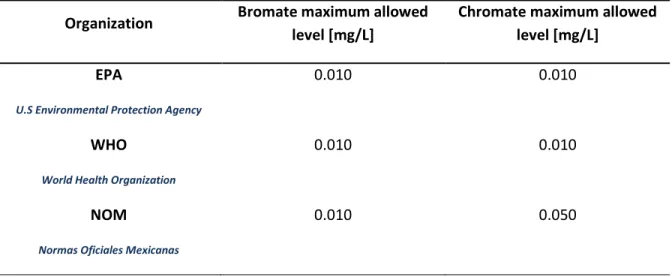
Table 1 Bromate and chromate maximum allowed level on drinking water by EPA, WHO and NOM.
Organization Bromate maximum allowed
level [mg/L]
Chromate maximum allowed level [mg/L]
EPA
U.S Environmental Protection Agency
0.010 0.010
WHO
World Health Organization
0.010 0.010
NOM
Normas Oficiales Mexicanas
0.010 0.050
3
Research motivation
Since bromate and chromate are two carcinogenic compounds that could be found in drinking water risking human’s health, efficient, economic and easy-to-do removal methods and adsorbents have to be developed. Double-layered hydroxides are adsorbents with a high adsorption capacity, an easy and non-risky synthesis, precursor salts are non-expensive reactants, and multiple adsorption/desorption cycles can be performed with the synthesized material. In fact, a wide variety of uses have been reported for double-layered hydroxides; for instance, the intensive use of double-layered hydroxides as adsorbents in removing diverse pollutant anions from aqueous solutions has been reported. However, there is a lack of information about the effect of thermal treatment of double layered hydroxides on the removal of anionic pollutants and, at the same time, adsorption/desorption and kinetic studies are not commonly reported for the dried and calcined adsorbents.
4
Hypothesis
Mg-Al double-layered hydroxides have an adsorption capacity greater than commercial granular activated carbon and they can be used for bromate and chromate removal in aqueous solution in batch and continuous process.
![Figure 4 Brucite sheet section sho hydroxyl anion with three Mg 2+ basal space [1]](https://thumb-us.123doks.com/thumbv2/123dok_es/6169608.182997/29.918.174.729.744.893/figure-brucite-sheet-section-hydroxyl-anion-basal-space.webp)