VIBRATION OF POROUS PLATES IN STRUCTURAL/ACOUSTIC
COUPLING APPLICATIONS
PACS REFERENCE:43.40.Dx
Leclaire, Philippe The University of Hull, Cottingham road Hull, HU6 7RX, UK
Tel: +44 1482 465049 Fax: +44 1482 466664 E-mail: [email protected]
ABSTRACT. The transverse vibration of thin poroelastic plates can be described with the help of the standard theory of plates, the fluid-solid relative displacement in the pores and fluid-solid coupling terms. Two coupled equations of dynamic equilibrium were obtained that can be solved by a variational method. The method can be used for any boundary condition at the edges. The influence of the plate parameters is studied and a condition of maximum damping is given. The calculated plate deflection is compared to experimental results for clamped porous plates. Studies currently in progress and possible applications involving structural/acoustic interactions are outlined.
1. INTRODUCTION
Porous panels can be used in applications such as flow duct silencers, fuselage structures in the aeronautical industry or double-wall building structures. A great number of applications exist where the vibration of the porous layer itself should be considered, in addition to the dynamics of the rest of the structure. For a thin and fairly rigid porous plate of finite size, the solid motion may correspond to a bending vibration with negligible variations of thickness.
Theodorakopoulos and Beskos [1] proposed a theory describing the bending vibrations of rectangular porous plates saturated by a fluid. By making the additional assumption that the plate is thin with respect to the acoustic wavelengths, a simpler analysis is possible without significant loss of generality, the major advantage being the gain in simplicity and flexibility of the model [2,3]. The plate is treated as a classical homogeneous plate but where elastic, inertial and viscous interactions can take place within the pores. The main physical parameters involved in this model are the porosity, the tortuosity and the permeability, and for the mechanical properties: the densities, Young's modulus and Poisson's ratio.
2. EQUATIONS FOR THE VIBRATION OF A POROUS PLATE
Two simple equations describing the bending vibration of a thin rectangular porous plate of thickness h have recently been proposed [2]:
(
w w)
q hw Mh
D ∇ s+ s+ f =
+α 4 ρ&& ρ &&
3 2
12
( )
(
w m w)
P hw
Mh∇ s − ρf&&s+ ω&& =∆
α 2
where ∇4=∇2
( )
∇2 and ∇2=∂2 ∂x2+∂2 ∂y2 in the system of coordinates (x, y, z) with x and y parallel to the plate laterals sizes a and b, respectively. In these equations, D is the bending stiffness of the plate, α and M are Biot’s elastic coefficients [5] that can be related to known or measurable elastic constants, h is the thickness, ws is the plate lateral displacement, w is thefluid solid relative displacement in the pores, ρ is the density of the solid-fluid mixture, ρf the
density of the fluid and ρs the density of the solid. The coefficient m(ω) is a frequency dependent
mass [6] introduced to accounts for the viscous friction between the fluid and the solid. This coefficient depends on the porosity, the permeability and the tortuosity. The fluid-saturated plate is subjected to the load q and the pressure difference between the two surfaces is ∆P. The first equation corresponds to the instantaneous elastic response of the plate and the second equation describes the relative motion between the solid and the fluid, including energy losses by viscous friction [7]. The two equations involve elastic coupling factor through the terms containing α, and inertial coupling through the terms containing the accelerations
w
&
&
s andw
&
&
.3. SOLUTIONS OF THE EQUATIONS OF EQUILIBRIUM FOR DIFFERENT BOUNDARY CONDITIONS AT THE EDGES
3.1. Variational method
If small variations δws and δw are considered for the plate deflection and for the fluid-solid
relative motion, respectively, the quantities [(D+α2Mh3/12)∇4ws]δws and [αMh∇2ws]δw represent incremental variations of the works of the internal forces during the motion of the fluid-saturated porous plate while [h(ρw&&s+ρfw&&)−q]δws and [h(ρfw&&s+m(ω)w&&)−∆P]δw can be considered as the works of the external forces (inertial terms and excitation). Applying a variational principle that minimises the total work within the boundaries (a,b) of the plate yields two variational equations for the porous plate:
(
)
∫ ∫
= − + + ∇ + b a s f ss h w w q w dxdy
w Mh D 0 0 4 3 2 0
12 ρ ρ δ
α & & & &
(
)
[
]
∫ ∫
b a Mh∇ ws−h fws+m w −∆P wdxdy=0 0 2 0 ) (ω δ ρ
α && &&
These two equations need to be solved simultaneously. Finding non-trivial solutions leads to explicit forms for ws and w and is a verification of the compatibility of these equations.
3.2. Solutions
The solutions ws and w, but also δws, δw, q, ∆p are expanded on the basis of orthogonal or
quasi-orthogonal eigenfunctions Φrn(x,y). For example for ws:
∑∑
∞= ∞= Φ = 1 1 ) , ( ) , ( r n rn s rns x y W x y
w
The plate is rectangular and two independent sets of functions are used, one set for the x-axis parallel to the a-side of the plate and the other for the y-axis along the b-side. These functions are called the beam functions. The eigenfunctions are then written as products of the beam functions:
Φrn(x,y)= θr(x).ψn(y)
coefficients. In this problem, the unknowns are the amplitude coefficients Wrns of the plate deflection and Wrn of the fluid/solid relative displacement. The functions θr(x) and ψn(y) are trial
functions in the variational method. The form chosen for the trial functions in this study is a linear combination of sinusoidal and hyperbolic functions:
+ + + = a x C a x C a x C a x C
x r r r r r r r r
r λ λ λ λ
θ( ) 1 sin 2 cos 3 sinh 4 cosh ,
the same form being used for ψn(y) as a function of y. The coefficients C1r, C2r, C3r and C4r depend on the boundary conditions at the edges of the plate and allow any condition involving simply supported, clamped or free edges to be included. These coefficients are deduced from the determinant of the homogeneous boundary conditions. The parameters λr are given by a
frequency equation, also characteristic of the way the plate is supported at the edges.
Inserting the trial functions in the double series giving ws, w, δws, δw and q, and inserting all
these in the variational equations leads to two equations in Wrns and Wrn.
3.3. Fluid loading
At the scale of the wavelengths, the porous medium appears as a continuous medium and the main results of the classical theory of plates can be applied to the porous case. It is possible to account for the fluid loading through and additional term that can appear together with the excitation terms: T pq BF mnpq P
mn j Z w
f =− ω
∑
where ZmnpqBF is the radiation impedance matrix and wT is the total velocity in the vicinity of the
plate surface. The total velocity field can be obtained from the simple sum wT = ws + w [8]. For
simplicity, this effect is not implemented numerically in this study. The experimental results will show that although this simplification is made, the comparison between theoretical and experimental results is fairly good.
4. NUMERICAL AND EXPERIMENTAL RESULTS
4.1. Numerical simulation
The modulus of the deflection, calculated at the centre for a simply supported plate is plotted in Figure 1 versus frequency for an air-filled porous panel of 0.5m×0.5m×10.70mm.
1 00 1 01 1 02 1 03 1 0- 1 2
1 0- 1 0 1 0-8 1 0-6 1 0-4 1 0-2
F r e q u e n c y ( H z )
|ws| (m)
P o i n t f o r c e 1 N a t ( 0 . 1 5 m , 0 . 1 m ) U n i f o r m p r e s s u r e 0 . 1 P a
Figure 1: Deflection calculated at the centre of a simply supported air-filled porous plate
The plate studied (Y-foam) was fabricated at the University of Bradford from recycled car dashboards for noise control application. The plate has a density of 353 kg/m3, a porosity of 0.69, a tortuosity of 1.3, a permeability of 2.7×10⁻¹⁰, a Young’s modulus of 2.1×10⁷ N/m2 and a loss factor of 0.1. The density of air is 1.2 kg/m3. The panel is excited either by a uniform incident pressure of 0.1 Pa amplitude or by a unit point force (1 N) located at x0 = 0.1 m, y0 =
0.15 m. These were the numerical values used in the simulation. The response is calculated in
The frequency and quality factor of the resonance peaks depend on the loss factor of the material but also on the microstructural parameters (porosity, tortuosity and permeability) as illustrated in Figure 2 where the calculated first resonance area of a porous sandstone saturated by water has been plotted versus frequency and permeability. The loss factor was put to zero in the numerical simulation so that the predicted damping is solely a consequence of the viscous friction mechanisms. This figure shows that the plate response exhibits an area of maximum damping between two sharp peaks. A simple approximate formula providing with good accuracy the value of the frequency of maximum damping was derived [2]:
f f
f b
ρ κτ
ηφ φρ
τ ω
∞ ∞
= =
0
where bf is Biot’s friction coefficient, τ∞ the tortuosity, φ the porosity, κ the permeability, η the
fluid dynamic viscosity and ρf the fluid density. This frequency is almost identical to Biot’s
characteristic frequency except that it accounts for the tortuosity.
1 4 1 6 1 8 2 0 2 2 2 4 2 6 2 8 1 0
- 1 1
1 0- 1 0 1 0- 9 1 0- 8 1 0- 7 1 0- 6
1 0- 4 1 0- 3 1 0- 2 1 0- 1 1 00
F r e q u e n c y ( H z )
Modulus of Deflection (m)
Figure 2. Effect of permeability on the resonance peaks and frequency of maximum damping
The physical interpretation of this behaviour is that the maximum damping occurs between two limit situations where the damping is very low (i.e. the resonance is sharp). In the first situation, the permeability is zero and so the fluid cannot flow in the porous material. Therefore, the attenuation by viscous friction (the only one considered in this model) is low. In the second situation, the permeability is infinite. In this case, the fluid can easily flow along the solid in the pores but the viscous attenuation is also very low because of the infinite permeability. Between these two limit cases, Biot’s viscous attenuation occurs, with a maximum in the damping. The conclusions of the theoretical and numerical studies are that the resonance frequencies increase with both porosity and permeability, and decrease with tortuosity while the damping increases with porosity, decreases with tortuosity and reaches a maximum value at a frequency depending on these three parameters.
4.2. Experimental results and comparison with predictions
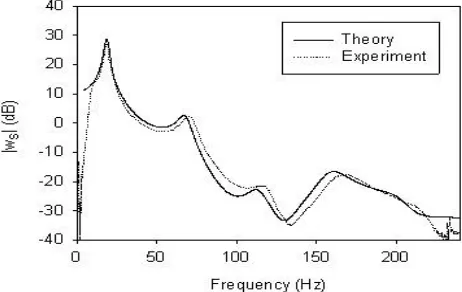
of Young’s modulus and the Poisson ratio used in the model. Also, it was assumed that the incident pressure field at low frequencies is uniform over the plate surface, while it is not perfectly constant in the real experimental configuration.
[image:5.596.179.410.111.257.2]Figure 3. Theoretical and experimental deflection at the centre of a porous plate (Y-foam)
Figure 4 shows the results for another plate (G-foam) with different characteristics such that the first resonance occurs at a lower frequency. The calculation and the experiment were carried out off-centre, at (14.4 cm, 24 cm) from a corner (the plate is square shaped). Here again, one can consider that the agreement is fairly good for the general shape. The reason for the bad agreement observed between 0 and 10 Hz is probably that the low frequency limit in the microphone response is 10 Hz and so the experimental results below this frequency should not be considered as reliable. The shape of the both the experimental and theoretical curves indicates that the accelerometer was located close to a node of vibration for the frequency range displayed so that only the movement corresponding to the first resonance frequency was detected. Smaller resonance peaks at higher frequencies may also have been heavily damped due to the high loss factor of this material and to the viscous friction mechanism.
Figure 4. Calculated and measured deflection off-centre (G-foam)
5. CONCLUDING REMARKS
A simple model of vibration of a porous plate based on the application of the classical theory to porous plates has been proposed. Two coupled equations characterising the elastic response of the plate and the fluid-solid relative motion with friction were proposed. A variational method for solving these has been applied and the solutions have been given for different materials with the four edges clamped. The comparison between experimental and theoretical results on the plate deflection is fairly good if the viscoelastic damping in the solid is accounted for.
preliminary study has shown that the vibration can significantly enhance the acoustic performance at low frequencies where the absorption coefficient is generally low [9]. The applications are concerned with the design of noise barriers, noise attenuating devices in flow ducts and in building engineering. An important issue that needs to be addressed is the determination of the sound power radiated by a vibrating porous plate. It is thought that the determination of this parameter and of the other vibroacoustic indicators requires the knowledge of the total velocity field in the vicinity of the plate surface. Since the total velocity field is given
by wT(x,y) = ws(x,y) + w(x,y) [9], this calculation requires the determination of ws and w at many
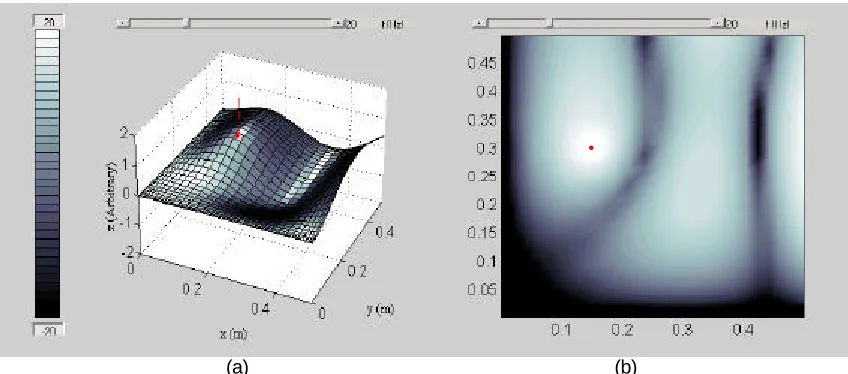
positions on the plate. As a step towards the calculation of the radiated sound power, Figure 5a) shows the deformation of a porous plate at a frequency of 28 Hz. The mean square velocity and therefore the distribution of the vibrational energy on the surface is represented in Figure 5b).
(a) (b)
Figure 5. (a) Deformation at 28 Hz of a fluid-saturated porous plate with two consecutive edges clamped and two consecutive edges free. (b) Distribution of energy on the surface. The plate is excited by a point force in this example. The dot gives the location of the force (0.15 m, 0.3 m).
This work has been carried out with the support of the British Engineering and Physical Sciences Research Council (EPSRC) grant number GR/R43761/01.
REFERENCES
[1] D. D. Theodorakopoulos and D. E. Beskos, ‘Flexural vibration of poroelastic plates’, Acta Mechanica, 103, 191-203 (1994).
[2] P. Leclaire, A. Cummings and K. V. Horoshenkov, 'Transverse vibration of a thin rectangular porous plate saturated by a fluid', J. Sound Vib., 247, 1-18 (2001).
[3] P. Leclaire, K. V. Horoshenkov, M. J. Swift and D. C. Hothersall, 'The vibrational response of a clamped rectangular porous plate', J. Sound Vib., 247, 19-31 (2001).
[4] R. Szilard, Theory and Analysis of Plates: Classical and Numerical Methods, Prentice-Hall, Englewood, New Jersey (1974).
[5] M. A. Biot and D. G. Willis, ‘The elastic coefficients of the theory of consolidation’, J. Appl. Mech., 24, 594-601 (1957).
[6] M. A. Biot, ‘Mechanics of deformation and acoustic propagation in porous media’, J. Appl. Phys., 33, 1482-1498 (1962).
[7] M. A. Biot, ‘Theory of buckling of a porous slab and its thermoelastic analogy’, J. Appl. Mech. ASME, 31, 194-198 (1964).
[8] H. Deresiewicz and R. Skalak, ‘On uniqueness in dynamic poroelasticity’, Bull. Seism. Soc. Am., 53, 783-788 (1963).
[image:6.596.85.509.203.390.2]