Application proposal for Colombian agriculture
Maria Daniela Ariza Ariza1, Nayibe Cardona Díaz2, Giovanny Mauricio Tarazona
Bermúdez3
Abstract: This document analyzes and verifies agricultural applications available in Colombia, evaluating their level of functionality and usability, in order to make a proposal of the elements that an application for agriculture should contain, taking into account aspects that are not contemplated in the evaluated applications.
• Keywords: agricultural apps, precise agriculture, usability, functionality, crop management.
Resumen: En este documento se realiza un análisis y verificación de aplicaciones agrícolas disponibles en Colombia, evaluando su nivel de funcionalidad y usabilidad, con el fin de realizar una propuesta de los elementos que debe de contener una aplicación para el agro, teniendo en cuenta aspectos que no se contemplan en las aplicaciones evaluadas.
Palabras clave: aplicaciones agrícolas, agricultura precisa, usabilidad, funcionalidad, gestión del cultivo.
1. Introduction
During the last decades there is a great interest in the use of data and the analysis there of to achieve an efficient applicability in the agricultural sector, which seeks to make big and small entrepreneurs of the agro take effective decisions about their work and increase your competitiveness. This is how the frequent and increasing use of mobile applications and web in the world is generating a greater offer of them in different portals and modalities; The verification of the functionality of these applications is an important factor and a quality
1Estudiante de Ingeniería Industrial, Universidad Distrital Francisco José de Caldas, , Correo electrónico: [email protected], ORCID: https://orcid.org/0000-0003-0451-1310
2Estudiante de Ingeniería Industrial, Universidad Distrital Francisco José de Caldas, Correo electrónico: [email protected], ORCID: https://orcid.org/0000-0003-3851-988X
component for creators and users. Taking this to a more compact research area, the agricultural sector is generating large amounts of data, which are and want to be used by farmers to make decisions about their work and their lands. In the same way, the increase of their productivity and work capacity is an essential factor for each worker, farmer or entrepreneur, for this the use of applications is a way to update their information in real time. The frequent and increasing use of web and mobile apps in the world is generating a greater supply of its in different portals and modalities; the verification of the functionality of these applications is an important factor and a quality component for developers and users. Carrying this to a more compact area of research, the agricultural sector is generating large amounts of data, which are, and want to be, used by farmers for decision-making on their work and their lands [1]. In the same way, the increasing of its productivity and work capacity is an essential factor for each worker, farmer or employer, for this purpose, the use of apps is a way to update their information on real time [2].
2. State of Arte
Nowadays, the use of data in any business or commercial ambit has become an essential activity for the planning, programming and implementation of projects in different productive sectors of any country. Over the years there have been several discussions on the use of information in the agricultural work, demonstrating, in many cases that has been implemented, a prosperous advance in the markets and competitive positioning of farmers, traders and entrepreneurs who decide to rely on data and information collected and analyzed, in their productive sectors [3].
2.1. Precision Agriculture (PA)
store, manage, and integrate both data, so that they respect the privacy of individuals while enabling various stakeholders to take benefit of improved information and analysis [5]. The current ratio of agricultural lands respecting to the world population is enough to satisfy the world's nourishment needs; however, the global population is expected to grow exponentially in the coming years, where the total area of agricultural land shrinks day by day [1]. This cause, in addition to other ones such as pollution, misuse of resources, leads agricultural production techniques in different countries to be updated to increase production and generate a secure food supply [6], For them it is essential to collect data from various sources of PA to make predictive decisions due to the increase in production and agricultural management depends, in most cases, the climatic conditions [7].
Both governmental and non-governmental organizations have established a wide variety of data, knowledge and institutional arrangements that, together, constitute an "infrastructure" that supports the management of agricultural landscapes [8]. This physical and institutional infrastructure differs greatly throughout the world, but what they all have in common is the great challenge to acquire specific data and specific location data, combining them with analytical tools to improve the quality of the decision. In various degrees, this decision of making infrastructure, has evolved in many countries along public policy, toward what we describe as "science-based policy", that is to say, a policy designed to achieve the goal of sustainable agricultural management as efficiently and effectively as possible, given the availability of science and technology [9].
within the system and include both states and flow variables. The state variables define the status or performance of the system at specified points in time. [12].
The decision-support tools, generally considered to be based on software, can be an important part of the decision-taking hunt based on evidence in agriculture to improve productivity and environmental products [13]. These tools can lead users through clear steps and suggest ways of optimal decision or it can also act more as sources of information to improve the evidence base for decisions [14]. It is clear that the exponential increase in the data that can be found and the difficulty of its treatment, generates one of the most complicated obstacles toward the use of same. The planning for agricultural adaptation and mitigation must rely on informed processes of decision-taking [2] [15].
Typically, the data set of precision agriculture refers to the following types: [7][16]
• Historical data.
• Farm equipment and sensor data
• Social and based on the Web data
• Publications
• Sequence distributed data
• Businesses, industries and external data
Specialists on precise agriculture think that the ideal thing would be working with interdisciplinary teams, without relying on a single company, so seed laboratories could also access to these data, and be able to recommend the material, the density and fertilization adapted to each particular environment, among other factors. [17].
2.2. Precision agriculture (PA) in Colombia
Colombia depends, in a large measure, of the retail trade in regard to the products of the agro, the vast majority of the trade is in stores or neighborhood markets and a lesser extent in large chains of market that is where the intermediaries influence the price of the product [21]. In this type of trade are always involved, these intermediaries are those who play with the supply and demand by balancing the prices of the products according to the quantities of product on the market. It is like a tool for electronic commerce allows you to avoid the intermediary and brings the product to the final distributor [22].
Currently, in Colombia, the e-commerce and information and communication technologies are increasing fastly, this is a global movement that cannot be stopped and the agro cannot be oblivious to this, in the digital market there are countless apps and web portals that allow people to put on sale their products whether they are produced by themselves or resold, knowing the weather information, latest news, among other functions [23]. However, in the agricultural sector of Colombia, the increase in the use of these technologies is lower, compared to other economic sectors, despite the fact that efforts have been made to modernize the field, many producers have been unable to adapt to new technologies and how to use them [24][25].
Institutions such as the Ministry of Information and Communication Technologies and the Ministry of Agriculture and Rural Development are generating a process of modernization and national connectivity generating training to new generations of agricultural producers in communication technologies and developing mobile apps [26]. There is a new generation of agricultural producers closest to the new technologies, which is displacing the old ones and traditional generations of producers who gave their lives for the Colombian countryside, that is how now more detailed studies of the soil, with tools topographical and soil analysis equipment that generate more accurate data are made, also GPS are used to predict the weather [22].
Colombia, being one of the countries of greater use of mobile apps in Latin America, has been concretized the different characteristics that must have an app either for mobile or web to achieve appropriate functionality for users, and in this case the producers, with the possibility of a quick and easy learning: [27][28].
• Functionality and adaptability on mobile devices
3. Platforms Evaluation
For the evaluation of the functionality of some mobile platforms that have been designed for the agricultural sector, there were rated two relevant aspects of the proper functioning of the apps such as the following:
• User interface: In this section, we verified that the environment on which the user
communicates with the device could be comprehensible at all points of contact between the user and the app, in this way, apps should be easy to understand and easy to operate.
• Content of the Application: In this section, we characterized the different
characteristics or requirements that have different applications to assess what special features designed each of them, with regard to the field of application, in this case agriculture [29].
This evaluation was carried out using a matrix constructed and designed by the authors, in which the aspects to be evaluated are contemplated and that are evidenced in the graph. To perform this process, the applications mentioned were downloaded to different devices, being these Android because this platform covers most of the device market being the easiest to use and acquire by our target market, and with it was made the verification of each of the proposed aspects.
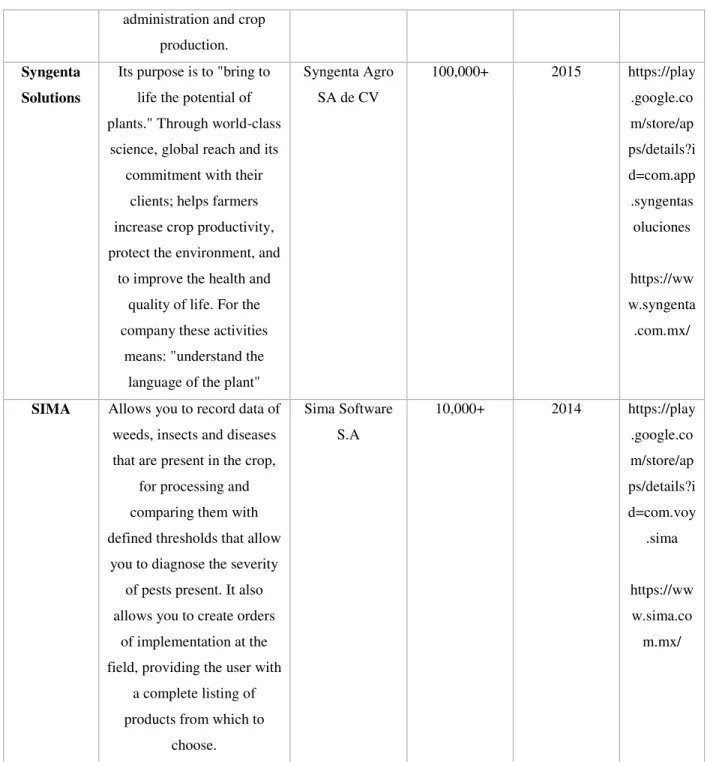
The following assessment was conducted to the 9 applications in the agricultural sector, with largest number of downloads and/or higher grade use (Table 1).
Name Description Entity in charge Number of downloads Year of Development WEB SITE
AgroClima Provides information of different variables as the
weather forecast, daily alerts
and the incidence of these
phenomena in the
Colombian agriculture in
different regions of the
country, as well as the data
of climate variables of
Ministry of Agriculture and Rural Development, Ministry of Information and Communication Technologies
1,000+ 2016 https://play
precipitation, temperature,
sunlight and humidity.[30]
Agro Insumos
Allows you to consult the
sales prices of the main
agricultural inputs of
Colombia and compare them
with the national average
and departmental levels,
allows users to report the
purchase prices in a specific
point of sale, it helps the
user to locate points of sale
in a municipality and/or
registering them. Ministry of Agriculture and Rural Development, Ministry of Information and Communication Technologies
1,000+ 2016 https://play
.google.co m/store/ap ps/details?i d=c.gov.ag ronet.agroi nsumos Agro TeConecta
Allows producers to the
consultation of the main
steps regarding the
agricultural sector, for the
development of their
economic activities and
certifications of agricultural
products, which allows
different users have
complete information of the
different procedures and
regulations that must be
followed for undertaking
activities of negotiation,
communication and
collaboration in working
modes. Ministry of Agriculture and Rural Development, Ministry of Information and Communication Technologies
500+ 2016 https://play
.google.co m/store/ap ps/details?i d=co.gov.a gronet.agro teconecta
AgroMapp Offers its users a complete catalog of crops or products
(A-Z), in the same way
provides various information
about nutrition, protection,
seeds, supplements, the
Bioagrotech 10,000+ 2016 https://play
.google.co
m/store/ap
ps/details?i
various agricultural products
in each country or region,
interactive improvement,
among other significant
activities bionet.agro mapp https://bioa grotech.co/ Booster Agro
Allows users to access the
entire climate information
and productive in their fields
in one place. Allows you to
compare all the predictions
of climate, satellite
monitoring of crops, satellite
weather station, form of
climate records, information
collaborative.
Booster Ag
Tech, Inc.
10,000+ 2017 https://play
.google.co m/store/ap ps/details?i d=com.boo steragtech. boosteragr o http://term s.boosterag ro.com/
Dr. Agro Directed to different agricultural workers, in
order to support and guide in
the identification,
management and control of
insects, pests and diseases of
different crops.
CorpoIca
Mobile
Development
1,000+ 2016 https://play
.google.co m/store/ap ps/details?i d=co.org.c orpoica.do ctoragro
Kanpo Allows for the implementation of the
measures necessary to
achieve the certification of
Good Agricultural Practices.
Some features are: receive
suggestions for use of
agricultural inputs, access to
recommendations for
improvement, set actions,
resources, costs and time
required for efficient
Kanpo 1,000+ 2015 https://play
administration and crop
production.
Syngenta Solutions
Its purpose is to "bring to
life the potential of
plants." Through world-class
science, global reach and its
commitment with their
clients; helps farmers
increase crop productivity,
protect the environment, and
to improve the health and
quality of life. For the
company these activities
means: "understand the
language of the plant"
Syngenta Agro
SA de CV
100,000+ 2015 https://play
.google.co m/store/ap ps/details?i d=com.app .syngentas oluciones https://ww w.syngenta .com.mx/
SIMA Allows you to record data of weeds, insects and diseases
that are present in the crop,
for processing and
comparing them with
defined thresholds that allow
you to diagnose the severity
of pests present. It also
allows you to create orders
of implementation at the
field, providing the user with
a complete listing of
products from which to
choose.
Sima Software
S.A
10,000+ 2014 https://play
.google.co m/store/ap ps/details?i d=com.voy .sima https://ww w.sima.co m.mx/
Table 1. Description of the mobile platforms evaluated
3.1 Results of the Evaluation
The results of the evaluation of applications in graphical form are below (Figure 1).
(A) (B)
Figure 1(a). A result of the evaluation of the user interface component
Figure 1(b). A result of the evaluation of the content component applications
Source: Own.
With regard to the user interface, the most of the apps comply with the characteristics necessary for a normal operation, which makes it much easier to use, thanks to which the user can interact with the app understanding its entire functionality.
The content of the applications in the agro, varies, each app focuses on punctual aspects required for the process to make a crop, this prevents that users may have control over their project, because it requires multiple apps and the information adding to each app for performing the timely aspect for what it was developed, thus forcing the user to repeatedly enter the same information, becoming a tedious process and not into a support tool.
4. Proposal mobile platform "Agro Engineering"
post-planting process, giving you a tool that fits the needs of each crop and allows the farmer to have a monitored different crops products in different geographical locations.
With this application you expect the farmer to monitor its cultivation globally, being aware of the status of the same, giving you the information of different variables that will allow you to make objective decisions on its planting in order to optimize inputs, times and costs. The farmer will be an important element for the proper functioning of this application, he will be the one who provides information on his cultivation, ensuring that this app is adjusted to the conditions of each one of the plantings and at the end of the process will allow you to set the gain obtained.
This application will become a fundamental tool for farmers since it will allow them to plan and monitor all the stages of the crop, taking into account functions that do not contemplate the evaluated applications such as activities, costs and time. This is why the farmer will have a global vision of the state of his crop so that he can make decisions at the right time. This application seeks that users have all the necessary information to make a crop and create a network of contacts with other users who produce or buy the products cultivated in order to establish relationships between them and strengthen agriculture in Colombia.
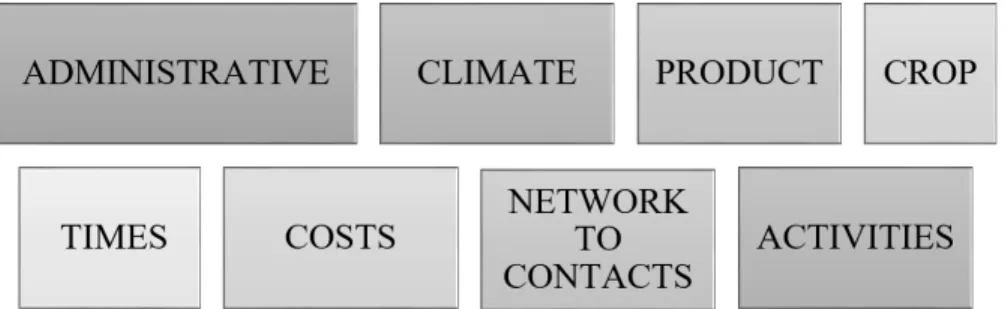
In the functional requirements raised eight modules, as shown in Figure 2, which allow us to have control of the cultivation of globally, because each one of these modules provides information from a different aspect.
Figure 2: Modules of the functional requirements of the application
Source: Own.
• Administrative: Contains the general information of the crop, as well as a report that shows the global state showing the time. In this component we find: Lot size, location, name of the crop, name of the manager, general report.
• Climate: Provide information of variables related to the climate as listed below
and different sources in order to ensure and verify the information provided. In this component we find: Temperature, humidity, wind, weather, pressure, P. dew, burst.
• Crop: Provide information on the specific crop, where you will find detailed
information on the same so that the user can perform queries on the crop phenology, diseases and recommendations that should be taken. In this component we find: Green Index (HD), crop phenology, quantity of plants sown and diseases.
• Products: Allows the user to select the product they are going to plant, in order to
ensure that the information found in module of cultivation will be only on that product. In this component we find: description, image, historical price of the products.
• Time: Allow the user to have basic knowledge of the times and their work
according to its cultivation. In this component we find: land preparation, sowing the seeds, phases of cultivation and collection.
• Network of Contacts: Provide information on other farmers that use the
application and are sowing the same product, in addition to having the information of workers that are part of the crop, where you can authorize that some of them have access to the information of the crop. In this component we find: Information from other farmers and information of collaborators.
• Costs: Will allow the farmer to have control over each one of its costs in each of
• Activities: You Will Be Able to perform the planning of activities from the beginning of the crop and the application will warn you on the date you selected to do not forget it. In this component we find: Activity, Cost and time and reminders.
4.1. Information Flow
It is important to establish the flow of information within the application, in order that the user only have to supply only once the data that each of the modules will process, then send this information to others who need it, for its proper functioning (Figure 3).
Figure 3. Diagram of information flow
Source: Own.
The arrows indicate the direction from the module from which the information leaves towards where it arrives, to obtain that each one of the modules counts on the necessary information for its proper functioning, because the modules of administration, costs, culture and network of contact require information that is in the other modules either because the system gets it or the user provides it.
4.2. Proposals Interfaces
necessary that the interface only displays the information needed and show a large letter accompanied by basic icons that will allow the interpretation of the same (Figure 4).
(A) (B)
Figure 4(a): User interface for planting activities - App for
Figure 4(b). User interface for planting costs
Source: Own
.
Other important elements are the interfaces of activities, costs and duration. During the project will be able to download reports that allow you to have a compilation of the costs, resources and time incurred.
5. Conclusions
• The applications evaluated for agriculture are designed for very specific aspects such as knowing the climate, marketing products or knowing about specific crops. It is therefore necessary to have several applications installed in order to have control of the entire crop.
save on the products needed for cultivation, minimizing costs and optimizing the agricultural work, reducing the environmental impact by optimizing the use of water, pesticides and fuel machinery; as well, with fewer resources obtain greater production, allowing you to cope with the massive reduction of arable land which we see in our days and the growth of the world's population.
• Most applications have as main function the management of an activity related to agriculture, that is to say, works the climate or the care of crops or disease, separately, but not manages all activities that are in this field; because of this, to supplement the administration of agricultural production, it is imperative that users downloading multiple platforms to achieve the full development of the activities.
6. Future Work
References
[1] X. Pham and M. Stack, “How data analytics is transforming agriculture,” Bus. Horiz., vol. 61, no. 1, pp. 125–133, 2018.
[2] K. Sabarina and N. Priya, “Lowering data dimensionality in big data for the benefit of precision agriculture,” Procedia Comput. Sci., vol. 48, no. C, pp. 548–554, 2015. https://doi.org/10.1016/j.procs.2015.04.134
[3] B. Mertens, “From Farm To Fork,” Forbes Asia, vol. 7, no. 14, pp. 42–48, 2011. [4] M. Kumar and M. Nagar, “Big Data analytics in agriculture and distribution channel,” 2017 Int. Conf. Comput. Methodol. Commun., no. Iccmc, pp. 384–387, 2017. https://doi.org/10.1109/iccmc.2017.8282714
[5] J. Antle, S. Capalbo, and L. Houston, “Using Big Data to Evaluate Agro-environmental Policies,” Choices Mag. food, farm, Resour issues, vol. 30, no. 3, pp. 1–8, 2015.
[6] OMM and CIIFEN “Servicios de Información y Predicción del Clima y Aplicaciones Agrometeorológicas para los países Andinos,” [Online] Available:
http://www.wamis.org/agm/pubs/agm6/TD1234_AGM6_WCAC2.pdf
[7] M. R. Bendre, R. C. Thool, and V. R. Thool, “Big data in precision agriculture: Weather forecasting for future farming,” Proc. 2015 1st Int. Conf. Next Gener. Comput. Technol. NGCT 2015, no. September, pp. 744–750, 2016.
https://doi.org/10.1109/ngct.2015.7375220
[8] G. wa Mbũgwa, S. D. Prager, and J. M. Krall, “Utilization of spatial decision support systems decision-making in dryland agriculture: A Tifton burclover case study,” Comput.
Electron. Agric., vol. 118, pp. 215–224, 2015. https://doi.org/10.1016/j.compag.2015.09.008
[9] S. M. Capalbo, J. M. Antle, and C. Seavert, “Next generation data systems and knowledge products to support agricultural producers and science-based policy decision making,” Agric. Syst., vol. 155, pp. 191–199, 2017. https://doi.org/10.1016/j.agsy.2016.10.009 [10] J. M. Antle, “Modeling Agroecosystem Services for Policy Analysis *,” [Online] Available:
http://citeseerx.ist.psu.edu/viewdoc/download?doi=10.1.1.173.2728&rep=rep1&type=pdf
[12] J. M. Antle and S. M. Capalbo, “As a Managed Ecosystem : Agriculture Policy Implications” Journal ofAgricultural and Resource Economics, vol. 27, no. 1, pp. 1–15, 2013.
[13] N. Wang, N. Zhang, and M. Wang, “Wireless sensors in agriculture and food industry - Recent development and future perspective,” Comput. Electron. Agric., vol. 50, no. 1, pp. 1–14, 2006. https://doi.org/10.1016/j.compag.2005.09.003
[14] D. C. Rose et al., “Decision support tools for agriculture: {Towards} effective design and delivery,” Agric. Syst., vol. 149, pp. 165–174, 2016.
[15] P. Brandt, M. Kvakić, K. Butterbach-Bahl, and M. C. Rufino, “How to target climate-smart agriculture? Concept and application of the consensus-driven decision support framework “targetCSA”” Agricultural Systems, vol. 151, pp. 234–245, 2017. https://doi.org/10.1016/j.agsy.2015.12.011
[16] M. A., “Colombia Digital,” 2013. [Online]. Available:
http://colombiadigital.net/actualidad/articulos-informativos/item/5687-agro-y-tecnologia-cosechando-futuro.html
[17] J. Nagel, “Principales barreras para la adopción de las TIC en la agricultura y en las áreas rurales,” Nac. Unidas - CEPAL, p. 54, 2012. https://doi.org/10.2307/j.ctv3dnp2m.4 [18] M. Akimowicz, H. Cummings, and K. Landman, “Green lights in the Greenbelt? A qualitative analysis of farm investment decision-making in peri-urban Southern Ontario,”
Land use policy, vol. 55, pp. 24–36, 2016. https://doi.org/10.1016/j.landusepol.2016.03.024
[19] R. Argüello, “alianzas público-privadas para el desarrollo de agronegocios Informe de país: Colombia,” [Online] Available: http://www.fao.org/3/aq437s/aq437s.pdf
[20] E. Alejandra, C. Niño, and U. S. Arboleda, “Planteamiento de una Metodología y Modelo de integración de las TIC al sector Agrícola”, Eleventh LACCEI Latin American and Caribbean Conference for Engineering and Technology (LACCEI’2013), August 14 - 16, 2013 Cancún, México. pp. 1–10.
[22] D. R. Alvarado, “el comercio electronico una estrategia para los negocios del agro en colombia,” Programa académico especialización en alta gerencia, Universidad Militar Nueva Granada, Bogota D.C., Mayo de 2016.
[23] T. Jetzek, M. Avital, and N. Bjørn-Andersen, “The Value of Open Government Data,”
PERSPEKTIV, no. 23, p. 12, 2013.
[24] S. Ch. Chandra Sekhar, Asst. Prof, Dept.Of IT, AITAM, “Productivity Improvement in Agriculture Sector Using Big Data Tools.”, International Conference on Big Data Analytics and Computational Intelligence (ICBDAC) , pp. 169–172, 2017.
[25] G. de Colombia, “Vive Digital,” 2014. [Online]. Available:
http://estrategias.gobiernoenlinea.gov.co/623/w3-article-8340.html
[26] J. W. Jones et al., “The DSSAT cropping system model”, European Journal of
Agronomy,vol. 18, no. 3–4. 2003, pp. 235-265
[27] M. A. F. Rojas, “Determinación del grado de uso de aplicaciones móviles en procesos agroindustriales,” Programa de ingeniería industrial, Universidad Militar Nueva Granada, 2015.
[28] J. Fwerraris, “Infotechology” 2013. [Online]. Available:
http://infotechology.com/columnistas/La-importancia-de-la-experiencia-de-usuario-en-las-aplicaciones-moviles-20130618-0003.html
[29] H. Badal, “Usabilidad de Aplicaciones,” 2013. [Online]. Available:
http://www.yeeply.com/blog/usabilidad-aplicaciones-moveles/