The Post-Industrial Myth
Daniel Townsend
Chapter 1
Regeneration in the UK
economy
Britain is supposedly a post-industrial country. I guess you could argue that this is the case, since the rapid pace of industrialisation which resulted dur-ing, and to some extent after, the Industrial Revolution has come to an end. The problem is, post-industrialisation gives a very misleading message. It implies that industry, by which many come to understand as manufacturing based activity, has come to an end. Or an even more perilous view is that it isn’t important.
Who harboured this view? In my opinion it’s a fallacy, whose existence is of potential detriment to the UK, and other developed countries. In this article I shall discuss how this term came to be, and the bearing that it may have on the future development, both socially and economically of the UK. Arguably, the times of greatest change in post-war Britain were the Thatcher years. I am not of the opinion that all of Thatcher’s policies were positive, but nonetheless, prior to Thatcher’s ascension the country was in economic dire straits. There were lumbering old dinosaurs of industry, which gobbled up state subsidies, and showed little, if any, appetite for change. After the episodes of wide spread privatisation, which have been well docu-mented elsewhere, the UK fell in to the seeming ignominy of the 90’s where the country quietly rebuilt itself under the auspices of a Labour government. Defining changes in the economy took place, where new growth was largely from the emergence of a preeminent financial services sector, which
4 CHAPTER 1. REGENERATION IN THE UK ECONOMY
has lasting importance today. The emergence of the City of London at the forefront of the global finance industry was largely a by product of changes in government policy. It is sometimes easy to forget that Canary Warf was built atop docklands in the heartland of London, which in the past had pro-vided widespread employment, but had since fallen into terminal decline. London, which had served as a thriving site for the exchange of goods, had become unsuitable for that which it had built its fortunes on. This is why the regeneration, based heavily on the trading of financial instruments, was so symbolic. Canary Warf, in my opinion is the greatest economic success story in the last 50 years for the UK. But the downturn in economic activity that predated the developments in the City was widespread, and in no way isolated to London. Liverpool was in a similar position to London in that it was once heavily dependent on its docks and systems of trade, and has never fully recovered.
5
During the late 90’s and the start of the new century, new impetus seemed to be found to set more of the countrys cities in good stead for the coming millennia. The idea was hit upon to instigate a cultural renais-sance in these cities, as characterised by the proliferation of Starbucks coffee chains, and the development of more and more shopping outlets, aiming to stimulate consumer spending. It mattered little that each city underwent almost identical changes, albeit for a couple of iconic new statues, public art works, or amenities which set each apart. It was well and truly an attack of the clones, and the cities selected for such ’updating’ suffered culturally under the onslaught of the retail chains. Places which were previously brim-ming with individuality, soon became lost in the ’me too’ era of Topshop, Debenhams, and Primark. As long as the high street looked good, never mind public housing, or real jobs, or giving people more to look forward to than the Saturday shopping trip. This was it - 21st Century Britain. Well and truly a nation of shop keepers.
6 CHAPTER 1. REGENERATION IN THE UK ECONOMY
Chapter 2
The City and Industry - Bed
Buddies?
Industry as it exists today has to contend with an increasingly difficult op-erating environment. Up until early 2008, the pound has been consistently strong. There are benefits to this to the wider economy. Banks for instance favour a strong home currency. And consumers benefit from greater pur-chase power in the shops. But manufacturing, or in a broader sense, any company geared towards the export of products, is seriously hampered by the high value of the pound. In an increasingly competitive global economy, UK tangibles are simply priced too highly. And this doesnt just apply to heavy industry it is equally applicable to agriculture. Consider a sheep farmer. The price that a farmer will receive for sheep fleeces is so low that shearing the sheep is a loss making exercise. Even in the face of strong international demand, there is little money to be made. Big deal you might say, but this simple example is representative of real business struggling to compete.
However, during the credit crunch of ’08, the pound has begun to fall in value. Big city institutions have taken big knocks, and are crying out about a recession. But this downturn is largely confined to banks, who watch in-credulously as manufacturing based activity remains steady. The truth of the matter is, manufacturing and export can benefit from the deflated value of the pound. All of a sudden products may seem more attractive to interna-tional buyers. It’s clear that the credit crunch has hit the UK very strongly, but this is mostly due the high reliance on banks. It serves to illustrate that a balanced economy is needed to help ride out the financial turbulence.
8 CHAPTER 2. THE CITY AND INDUSTRY - BED BUDDIES?
And this includes manufacturing based activity. Innovative companies can think their way out of a fix, or else are already benefiting from strong order books. A case in point is Rolls Royce, who currently has an order book worth 45.9bn1. Likewise, companies in the oil, mining and pharmaceutical sectors have continued to perform unabashed.
Figure 2.1: Rolls Royce Jet Engine
Chapter 3
The Second Industrial
Revolution
For the last hundred years or so, the economic development of this country has been predicated on cheap energy. We’ve been fortunate to have such ex-tensive oil and gas reserves in the North Sea. It has allowed us to persist on our fundamentally 19th Century based infrastructure. But as the cost and social implications of using traditional fuels is becoming more prohibitive, we will surely have to look to alternatives. Whether this means ripping out or retrofitting the existing infrastructure remains to be seen, but either way investment will have to be made in the areas that have been neglected for nigh on half a century.
The UK could lead the world in a second Industrial Revolution, because that is surely what its going to take. It’s up to politicians to make the brave decisions and instigate fundamental changes which will secure the future of this country as a global player. And undoubtedly this depends on being a trail blazer of change. This way the UK can give rise to companies with the expertise necessary to tackle the problems which all countries will eventually encounter.
We can’t afford to talk about a post industrial economy when the in-evitable changes will only be instigated by industrial companies whether that means existing big players, or new start ups generating the ideas thatll secure a sustainable future.
Chapter 4
21st Century Products
A thoroughly modern industry is software. It’s a good example of a service-style business. There are many big players in the world of software, but they all follow a limited number of business models. There are the traditional types like Microsoft, who sell there software like any other product. They are almost exclusively involved in the provision of core, infrastructure style software. Oracle, Autodesk and Adobe are others in the fortunate position to be so central in the software ecosystem. Another lucrative model, as exhibited by Google, Yahoo, and any number of Web 2.0 start ups, is the provision of free, ad supported software. An example of the third type is Apple. Apple puts a lot of money into the development of software, but mainly in order to create a better user experience from their blend of highly synchronous hardware and software. There goal is sell as much hardware as possible, because hardware can be highly lucrative, and unlike software, it can’t be pirated.
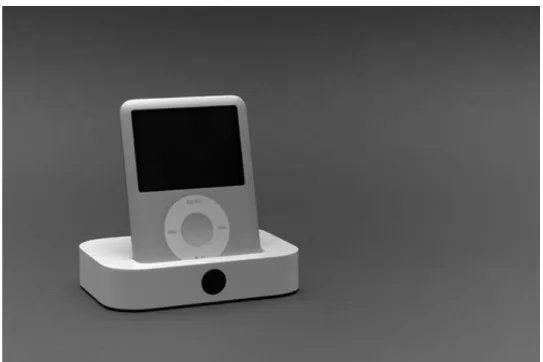
Apple has attracted a lot of press recently, mostly concerning the suc-cess of its products. Apple is a fantastic example of the blurring of the lines between manufacturing and services. Apple manages to provide intangible benefits through tangible products. This is an area that the UK needs to be more strongly involved in where manufacturing is not overlooked, but is rather one half of the equation, the other being talented, driven people with great ideas. Could the iPod have been created in the UK? We undoubtedly have the talent, but I wonder whether we have the necessary skills to turn such a product into reality.
12 CHAPTER 4. 21ST CENTURY PRODUCTS
Figure 4.1: iPod
tance of people within the British design scene who are committed to the realisation of ideas:
”As a buyer for furniture store SCP, Van Elten felt many good designs weren’t making it to the market due to the paucity of British manufacturing. So, with his own capital, he decided to batch-produce in the UK...Saluted for investing in young British talent, Van Elten maintains he is a ”producer”, not a manufacturer (”I don’t have any factories”).”
spectacu-13
larly wrong.
Figure 4.2: Dyson vacuum cleaner
Chapter 5
Doing More
Hopefully this article helps to banish the myth of the post-industrial econ-omy. What I am calling for is greater diversity in our economy, and the removal of harmful bracketing that can lead to unfair policy decisions.
1. http://www.rolls-royce.com/media/showPR.jsp?PRID= 40609
2. http://arts.guardian.co.uk/art/design/story/0,,2159165,00.html 3. http://flickr.com/photos/keithbarlow/2322200604/
4. http://flickr.com/photos/i-fotos/1090071149/ 5. http://flickr.com/photos/moertl/1779434588/
6. http://www.allergysolution.com/prodimages/Dyson3089a.jpg