UNIVERSIDAD TÉCNICA PARTICULAR DE LOJA
La Universidad Católica de Loja
ESCUELA DE CIENCIAS DE LA EDUCACIÓN MENCIÓN INGLÉS
MODALIDAD ABIERTA Y A DISTANCIA
A DESCRIPTIVE ANALYSIS OF ANGLICISMS USED IN ECUADORIAN MAGAZINES
Research done in order to achieve the Bachelor’s Degree in Teaching English as a Foreign Language
AUTHOR:
YÉPEZ RÍOS NELLY PATRICIA ADVISOR:
MGS. VARGAS SARITAMA ALBA
CERTIFICATION
The Magister Alba Vargas Saritama CERTIFIES THAT:
This research work has been thoroughly revised by the graduation
committee. Therefore, authorizes the presentation of this thesis, which
complies with all the norms and internal requirements of the
Universidad Técnica Particular de Loja.
Loja, January 10, 2011
Mgs. Alba Vargas
CONTRATO DE CESIÓN DE DERECHOS DE TESIS DE GRADO
Yo, Nelly Patricia Yépez Ríos declaro ser la autora del presente trabajo y
eximo expresamente a la Universidad Técnica Particular de Loja y a sus
representantes legales de posibles reclamos o acciones legales.
Adicionalmente declaro conocer y aceptar la disposición del Art. 67 del
Estatuto orgánico de la Universidad Técnica Particular de Loja que en
su parte pertinente textualmente dice: “formar parte del patrimonio de
la Universidad la propiedad intelectual de investigaciones, trabajos
científicos o técnicos y tesis de grado que se realicen a través, o con el
apoyo financiero, académico o institucional (operativo) de la
Universidad”
………
Nelly Patricia Yépez Ríos
AUTHORSHIP
The thoughts, ideas, opinions and the information obtained through this
research are the only responsibility of the author.
CONTENTS
Certification ii
Contrato de cesion de derechos iii
Authorship iv
Contents v
Abstract 1
Introduction 2
Methodology 5
Discussion
Literature Review 7
Results 28
Description, analysis and interpretation of the results 38
Conclusions 77
References 79
Abstract
This study aims to identify and analyze the use of anglicisms in
Ecuadorian magazines, taking as variables the scholarly, cultural and
general interest magazines. Examples of words which come from the
English language are provided to illustrate how this language has
influenced the Spanish written and to help the readers to understand
the morphological, semantic and syntactic approaches of those
anglicisms as well as the possible causes for their introduction into the
Spanish language.
The research was conducted in Quito- Ecuador; the magazines
analyzed were: El Búho and El Apuntador for the Cultural variable;
Ecuador Terra Incógnita and Capital for the Scholarly variable and
Cosas and Diners magazines for the General Interest variable.
This study was addressed using a qualitative and quantitative
approach. Each magazine was carefully analyzed by using skimming
and scanning, reading techniques and note taking in order to collect
data about the anglicisms used in Spanish magazines.
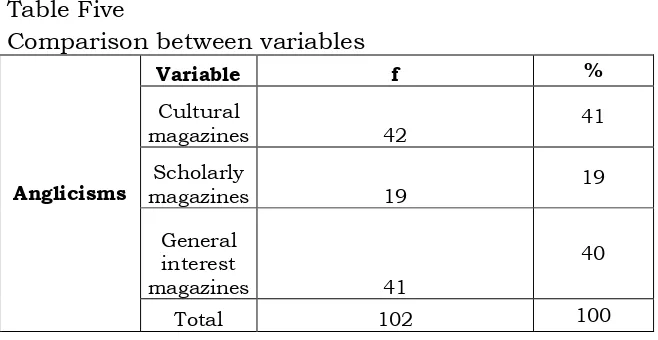
This research evidences that there is a bigger amount of
anglicisms in general interest magazines, a forty percent as opposed to
the nineteen percent of English terms found in scholarly magazines
which aim to convey a more formal language due to the audiences they
approach.
Introduction
This study has been conducted as a means to identify how the
English language influences writers of magazines in Ecuador and leads
them to include English terms into their publications, how often do they
do it and which type publications contain the highest number of
anglicisms.
The present investigation has one general objective which is to
research on the linguistic phenomenon of anglicisms used in
Ecuadorian magazines. And four specific objectives which are: to
identify the syntactic and lexical anglicisms most commonly used in
Ecuadorian magazines; to make a deep analysis of the anglicisms found
in Ecuadorian magazines regarding syntactic, semantic and
morphological aspects; to establish which variable (cultural, scholarly
and general interest magazines) contain the highest number of
anglicisms; to determine which anglicisms are mostly used.
The methodology used for this research has taken a qualitative
and a quantitative approach, using three variables which are: cultural,
scholarly and general interest magazines, taking as samples for the
study the magazines El Búho and El Apuntador for the first variable,
Capital and Terra Incógnita for the second and Cosas and Diners for the
To collect the information found in the magazines, charts were
used in which the information found was tabulated to present a statistic
approach on the number of anglicisms per variable.
The anglicisms were found within these magazines using
skimming and scanning procedures and note taking. To identify the
origin of the terms found the tools used were the Merriam Webster
dictionary and the dictionary of the Royal Academy of the Spanish
Language.
Previous studies have shown the recent and powerful influence of
the Anglo- Saxon culture in Spanish speech over the last few years, as it
is the case of a study conducted by Rollason (2010), where it was
demonstrated that smaller speaking communities such as the Spanish
or even the French ones, have suffered the overbearing power of the
English language taken over some of the important parts of its speech.
The beneficiaries of the present document are primarily the
students of English as a Foreign Language who need to be aware of the
impact of their study in our society, also the English students who may
encounter these features throughout their readings and in general all
students and readers who look into magazines every day and come
across these terms who in advance will be aware of the causes for the
The present research did not present many limitations, perhaps one of
them would be the fact that some words that at the beginning were
considered anglicisms do not come from the English language, which
has led to a deeper investigation and in some cases to the exclusion of a
word that was considered to be an anglicism.
The general objective of this research was accomplished thus the
linguistic phenomenon of anglicisms was studied and the samples
collected allowed to analyzed how these are being used in Ecuadorian
magazines. The specific objectives were also accomplished, especially in
the part concerning the analysis of results, were there is a detailed
description of each feature in terms of syntax, semantics and
morphology. It has also been established that the cultural and scholarly
magazines bare less anglicisms that the general interest ones and finally
several tables have been designed to show the reader which anglicisms
are most commonly used and the frequency of their appearance in each
Methodology
To conduct this research three variables were taken into
consideration: cultural, scholarly and general interest magazines written
and produced in Ecuador between the years 2009 and 2010, taking two
items per variable.
To gather the bibliographic support the research used dictionaries
both in the Spanish and in the English language; books taken from
libraries and the internet. The guide provided by the UTPL was used in
the compiling of information as well.
The research was conducted in Quito, Ecuador, using the
following magazines: for the cultural variable the magazines chosen were
El Búho magazine which deals with literature affaires and El Apuntador
magazine, dedicated to theater issues. For the scholarly variable the
magazines of study were Capital magazine, dealing with economics and
statistics and Terra Incógnita which treats environmental affaires.
Finally for the general interest magazines the chosen ones were Cosas
magazine, which deals mostly with fashion, celebrities and social events
and Diners magazine which covers a broader specter, dealing with
cultural, economics, social and other aspects of interest.
The methodological approach for the present investigation was
qualitative and quantitative, using skimming and scanning procedures
and note taking, reading the magazines cover to cover and outlining all
terms were checked in the Merriam Webster dictionary to verify if they
came from an English root and the Spanish Royal Academy dictionary to
see if those terms were already accepted into the Spanish language or
were only used in the every day speech of people.
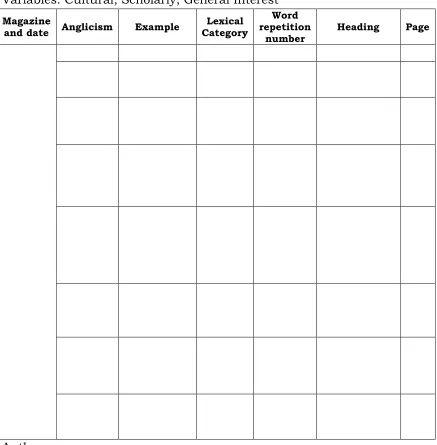
After the information was gathered, the anglicisms were
incorporated in charts that contained the following information: the
name of the magazine, the examples in which they were found, the
lexical category they belong to, the number of repetitions in the same
article, the name of the article and the page in which the article is.
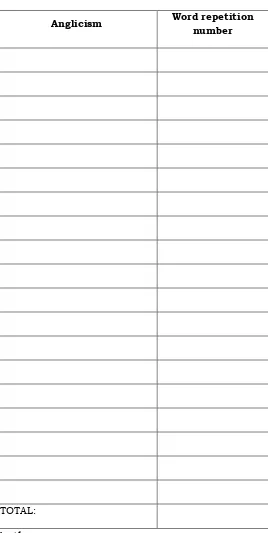
Two other charts were made in addition; one to tabulate the
number of anglicisms that were found and a third one to establish the
percentage of anglicisms found per variable.
The steps taken to gather the information, as mentioned above,
were the reading of the magazines and highlighting of the anglicisms,
secondly the verification of the root they belong to and the tabulating
procedure using the charts already mentioned.
Finally the research presents a linguistic analysis in which the
thirty most recurrent anglicisms are analyzed in terms of syntax,
semantics and morphology. Then the ten anglicisms most used in all
three variables undergo a comparative analysis that permitted this
study to reach the main objectives and come to conclusions.
DISCUSSION Literature Review
If the study of language throughout history has taught people
something is that language is not an absolute figure but a constant
change of structures that is meant to accommodate its users. From the
first spoken languages until the present era, it can be seen how speech
has experimented the introduction of new terms that are as diverse as
the forms of existing languages.
The reason for these changes may rely on the fact that people
speak to communicate with others and sometimes these others do not
happen to speak the same language. So, what is the aim of speech? To
cast people away because of the idiomatic barriers? Or to bring their
interlocutors closer by taking some of the expressions, words, dialects,
and make them their own? The question may be who is adopting the
majority of these features, which community welcomes them and which
excludes them and why?
In a third world country like Ecuador, which is making its way
through progress, it is important to ask questions like: is it essential to
learn and to incorporate English words to make this path shorter, or is
there a way to accomplish progress and maintain the Spanish language
intact? Given that language is a trade mark of people’s identity. These
and further questions will be explained in the present report, that is
include in their pages, the frequency in which they do it and which
anglicisms seem to be the most used, the ones that nowadays make a
part of the daily Spanish speech.
This study addresses anglicisms by exploring related topics such
as linguistics and its branches (morphology, semantics, pragmatics,
phonology and syntax), contact languages, language vice, barbarisms,
borrows and loans and finishes with the mere description of anglicisms
and structural definitions of magazines. It also shows how previous
studies have contributed to this matter and content information that
will provide the reader with a fair explanation about the use of
anglicisms in Ecuadorian magazines.
Linguistics
According to Martinet (1972, p. 11) “One can learn how to speak
without knowing anything about linguistics, as they can digest without
knowing the theory of digestion…” letting us understand until what
point linguistics is an innate part of our lives. Spoken language
connects us with the world around us, it gives meaning to everything we
know and it would take very little to demonstrate that not having this
ability would be similar to be a handicap. That is why linguistics have
shown to be one of the most studied science to comprehend the process
of thinking and how it affects our development. Lyons (1974), in his
study about Chomsky, described linguistics merely as the science that
took the last mentioned linguist to findings on the topic that may have
been saw as too futuristic for his time but now are gaining more and
more attention as how we already said, it is a inherent though crucial
process of the human being.
Morphology
A not very ancient research of the term morphology carried out by
Geert (2007) stated what we already knew about the subject though
putting more emphasis as to say that it studies the internal, not only
external structure of words, he also claims that this is the starting point
for the semantics viewed in the interconnection of words themselves.
These are the same words that will further suffer the melting into other
idiomatic cultures which will input them a new meaning and by
consequence a new morphology.
Semantics
As established by Frawley (1992, p. 1) “Linguistic semantics is the
study of literal meanings that are grammaticalized or encoded…”
perhaps the most relevant branch of linguistics, or at least the most
related to knowledge. That is how we define our codes; how we decide
which grammatical structure is better suited to refer to an object, a
circumstance or even a feeling. Frawley goes beyond that same
definition when he suggested that aside from being a part of the
linguistic sciences, semantics constitutes the core of the study of a more
correlated speech is to our thinking process. Therefore it is no surprise
that we have included these definitions to help us understand why we
decide to incorporate new features to our speech, given that this is a
conscious act that requires both a sociological and a linguistic
approach. Semantics will eventually inherit the new words we borrow,
such as anglicisms, and will also have to deal with their meaning, which
is why its definition becomes necessary.
Pragmatics
One of the most accurate definitions of pragmatics is the one
proposed by Levinson (1983) perhaps a little too particular when he
mentions that this subjects deals with the study of language from a
functional point of view. Looking at the word pragmatics that is exactly
what it does, thus pragmatics is the theory taken to practice. Therefore
in this description it can be found another clue to the study on
anglicisms, they have been helpful to Spanish in matters of use, which
is practice. It has accommodated itself to the use of these borrowed
words for no other reason than the fact that it needs them in its
practical everyday speech.
Phonology
Some languages distinct themselves only by their hearing
features, in several speech communities words differentiate from one
another only by a sound, so it is not rare that this study brings up
senses. From a very specific approach, phonology is the study of the
phoneme, which is a unit of speech, or the sounding version of a written
word. According to Roach (2000, p. 44) phonology is concerned with
“studying how phonemes function within a language and the
relationship among them”. In other words, phonology deals with the
pronunciation part of speech, which has also suffered modifications with
the introduction of words from other languages, because along with the
word comes the pronunciation of it, which production is different in
each language, in Spanish it is said that words are spoken the same way
as they are written, in English however, is the other way around, this
shows us that the Spanish speakers had to obligate themselves to think
backwards to cope with the new structures the learn when they
incorporate the English language into their speeches.
Syntax
Here the study presents what is probably the most complex
branch of linguistics, syntax. The term syntax comes from the Greek
word syntaxys which means arrangement. Van Valin (1997) believes
that this arrangement has a connection with the meaning words have
within a sentence, this is a proven fact because, at least when it comes
with the English language, a word can be rather a noun, a verb, and
adjective, all depending of the position they are in a particular sentence
or clause. For Chomsky (1979) syntax means productivity, when people
knowing that all the phrases we elaborate have a given set of rules, even
as children, they are being respectful to those rules because without
them, their speech would have no meaning, it would be impossible for
them to make themselves clear. So before they even learn how to spell
their names, people follow all the rules of the grammar of their native
language, but maybe it is only when they attempt to learn a second one
that they have to comprehend this intricate system of production that is
what syntax is all about.
Lexical categories
When syntax is being discussed it is important to understand that
there nouns, verbs, adjectives, adverbs and prepositions and bare this
name because the posses lexical meaning, they are sometimes called
content words as well. The functional category is reserved for those
words that we need to put our speech together but which do not posses
a meaning of their own, these words being the auxiliary verbs,
conjunctions, articles, etc. Each language functions differently, that is
why the grammar rules of one can be useless to another, the purpose of
these rules is to come to the conclusion that as far as we can be from
other speech communities, we have things in common, as far as
structure, this may make sense in the universal grammar theory with
which Chomsky surprise the world of linguistics not too many years ago,
and in the field of anglicisms this theory has a lot to teach us, thus the
with a whole new set of structure rules, into ours proves that the so
called universal phenomenon is possible and moreover, it happens
already. There also exist lexical categories in which this subject can be
further subdivided. Van Gelderen (2010) speaks about two main
categories: the lexical and the functional.
Contact languages
According to Siemund and Kintana (2008, p. 5) “The relevance of
the social factor manifests itself in the modules of language preferably
affected by language contact…” This is the core of our investigation,
thus it aims to explain how one language is affected by another and
why. There are no few questions as to why the Spanish language has
been affected by the contact whit English, why isn’t it modified to fit
with its Latin pairs? But this contact that we refer to goes beyond a
simple alteration of speech, it has changed the grammatical structures
and that is why they are even accepted within our dictionaries, the
contact to which we refer to is not the product of a decade or two but a
process which has taken many years to the point that it may not be
recognizable for the new generations, when the stumble across a word
that they thought of as their own when in fact was the result of the
contact with another speech community way beyond its geographical
Language vice
As it has been established, language is not an absolute and
unstable parameter; it is a sort of speech factory, always in movement,
always progressing towards something that can bring it closer to a
global understanding. But what if this progress does not come in the
form of a perfect variable, thus when we introduce another language
feature into our own, we also introduce the errors that may come along
with them, the grammatical misconceptions that were not resolved yet in
its mother tongue. This is what is called language vice, or as better said
by Lyons (1974, p. 95) “…the fact that the announcements produced will
contain a diversity of errors and distortions (mispronunciations,
changes in constructions, etc.) due to the malfunctioning of the
psychological mechanisms implied or their limitations.”
If we have not yet mastered our own language, how can we
transfuse it to another speakers without the inevitable blank that we
have not been able to fill, and in turn, how can we receive this
transfusion if it comes with an error, or is this not much of an error if
we do not posses the structure to judge it as such. That being said, this
study claims that many of the features that the Spanish language has
inherit, are not the best ones and the fact that we incorporate it to our
language does not imply that we are saved of this grammatical mistake.
be transformed to fit into another one, so the error becomes a constant
and with it, the vice that we put into our daily speech.
Barbarisms
Continuing with the above mentioned subject, one can only hope
that the words we inherit come to make an improvement in our
language, that they will help us develop a tighter connection with the
world, in order for that to happen the way we speak has to be enriched,
but as we said before, what kind of structures are we enriching it with?
Webster (1994) recognizes the existence of three kinds of borrowed
words called barbarisms: obsolete words, new words and words “new modeled”.
This meant that some structures of our speech are too dusty to be
used; others are so new that they have not been yet accepted and some
other ones are not even considered words but sort of words elaborated
to accommodate a circumstance for which there are not any. This
happens in our mother tongues, it happens to us during childhood
when we do not know how to spell correctly or to conjugate all the verbs,
we come up with words like “hacido” instead of hice (the young boy who
says to his mother: yo no hacido eso) for example. This may seem funny
and in deed it is, but what if it becomes more popular and people in that
speech community starts using it, perhaps just for laughs but then it
progresses until the point where it’s normal to use it in a conversation
been using the incorrect form of a word for a long time does not exactly
make it right, it is what constitutes a barbarism.
Anglicisms
This point may encounter the touch stone of this study, the
definition of anglicisms. One of the simplest explanations of this item is
the one proposed by Miseska and Radovanovic (2000) when they
establish, among other things, that anglicisms are words borrowed from
the English language that when entering into our, or any other
language, go through the necessary modifications to fit in with the
receiver’s syntax. A much more specific definition is the one provided by
Gorlach (2003) when he claims that the morphology, spelling and
phonology are also integrated into the receptor’s speech when they
adopt these idioms that are recognizable to have an English
background. As already said this phenomenon is not only a
characteristic of Spanish, this can happen within French, German or
even languages so distant as Japanese or Mandarin. A fair explanation
to this fact would be easily summarized in a single word: globalization.
The communities, who would still be reluctant as to welcome
global expressions, whether these are idiomatic, cultural, economical,
etc. into their core, would probably be left out of the so called progress
of our era. Given that language is one of the most important functions of
our knowledge, this may be the sponge which sucks up the first
country like Ecuador, it is no surprise that these approaches have been
more than welcomed and that their features form now an essential part
of our daily speaking. Let us take for instance the word bar; almost
nobody stops to analyze its grammatical ancestors, it has already been
included in our dictionaries, we teach it to our children, at home and in
the classroom.
Nevertheless, this small word does not belong to us, it was
borrowed from the English language so long ago, that we don’t even
have a Spanish equivalent to replace it. That is one of the reasons that
we need to borrow words, because we don’t own them in our language.
May be because they correspond to items that were brought into our
countries with a given name, we did not get to name them ourselves,
like would probably be the case of the word bar; the bar was an
Anglo-Saxon invention, therefore, its name is just part of the package: you
receive an item, you inherit a word, period.
But what about the items that already had a name in Spanish
(which, as already said, can be the case of French, Italian, German,
etc.), and that we rename it to accommodate the global needs for a
general understanding and gave it a new English name? Due to reasons
that may be part of further studies, the English speaking community
has become the strongest one in the world, even when is not the
in Asia with names already given in English, that is the power that it
has over the world.
We may say that among all the things that the American
community has conquered, language may be the vastest. So it is hard to
grasp over a magazine one day in Quito or any other city of our country
and not come across with words like fashion, bar, rock, cyber, etc. If we
can not beat them we may as well understand them and unravel their
anatomy so we can give it the best possible use.
Borrowings and loans
What constitutes a borrowing and when this borrowing goes
beyond to become an anglicism? Is it necessary to be bilingual to loan
words from another language? Nowadays almost every person of the new
generation knows at least a few words in English, that does not
necessary make them bilingual, but it already, gives them permission to
borrow some of the words they do know to incorporate them in their
language when they feel the need to do so. Evidently this phenomenon is
much more common and repetitive among true bilingual individuals.
There may be a blank in a conversation between a person who
was born in Ecuador but who grew up in Illinois, what is there for them
to do when they do not find the exact adjective, noun or verb to make
their speech more understandable? To remain quite does not seem to be
the choice, so, whether they like it or not, whether they are aware of it or
blanks in their conversation. That is what linguists have named
borrowings and loans. Hock (1991) explains this phenomenon as a
result of linguistic contact; he claims that we not only borrow single
items of speech but whole clauses if we feel like we have to. As he
stated, this is the product of a linguistic brotherhood, we would not
borrow words from Japanese, we have never been in near contact with it
and therefore we do not know any words from it.
With English, however, we are almost too close, maybe this
language has overwhelmed us to the point of being essential to borrow
some of its words to make ourselves clear. It is present in all settings:
the formal ones, in the business meeting of an airline staff when using
the word overbooking; in an informal one, when two kids tell each other
a gossip using the word man to refer to any given individual, regardless
of its gender. When this happened to a foreign visitor from the United
States many years ago, it was considered a borrowing, today; it has
already fallen into the category of an anglicism. It is true that for a
person to borrow a word from another language they have to be at least
very familiar with it, if not totally bilingual, we have seen this happen
with small children coming from abroad, but it may be the starting point
of a new addition to the Spanish language, a new word that has come to
Magazines
Some of us may almost never buy a newspaper, it is astonishing
to discover how small is the population that buys books if not only for
academic purposes, people in the present days do not often read for
pleasure, as sad as it is to find out. But almost every one of us has ever
stumbled across a magazine. In a doctors waiting room, in an airport,
while waiting in line at the supermarket; a magazine is always there to
keep us company. Martinez (1973) believed that magazines were very
important vehicles of cultural and informative feedback in the present
times. He puts them in a medium point between the complexity and
richness of a book and the simplicity and quick approach of a
newspaper. This may sound too progressive, as Martinez is claiming that
a magazine may be the substitute of both a newspaper and a book, but
its somewhat controversial asseveration is not too far from the truth.
The statistics of sales would serve as a means to corroborate that
affirmation as well as a brief sample of readers that will not be lying if
they say that they have at least once in their lives grasp over a magazine
but maybe never bought a book or even a newspaper. A magazine is a
not too thick written publication that appears weekly, monthly,
annually, etc., as stated by Webster (1978), it contains general events,
talks about the recent most important ones or it can be specialized in an
specific subject such as science, culture, sports, among others. As they
that we have taken magazines as the source of our investigations, thus
they contain a language that people are related to and their audience
goes from children to grown ups from every social status and cultural
background.
Language used in magazines
As already mentioned by Martinez (1973, p. 335) a magazine
“…constitutes one of the main cultural and informative vehicles of our
time” it would not have been so if its language was uptight and
pretentious, nor if it would have been way to colloquial. But more
truthfully, it is not the reader who accommodates to the language used
in a magazine; it is the magazine that uses a language that it considers
better suitable for its target audience. It will contain very casual
expressions familiar to kids and very scientific words directed to the
reading of biologists. Therefore, if the phenomenon of anglicisms has
come to be so global among the speakers, how could we not expect to
find them in a magazine? In fact we would feel in the boarder of
unliteracy if we did not know at least a few. A magazine’s language has
to address what people needs and if people in Ecuador have become so
familiar with the use of a word like fashion, a magazine is going to be
one of the first places we could expect to find it in.
Magazines’ audience
As we mentioned above, there are as many magazines as groups of
and cartoon characters; the ones suited for teenagers which will talk to
them about musicians, celebrity gossips and even make up advices;
there are magazines for those who enjoy literature or theater and also
for the ones who enjoy to travel around the world without leaving their
houses. Of course some magazines are more popular than others; we
would find more teenagers in the need of finding out their favorite
musician’s favorite color, than theater lovers who want to review a critic
of the newest play they saw. The State News Media (2004, abstract)
claims that “…readership surveys indicate that the audience for news
magazines is holding steady, while the audience for pop culture,
entertainment and lifestyle magazines is growing”. This is a mass media
fact; nevertheless, our study will address the different kinds of
magazines in the search for anglicisms. We hope to clarify the question
of which specific group uses them the most, when and how often, as
well as what are the anglicisms with which people in Ecuador relates the
most.
Previous studies about the use of anglicisms in magazines
In a study carried out by Rodriguez (1996) it has been suggested
that Spanish also has loaned some words to the English language,
though the frequency is far from equal. The globalization theory leads us
to believe that it is normal for us to speak the language of the most
powerful, they did not advice us, however, as how to keep our identities
and unique as the one from Cervantes, it would be better to come to
terms with the fact that it has adopted many children, some of them
more useful and necessary than others, but as far as purity is
concerned, there is not a language in the world which has not been
altered throughout the history, even so, it is not hard to notice which
languages have been more so than others.
Anglicisms are just one of the ways in which it has been modified,
though due to the contact with that speech community, it may easily be
the phenomenon that has had the most influential power of them all.
Although for some specialized fields, the introduction of words
from the English language has been widely accepted, as for example, for
the technological field, even more so for the branches which are most
related to the media. Timofeeva (2007), found that the use of anglicisms
has improved the specter of communication within the world of websites
and global business, because they have adopted terms that are now very
popular amongst those who work with tools like computers, software,
and internet. Although this study took only one website to carry out the
investigation, it proved to be very successful, because of the generalized
tendency to adapt the language to the field of expertise in which it was
learned.
In a third study carried out by Oncins- Martinez (2009) it was
found that some words were less likely to be adapted from English to
fact that Spanish has a more linguistic features than English. He took
as an example the Spanish adverb dramáticamente, and from then on
showed how the translation of words like these is not only impossible
but also diminishing to the richness of the language. That is why the
anglicisms most found correspond to the lexical categories of nouns,
which are easy to translate and do not need conjugation.
Spanish is not the only language that has adopted words coming
form English, nor are the so called lesser languages. German magazines
and newspapers also saw themselves affected by the influence of this
phenomenon. In a study conducted by Onysko (2007) it was found that
in the most recent years, German magazines adopted several terms in
English, mostly when talking about popular culture, recent events or the
red carpet. But the phenomenon spread to economical and even political
issues, which proves that the anglicism trend went beyond the borders
of the nearest speech communities.
Going deeper in the study of how the English language has
influenced European speech communities, Hartamann (1996) took the
eastern Europe countries as a sample of how far the phenomenon has
gone and explained that the changes have not only been structural but
that the semantics, morphology and even phonology of those languages
have been altered by the introduction of English terms, but he also
claims that these aspects have not yet been taken into account as much
Despite the fact that some European languages have adopted
English features in the various printed publications they own, it would
be inaccurate to say that they are the ones who have taken the biggest
load of this approach. In a study conducted by Rollason (2010), it was
demonstrated that smaller speaking communities such as the Spanish
or even the French ones, have suffered the overbearing power of the
English language taken over some of the important parts of its speech,
some times replacing words already existing in the host language.
Rollason explains that the socio economical factor is the most important
one in the globalization of the countries as well as the languages.
After the dissolution of the Soviet Union, small countries like
Croatia and Slovenia got their independence and do did their languages.
Beaugrand & Seidholfer (1998), in a study carried out in those
countries, concluded that given that the students were recently entered
in the ESL educational system, as well as the cyber culture, they had
some trouble understanding the jargon used to master those fields, but
that the necessity of doing so, took them to approach the Anglo-Saxon
speech community in order to get familiar with the new subjects they
were studying, proving until what point the introduction of that
language was essential to complement the academic process.
As far as the amount of anglicisms per field of speech, some have
seen themselves benefit form this language addition better than other,
was found that the globalization strike directly into the language of its
users, thus they were eager to make the most possible contacts they
can, and they were obligated to learn the terms that came along with it.
Examples of that would be the wide spread use of words like
marketing, which is a term already accepted into the Spanish
dictionaries.
Another field highly influenced by the anglicism phenomenon is
the field of informatics. Since computers and software are American
inventions, the language that comes with them is an inherited part of
the usage of those equipments. One can not learn how to use a
computer or navigate through the internet without being familiar with
the subsequent terms that are, of course, English related, as found out
in an investigation performed by Sampedro (2000).
The final approach of the present literature review is one similar to
the first statement: is the Spanish language being affected for better or
for worse by the introduction of words coming form a bigger speaking
community as is the English one? Is it normal to adapt ourselves to the
fact that our once purer and richer language is being shortened in
expressions and molded into something new? This question is too being
asked in countries whose languages also come from a Latin root, such
In a study carried out by Anderman & Rogers (2005) focusing on
press publications in France, it was determined that certain terms
introduced in the French language coming from English were totally
unnecessary, thus the words that they represented were already existing
in that speech and furthermore, that the richness of French was being
diminished by the melting of words between languages which result in
barbarisms which are now very popular, specially among young people
Results
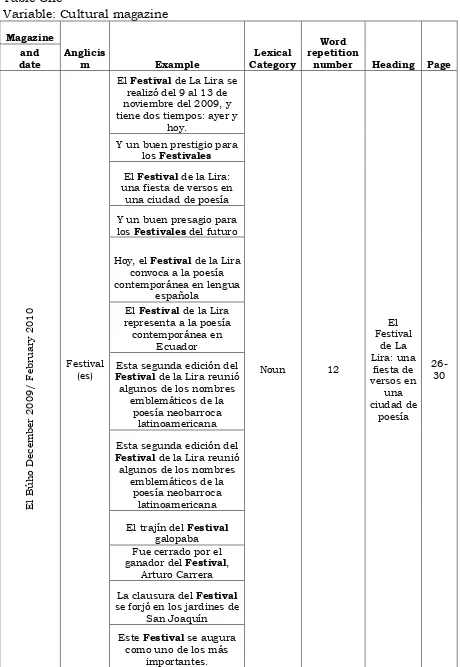
Table One
Variable: Cultural magazine
Magazine
Anglicis
m Example
Lexical Category
Word repetition
number Heading Page and
date
Festival (es)
El Festival de La Lira se realizó del 9 al 13 de noviembre del 2009, y tiene dos tiempos: ayer y
hoy.
Noun 12
El Festival de La Lira: una fiesta de versos en una ciudad de poesía 26- 30 Y un buen prestigio para
los Festivales El Festival de la Lira:
una fiesta de versos en una ciudad de poesía Y un buen presagio para
los Festivales del futuro
El B ú ho D e ce mb er 2 0 0 9 / Fe b ru ar y 2 0 1 0
Hoy, el Festival de la Lira convoca a la poesía contemporánea en lengua
española El Festival de la Lira representa a la poesía contemporánea en
Ecuador
Esta segunda edición del Festival de la Lira reunió algunos de los nombres
emblemáticos de la poesía neobarroca
latinoamericana Esta segunda edición del Festival de la Lira reunió algunos de los nombres
emblemáticos de la poesía neobarroca
latinoamericana El trajín del Festival
galopaba Fue cerrado por el ganador del Festival,
Arturo Carrera La clausura del Festival
se forjó en los jardines de San Joaquín Este Festival se augura
como uno de los más importantes.
El B ú ho D e ce mb er 2 0 0 9 / Fe b ru ar y 2 0 1 0 Iceberg
Una buena ilustración de esta tendencia es el aumento de la astrología, pero ello es apenas la punta
del iceberg.
Noun 1
El científico frente a la anti y la pseudociencia
32
Off
Una voz en off que recita unos cortos poemas del
mismo artista.
Adjective 1
Cuatro en el CC de la PUCE. La muestra de fin de
año
58
Bar
De aquí a un recital de poesía en la Casa de la Cultura, previo a una visita
al bar.
Noun 1 Hotel Crespo: un hostal con historia 22
El A p u nt ad o r /J anu ar y 2 0 1 0
Clown confían sus propuestas al Producciones escénicas clown
Noun 1 El teatro como
mirada 12
Talk Show
No obstante, motivo del talk show, motivo de análisis y más disparates comerciales.
Noun 1 Locura y escena 40
Rol
Incluso devolver al actor su rol de hacedor y creador.
Noun 2 Festivales y encuentros
32-39 También se requiere
precisar el rol del estado
Box
Eso pensaba, en Box, donde unos pocos espectadores vecinos tenían también una
actitud de espera
Noun 1 En pocas palabras 53
Hobby teatro como hobby, no como Hay otros que les gusta el carrera
Noun 1 En pocas palabras 52
Web Recorro la web revisando,
leyendo sobre otras revistas Noun 1 Primera llamada 3
Gay
Soy gay, le dijo tajantemente el calvo y estuvo a punto de levantarse
y marcharse.
Noun 2 Café Gay 56
Café Gay
Festival (es)
Los festivales y encuentros de teatro y danza nacionales
han copado el espectro artístico del país
Noun 19 Festivales y encuentros
El A p u nt ad o r /J anu ar y 2 0 1 0 Festival (es)
Festivales y encuentros: espacios que articulan la
sensibilidad
Noun 19 Festivales y
encuentros 32-39 El Festival de teatro de
Manta es parte de la red Los encuentros y Festivales
han tenido la fuerza para formar públicos El Festival internacional de
teatro experimental se realiza en Septiembre
Hay que evaluar la incidencia que tienen los
Festivales y encuentros
Ha sido a través del Festival que hemos podido ver grupos representativos Los Festivales y encuentros
no provocan todavía un debate
El Festival del sur terminó expandiendo sus fronteras Se llamó al primer Festival
de análisis y evaluación La poética del Festival de
artes escénicas de Guayaquil Es un Festival con
identidad propia El único Festival que tiene
el carácter de nacional Los niños cuentan con
sendos Festivales El Festival de títeres fue fundado hace nueve años El noveno Festival de títeres
tuvo nuevos rostros El segundo Festival alternativo de teatro
latinoamericano Los Festivales han podido
mostrar lo que los grupos producen
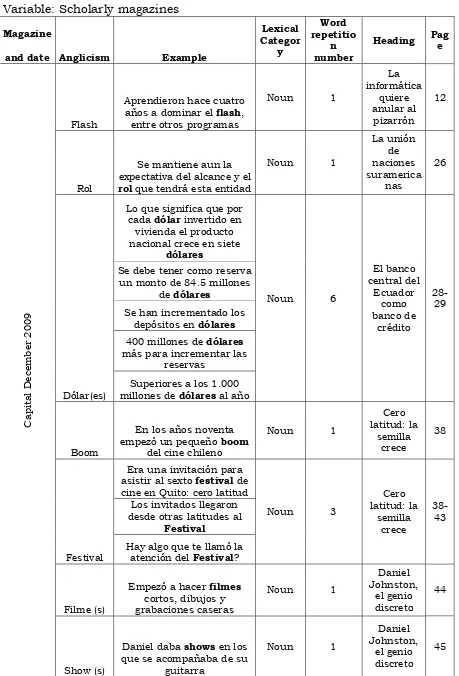
Table Two
Variable: Scholarly magazines
Magazine
Anglicism Example
Lexical Categor y Word repetitio n number
Heading Pag e and date C ap it al D e ce mb er 2 0 0 9 Flash
Aprendieron hace cuatro años a dominar el flash, entre otros programas
Noun 1
La informática quiere anular al pizarrón 12 Rol
Se mantiene aun la expectativa del alcance y el rol que tendrá esta entidad
Noun 1
La unión de naciones suramerica nas 26 Dólar(es)
Lo que significa que por cada dólar invertido en
vivienda el producto nacional crece en siete
dólares
Noun 6
El banco central del Ecuador como banco de crédito 28- 29 Se debe tener como reserva
un monto de 84.5 millones de dólares
Se han incrementado los depósitos en dólares 400 millones de dólares más para incrementar las
reservas
Superiores a los 1.000 millones de dólares al año
Boom
En los años noventa empezó un pequeño boom
del cine chileno
Noun 1
Cero latitud: la semilla crece 38 Festival
Era una invitación para asistir al sexto festival de cine en Quito: cero latitud
Noun 3
Cero latitud: la semilla crece 38- 43 Los invitados llegaron
desde otras latitudes al Festival
Hay algo que te llamó la atención del Festival?
Filme (s)
Empezó a hacer filmes cortos, dibujos y grabaciones caseras
Noun 1
Daniel Johnston, el genio discreto 44 Show (s)
Daniel daba shows en los que se acompañaba de su
guitarra
Noun 1
Daniel Johnston,
el genio discreto
[image:36.612.113.572.58.734.2]Ecu ad o r T er ra Incó gn it a M ar ch 2 0 1 0 Eslogan
El eslogan que introduce la campaña del Ministerio
de Turismo
Noun 1 Minas ilegales 6
Turismo
El eslogan que introduce la campaña del Ministerio de
Turismo
Noun 2 Minas ilegales 06-Jul El Ministerio de Turismo
no se ha inmutado frente a las denuncias
Internet
Lo bueno que sale de los concursos es que la noticia
se empieza a regar, con el internet todo es tan rápido
Noun 1
Las imágenes de Karla
Gachet
19
Show Su trabajo es armar un
show para la gente. Noun 1
Las imágenes de Karla
Gachet
23
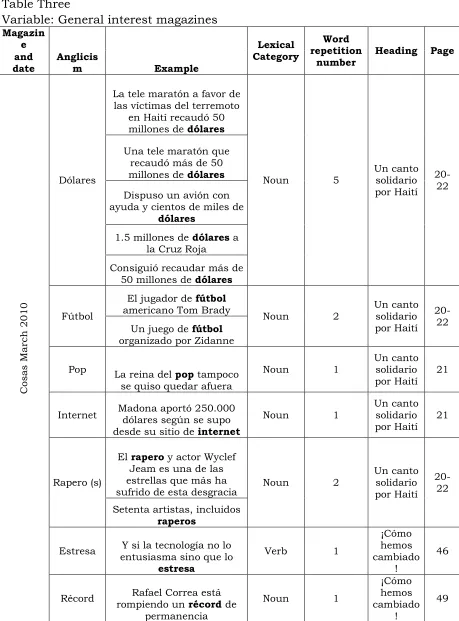
Table Three
Variable: General interest magazines
Magazin e
Anglicis
m Example
Lexical Category
Word repetition
number
Heading Page and date C o sa s M ar ch 2 0 1 0 Dólares
La tele maratón a favor de las víctimas del terremoto
en Haití recaudó 50 millones de dólares
Noun 5
Un canto solidario por Haití
20- 22 Una tele maratón que
recaudó más de 50 millones de dólares Dispuso un avión con ayuda y cientos de miles de
dólares
1.5 millones de dólares a la Cruz Roja
Consiguió recaudar más de 50 millones de dólares
Fútbol
El jugador de fútbol americano Tom Brady
Noun 2
Un canto solidario por Haití
20- 22 Un juego de fútbol
organizado por Zidanne
Pop La reina del pop tampoco se quiso quedar afuera
Noun 1
Un canto solidario por Haití
21
Internet Madona aportó 250.000 dólares según se supo desde su sitio de internet
Noun 1
Un canto solidario por Haití
21
Rapero (s)
El rapero y actor Wyclef Jeam es una de las estrellas que más ha
sufrido de esta desgracia Noun 2
Un canto solidario por Haití
20- 22 Setenta artistas, incluidos
raperos
Estresa Y si la tecnología no lo entusiasma sino que lo
estresa
Verb 1
¡Cómo hemos cambiado
!
46
Récord Rafael Correa está rompiendo un récord de
permanencia
Noun 1
¡Cómo hemos cambiado
!
C o sa s M ar ch 2 0 1 0 Fans
Sus fans lo convirtieron en el segundo mejor futbolista
juvenil
Adjective 1
Antonio Valencia: de Lago Agrio al Manchester
United 54
Casting
Daniel, hijo de Alan y Marcia, una directora de
casting
Noun 1
Daniel Radcliffe, descolar al ídolo de Harry
Potter
66
Show
El show se enfocó en algo que nadie había tocado
Noun 2
Sarah Jessica Parker: de patito feo a icono de la
moda
66- 67 Una de las protagonistas del
show es Kim Katrall
Sexys
Muy por el contrario, estas cuatro sexys y glamorosas
neoyorquinas
Adjective 1 Sarah Jessica Parker: de patito feo a icono de la
moda
67
Look
Sarah Jessica no puede mirar sus fotografías sin sentir vergüenza de su look
Noun 1 67
Miss
“Lo de Miss Ecuador es parte del pasado”
Noun 6
Cuando Cosas llegó a Ecuador
80- 123 “Ni siquiera mientras fui
Miss Ecuador” La gala final de Miss Universo nos llenó de
sorpresas Ecuador, sede de Miss
Universo 2004 Miss Australia se llevó la
corona Universal Miss Ecuador no ganó el
concurso
Roquero
A pocos meses de su noviazgo con el roquero
Tommy Lee
Adjective 1
Cuando Cosas llegó a Ecuador
D in er s /O ct o b er 2 0 0 9 Dark
Que siempre tuvieron, de todos modos, algo dark
Adjective 1 Lo mejorcito del siglo XX 40
Sexy
En aquella ocasión el símbolo sexy italiano
Adjective 1
Cuidado: cámaras indiscretas
45
Underground
Una galería de arte underground
Adjective 1
Banca roja, cincha y Ponce, de barro y caña
50
Man
Acabamos de grabar un disco con el man
Noun 6 Míster Mass 66- 72 Tengo que escribir algo
sobre ese man Y cuando llegué le vi a la
man con otro
Yo tampoco la quería a esa man
Y con el man hicimos secuencias de patines Nadie patina como el man
Mister
Esta podría ser la historia
de Míster Mass Noun 1 Míster Mass 66
Rock
Se escucha el fantasma de
una gran canción de rock Noun 1 Míster Mass 72
Jazz
Se escucha música electrónica o jazz
Noun 1 Paris vía
Florencia 83
Thriller
Como un thriller para librería de aeropuerto
Noun 1
Roberto Bolaño, el secreto del mundo 87 Punk
Una pareja punk cercada de perros y mochilas
Adjective 1
Roberto Bolaño, el secreto del mundo 88 Estatus
Lastimosamente en Quito, el tema es entendido como una cuestión de estatus
Noun 1 El peatón, ese ser invisible 96
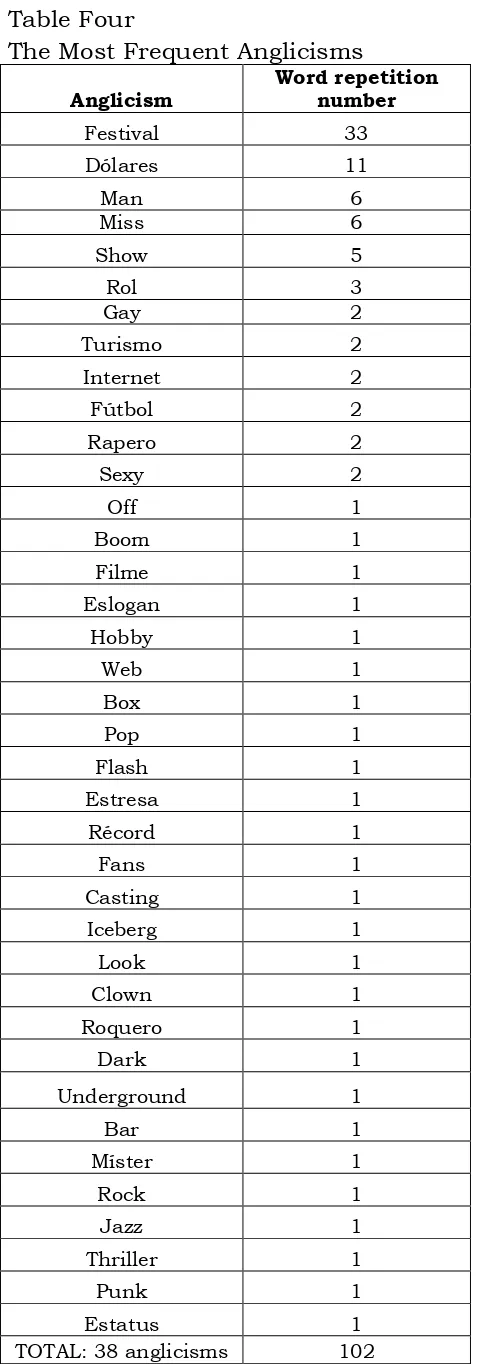
Table Four
The Most Frequent Anglicisms
Anglicism
Word repetition number
Festival 33
Dólares 11
Man 6
Miss 6
Show 5
Rol 3
Gay 2
Turismo 2
Internet 2
Fútbol 2
Rapero 2
Sexy 2
Off 1
Boom 1
Filme 1
Eslogan 1
Hobby 1
Web 1
Box 1
Pop 1
Flash 1
Estresa 1
Récord 1
Fans 1
Casting 1
Iceberg 1
Look 1
Clown 1
Roquero 1
Dark 1
Underground 1
Bar 1
Míster 1
Rock 1
Jazz 1
Thriller 1
Punk 1
Estatus 1
TOTAL: 38 anglicisms 102
Table Five
Comparison between variables
Anglicisms
Variable f %
Cultural
magazines 42 41
Scholarly
magazines 19 19
General interest
magazines 41
40
Total 102 100
Description, analysis and interpretation of the results
This section of the present study is aimed to analyze the
anglicisms found in Ecuadorian magazines. The variables, as it was
already mentioned, are the cultural, scholarly and general interest
magazines written and produced in Ecuador.
The analysis focuses first on the linguistic aspects of anglicisms
including the semantic, syntactic, morphological, and other aspects that
have affected each individual word on its introduction into the Spanish
language. The second analysis presents a comparative analysis to
determine the ten most recurrent anglicisms and the causes for their
use in Spanish magazines. Additionally, a comparison among variables
is done in order to discover the type of magazine which contains the
highest number of anglicisms.
Linguistic analysis
The linguistic analysis addresses each of the thirty most common
anglicisms (ten per variable) in order to interpret the various aspects
that these words have undergone to be accepted and/ or used into the
Spanish language. Each anglicism is analyzed from the morphological,
semantic and syntactic point of view. The research evidences that some
of the words were introduced into the Spanish language exactly as they
are used in English; meanwhile others have undergone some changes to
Festival
This word has been a part of the Spanish language for a very long
time until the point that almost nobody knows that it has an English
background. The word was found in the example “El Festival de La Lira se realizó del 9 al 13 de noviembre del 2009, y tiene dos tiempos: ayer y
hoy” among others in the same publication.
From the semantic point of view the term Festival is used to refer
to celebrations that take place within a particular context or have a
defined motive. That meaning is the same in both languages.
In terms of morphology the word entered the Spanish language
with no changes from its original structure at all. Nevertheless, if it is
used it in its plural form it will be necessary to add an e plus the letter s
since it is a word that ends in a consonant.
In the syntactic field it may be established that this is a noun, it
can not be used otherwise in the same way it is written but it refers to
all things related to festivities and celebrations, with some changes to its
structure it could be also an adjective as in the word festivo or an
adverb as in festivamente, but it will deviate it from the word itself. In
the magazines searched the word was only found as a noun, that is, the
word Festival and no other lexical category related to it was present in any of the variables.
This word was chosen because it seems interesting to know until
noticed as an outsider, therefore it is an example of the impregnation of
anglicisms in our daily speech and it also demonstrates how the roots of
our native tongue have already be altered beyond recognition.
There is not an equivalent of this word in Spanish; it could be
replaced with words like encuentro or celebración but those words will
not fulfill the same meaning, therefore it has not replaced any word
already existing in Spanish and it has been accepted in the RAE
dictionary.
Rol
This is an English word with some roots coming from French.
Morphologically speaking it has undergone some changes when entering
the Spanish speech, for instance the original word in English is role, but
in Spanish the final vowel (e) has been dropped, because in Spanish
there could not be a word ending in a silent vowel. In its plural form the
word adopts a letter e plus the s corresponding to plural words in
Spanish
Semantically speaking the term rol has come to replace the Spanish word papel, for example, but it serves a much more specific
purpose, therefore it is widely used when referring to the part one plays
in any kind of action, especially in the theater. In the example: “Incluso
devolver al actor su rol de hacedor y creador” it is clearly established the
The word role is accepted in the RAE dictionary but with the
subsequent changes like the removal of the final e.
The word rol functions as a noun, it could be transformed into a verb if we look at the word enrrolar, but the meaning is somewhat
different. This word was found in all the variables thus its meaning is
suitable for more than one purpose such as the role of an actor in a play
or the role of the government in public politics. Both meaning and
function are the same in Spanish and in English.
Gay
The word gay was first used in English to refer to a homosexual person, man or woman. It originally meant happy and is similar to the
word gai in French, which also means happy. In Spanish has been used
for no more than one or two decades, though it could be said it is rather
new, but over the years it has been more and more used. The meaning
is the same in both languages.
It has not undergone any changes in Spanish and it has recently
been accepted into the RAE dictionary. It may be said that it has come
to replace the already existing word homosexual, but there are no
equivalents that convey the same meaning, which is a lot more informal
that the previous mentioned word. The example in which it was found
“Soy gay, le dijo tajantemente el calvo y estuvo a punto de levantarse y marcharse” was taken from a theatre magazine, which is one of the
The word gay in English can be an adjective when is used to refer
to a pleasant mood in a person or as a noun to refer to a homosexual
person. In Spanish it is only considered as a noun. It was found mostly
in cultural magazines, when referring to a sociological factor or in
general interest magazines, when gossiping about celebrities.
The addition of this word into the Spanish language has come to
enrich its vocabulary; it can be used in either strictly formal way or in a
disrespectful manner. The word gay was not always used to express the
meaning it has now, but as it is, it is widely used in both formal and
informal contexts.
Hobby
This is a term used to refer to activities one does in their leisure
time, it carries the same meaning both in Spanish and in English. The
example in which it was found illustrates this point rather well “Hay
otros que les gusta el teatro como hobby, no como carrera” meaning that
theatre, for instances, can be an activity performed in a person’s spear
time, therefore, a hobby.
This word came to replace the Spanish one pasatiempo. However
its use has become so popular that aside from being accepted into the
RAE dictionary, it constitutes the first choice when there is the need to
The anglicism hobby has maintained its original structure coming
form the English language, that is, morphologically speaking, the word
has remain the same way it was found.
This word is a noun and can not be used otherwise. There is not a
transformation of it into a verb, an adjective or any other lexical
category. The relevance of this word and the reason why it was chosen
as an example is that this anglicism has not change and maintains its
original English structure, which is completely different from the regular
Spanish words, nevertheless, it has become so popular among speakers
that the former word, pasatiempo, it has almost disappeared from the
Spanish common speech. It can be, therefore, said that this particular
anglicism has contributed and introduces an important statement inside
our mother tongue.
Web
The word web is one of the most popular words in the field of computers, mainly because of the massive use of the internet. Its
meaning in both languages is applied to systems found on the internet,
though in English it also means entanglement. In Spanish it is borrowed
only to convey things related to the internet search, like web page or web site, like in the example in which it was found “Recorro la web revisando, leyendo sobre otras revistas”, found in an opinion article in
the Apuntador magazine, where the already mentioned point is well
In terms of morphology the word web has kept its original form and there is no equivalent for it in Spanish therefore no changes or new
words on the subject have been registered. It may be said that as the
phenomenon of global communication through the internet is property
of the English speaking community, all the terms that came along with
it are somewhat mandatory for the rest of speaking communities to
learn and incorporate if they do not want to be left behind in this
process.
The word web is a noun; it has not been used or transformed into
other lexical categories. The relevance of the word for the present study
obeys to the fact that it has been found in all three variables: cultural,
scholarly and general interest. The use of the term web has spread over
the world until the point where many activities of our daily life could not
be explained without the existence of this word, that is also one of the
reasons why the RAE dictionary has included it in their pages.
Show
The anglicism show was introduced into the Spanish language and has replaced the existing word espectáculo, as we can se in the
present example “Daniel daba shows en los que se acompañaba de su
guitarra”. This may have happened due to the much broader specter it
covers, as it can be applied to all kinds of shows.
In the Spanish form, the word show does not change at all, except
final s. In terms of semantics it carries the same meaning as it does in
its original language. The relevance to our study relays in the fact that
even though there is an equivalent word for it in Spanish, people usually
prefer the anglicism, maybe because the massive influence of the media,
which uses it often and in the present years it has include more
branches to the word, like the expression talk show or reality show, also
Anglo-Saxon phenomenon widely encountered in television.
The word is a noun; it does not suffer changes to enter another
lexical category neither in English nor in Spanish. The term show is
already accepted in the RAE dictionary. It is more common to found
these type of anglicism in variables like general interest magazines
which, for example talk about show business, however, it can also be
found in cultural magazines in which people express their thoughts
about a particular piece of theatre, concert or other kind of stage
presentation.
Clown
This particular word was chosen to demonstrate a point, which is
that even when there is a similar word in Spanish, the word payaso, we
have chosen this one because it conveys a whole new meaning; the word
still refers to what it does in English, but is a totally different type of art.
It refers to an actor who plays the role of a mime and a fool but with an
artistic approach. It is no longer the clown that amuses children at