A Comparative Linguistic Analysis of
English and Spanish Advertising
Discourse
Sonia Lavandeira Rojo
Doctoral Thesis UDC / 2015
Director: Elizabeth Woodward Smith
A Comparative Linguistic Analysis of
English and Spanish Advertising
Discourse
Sonia Lavandeira Rojo
Doctoral Thesis 2015
Director: Elizabeth Woodward Smith
Vº Bº Director
project which was compiled for my dissertation. This study was carried out thanks to my supervisor, Dr. Elizabeth Woodward Smith, who showed me the fruitful and satisfying result of hours of dedication in investigating the fascinating world of advertising. Thanks for her invaluable help and patience during all these years.
INDEX
PAGE
1. INTRODUCTION 25
1.1 The aim of this study 25
1.2 The early days of publicity 37
1.3 The state of present research on advertising discourse 48
1.4 Theoretical framework 49
2. ADVERTISING 61
2.1 Definition. Types of advertisements 61
2.2 Attention-seeking devices 71
A) Images 72
B) Heading 76
C) Intertextuality 78
D) Celebrities 80
E) Samples 81
G) Principle of reversal 83
H) Other methods 84
2.3 Our analysis 84
3. THE STUDY OF ADVERTISING LANGUAGE 87
4. PHONOLOGY 93
4.1 Vowels 94
4.2 Diphthongs and tripthongs 104
4.3 Consonants 106
4.4 Wordplay and unconventional spellings 110
4.5 Sound symbolism 115
4.6 Alliteration and parallelism 118
4.7 Rhymes and repetition 121
5. MORPHOLOGY 125
5.1 Affixation 125
5.2 Comparative and superlative adjectives 129
5.4 Functional conversion 140
5.5 Clipping 141
5.6 Acronyms 142
5.7 Foreign elements in English and Spanish advertisements 142
6. Syntax 147
6.1 Declarative sentences 150
6.2 Interrogatives 152
6.3 Imperatives 157
6.4 Exclamations 164
6.5 Proverbs and sayings 165
6.6 Disjunctive syntax 169
6.7 Complex sentences 175
7. SEMANTICS 179
7.1 Adjective selection 181
7.2 Denotation and connotation 194
A) Cleaning products 195
C) Toothpaste 198
D) Soaps 198
E) Perfumes 199
7.3 Country connotations 201
7.4 Colour connotations 204
7.5 Sexual connotations 207
7.6 Humour connotations 208
7.7 Adaptations 210
7.8 Puns 218
7.9 Cohesion 222
7.10 Parallelism 229
7.11 Metaphor, personification and metonymy 232
8. PRAGMATICS 241
8.1 Implicit elements 242
8.2 Hyperbolic statements 249
8.3 Deixis-anchorage 253
8.4 Formal and spoken language 258
8.5 Pronominal treatment 262
8.7 Persuasive language 274
8.8 Language used on the Internet 277
8.9 Language for other types of discourse 278
9. CONCLUSION 283
10. REFERENCES 309
11. SUMMARY 325
LIST OF PICTURES
PAGE
Picture 1. The Coca-Cola bottle 29
Picture 2. Pepsi’s logos 29
Picture 3. Roadside hoardings 34
Picture 4. Advertising on a telephone box 34
Picture 5. Advertising on buildings 35
Picture 6. Advertisement found in Pompeii 38
Picture 7. Touran advertisement 39
Picture 8. Terra’s website 42
Picture 9. Burger King 44
Picture 10. Nike 45
Picture 11. Advertising kills 75
Picture 12. Communication process 88
Picture 13. Obama’s poster 101
Picture 14. Movistar 102
Picture 15. Pezqueñines 112
LIST OF DIAGRAMS
PAGE
Diagram 1. Grammatical hierarchy 54
Diagram 2. Advertising media 61
Diagram 3. Types of advertisements 63
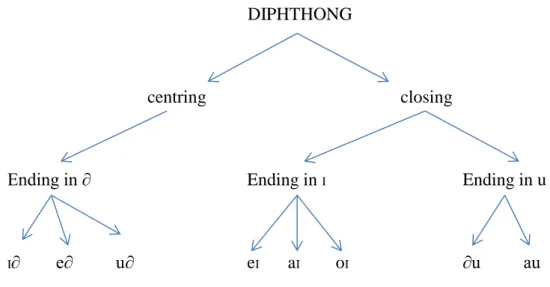
Diagram 4. English diphthongs 104
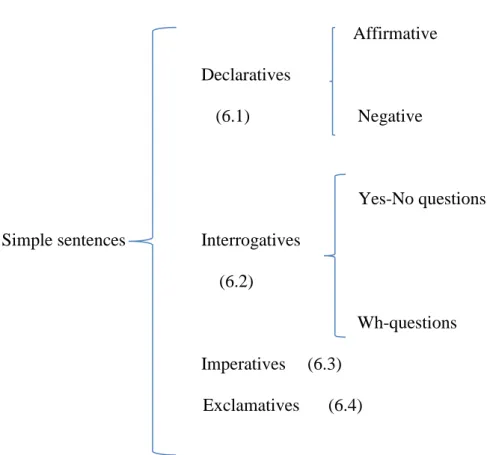
Diagram 5. Quirk’s classification 149
Diagram 6. Burton-Roberts’ classification 149
Diagram 7. Meaning 180
Diagram 8. Double exophora 227
Diagram 9. Carphone advertisement 227
Diagram 10. Speech acts 241
LIST OF TABLES AND CHARTS
PAGE
Table 1. Elements of a communicative situation 88
Table 2. Advertising elements 89
Table 3. English vowels 94
Table 4. Spanish vowels 95
Table 5. Distinctive features /i:/ - /I/ 97
Table 6. English consonants 106
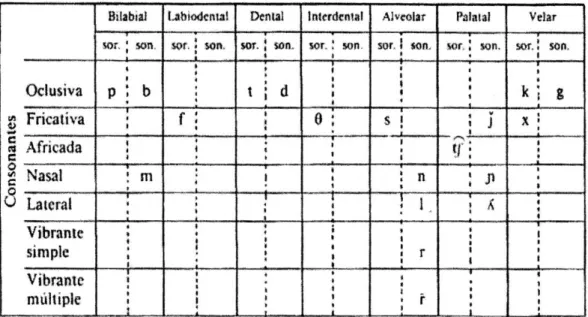
Table 7. Spanish consonants 107
Table 8. Distinctive features /p/ - /t/ 108
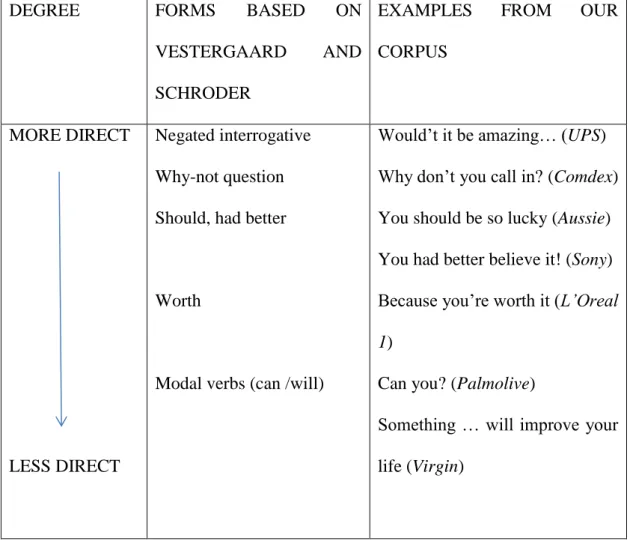
Table 9. Directness in English advertisements 162
Chart 1. Percentages of types of English advertisements 182 Chart 2. Percentages of adjectives found in English advertisements 182 Chart 3. Percentages of types of Spanish advertisements 190 Chart 4. Percentages of adjectives found in Spanish advertisements 190
Table 10. Sony advertisement 225
Table 11. Hesperia advertisement 226
Table 12. Fiat advertisement 272
Table 14. New words 286
Table 15. Morphology 291
Table 16. Syntax 295
Table 17. Semantics 298
Table 18. Pragmatics 302
1.
INTRODUCTION
1.1
The aim of this study
The reason for choosing to carry out a linguistic analysis of advertising discourse in English and Spanish is the author’s on-going interest in discovering the
main characteristics of the language used in the fascinating world of advertising, together with her bilingual and bicultural upbringing. Advertising discourse is a particularly rich field of study, since advertisers make great efforts to achieve their main purpose: to catch the attention of potential buyers. That is why advertising language is so persuasive, and why advertisements have to be catchy enough to attract possible consumers and persuade them to acquire the product or service which is being advertised.
Cannes Festival1 because of their greater creativity. Ocaña (67) highlights the creative superiority of countries such as the United States and Great Britain in this festival. Tungate (265) states that Spanish advertising has certain warmth and sensuality which the advertising created by the witty British and the funny Americans lacks. Fox (183) considers English publicists should be more subtle, understated and ironic, and not so boastful as the American ones, but she gives arguments to demonstrate that English advertising is too boastful, although she recognises that this is translated to other cultures as having a witty, innovative and creative advertising. Creativity may be expressed in many different ways, but we hypothesize that advertising copy-writers’ success in competitions and festivals, and in the commercial world in general, is due to a great extent to clever manipulation of language and maximization of the resources of the English language. This is not to say that advertising discourse in Spanish does not make use of inherent linguistic resources. Rather, that given that the morphological, syntactical and phonological elements of each language are different, then the resulting strategies are also different. This inclines us to hypothesise that English advertisements may have something that Spanish ones do not have, and whatever it is, it somehow makes them more effective or successful.
1 The Cannes Lions International Festival of Creativity is the world’s biggest celebration of creativity in
We are obviously surrounded by advertisements everywhere we go. The first aim of any advertisement, therefore, is to draw attention, that is, it must be seen easily by any potential buyer of the product. If we are walking along the street, it must be situated in a strategic place, for instance, on a billboard in front of a traffic light where many people stop and inevitably have to look at it while they wait. Another interesting place would be on a bus-stop. People often look at adverts to help pass the time while they wait for the bus. While they wait for those few minutes, people can be persuaded that the advertised product is necessary for them. However, advertisements placed in the written media, such as in magazines or newspapers, need different strategies to draw attention. When reading the written press, people are interested in the editorial work, in the news or photos of an article, and they do not usually pay attention to advertisements; in fact, advertisement pages are usually turned over quickly. Therefore, in these cases, advertisers have to use several strategies in order to draw attention. They can introduce puns, images, hooks, famous people talking about the product, and so on. Later in this work we will study the most used “tricks of the trade” for this purpose.
Picture 1. The Coca-Cola Bottle (Coca-Cola Company. Coca-Cola Journey Homepage, 2008)
Picture 2. Pepsi’s logos (Haendel, 2008)
not talk about the drinks; they only talked about the image of the product. This is what happens when a product has already created a good image. Efforts are not needed in order to persuade people to buy their product, since they only need advertisements to feed their good image. Ocaña (173) insists on the importance of the brand name of a product because “[L]a imagen de marca es única e irrepetible”. Ocaña insists on the
fact that products can be copied but not brand names: “El primero que mezcló leche con polvo de chocolate hizo un Cola Cao, y aunque Nesquick se gaste miles de millones, Cola Cao ya es un genérico. El consumidor pide un Cola Cao. Y contra eso no se puede luchar” (176). We have stated that people tend to choose a known product
rather than a product which they have never heard about. But on occasions they can choose the unknown name for reasons of price, or depending if the product is for them or for another person: we tend to give presents with a known brand name, because it makes us feel that we are giving a good gift. Advertisers must pay attention to brand names and sometimes, we hear about advertising failures caused by unsuitable brand names. For example, Volkswagen launched a car called “Nova” in South America, which was an unfortunate name, because people interpret it as “Volkswagen no va”,
especially in a culturally different advertising context. Brand names are so important, that according to Ocaña (174), companies prefer buying a well-known brand name for a new product than trying to search for and create a new name. Ocaña (174) gives the example of when Danone buys Yoplait. Yoplait finishes its production and Danone makes both brands, so Danone has bought the brand name and not the product.
We think that language has an important role to play in any advertisement, and in fact, we suspect that its effectiveness depends on the degree of linguistic flexibility of a particular language, and it may be that English offers more possibilities than Spanish in this aspect. This is obvious, for instance, in the morphological field since the English language allows more freedom in the combination of morphemes for the creation of new words than the Spanish language. More examples can be found in the same field or in other linguistic fields such as phonology, syntax, semantics and pragmatics.
that these written advertisements can keep some of the words and images of a television advertisement in order to remind the addressee of its existence, although these addressees may interpret it in different ways depending on their sex, age, social status, and so forth. This information about addressees is very important for advertisers, and many surveys are carried out to learn more about potential buyers. The American Association of Advertising Agencies gives the following outline to determine the demographic characteristics of the possible consumers (based on the American Association of Advertising Agencies, 2009):
House role (head of the family, housewife, wife, son, relatives, friends …)
Age (under 6, over 18, middle-aged …)
Sex (male or female)
Education (student, graduated …)
Marital status (married with present / absent spouse, single, widow,
divorced, pregnant …)
Religion (practising, non-practising, Protestant, Catholic, Jewish, other,
none)
Politics (liberal, democrat, conservative …)
Race (white, black, other)
Main language spoken at home (English, Spanish, other)
Salary (less than 10 000 $, more than 50 000 $, …)
Occupation (place at work, private or public companies, self-employed,
night job, retired …)
Home characteristics are also taken into account in this outline such as: the size of the country, the geographic area (metropolitan, city, suburbs, urban, rural …), geographic region (north, south, mountain, coast …), children at home (under 18, no children …), type of home (number of members, family ties, number of adults, number of women …) or house property (rented, owner …). All this information is important for advertisers in order to create their advertisements, since the consumers’ data and situation give the key to know what they may need and how to present the advertised products in a successful way.
Picture 3. Roadside hoardings on C-550 (Arteixo-Coruña)
Picture 4. Advertising on a telephone box
If there are several companies which offer the same service to consumers, then these companies spend a fortune on a good persuasive advertising campaign in order to increase sales. Telefónica, like many companies, invested a great amount of money in its 2010 summer advertising campaign as we can deduce from the previous and following pictures. Picture 4 shows a telephone box packed with messages advertising Internet. The surprising element is to see the additional advert above the telephone box, which will not go unnoticed. In Picture 5, we can see an enormous canvas covering a huge building, and on it we can see the advertisement, which, due to its size, can be seen from quite a distance. In both cases, advertisers are using different strategies in order to attract attention.
The world of advertisements is very complicated, vast amounts of money are invested to create “good” advertisements, and advertising agencies work hard in order to create the most “catchy” and “memorable” advertisements. Paradoxically, when the
buyers of the product acquire it, they do not pay only for the product but also for the advertising campaign that persuaded them to buy it. Advertisements do not only inform about the existence of the product advertised, but also persuade us that the product is necessary and that it is the best. Nowadays, advertisements are based on psychological studies, especially in the case of television and cinema advertisements. Viewers can receive impressions of a certain product subconsciously because its appearance on the screen was so brief that they did not realise it. Nevertheless, the image will be picked up by their subconscious. For example, in a TV serial when we see a happy family having breakfast with a specific brand of milk, this is what Ocaña (95) refers to as “product placement”; or when some years ago, at the cinema before a voice-over reminded you to switch off your mobile phone, you could hear the sparking of a can of Coca Cola being opened at the same time, thus making you wish for one.
Our aim here is to apply linguistic analysis to a recent sample of advertising discourse in the English and Spanish languages. We will analyse the “linguistic tricks of the trade” used in the advertising world, we will draw up an outline of the linguistic
that we suspect that English advertising discourse is more effective than the Spanish one, and to prove such a hypothesis we will create a corpus with a considerable number of examples in both languages. We will see how advertisers use language to fulfil their objectives, and for this purpose we will deal with modern advertisements from English and Spanish newspapers and magazines. The linguistic characteristics will be taken from the advertisements of our corpus and will be analysed from a linguistic point of view. We have divided the characteristics we aim to study into five linguistic fields: phonology, morphology, syntax, semantics and pragmatics, each one of these corresponding to a chapter of this work.
Although we are concerned with modern publicity, it is worth giving a very brief account of the early years of advertising, in order to see how similar, or dissimilar, it was to modern adverts.
1.2
The early days of publicity
Greeks and the Romans and in fact, archaeologists have found painted walls announcing sales of meat, milk and shoes in Pompeii.
Picture 6. Advertisement found in Pompeii (Russell and Lane 4)
Picture 6 represents one of the oldest advertisements found in Pompeii. We can see how repetition of images (a row of hams) is used in order to advertise a butcher’s,
and this method of repeated images is also seen nowadays, as represented in Picture 7, where two identical ads are placed together:
However, written communication did not start before oral communication, so oral advertising was probably the more ancient form of publicity: “En las antiguas
civilizaciones hebrea, griega y romana, la publicidad hablada era un institución reconocida. Los pregoneros públicos hacían sus transacciones proclamando nuevos artículos de venta” (Brewster et al. 22). Russell and Lane (4) include an anecdote about
the French inn owners who advertised their wines by using street vendors who also offered free samples. This fact of offering free samples dating from 1100 BC is still very used in modern publicity. Three-dimensional signs were also used to announce goods and services: for instance in the sixteenth century, the use of a striped bar to announce a barber’s, a sign which still survives in our days.
The nicest Spanish Blacking for Gentlemen’s Shoes ever invented or used, making them look like new.
The Incomparable Beautifying Cream of the Face, Neck and Hands takes away all Freckles, Spots, Pimples, Wrinkles, Roughness, Scurf, Morphew, Yellowness… Sold only at Mr. Lawrence’s Toyshop…
Nectar and Ambrosia: The highest Cordial in England, prepar’d with the richest Species, Herbs, and flowers, and done with right French Brandy, (and I refer to the judicious if it be not so,) now sold in 2d. Dram Glasses at many Eminent Coffee-houses in and about the City of London... (Bond 170-1) 2 .
In spite of having been written more than 300 years ago, we can identify certain characteristics still used by modern publicity to catch the reader’s eye. For example,
the use of adjectives, which are carefully chosen, the use of comparatives and superlatives, and the use of hyperbolic statements. Advertisements do not only inform about the product, but also persuade the reader that the product is necessary and that it is the best.
Nowadays, magazines and newspapers, as well as television, cinema and radio continue to advertise products. The press is financed by the revenues from advertisers
(Bromhead 169). According to Brewster et al. (341) the first appearance of ads on the radio was around 1922, and on television around 1939. At present, many radio and television programmes in the UK and Spain are sponsored by advertising companies, although some channels do not show any advertisements.
A more recent medium is the Internet, where there are sites wholly devoted to advertisements, as for example adflip.com, where visitors can even vote for their favourite advertisement. According to Ocaña (113) we can find different forms of advertisements on the net such as banner, skyscraper, pop up, pop under, and layer. A home page such as the following one (Picture 8) taken from terra.es will allow us to analyse the different forms of advertising on the net. In the first place, we can see a banner advertising NOKIA, and if Internet users are interested in finding more they just have to click on it. This banner also seems to be a layer: “Elemento publicitario que aparece sobre la página con animación y movimientos predeterminados” (Ocaña,
Picture 8. Terra’s website (Terra Homepage, 2008)
the search on the right hand side we will be able to see links advertising cheap flights, trips and travel agencies; when we click on any of them, this is when the advertiser has to pay for the advertisement. This method is called Google AdWords. However, when an advertisement is included on a web site, it is called a Google AdSense, and the owner of this site will obtain profits when anyone clicks on the advertisement.
Nowadays, digital advertising includes games, tests, blogs, interactive and ludic sites. The publicist Williams collects several examples of different Internet campaigns which revolutionised publicity in this medium, as for example, Burger King or Nike webs. In the first one, they presented a man disguised as a chicken to whom internauts could give orders, as for instance make him dance or do a somersault. Although all these orders were previously recorded, the mere fact that the “chicken”
Picture 9. Burger King (Burger King, 2011)
Nike also created with great success several digital advertising campaigns, among which we can highlight “The Chain” in which the football player Ronaldinho kicks a ball and the viewers had to follow the chain of kicks, the only condition being that the ball had to come in from the left and go out from the right. Participation was massive and a two-hour video was created with some of the received videos. This campaign was also reinforced with the appearance of the advert on TV where viewers were asked to visit the website in order to participate (Williams 35).
The innovation in the field of digital advertising is that consumers can interact giving and sharing opinions in forums, blogs, or consumer sites like ciao, trnd or bopki. Social networks like Facebook contain advertisements and different brand names of products create groups of followers. A tool like YouTube can also be used to praise, criticise and make parody of some advertising campaigns, or simply if you want to view some content you will have to see first an advert, which sometimes can be omitted after seeing it a couple of seconds. An example of the use of YouTube and Facebook used jointly for a major impact would be the “Gorilla” ad advertising the
you could see a man disguised as a gorilla playing the drums while he sang a song by Phil Collins. New versions of the advert soon appeared in YouTube.
Some publicists such as Williams (7) consider that the definitive jump to online advertising appears with what she calls “viral publicity”, which is defined as an advert,
usually in a video format, which is broadcasted on Internet and spreads like a virus among Internet users. Viewers look for these videos which are deliberately passed on, in contrast to the different forms of adverts previously seen by Ocaña which could irritate and distract the internaut. Digital advertising is effective in the sense that it attracts public interest and this fact is translated into more sales, and this is achieved on a world level. MacMillan writes an article entitled “The dotcom Wars” for Campaign magazine where he compares the dotcom boom (related to Internet advertising) to the great impact of the Gold Rush by defining it as a huge billboard reading “Welcome to the new gold rush”. In spite of the rise, Tungate (259) also talks about the fall of
numerous visits at that moment, but no long-term purchases. The reason was that it did not manage to create an image and a brand for their service.
Among the advantages of digital publicity we could highlight the form, simplicity, speed, interactivity, low cost, word level and millions of followers that Internet has. Among its disadvantages we could mention that not everybody has access to Internet and advertising methods and strategies become outdated very quickly. We will conclude with the reflection that digital advertising must always be innovative because techniques can be repeated but become very tiring and new techniques must be worked out in order replace the previous ones.
According to our corpus, and experience of collecting adverts for the last thirteen years, the most frequently advertised goods are beauty products, cars, mobile phones, household products and drinks. But everything can be advertised. Even the Church of England advertised itself on television in 1992 in an attempt to stem the decline in membership and attract young people, as explained in newspaper article: “Church puts its faith in TV advert” by Victoria Combe. The main objective was to
publications, where their ideas were expressed, and these publications included advertisements for medicine and special potions made of alcohol.
1.3
The state of present research on advertising discourse
Advertising discourse presents a wide range of options for research, as for example in the fields of psychology, linguistics, statistics, economy, art, aesthetics, history, communication or technology. Eguizábal (17) states that psychology was the first discipline to take advertising seriously. He also outlines three theoretical treatments in the study of advertising: the multidisciplinary, the systematic and the semiotic treatment. In the first one, the study of advertising goes together with other disciplines such as art, economy, or psychology, among others. The systematic treatment considers that advertising is a confrontation of systems, whose elements are related to each other as, for instance, information, evolution, context or economy. Finally, the semiotic treatment that, according to Eguizábal (20), was first promoted by Roland Barthes, deals with images and language.
our daily lives, many studies have been carried out on the topic. This implies that advertising is a familiar research topic; nevertheless, we think that our study is innovative in the sense that we created a corpus of English and Spanish advertisements over a period of thirteen years in order to compare both discourses. This fact makes our contribution on the subject valid in time, as we take into account the dynamic character of advertising. The press offers a great range of adverts and this contributes to the variety of our corpus as well as to the depth of our analysis. Having advertisements written in English and Spanish allows us to develop a contrastive analysis with the objective of studying the similarities and differences between both discourses. Linguistic studies on advertising carried out so far provide characteristics found in advertisements focusing for example, on one linguistic aspect, whereas we focus on several linguistic fields and take into account different aspects of each field. Since this subject matter will be dealt with here from a linguistic point of view, the next section provides the theoretical framework to be used for its analysis.
1.4
Theoretical framework
He takes “texts” as “the linguistic / semiotic elements of social events, analytically isolable parts of the social process”. We take into account written texts from the press,
particularly advertisements from British and Spanish newspapers and magazines. We also provide explanations of the semiotic aspects of these advertisements as, for example, their visual elements when necessary. Fairclough (2005) argues that when analysing discourse, some authors limit their study to identifying forms whereas others carry out a detailed linguistic analysis. In our analysis, we take into account both positions, that is, after identifying the recurrent features in advertising discourse, we classify them according to the linguistic field to which they belong, and finally, in most cases, we provide a detailed analysis. We coincide with Fairclough (2011) when he considers the aim of “Critical discourse analysis” (CDA) is to “identify through analysis the particular linguistic, semiotic and ‘interdiscursive’ features of ‘texts’ which are a part of processes of social change”, since we identify and analyse the
particular linguistic, semiotic and interdiscursive aspects of British and Spanish writtenadvertising texts which are found in the changeable field of publicity.
(39-40) describes three important disciplines in the study of language. In the first place, he mentions grammar, which offered rules to distinguish between correct and incorrect forms, in the second place, philology, which studied language used in written texts in a critical way; and in the third place, comparative grammar, whose aim was to compare languages. However, after these studies, a new discipline was born: linguistics, which considers language as the central point of its analysis. Many studies have been carried out in order to arrive at a definition of what is meant by language. For instance, Chomsky (1989:11) considers it an innate human faculty which is biologically determined, whereas Sapir (14) stated that it is experience that makes up language and has nothing to do with innateness. Saussure (60) defines language as a social system of signs which is studied by semiotics. These signs are made up of sounds (phonetics), which are combined among themselves (phonology), in order to form morphemes and words (morphology), with meaning (semantics), which make ordered structures (syntax), and have a communicative intention (pragmatics).
Bloomfield (87) defines the “phoneme” as something abstract that all
morphemes, which are the unit of study of morphology. Crystal (198) defines this field as the study of “the structure of words” which is divided into two domains: inflectional
morphology and lexical morphology.
The use of morphemes to mark plurality in nouns or participles in verbs are examples of inflectional morphemes which exist in both English and Spanish. In English we also have inflectional morphemes in the use of comparative and superlative forms which are not seen in Spanish, which uses no inflectional ways of expressing higher degree.
discourse, along with blending or shortening words to create clipped forms and acronyms. Borrowing words from other languages is often found in publicity as we will see in our analysis, for instance the use of French words in English and Spanish advertisements. Concerning the creation of new words, Bauer (239) talks about “word manufacture” when a word “is created ex nihilo, with no morphological, phonological or orthographic motivation whatsoever” and this is usually found in brand names of
advertised products / services. In the Spanish language, we can find all these morphological processes3 (Alvar 21), and when dealing with affixation we can talk about the use of “interfijos” which are “elementos sin función gramatical significativa y que enlazan la base lexica y los sufijos” (Otaola 107). Frequent interfixes are “-ar-,
-arr-, -ot-” as found in “humareda, jugarreta, pisotón” respectively. This process is less productive than prefixation and suffixation.
Words are composed of morphemes and word order is an important part of the study of syntax, which also pays attention to sentence structure. Crystal (216) classifies sentences into simple and multiple sentences depending on the number of clauses they have. He talks about four levels in the grammatical hierarchy which are summarized in the following diagram:
3 The Spanish Word “acrónimo” is used to refer to the English word “blending”, whereas the Spanish
WORD
PHRASE
CLAUSE
SENTENCE
Diagram 1. Grammatical hierarchy (based on Crystal 217)
Rojo (114) states that this hierarchy also applies in the Spanish language. Simple sentences can be classified as declarative, interrogative, imperative or exclamatory (Quirk et al. 803), whereas multiple sentences can be divided into compound and complex sentences (Crystal 226). The Spanish language follows the same classification and distinguishes “juxtaposition” as another type of complex
Words and sentences form texts with meanings. Beaugrande and Dressler (3) define a text as a communicative occurrence with seven standards of textuality: cohesion, coherence, intentionality, acceptability, informativity, situationality and intertextuality. In our section about semantics we deal with the concepts of cohesion and coherence. Halliday and Hasan (48) consider that cohesion occurs when the interpretation of some element of the text depends on another, and they distinguish five major types of cohesive ties: reference, substitution, ellipsis, conjunctions and lexical cohesion. A text is said to be coherent when all the elements are related to each other (Brown and Yule 224). Advertisements make use of these standards, unless they are interested in creating other effects. If the text is formulated in a cohesive and coherent way by the addresser, and it is received as such by the addressee, then we are dealing with the standards of intentionality and acceptability respectively (Beaugrande and Dressler 7). These authors (8-9) consider that the text is always informative as it provides information and it always occurs in a context, all of which is related to the standards of informativity and situationality. Regarding the last standard listed by Beaugrande and Dressler, intertextuality deals with the use of a text or texts within other texts and, as will become apparent later, it is very much used in advertising discourse.
the following phenomena important in any pragmatics theory: deixis, implicature, presupposition, speech acts and several aspects in the discourse structure. Austin (25) states that language consists of carrying out speech acts, such as making statements, orders, questions, promises, suggestions, or apologies. These speech acts are possible thanks to certain linguistic rules, such as the “principle of expressivity” (Austin 28)
which consists of saying what one wants to say. This is very important in advertising because advertisers have to pay attention to what they want to say and how they say it, because otherwise their message might not be understood by readers. This principle is closely related to Grice’s maxims, since all speech acts should take into account
several rules, as for example quality or quantity.
Fairclough (2011) distinguishes three forms of critique with relation to CDA: ideological, rhetorical and strategic critique.
Whereas ideological critique focuses on the effects of semiosis
on social relations of power, and rhetorical critique on persuasion (including “manipulation”) in individual texts or talk, what we might call “strategic critique” focuses on how semiosis figures
within the strategies pursued by groups of social agents to
change societies in particular directions.
interdiscursive analysis of the advertisements of our corpus. We also pay attention to the second and third forms of critique: advertisers use persuasion and other strategies to make readers buy their products or use their services. Advertising cannot be understood without rhetoric because all advertisements are designed to give reasons to potential buyers to change their behaviour by choosing a certain product or service (Baños et al. 163). These authors consider that rhetoric has its origins in Greece in the 5th century B.C. with the doctrine of Corax, Tisias and Aristotle, and later with Cicero the doctrine of rhetoric is made explicit. In his work, Cicero (54-56) talks about the five steps which make up rhetoric discourse: inventio, dispositio, elocutio, memoria and pronunciatio. Therefore, what is said, how it is said and in which order are very important elements, and these steps are considered in advertising discourse: advertisers search for reasons to present the product, they display all the information throughout the advertisement in the heading, subheading, body text, slogan (if all these parts appear) or just in the brand name. In order to be persuasive they use language in a concise manner and they often use figures of speech such as metaphors, metonymy, personifications, or hyperboles.
morphology, semantics, syntax and pragmatics. These are the linguistic fields which we take into account in order to analyse English and Spanish advertising discourse.
In our analysis we start with the study of phonology. In the first place, we provide the differences between phonetics and phonology according to Gimson, and then we continue with the description of the English and Spanish phonetic systems based on Gimson (1994), Roach (1991), D’Introno (1995) and Quillis (1973). In the section on morphology we consider the morphological studies carried out by Pyles (1993) and Quirk (1985) studying the different types of word formation and creation. Syntax is defined according to linguists Baker (1995) and Crystal (1995), and we follow the classification of simple sentences established by Quirk (1985), and the classification of complex sentences carried out by Burton-Roberts (1989) and Spanish linguist Rojo (1978). We start the section on semantics with the definition of this discipline according to Akmajian et al. (1990), and we continue our analysis in this field with the studies of Leech (1972), Crystal (1995) and Cook (1992). Finally, for our analysis of pragmatics we refer to the studies carried out by Searle (1980), Grice (1991) and Levinson (1983), examining deictic elements, presuppositions and implicature.
2.
ADVERTISING
2.1 Definition. Types of advertisements
The phenomenon of advertising surrounds us daily. We are bombarded by advertisements on television and radio, in magazines and newspapers, in buses, trains and on street hoardings. Baños (233-278) offers the following classification of advertising media.
Newspapers (paid / free) Press Magazines
Conventional media Radio and Television Cinema
Advertising Outside
Media Internet
Direct advertising Non-conventional media
Sales point advertising Interactive television
New media
In the first place, we can distinguish between conventional and non-conventional media. Press, radio, TV, cinema, outside advertising (as for example street hoardings) and Internet are mentioned as conventional ones, whereas direct advertising (as for example handing out leaflets), and sales point advertising (when we are offered a sample or a small tasting of a product in a desk of a store) are included as non-conventional media. Among the new media, Baños (271) mentions interactive television and the use of mobile phones. It is curious that a revolutionary phenomenon such as Internet is mentioned among the conventional media and not the new ones. A possible reason could be that digital advertising came with such an impulse that now the new strategies to surprise the audience are already extinguished.
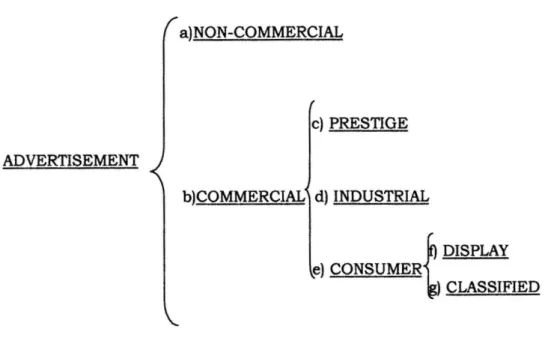
Diagram 3. Types of advertisements
First of all, they distinguish between (a) non-commercial and (b) commercial advertisements. Examples of the first class are those for associations and / or societies for charity or political purposes. Examples of these kinds of adverts are Fondation, released in a British magazine, and Ayuda, released in a Spanish one. The former is an appeal by “Fondation pour la protection de l’enfance et l’action humanitaire”, and the latter is an appeal by “Ayuda en Acción”.
rather than an immediate increase in sales (Vestergaard and Schroder 1). In British Airways, the company gives a message for its customers communicating the effort
they are making to return to normal service after the period of industrial action, and in Cortefiel, the Spanish clothes firm thanks its customers for helping them to reopen a
shop. The aim of these advertisements therefore, is to remind people of the existence of the firms and to leave a positive image, just as in Northern Rock which aims to create a favourable impression of the society because its members will probably receive the information of the meeting by post or electronic mail. Or the Spanish Advertisement Iberia 1, which just makes up a Christmas tree using their destinations, only wishing Happy Christmas to everybody, and not trying to sell flights directly. Sometimes, a firm advertises its goods or services to other firms. These advertisements are known as industrial advertising (d). This type of commercial advertisement is usually found in specialised trade journals or in the business pages of newspapers (Vestergaard and Schroder 2), and one example can be seen in Market Prices. The third type of commercial advertisements is known as consumer advertising (e). The advertiser is a firm appealing to individual potential buyers rather than to other firms in order to promote the sales of products and services, yet Vestergaard and Schroder (3) distinguish between display (f) and classified advertising (g).
advertisements. This kind of advertisement is generally released by a large firm or an association (Vestergaard and Schroder 3). For instance, Galaxy has the form of a quiz. The British magazine She differentiates it from the editorial material by writing in the top right hand corner of the page the word “ADVERTISEMENT”. Perhaps advertisers are legally obliged to warn readers that it is an advert, and not editorial material. Nordic Mist is an advertisement for tonic and mentions an advertisement from its competitor Schweppes. Nordic Mist focuses on the word “ADVERTISEMENT” of the Schweppes advertisement and encourages the readers that they should not pay attention to what it claimed because it was only what the top right corner of the page said: ADVERTISEMENT, and it is not based on a reliable study. This idea is further developed in the advertisement which emphasises the idea that what they say about Nordic Mist is true due to a more scientific study based on statistics.
Classified advertisements (g) are placed on special pages and ordered according to subject. And as they are written by smaller local firms or private individuals, it can be said that there is a communication between equals (Vestergaard and Schroder 3). Classified is an extract of classified advertisements which deals with “Car Hire” and “London Hotels and Apartments”. This kind of advertisements lacks
the persuasive language of other types because hardly anything or very little is done to persuade “buyers” to read the advertisement. In fact, this type of advertisements is
otherwise they are ignored by the average reader. The language used is minimal communication due to space and cost. These advertisements include telephone numbers for contact which will provide the rest of the information.
Display advertisements can advertise material needs or social needs (Vestergaard and Schroder 5). Examples of material needs are advertisements for food (Homepride and Barilla), drinks (Appletiser and Trina Light), and clothes (C&A and Custo). But they can also be advertisements for social needs because by using these
products we can identify ourselves with a certain social group. For instance, in C&A we can feel identified with the women who appear in the image and we could feel that we belong or would like to belong to that group (professional class women). If we would like to dress like them, we can find their clothes in C&A. In the same way, Custo presents clothes by Custo Barcelona which evoke fashion, coolness and originality for young people. Thus, clothing becomes a carrier of information about what kind of people we are or aspire to be. A clearer example of social needs is perfume, because women define themselves depending on the brand of perfume they use. Dior 1 is an advertisement for Christian Dior’s “Hypnotic Poison”. The name and the image recall a kind of “Mata Hari”, a woman whose attractions are difficult to
After this general summary of types of advertisements, let us examine definitions given by some authors of what is meant by advertising. A general commentary on their different points of view will follow.
In its simplest sense the word “advertising” means “drawing attention to something”, or notifying or informing somebody of
something (Dyer 2).
La publicidad es la rama de las comunicaciones del proceso de
mercadotecnia. Es un método para enviar un mensaje de un
patrocinador, a través de un canal de comunicación formal, a una
audiencia deseada (la palabra publicidad procede del término
latín advertere, que significa “enfocar la mente hacia”) (Russell
and Lane 27).
La publicidad es un proceso de información al público que tiende
a incrementar las ventas de un producto (Sardón 250).
El anuncio se orienta a la función específica de incrementar las
ventas, mientras asocia al producto a situaciones agradables,
contribuyendo a crear una actitud favorable en el possible
comprador. La comunicación por medio del anuncio está
relacionada con la obtención de un resultado, con la idea de
persuadir y conmover al consumidor (Woodward 92).
La publicidad es … el arte de convencer consumidores (Bassat
La publicidad no es una noticia sino un mensaje comercial que
debe repetirse constantemente al consumidor hasta que se queda
con la idea y el producto le viene inmediatamente a su cabeza a la
hora de elegir un producto para cubrir la necesidad de que se trate
(Ocaña 72).
… la redacción publicitaria es la técnica redaccional aplicada a la
publicidad, especializada en públicos indiferentes y distraídos
(Curto et al. 19)
Pensar que lo esencial publicitario consiste en vender géneros es
tan ingenuo como pensar que lo esencial de la moda es cubrir
nuestra desnudez o protegernos contra el frío. Por supuesto que
la publicidad vende mercancías, de la misma forma que la
vestimenta nos cubre, pero ese pensamiento, reduccionista a
todas luces, no nos ayuda en absoluto a comprender la
publicidad, y ello es lo que debe construir el objetivo de un
conocimiento teórico del fenómeno (Eguizábal 7).
Advertisements are one of the most important cultural factors
moulding and reflection our life today. … obviously it has a
function, which is to sell things to us. But it has another function,
which I believe in many ways replaces that traditionally fulfilled
by art or religion. It creates structures of meaning (Williamson
11-12).
Commercial speech - advertising- makes up most of what we
states, it is part of our culture, and that is why we consider it worth studying. This author also defines advertising as commercial speech, that is, the language used in activities related to business.
From the above definitions we can conclude that:
Advertising is a process of communication.
Advertising increases sales of goods.
Advertising is an art.
Advertising persuades consumers.
Advertising tries to create positive attitude towards a product.
Advertising sells goods.
Advertising is everywhere.
Advertising is part of our culture.
Advertising is necessary.
Advertising is commercial speech.
Advertising is a process of communication in which advertisers use persuasive language and other resources to increase sales, making their advertisements noticeable enough to consumers, who sometimes may be indifferent and absentminded towards the product or service which is being advertised.
2.2 Attention-seeking devices
There is serious competition between advertisers due to the fact that there are thousands of professional advertising agencies in the world, and this is one of the reasons why admen try to be original. Their main aim is to make sure that their advertisements are noticed. They have to attract attention and arouse interest in the addressee of the advertisement, who will probably not care consciously about advertising. Then they have to stimulate and create a desire in order to make the receiver buy the object which is advertised. They work hard to connect with the addressee, because of the competition with other agencies. Goddard (11) claims that attention-seeking devices are used to make people want to start the decoding process,
But which are the most common attention-seeking devices? Some of the characteristics which follow are taken from Goddard (11-26), while the examples of advertisements are from our own corpus.
A)
Images
Benetton is an advertisement for a firm which often advertises itself with striking images which have nothing to do with clothing. Their aim is to impress the reader with tough images, and in this case they are dealing with equality between races showing three hearts, which are the same no matter to whom they belong. Other examples, which are summed up in a newspaper article written by Capeáns, are a nun and a priest kissing each other, a youth with AIDS about to die surrounded by his family, and a big stain of blood, which reminds us of the atrocities of the war in Yugoslavia.
advertising discourse when he exemplifies it with Absolut ads, which are ads representing the Vodka bottle in several ways (Absolut); these ads are collected as if they were cards.
Advertisements for cigarettes used large pictures to advertise themselves because they could not legally encourage people to smoke, as the Code of Advertising Practice establishes in the Articles of the Asociación para la Autorregulación de la Comunicación Comercial (AUTOCONTROL), which includes a clause concerning health protection: “Advertising must avoid the encitement of its receivers, specifically
adolescents, to behave harmfully to their health”. An example of the use of large pictures to advertise tobacco is an image of an unusual landscape with the slogan “Marlboro. Come to where the flavor is”, in Marlboro. In fact, many Spanish
advertisements for cigarettes were taken directly without translation from the American/ British campaign, thus emphasising the authenticity of the product and at the same time without saying a word to encourage smoking. According to Chatman (185-194), the best way is to turn to visual imagery, that is to say, giving an image evoking the nice feelings smokers get from smoking: “How? By telling a story, the
story of light-hearted folks... who smoke for the simple pleasure of it, and couldn't care less about official admonitions. Admonitions, of course, always come in dull old language” (Chatman 185). Therefore, cigarette advertisements often use a printed
identify them as advertisements for cigarettes. Examples: Embassy with the warning “Smoking Kills” or Camel with the warning “Las Autoridades Sanitarias advierten que el tabaco perjudica seriamente la salud”.
Chatman (186) also says that one can find advertisements with pictures of people smoking, which implicitly invites the viewer to join the happy group, although, one can also find a linguistic unit such as “For people who like to smoke…”
Sometimes we can see an image which seems to have no relation at all with a tobacco advertisement, so viewers make up their own interpretations. Thus, not only do they invent stories for the advertisement, but they also try to find reasons for smoking, which is the aim of the advertisers. Nicotinell could be taken as a counter-example because, according to Chatman, an image with people could be the typical one for an advertisement of tobacco, but in this case, the advertisement uses the usual setting to invite people to stop smoking.
Tobacco advertising is controversial and has been banned on Television, radio, in cinemas, shop windows and vending machines by law 28/2005 (Art. 9). According to a newspaper article by Alan Zarembo, they cannot target children or imply that “smoking enhances your appearance”. This article also includes a poster of a
animal is reduced to a skeleton. In this advertisement, we can also read: “La pub tue” (Advertising kills), which parodies the warning: “Smoking kills”.
Picture 11. Advertising kills (reproduced from Newsweek, June 16, 1997)
Terra may impress the newspaper reader as it is a blank page, the reader may
want to know the reason and indirectly he/she is “forced” to read the small writing “Urge equipo creativo” and even the lateral text:
TERRA GMC selecciona para su departamento creativo:
Directores de Arte, Creativos, Diseñadores Gráficos y
Web-Masters con una experiencia mínima demostrable de 3 años
para incorporación inmediata. Interesados enviar currículum a:
[email protected] Reserva absoluta a interesados.
Golf may also be striking because the whole page is packed with small pictures
of Golfs resembling stamps, the reason being to demonstrate the car’s adherence to the
road as if it were a stamp to be adhered to envelopes. “Nuevo Golf TDI 130 CV 4 Motion. Máxima adherencia sobre cualquier superficie”. Three-dimensional images are often related to TV or cinema ads, but Milar is original because the advertisers managed to include a 3D advertisement in a printed page. At first sight, all we see a distorted image on a TV screen, but with the paper glasses provided with the advert, we can see the image of a dinosaur coming out of the TV. In this way, the advertisers attract the viewers’ attention and curiosity since most of them will probably be unable
to see the image. This is an effective way of implicating the viewer in the communicative process, which, in advertising is often difficult to achieve, given the quantity of messages bombarding the reader / viewer. Once attention is caught, the advert is read and this is the advertisers’ first objective.
B)
Headings
Striking headings are often used to attract attention, for example in the case of Vaseline 1 whose heading “Can be applied with or without tongue” sparks the readers’
curiosity and makes them read the whole advertisement to find out what the tongue has to do with the product offered. Foundation also has a striking heading “STOP IT” and
case, a famous person (Phil Collins) is used to ask for help. The body copy also uses tough language, but we will analyse how language works in advertisements later in this study.
In written advertisements, therefore, there is usually a hook “the initial piece of
attention-seeking verbal language used to draw the reader in” (Goddard 106). Goddard states that hooks often occur in a question form: UPS “Wouldn't it be amazing if sending a package across Europe could be as simple as sending it across town”. The question identifies a problem which the rest of the advertisement expands on:
“For other delivery companies, the concept of a wholly-integrated, one-market
Europe is still a bit ethereal. For UPS, it is reality”.
Once the problem is set out, the advert suggests that the delivery company UPS has the solution:
Our uniform, all-embracing system of package delivery is now in
place across Europe. We offer your business the ease and
convenience of a common set of services and capabilities for
both national and international deliveries, including guaranteed
10.30 am Express, guaranteed (and confirmed) 8.30 am Express
Plus, and state-of-the-art technology to confirm delivery across
single-mindedly. It’s one more reason UPS is Europe’s new
delivery system.
C)
Intertextuality
Advertisements sometimes refer to other contemporary advertisements or imitate non-advertising texts. This phenomenon is known as intertextuality, which refers “to the way one text can point to or base itself on another” (Goddard 69). In
Scholl we can see a used trainer in the middle of the page with the slogan “Just smell
it”. This advertisement takes for granted that the original one is remembered by the
readers, who can establish the relationship between both advertisements. In this case the original text is NIKE's “Just do it”. If they cannot remember, it does not matter because the new one can be enigmatic or can make people ask others what it is about: interest has been aroused and the objective is fulfilled. Texts which use intertextuality provide certain satisfaction for the “clever” reader who is able to make the connection.
Aussie makes reference to Kylie Minogue and her songs. First of all, they have
chosen an Australian person to relate it to Aussie’s logo, which is a kangaroo, the
national emblem of Australia, an emblem which also appears in the background of the ad. Then, there is a question “An Aussie shampoo perfectly matched with an Aussie conditioner?” which presupposes an affirmative answer: “You should be so lucky”, an
its chorus Lucky, lucky, lucky. The body text continues with all these allusions: “These two are designed ‘Especially for you’”, another song by Kylie Minogue and Jason
Donovan, which is the reason why it is quoted in the advertisement. Aussie shampoo and conditioner will leave the hair “with more gloss and shine than your average
multi-platinium award winning international superstar”, which again elicits Kylie Minogue as an answer from the readers.
In Spanish advertisements we can also find this phenomenon. Some years ago, we could see roadside hoardings advertising “Coca-Cola”, with the slogan “Sed o no Sed”, thus referring to Shakespeare’s “To be or not to be” (=“Ser o no ser”).
Many advertisements, both in the English and Spanish language, make allusions to the Bible. The reason is that the general audience of both cultures would recognise them and make the connection. Philadelphia and Abril can illustrate this:
“Let there be extralight” (Philadelphia) = allusion to the creation of the world.
(The pun will be commented on later in this work).
“Tras el séptimo día llovió. Y empezó Abril” (Abril) = allusion to the seventh
Advertisements sometimes evoke knowledge of a film or story (Cook 190). Smeg 1 evokes the story of “Snow White and the Seven Dwarfs” when the wicked
Queen asked her mirror: “Mirror, mirror on the wall, who is the fairest of them all?”
In this advertisement, the reply of the mirror would be “Smeg”. The allusion to the mirror could also be seen in the image, where we can see the dishwasher reflected on the floor.
Another example of intertextuality is when an advertisement takes the characteristics of other discourse types (Vestergaard and Schroder 62). For instance, Galaxy takes the quiz form to advertise chocolate or Homepride and Barilla which have the form of a recipe advertising “Homepride Sweet and Sour Sauce” and “Farfalle Barilla” and can make the reader want to keep it for future reference when
cooking, or Thomas, which looks like a comic strip advertising toys. Wella and Kymco advertise “Shockwaves Wella” and “El bache maldito” as if they were films. Leech
(99) refers to this phenomenon as role borrowing.
D)
Celebrities
Cindy Crawford is advertising an Omega watch, or by association such as in Max Factor 1, in which the make-up artist of Evita advertises MAX FACTOR (“The
Make-up of Make-up Artists”).
“Another method is to appeal to the authority of science or the medical profession” (Vestergaard and Schroder 66). The painkiller “Tylenol” in Tylenol is
recommended by doctors, thus making more credible the qualities of the product advertised.
E)
Samples
Magazines sometimes bring samples of perfumes/shampoos. In Palmolive the first page asks the question “Who can resist the gentle touch of Palmolive Nourishing Shower Gel with Essential Oil?” and the second page gives us a sample of the gel
which is stuck to the image of it asking a second question connected to the first one: “Can you?”. The answer expected is a negative, and so the reader is invited to interact
“invited” to do a crossword, where all the definitions (housework problems) have the
same solution: Soda Crystals.
F)
Graphic devices
Graphic devices are used for example in CNN in which iconicity with words is used because the words take the shape of a business graph. Or in WWF 1 and WWF 2 in which the words take the shape of a fish and a fallen tree respectively. Cook (77-84) talks about writing which provokes iconic behaviour, such as in Sony which makes us move as sound waves while reading it or Santiveri whose body copy represents the contours of the slopes.
Sometimes, attention-seeking devices have to do with typographical features (Goddard 16-7). A verbal text can be presented in different fonts, styles and sizes, in bold, in upper-case and lower case letters and with different features of punctuation. Any of the above advertisements can illustrate this; however let us look at Kellogg’s 1. It represents the handwriting of a young girl, and in fact, the words come out from her head, metaphorically and physically speaking (see the image in the advertisement). The ascending lines seem to have been written in a rush, and the slogan “más ke amigas” seems to represent the girl’s writing because of the modern use of “ke”
waste time while chatting, a way of writing with which the girl will probably be familiarised. We can deduce all this simply by means of typographical devices.
G)
Principle of reversal
Cook (218) deals with the principle of reversal: “Features considered typical of ads are often pointedly abandoned, thus defeating expectation and arresting attention”.
For instance, in BT 1 we can see how the advertisement for British Telecom takes another advertisement (probably invented) admitting that ads can lie (we have seen this presupposition earlier in section 2.1. in Nordic Mist), and trying to gain the reader’s confidence implying that they are honest by offering a good Christmas gift.
Fox (184) also quotes an example of this technique when she recalls an advert for the yeast-based “Marmite”, in which advertisers focus on the repulsion some people feel for it: “some people eat this stuff but a lot of people can’t even bear the smell of it? Only in England!”.
In Peugeot 1 we can see the car advertised like a fragrance, the ad has a part of the page folded and invites the reader to lift it up “Pruébalo” as if we were to find a
H)
Other methods
An addressee will probably not read an advertisement without an attention-seeking device such as a slogan or a hook; that is to say, without something that catches his/her attention. A full written page would be too boring and time consuming to read and therefore the advertisement would not work. Let us take Solpadeine MAX: this advertisement consists of two pages, very alike but with a slight
change in the heading. The reader will see the first page and probably turn over without paying much attention. But when he sees again almost the same (there is a change in the heading though the image is the same), this attention-seeking device will work and will make the reader go again to the first page because he knows that he has seen it before. He will try to identify the aspect which differentiates the first page from the second, and in doing so he will be reading the advert, which is what the advertiser wants.
2.3 Our analysis
language? Do both cultures use language in the same way to achieve the advertiser’s
3.
THE STUDY OF ADVERTISING LANGUAGE
Akmajian et al. state in their first chapter that linguistics is related to language and communication (both between people and between animals). In the second and third sections of their book, they analyse language according to different linguistic fields: phonology, morphology, syntax, socio-linguistics, dialectology, semantics, pragmatics, and neurolinguistics. Language can also be studied from the point of view of other fields connected to linguistics such as philosophy, anthropology and sociology, among others (Akmajian et al. 24). However, linguistics does not only focus on language and how it functions but also studies the human mind: “language
has sometimes been described as a 'mirror of the mind' so that the study of language should then give unique insight into human thought” (Chomsky 1996:1). In this study, as we have already stated, we intend to follow the traditional division into linguistic fields.
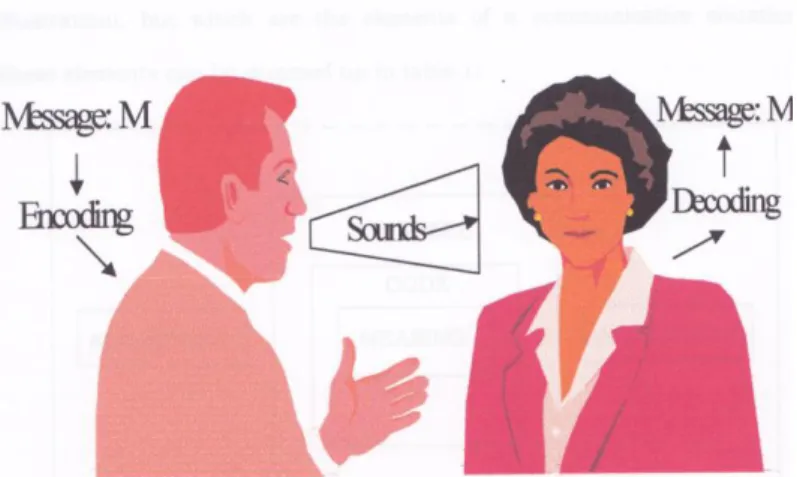
communication? Communication is “the transmission and reception of information between a signaller and a receiver” (Crystal 460).
This can be illustrated in the following way:
Picture 12. Communication process (based on Gimson, 8)
According to Vestergaard and Schroder, advertising is “verbal/non verbal, public, one-way communication” (14). But what are the elements of a communicative situation? These elements can be summed up in table 1:
CONTEXT