! "#
$%
! "#
! "#
$%
$%
European Journal of Pharmaceutical Sciences 26 (2005) 438–445
Studies on the formation of O/W nano-emulsions, by
low-energy emulsification methods, suitable
for pharmaceutical applications
N´uria Sadurn´ı
a, Conxita Solans
a, N´uria Azemar
a, Maria Jos´e Garc´ıa-Celma
a,b,∗aDepartment of Surfactant Technology, IIQAB-CSIC, Jordi Girona 18-26, 08034 Barcelona, Spain
bDepartment of Pharmacy and Pharmaceutical Technology, Faculty of Pharmacy, University of Barcelona, Joan XXIII, 08028 Barcelona, Spain
Received 22 February 2005; received in revised form 4 July 2005; accepted 3 August 2005 Available online 8 September 2005
Abstract
The formation of O/W nano-emulsions suitable for pharmaceutical application and the solubilisation of a practically non-water-soluble drug, lidocaine, have been studied in water/non-ionic surfactant/oil systems. Nano-emulsions were prepared by using low-energy emulsification methods, changing the composition at constant temperature. Kinetic stability was assessed by measuring droplet diameter as a function of time. Lidocaine solubilisation was studied in nano-emulsions with high water content. In the water/Cremophor EL/Miglyol 812 system the lowest droplet sizes, from 14 to 39 nm at 10/90 and 40/60 oil/surfactant ratios, respectively, and 90% of water content, were obtained with an emulsification method consisting of stepwise addition of water to oil/surfactant mixtures at 70◦C. Nano-emulsions of this system showed high
kinetic stability. Droplet diameters did not exceed 67 nm after a period of at least 7 months. The maximum lidocaine concentration solubilised in nano-emulsions of the water/Cremophor EL/Miglyol 812 system with 90 and 95% of water content was 3.5 and 2.1%, respectively. These values are within the therapeutic range of lidocaine.
© 2005 Elsevier B.V. All rights reserved.
Keywords: Nano-emulsions; Surfactants; Low-energy emulsification methods; Drug solubilisation
1. Introduction
Nano-emulsions are a type of emulsions with uniform and extremely small droplet size, in the range 20–200 nm (Solans et al., 2003). Due to their characteristic size, some nano-emulsions are optically transparent. These properties together with low viscosity, high kinetic stability against creaming or sedimentation and a large interfacial area (Buszello and M¨uller, 2000; Solans et al., 2003) make nano-emulsions of increasing use in many different applications (Solans et al., 2003). In the literature, this type of liquid/liquid dispersions are also referred to as submicron emulsions (Benita and Levy, 1993; Lundberg, 1997; Sznitowska et al., 2001), miniemul-sions (Ugelstad et al., 1973; El-Aasser et al., 1984; El-Aasser
∗Corresponding author. Tel.: +34 934024548; fax: +34 934035936. E-mail address:[email protected] (M.J. Garc´ıa-Celma).
and Miller, 1997), ultrafine emulsions (Nakajima et al., 1993; Nakajima, 1997), unstable microemulsions (Rosano et al., 1981), etc. The term nano-emulsion is increasingly used because it gives a clear idea of the nanoscale size range of the droplets, avoiding misinterpretations with other kinds of dispersions such as microemulsions, which are thermody-namically stable systems (Dinielsson and Lindman, 1981; Solans et al., 1997).
N. Sadurn´ı et al. / European Journal of Pharmaceutical Sciences 26 (2005) 438–445 439
components, also named condensation, low-energy or “spon-taneous” emulsification methods (Gopal, 1968) are receiving increased attention. In these methods, nano-emulsions are obtained as a result of phase transitions produced during the emulsification process which is carried out, generally, at constant temperature changing composition (Forgiarini et al., 2001; Us´on et al., 2004) or at constant composition changing temperature (Izquierdo et al., 2002; Morales et al., 2003), the well-known PIT method (Shinoda and Saito, 1968). In practice, a combination of high-energy and low-energy emulsification methods has proved to be an efficient way to obtain nano-emulsions with small and very uniform droplets (Nakajima, 1997).
Nano-emulsions have experienced a growing interest as colloidal drug carriers for pharmaceutical applications. The use of nano-emulsions in topical administration of drugs is well documented (Friedman et al., 1995; Youenang Piemi et al., 1999; Fernandez et al., 2000). However, nano-emulsions reported in the literature are prepared by using high-energy emulsification methods as sonication, high-shear mixing or high-pressure homogenisation to form them (Walstra, 1996; Floury et al., 2003; Landfester et al., 2004). Drug penetration was reported to be strongly enhanced by sol-ubilisation in small droplets (below 0.2m) (Schwarz et
al., 1995). In this context, it has also been reported that when using oil-in-water emulsions as vehicles, the phar-macological activity is correlated to emulsion droplet size (Amselem and Friedman, 1998). Nano-emulsions are also used as ocular delivery systems to provide a reservoir for sustained release of drugs (Sznitowska et al., 1999). Oil-in-water nano-emulsions can be administered orally to increase the bioavailability of poorly water-soluble drugs (Wagner et al., 1966; Bates and Carrigan, 1975) due to an enhance-ment of the intestinal absorption of the drug (Constantinides, 1995). It has been also found that the absorption in the gastrointestinal tract is improved by a small droplet size (Toguchi et al., 1990). They are also used as intravenous delivery systems for the administration of lipids in par-enteral nutrition and for their capacity to incorporate water non-soluble drugs directly to the veins (Lundberg, 1997; Mbela et al., 1998; Jumaa and Muller, 1998). Although, as it has been showed, there are several studies related to nano-emulsion applications in the pharmaceutical field, further effort is required in order to fully understand the mech-anisms directly implied in nano-emulsion formation and stability and, therefore, optimise nano-emulsification pro-cesses.
The objectives of this work have been to study nano-emulsion formation with biocompatible components using low-energy emulsification methods and the solu-bilisation of a model non-water-soluble drug, lidocaine, a local anaesthetic of the amide type. For this pur-pose a water/polyoxyethyleneglycol castor oil derivative surfactant/medium-chain triglyceride system was chosen and its phase behaviour was determinated prior to study nano-emulsion formation and lidocaine solubilisation.
2. Materials and methods
2.1. Materials
Non-ionic surfactants, Cremophor EL and Solutol HS 15, supplied by BASF, were used. Cremophor EL is obtained by reacting castor oil with ethylene oxide in a molar ratio of 1:35. Its hydrophilic–lipophilic balance (HLB) lies between 12 and 14 (BASF Corporation, Technical literature). Solutol HS 15, whose HLB lies between 14 and 16, consists of polyglycol esters of the 12-hydroxystearic acid and free polyethylene glycols (BASF Corporation, Technical literature). The oils used, Miglyol 812, a medium-chain triglyceride was pur-chased from ROIG FARMA, and castor and soybean oils were purchased from SIGMA. Water was deionised by Milli-Q fil-tration. Lidocaine (2-diethylamino-N -[2,6-dimethylphenyl]-acetamide) was purchased from SIGMA.
ortho-Phosphoric acid 85%, acetonitrile and methanol, purchased from Merck, and triethanolamine, purchased from Fluka, were the analytical products used for HPLC analysis.
2.2. Methods
2.2.1. Phase diagrams
The phase diagram was determined at 25◦C by stepwise addition of one component to the mixture of the other components and homogenized with a vibromixer. After each addition the samples were stirred, homogenized and kept at 25◦C. The occurrence of phase separation was observed within a period of 48 h. To better define the phase boundaries some samples were prepared by weighting all components in ampoules, which were sealed, homogenized with a vibromixer and kept at 25◦C to equilibrate. Liquid crystalline phases were identified by using crossed polarisers and by optical microscopy (Reichter Polyvar 2, Leica) under polarized light.
2.2.2. Nano-emulsion formation
Nano-emulsions were prepared by addition of water to mixtures of the other two components (oil and surfactant), using a magnetic stirrer at approximately 2000 rpm. Inde-pendently of the temperature at which they were prepared, the samples were kept at 25◦C.
2.2.3. Small-angle X-ray scattering (SAXS)
Small-angle X-ray scattering equipment consisted of a Siemmens K-760 generator, Cu K␣anode (λ= 1.542 ˚A). The
440 N. Sadurn´ı et al. / European Journal of Pharmaceutical Sciences 26 (2005) 438–445
to an angleθ. The interlayer spacing,d, of liquid crystalline phases was determined by the Bragg equation (d= 2π/q).
2.2.4. Dynamic light scattering (DLS)
The mean droplet sizes of nano-emulsions were determined using a Malvern 4700 photon correlation spec-trometer (Malvern Instruments, Malvern, UK). An argon laser (λ= 488 nm) with variable intensity was used. Measure-ments were always carried out at a scattering angle of 90◦. The DLS data was analysed by the cumulants method obtain-ing thez-average mean of nano-emulsion droplet diameter and the polydispersity index, which is a dimensionless measure of the width of size distribution, and the CONTIN method. Polydispersity indexes lower than 0.2 indicate that polydispersity maintains its significance as an accurate measure.
2.2.5. Drug solubilisation
Lidocaine was incorporated to oil/surfactant mixtures prior to the addition of water to form the nano-emulsions. The samples were first homogenized with a vibromixer, then, placed in an ultrasound bath for 15 min and they were finally kept in a water bath at 25◦C. They were examined by visual and optical observation after, at least, 12 h of preparation. The appearance of crystals observed by optical microscopy indi-cated that the maximum concentration of solubilised drug had been exceeded. The concentration of solubilised drug was determined by HPLC.
2.2.6. HPLC
The concentration of lidocaine solubilised was determined using a Waters LC-Module I instrument, operated at ambient temperature, consisting of an automatic autosampler sys-tem equipped with a 200l loop injection valve, a
vari-able wavelength UV–vis detector and a Spherisorb ODS 2 (150 mm×4.6 mm, 5m). The mobile phase consisted
in a mixture of acetonitrile/methanol/triethanolamine/85%
ortho-phosphoric acid 200/150/3/2 up to 1000 ml of water, adding 85%ortho-phosphoric acid until pH 2.5. The flow rate was 1 ml/min, UV detector 205 nm, injection volume was 10l, the retention time was 2.75 min, and calibration
curves, 30–1025g/ml, were constructed from linear plots
of peak area versus concentration. The calibration was car-ried out by diluting lidocaine in methanol. It was determined experimentally that lidocaine is very soluble in methanol (>50 wt.%).
3. Results and discussion
[image:4.842.315.552.70.297.2]Nano-emulsion formation was achieved in different water/non-ionic surfactant/oil systems. Phase behaviour of the water/Cremophor EL/Miglyol 812 system at 25◦C, nano-emulsion formation and properties in different systems, and solubilisation of lidocaine in selected compositions are
Fig. 1. Pseudoternary phase diagram of the water/Cremophor EL/Miglyol 812 system, at 25◦C. L1: isotropic liquid phase (direct micellar solution or O/W microemulsion); L2: isotropic liquid phase (reverse micellar solution or
W/O microemulsion); II: two isotropic liquid phases; L␣: anisotropic phase
(lamellar liquid crystalline phase); H: anisotropic phase (inverse hexagonal liquid crystalline phase); MLC: anisotropic multiphase region (equilibrium
not determined); M: isotropic multiphase region (equilibrium not deter-mined). a and b: samples which SAXS spectra are shown inFig. 2.
3.1. Phase behaviour
The phase diagram of the water/Cremophor EL/Miglyol 812, at 25◦C, is shown inFig. 1. Four distinct one-phase re-gions are observed, L1, L2, H and L␣. L1and L2are isotropic,
liquid colourless phases. L1region extending along the water/ Cremophor EL axis, from a water/surfactant weight ratio of 48/52 to the water vertex consists of aqueous micellar solutions or O/W microemulsions. The maximum oil solu-bilised is 2 wt.% at a 51/49 water/surfactant weight ratio. The L2region, which extends along the Miglyol 812/Cremophor EL axis up to an oil/surfactant weight ratio of 45/55, cor-responds to reverse micelles or W/O microemulsions. The maximum water solubilised in this region is 31 wt.%. The other monophasic regions, H and L␣, are anisotropic. H, a
hexagonal liquid crystalline phase, extends along the water/ Cremophor EL axis, from water/surfactant weight ratios of 32/68 to 40/60. The maximum oil content solubilised in this region is 8 wt.%. L␣region, which corresponds to lamellar
N. Sadurn´ı et al. / European Journal of Pharmaceutical Sciences 26 (2005) 438–445 441
Fig. 2. Intensity vs. scattering vector,q, at 25◦C of samples belonging to region H (—) and L␣(. . .). The compositions of the samples are: (a) 35%
water and 65% surfactant; (b) 18% water, 72% surfactant and 10% oil.
The type of liquid crystal structures could not be identi-fied by polarized optical microscopy because of their fragility. They were characterised by SAXS determinations, at 25◦C. As an example,Fig. 2 shows the spectra corresponding to samples (a) and (b) of region H and L␣, respectively
(indi-cated inFig. 1). For sample (a) the ratios of interlayer spacings from first, second and third peaks are 1:1/√3:1/2 which corre-spond to a hexagonal structure (Larsson, 1976) and for sample (b) the ratios from first and second peaks are 1:1/2 which agree with a lamellar structure (1:1/2:1/3) (Larsson, 1976). The interlayer spacings,d, measured were 9.5 and 9.8 nm for samples (a) and (b), respectively.
3.2. Nano-emulsion formation and properties
Nano-emulsions were prepared in the water/Cremophor EL/Miglyol 812 system by addition of water to oil/surfactant mixtures, previously homogenised. First, they were prepared at 25◦C and water was added stepwise (method A) or at once (method B).
Transparent or transparent-bluish liquid dispersions appeared after addition of approximately 50 wt.% of water for oil/surfactant (O/S) ratios from 1/99 to 30/70 in method A and up to 40/60 in method B (as shown inFig. 3). These transparent colloidal dispersions are not microemulsions but nano-emulsions because they are formed in a multiphase region, M (Fig. 1). Moreover, when samples were prepared by mixing all the components at the final composition or by adding oil to water/surfactant mixtures they showed a milky appearance.
To find out if nano-emulsions could be formed in this sys-tem at higher oil/surfactant ratios, the samples were prepared at higher temperatures.Table 1summarizes the methods stud-ied and the maximum O/S ratios at which nano-emulsions could be formed.
Nano-emulsion region could not be extended at O/S ratios higher than 40/60 in any of the methods studied. At 50◦C, the extension of nano-emulsion formation was as that at 25◦C. At both temperatures the maximum O/S ratio at which
Fig. 3. Nano-emulsion region formed by using emulsification methods A (up to 30/70 O/S) and B (up to 40/60 O/S); O/S = oil/surfactant ratio.
they formed was 40/60 when water was added at once and 30/70 when it was added stepwise. However, at 70◦C, nano-emulsions with O/S ratio up to 40/60 could also be obtained by stepwise addition of water. The most striking result was that the maximum O/S ratio reached, 40/60, was obtained when water was added at once, independently of the tem-perature of preparation (methods B, D and F), which is of the outmost interest for practical applications. Provided that surfactant and oil are previously mixed nano-emulsions are formed “spontaneously” in this system.
In previous studies formation of nano-emulsions by low-energy methods has been related to phase transitions during the emulsification process involving lamellar liquid crystalline phases (Forgiarini et al., 2001; Izquierdo et al., 2002). The properties of the lamellar liquid crystalline phase were studied in the water/Cremophor EL/Miglyol 812 system by SAXS determinations, at 25, 50 and 70◦C. Although the phase behaviour of the system was only determined at 25◦C, some preliminary phase behaviour studies as a function of temperature confirmed the presence of lamellar liquid crystalline phases in the system at 50 and 70◦C. The interlayer spacings, measured at 25◦C, of samples with different O/S ratios and water concentrations between 26 and 32% were of the order of 17 nm. These values are higher than those reported for systems with polyoxyethylene non-ionic surfactant with similar degree of ethoxylation as that of Cremophor EL (Kunieda et al., 1999) which are of the order of 9 nm. Large interlayer spacings imply high flexibility of the lamellar structure, which could disorder easily on addition of water leading to the formation of nano-droplets. This would explain the “spontaneous” nano-emulsification that takes place in this system.
Droplet diameter was determinated in nano-emulsions with 90 wt.% of water after preparation, at 25◦C. Samples were prepared according to the methods described inTable 1. The results are plotted as a function of oil/surfactant ratio in Fig. 4.
442 N. Sadurn´ı et al. / European Journal of Pharmaceutical Sciences 26 (2005) 438–445
Table 1
Maximum O/S ratios of nano-emulsion formation with different methods (O: oil; S: surfactant)
Method Water addition Temperature (◦C) Maximum O/S ratio of
nano-emulsion formation
Preparation Storage
A Stepwise 25 25 30/70
B At once 40/60
C Stepwise 50 25 30/70
D At once 40/60
E Stepwise 70 25 40/60
F At once 40/60
suggests that the oil constitutes the inner structure of the nano-droplets, which is consistent with a direct O/W-type structure (Attwood and Ktistis, 1989). Droplet diameters ranged from 14 nm (lowest O/S ratio) to 51 nm (highest O/S ratio). It was found that polydispersity indexes also increase with the increase in O/S ratio. It is noteworthy that for low O/S ratios, nano-emulsion droplet diameter is independent of the method of preparation. However, at high O/S ratios droplet size decreases with the increase in the temperature of preparation. Although the maximum O/S ratio, 40/60, was obtained by methods B, D, E and F, the lowest droplet diameter (38.9 nm) and polydispersity index were obtained with method E.
Nano-emulsion formation was also studied by emul-sifying with method E in water/Cremophor EL/castor oil, water/Solutol HS 15/Miglyol 812 and water/Solutol HS15/soybean oil systems, which are suitable for pharma-ceutical purposes. Transparent or transparent-bluish liquid dispersions corresponding to nano-emulsions appeared after addition of water to mixtures of oil and surfactant from the ratio O/S 1/99 to 40/60 in the water/Solutol HS 15/Miglyol 812 and from 1/99 to 20/80 in the water/Cremophor EL/castor oil and water/Solutol HS 15/soybean oil systems.
Nano-emulsion droplet diameter was determined in the different systems. The results obtained for nano-emulsions with 90 wt.% of water are indicated inFig. 5. Droplet size increases with the increase of O/S ratio. These results are sim-ilar to those of the water/Cremophor EL/Miglyol 812 system,
plotted inFig. 4. Nano-emulsion droplet diameters are big-ger than those measured in the water/Cremophor EL/Miglyol 812 system. However, they are lower than 45 nm, which is the droplet size corresponding to the nano-emulsion of the water/Solutol HS 15/Miglyol 812 system, with a 40/60 O/S ratio. It should be noticed that nano-emulsion droplet sizes of water/non-ionic surfactant/oil systems studied are excep-tionally small compared to those reported in the literature (Bouchemal et al., 2004).
Nano-emulsion stability was determined by measuring droplet size as a function of time, at 25◦C. Nano-emulsions prepared by method E were selected for this study because this method produces the lowest droplet size and polydis-persity index at all O/S ratios. The stability results obtained for nano-emulsions of the water/Cremophor EL/Miglyol 812 system with 90 and 95 wt.% of water are plotted inFig. 6.
[image:6.842.52.286.539.707.2]separa-N. Sadurn´ı et al. / European Journal of Pharmaceutical Sciences 26 (2005) 438–445 443
Fig. 6. Droplet diameter of nano-emulsions of the water/Cremophor EL/Miglyol 812 system prepared by method E as a function of time with 90 wt.% (empty symbols) and 95% (filled symbols) of water content, at 25◦C.
tion took place in this period of time. It should be pointed out that neither freeze–thaw cycles (from−18 to 25◦C) nor ultra-centrifugation at 25◦C (25 h, 22,912
×g) produced complete phase separation of these nano-emulsions.
Due to the small droplet size nano-emulsions are stable against creaming or sedimentation. However, irreversible destabilization can occur by Ostwald ripening and/or coalescence mechanisms. It has been reported that the main nano-emulsion destabilization mechanism is Ostwald ripening (Taylor and Ottewill, 1994): when nano-emulsions are polydisperse there are solubility differences between small and large droplets and diffusion of the dispersed phase through the continuous phase occurs. Then, large droplets grow at the expense of smaller ones. The LSW theory (Lifshitz and Slyozov, 1961; Wagner, 1961) gives an equation for the Ostwald ripening rate,W, which depends on
r(the droplet radius at a given time,t),C(∞) (the solubility of a droplet with a infinite radius),Vm(the molar volume of the oil),D(the diffusion coefficient of the dispersed in the continuous phases),ρ(the density of the oil), andR(the gas constant) and T (the absolute temperature). The equation predicts a linear variation of r3 with time. Coalescence (Walstra, 1996) is produced when two or more emulsion droplets fuse to form a unique larger one. Deminiere studies (Deminiere et al., 1998) predict a linear relationship of 1/r2
with time. To know if the mechanisms of destabilization were Ostwald ripening or coalescence, r3 and 1/r2 were plotted versus time, respectively. Contrary to what the theories predict no linear variation was obtained, an indication that none of these mechanisms is predominant and maybe both breakdown processes occur simultaneously in this system.
Nano-emulsion stability was also studied for water/ Cremophor EL/castor oil, water/Solutol HS 15/Miglyol 812 and water/Solutol HS 15/soybean oil systems up to 130 days. During this period of time nano-emulsion droplet diameter was lower than 53 nm.
3.3. Solubilisation
The solubilisation studies were carried out by incorpo-ration of the drug to oil/surfactant mixtures prior to nano-emulsion formation in the water/Cremophor EL/Miglyol 812 system, as described in Section 2.2.5. Method E (stepwise addition of water at 70◦C) was not considered appropriate to prepare nano-emulsions for solubilisation studies because lidocaine suffers a slow degradation to 2,6-dimethylaniline and N,N-diethylaminoacetic acid already at 80◦C (Gr¨oningsson et al., 1985; Powell, 1987). Instead, method D (addition of water at once at 50◦C) was selected for this purpose because those nano-emulsions showed lower polydispersity indexes than those prepared at 25◦C.
The results of maximum solubilisation of lidocaine at 90 and 95 wt.% of water as a function of O/S ratios are shown inFig. 7. For comparative purposes, lidocaine solubilisation was also studied in samples without oil (O/S = 0/100), which correspond to micellar solutions.
The maximum concentration of lidocaine solubilised increases when oil/surfactant ratio increases at both water concentrations. Moreover, independently of oil/surfactant ratio, nano-emulsions with the higher water content showed lower maximum lidocaine solubilisation, as expected for a practically water-insoluble drug. The maximum lidocaine solubilisation values were 3.54 and 2.11 wt.%, for nano-emulsions with 90 and 95 wt.% of water content, respectively, and O/S ratios of 40/60. The theoretical values of lidocaine solubilisation were 2.71 and 1.35 wt.% for the corresponding samples. These values were calculated taking into account the solubility of lidocaine in nano-emulsion components, which were determined experimentally, at 25◦C. Lidocaine is prac-tically insoluble in water (0.4 wt.%), and freely soluble in Cremophor EL (24.7 wt.%) and Miglyol 812 (30.5 wt.%). The higher experimental values of solubilisation as com-pared to the theoretical ones clearly show that the increase in interfacial area provided by the nanodroplets allows higher solubilisation (Florence, 1981). It is noteworthy that nano-emulsions with 90 wt.% and some with 95 wt.% of water
444 N. Sadurn´ı et al. / European Journal of Pharmaceutical Sciences 26 (2005) 438–445
Fig. 8. Droplet diameter of nano-emulsion with 90 and 95 wt.% of water content as a function of O/S ratio, with 1 wt.% of lidocaine solubilised, at 25◦C.
content solubilised the therapeutic concentration of lidocaine to be applied in surface anaesthesia, which is in the range 2–10 wt.%.
It was considered of interest to determine the possible effect of lidocaine on nano-emulsion droplet size and stabil-ity. For this study, the concentration of lidocaine solubilised was kept constant (1 wt.%) at all O/S ratios.
The variation of nano-emulsion droplet diameter as a func-tion of time was the same as without drug solubilised, during the experimental time of the study (1 month). Droplet size variation with the increase of O/S ratio (Fig. 8) also follows the same trend as without drug incorporated (Fig. 4). The values are slightly lower than those without lidocaine solu-bilised (Fig. 4). It should be noted that at high O/S ratios the difference in size is enhanced. It has been reported that solu-bilisation of 0.5% of lidocaine in O/W emulsions produce a slight decrease in droplet size (from 400 to 390 nm) (Gopal and Bhogi, 1999). In contrast, some authors have described an increase in droplet size when lidocaine was solubilised in propofol emulsions (Park et al., 2003). However, it is not clear if the increase in size reported was due to emulsion destabilization. The cause of the decrease in size with lido-caine incorporation could be attributed to the amphiphilic behaviour of the drug which chemical structure is com-posed of a hydrocarbon chain, an aromatic ring and an amide group.
In conclusion, O/W nano-emulsions with extremely small droplet sizes have been formed in water/non-ionic surfactant/oil systems suitable for pharmaceutical applica-tions by using low-energy emulsification methods. In the water/Cremophor EL/Miglyol 812 system, the lowest droplet sizes and polydispersity indexes were obtained by the emul-sification method consisting of stepwise addition of water at 70◦C. At 90 wt.% of water content, nano-emulsion droplet diameter ranged from 14 up to 39 nm for O/S ratios between 10/90 and 40/60, respectively. Surfactant and oil
homogeni-liquid crystal structures seem to be key factors for nano-emulsion formation in this system. By adding water stepwise at 70◦C, nano-emulsion formation was also achieved in different systems suitable for pharmaceutical applications, proving to be a good method of nano-emulsification in water/non-ionic surfactant/oil systems.
Nano-emulsions of the water/Cremophor EL/Miglyol 812 system show high kinetic stability: no phase separa-tion occurred during the experimental time of at least 7 months. Moreover, droplet size of nano-emulsions with an oil/surfactant ratio of 10/90 was not changed within this period of time. At higher oil/surfactant ratios, although nano-emulsion droplet size increases with time, droplet diameter did not exceed 67 nm in the same period of time.
Solubilisation of therapeutic concentrations of a practi-cally non-water-soluble drug, lidocaine, was achieved in O/W nano-emulsions with 90 wt.% of water content at O/S ratios from 10/90 to 40/60 and with 95 wt.% of water at 10/90 O/S ratio. The variation of droplet size with time of nano-emulsions with 1% of lidocaine was of the same order as without lidocaine. Considering the capacity of solubilisation of the system and the stability results, they can be consid-ered as promising drug delivery systems, for topical and oral administration.
Acknowledgments
The authors acknowledge financial support by the Spanish Ministry of Science and Technology, DGI (Grant PPQ2002-04514-C03-03) and Generalitat de catalunya, DURSI (Grant 2001SGR-00357). N.S. also acknowledges the financial sup-port by the “Fondo Social Europeo”, under a CSIC grant (Program I3P).
References
Amselem, S., Friedman, D., 1998. Submicron emulsions as drug carriers for topical administration. In: Benita, S. (Ed.), Submicron Emulsions in Drug Targeting and Delivery, vol. 9. Harwood Academic Publishers, London, pp. 153–173.
Attwood, D., Ktistis, G., 1989. A light scattering study on oil-in-water microemulsions. Int. J. Pharm. 52, 165–171.
Bates, T.R., Carrigan, P.J., 1975. Apparent absorption kinetics of micronized griseofulvin after its oral administration on single – and multiple – dose regimens to rats as a corn oil-in-water emulsion and aqueous suspension. J. Pharm. Sci. 64, 1475–1481.
Benita, S., Levy, M.J., 1993. Submicron emulsions ad colloidal drug car-riers for intravenous administration: comprehensive physicochemical characterization. J. Pharm. Sci. 82, 1069–1079.
Bouchemal, K., Brianc¸on, S., Perrier, E., Fessi, H., 2004. Nano-emulsion formulation using spontaneous emulsification: solvent, oil and surfac-tant optimisation. Int. J. Pharm. 280, 241–251.
Buszello, K., M¨uller, B.W., 2000. Emulsions as drug delivery systems. In: Nielloud, F., Marti-Mestres, G. (Eds.), Pharmaceutical Emulsions and Suspensions. Marcel Dekker, New York, pp. 191–228.
dis-N. Sadurn´ı et al. / European Journal of Pharmaceutical Sciences 26 (2005) 438–445 445
Dainielsson, I., Lindman, B., 1981. Lipid microemulsions for improving drug dissolution and oral absorption: physical and biopharmaceutical aspects. Pharm. Res. 3 (4), 391–392.
Deminiere, B., Colin, A., Leal Calderon, F., Bibette, J., 1998. Lifetime and destruction of concentrated emulsions undergoing coalescence. In: Binks, B.P. (Ed.), Modern Aspects of Emulsion Science. The Royal Society of Chemistry, Cambridge, pp. 261–291.
El-Aasser, M.S., Lack, C.D., Choi, Y.T., Min, T.I., Vanderhoff, J.W., Fowkes, F.M., 1984. Interfacial aspects of miniemulsions and miniemulsion polymers. Colloids Surf. 12, 79–97.
El-Aasser, M.S., Miller, C.M., 1997. Preparation of latexes using miniemulsions. In: Asua, J.M. (Ed.), Polymeric Dispersions: Prin-ciples and Applications. Kluwer Academic Publishers, Dordrecht, pp. 109–126.
Fernandez, C., Marti-Mestres, G., Ramos, J., Maillols, H., 2000. LC anal-ysis of benzophenone-3. II. Application to determination of ‘in vitro’ and ‘in vivo’ skin penetration from solvents, coarse and submicron emulsions. J. Pharm. Biomed. Anal. 24, 155–165.
Florence, A.T., 1981. Drug solubilization in surfactant systems. In: Yalkowsky, S.H. (Ed.), Techniques of Solubilization of Drugs, vol. 12. Marcel Dekker, Kalamazoo, Michigan, pp. 15–89.
Floury, J., Desrumaux, A., Axelos, M.A.V., Legrand, J., 2003. Effect of high pressure homogenisation on methylcellulose as food emulsifier. J. Food Eng. 58, 227–238.
Forgiarini, A., Esquena, J., Gonz´alez, C., Solans, C., 2001. Formation of nano-emulsions by low-energy emulsification methods at constant temperature. Langmuir 17, 2076–2083.
Friedman, D.I., Schwarz, J.S., Weisspapir, M.R., 1995. Submicron emul-sion vehicles for enhanced transdermal delivery of steroidal and non-steroidal antiinflammatory drugs. J. Pharm. Sci. 84 (3), 324–329. Gopal, E.S.R., 1968. Principles of emulsion formation. In: Sherman, P.
(Ed.), Emulsion Science. Academic Press, New York, pp. 1–75. Gopal, K., Bhogi, B.S., 1999. A novel self emulsifying parenteral drug
delivery system. J. Pharm. Sci. Technol. 53 (4), 168–176.
Gr¨oningsson, K., Lindgren, J.-E., Lundberg, E., Sandberg, R., Wahlen, A., 1985. Lidocaine base and hydrochloride. In: Academy of Phar-maceutical Sciences (Eds.), Analytical Profiles of Drug Substances, vol. 14. Academic Press, Orlando, pp. 207–235.
Izquierdo, P., Esquena, J., Tadros, Th.F., Dederen, C., Garc´ıa, M.J., Aze-mar, N., Solans, C., 2002. Formation and stability of nano-emulsions prepared using the phase inversion temperature method. Langmuir 18, 26–30.
Jumaa, M., Muller, B.W., 1998. The effect of oil components and homog-enization conditions on the physicochemical properties and stability of parenteral fat emulsions. Int. J. Pharm. 163, 81–89.
Kunieda, H., Shigeta, K., Suzuki, M., 1999. Phase behavior and formation of reverse vesicles in long-polyoxyethylene-chain nonionic surfactant systems. Langmuir 15, 3118–3122.
Landfester, K., Eisenbl¨atter, J., Rothe, R., 2004. Preparation of polymer-izable miniemulsions by ultrasonication. JCT Res. 1, 65–68. Larsson, K., 1976. Crystal and liquid crystal structures of lipids. In:
Friberg (Eds.), Food Emulsions. Marcel Dekker, New York, pp. 36–66. Lifshitz, I.M., Slyozov, V.V., 1961. The kinetics of precipitation from
supersaturated solid solutions. J. Phys. Chem. Solids 19, 35–50. Lundberg, B.B., 1997. A submicron lipid emulsion coated with
amphi-pathic polyethylene glycol for parenteral administration of paclitaxel (Taxol). J. Pharm. Pharmacol. 49, 16–21.
Mbela, T.K.M., Deharo, E., Haemers, A., Ludwig, A., 1998. Submicron oil-in-water emulsion formulations for mefloquine and halofantrine: effect of electric-charge inducers on antimalarial activity in mice. J. Pharm. Pharmacol. 50, 1221–1225.
Morales, D., Gutierrez, J.M., Garcia-Celma, M.J., Solans, C., 2003. A study of the relation between bicontinuous microemulsions and oil/water nano-emulsion formation. Langmuir 19, 7196–7200.
Nakajima, H., 1997. Microemulsions in cosmetics. In: Solans, C., Kunieda, H. (Eds.), Industrial Applications of Microemulsions, vol. 66. Marcel Dekker, New York, pp. 175–197.
Nakajima, H., Tomomasa, S., Okabe, M., 1993. Preparation of nano-emulsions Recueil des resumes. In: Premier congres mondial de l′emulsion, vol. 1, Paris, p. 63.
Park, J.W., Park, E.-S., Chi, S.-C., Kil, H.Y., Lee, K.-H, 2003. The effect of lidocaine on the globule size distribution of propofol emulsions. Anesth. Analg. 97 (3), 769–771.
Powell, M.F., 1987. Stability of lidocaine in aqueous solution: effect of temperature, pH, buffer, and metal ions on amide hydrolysis. Pharm. Res. 4 (1), 42–45.
Rosano, H.L., Lan, T., Weiss, A., Whittam, J.H., Gerbacia, W.E.F., 1981. Unstable microemulsions. J. Phys. Chem. 85, 468–473.
Schwarz, J.S., Weisspapir, M.R., Friedman, D.I., 1995. Enhanced trans-dermal delivery of diazepam by submicron emulsion (SME) creams. Pharm. Res. 12 (5), 687–692.
Shinoda, K., Saito, H., 1968. The effect of temperature on the phase equilibria and the types of dispersions of the ternary system composed of water, cyclohexane, and nonionic surfactant. J. Colloid Interf. Sci. 26, 70–74.
Solans, C., Esquena, J., Forgiarini, A., Uson, N., Morales, D., Izquierdo, P., Azemar, N., Garc´ıa-Celma, M.J., 2003. Nano-emulsions: forma-tion, properties, and applications. In: Mittal, K.L., Shah Dinesh, O. (Eds.), Adsorption and Aggregation of Surfactants in Solution, vol. 109. Marcel Dekker, New York, pp. 525–554.
Solans, C., Pons, R., Kunieda, H., 1997. Overview of basic aspects of microemulsions. In: Solans, C., Kunieda, H. (Eds.), Industrial Appli-cations of Microemulsions, vol. 66. Marcel Dekker, New York, pp. 1–19.
Sznitowska, M., Zurowska-Pryczkowska, K., Janicki, S., J¨arviuen, T., 1999. Miotic effect and irritation potential of pilocarpine prodrug incorporated into a submicron emulsion vehicle. Int. J. Pharm. 184, 115–120.
Sznitowska, M., Janicki, S., Dabrowska, E., Zurowska-Pryczkowska, K., 2001. Submicron emulsions as drug carriers. Studies on destabilization potential of various drugs. Eur. J. Pharm. Sci. 12, 175–179. Taylor, P., Ottewill, R.H., 1994. The formation and ageing rates of
oil-in-water miniemulsions. Colloids Surf. A: Physicochem. Eng. Aspects 88, 303–316.
Toguchi, H., Ogawa, Y., Shimamoto, T., 1990. Effects of the physic-ochemical properties of the emulsion formulation on the bioavail-ability of ethyl 2-chloro-3-[4-(2-methyl-2-phenylpropyloxy)phenyl] propionate in rats. Chem. Pharm. Bull. 38, 2797–2800.
Ugelstad, J., El-Aasser, M.S., Vanderhoff, J.W., 1973. Emulsion polymer-ization: initiation of polymerization in monomer droplets. J. Polym. Sci. Polym. 11, 503–513.
Us´on, N., Garcia, M.J., Solans, C., 2004. Formation of water-in-oil (W/O) nano-emulsions in a water/mixed non-ionic surfactant/oil systems pre-pared by a low-energy emulsification method. Colloids Surf. A 250, 415–421.
Wagner, C., 1961. Theorie der Alterung von Niederschlagen dursch Umlosen (Ostwald-Reifung). Zeitschrift fuer Elektrochemie 65, 581. Wagner, J.G., Gerard, E.S., Kaiser, D.G., 1966. The effect of the dosage
form on serum levels of indoxole. Clin. Pharmacol. Ther. 7, 610– 619.
Walstra, P., 1983. Formation of emulsions. In: Becher, P. (Ed.), Encyclo-pedia of Emulsion Technology, vol. 1. Marcel Dekker, New York, pp. 57–127.
! " # " $%&'$(% &)*)
+ , - ! ! . . / #
. + # # # / (&012 1&)'1$(
$33&
+ . 4 . / + #
# &5 &$5'&%* &)*1
+ . 4 + #
# 1& &$)'&1) &)()
6 7 8 # 0 + 9
6 # . : . 9 # 2
. # . # # + .# 09
2 8 # &%0&32 $;$('$;1* &))*
# # < = # < +# # #
< 0> 2 < +# # . 9 #
+ 8 &51'&(1 &))*
+ > , !. # <.# /
" &( 1%5 &))3
, > ! / 8 # #
&&0%2 $51'$5% &)*%
" 8 , . # # .# < $( ;*)'
(5( $33$
" " # .# ? .# < $( &$*1'&1%; $33$
9 , . ' '9 # #
@ A < < 7< 5*5*%3& &)))
# " = # / + + #
+. + ' +# # , # &5% $15'$%1
&))(
' " = # # # < ! # / / ##
; &;;'&;* &))%
A < = " # .# ? # >
*1 $5'13 &)*(
. 4 # = # " ! 9 - !- &'&% &)*1
<= B C # >8 $335
<=+ B C < < &5 $335
># A B . D > # &)($
" = "
" # " 8 A < $ %%&'%53 &))&
# " > , < > &);&&**3) & &))(
> < > # @ 8 > ' " < >
" # .# ? " # <.# &55 &*&'&)* $333
" ' # # < < 9 ? - ! # /
# +# # 0<">2 # A <">
# @ < 1; <&;; &)))
A " B ? @ " E " " / " /
@ " # # . . +. . 6 .
6 . # 9 '+ '
A 6 . $3& *(')1 $33%
< < +# # . < ) &'&) &))*
< = # 4 " . # # 9 E +
< 8 . " < +# #
# # . # ? # < *$ &3;)'
&3() &))1
< " ! < < " A + .
+ # # (; $$5'$1( &))&
8 " " / ! < / < ? . . . ,
# 15&'155 &)*1
' " " / # E < " E , , @
" . 8 A <
+# # # . ! ## ? / &33 &%5'&55
$33%
# " . ?. " # 9
# # 6 # # # )) $&)'$$* &))1
# > A E F > " # .
# A 6 . @ &3 ($)'(%$
&));
. / / G < '8 < E / 8
. > # # 5; 012
1*)'1)$ $331
" < / < " # / <. # < < <
" ! 9 - 13 &)**
, / 4 , 4 " . +
# A # = # &&) &)('$(3 $33$
" ! H 8 = = $(55&1; &))*
? , < "I / "I 4 A .
+ . J4 # # 9 < < &5 >
# # %) &%1'&%) $333
, # A 4 ,9 " # # .
# . . #
(& 11)'153 $33&
. + 0 ,/ #
@ 4 , 2 1+ 53$'53) &))1
. > 0< / .
/ F > 2 $ %;'5) &))&
# A # , ' . < ! ' # 9 .
.# , .# 0 # # < .# # 2 %&0&2 $%'
$5 $333
9 " <# = " < / # # #+ # 9
L ' M # # # 0 , / # @ 4 ,
2 <A< + 1+ &$1'&$( &))1
= / A %) &(1 $&3 &)(5 A &; &533 %& &)(;
8 #+ , A , < 8 E < " 4 4 ?
, 4 N . = # # # . '
? + # 6 # / &( $ &(5'&*$ $333
: ! @ + / . " 4 + # . - .
'&α 0 8'&α 2 '* 0 8'*2 6
# # J
? A 6 @ &( 1&&'1$& $331
0(;J(;*J>> 2 > ## 8 $;$J&;)
$( . &)(;
. ! , - ! + . / ! ' #
# 6 # # + #
$(& $5&'$5; $33%
< 8 , ! < + . # .+ #
8 # A # # < 1 0%2 1)&'1)$ &)*&
@ " + " + A < = # ? #
. )%)$ 55 %&'%( &)*1
= > # #+ & .
# (;' &'* &))&
B C O> $33 $33$
< + ? K F # # A
7 &))*
' " '@ '"F ? 8K ?'N " . '
. / . . # # #
. # > # # %1 1('%$ &))(
# 8 = + 8 #
# 0 2 "
># < A / . < . # . #+ $;&'$)& &))*
# 8 # # # #
, > 8 + # 8 # 8 > " & $5&'$*$ &))$
< / ' # # # + . #
# %% ;%3';%5 &))$
B ? " # B @ ('&&( $33&
# " " <. ' ' 6 +. # #
.# ? .# < .# # %$ %$$$'%$$( $33%
@ ? < 8O < = , A . , ,HH =
$33&$&%3*& $ $33&$&%3*& &) $33&
@ ? < # A + 8O < = > . > &&$3&3$
? 4 9 . " . 6 .
+ . # # #+ , # >6 A
*$ 1(( &)%%
. # A # = #
# < 4 , &&) 5&&'5%( $33$
>
>
>
>
> > 4 4 <9 , > ' # ?
6 ' 9'
&$ $;5%'$;;; &))%
> ' " < 8 - A " A @ 4 = 9 = "
# # # # .# < &$ ()')(
&)*%
> ' " < " " 6 # # 0 " 0> 2
.# , 9 # +
&3)'&$; &))(
> " > # + #
# # + # / &5 &))'$3* &))&
> " > # + : # # *3
%%'%) &)*$
> + " - = #+ # # 8 11( ;(1
&))&
> = 4 P# A # @ + ! 9 - &))%
=
=
=
=
= " A 8 < + 9 #
# # + # # # # .
= ? " '" / # " 8 . + ? '1
# Q O Q O #
+# # # # $% &55'&;5 $333
= = + " = 8 " "
9 # # # # # <A # < & ;3';1 &))&
= . / ? +. : ' / < 5$
()'&%1 &))%
= 8 # . # (0;2
11)'1%3 &)*&
= . 8 <# / 4 " #+ #
# + . # #+ # < ;& ;&';; &)($
= > : ?D ? < = # ' # +. 9'
. # # # 8 # &( $3(;'$3*1 $33&
=P A @ /.+ 4 # #
' # < 5* &&)'&%) &))5
=P A /.+ 4@ " ># < #+ A
/ . < . # . 1)5'%$; &))*
=P A < # 0/ " / 8 2 ! 9 - "
&35'&$5 &))(
= / 4 " > " . 6. + '
! ++ # . $%5 *3*'&5 &)*1
= + < > ? 9 " # 9 ' # '+ ? . #
.# < ;1 &') &)(*
= # < 9 ? " # .
<.# # (5 &))1
= # < 9 ? < 4 " < +# #
# . ' ## . # <
= + < > " . 4 ! < . #
+ 6 > # # %30;2 155'1;1
&))%
Fruijtier-Pölloth, C., Safety assessment on polyethylene glycols (PEGs) and their derivatives
as used in cosmetic products, Toxicology, v. 214 (1-2), 1-38, 2005.
= ! A #
# A 6 . &5& 55';1 $333
E 9 " <? 9 " < ? # +# # . '
+ . # ? 5;012 $$3'$$$ $33&
'/ : ? < F# > = > . # #
9 # ' # '
# # / $& 0*2 &%$*'&%1* $33%
B ' # " < + ? # # 0< ,
> 2 # # " ! 9 - ;; &'&) &))(
F B C A $33&
+ # @ 9 E ! , < + # # >8 9+
# > 1( &5)3'&5)*
$33&
.# # 9, < $(
&*)'$3) &)*(
/ < 133 *1)'*%1 &)*5
8 A A / A HH $ 4
$33$3*3*;% & $33$&3&( &5 $33$
# " . 4 8 ' ' 08 2 . .
, < # . . . # # < A 510%2 &;*'&(; &)))
. " - . 8 # # #
# 8 / &; %1%'%%3 &)(5
P , 8 '> 8 + > < + / 4 8 +
. 0= . , > 2 . + # ! 9
. &% $3('$15 &)*5
. / < # .
0 . / 2 A # . ! 9 - (5'(;
&)*)
. / " # # + 0 /8
" + 2 + " # R " . R . ! 9
- " &1'$; &)*)
. / = + . # # .
# # # A # . &$1 &'$% $331
< # $$% &'&* $33&
+ # >6 0/ 9 / < . 4 > 2
# # # $335
4 A + A #
A . + % &)*)
> 4 " , A ?
# . + . # # # #
/ &1 5%$'5%; &));
/ < / > ? ' ? +#
# < 0> 2 < +# # . 9
A . # . + < # # && *5')( &);3
8 A # @ $335
< - A " # > +
# ) &;5 &)*&
. # A " # / . . 9 #
> ! &1 1&*'1$3 &)*)
" , ! 8 # # #
&& &%1'&5% &))1
B C <. =;* $33$
> # # < 4 " < 9 ? - G 9 ? > = #
# . # # +#
# # / &1 &3*1'&3*( &));
< 4 = . #
+ # < *3 %$%'%$( &))&
9 / !A A 6 . A 6 / < &$ &'
5 &)*$
! # < = < # &))&
?: > : A A = B " ? # ! <
= # + . ' # #
# 8 # &* $;'13 $33$
A ? # 8 #
# . 9 : ? .
1* &135'&1&; &)**
< , < , - , ,/HH ( ,/ $3313)3$%3
$331&&$* / + , $331
4 = # = + + #
A 0" 2 1 5 $5'1& $333
/ " 8 < # . 0< > < @ #
> 2 A / . < . # . #+ ((')& &))$
P 8 # #+ , , + < .# :
0 4 .&< 2 ;&'*) &)*)
# " , + "I 4 . # # .
# # # 6 # #
(1 0;2 $)1'13& &)))
# " "I 4 ' > ';;3'&$' . 6.
# . #
+ . .# < $$( 1%('151 &)))
# " "I 4 # # ? #
# # $(0&32 &&&5'&&$& $33&
# " "I 4 # + ? 9 # 6
> ';;3'&$' . 6.' ' # + . >
# # 5% $3('$&$ $33$
# " "I 4 A # # ?
. # + . # # &;1
*&'*) &))*
# " "I 4 A + ? # '
, , , ,
, - ! + ! . / # + + .
# # # < # . < . .
&% *$'*; $33&
, G ' , / '- 8 ' '" < . # J4
# < &5 &&('
&$5 &)))
, # - , - < > + # #
' # . . # # # &)% *&'*)
$333
, # A A , , . A " , - ! . # A
+ # # # # # 1(
%;1'%;; &)*)
, 4 # + . # .+ +.
# . 8 + # '4 'A $* &)3'&)5 &))5
, < < < +# # . 0< # > 2
&&)'&5$ &))*
, , A ! # A > G ># #
# " &5 &)('$35 &))*
, # = " . # +. 9 #
# # + . # #
# < &1 $)1'13$ &))&
, " ## $33%
, . # # . . . .
# # # . 5( %*&% &)($
, , # + 4 ? S
# 1; 0&2 5'&3 &))(
, < # < # . .
. # A 510%2 &;*'&(; &)))
, = + < # J9 J . # .
+ 9 + ? # # 9
# < T 5% 0%2 &3&3'&3&% &)*&
, < , < ? " + #
' . 6. . ' . # 8 # &5 1&&*'1&$$
&)))
8 8 8 8
8 , 4 " .# ' :
# # " # 11 0(2 $1(3'$1(; $333
8 , . : . 0= + > 2 = #
" ! 9 - 1;';; &)(;
8 , " . U " # . # +.
. 9# # 9 ' . # # "
# # # / $*5 $(*'$*$ &))1
8 4 A = # + . # +.
# . +
# . + ' A =
< 5 &35'&&5 &)*$
8 # 8 = 4 # " " > . #
A>48 . # > #. # .
@ . &&0$2 <$(% &))*
8 . " - < < ' ' # + . # 9 E +
? # +# # < A %50$2 &3&'&&( &))&
8 . " - < ? 4 = < " && ()')$ &))%
8 4 / = , < - " < E A " > #+
# ' '9 # # #
$** $('1% $335
8 " = / . ! > = 8 = # < = # @
E " #. 1 # ? ? .
8 ? " < . ? @ @ A # . # < &) 15'53 &);&
8 H - " G 8 < # ? #
.# +. # # .# ? 8 # $3 &3$(*'
&3$*$ $33%
8 / 4 A " + + 9 #
9 + # # #
# # / $() 15&'15; &)*(
8 4 4 < 6 . ' = # A 6 13
0$2 &55'&;3 &))$
8 < "I # # 0! = " '
" 2 " $15'$1) $333
8 + +# # 9 # . . .
# 6 0A 6 2 # # %) &;'$& &))(
8 + ' # + ? 9 . '
# 6 # < *1 0&2 ($'(5 &))%
8 + " # ' / A < +# #
# . . . ' 9 #
# &1% &&)'&$( &));
" " " "
" A " + ?
+ # < 5$ ;)%';)) &);1
" ? +. # . #
; %; &)*3
" , # " # '
" ? 8 ! < 0< " 2 < " ! 9 - $1 %)1'5%( &)*(
" B # = # F < <9 #
# > $331
"+ A , " > # 8 9 < +# ' '9 #
# # : '
# . # # # 53 &$$&'&$$5 &))*
" ! 8 &3V .+ # # # 1% &3*3'
&3*; &)((
" / 9 / ! " < " 6 #
+ . # J / 1 > $%5'$5& $331
" < K ? 7 #
? # E # $&; &'*
$33&
">/ , B C A9 *3 $333
" ? " # > # 0 < 2
# < ;$ &(&'&)) &))%
" , > + . , &V 8 E >"8 #
O! #+. < O 9
! ;) &*5'&*( $33&
" " " . 4 " #+ 9 ' +
+ # # < (& 13$'13% &)*$
" ? " ' # " < . + 9
+ # # J9 ' # # 8 # &)
(&);'($33 $331
" , , 9 , ! , - ! . / #
: > # # 5$ &31'&&$ $33&
! E # " # # 0< , > 2
# # " ! 9 - ;; &(5'&)( &))(
! E # T A # # < T + " ' # /
# # # O # & ;1 &))1
! / < < . ! < #
# &3& $%)'$5; &))%
! < , < W = / ! 6
# = # + . # .
A @ $1 5(';5 &))*
! '" < = / # # 6 #
6 + +. ' '9 +# # # $;1
&;5'&(& $331
! > " # 9 6 " > # &5
$3)'$&* &)((
+ A A " # + + 9
. + . = . # < ;5 ( &)(*
< 9 < 8 / # #
. 6 . . # # / $3 (1*'(%% $331
4 > '< < ' , - 8 , ' A +
? + # X )(012 (;)'((& $331
/ 7 " < 9 #
< " . . ' > + 8 .#
9 # .# %; &1$1'&113 $335
A / " # A>48 < # > ! '
" < / =8 / &(1 &))5
A / ! + .
+. # 9 # $3 $%&'$%; &)*)
" < ?D ? " B ? F ? " <
# 4J ' # < . # > $%) &&5'
&&* $33%
/ = " 8 8 + . 9 !
< *( 1*(&'1*(1 &))3
/ . / # + . # / ) ;;1';;) &))$
+ . " + > > + #
# # # # %$ %;*'%($ &))3
< 4 ? # +.
+ : # . ## $( $&1'$&( &)*$
< 4 ? #
+. + : # . ## $( $$)'$%& &)*$+
/
/
/
/
/ = # > Y A K $335
/ + " > " , / # . 0A! 2 6
-# # # / ( ;(1';(; &))3
/ + " < 4 , A + 9 +
0/ + " < 4 , 2 # + 6 . # ! 9
-" &'%$ &))*
/ 8 8 A 4 4 # + 4 > = 7 + # #
/ 9 . > , > > . @ + < 6
9 ? 0A 6 2 < # $3 &'&5 &))1
<
<
<
<
< B ! < ? # ! B ' # " < # J4
' # +. 9' . # # + #
> # < $; %1*'%%5 $335
< > ? > = + < > 8 # ! 9 - "
$5)'$(& &))$
< ! + , ! " - %3 0&&2 )**')% &))&
< '" ! < @ " 4 " !
+ ? # # $3* (&'*3
$333
< / # A > ', = ! # . <. #
0" < A > 2 # < A . < &) )'%) &)))
< / # + . . / 5& (3$'(%( &)(&
< = 4 4 < / # / < # " #
.# ? < &51 1)'%5 &)))
< 9 8 # # #
# . / 13 &'&5 &))%
< 9 ? < 4 " / = # > # . ? #
+. +# # 0<">2 # # / &$ ;*(';)$ &))5
< / # 6 # # #
4 / " = . / / < <.# # <
1*$ 4 # # < . &5*'&;* &)*)
< E = > A 8 / 53 #
# ? # ;$ &'( &))3
< < , A , , - -
< , , > > . ># A . 0 2 " ! 9 - & 11('1;( &)*1
< , < < 13 $5* &);)
< , < < $; (3 &);*
< ## 'A 8 < < 8O = > > HH 4 > &3&111) &
$3333;$* ) $333+
< ## 'A < 8 < 8O = > > HH 4 > &3&3%&1 & $3333;$& &$ $333
< ## 'A < 8 < 8O = > > &3&*1;1 & $333
< " + # A # = # &&) 5$)'5%(
$33$
< " < < < / = # + #' # '
H' . . $; (*('()% &))1
< < 8 ! 9 # #
+ + . / )5 &(1'&*1 $33%
<# # " A ? = + # #
+ # + .
# $(3 0&'$2 &3)'&&* $33%
< > : = 7 ! " ?: ? # !
B ' # " $331 ! ' # = # 0"
, 8 < > 2 < < "
! 9 - &3) 5$5'55% $331
< ?: ! ? # ! ' # " ! ' #
< &3 &3$'&&3 $335
< / , 9 + # # 0<
, > 2 # # " ! 9 - ;;
&'&) &))(
< ' + < # A 8O = ! ' # 9 < &3* &%5'&%) $33%
< > 4 < + " "I / > . + .
<8! !8 + . # > #
# 5* *1')3 $33%
< + = # A # = #
# < &&) %3&'%)* $33$
<? 9 " T E 9 " < T / 9 8 9 + .
? # # : ' +# #
# ++ > # # 5$ &5)'&;1 $33&
<? 9 " T < T + 9 > G 9 ' . ? 9 , < +# #
< + ? > # <
&$ &(5'&() $33&
A
A
A
A
A + + > > < ? . <. # 0A. 2 #
< < " ! 9 - %& 1&('11& &))3
A + > > < = " 6 = ! 9
: +# # # < A
# < % 0$2 &55'&;$ &))%
A A = @ > . ># A . 0> 2 "
& &'5; &)*1
A > '< < < #. " , " ?
' # . . # 0<!> <2 ' '
# $*5 &3)'&&) $33%
A # < ' '9 # #
. # 8 / %1 %*)'511 $33%
A 9 - < # # A > . #
# # + + . . $' '1'Z%'0$'# . '$'
. . 6.2 . [ # # 1* $()('$*33 &))3
A + > 0 ,/ # @
4 , 2 @ 1+ 5$3'5$) &))1
A " " / = &3 # A .
1**'%3% &))&
A " = A < + . ' #
. # 6 > # # 51 $31'$3* $33$
7 7 7 7
7 T > ' " < T @ 4 ># .# ?
.# ? # # .# < .# && 531'5&1 &)(1
7 ! " < = # 9 ' ' 04J 2 ' #
9 J# 6 ' J . # +. 9' . #
# $53 %&5'%$& $33%
7 ! A > # K ' #
7 $331
@ @ @ @
@ A <# @ , 4 < ? 0 2
# (0;2 13)'1&3 &)*&
@ # = <. #
. . / )(
0&2 55';; $33%
@ 9 . > < 4 9 A A . < + . 8. + >
# # &)%*
@ 4 # ? # . ' + .
0 2 0 2 # A 6 (1 53&'53) $333
4 4 4 4
4 =P A /.+ 4 # # '
# # <
. # > (; 5&'5( &))1
4 A # 8 " =P A < # / " "
/ 8 2 < < < ;* $3('$$% &))(
4 A ! 7# 0 9 '/ 2
G > # ;5 5*& &);&
4 = # # 0 > 2 > . ># A .
" ! 9 - & 5('&$( &)*1
4 > . ># A . 0 2 " ! 9
- % &';$ &));
4 <# > " ># < 0 2
#+ A / . < . # . 5;'5) &))*
4 , , / # A # = # 4 ,
# < &&) 1&)'%33 $33$
4 4 , , / " #
# # #+ A/'=A / . # < &; &))'$&3
&))%
4 8 #+ < # # # >8
# )) %;*'%(1 &))$
4 ++ ! > " + ? +
13 &*3'&*; &)(;
4 / 9 / 4 . # 6 * &$;1'&$;* &))3
4 ? 4 9 A < # # + + #
/ . 0> 2 A # . # /
" ! 9 - &'$$ &)*)
4 " . A A # # #
6 < # # $( &5'%1 &)(;
4 # , ' < + " + N # . #
# # : # 9
9 # # # / $*& $)1'$)5
&)*)
4 / " + A>48 9 08 : 8 2
! " # ! 9 - "
&&1 &)*)
4 . . + #
A = . < %% 1(;'1)* &)%*
4 A # + #
< 1$5 1&'%$ &);%
4 / # 7 , ? , < / 4 ! /
A # ! 9 ' ' ' # #
$$& $1'1% $33&
4 / # 4 ! / A .
# 9 ' ' ' # # $$3 ;1'(5 $33&
-- " W = W 8 +
? # # A $$ 1)'%% &))(
- # " , < " . . .
+# # . /
G G G G
G < '4 G < 'H 4 - " 4 4 8 '" <. < $J . .
# # # .# ? 8 # $& $&$%'$&$*
! "#
$%
! "#
! "#
$%
$%
• !" # $%
# & '( ) * +
$ & ) , & )$ & )
& ) -. / 0
/ " !
/ 1
• 2
* + #
3 ! # 2 #
#
! /
• 4 # ,
5
" ! ! /
$ * + 678
• $ " 4 $9 :
;'<2 $ " 4 $9 : ;'< 5 ' '2
$ " 4 $ 5 $ = ' $9 : ;'<2
- !" # #
5-! - 2 3
-- #
& $ " 4 : >; ' '$9 : ;'< $
$ " 4 (77 ' '$9 : ;'<
#
5-3 ! # #
! #
# $ "
2 ! ! / 1
& ) !
5-0 # #
• 4 #
-$ " 4 $9 : ;'<2 $ " 4
: >; ' '$9 : ;'< $ "
4 (77 ' '$9 : ;'< " #
-! - @
# 5- # * 1
3
• /
" '77
! : *
4 !" /
# ! !
* +
* +
* +
* +
/ / / /
• !" # $% &4 A
<77) * +
/ B-
-/ 0 / " !
/ 1 2 2
! 5 / /
4 - ! # !"
# #
#
# C * + ! /
• 4 # , 5 "
2 2 ! !
!" @ 0 ;777 2 ;
# 78
• # - 3
! # 2 !
/ $ 2 # / #
#
$ " 4 4 A <77 D E < ' 72 $9 :
;'< $ = ' 4 A <77 D E < ' 72
$9 : ;'<
• !" @ 0 * + !
! $
, " 3 '7777 2 ;
! # 78 4 3
!5
4 / 2
• ! / 3
-3 &'; 7 )
0 1
0 1
0 1
0 1
$% $% $% $%
• !" 0 - @
# # 2 1 2
$% F7G ! #
$
• 9 : ;'< 5 ' '
• @ &' <G) $%
$ " 4 $9 : ;'< $
= ' $9 : ;'<
$ / 2
-$ " 4 $9 : ;'< 5 ' '
$ " 4 $ 5 1
#
B-# B-#5 - 2 - * 1 #
0 2
,
• 1 # #
0 $ "
4 $9 : ;'<
B# B#5
-2 * +
-- #
• 0 @ # #
! < 8 5
4 4 4
4 1111 //// @@@@ 0000
• !
/ " #
-$ " 4 $9 : ;'<
$ = ' $9 : ;'< !
, 2 - 2
2 #
• / 2 ;7 '(F µ $ <"
$ " 4 $9 : ;'<
$ = ' $9 : ;'< #
# 0 !"
@
• $% #
# * +
$ " 4 $9 : ;'< $
= ' $9 : ;'< / "
UNIVERSITAT DE BARCELONA
UNIVERSITAT DE BARCELONA
UNIVERSITAT DE BARCELONA
UNIVERSITAT DE BARCELONA
FACULTAT DE FARMÀCIA
FACULTAT DE FARMÀCIA
FACULTAT DE FARMÀCIA
FACULTAT DE FARMÀCIA
DEPARTAMENT DE FARMÀCIA I TECNOLOGIA FARMACÈUTICA
DEPARTAMENT DE FARMÀCIA I TECNOLOGIA FARMACÈUTICA
DEPARTAMENT DE FARMÀCIA I TECNOLOGIA FARMACÈUTICA
DEPARTAMENT DE FARMÀCIA I TECNOLOGIA FARMACÈUTICA
ESTUDI DE LA FORMACIÓ DE
ESTUDI DE LA FORMACIÓ DE
ESTUDI DE LA FORMACIÓ DE
ESTUDI DE LA FORMACIÓ DE NANO
NANO
NANO
NANO-
-
-
-EMULSIONS
EMULSIONS
EMULSIONS
EMULSIONS
DE FASE EXTERNA AQUOSA
DE FASE EXTERNA AQUOSA
DE FASE EXTERNA AQUOSA
DE FASE EXTERNA AQUOSA I
I
I
I SOLUBILITZACIÓ
SOLUBILITZACIÓ
SOLUBILITZACIÓ DE
SOLUBILITZACIÓ
DE
DE
DE
FÀRMACS LIPÒFILS
FÀRMACS LIPÒFILS
FÀRMACS LIPÒFILS
FÀRMACS LIPÒFILS
Núria Sadurní Gràcia
Núria Sadurní Gràcia
Núria Sadurní Gràcia
4.1. SELECCIÓ D’EXCIPIENTS
4.1. SELECCIÓ D’EXCIPIENTS
4.1. SELECCIÓ D’EXCIPIENTS
4.1. SELECCIÓ D’EXCIPIENTS
Taula 4.1. Descripció química, vies d’administració i toxicitat dels excipients emprats en la tesi (Handbook Pharm. Excip., 2005; BASFa; BASFb; ICI, 2001; Gattefossé, 2004).
TIPUS D’EXCIPIENT Tensioactiu (nom comercial) DESCRIPCIÓ QUÍMICA VIES D’ADMINISTRACIÓ
TOXICITAT (segons via admin.)
Cremophor EL No iònic etoxilat Tòpica Oral Parenteral
No tòxic (no irritant) No tòxic
No tòxic1
Synperonic F68 No iònic de tipus bloc copolimèric
Tòpica
Rectal Parenteral
No tòxic (no irritant, no sensibilitzant)
No tòxic No tòxic
Solutol HS15 No iònic etoxilat Tòpica Oral Parenteral No tòxic No tòxic No tòxic Epikuron 200 Fosfatidilcolina purificada d’origen vegetal Tòpica Oral Parenteral
No tòxic (no irritant, no sensibilitzant)
No tòxic No tòxic
1 Reaccions anafilàctiques en casos aïllats en ser administrat per via parenteral 2 Poden administrar-se fins a concentracions del 30% v/v per via parenteral
3 S’han descrit l’aparició d’efectes adversos greus (reaccions d’hipersensibilitat, reaccions del sistema
nerviós central i embolismes) en ser administrat per via parenteral
Co-tensioactius DESCRIPCIÓ QUÍMICA D’ADMINISTRACIÓ VIES TOXICITAT
Polietilenglicol 400
Tòpica Oral
Rectal Parenteral
No tòxic (no irritant) No tòxic
No tòxic No tòxic2
Transcutol P
(nom comercial) dietilenglicol purificat Èter monoetílic de Tòpica Oral Parenteral
No tòxic (no irritant) No tòxic
No tòxic
Solvents DESCRIPCIÓ QUÍMICA D’ADMINISTRACIÓ VIES TOXICITAT
Miglyol 812
(nom comercial)
Triglicèrid de cadena mitja d’origen mineral
Tòpica Oral Parenteral
No tòxic (no irritant) No tòxic
No tòxic
Oli de ricí llarga d’origen vegetal Triglicèrid de cadena Tòpica Oral Parenteral
No tòxic (no irritant) No tòxic
No tòxic
Oli de soja
Triglicèrid de cadena
llarga d’origen vegetal Tòpica Oral Parenteral
No tòxic (no irritant) No tòxic
No tòxic3
Oli d’oliva llarga d’origen vegetal Triglicèrid de cadena Tòpica Oral Parenteral
No tòxic (no irritant) No tòxic
No tòxic
Aigua Milli-Q
(desionitzada i filtrada)
4.2. FORMACIÓ DE NANO
4.2. FORMACIÓ DE NANO
4.2. FORMACIÓ DE NANO
4.2. FORMACIÓ DE NANO-
-
-
-EMULSIONS AMB MÈTODES DE BAIXA
EMULSIONS AMB MÈTODES DE BAIXA
EMULSIONS AMB MÈTODES DE BAIXA
EMULSIONS AMB MÈTODES DE BAIXA
ENERGIA
ENERGIA
ENERGIA
ENERGIA
4.2.1. ESTUD 4.2.1. ESTUD4.2.1. ESTUD
4.2.1. ESTUDIS PRELIMINARS IS PRELIMINARS IS PRELIMINARS IS PRELIMINARS
Un cop seleccionats els excipients es va procedir a fer un estudi sistemàtic sobre la formació de nano-emulsions per mètodes de baixa energia a temperatura constant en sistemes tipus aigua/tensioactiu/component oliós que contenien alguns dels excipients descrits a la Taula 4.1 ja fossin amb un únic tensioactiu o component oliós o combinant més d’un amb diferents proporcions (Taula 4.2).
Taula 4.2. Tensioactius i solvents utilitzats en la formació de nano-emulsions per mètodes de baixa energia a temperatura constant.
TIPUS D’EXCIPIENT NOM COMERCIAL
Cremophor EL Synperonic F68
Solutol HS15
Tensioactius i co-tensioactius
Polietilenglicol 400 Miglyol 812
Oli de ricí Oli de soja
Oli d’oliva
Solvents
Aigua Milli-Q
En estudis anteriors es van formar nano-emulsions de tipus oli-en-aigua en el sistema aigua/Cremophor EL:Cremophor WO7 3:1/miristat d’isopropil mitjançant addicions successives d’aigua a mescles oli/tensioactiu a elevada temperatura (Delgado Tesi doctoral 1998; Uson Tesi doctoral 2003). El fet que en aquests treballs s’utilitzés com a tensioactiu en proporció majoritària el Cremophor EL que és un dels tensioactius seleccionats en aquest treball va donar lloc a desenvolupar un mètode de formació similar que consistia en variar la composició del sistema durant el procés d’emulsificació a temperatura constant.
En el present treball es va mantenir l’ordre i la velocitat d’addició d’un dels components: addicions successives de petites quantitats d’aigua a barrejes oli/tensioactiu prèviament homogeneïtzades. En quant a l’elecció de la temperatura durant l’emulsificació per tal de minimitzar despeses d’energia es va emulsificar a 25ºC. No obstant degut a l’aparició de fases molt viscoses durant l’emulsificació en alguns dels sistemes escollits (p.ex. aigua/Cremophor EL/Miglyol 812 i aigua/Synperonic F68/Miglyol 812) que impossibilitaven una òptima homogeneïtzació de les mostres es va optar per augmentar la temperatura fins a 70ºC. A aquesta temperatura no es produeix la degradació química de cap dels excipients utilitzats. Un cop preparades les mostres es mantenien termostatitzades a 25ºC.
Tensioactiu
Component olios Aigua
0 50
100 0
50
100
0 50 100
10/90 O/T
20/80 O/T
30/70 O/T
40/60 O/T
50/50 O/T
90% A
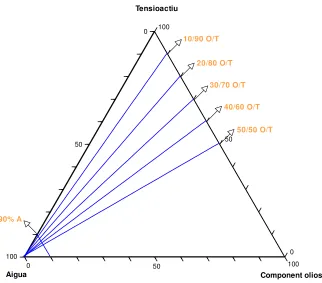
Figura 4.1. Diagrama triangular aigua/tensioactiu/component oliós, amb les línies que uneixen punts d’una mateixa relació O/T i amb la línia que uneix punts amb un percentatge constant d’aigua (90%).
[image:51.595.130.452.106.389.2]4.2.1.1. SISTEMES AIGUA/CREMOPHOR EL/COMPONENT(S) OLIÓS(OS) 4.2.1.1. SISTEMES AIGUA/CREMOPHOR EL/COMPONENT(S) OLIÓS(OS) 4.2.1.1. SISTEMES AIGUA/CREMOPHOR EL/COMPONENT(S) OLIÓS(OS) 4.2.1.1. SISTEMES AIGUA/CREMOPHOR EL/COMPONENT(S) OLIÓS(OS)
En una primera etapa s’ha estudiat la formació de nano-emulsions en sistemes amb Cremophor EL com a tensioactiu i amb diferents components oliosos (un oli mineral Miglyol 812 i diversos olis vegetals oli de ricí oli de soja i oli d’oliva sols o combinats entre ells). Els resultats es mostren a la Taula 4.3.
Taula 4.3. Formació de nano-emulsions en sistemes tipus aigua/Cremophor EL/component(s) oliós(os), amb un 90% d’aigua i diferent relació O/T .
COMPOSICIÓ OBSERVACIONS (25ºC)
Component oliós %T Relació O/T
Addicions successives d’aigua
Mescla components
TIPUS DE DISPERSIÓ
9 10/90 Dispersió transparent, líquida Tèrbol emulsió
Nano-8 20/80 Dispersió transparent-blavosa, líquida Tèrbol
Nano-emulsió
7 30/70 Dispersió transparent-blavosa, líquida Tèrbol
Nano-emulsió
6 40/60 Dispersió transparent-blavosa, líquida Tèrbol emulsió
Nano-Miglyol 812
5 50/50 Dispersió opaca, líquida _ convencional Emulsió
9 10/90 Dispersió transparent, líquida Tèrbol emulsió
Nano-8 20/80 Dispersió transparent-blavosa, líquida Tèrbol emulsió
Nano-Oli de ricí
7 30/70 Dispersió opaca, líquida _ convencional Emulsió
9 10/90 Dispersió transparent,
líquida Tèrbol emulsió
Nano-Oli de soja
8 20/80 Dispersió opaca, líquida _ convencional Emulsió
9 10/90 Dispersió opaca, líquida _ convencional Emulsió
8 20/80 Dispersió opaca, líquida _ convencional Emulsió
Oli d’oliva
7 30/70 Dispersió opaca, líquida _ convencional Emulsió
9 10/90 Dispersió transparent, líquida Tèrbol
Nano-emulsió
8 20/80 Dispersió transparent-blavosa, líquida Tèrbol emulsió
Nano-7 30/70 Dispersió transparent-blavosa, líquida Tèrbol emulsió
Nano-Miglyol:oli de ricí 1:1