POLITECNICO DI MILANO
Management Engineering Department
Polo Territoriale di Como
Master of Science in Management Engineering
STRATEGIC ANALYSIS OF THE IMPLEMENTATION OF A CRM
TECHNOLOGY IN A TELECOMMUNICATIONS COMPANY
Supervisor: Fabrizio Amarilli
Master Graduation Thesis
Juana Camila Valenzuela
Id. 813765
Maria José Vallejo
Id. 811726
Table of Content
Abstract ... 4
1 INTRODUCTION ... 5
1.1 Background ... 5
1.2 Problem Discussion ... 6
1.3 Purpose ... 7
1.4 Scope definition ... 7
1.5 Methodology ... 8
2 THEORETICAL REVIEW ... 10
2.1 Customer and Customer Relationships ... 10
2.2 B2B Customer Relationships ... 12
2.3 The Telecommunications Industry ... 13
2.4 CRM Theory ... 18
2.4.1 Definition and Objectives ... 18
2.4.2 CRM and Business Strategy ... 20
2.4.3 Advantages and Disadvantages ... 21
2.4.4 Factors of Success and Failure ... 24
2.4.5 Types, Characteristics and Functionalities of a CRM ... 27
2.4.6 CRM Implementation ... 29
2.5 CRM Performance Measurement ... 30
3 CONCEPTUAL FRAMEWORK... 32
3.1 Description of the company ... 32
3.1.1 General Overview... 32
3.1.2 Enterprise Business Unit ... 32
3.1.3 Business Strategy ... 36
3.2 CRM System Description ... 38
3.2.1 CRM Capabilities ... 41
3.3 Project Implementation ... 43
3.3.1 Project Objectives ... 44
3.3.2 Project Scope ... 45
3.3.3 Stakeholders ... 46
3.3.5 Project Team ... 49
4 ANALYSIS ... 51
4.1 Methodology ... 51
4.2 Sales Process Analysis ... 53
4.2.1 Process Mapping ... 54
4.3 Strategy Development ... 66
4.4.1. VMOST Analysis ... 67
4.4 Value Creation ... 76
4.4.1 Value Customer Receives ... 76
4.4.2 Value the Organization Receives ... 80
4.5 Channel and Media Integration ... 82
4.6 Information Management ... 85
4.7 Performance Assessment ... 90
5 CONCLUSIONS AND RECOMMENDATIONS ... 100
5.1 Sales Process ... 100
5.2 Strategic Framework ... 101
5.2.1 Strategy Development ... 101
5.2.2 Value Creation ... 102
5.2.3 Channel and Media Integration ... 104
5.2.4 Information Management ... 104
5.2.5 Performance Assessment ... 105
Abstract
Customer relationship management has emerged as a practice that brings together diverse pieces of information about customers and has been increasingly used as a major business strategy. However, there is a low success rate of CRM implementation in companies; businesses are finding it hard to realize benefits from this strategy. Implementing a new technology in a company requires changes elsewhere in the organization if it is to be integrated and used effectively; change is difficult and is likely to be resisted. The current business environment on the other hand is pushing organizations towards approaching a holistic perspective concerning their customers.
The studied company implemented a CRM technology in one of the Business Units as part of their customer relationship management strategy. The work takes a strategic analysis to the project implementation founded on the potential of more customer-focused, process-based strategies to achieve the goals of adopting customer management strategies: create, develop and enhance relationships in order to improve customer value and corporate profitability and thereby maximize shareholder value. The analysis is divided on three main parts:
Based on the premise that processes are what deliver value to the customer, takes a process-oriented perspective to analyze the sales process involved in the business unit where the CRM implementation project takes place.
Applies a strategic framework founded by understanding CRM as a holistic approach to managing customer relationships in order to create value to shareholders; that requires a cross-functional approach that involves the integration of key processes oriented towards customers. The processes are managed as an integrated and iterative set of activities that deal with strategy formulation, value creation, information management, multi-channel integration and performance assessment.1
INTRODUCTION
Contains an insight to the development of the project and research. Initially, a background of the research subject is presented followed by the discussion of the specific problem to be treated during the project. It is then specified the purpose of the research as well as the scope it will broaden and the methodology that was used according to the structure of the project.
1.1
Background
Quick changes in technologies, globalization, accelerating pace of life and the growth importance of information to the society has increased the global investments in information technology (1), in addition, factors like increasing forces from competition, maturing markets, demanding customers and industry convergence, is making businesses to treat customers as a critical source of profitability and sustainable growth. Firms are pushed to develop more efficient and effective customer-focused strategies. Increased investments enterprises are doing on CRM systems are an evidence of the approach companies are taking, CRM technologies are used as a mean to manage efficiently customer relationships, especially in business-to-business relationships where the firm’s extended working relationship is frequently crucial for the maintenance of a healthy business (2).
CRM data is among the most important and comprehensive information available to management in many organizations (3) and it has led to an increase of the use of CRM systems in companies of all sizes and sectors. The consistent application of CRM data for managerial decision-making can transform the firm's value creation process from initial customer prospecting right through contract renewal negotiations. However, recent investigations have shown that the implementation of CRM systems are not always successful, the Gartner Group for example has found that approximately 70% of CRM projects resulted in either losses or no bottom-line improvements in firm performance (4) and that CRM customer complaint than more than 50% of their CRM projects failed (5).
According to Accenture’s B2B Customer Experience Research, for more than half of B2B companies around the world and across industries, nearly half of their Customer Experience investments are ineffective. The problem becomes bigger considering that of more than 1450 executives at B2B companies around the world, 88% indicated they are investing more in this area year-on-year, which means half of this invested money is ineffective. Different sources of literature review (1), (2), (3), (4) have identified the main failure reasons or success factors that affected accomplishment of CRM, a joint list of them is mentioned as follows:
Assuming that CRM is a technology issue
Losing vision of customer-centricity
Inadequate support of top management
Lack of frontline training
Inappropriate use of metrics
Undervaluing data analysis
Inflexible business process
Underestimating the importance of change management
Therefore, companies need a way to reduce CRM strategy execution failure and to maximize CRM performance.
As first issue, there is a big amount of literature and academic articles about CRM but there are many different approaches given to its meaning and no common agreement about what CRM is. A review of CRM definitions was done in (5) and suggests that CRM can be considered at three levels: CRM is about the implementation of a specific technology solution project; CRM is the implementation of an integrated series of customer-oriented technology solutions; and CRM is a holistic strategic approach to managing customer relationships to create shareholder value. Its definition has an impact on how CRM is accepted and practiced by the organization and in consequence its success or failure on the implementation. The study is based on assuming the meaning of a holistic strategic approach and the followed approach starts on it.
1.2
Problem Discussion
CRM projects call for both organizational and technological changes. Few empirical researches have dealt with these management issues and an integrated and balanced approach is required (6). CRM is important for organizations; an insight of this is the amounts than are being invested on CRM projects. Even with the increase of expenditures on CRM projects, statistics (7) show that 60 to 80% of CRM projects fail to achieve their objectives. The success rate of CRM implementation is low and many organizations are finding it hard to realize business benefits from it (8). A recent study (1) concluded that more than two-thirds of CRM projects end up in failure, however the successful third could obtain up to 75% return on investment. Failures could be avoided if the CRM’s strategies are correctly linked to its employees, customers, channels, strategies and IT infrastructure; a CRM strategy involves the entire enterprise.
Encouraged by the implementation of a CRM technology system in the studied Company, a strategic perspective is addressed believing it would broaden the understanding of the CRM concept and its role to enhance customer value and in consequence, shareholder value. To support the strategic perspective, a framework for Customer Relationship Management is used (1). It is a process-oriented conceptual framework that places CRM at a strategic level by recognizing the key cross-functional processes involved in the development of CRM strategy.
Companies in general, have invested or plan to invest huge amounts to implement CRM strategies, tools and infrastructure in order to attract and retain profitable customers in today´s increasingly competitive market (3), it is then reasonable, to have a measurement system to assess its effectiveness. Consistently with this, a CRM Scorecard is developed to propose an effective performance measurement method. The method is based on the adaptation of the traditional BSC to a CRM Scorecard developed by (3).
Founded on the failure problems and statistics regarding customer management strategies
and motivated by the CRM project carried out by the studied company who has taken a
customer-centric strategy, it was developed an analysis on the business case taking
1. Considering CRM as a holistic strategic approach to managing customer relationships to create shareholder value.
2. Developing a measurement system of CRM performance using the balanced scorecard approach.
Previous statements have focused of the problems that CRM strategies and projects are having in companies and how to avoid them, but there must be something that supports the importance that has been given to CRM. Today’s environment is very competitive, Thompson (9), states that product/price-based differentiation is waning because of maturing markets, global trade, efficient manufacturing and internet. Successful CRM becomes then in a differentiator, if competitors are doing more or less the same in product and price terms, making a difference on how customers feel is a much sustainable relationship over the long haul. This supports the fact that CRM has a major role and efforts towards its successful application must be done.
1.3
Purpose
Based on the presented reasoning, and the importance of companies being customer-oriented, the purpose of the research is to analyze the implementation of a CRM system towards a strategic CRM approach including a performance measurement system according to the company’s strategy. In conclusion, the present project has four main objectives of research:
1) To analyze the main business process affected by the implementation of the CRM technology motivated by adopting a process-based strategy that is oriented on delivering value to customer.
2) To apply a conceptual framework (a model) for CRM strategy assessment to a Business Unit division of a company operating in the telecommunications Italian industry and identify the role of the CRM implemented technology in the strategic processes.
3) To develop a strategic measurement system oriented towards CRM that allows monitoring its performance at different levels and broadening different perspectives to ensure that by enhancing customer experience, shareholder value is increased. The result is to select CRM measures to assess CRM strategy.
For confidentiality reasons, nor the name of the company or the implemented CRM technology will be specified. A general context, which is big enough to understand the environment and business case situation will be presented. When referring to the studied organization, it is mentioned in a generic way as the Company or a fictitious name “Italcom” and the same way when referring to the CRM technology or a non existing one denominated Sas CRM.
1.4
Scope definition
during the whole research the accepted perspective about a CRM is a strategic one that involves all the organization and a cross-functional integration of processes, the analysis focuses on the Corporate Sales Channel Department but always in line with the corporate strategy. The motivation of the focus is the implementation of a CRM technology in the business area. The used framework, sees CRM management as involving the whole organization and avoiding functional divides, during all the analysis CRM’s interaction and influence on the company’s performance is taken into consideration.
The analysis to be performed uses a conceptual Framework for CRM developed by Payne and Frow (1) that goes through five generic cross-functional processes to develop a CRM strategy. It starts from validating the alignment between the implemented CRM system and the business strategy. It allows the orientation of the IT system towards organization’s goals and system’s context and positively influences its effectiveness. The analysis involves system requirements and business strategy. Another important factor considered was the use of CRM data in order to draw meaningful conclusions for driving business decisions. Therefore, as part of the study, the type of information that can be gotten from the CRM is analyzed in order to make a better use of valuable historical data and build competitive strategies. Analysis continues with the assessment of CRM performance taking into consideration the competitive advantage developed to ensure that strategic aims in terms of CRM are being delivered and that a basis for future improvement is established. Finally, a CRM Scorecard is developed to support the performance assessment. A process-based framework provides insights to help companies achieve success with CRM strategy development and implementation (1).
The approach that was taken focuses on the implemented CRM system, Company’s strategy is always taken into consideration but the analysis is motivated from the CRM employment and how it is in line with company’s customer strategy. The premise of considering CRM from a strategic perspective to create shareholder value guides the work. The motivation of a new CRM technology in the company does not means that CRM is considered as simply an IT solution; on the contrary, it is avoided as it has been identified as a key reason for CRM failure.
1.5
Methodology
In order to perform the described analysis, the first thing to do was to understand the problem and motivation of the study in order to understand the direction of the investigation. Next step was to review the existing information and academic literature in CRM considering strategic frameworks, implementation of CRM projects, and performance measurement models for CRM. With this, the model to use and approach to follow was chosen combining different researches and developed model to fit the existing problem. Knowing the complete tactic to follow, the scope and purpose of the project was defined
The complete bibliographical review was done to make up the theoretical framework, concerning the different topics and backgrounds included in the work in order to build a conceptual base to support the analysis done. The conceptual framework was then presented to contextualize the environment where the analysis takes place, including a general description about the company and business unit where the project and the case study takes places.
process and then followed by a strategic approach. Ending with the development of a measurement system.
Finally, conclusions on the analysis are done adding also recommendations and proposed improvements.
The present work is divided in the chapters listed below:
Chapter 1: INTRODUCTION
Consists on the outline of the project, including the background, discussion of the problem, its purpose, scope and the methodology used.
Chapter 2: THEORETICAL REVIEW
Literature review of the study broadening all the necessary concepts to know for the development of the analysis
Chapter 3: CONCEPTUAL FRAMEWORK
Presents the frame of reference of the study, including a presentation of the company-s situation, the business unit involved, the project and the benefits the company expects to get from the CRM strategy and initiatives.
Chapter 4: ANALYSIS
The analysis of the study is developed
Chapter 5: CONCLUSIONS AND RECOMMENDATIONS
2
THEORETICAL REVIEW
The theoretical review consists on examining the different concepts that were broaden in the
study. It provides the reader with the necessary information about concepts and literature
related to it. The order to do it starts from the CRM concept
2.1
Customer and Customer Relationships
In general terms, customers are those that purchase the goods or services produced by a business. They can be defined as the company's source of revenue, profitability and sustainable growth (10) and are considered as the most important asset; if there are no customers, there is no business. Therefore, the efforts of every organization should be oriented towards getting, keeping and growing customers.
Recent theories of business strategy recognize the importance of involving the customer relationships and customer centricity into earlier stages of the business strategy development and as is underlined in (11). Business strategies themselves should be customer centered and not just the implementation of them. At the end, all business strategic objectives are about maintaining, strengthening and growing company’s customer base that will result on achieving good organizational economic performance.
A relationship between a customer and an enterprise can be beneficial when the customer teaches the company providing information about his/her wants and expectations. In return, companies are more capable to offer personalized products and services that meet customer's individual needs. Then, satisfied clients will be willing to invest more in the company. In this collaborative process, the customer tells the enterprise how he/she will like to be served and the enterprise modifies its behavior according the needs of this particular customer. According to (10), this type of relationship is called "Learning Relationship" and it establishes the framework for understanding how to build customer value.
In (10), Peppers and Rogers refer to the customer - strategy driven approach in which competitive advantage is created by exploiting the information to generate growth and profit. Through the establishment of individual relationships with customers, enabled by the right usage of information and the personalized treatment among customers, competition is focused in customer’s differentiation and the goal is to keep customers longer and grow them bigger. In the same way (11), focuses the development of a customer based business strategy on the concept of business-market strategy establishing what the business will do and how it will operate within its environment and by doing so, processes and activities will become clearer for implementation.
During the last century, the main goal of the companies was to increase the market share using mass media. The idea was to increase awareness and reach as much customers as possible, who were seen as a single unit. Products and services were offered through standardized processes reaching commoditization and economies of scale (10).
Now, customers had revolutionized in an interactive era in which interactive media predominates in the way of doing business and growth is related with the beneficial customer - enterprise relationships encouraged by customer's feedback and social networking, that facilitates a two - way dialogue between organizations and customers.
This century is recognized by an individualization approach where customers are more informed, empowered and sophisticated during their shopping experience and want to be treated as individuals that know what they want and how they want it. At the same time, new technologies are helping enterprises to conduct business at a more intimate and individual customer level allowing the creation of a stable customer base instead of just concentrating on single sales.
Moreover, globalization created new challenges for companies for managing customer relationships that are developed in a more complex environment involving different cultural, social, political, economic and environmental factors that influence the organization's performance in a multinational level.
According to (12), the competitive advantage in a global economy arises from three main goals:
Global efficiency taking advantage from the presence in different locations
Multi market flexibility achieved by understanding customer needs in different markets
Worldwide learning supported by the understanding of internal customers and the implementation of measurement performance systems
Under this point view, companies’ success is focused in the achievement of economies of scale and the establishment of profitable customer relationships, enhanced and supported by the use of CRM practices. In today's global economy, those firms that can reduce cost while at the same time realizing and anticipating the needs and desires of their target customers, will be the most successful (12).
Following the traditional approaches used in the marketing processes for acquiring, retain, and increase profit from customers, companies are able to implement segmentation and targeting methods and achieve mass customization. Nevertheless, a growth in the customer base value can be achieved through changes in the organization's structure. In particular, new strategies supported by new technologies focused on growing the value of the company by growing its customer base, are used nowadays to help companies to manage its customer relationships.
In (12), Raab explains customer orientation as an effect of implementing CRM and is related to the speed and effectiveness of reaction to market opportunities and threats where companies' activities are focused towards the achievement of customer satisfaction.
structure. Therefore, customer satisfaction is based on suitable structures, modern technological solutions, management and employees, all performing tasks towards the customer (12).
In this context, organizational structure refers to the balance between the specialization and support aiming high coordination and avoidance of intermediaries. Examples of this are cross - functional teams and the introduction of ICT.
Including the management of customer relationships as part of the strategy of the organization can increase the efficiency and effectiveness of the business processes by using the concepts of individualization and personalization. An increment on customers' satisfaction can lead to more customers that are loyal and with them, a growth in the individual customer's profit margin.
In order to establish strong customer relationships, customer strategies should involve the overall enterprise and must have a high level of integration among functions and processes. Employees should have access to real time information and must deliver the same message to the customer throughout the whole process, making it a seamless and optimal customer experience. In addition, from the internal point of view, enterprises seek to create a unique and centralized view of each customer across all business units (10).
As one of the three pillars proposed by (12), the success of a customer - driven strategy is strongly related with the level of customer orientation among its employees. Besides the inclusion of the concept into the goals and principles of the company, employees can be motivated and encouraged to deliver a better customer experience through the use of rewards and incentives that will facilitate the internal cooperation and support within the processes. Hence, more satisfied employees, convinced about the importance of the customer for the business, are willing to deliver a better service.
Within this context, technology is a mean to treat different customers individually and to increase the value of each one to the firm. By the use of technology, companies try to understand customer's point of view and act as its competitive advantage (10). Technology serves as a catalyst of CRM, making companies more intelligent about customers' needs. As the second pillar of CRM proposed in (12), technology allows the coordination of the activities in a global market where knowledge regarding the market and customers is a prerequisite for success rather than an exception. Technological tools within a customer - driven strategy is a mean to collect and analyze information in appropriate ways.
2.2
B2B Customer Relationships
There are different ways to classify types of customers; one is according to the type of customer that has the relationship with the business, if it is a Business-to-Consumer or Business-to-Business relationship (B2C and B2B respectively). Whom the company sells to makes a difference in the way they are coped.
B2B customer bases are smaller than those of B2C are, but they need solutions for their entire division or company, which means a bigger budget, a longer buying cycle, a bigger transaction, and for instance, each customer has a bigger impact on the company, so customer service plays an even more important role in keeping customers happy. Furthermore, rarely is there a single decision maker and it means it is necessary to find a way to balance the needs and wants of several parties.
In general terms B2B are characterized by being relationship-driven which means a need to maximize the value of the relationship, also because the brand identity is created on personal relationship. Mckinsey’s study (13) The Basics of B2B Sales Success found that there is a big difference between what customers said was important and what actually drove their behavior and that what really determined how customers rated a vendor’s overall performance, the most important factors were product or service features and the overall sales experience.
For B2B customers the brand is important but will only help you be considered, not necessarily chosen, the business buyer is sophisticated, understands the product or service more than the company and wants to buy it to help their company stay profitable, competitive and successful, so customer experience is fundamental, it is critical to growth. Accenture, on their B2B Customer’s experience Research1, identified what master customer experience companies were doing to generate higher-than-average revenue growth; the answer was developing strong customer experience strategies and executing them well. The definition given to customer experience was “how business customers and their stakeholders perceive the entirety of interactions they have with a supplier company across all marketing, sales and service touch points”, and includes: marketing and sales campaigns, lead follow-up, account management, quote/order management, solution shaping, contracting customer support, preventive maintenance, SLA definition and monitoring, planning and performance management, sales effectiveness and multi-channel customer interaction.
Providing the most satisfying customer experience is a competitive differentiator. For B2B companies, providing a satisfying customer experience is a lead generation and acquisition enhancement vehicle. B2B-facing firms can no longer remain competitive by simply presenting a workable but basic “industrial strength” customer experience. The best performing B2B companies are paying attention to the customer experience on a daily basis, because they know it is what their customers and prospective customers expect.
2.3
The Telecommunications Industry
The communications industry is composed by four main areas: TICs, radio and TV, postal services, and publishing and Internet. By 2013, the Italian telecommunications sector represented the 61% of the whole market and about 4% of the national GDP. As will be described later, the reduction in the expenditure of users and businesses and the subsequent decrement in revenues is a generalized phenomenon of the industry. However, the most important decrease was perceived in the telecommunications sector.
In (14), Strouse presents a wide analysis of the telecommunication industry within a global market. Although it was made during the beginning of the last decade, it is a good approximation of the sector and provides a general perspective of the factors influencing the overall market behavior. In general, the telecommunication industry is characterized by the presence of monopolies operating in a multinational context with high investments in infrastructure and networks. Furthermore, with the global economic crisis, the appearance of smaller new competitors in the market was constrained protecting it from the pressure of competition. However, the diversification of services enabled by technological development and the combination between telephony services together with entertainment has opened the doors for more companies to compete in the industry with a larger portfolio of services that suits customers’ needs that, at the same time, are becoming more educated and demanding, as explained before.
From this point of view, customer orientation strategy in the telecommunication industry is a way a survival more than a source of differentiation. With the technology present in both sides of the market, customers drive the demand and companies make it possible for them to access to their services and information with end-to-end information systems.
The Porter’s analysis of the five forces reveals that the telecommunications market is high concentrated within a few number of main competitors. However, diversification of the services provided has intensified the internal rivalry of the market increasing the level of competition. In relation to the threat of new entrants, the high price of the infrastructure, existing patents and trademarks keep potential new entrants out of the market lowering the level of competition. Suppliers are represented by the equipment manufacturers, facilities - based service providers, and intermediaries hence, the limited number of equipment suppliers increase the suppliers power. The convergence of the industry results in a high threat of substitute services as satellite TV, broadband among others. In addition, substitution can be generated by other services provided by the industry and enabled by the continuous technological development that can replace the old ways of communication. Regarding the bargaining power of buyers, it can be recognized as one of the most important forces that can influence the competitive intensity of the industry. In particular, the framework of the customer - oriented strategy is based on the recognition of the evolution of the customers into more informed, sophisticated and empowered buyers who demand each time better services at lower prices. In this context, with low switching costs and an undifferentiated strategy, churn rate increases and the level of competition rises while companies try to take customers away from their competitors. Therefore, the challenge for the telecommunication service provider is to “differentiate its services from those of its competitors as pursue a low - price strategy for undifferentiated services” (14).
consumption (Table 1). Together with decrement in total investments, show the negative performance of the sector during this period.
2012 2013 Revenues (All telecoms services/GDP) 2.46 2.21 Household expenditures (Telecoms/Total expenditure) 2.21 2.05 Investments (Telecoms/Total investments) 5.84 5.80
Table 1. Telecommunications in the industry 2012-20132
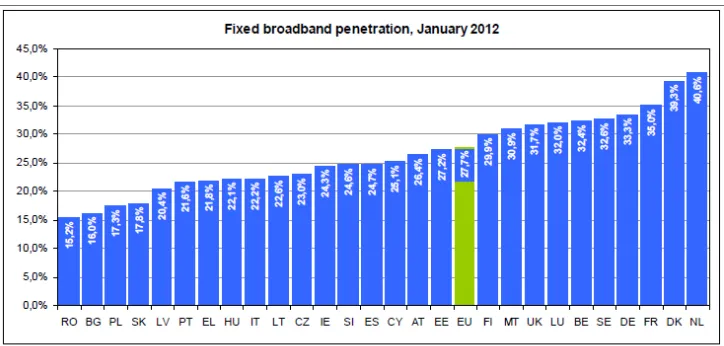
During recent years, the constant increment of mobile traffic data, supported by an increasing use of Smartphones and tablets, together with the reduction of investments in the fixed sector (in 2013 investments in infrastructure decreased by 5%) have helped the migration of revenues towards the mobile sector, consistent with the increment of the mobile penetration trend and increasing investment level of the last few years. As can be seen in the figures below, the fixed broadband penetration was of 22.2% compared to the 31.3% of the mobile broadband. In both cases, the penetration levels were below the EU rate (15).
Despite the efforts for responding to the slump in revenues, during 2013, the mobile network services presented the highest decrease and, unlike previous years, it almost doubled the reduction of the fixed network rate and involving data services. Specifically, the reduction in revenues of 11.2% in mobile services, compared to the 6% presented in fixed networks, generates the 28.1% of the wholesale revenues reduction (18.6%) and is the strongest source of the contraction in the revenues rate.
[image:15.612.127.489.442.615.2]On one hand, this behavior of the fixed market is consequence of the decrease of income in the complete sales process (origination, termination and transit services), the regulation unit price and the average reduction in total volumes. On the other hand, unit price reduction of voice calls is the main reason of the contraction of the mobile sector (16).
Figure 1. Fixed broadband penetration 20123
Figure 2. Mobile broadband penetration 20124
Following the idea presented by (14) and according to (15), the Italian telecommunication market is characterized by the high level of concentration. In particular, by 2011 the mobile market share was concentrated in four main companies: Telecom Italia, Vodafone, Wind and H3GItalia, being the first two, owners of ⅓ of the market share, each. By 2011, the penetration rate was second in the EU with a large predominance of pre-paid cards representing 83% of the overall subscriptions. Nowadays, with the extensive coverage of the technology, 3G and the introduction of 4G, investments have increased and, accordingly to the analysis presented above, provision of additional services has become more important than prices. On the other hand, the fixed sector is characterized by the substitution of revenues by mobile services and by the increasing importance of packages where fixed voice is seen as a commodity.
The reduction in the prices of telecommunications services is consequence of regulations and high technology development that enables companies to provide better services at lower prices. This behavior benefits consumers, especially in the mobile sector where telephony and data services are frequently sold together and presented an average decreased in prices of 15.9% in 2013. As can be seen in the following figure, the telecommunications sector is the only service sector that presents this trend that can be explained by the high rate of technological innovation. Moreover, Italy is the country with the highest reduction in prices in Europe, which fell by 24.5%, more than twice the European average (16).
Figure 3. Telecommunications main public tariff trends5
Referring back to the decreasing trend of revenues in the Italian telecommunications industry, the total expenditure of customers decreased 8.8% in 2013 compared to the 4.1% of the previous year. It is important to notice that the reduction in the spending was more relevant among the business consumers who contributed with the 7.2%.
Regarding the consumers, the main goal of the industry is the enhancement and transparency towards the clients. With a well-defined measurement system, the relationship between communication services and networks on one hand and applications and contents running over them on the other, can help in the evaluation and improvement of the services provided. Limitations in the services can lead to sources of differentiation among competitors (15).
In summary and according to (16), the telecommunications industry in Italy in 2013 was characterized by:
Contraction in services and corporate spending compared to 2012
Constant decrease in unit revenues and, for the first time, income reduction from data services
Decreasing trend in the consumption rate of fixed network services
Stable and full maturity in the fixed broadband sector and expansion in mobile broadband
Decreasing investments in fixed and mobile infrastructure
Telecommunications market is characterized for being a very competitive one. The economic recession has caused higher customer churn rates and customer costs and has pushed industries towards value-added services where the market is growing. The Italian Mobile Telecommunications industry is one of the most advanced in Europe as it has the highest penetration rate, 3G connections and mobile broadband connections among EU5 countries (UK, France, Germany and Spain). The Italian telecommunications market, composed by four main mobile operators, TIM, Vodafone, Wind and H3G (Tre) and is a competitive mature one characterized by high penetration rate of SIM cards and high percentage of 3G connections, heavy mobile phone users for voice services, high rate of Mobile Broadband connections, high social networks users and high penetration of smartphone devices which presents a challenging environment for companies operating in it.
2.4
CRM Theory
The concept of Customer Relationship Management is generally used to describe technology-based customer solutions, but the definitions to the term are very broad. They go from wide concepts that consider direct mail as CRM to those that focus on managing costumer databases or performing data mining on customer’s information. Definitions and descriptions of CRM vary considerably, which means there are different points of view and approaches. The variety on the definition means not only a variety on its concept but the way an organization accepts and practices it.
2.4.1 Definition and Objectives
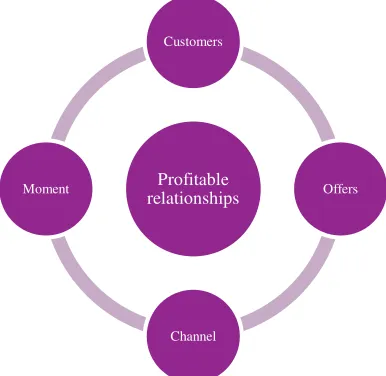
[image:18.612.221.414.413.601.2]As mentioned before, business success within the global market depends on the speed of reaction and anticipation of customers’ needs by lowering costs at the same time. Therefore, success is related to the accurate and timely feedback that let business to anticipate the future needs and desires of their customers. CRM is defined by (8) as a process that aims to bring together diverse pieces of information about customers, sales, marketing effectiveness and responsiveness and marketing trends. It is a management philosophy that places the customer at the center of the organization and focalizes efforts towards existing and potential, durable and profitable customer relationships (12). This definition is extended in (10) to the managerial decisions oriented towards the preservation and increment of the customer base value by gathering information about customers and delivering a superior value and satisfaction by targeting the right customers, offering the right service, through the right channel and at the right time (3).
Figure 4. Enablers for long-term profitable customer relationships
Although at the beginning the term Customer Relationship Management was introduced to refer to the set of tools used for the automation of the functions related to the maximization of the customer base, in reality the term includes a bigger context and, as it will be explained later, CRM projects are not only about technology but require the involvement of the whole organization in both operative and managerial perspectives. As a matter of fact, (17) defines CRM as an organizational capability
Profitable relationships
Customers
Offers
with the potential of becoming a source of competitive advantage that can result in the positioning improvement and therefore, in business performance enhancement.
The business case presented in (18) is an example of how the implementation of a CRM project involves much more than just the technological aspects of the tool, but the combination between technology, process and people, through which the company aimed to redesign its customer management processes in such a way that customer satisfaction is increased. “CRM is an approach that integrates channels, products, and infrastructure strategies to understand and influence customer behavior through meaningful communications”6 and its goal is to improve customer acquisition, retention and profitability. Its approach is based on maintaining positive relationships with customers, increasing their loyalty and expanding lifetime value by collecting, sorting and integrating customer data.
After having a broad and complete definition of a CRM, what it involves and that its goal is to enhance customer relationships, is important also to define what “customerrelationships” involve. Enhancing customer relationships is achieved by targeting it on different ways. On one side, there is the lifetime value, that refers to the net present value of the potential revenue stream for any particular customer over a number of years, starts with current purchase activity then extrapolates to include potential additions from cross-selling, upgrades, ownership, etc. On the other hand, we have customer ownership that attempts to own the customer spending, build brand equity, maintain customer contact and keep current with the market trends.
A list of the potential benefits that might be obtained by well implementing a CRM is proposed by (19):
Develop better communication channels
Collect customer related data
Create detailed profiles of individual customers
Increased customer satisfaction
Access to customer account history, order information, and customer information at all touch points
Identify new selling opportunities
Increased market share and profit margin
Increased revenues
More effective reach and marketing
Improved customer service and support
Improved response time to customer requests for information
Enhanced customer loyalty
Improved ability to meet customer requirements
Improved quality communication and networking
Reduced costs of buying and using product and services
Better stand against global competition
Kim, Suh and Hwang (2003) divided the strategies and objectives initiatives in four categories:
1. Customer knowledge: appropriate customer information collection, analyzing customer data, acquiring new customers, employee training and skills improvement, CRM technique improvement and secure service.
2. Customer interaction: responding appropriately to customer request, business process integration, channels management improvement, maximizing the efficiency of organizational operations and customizing products and services.
3. Customer value: improving customer retention, increasing profits, customer service and support improvement and building an attractive virtual community.
4. Customer satisfaction: improving service quality and establishing relationships with customers.
2.4.2 CRM and Business Strategy
While customer satisfaction is becoming the center of organizational activities, CRM is emerging as a business strategy at the top of the agenda due to the importance of managing customer relationships as a factor of success and the high investments required for the implementation of this type of projects.
For this reason, it is important to understand how the engagement of a customer oriented strategy influences in business activities and outcomes. Also, is necessary to analyze how the implementation of a CRM system influences the strategic objectives and performance of the organization, and the processes to achieve them, how customer driven practices can become a competitive advantage in the market by managing customers as strategic assets.
The analysis made in (20) shows how the alignment between business strategy and IT has been studied under different frameworks and perspectives and, after accepting the fact that alignment contributes to organization’s success and realizing that it is one of top management main concerns, possible problems, as misalignment, IT stagnation and globalization, can be assumed as challenges rather than limitations for implementing information systems.
In the literature (20) , the term alignment refers to the congruence, integration, and/or fit of the IT strategy with the business strategy and how the first one is able to reflect company’s mission and goals in the strategic, structural, social and cultural dimensions, referring to how business strategy and IT strategy complements each other, how company’s structure support both strategies, the level of understanding and commitment towards this approach, and the degree of alignment between both plans and the way of working, respectively.
In particular, recent studies have tried to explain the real impact of CRM into business strategy and, although there is not enough evidence from business practices that can support the direct relation between CRM and business performance, (17) shows how the effect of implementing CRM is indirect and conditional, depending in both, the strategic approach and the type of industry. In particular, it states that CRM can help positioning the company under either, differentiation or cost leadership strategies. In the first case, a differentiated position is achieved thanks to the increment of the knowledge base, helping the company to adapt to customers’ needs in a better way compared to competitors hence, driving the overall business performance. In the second case, CRM can affect both, operational and managerial costs; on one hand, the integration of the operative processes can increase the efficiency and productivity, reducing sales and services costs. On the other hand, customer management expenditures may be reduced due to the focalization of activities on profitable customers.
In the same way, the use of a CRM system in industries with high commoditization level has a greater impact in strategies of differentiation than those based in cost leadership. Within this type of industries, customers tend to have more experience with the product offerings so it is better for companies to have a deeper understanding about customers’ needs in order have customer relationships as a competitive advantage. Therefore, CRM efforts should be focused in the enhancement of business strategies reflected in business performance.
Besides understanding the effect of CRM in business strategy, it is important to analyze how the right integration of organizational resources can contribute for encouraging the CRM initiative and generate a competitive advantage. The case of study analyzed in (18) depicts how under the right balance, information systems can become a core competency thanks to the coordination between business processes and organizational structure represented by three components: business, technology and people’s behavior attitude.
2.4.3 Advantages and Disadvantages
(21) Indicates that CRM is an integration of technologies and business processes that are adopted to satisfy the needs of a customer during any given interaction. Whilst the potential benefits of a CRM might be attractive, the implementation must be carefully managed in order to receive good results. Statistics from Gartner indicate, “Customers complain that more than 50% of their CRM projects have failed and the majority will underestimate costs by between 40% and 75%”. Advantages can be all if the implementation and management of the system is appropriate, but the risks will always exist and might convert what could be a great success in a complete failure.
gathering and processing information along the lifecycle of every customer relationship, CRM enables companies to offer appropriate responses to customer changes and helps in forecasting the demand in a more accurate way.
Although the list of benefits that an organization can have after implementing CRM is huge, (22) summarizes it in five key points:
Cost reduction: CRM technological tools improve the productivity of the overall enterprise by helping in the fulfillment of the main activities related to the client service.
Profit increase: CRM allows the control and management of the processes, the agreement of a service level and the minimization of errors and defects.
Customer satisfaction and loyalty: the improvement in the customer-oriented functionalities signifies building stronger relationships with potential and existing customers due to the appearance of self - service processes, more efficiency, possibility of customization and the ability to meet better customers’ needs and desires. At the same time, more satisfied customers result in profit increase and cost reduction while loyal customers buy more and are less expensive to manage.
Employees’ satisfaction: when the correct tools are well used, CRM system can facilitate employees work. More satisfied employees improve productivity, performance and are willing to deliver a better customer service. The introduction of a new system and different procedures imply a cultural change in the overall organization to adopt the new methodologies.
Better business intelligence: is achieved when there is a better understanding of the customers because of the gathering and analysis of the right information.
[image:22.612.94.526.465.690.2]A broaden, detailed list of tangible and intangible benefits of CRM is presented in (23) and, as shown in the following figure, can be classified within the main areas of influence.
Figure 5. Benefits of CRM Cost reduction
Reduced internal costs
Reduced marketing costs
Profit increase
Increase revenues
Protected marketing investments with maximized returns
Customer satisfaction and
loyalty
Quicker turnaround time
Higher customer retention rates Positive word-of-mouth Improved customer service Employee's satisfaction
Higher employee productivity Streamlined business processes Better business intelligence Closer contact management Increased depth and effectiveness of customer segmentation Acute targeting and profiling of
customers
Better understandingof
There are diverse advantages that, although are important for the organization’s performance, are difficult to measure and most the effects are evident in the long term. Moreover, when customer’s satisfaction is not placed at the center of the processes, is more difficult to perceive them in the short term. Effects on profit, sales, and costs require patience and time to let them appear. For these reasons, in order to understand the advantages and effects of CRM systems is necessary to establish the right performance measurement system and a baseline to be able to compare future results. However, CRM is not a product; it is a discipline, a framework, an integrated approach to managing relationships with customers, which requires continuous improvement. It is a strategy, not a tactic, and in most cases involves changing the focus and culture of the organization from a product- to a customer-orientation.
As said before, benefits can became harms in a company when implementing a CRM and it can be due to many reasons. The company could not be prepared for example of could lead incorrectly the implementation project. Additional to this before implementing a CRM and making the investment, the possible disadvantage must be taken into consideration and strategies to avoid them to affect the company must be designed.
Literature about CRM disadvantages is not as broad as for advantages; nevertheless, author have mention them on their studies. A set of disadvantages is listed below because of putting together and complementing the disadvantages found in different studies and pointed out by different authors:
Staff resistance: employees might not see the immediate advantages in using a CRM system in their business interactions. Managers and business owners might have to deal with moments of staff resistance as they attempt to get the entire team on board with the process.
Resentment: CRM software's biggest disadvantage is the resentment employees may feel toward the software. Often, implementing new systems indicate growth or the need for cutbacks to save the company money. Older employees who have used older systems or their own methods may feel offended as though they are not competent in doing their jobs. Once a new system is brought around, it is important for an organization to keep employees in the loop.
Training: comes by the hand with the staff resistance and is helpful to mitigate it. A training to the staff must be provided and should contain real, live case studies that show the benefits of CRM, business owners and managers can demonstrate the features of the system and adequately outline how it will benefit customers, daily work flow, employees and the business overall. Training is considered as a disadvantage because takes time and money and becomes another uncertainty factor during the project implementation because is another issue that if is not properly done can harm the CRM success.
Require additional work inputting data: in order to make the system work, an initial set of data must be entered, and because the company is dealing with a new systems, means an extraordinary activity that at the beginning can be challenging and might need the need of people from outside the company, consultants for instance that already know the system.
Require continuous maintenance, information updating, and system upgrading costly: are all additional costs and time requiring activities that the company did not had to perform before. All these costs must be taken into account when deciding if implement or not a CRM for the company.
Difficult to integrate with other management information systems: CRM software or system may not integrate well with other email and accounting systems. If this is the case, a CRM could prove costly for a company because it is utilizing more resources than originally thought. This disadvantage has a big weight for the company, it will make it a critical issue the ability to integrate and “talk” with other systems that the company uses. It is important to take into consideration the possibility to integrate the CRM with other information systems and will make a big difference for the company in order to take advantage on the investment. Companies must evaluate all departments that will be involved in its use before the purchase
A Learning Curve: either implementing a CRM for the first time or upgrading an older version will require employees to take the time out to learn the system. People fear what they do not know. This may reduce productivity as they become familiar with the new system.
The idea of CRM mainly concerned with the retention of existing customers comes from the fact that they represent the primary source of information on which building a CRM strategy. With CRM technologies and techniques, organizations focus on the active involvement of customers rather than on the manipulation of their perceptions in regards of their needs and behaviors (McKenna qtd. in Parvatiar et al. 2001). Then, a CRM represents a marketing approach to build solid and long lasting relationships with individual customers (Jackson qtd. in Parvatiyar, 2001). However, CRM along with the application of marketing techniques can also serve to attract new customers.
CRM tools are meant to supplement a company’s strategy for building effective customer relationships. Appropriate strategy and excellent implementation are both needed for obtaining successful results. Building relationships with customers is a fundamental business of every enterprise, and it requires a holistic strategy and process to make it successful.
2.4.4 Factors of Success and Failure
They recommend some practices and considerations to be taken into account and for this; the possible factors of success and failure must be analyzed.
Main critics are related to the excessive time required, high costs, disruptions of the implementation, and possible limitation on future benefits. There are many causes why this type of enterprise can end or appear to end with unsuccessful results. Literature approaches the causes of failures or success on different ways: identifying the causes of failure (24) (22) or identifying the critical success factors on the implementation of a CRM, for example (23).
Mendoza (2005), calls four main causes of failure from a research performed by Forsyth where they took 700 companies and the main causes of failure were organizational change, company policies/inertia, little understanding of CRM and poor CRM skills.
According to (22), conclusions of failure can be consequence of an inappropriate or absence of well-defined objectives during the earlier phases of the project development that prevents to measure and compare future results. He point out that causes of a real defeat may not depend on the adoption of a CRM strategy itself but can be summarized in the 3Ps: politics, people and process, referring to the managerial support and involvement, acceptance of the change and project implementation process, respectively. In addition, when managers see CRM as an isolate support-marketing tool, efforts towards the business performance are limited and the outcomes may not be as expected.
This idea is supported by (23) in which a conceptual model is proposed, that classifies the main CSFs of CRM systems among three organizational areas: context, supporters and project organization. The context refers to the factors inside the organization that may be achieved in order to support a CRM system; supporters represent the managerial support necessary to initiate and develop the project, and project organization takes into account performance of the processes of development and implementation. The following figure presents the list of CSFs considered as the main factors necessary to have a successful project under a dynamic business environment.
Figure 6. CRM CSFs7
7 (23)
Support
Organization
Project
•Top Management Support
•Knowledge management capabilities
•Willingness to share data •Willingness to change processes •Technological readiness •Communication of CRM
strategy
The model is intended as a framework that can help to understand the dynamics of the implementation of an innovative technological solution for the management of customer relationships, underlying possible causes of success and failure by considering the critical success factors and the interrelation between them.
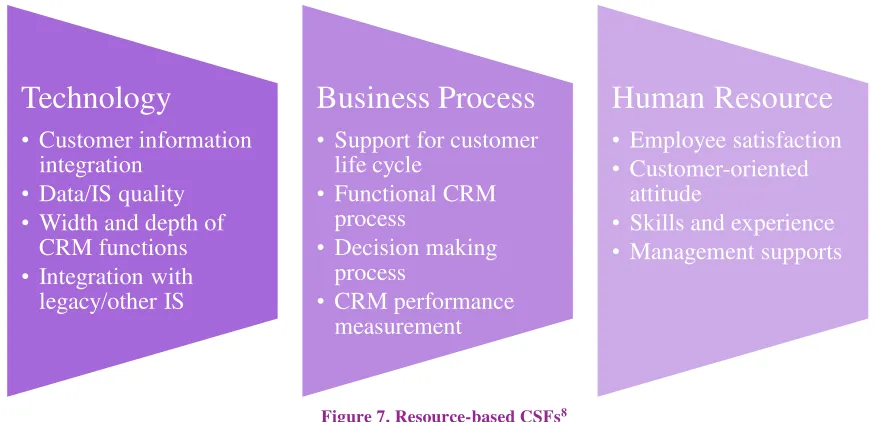
[image:26.612.84.522.309.520.2]A different study shows the importance of the integration of organizational resources and capabilities necessary to run CRM as a corporate business strategy. Based on a resource-based view, (18) highlights the limitations of CRM implementation taking into account the integration of information systems with the human resources and capabilities involved in the CRM process implementation. Thus, a company should align IT resources, including technical and human, with non-IT resources, culture, policies and rules. In this way, the resource- based view provides a framework for achieving a balance between technology, process, and people, considered as key components for information systems implementation. Assuming a different approach, in (18), instead of analyzing the factors of success of CRM in relation to the project evolution, the case of study identifies the CSFs according to the integration of these resource organizational components:
Figure 7. Resource-based CSFs8
Mendoza (2005) has a similar approach considering that CRM systems must be taken as, potentially, a key component of the operation of a CRM strategy, not the only component, and that to achieve the CRM objective there is a series of aspects involved, which divides on processes, human factor (people) and technology. Moreover, establishes that CRM is not merely technology applications for marketing, sales and service but rather a cross-functional, customer-driven, technology-integrated business strategy that maximized relationships and encompasses the entire organization.
In this context, success depends on the enterprise’s ability to recognize technology as a mean and support of the logical processes. Success factors are defined according to the scope, the internal and external customer oriented approach, and the use of right performance measurements. Accordingly, any attempt of neglecting human resources along the whole project will result in its failure, since
8 (18)
Technology
•
Customer information
integration
•
Data/IS quality
•
Width and depth of
CRM functions
•
Integration with
legacy/other IS
Business Process
•
Support for customer
life cycle
•
Functional CRM
process
•
Decision making
process
•
CRM performance
measurement
Human Resource
•
Employee satisfaction
•
Customer-oriented
attitude
•
Skills and experience
CRM as a business strategy is driven by people and not by technology, or said in a different way, is people who drive technology.
It is important to notice that there is not a perfect CRM system for every enterprise, but commercial systems that may be the best choice for specific companies and that might not be the best solution within a different environment (22). In fact, the conditional success of CRM depends on the environmental circumstances under which it operates. Additionally, a successful implementation of CRM does not imply the success of the strategy because, as was described before, its success is not associated to isolate factors. A project of this type should involve the identification of the needs, the selection of relevant resources and the integration processes with the business and since, CRM is a continuous learning process, it should evolve constantly to be able to respond to quick changes of customer needs (18).
2.4.5 Types, Characteristics and Functionalities of a CRM
There is a big variety of CRM available nowadays in the market. They all offer lists of striking benefits for the companies and one a manager decides to implement the use of a CRM on his business he finds himself in front of a big offer that need to understand in order to better decide what is beneficent for his company according to the functionalities that will have the CRM.
There are different classifications of the types of CRM, it was considered Payne’s classification where three types are defined: collaborative, operational and analytical, a company, might require one or several of the three types.
Analytical: focuses on the intelligent mining of customer related data for strategic and tactical purposes. Analytical CRM is concerned with capturing, storing, extracting, integrating, processing, interpreting, distributing, using and reporting customer-related data to enhance both customer and company value.
Collaborative CRM: involves the use of collaborative services and infrastructure to make interaction between a company and its multiple channels possible. This enables interaction between customers, the enterprise and its employees.
Operational CRM: focuses on the automation of customer-facing and customer-supporting processes such as selling, marketing and customer service. Most of them enable marketing automation, sales-force automation and customer service automation.
Integrated systems, as ERPs and CRMs are complex and difficult to implement, but are likely to integrate the organization in both, internally and externally contexts with more efficient communication processes and transactions, and in particular, for CRM, greater insight into customer needs and sales processes performance. In general, these systems involve the integration of different technologies offered, in most of the cases, in packages provided by commercial vendors, which aim to improve front-end tasks like sales, call center, and marketing.
From the functional perspective, CRM is constituted by operational and analytical functions that include the software and business processes that support daily operations, and the strategic planning, measurement and changes required to build customer value, respectively (10). The main functionalities of a classic CRM system are described in (22) as follows:
Sales force automation (SFA): follows the path of the customer, the contract and the activities during the sales process. Can also include additional functionalities like settlement of prices and possible offers. It has direct relation with the revenues of the company.
Telemarketing tracking: allows the use of Computer Telephony Integration systems for the customization of the service delivered to the customer.
Marketing automation: include the automation of the main marketing tasks as campaign management, planning, communication channels and segmentation tools.
Assistance tracking: follows the process of assistance from the reception of the case until its solution. It includes the storage of the information related to the service provided.
Field service: tools for the support of the mobile workforce.
Product configuration module: immediate functionalities online for customers to customize product according to their needs and desires.
Knowledge base management: serves to establish the knowledge base across the organization and supports the generation and maintenance of the documentation for both, internal and external customers.
Web portal: allows customers to access the knowledge base and online functionalities. Includes services of online assistance, chat, e-commerce among others.
Analytic: one of the main advantages of a CRM system. It allows the visualization and analysis of the activities related to the customer service.
CRM
Strategy developmentValue creation
Multichannel integration Information
management Performance
Besides these, CRM systems can have additional modules that support tasks like planning, estimation and human resources management.
The implementation of a CRM strategy supported by a CRM system requires changes within business processes and technology that results in the interconnection between knowledge and interaction management, remarking the use of marketing intelligence to generate and maintain profitable customer relationships, leveraging the quality of communications among parties (Zablah, Bellenger, Johnston 2004) (23). Thus, when adopting a CRM philosophy, companies assume customer relationships as constantly evolving assets that go through three stages during their lifecycle: initiation, maintenance, and termination (17). At the end, customer management processes are designed according to the customer’s needs and CRM is a support tool.
2.4.6 CRM Implementation
There have been different cases of study that try to understand how CRM projects are implemented and why this process is important in reaching successful results.
From one point of view, acquiring a CRM can be seen as an evolutionary process where phases are identified depending on the level of penetration of the innovative customer-driven practices (23). Following a different approach, the project development can be described in two phases according to the degree of integration with the business strategy (18).
In this way, CRM implementation process can be depicted in two integration phases: the integration of functional resources and innovative capabilities, and the integration of human resources and transforming capabilities while the project introduces and establish the new CRM practices.
Accordingly, a CRM system passes through three processes; during the initial stage, it is undertaken by the project team who takes into account the needs and requirements of end users. The starting point is the analysis of the as-is situation of the company considering the channels, systems integration, source of information and problems that should be faced when deciding to implement a CRM. As a result, the ultimate objective is understood, settling the ground for starting the implementation process.
As it enters into the deployment phase, the innovative technology practices start diffusing through the business processes and, at the same time, functional resources and capabilities are integrated within customer-oriented activities using the information resources together with the internal resources and capabilities; improving the operational performance of the company. Information resources refer to the knowledge and processes that support customer management strategies while the innovative capabilities are both, analytical and operational customer-oriented competences. It is expected that the new operational CRM capabilities reduce operational costs and improve customer relationships.