FR: 15/05/2018 FA: 05/06/2018
Dossier
International Mobility of the Wealthy in an Age of Growing Inequality
La movilidad internacional de los ricos en tiempos de desigualdad creciente
Andrés Solimano*
Abstract: The global economy and society are affected by the rising inequality in income and wealth along with an increasing frequency and severity of financial crises, tendencies for protectionism, and fragmented globalization. A largely unexplored topic in migration analysis is the international mobility of the wealthy and their assets, looking for countries that offer financial security, lower taxation, good educational facilities, safe cities, and other amenities. This mobility is largely motivated by [an] increasing concentration of wealth and incomes toward the top 1 or 0.1 percent in several economies and the search for diversification of newly created wealth. Some economies that are home of the wealthy are affected by political instability insecurity and weak property rights, prompting them to leave. The outflow of the wealthy and their assets has various consequences on both home and receiving nations such as a reduction of reduce tax revenues in the home country, an increase in property prices in the receiving nations, and is creating as well as the creation of a whole (legal) industry granting passports, residence, and citizenship oriented to the wealthy. This paper provides an overview of these trends backed by available empirical information. Main substantive topics include (a) identifying the main motivations of for the international mobility of the wealthy including “pulling” and “pushing” factors; (b) similarities and differences between the migration of wealthy individuals and the mobility of their assets (offshore wealth) towards low-tax jurisdictions and fiscal paradises; (d) the emergence of a “market” for passports, residence permits, and citizenship rights catered to the very wealthy. Keywords: income inequality, wealth, protectionism, globalization, mobility
Resumen: La economía y la sociedad global se ven afectadas por la creciente desigualdad de ingresos y riquezas, así como por el aumento en la frecuencia y severidad de las crisis financieras, las tendencias proteccionistas y la globalización fragmentada. Un tema poco inexplorado en el analisis migratorio es la movilidad internacional de personas de alto patrimonio y sus activos en busca de paises que ofrecen mayor seguridad financiera, menores impuestos, buenos servicios educativos y ciudades más seguras. Esta movilidad es motivada en gran medida por la gran concentración de la riqueza e ingresos en el 1 o 0.1 por ciento mas rico, además de una búsqueda de diversificación de la nueva riqueza. Los ricos se van de economías afectadas por la inestabilidad política y riesgos sobre los derechos de propiedad. La movilidad de los ricos y sus activos tiene variadas consecuencias sobre las naciones de origen y destino: en general se produce una reducción de la recaudacion tributaria en los países de origen, suben los precios de propiedades en las naciones destino y se ha creado toda una industria (legal) de otrogamiento de pasaportes, residencia y ciudadanía para ricos. Este artículo proporciona un panorama general de las tendencias descritas respaldado por la información empírica disponible. Los principales temas incluyen: (a) identificacion de las principales motivaciones para la movilidad internacional de individuos de alto patrimonio neto, considerando los factores de "atracción" y "salida " en dicha movilidad; (b) similitudes y diferencias entre la migración de individuos ricos y la movilidad de sus activos (riqueza offshore) a jurisdicciones de baja tributación y paraísos fiscales; y (d) el surgimiento de un “mercado” para pasaportes, permisos de residencia y derechos de ciudadanía dirigido a personas de alto patrimonio.
Palabras clave: desigualdad de ingresos, riqueza, proteccionismo, globalización, movilidad
1. Introduction
Two main mega-trends of the 21st century: economic globalization and rising inequality have
encouraged the mobility, across national boundaries and jurisdictions, of people with different
levels of income and wealth. At one end of the spectrum we find the mobility of labor in search
for higher wages and better employment opportunities abroad. As we move up in the ladder of
skills and qualifications there is the international mobility of talent, say people with special skills
and advanced human capital such outstanding professionals, executives, academics, artists,
writers and people in the entertainment sector and sports, (Solimano, 2008, 2010). A new,
related field, is the global mobility of the wealthy, or “High-Net Worth Individuals (HNWIs”),
often defined as people with net assets above one million dollars. The pyramid of HNWIs
include also multi-millionaires, ultra-HNWIs and billionaires (see section 2 for operational
definitions). This is a small but economically powerful elite: they represent less than one
percent of the total world population but control near 45-50 percent of total household wealth
in the world.
The wealthy face at least two critical decisions: (a) where (including their families) to
reside and (b) in which countries and what instruments place their wealth for which competing
investments include company shares, residential and commercial property, bonds, works of art,
gold and other valuable commodities.
The geography of big wealth creation and circulation matters. In the last decades, large
Africa. Given the history of instability and potential for confiscation (real or imaginary) in
these countries and regions the very rich is starting to establish their residence in high income
nations. A main goal of this mobility is to achieve protection for their asset holdings in countries
with sophisticated financial systems, well enforced property rights, good educational facilities
for their children and cosmopolitan cities. With the proliferation of investment migration
schemes, the wealthy enjoy special advantages to acquire permanent residence and citizenship
in the host country in exchange for capital contributions to special government funds, the
acquisition of real estate and the opening of bank accounts in the receiving countries. Thus, the
migration of the wealthy is not really motivated by the desire of accessing better jobs abroad as
in the case of worker’s migration or talent migration but is geared to protect assets and family
and enjoy first world amenities (safe neighborhoods, good schools, efficient public
transportation systems, ample availability of cultural activities and sports enjoyment). The level
of income and wealth taxes and the cost of enforcement in the host country also matter in the
decision to move from one country to another country.
The wealthy can also enhance its international mobility through engaging in investment
migration programs in “exotic countries” -- often small islands and independent jurisdictions --
that enable the wealthy to acquire nationality of countries with low or no income taxes and,
importantly, access to a large number of countries, in visa- free fashion. In fact, a citizen of, say,
the Caribbean island of Saint Kitts and Nevis, that in exchange for a certain investment say
around half- million dollars receives a passport that entitles the holder free-visa entry to 152
visa.1 At the same time, the direction of this mobility is not only from core to periphery but we are also witnessing outflows of the wealthy from traditionally recipient locations such as
London and Paris as the rich want to escape taxation and, at times, terrorist activity that is
staring to affect also these privileged cities.
This paper examines the main pulling and pushing factors behind the growing
phenomenon of the international mobility of wealthy individuals, including the impact of
taxation, the role of economic and political instability, violence, the migration regime and
inequality. In addition, we provide recent orders of magnitude of the size of the HNWI pool and
its patterns of international mobility across countries and cities. The paper also discusses,
briefly, differences between mass and elite migration in terms of their impact on the host
country in areas such as labor market, access to social services and differentiated migration
rules facing those endowed with capital in comparison with those who bring mainly their labor
effort. The section also highlights the potential impact of inflows of the wealthy on the price of
real estate (making preferred city locations more expensive for locals) and the potential for
corruption of local political and policy elites.2
2. The Global Wealthy and the Rise of Inequality
The wealthy are often defined by their net asset holdings (assets minus debt); these definitions
can be also complemented by his or her income flows. Some operational definitions are used in
the emerging literature, largely connected with wealth-management companies, in the field.
1
This feature can be very valuable for citizens of Iran, Russia, China, Mexico, Colombia, India and other countries that face restrictions to entry to a host of countries.
2
Besides HNWIs we find multi-millionaires (net worth over U$ 10 million), billionaires (net worth
over one billion; New World Wealth, NWW, Research and Markets, 2018). Other definitions are
Ultra-Net Worth individuals with net wealth over U$ 50 million and Demi-billionaires for those
with net worth over U$ 500 million (Knight Frank, 2018).
Personal wealth can be accumulated from individual savings, inherited from parents,
acquired through privatization processes or grabbed through opaque or openly illegal means.
Wealth increases when it earns a positive return (flow of income) when invested in the capital
market, real estate, art work or productive enterprise. In general, wealth tends to be much
more concentrated than income (wealth-Gini coefficients are systematically higher than
income-Gini coefficients, Solimano, 2017). 3
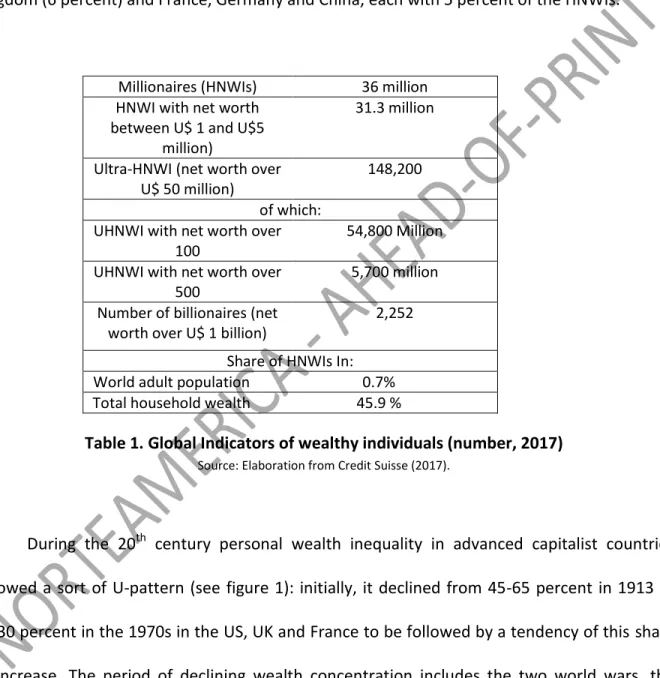
It is estimated that in 2017 there were around 36 million HNWIs worldwide, with 31.3
million having net assets between one and five million dollars, near 150,000 “ultra-HNWIs”,
5,700 Demi-billionaires and 2,252 billionaires.4 It is apparent that we are in the presence of a rapidly shrinking pyramid of HNWIs that controls a large share of personal global wealth (see
table 1).
3
From a statistical perspective, wealth data come, generally, from six main sources: (a) household balance sheets, (b) national wealth surveys prepared by central banks, (c) tax-based wealth data, including estate tax records at death, coming from national tax agencies in countries where wealth taxes do exist, (d) indirect income tax capitalization method using data from revenues from capital incomes provided by tax agencies, (e) data provided by wealth-management companies and commercial banks, (f) list of billionaires. Consensus has developed that tax-based information on income and wealth is deemed superior in accuracy compared with self-reporting household or individual surveys due to problems of under-reporting of income and/or wealth. Still tax -based information suffer from problems of tax avoidance and elusion, (Solimano, 2017, ch.3).
Geographically, the millionaires (HNWIs) are concentrated mostly in the United States
that holds 43 percent of the world’s millionaires. The next country in terms of HNWIs, but with
a much smaller percentage, is Japan with 7 percent of the total, followed by the United
Kingdom (6 percent) and France, Germany and China, each with 5 percent of the HNWIs.
Millionaires (HNWIs) 36 million HNWI with net worth
between U$ 1 and U$5 million)
31.3 million
Ultra-HNWI (net worth over U$ 50 million)
148,200
of which: UHNWI with net worth over
100
54,800 Million
UHNWI with net worth over 500
5,700 million
Number of billionaires (net worth over U$ 1 billion)
2,252
Share of HNWIs In: World adult population 0.7% Total household wealth 45.9 %
Table 1. Global Indicators of wealthy individuals (number, 2017)
Source: Elaboration from Credit Suisse (2017).
During the 20th century personal wealth inequality in advanced capitalist countries
followed a sort of U-pattern (see figure 1): initially, it declined from 45-65 percent in 1913 to
20-30 percent in the 1970s in the US, UK and France to be followed by a tendency of this share
to increase. The period of declining wealth concentration includes the two world wars, the
interwar years and the golden age of capitalism phase after world war II to the early 1970s.
the United States, coinciding with the neo-conservative revolution of Ronald Reagan in the
early 1980s, a trend that continued during Democratic party governments in the 1990s. In fact,
the top wealth’s share in the U.S roughly doubled from close to 20 percent in the late 1970s to
near 40 percent in 2013. The trend towards higher wealth inequality in the United States was
well above that of other advanced capitalist nations. In the United Kingdom the wealth’s share
of the top 1 percent also increased since the Thatcher conservative government, reversing its
previous downward trend experienced during a part of the 20th century but it remained
substantially lower level than the top wealth share in the United States ( it stabilized at around
20 percent in the period 1980-2015). In France there was a surge in the mid 1990s in the top
wealth share to decline afterwards, stabilizing at a higher level than its historical record (see
figure 1).
The trends towards higher wealth concentration did not only take place in core
capitalist countries in the last third of the 20th century and early 21st century but also in former
communist countries such as Russia and China. In Russia, since the mid 1990s the wealth’s
share of the top 1 percent went up from close to 20 percent to near 45 percent in 2015 (a jump
somewhat similar to the large increase in the United States). In addition, since the 1990s there
has been a substantial increase in the wealth share of the top 1 percent in China (figure 1). The
egalitarian wealth distribution of their socialist periods was reversed in the last two decades
Figure 1. Top 1% shares across the world, 1913-2015: the fall and rise of personal wealth inequality (selected countries)
Source: www.WID.world (2018).
3. International Mobility and Migration of the Wealthy
The global age makes it far more easy the possibilities of migration for the wealthy (a small
group) than for the working poor (mass migration) through the use of investment migration
regimes. Free market economist Gary Becker (Becker 1987) argued, decades ago, that letting
immigrants to pay for the right to reside in another country (say for obtaining visas and/or
eventually residence) was more efficient than subjecting them to lengthy waiting periods for
obtaining residence permits and/or citizenship rights. In turn, other authors such as Surak
(2016), Sumption and Hooper (2014) and Prats (2017) examine various dilemmas of the market
treated as a commodity to be traded in a market. In a market for visas and nationalities the
wealthy get an advantage: having substantial wealth provides them with a critical advantage for
obtaining residence permits and citizenship and enjoy the superior living standards of rich
nations. In contrast, foreign workers and poor migrants could not afford, in general, hefty
payments to get visas. Existing inequalities of income and wealth are clearly reflected in
prevailing migration policies.
3
.1 Why the Wealthy emigrate? Pulling factorsHistorically, individuals of high-wealth, including entrepreneurs and rentiers have moved
internationally for at least three reasons: (a) in response to new opportunities for obtaining
good profits abroad, (b) escaping from political or ethnic persecution and nationalization
policies, (c) seeking to shield their assets from taxation and financial uncertainty in their home
countries.
The financial empire built by the Rothschild family in the 19th century required an
important degree of international mobility of those at the helm of the family business.5 In turn, successful entrepreneurs such as Mellon, Vanderbilt, Carnegie, Rockefeller, Soros and others
migrated to the United States where their careers and fortunes (including philanthropic
activities) received a big boost. 6 On the other hand, in several countries during the 20th century, the wealthy left home at the time of anti-capitalist revolutions. That was the case of
the Russian revolution of 1917 in which the Russian wealthy went, mainly, to Europe to escape
5 For an interesting biography of the Rothschild family and their times, see Ferguson (1999). 6
the Bolsheviks. The Chinese revolution of 1949 also led to Chinese economic elites to leave
mainland China and settle in other parts of Asia where they became important engines of
entrepreneurial activity and the Cuban revolution of 1959 prompted a massive exodus of the
wealthy and upper middle class, chiefly to the United States. In recent decades, the threat of
socialism evaporated and global capitalism consolidated (albeit with a high incidence of
economic crises) which has favored the free migration of the rich. The risks for the wealthy did
not disappear but shifted from socialism and the possible nationalization of their assets to
other causes such as terrorism and financial uncertainty. Migration theory (Solimano, 2010) and
attitude surveys conducted by wealth management companies highlight the following list of
factors that can be relevant to high-net worth individuals in choosing a country to establish a
residence for them and their families:
a) Personal safety.
b) Availability of high-quality health services.
c) Favorable tax treatment.
d) Protection of wealth and property rights.
e) Good education opportunities for the children.
f) Visa-free mobility to third countries.
Analysts have developed the concept of a “global market of nationalities” in which
governments compete among them to attract a small elite of wealthy people7 in sharp contrast with the bureaucratic procedures applied to unskilled migrants often coming from developing
countries. This shows the asymmetric nature of the “global market for nationalities” in which
people with high wealth face much more favorable immigration rules than middle class and
working class immigrants.
In the market for nationalities framework a “Quality of Nationality Index, QNI” (H&P and
Kochenov, 2016) ranks countries in terms of levels of economic and human development,
internal peace and political stability, visa-free access to third countries (freedom to travel),
ability to work without permits and special visas (freedom of settlement) and quality of the
legal system. Interestingly, the index gives a considerable weight –as a very valued trait by
prospective immigrants-- to the fact that holding citizenship of certain countries (e.g member
nations of the European Union) enhances the ability to travel without restrictions to other
nations.8 Another feature of a preferred host country is the ability to place assets in a safe environment, although the physical location/destination of the rich may not necessarily
coincide with the location of their assets. The latter often go to “fiscal paradises” such as the
Cayman Island, U.S Virgin Island, British Virgin Island, Switzerland, Panama, Jersey Island, Hong
Kong, Singapore, Macau that offer discretion/secrecy on the owners of bank accounts and
property and establish low taxes (or no taxation at all) on yields of assets and other sources of
7
Solimano (2014) discusses the formation and impacts of economic elites in the neoliberal era.
8
income of foreign depositors (see Solimano, 2018).9 Also wealthy migrants will value for settling themselves, countries with well-developed banking systems, currency and capital convertibility,
adequate legal services, predictable policies and “capital-friendly” tax structures.
3.2 Why the Wealthy Leave their Home Nations? Pushing Factors
In general, economic insecurity, cumbersome taxation systems, lack of adequate protection of
property rights, political uncertainty, austerity policies, depressed asset prices, violence and
terrorism are factors that induce the rich (and the non-rich) to leave their country of residence.
A telling case is Russia where a large number of multi-millionaires (often formed by
enterprise directors during the communist period) were created in a short time period after the
abolition of the Soviet Union. The new oligarchs moved fast and grabbed valuable state assets
through insider’s privatization --a sort of “post-socialist accumulation by dispossession” --
opening the door for private wealth accumulation at large scale. Nowadays, this new oligarchic
class wields a strong presence and influence on contemporaneous Russian society.10 These developments led, among other things, to the worsening in income and wealth distribution
indicators in Russia.11
9 Zucman (2013) offers detailed estimated of “hidden wealth” in fiscal paradises around the world. An update of
these estimates is in Alstadsaeter, Johannesen and Zucman (2017).
10
The term “accumulation by dispossession” was elaborated by social scientist David Harvey in its analysis of privatization, transformation of commons, conversion of public goods and communal goods in private property during neoliberal capitalism, see Harvey (2005).
11
The Latin America case can be also illustrative of the formation of economic elites
following privatization and free market policies in the 1980s and 1990s (Solimano, 2016).
Historically, inequality in the region in the colonial period was associated with concentrated
patterns of land ownership (including gold and silver deposits underneath) allotted by the
Spanish crown to its delegates and local oligarchies of Spanish descent. More recently, land
ownership was replaced by an unequal distribution in the holdings of financial assets, capital
and natural resources such as copper, oil, thin, rubber and others as main sources of overall
inequality. Current estimates of Gini coefficients for net personal wealth yield numbers in the
range of 70-80 percent for some developing countries such as Chile. Even more concentrated is
financial wealth, with the financial assets- Gini coefficient climbing to 90 percent. 12
High inequality, though benefitting the wealthy, can also induce the rich to leave their
home countries (or at least place part of their assets abroad) as unequal societies are more
prone to experience macroeconomic and financial crises, and cycles of populism and
authoritarianism. In contrast, these cycles are rarely observed in more socially cohesive and
egalitarian societies (e.g Scandinavian and Central European nations)13. This favorable combination of social attributes often encourages the rich to remain at home (see below). 14
12 The world average Gini coefficient for income is around 40 percent and for wealth Gini is near 70 percent,
Solimano (2017).
13
See Easterly, 2001 for cross-country econometric evidence on this.
14 When destabilization entails a financial crisis and bouts macroeconomic instability the very wealthy may either
Another set of factors that can trigger the flight of people and capital are violence,
terrorist activity and taxes. France had outflows of HNWIs coinciding with the Paris terrorist
attacks of late 2015 and the Nice’s attack of July 14th, 2016. A similar situation can be attached
to Turkey (also experiencing outflows of HNWIs, see table 3 below) affected by terrorism and
heightened Islamic fundamentalist activity. In the Latin American context, economic collapse
since 2014 in Venezuela with hyperinflation, scarcities and massive output contraction has
prompted the wealthy and large segments of the population such as professionals, middle class
and also working people to leave the country.
High taxes can also stimulate the rich to leave home but not in all countries. In 2014
prominent French actor Gerald Depardieu was granted Russian nationality following his desire
to stop paying what he considered high taxation in his home country. There is also a number of
wealthy (and middle- class Americans), mostly living outside the U.S. and holding other
nationalities, that have relinquished their American citizenship in recent years. Interviews
highlight that a main motivation for doing so is not so much a very high level of taxation but the
complexity of the US tax system, including the high cost of filing taxes every year outside the
U.S. when tax experts conversant on that tax system are in short supply. Also concerns on the
invasion of privacy on asset holdings by U.S. tax authorities is reported to be another cause for
relinquishing US citizenship.15 On the other hand, countries with a high level of personal taxation such as Scandinavian countries do not figure prominently among the nations in which
rich nationals depart from their home countries (see below). Therefore, the relationship
15
between the level of taxation and the departure of the very rich is not that straightforward. The
rich may not like paying high taxes but if they receive, like in any other citizen in universal
systems of provision, good quality social services such as education for their children, health
services, pensions provided by the state and funded with income and wealth taxation as in the
case of Scandinavian countries, the rich (and the non-rich) may decide to stay at home.
4. Statistical estimates of migration of the wealth
The international mobility of wealthy individuals has been increasing in recent years.16 In 2017 there were near 95,000 HNWIs that moved to reside abroad compared to 82,000 HNWIs in
2016 and 65,000 in 2015 (WWN, Research and Markets, 2018). As the total stock of migrants is
near 250 million, we are speaking of a very small group of individuals worldwide but with a
large command of financial resources (see section 2).
The wealthy is benefitting by having second nationalities: it is estimated that 34 percent
of HNWIs, globally, have a second passport/dual nationality. This percentage is the highest for
wealthy Russians/CIS, (58 percent), followed by wealthy Latin Americans, (41 percent), and
16 Private sources of information on wealth holdings, with an international bent, are prepared wealth management
wealthy individuals from the Middle-East, (39 percent). Asian and Australasian have the lowest
percentage of second passports/dual nationality. 17
4.1 Inflows and Outflows
The three most preferred country destinations for HNWIs in 2017 (countries with netinflows of
HNWIs above 1,000 individuals) were Australia, the United States and Canada, followed by the
United Arab Emirates and small countries in the Caribbean such as Bermuda, Cayman Island,
Virgin Island, St. Kitts and Nevis and others (table 2). 18
In turn, a list of 11 countries with the largest net outflows of HNWIs in 2017 (table 3) is
headed by China and India (the scale factor has to be considered here) followed by Turkey,
France, the United Kingdom and Russia. It is quite remarkable that two advanced countries
such as the UK and France appear with significant net outflows. Two Latin American countries,
Brazil and Venezuela, both affected by serious economic and political crises, are among the top
ten countries with the largest outflows of HNWIs. Two Latin American countries, Brazil and
Venezuela, both affected by either economic or economic crises (or both), are among the top
ten countries with the largest outflows of HNWIs.
Two Latin American countries, Brazil and Venezuela, both affected by serious economic
and political crises are among the top ten countries with the largest outflows of HNWIs.
17 Knight-Frank (2018). See also Fernandez (2017).
Table 2
Countries ranked by HNWI net inflows, 2017
Note: figures rounded to nearest 1000
*Caribbean includes Bermuda, Cayman Islands, Virgin Islands, St Barts, Antigua, St Kitts & Nevis, etc.
Source: New World Wealth, NWW, Research and Markets (2018).
Country Net inflows of
HNWIs in 2017
Australia 10000
United States 9000
Canada 5000
United Arab Emirates
5000
Caribbean* 3000
Israel 2000
Switzerland 2000
New Zealand 1000
Singapore 1000
Main cities that received inflows of HNWIs above 1,000 in 2017 were Auckland, Sydney,
Melbourne, and Perth, Tel Aviv, Dubai, San Francisco, Vancouver and others (table 4). It is
worth noting that Canada and Australia concentrate large inflows of HNWIs in recent years. In
contrast, cities that experienced outflows of HNWIs above 1,000 in 2017 were Istanbul, Jakarta,
Country Net outflows of HNWI
net outflows in 2017
China 10000
India 7000
Turkey 6000
United Kingdom
4000
France 4000
Russian Federation
3000
Brazil 2000
Indonesia 2000
Saudi Arabia 1000
Nigeria 1000
Venezuela, RB 1000
Table 3
Countries ranked by HNWI net outflows, 2017
Note: figures rounded to nearest 1000
Lagos, London, Moscow, Paris and Sao Paulo (table 4). Some of these cities are identified with
the typical factors that encourage the exit of people from their home countries/cities such as
violence, terrorism, high taxes, pollution and traffic congestion; nonetheless, cities such as Paris
and London that have traditionally been preferred destination for the wealthy show now
positive net outflows of wealthy individuals. Reasons for these reversals are related to
incidences of violence such rape, terrorism, attacks on women, religious tensions and
anti-Semitism.
City (alphabetical) Location
Auckland New Zealand
Dubai UAE
Gold Coast Australia
Los Angeles USA
Melbourne Asutralia
Montreal Canada
Miami USA
New York City USA
San Francisco Bay area
USA
Seattle USA
Sydney Australia
Tel Aviv Israel
Toronto Canada
Vancouver Canada
City (alphabetical)
Location
Istanbul Turkey
Jakarta Indonesia
Lagos Nigeria
London UK
Moscow Russia
Paris France
Sao Paulo Brazil
Table 4
Cities with large (1,000+) inflows of HNWIs in 2017
Source: New World Wealth, NWW, Research and Markets (2018).
Table 5
Cities with large (1,000+) outflows of HNWIs in 2017
In turn, it seems that the level of inheritance taxes in the UK and France (over 40
percent) also acts as a deterrent for the very rich (GWMR, 2018).
Bilateral corridors (see box 1) include wealthy Chinese going to the US, UK and Canada;
wealthy Indians going to the US, UAE, Canada, Australia and New Zealand; rich Britons going to
Australia and the US, wealthy Russians moving to the US, Cyprus, Switzerland, the UK; the
French going to Canada, Switzerland and the US; Brazilians going to Portugal, Spain and the US,
Venezuelans going to the US and so on. The diversity of countries of origin is wide and includes
emerging economies and post-socialist, post-statist countries as well as advanced economies.
Destination nations include mature advanced capitalist economies (US, UK, Switzerland,
Australia) as well as southern European nations as Cyprus, Portugal, Spain and small islands in
the Caribbean.
Chinese HNWIs moving to USA, Canada and Australia.
Indian HNWIs moving to USA, UAE, Canada, Australia and New Zealand.
Turkish HNWIs moving to Europe and the UAE.
UK HNWIs moving to Australia and USA.
French HNWIs moving to Canada, Switzerland and USA.
Russian HNWIs moving to USA, Cyprus, UK, Portugal and the Caribbean.
Brazilian HNWIs moving to Portugal, US and Spain.
Indonesian HNWIs moving to Singapore.
Saudi HNWIs moving to UK, France, Switzerland, South Africa and the UAE.
Venezuelan HNWIs moving to USA.
Box 1
Main corridors for the wealthy
4.2 Levels of HNWIs by Country and City
Let us turn to the level of HNWI per country and city rather than yearly flows. The country that
has the largest concentration of HNWI,(including multi-millionaires and billionaires) is the
United States (with around 5 million HNWIs) followed by Japan (1.3 million), China (877.700)
and the UK (826,900) for HWNIs (table 6). For the case of multi-millionaires and billionaires the
second main country of origin/residence is China, followed by the UK for multi-millionaires and
India for billionaires. In 2017 New York had the largest number of HNWIs (393,500), followed by
London (353,600), and Tokyo (321,800), table 7. These three cities entertain prime property
market, cosmopolitan environments and have highly developed financial systems. These cities
are followed by Hong Kong, Singapore, San Francisco Bay Area and Los Angeles (all in the range
of 200,000- 250,000 HNWIs) with Chicago, Beijing and Shanghai having over 250,000 HNWIs.
For multi-millionaires New York is also the main city of concentration followed by London and
Hong Kong. For billionaires, New York is followed by Hong Kong, Beijing and Shanghai. In spite
of the net outflows of HNWIs (see table 5) both London and Moscow are still high in the world
Rank HNWIs Multi-millionaires Billionaires
Country No. Of resident
Country No. Of resident
Country No. Of resident
1 United
States
5,047,400 United States
221,580 United States
737
2 Japan 1,340,900 China 40,930 China 249
3 China 877,700 United
Kingdom
26,130 India 119
4 United
Kingdom
826,900 Japan 25,470 United Kingdom
103
5 Germany 813,300 Germany 25,070 Germany 82
6 Switzerland 406,900 Switzerland 21,400 Russian Federation
79
7 Australia 376,600 India 20,730 Hong Kong SAR, China
56
8 Canada 372,700 Canada 12,510 Canada 44
9 India 330,400 Australia 12,340 France 41
10 France 305,200 Hong Kong SAR, China
11,200 Australia 36
Table 6
The Top 10 countries for HNWIs, multi-millionaires and billionaires, 2017
Rank HNWIs Multi-millionaires Billionaires
City No. Of resident
City No. Of resident
City No. Of resident
1 New York City
393,500 New York City
17,610 New York City
68
2 London 353,600 London 11,950 Hong Kong 56
3 Tokyo 321,800 Hong Kong 11,200 Beijing 52
4 Hong Kong 250,700 San Francisco Bay area*
10,250 Shanghai 52
5 Singapore 239,000 Los Angeles*
8,900 London 47
6 San
Francisco Bay area*
220,000 Tokyo 7,770 Moscow 45
7 Los
Angeles*
199,300 Singapore 7,700 San Francisco
Bay area
41
8 Chicago 150,200 Beijing 7,110 Los Angeles
35
9 Beijing 149,000 Chicago 6,950 Seoul 28
10 Shanghai 145,800 Shanghai 6,940 Mumbai 28
Table 7
The top 10 cities for HNWIs, Multi-millionaires and Billionaires, 2017
*San Francisco Bay area includes: San Francisco, San Jose, Oakland, Palo Alto, Los Altos, Redwood City, Moraga, San Mateo and Mountain View. Los Angeles includes: Los Angeles, Beverley Hills and Malibu.
Source: New World Wealth, NWW, Research and Markets (2018).
Concluding Remarks
This paper shows a very high concentration of wealth in small elites and identify the various
incentives for the wealthy to leave their home countries and reside in locations where their
assets are better protected and the quality of life is good. The international mobility of people
(global migration) is showing signs of increasing divides driven, in part, by the existence of more
the non-wealthy. The so-called investment migration regimes offer visas and citizenship rights
in exchange for capital contributions to the host country government funds and investments in
real estate and the local banking system. This is in contrast with bureaucratic and cumbersome
migration systems oriented to deter the entrance and permanence of the working migrants
often coming from the periphery of the world economy. Mass migration can be politically
contentious due to possible adverse effects on wages, pressures on publicly provided
education, housing and health services and different cultural backgrounds. In the case of the
migration of the wealthy most of these considerations are not that relevant. The number of
wealthy migrants is small compared with the immigration of working people, the wealthy often
does not take jobs competing with nationals (although this may be the case of senior managers
and highly paid professionals). Moreover, the wealthy bring fresh funds and market contacts. At
the same time, there are certain features associated with the arrival of the wealthy that can be
disruptive: their investments in residential or commercial property in recipient countries is
pushing up the price of property in recipient countries, crowding-out nationals that can not
afford to acquire or rent housing that has become expensive after the buying of foreigners. In
addition, the potentially corruptive effect associated with inflows of foreign money on the local
References
ALSTADSAETER, ANNETTE, NIELS JOHANNESEN AND GABRIEL ZUCMAN
2017 “Who Owns the Wealth in Tax Havens? Macro Evidence and Implications for Global
Inequality”, NBER working paper 23805, available at
<http://www.nber.org/papers/w23805.pdf>
ALVAREDO, FACUNDO et al.
2018 World Inequality Report 2018, World Inequality Lab, available at
<https://wir2018.wid.world/files/download/wir2018-summary-english.pdf>
BECKER, GARY S.
1987 “Why not Let Immigrants Pay for Speedy Entry”, in The Economics of Life: From Baseball
to Affirmative Action to Immigration. How Real-World Issues Affect Our Everyday Life,
New York, Mc Graw-Hill.
CREDIT SUISSE
2017 Global Wealth Report, available at
<http://publications.credit-
suisse.com/tasks/render/file/index.cfm?fileid=12DFFD63-07D1-EC63-A3D5F67356880EF3>
DURDEN, TYLER
2014 “Why Americans are Dumping their US Citizenship: 5 Case Studies”, Zero Hedge,
available at
<https://www.zerohedge.com/news/2014-03-11/why-americans-are-dumping-their-us-citizenship-5-case-studies>
EASTERLY, WILLIAM
2001 “The Middle Class Consensus and Economic Development”, Journal of Economic Growth,
vol. 6, no. 4, pp. 317-46.
FERGUSON, NIALL
1999 The House of Rothschild: The World’s Banker 1849-1999, New York, Viking Press.
FERNANDES, D.
2017 “Switzerland and Singapore Market and Magnets for High Net Worth Individuals: Some
KOCHENOV, DIMITRI
2016 Henley & Partners-KochenovQuality of Nationality Index, Zurich, Ideos Verlag.
NAGY, BOLDIZSÁR
2017 “In Whose Interest? Shadows over the Hungarian Residence Bond Program”,
IMC-Transparency International, available at
<https://investmentmigration.org/download/whose-interest-shadows-hungarian-residency-bond-program/>
NEW WORLD WEALTH (NWW)
2018 Global Wealth Migration Review, Johannesburg, available at
<https://samnytt.se/wp-content/uploads/2018/02/GWMR-2018.pdf
NOVOKMET, FILIP, THOMAS PIKETTY AND GABRIEL ZUCMAN
2017 “From Soviets to Oligarchs: Inequality and Property in Russia 1905-2016” WID.world
Working Paper Series N° 2017/09, available at
<http://piketty.pse.ens.fr/files/NPZ2017WIDworld.pdf>
POPOV, VLADIMIR
2014 Mixed Fortunes, An Economic History of Russia, China and the West, Oxford, Oxford
University Press.
PRATS, E.
2017 “Commoditization of Citizenship” draft paper for IMC workshop,Geneva.
SHIRLEY, ANDREW, ed.
2018 The Wealth Report 2018, Knight Frank, London, available at
<https://www.knightfrank.com/resources/wealthreport2018/the-wealth-report-2018.pdf>
SOLIMANO, ANDRÉS
2017 Global Capitalism in Disarray. Inequality, Debt and Austerity, Oxford, Oxford University
Press.
2016 “Is Inequality Really Declining in Latin America? Evidence on Income, Wealth and the
2014 Economic Elites, Crisis and Democracy, Oxford, Oxford University Press.
2010 International Migration in the Age of Crisis and Globalization, Cambridge, Cambridge
University Press.
2008 The International Mobility of Talent, Oxford, Oxford University Press.
SUMPTION, MADELEINE AND KATE HOOPER
2014 Selling Visas and Citizenship. Policy Questions from the Boom in Investor Migration
Programs, Washington D.C., Migration Policy Institute, available at
<https://www.migrationpolicy.org/research/selling-visas-and-citizenship-policy-questions-global-boom-investor-immigration>
SURAK, KRISTIN
2016 “Global Citizens 2.0. The Growth of Citizenship by Investment Programs”, IMC Working
Papers, Investment Migration Council, available at
<https://investmentmigration.org/download/global-citizenship-2-0-growth-citizenship-investment-programs/>
ZUCMAN, GABRIEL
2013 “The Missing Wealth of Nations: Are Europe and The U.S. Net Debtors or Net