Natural Disasters and Clientelism: the Case of Floods and
Landslides in Colombia*
Jorge Gallego
SERIE DOCUMENTOS DE TRABAJO
No. 178
Natural Disasters and Clientelism: the Case of Floods and
Landslides in Colombia
∗
Jorge Gallego
†February 10, 2015
Abstract
What are the effects of natural disasters on electoral results? Some authors claim that
catastrophes have a negative effect on the survival of leaders in a democracy because voters
have a propensity to punish politicians for not preventing or poorly handling a crisis. In
con-trast, this paper finds that these events might be beneficial for leaders. Disasters are linked
to leader survival through clientelism: they generate an in-flow of resources in the form of aid,
which increase money for buying votes. Analyzing the rainy season of 2010-2011 in Colombia,
considered its worst disaster in history, I use a difference-in-differences strategy to show that in
the local election incumbent parties benefited from the disaster. The result is robust to
differ-ent specifications and alternative explanations. Moreover, places receiving more aid and those
with judicial evidence of vote-buying irregularities, are more likely to reelect the incumbent,
supporting the mechanism proposed by this paper.
∗I would like to thank Oeindrila Dube, Rebecca Morton, Adam Przeworski and Alastair Smith for helpful comments.
Maria Paula Contreras, Diego Eslava, and Gabriel Angarita provided superb research assistance. The usual caveat applies.
1
Introduction
What are the effects of natural disasters on the survival of a leader? On the one hand, some
authors purport that the occurrence of natural disasters has negative effects on political survival in a
democracy, as voters punish incumbents even if the events are considered “acts of God” (Achen and
Bartels (2004), Quiroz and Smith (2010)). On the other hand, this paper finds that natural disasters
might be beneficial from an electoral perspective for democratic leaders in developing countries. The
mechanism proposed links disasters to leader survival through clientelism: disasters generate an
in-flow of resources in the form of donations and humanitarian aid, which increase cash and resources
available for buying votes. Hence, disasters might increase subsequent vote shares and the probability
of reelection for those holding office, if the institutional setting in which the disaster takes place favors
patronage and vote-buying.
Why is it that disasters might be beneficial for incumbents? There are at least three reasons why
this may be true. First, if politicians in office are efficient at ameliorating the pervasive consequences
of the disaster, an adequate provision of humanitarian assistance and relief might lead voters to
reward this efficiency. Second, disasters are traumatic events that can alter political preferences and
the behavior of those who have been exposed to it (Fair et al. (2014)). For instance, a disaster might
increase the levels of political engagement of the affected population, and if these citizens support the
incumbent, a subsequent improvement of his performance is expected. And third, incumbents might
use aid and relief to buy votes. After the disaster, victims are expected to increase the propensity to
sell their votes. An increased budget for buying votes and a higher propensity to sell them will result
in more clientelism in favor of the incumbent. Within this paper, evidence is presented supporting
the third argument, while refuting the other two.
To support these claims, the paper offers the fact that between 2010 and 2011 Colombia suffered
the worst rainy season of its history, while some weeks later —in October of 2011— local elections
were held. More than 3 million people (about 8% of the Colombian population) were affected by the
disaster and around 3.5 billion dollars had been allocated to ameliorate its consequences. Naturally,
some municipalities were more affected than others and some have received more resources from
the central government, which creates a source of variation in terms of levels of victimization and
distribution of disaster relief. Consequently, the empirical strategy proposed in this paper utilizes a
difference-in-differences (DID) estimator to calculate the causal effect of exposure to the disaster on
infrastructure aid on this probability.
In the simplest specification, municipalities’ level of exposure to the disaster is represented by the
number of victims per capita caused by floods and landslides. Other specifications include a measure
of extreme rainfall quantified by the maximum level of precipitation in 24 hours during the six
months in which the rainy season was more intense. The strategy compares incumbents’ probability
of reelection in the 2007 (before the disaster) and the 2011 (after the disaster) mayoral races as a
function of exposure to the disaster. Under a common trend assumption, the DID estimator provides
a causal estimation of the effect of the disaster on incumbents’ electoral performance and political
survival.
In order to account for potential endogeneity concerns —given that the number of victims or the
amount of aid received by a municipality are not completely exogenous to the political process or to
municipality-level unobservable variables— this paper employs an instrumental variables approach
to identify the causal effect of the disaster on electoral outcomes. Water supply per capita at the
municipality level, which is a measure of surface runoff (or the average volume of water contained
by major water bodies) is utilized as an instrument for levels of victimization. The basic argument
is that municipalities surrounded by voluminous water bodies (major rivers, lakes, ponds, etc.) are
more likely to experience floods during days of heavy rainfall and consequently are predicted to have
a higher number of victims.
The results illustrate that, in 2011, incumbent parties had a higher probability of being reelected
in mayoral elections in municipalities heavily affected by the disaster, than they did formerly in the
2007 elections. The estimations of the simplest specification suggest that, compared to a situation
with no victims, a municipality in which the whole population was affected experienced an increase
in the probability of reelecting the incumbent party 23 percentage points higher in 2011. The impact
is even higher when the instrumental variables approach is utilized. Furthermore, the probability of
reelection is higher in municipalities that received larger amounts of humanitarian aid. In a context of
climate change and global warming, these results represent a contribution to the understanding of how
extreme climatic conditions and natural disasters shape political behavior and electoral outcomes.
These results are robust to several specifications and falsification tests. A potential concern of the
identification strategy is that heavy rain, floods, and landslides might affect agricultural production.
Income shocks generated by these events would have an impact on political preferences, altering
per capita is controlled for at the municipality level. The production of five main agricultural
products in Colombia are also controlled for within the analysis. In every case, whether the basic
DID specification is used or the IV approach instead, the effect of the disaster on the probability
of reelection remains positive and significant. These results suggest that even if the disaster affects
agricultural production and generates income shocks, a positive and alternative effect on political
survival still persists.
Additionally, I conducted a placebo test that strengthened the causal argument posed by this
paper. A second rainy season took place after the October of 2011 election, which was less devastating
than the first one, but still caused substantial damage and left in its wake a significant number of
victims. Using the rate of victimization associated with this post-election event, it is shown that
there is no relationship between this disaster and electoral performance. The second rainy season
was not helpful for incumbents, because any aid associated with it was disbursed after the election.
This supports the argument that the first rainy season —which took place before the election— had
an impact on electoral outcomes, because incumbents used aid strategically to acquire votes.
If the lethality of disasters has a negative impact on leaders’ survival in democracies, and given
that Colombia has a long tradition of democratic rule, why is it then the case that exposure to
floods and landslides had a positive impact for incumbent parties in the 2011 election? As previously
stated, the basic mechanism proposed in this paper links disasters to political survival through
clientelism. Data on the Colombian disaster allows for the disaggregation of relief between food and
infrastructure aid. Municipalities receiving higher amounts of food aid per capita are associated with
higher probabilities of reelecting the incumbent party. An equivalent association with infrastructure
aid is not found. This suggests that particularistic goods, which are typically used for clientelistic
transactions, have a clearer electoral impact than collective goods.
As previously mentioned, other explanations could account for the fact that there is a positive
association between exposure to the disaster and electoral performance of the incumbent party. For
instance, voters could reward the incumbent, because he efficiently handled the crisis. However,
using a proxy for efficiency, it is demonstrated that there is no relationship between incumbency
diligence and subsequent electoral performance. Also, citizens’ levels of political engagement may
change drastically after a traumatic event. For instance, voters affected by the disaster could become
more interested in politics and turn out will increase. Thus, if supporters of the incumbent were
party in office. However, this alternative explanation is also ruled out, because it is demonstrated
that victimization has no correlation with voter turnout. Therefore, it is not true that those citizens
who are more heavily influenced by the disaster will present with an increase in the turn out to vote.
This paper is comprised of seven sections, including this introduction. Section 2 reviews the
literature on the political economy of natural disasters with a particular emphasis on how these events
affect electoral outcomes and, therefore, can be used strategically by political actors. Background
information pertaining to the 2010-2011 rainy season in Colombia, as well as information on the 2011
local elections is provided in section 3. Section 4 describes the empirical strategy employed within this
paper, founded on a difference-in-differences estimation complemented by an instrumental variables
approach. Section 5 describes the data and its sources. Meanwhile, the main results of the paper are
reported in section 6, including the basic specification, the instrumental variables estimations, some
tests of the mechanism, and the validity of alternative explanations. Finally, section 7 provides the
concluding discussion for the paper, as a whole.
2
Literature
The political economy of natural disasters has focused on explaining the variation in the lethality of
natural disasters (Anbarci et al. (2005), Cohen and Werker (2008), Kahn (2005), Quiroz and Smith
(2010), Raschky and Schwindt (2009), Stromberg (2007), Toya and Skidmore (2007)). In general,
these papers argue that the nature and quality of political institutions greatly affect the number of
victims caused by a disaster. While some papers focus on cross-national data that includes many
types of disasters (Kahn (2005), Stromberg (2007), Quiroz and Smith (2010)), others focus on specific
events, such as earthquakes (Escaleras et al. (2007), Brancati (2007), Keefer et al. (2010)), hurricanes
(Abney and Hill (1966), Chen (forthcoming), Chen (2011)), or floods (Mustafa (2003), Congleton
(2006), Eisensee and Stromberg (2007), Fair et al. (2014)).
This paper is situated within the literature on the political legacies of natural disasters. Previous
work suggests that voters punish incumbents that do a poor job at implementing disaster relief
policies. Achen and Bartels (2004), for instance, argue that hard times tend to threaten governments,
“even in situations where objective observers can find little rational basis to suppose that those
incumbents have had any part in producing the voters’ pain” (p.9). The authors show how shark
attacks and floods and droughts can have a substantial negative impact on incumbent performance.
of shark attacks in New Jersey during the summer of election year significantly reduced President
Woodrow Wilson’s votes in the presidential election that took place in the fall. The attacks caused
deaths, but more importantly for their analysis, created considerable emotional and financial distress
to entire communities, as the revenues of the tourism industry dropped rapidly. Citizens blamed
the government for their misfortune, even if the attacks were not the fault of the government or any
governmental entities.
In spite of the fact that the findings of this paper (a disaster might be beneficial for an incumbent)
completely differ from Achen and Bartels’ (2004) results, it is not necessarily the case that both stories
contradict to each other. The authors recognize that it is possible that voters might have blamed
the government for not helping them with their economic distress. From hindsight a century later,
it is not hard to conclude that extending welfare benefits and unemployment compensation would
have helped. Nonetheless, it is important to remember that many of these social programs that
characterize welfare states today did not exist back in 1916. Therefore, a tragedy like the New
Jersey shark attacks was not used in favor of the federal government precisely because the relevant
clientelistic channels were not at the disposal of incumbent political leaders of the time.
Many studies analyzing the political effects of natural disasters identify accountability as a basic
characteristic of democratic countries that motivates politicians to carefully treat situations in which
the welfare of citizens is threatened. Healy and Malhotra (2009) show that there is a discrepancy
between the electorates’ reaction towards relief spending and preparedness spending. Voters reward
politicians’ efforts to ameliorate the consequences of a disaster that already occurred, but are
rela-tively indifferent towards efforts to prepare ex ante to these events. Overall, some of the results of
Healy and Malhotra (2009) are consistent with the findings of this paper, as they show that in the
U.S. delivery of particularistic goods to affected populations is beneficial for incumbents. In fact,
the authors suggest that preparedness spending has no electoral benefits, contrary to relief spending,
because of the collective nature of the former versus the particularistic flavor of the latter. In this
pa-per, a similar result is found, as allocation of food aid (particularistic spending) increases incumbent
parties’ likelihood of reelection, while infrastructure aid (collective spending) has no clear effect.
Other theories suggest that political institutions mediate the electoral consequences of natural
disasters. Quiroz and Smith (2010) frame the analysis in terms of the selectorate theory (Bueno de
Mesquita et al. 2003). For these authors, the occurrence and lethality of disasters have divergent
sizes of the coalitions that hold politicians accountable. The authors find that in large coalition
systems, such as democracies, where mass support is required to retain office, the lethality of a
disaster, and not its occurrence per se, has a direct negative effect on political survival. For autocrats
the situation is different, as the occurrence of disasters serves as a coordination device for protests
that might end up removing the leader, while lethality of disasters has no significant effects. Framing
the Colombian case within this theory, it is clear that the analysis corresponds to a democracy in
which politicians need the support of large coalitions to remain in power. Nonetheless, in contrast to
developed countries, the clientelistic nature of the political system in this developing country reduces
the size of this winning coalition, such that the delivery of particularistic goods to strategic agents
(i.e. the allocation of relief spending to influential local intermediaries) attenuates the pervasive
electoral effects of disasters’ lethality, even making them beneficial for democratic leaders.
This paper is also closely related to the literature on the strategic use of relief spending and
humanitarian aid for electoral purposes. These types of arguments generally rely on the theory
of retrospective voting (Fiorina 1981, Ferejohn 1986), arguing that voters reciprocate in the polls
towards the plight of politicians that pursue actions that increase their welfare. Chen (forthcoming)
uses information from disaster assistance that pertains to the summer of 2004 hurricane season in
Florida for the purpose of demonstrating that awarding Federal Emergency Management Agency
(FEMA) aid to the challenger party’s voters reduces their turnout, while distribution of aid to
the incumbent party’s supporters augments it. Moreover, the author finds that aid delivered a
week before the November of 2004 presidential election has a big effect on turnout rates, while aid
distributed a week after has no impact.
Overall, from Chen’s paper it is possible to infer that the 2004 hurricane emergency was beneficial
for the incumbent (Republican) party and, as a consequence, aid can be used to strategically suppress
opposers’ turnout and to increase supporters’ participation. As in his paper, I show that pre-election
aid has an impact on political outcomes, while post-election relief has no effect. Nonetheless, I go
even further because I analyze the effects of different types of aid and I use an instrumental variables
approach to improve the identification strategy. In a related piece (and using the same natural
disaster in the U.S.), Chen (2011) shows that the effects of FEMA aid distribution not only differs
across partisanship, but also as a function of voters’ income. Using a sample of Republican voters
registered in Florida that applied to FEMA aid after the 2004 hurricane season, the author finds
indifferent. These findings suggest that incumbents can strategically target the allocation of relief
transfers across income groups.
3
Background
3.1
Colombia’s 2010-2011 Rainy Season
President Juan Manuel Santos described the 2010-2011 rainy season as the worst natural disaster in
the history of Colombia.1
As a tropical country, Colombia is comprised of both wet and dry seasons,
whose duration and intensity is determined by a series of climatological phenomena that take place
during the year. Of particular importance for understanding Colombia’s current weather is the
ocean-atmosphere phenomenon known as “La Ni˜na”, which forms part of the broader “El Ni˜no Southern
Oscillation” (ENSO) pattern. La Ni˜na corresponds to a drop in the sea surface temperature across
the equatorial Eastern Central Pacific Ocean in front of the coasts of Peru, Ecuador, and Colombia
(IDEAM 2011). A significant increase in rainfall takes place, particularly in the Pacific, Caribbean
and Andean regions of the country, as a function of this decrease in temperatures combined with
wind patterns.
Even though this phenomenon occurs on a yearly basis, the event that started in the second
semester of 2010 and persisted until at least April of 2011 is considered the most intense in history.
During this period, rainfall registered unprecedented levels with values that presented 170 percent
above regular numbers (Sanchez, 2011). Extreme rainfall did not plague a particular region of the
country, but struck with a varying intensity through 28 out of the 32 departamentos2
and 93 percent
of the municipalities.
An increase in the river levels was a direct consequence of the heavy rain. Colombia’s hydrology
is one of the most abundant and complex around the world with almost every municipality having
access to a significant body of water. As a result, floods were a common event, causing damage and
loss for the affected population. In addition, given the complex topography of the nation and the fact
that an important proportion of its habitants are located in the Andean region, landslides caused by
the accumulation of water and sediments in the ground were the other major source of affectation.
According to official records,3
the 2010-2011 La Ni˜na rainy season phenomenon affected about 4
1
See http://www.semana.com/nacion/peor-tragedia-natural-historia-del-pais/155398-3.aspx
2
Departamentos are analogous to States in the U.S., although Colombia’s political system is far more centralized.
3
million citizens (more than 8 percent of the population), with 490 human deaths, 595 people injured,
12,908 houses destroyed and 441,579 affected, as well as 1,080,000 hectares of productive land flooded
(Sanchez (2011)). The Colombian disaster was not very lethal in terms of human loss, but it had
enormous social and economic impact measured by the number of people affected and the total
property destroyed. Figure 1 depicts the spatial distribution of this Colombian disaster. In terms
of the number of people affected, this event was particularly intense in the Pacific, Caribbean, and
Andean regions of the country.
Compared to other natural disasters around the world, this type of impact is common to events
that result from heavy rain and floods. For instance, using data from the Emergency Events Database
(EM-DAT), Stromberg (2007) documents that from 1980 to 2004, a total of 621 earthquakes occurred
in the world, causing approximately 215 million deaths and affecting 78 million. In contrast, 2102
floods took place in the same period, causing 171 million deaths, but affecting 2490 million people.
Hence, while other disasters are more lethal in terms of fatalities, floods like the ones that took place
in Colombia have higher levels of affectation.
The significant impact of the disaster led President Santos to create “Colombia Humanitaria”,
a National-Level Agency in charge of raising and distributing aid to the affected communities. For
this purpose, the government implemented a three-stage strategy that includes humanitarian aid,
reconstruction, and rehabilitation. More than US$3.5 billion were raised and distributed from the
central government to local authorities (at both the Departamento and Municipality levels). Most
of the resources were distributed to mayors, and for that reason this paper focuses on that election.
In addition, the disaster received substantial media coverage and captured the attention of the
entire country, explaining why Colombia Humanitaria is considered the most successful humanitarian
campaign in history, at least in terms of the amount of donations raised.4
3.2
The 2011 Local Elections
This season of above-average rainfall and the associated number of floods and landslides, extended
until the midst of 2011. Later that year, on October 30th, local and regional elections took place with
more than 130,000 citizens running for governor, mayor, or local councils. Elections for these offices
took place in the country’s 32 departamentos and in more than 1100 municipalities. Until 1988 mayors
in Colombia used to be centrally appointed. Now they are elected by universal suffrage and since
4
then local governments have been given increased responsibilities and powers to raise local revenues.
In this sense, the mayor is a central figure in advancing the interests of the municipality. Being
a multi-party system, immediate reelection of mayors (the main focus of this paper) is prohibited
in Colombia. For this reason, reelection of the incumbent party is used as a measure of political
survival.
Election day was relatively calm, although illegal armed groups (comprised by guerrillas and
paramilitaries) once more tried to interfere and alter the normal conduct of elections (Gallego (2011)).
Given the overlap between the political campaign associated with this election and the humanitarian
efforts aimed at ameliorating the impact of the disaster, several institutions monitoring the process
warned about the possibility of candidates using aid strategically for electoral purposes.5
The goal
of this paper is to show that these warnings were not completely misguided.
4
Empirical Strategy
To determine the causal effect of the natural disaster on party survival in Colombia, this paper
emphasizes the fact that the 2010-2011 rainy season was not concentrated on a particular region,
but instead exhibited spatial variation across the country. Therefore, it is possible to claim that the
intensity of rainfall, and to some extent, the occurrence of disasters, such as floods and landslides,
are exogenous to the political process and to electoral results. Different approaches will be used, in
order to measure a municipality’s level of exposure to the disaster. In the basic specification, the
rate of victims per capita will be used. Given that floods and landslides are mainly caused by events
of extreme rainfall, in other cases exposure to the disaster will be quantified through precipitation
measures.
In this paper, a difference-in-differences estimator is utilized, in order to compare party survival
in municipalities heavily and weakly affected by the disaster, before and after it occurred. For
this purpose, this research controls for municipality and year fixed effects in a linear regression.
Municipality fixed effects control for any specific characteristics that do not change over time and
that might affect the probability of reelection or the vote share of an incumbent party, such as
historical conditions or geographic characteristics of the municipalities.6
Time effects control for
5
See, for example, http://www.semana.com/enfoque/emergencia-invernal-riesgo-electoral/153227-3.aspx or http://www.semana.com/nacion/contraloria-desviacion-recursos-invierno-bacrim-mayores-riesgos-electorales/157305-3.aspx.
6
specific events that occurred in a particular year and that equally affect every municipality, such
as any political reform that might have changed the rules of the game for a particular election or
certain economic characteristics that caused an impact across the country. In this context, the basic
specification estimated is as follows:
Reelectionit =αi+βt+ (V ictimsi×P ost2010t)δ+Xitφ+εit (1)
where Reelectionit is a dummy variable indicating if the incumbent party won the mayoral election
in municipality i at election year t, for t = 2007,2011. Furthermore, αi controls for
municipality-level fixed effects while βt for time effects. Xit is a vector representing time-varying municipality
level controls. In this case and to avoid potential endogeneity caused by the inclusion of
post-treatment covariates, I include pre-disaster fixed values of different controls, and interact them with
a post-disaster time dummy (P ost2010t). This vector includes demographic controls (population and
population density), a climatological control (temperature),7
and a socio-economic control (poverty).
Finally, εit represents the error term for municipalityi at election-year t.
The main variable of interest in equation (1) is the interaction term V ictimsi×P ost2010t. Here,
V ictimsi is the number of victims per capita in municipality i, as a consequence of the 2010-2011
rainy season in Colombia. P ost2010t is a dummy variable, which indicates if the event (election)
analyzed took place before or after the disaster. Given that we only have two years, P ost2010t also
represents the year effects. Therefore, the coefficient of interest in this specification, δ, measures the
effect of the disaster on incumbent party reelection in 2011, as compared to the 2007 contest. Note
that the constituent terms of the interaction,V ictimsi and P ost2010tare absorbed by the fixed and
time effects respectively, and do not appear separately in (1).
It can be claimed that V ictimsi is not exogenous to municipality-level observable or
unobserv-able characteristics. For instance, it is likely that in poor and unequal municipalities, more families
will live in zones prone to floods and landslides, such as riverbanks or hillsides. Therefore,
munic-ipalities highly affected by the disaster would differ from weakly affected ones on other (possibly)
non-observable characteristics, making more difficult the identification of causal effects. This fact
support around the coasts (Pacific and Atlantic), while the Conservador party used to have more support in inner and mountainous regions.
7
would be troublesome if such characteristics exert a differential impact post 2010. For instance, if
poorer places voted differently in 2011. In order to account for this potential endogeneity concerns,
a primary identification strategy employed in this paper is to utilize a plausibly more exogenous
measure of municipality exposure to the disaster. Landslides and floods are more likely to occur
when extreme climatological events take place, such as episodes of heavy rain in short periods of
time.8
Therefore, an alternative specification estimated in this paper is as follows:
Reelectionit=αi+βt+ (Rainf alli×P ost2010t)γ+Xitφ+εit (2)
where all variables and parameters are defined as in equation (1). The difference between (1) and (2)
is that, in the second specification, exposure to the disaster is captured by the variable Rainf alli,
which quantifies events of extreme rainfall at the municipality-level. This variable measures, in
millimeters, the maximum level of rainfall in 24 hours experienced by municipality i during the six
months between October of 2010 and March of 2011.9
The rationale behind this measure is that in
those places in which it rained more during a whole day, the probability of having subsequent floods
and landslides (and hence more victims) is also higher.
Nonetheless, a climatological variable, such as extreme rainfall level, might be correlated with
agricultural production, which in turn could easily affect the political preferences of voters. Given
this correlation, failure to control for agricultural output would generate biased estimates of the
causal effect of the disaster on electoral outcomes. Therefore, this paper employs an instrumental
variables (IV) approach, using an exogenous source of variation correlated with the number of victims
per capita and uncorrelated with the error term. For this purpose, water supply per capita at the
municipality level is used to calculate the number of victims, as measured by hydrologists that used
the National Water Study (IDEAM (1998)), more than a decade before the disaster. This variable
measures surface runoff, which is an estimation of the volume of water contained in water bodies
(rivers, lakes, ponds, etc., not the ocean) and groundwater. Naturally, municipalities with bigger
rivers or lakes tend to have a higher supply.
Water supply (interacted with the time dummy) is a valid instrument for victims of floods and
landslides (also interacted) if it is not weak and if the exclusion restriction is satisfied. As will be
shown below, it is not weak being that an increase in supply predicts an increased likelihood of floods
8
See the definition and description of floods given by the Colombian central government at http://www.sigpad.gov.co/sigpad/paginas detalle.aspx?idp=144
9
and, hence, more victims. In terms of the correlation with agricultural activities, it is not expected
to be as high as in the case of rainfall, because this variable simply measures the volume of water
contained in rivers. An interesting feature of Colombia’s geography is that almost every municipality
has a river, therefore this variable is not an indicator of whether a population has access to a body of
water as a transportation or economic source. It simply measures the volume of water surrounding a
place, which in part is the result of topographic characteristics, such as the size of the hydrographic
basins that, perhaps, are exogenous to covariates affecting any political outcome.
Defining W ateri as the average level of water supply per capita in municipality i before the
disaster, the first stage of the IV approach estimates the following:
V ictimsi×P ost2010 =αi+βt+ (W ateri×P ost2010t)η+Xitφ+ωit (3)
While the second stage is given by:
Reelectionit =αi+βt+ (V ictimsi\×P ost2010t)ρ+Xitφ+εit (4)
where V ictims\i×P ost2010t are the predicted values that result from equation (3). Naturally, η is
expected to be positive, as floods are more likely to occur in places with more water surrounding.
Additionally, in order to test the mechanism -that disasters generate a flow of resources to local
authorities that is used to buy votes and consequently augments the probability of reelection- two
additional types of specifications are estimated. First:
Aidi =α+V ictimsiβ+Xiφ+ǫi (5)
where Aidi is a measure of disaster relief allocated by the central government in 2011 through
the Colombia Humanitaria project to municipality i. Two aid measures are employed: food and
infrastructure. Clearly, (5) is a cross-sectional estimation of the correlation between the number of
victims per capita and the subsequent amount of aid per capita received. To show that such aid
P r(Reelectioni) = Φ(α+F oodiβ1 +Inf rastructureiβ2+Xiφ+εi) (6)
where F oodi and Inf rastructurei are measures of the amount of food and infrastructure aid per
capita received by municipality i, while Φ(·) represents the cumulative distribution function of the
standardized normal distribution. Therefore, a probit regression is utilized when estimating (6).
Summing up, this section described the basic identification strategy used in this paper, that
employs a difference-in-differences estimation of the effect of the disaster on party survival. An
instrumental variables approach complements this strategy and different estimations are used to test
the robustness of the results and the validity of the mechanism.
5
Data
5.1
Data Sources
Victim-related data used in this study comes from the National Administrative Department of
Statis-tics (DANE). A few weeks after the disaster took place, and for the purpose of quantifying its effects,
DANE developed the Unique Record of Victims. According to this record, victims are “people that
have suffered serious damage associated directly to the event: partial or total loss of goods (estate,
livestock or crops) and/or disappearance, injury or death of family members” (DANE (2011), p.
11). In order to control for municipality size, the total number of victims is divided by the total
population. Therefore, the variable V ictimsi used below corresponds to the number of victims per
capita in municipality i as a consequence of the 2010-2011 wet season in Colombia.
Rainfall data comes from the Hydrology, Meteorology, and Environmental Studies Institution
(IDEAM), which is the official Colombian government environmental agency. This institution
regis-ters rainfall on a daily basis, using more than 2500 pluviometric stations located across the country.
Given that in Colombia there are about 1200 municipalities, and for some there is more than one
station, while for others there are none, this study geo-referenced both stations and municipalities,
calculated the distance between each,10
and determined the nearest one. As it was described above,
the variable Rainf alli is a measure of extreme climatological events, and corresponds to the
maxi-mum level of rainfall in 24 hours, measured in millimeters, registered for municipalityifrom October
10
of 2010 through March of 2011.11
Water supply, which is an estimate of surface runoff of major
water bodies and groundwater of Colombian municipalities, is measured by IDEAM and is reported
in the National Water Study (IDEAM (1998)). Measured in millions of cubic meters, this variable
represents the average volume of water available for Colombian municipalities during a regular year.12
Other disaster-related variables include total aid allocated to affected municipalities. This
infor-mation comes “Colombia Humanitaria”, the national agency created by the central government after
the crisis for the purpose of facilitating assistance to victims.13
Two types of humanitarian aid are
analyzed in this paper: food relief (measured as the number of grocery and hygiene kits per capita
allocated to affected municipalities during or weeks after the disaster) and infrastructure aid
(mea-sured as the amount of money per capita in Colombian pesos allocated to municipalities to construct
or rebuild infrastructure assets destroyed by the disaster or new ones to prevent future damage).
To measure the efficacy of local governments in facilitating these projects, a dummy variable called
Delays is constructed, based on information provided by the Attorney’s Office.14
The report lists
mu-nicipalities that were investigated in September of 2011 (one month before the election), because of
delays and other irregularities in the execution of these projects (Procuradur´ıa General de la Naci´on,
2011).
Municipality-level covariates include pre-disaster values for demographic, climatic, and
socioeco-nomic controls. Demographic controls include levels of population and population density in 2007, as
measured by DANE. The climatic covariate is average temperature in Celsius and is also provided by
DANE. Finally, this research uses poverty to control for socio-economic characteristics, measured as
the proportion of citizens with unsatisfied basic needs.15
This index is constructed by the National
Planning Department (DNP). Lastly, electoral variables for the 2007 and 2011 local elections are
derived from the National Registry, the official Colombian government electoral agency.
11
This particular range is chosen because of its intensity and data availability.
12
Regular years are defined as those in which surface runoff corresponds to the average multi-year value of historical series of representative flows (IDEAM (1998), p. 16).
13
See http://www.colombiahumanitaria.gov.co/Paginas/QueesColombiaHumanitaria.aspx.
14
Procuraduria General de la Nacion.
15
6
Results
6.1
Basic Specification: Difference-in-differences Approach
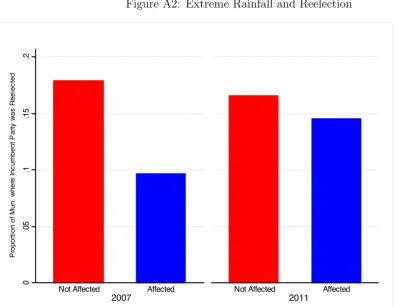
I begin by presenting a graph that summarizes the basic empirical strategy followed in this paper.
The main idea is to compare the proportion of municipalities in which the incumbent party got
reelected in 2007 and 2011, in places “affected” and “not affected” by the 2010-2011 disaster. In
Figure 2 municipalities affected by the disaster are those whose number of victims per capita are
above the 80th percentile.16
The graph shows that in 2007, before the disaster occurred, a similar
proportion of municipalities in both groups saw the incumbent party win again the mayoral election.
However, the situation is quite different months after the disaster took place: with 2007 as a reference,
there is a sharp increase in the proportion of municipalities heavily affected by the disaster where
the incumbent party won, whereas this proportion remains stable (decreases a bit) for municipalities
not affected.17
The rationale behind this analysis is that if the disaster had not occurred, reelection patterns in
municipalities affected and not affected would have followed a common trend, and consequently the
difference in the actual trajectories is the causal effect of the disaster that wants to be determined.
Figure 2 suggests that the disaster caused an increase in the probability of reelection in affected
municipalities compared to those not affected, in 2011 relative to 2007.
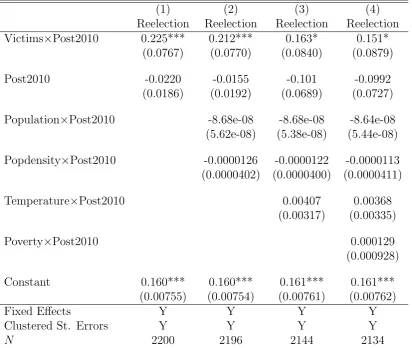
Table 1, which reports estimations for different specifications based on (1), corroborates these
results. Every specification includes municipality-level fixed effects, time effects, and standard errors
are clustered at the municipality level. Recall that the coefficient of interest is δ, the parameter
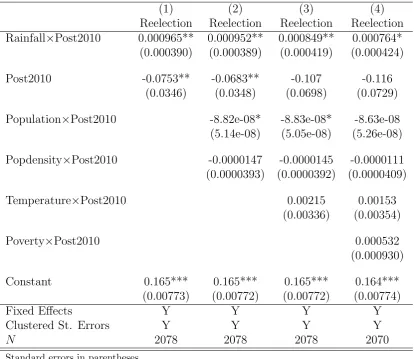
associated toV ictims×P ost2010. As columns 1-4 reveal, the positive and significant coefficients of
the different specifications suggest that in 2011 the increase in the probability of reelection is higher
in municipalities more affected by the disaster. In other words, an increase in the rate of victims
significantly increases the probability of reelection, in 2011 relative to 2007. Column 1 reports the
estimates when municipality-level controls not are used; column 2 shows that the result is robust
16
The shape of the figure and the intuition holds for lower and higher thresholds.
17
Analyzing this graph is might seem surprising that the average value for Reelection is quite low. Recall that this variable indicates whether or not the incumbent party was reelected in the 2007 and/or 2011 mayoral elections. Surprisingly, incumbents were reelected in only 16 per cent of the elections. This outcome supports the burgeoning literature that claims there is an incumbency disadvantage in developing countries (Brambor and Ceneviva (2011), Klasnja (2012), Linden (2004), Titiunik (2009), Uppal (2009)), in contrast to the robust finding that incumbency
advantage prevails in developed nations (Ansolabehere et al. (2000), Erikson (1971), Ferejohn (1986), Gelman and
to the inclusion of demographic -population and population density- controls; column 3 includes
temperature; and column 4 incorporates poverty. In every case the result is the same: a positive and
significant coefficient for the interaction between the rate of victims per capita and the post-disaster
dummy variable.
The estimates imply substantial effects. For instance, the coefficient in column 1 suggests that a
1 percentage point increase in the rate of victims per capita increases the probability of reelection
by approximately .23% in 2011. Thus, compared to a situation with no victims, a municipality in
which the whole population was affected experiences an increase in the probability of reelecting the
incumbent party 23 percentage points higher in 2011.
Endogeneity could bias the results presented above if our main variable of interest, V ictims×
P ost2010, is correlated with error term εit in (1). This situation could be the case, for instance,
if municipalities with higher levels of income inequality have more habitants living in zones prone
to floods and landslides, such as riverbanks or hillsides. If inequality also predicts whether an
incumbent party is reelected, estimates based on (1) would be biased. Another cause of endogeneity
and biasedness could be measurement error. For instance, it could be the case that municipalities
governed by corrupt politicians tend to over-report the number of victims just for the sake of obtaining
more aid. If there is a correlation between this source of measurement error (more victims registered
than real victims in “corrupt municipalities”) and the likelihood of reelection, the estimates based
on (1) would be biased.
Essentially, the problem of using the number of victims per capita as a measure of disaster
exposure, is that this variable might be correlated with a big number of political and economic
covariates that might also affect electoral outcomes. Consequently, endogeneity is less of a concern if
an exogenous variable correlated with the exposure of municipalities to the disaster is utilized instead.
Given that high levels of precipitation are the natural events that mainly cause floods and landslides,
which in turn cause victims, extreme rainfall is a natural variable to be analyzed, as suggested by
(2). The effects of extreme rainfall episodes on the probability of reelecting the incumbent party are
reported in the On-line appendix.
6.2
Instrumenting for Victims: Water Supply of Municipalities
Even though it is difficult or impossible to claim that political or economic variables explain the
eco-nomic production, as several agricultural activities, not necessarily captured by the controls included
in this paper, heavily depend on levels of precipitation. In fact, some authors use rainfall as an
instrument for economic growth to explain levels of civil conflict (Miguel et al. (2004)). Therefore,
if the performance of economic activities predicts electoral outcomes and party survival, estimations
based on (2), once more, might be biased. To account for these potential endogeneity bias, in this
section I present an alternative approach: the use of a hydro-topographic variable as an instrument
for levels of victimization associated to the 2010-2011 disaster.
Colombia is a great power in terms of water supply. Besides being the only South American
country with access to both the Atlantic and Pacific oceans, all across its territory several rivers
and lakes are found and serve as suppliers of water to the population. In fact, it is difficult to
find municipalities without access to water bodies. Naturally, accessibility to this important natural
resource is not only a function of rainfall. It also depends on topographic characteristics, which
determine the size river basins and soil accumulation, which in turn determine the levels of water
supply available for a municipality. Given that most of the victims of the disaster analyzed in this
paper suffered from floods that destroyed their homes, crops, lands and other properties, and that
these events are not only a function of rainfall but also of the existence and abundance of surrounding
water bodies, availability of water per capita will be used as an instrument for victimization.
Naturally, for water supply to be a valid instrument it is also necessary that the only channel
through which the interaction of water and the post disaster time dummy affects reelection results,
is through its effect on the interaction of victims and such time dummy. It could be claimed that
water supply affects the places where people choose to live. It is for this reason that I use per
capita levels in this analysis; in fact, the correlation between water supply per capita and population
density is weak and statistically insignificant (results not reported). It could also be claimed that
water supply affects economic activities, as in the case of rainfall. Nonetheless, given the nature of
the instrument described in (3), for this concern to be valid, it would be necessary to explain why is
there a differential effect of water supply on these activities in 2011 as compared to 2007, for a reason
different to the disaster itself. Besides, as it was mentioned before, water supply is not an indicator
of whether a Colombian municipality has access to a river or a lake for agricultural or transportation
reasons, because most municipalities have access. Consequently, the basic assumption behind the
use of W ater×P ost2010 as an instrument for V ictims×P ost2010 is that water supply measures
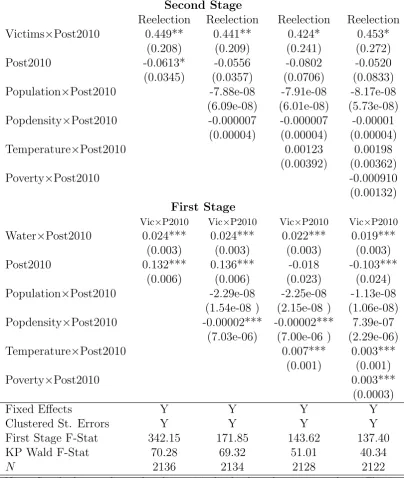
Table (2) reports the results of the instrumental variables estimation based on (3) and (4). The
estimates reveal that the findings presented above are robust to the instrumental variables approach.
Second stage results show that in 2011, as compared to 2007, higher rates of victimization caused
a higher increase in the probability of reelecting the incumbent party. This finding is robust to the
inclusion of demographic controls (column 2), climate (column 3), and poverty (column 4). The
coefficient in column 1 suggests that a 1 percentage point increase in the rate of victims per capita
increases the probability of reelection by approximately .45% in 2011. Thus, compared to a situation
with no victims, one in which the whole population was affected implies an increase in the probability
of reelecting the incumbent party 45 percentage points higher in 2011.
First stage results also conform to the expectations. After the disaster, municipalities with higher
levels of water supply are predicted to have higher levels of victims per capita. In every specification,
an F value higher that 40 corresponding to the Kleibergen-Paap test provides evidence to reject
the null hypothesis that the instrument is weak. Overall, results reported in table 2 suggest that
municipalities surrounded by more voluminous rivers are lakes are more likely to experience floods,
and that a place that had more victims exhibits a higher increase in the probability of reelecting the
incumbent party in 2011.
In this section an instrumental variables approach has been used to complement the
difference-in-differences strategy proposed above and to determine the causal effect of exposure to a natural
disaster on the probability of reelection of the incumbent party. Using water supply, interacted with
the post-disaster time dummy as an instrument for the number of victims interacted with this time
dummy as well, I find that the disaster caused an increase in incumbent parties’ survival in 2011
in municipalities heavily affected by floods and landslides. In the next section I present evidence
supporting the basic mechanism proposed in this paper.
6.3
Mechanism: Humanitarian Aid Increases Clientelism?
If a disaster diminishes the well-being of those affected, why would it be beneficial for a democratic
leader? The mechanism proposed in this paper suggests that after a disaster not only affected
citizens have a higher propensity to sell their votes: incumbents will also have higher budgets and
more resources to buy those votes. In order to test this hypothesis the paper presents two pieces
of evidence, based on information provided by Colombia Humanitaria, on the allocation of different
During the disaster, and weeks after it ended, the central government, through the Colombia
Humanitaria agency, distributed food aid to the affected population, in the form of grocery and
hygiene kits. Figure A1 and table A7, both in the On-line Appendix, show that the correlation
between food aid and victims of the disaster is positive, suggesting that at least in terms of the
allocation of particularistic aid -as food and hygiene kits- the government gave more to those with
more needs.
The disaster not only affected citizens directly through the loss of human lives, homes, or
live-stock. It also destroyed roads, bridges, and other infrastructure assets, which naturally increased the
economic costs to the affected communities. For this reason, Colombia Humanitaria allocated a fair
amount of humanitarian aid for the purpose of reconstructing local public goods destroyed by the
disaster, and for the construction of dikes and other structures that could prevent future floods and
landslides. Figure A5 and Table A8, both in the On-line Appendix, illustrate that the correlation
between the amount of money per capita allocated to infrastructure projects to mayors in each
mu-nicipality, and the number of victims per capita is positive, although it is weaker. This situation is
not surprising, because even though we would expect that places with more victims will also have
more destroyed infrastructure, the relationship would not necessarily be perfect. Some places might
have a lower number of victims but more costly local public goods destroyed. This evidence could
be the result of divergent costs of reparation of local public goods (bridges, roads, etc.), or could be
caused by an inefficient and perhaps politically oriented allocation of resources. However, without a
quantification of the economic damage caused by the disaster at the municipality level, it is hard to
determine the real cause of this discrepancy.
As in the case of food relief, is it true that high levels of infrastructure aid increase the likelihood
of reelection in 2011 for incumbent parties? Facts and intuition suggest that in this case things are
not so simple. Even though Colombia Humanitaria allocated resources before the election took place,
most of these projects, for different reasons, were not executed before October 30th, 2011. Therefore,
not all of the money was available during the electoral campaign, as opposed to grocery and hygiene
kits that were distributed before election day.
Columns 1-4 in table 3 report the estimates of a series of cross-sectional probit regressions of
reelection in 2011 on these different forms of aid. The results reveal that high levels of food aid predict
higher probabilities of incumbent party reelection in 2011. No significant effect on reelection is found
density, temperature, and poverty controls. Hence, these estimations reveal that particularistic
benefits, such as food, have a positive impact on party survival, while collective goods, such as
infrastructure aid, have no effect. These results support the mechanism proposed in this paper.
As defined and discussed in Gallego (2014), political clientelism is a dyadic relationship in which a
politician (the patron) offers private goods or services to the voter (the client) in exchange for political
support, which generally includes the vote. In this case, voters receive private rewards in the form of
food aid. Incumbents, in the meantime, are more likely to win in places more affected by the disaster
and where more relief was allocated. Does it mean that relief is being allocated strategically to gain
votes and win elections? In the following subsections I present evidence supporting such claim.
6.4
Why Clientelism?
The first piece of evidence in favor of the argument that parties allocated aid strategically in order
to get votes uses information from the Office of the Inspector General of Colombia. This institution
oversees the public conduct of those in authority, including Mayors and Governors. Before the
election, several analysts, NGOs, and the media warned about the possible use of relief with electoral
purposes.18
In fact, the Office of the Inspector General investigated irregularities in more than 200
municipalities.19
Most of these irregularities are related to the allocation of food aid. Some of
the motivations for conducting these investigations include “irregular management of humanitarian
aid”, “alleged utilization of resources for electoral purposes”, “allocation of aid to non-victims”, or
“allocation of aid in exchange for votes.” In other words, and following the definition stated above,
the Office of the Inspector General investigated cases of clientelism.
If the mechanism proposed in this paper is correct, in places in which (there is evidence that)
clientelism took place the probability of reelecting the incumbent party should be higher. For this
purpose, I create a dummy variable that indicates whether an investigation by the Office of the
Inspector General took place in the municipality. I only include cases in which the investigation took
place because of irregularities in the allocation of resources. Models 5-8 in table 3 report the results
of cross-sectional probit estimations in which the dependent variable is the probability of reelecting
the incumbent party. Once more, only information for the 2011 election is used in these regressions.
The results are quite interesting. The main variable of interest is Irregularities, and its associated
coefficient is positive and significant on every specification. It means that in municipalities in which
18
See, for instance, http://www.elespectador.com/noticias/politica/proselitismo-subsidios-articulo-302748
19
investigations for irregularities in the allocation of aid took place, the probability of reelecting the
incumbent party is higher.
Therefore, the results of this subsection reveal that it is not only true that places more affected
by the disaster and that received more relief are more likely to reelect the incumbent party. It
is also clear that in municipalities in which there is some official evidence of clientelism and
vote-buying through these resources, it is also more likely to reelect these parties. Politicians allocated
aid strategically in order to win elections. And they were successful at doing so.
6.5
A Placebo Test
In this section a placebo test is performed in order to corroborate the hypothesis that the disaster
increases the chances of reelection of the incumbent party. So far, data on affected population
corresponds to victims of the first rainy season, which goes from the second semester of 2010 until
April of 2011. However, after the election took place on October of 2011, a second rainy season
occurred. Although it was less intense and severe than the first one, it also caused damage and high
levels of victimization. For the placebo test, the number of victims per capita from November of
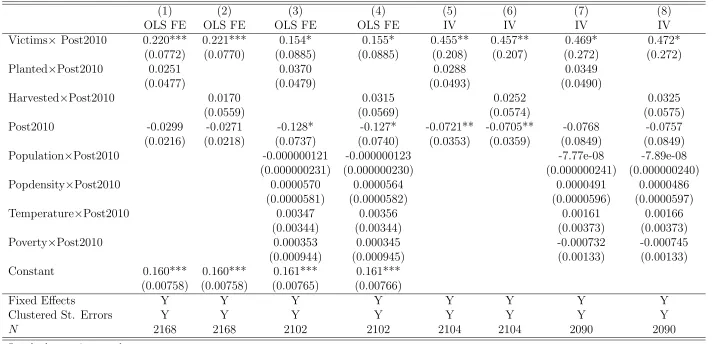
2011 through June of 2012 is utilized. Consequently, V ictimsAf ter is interacted with the Post2010
dummy variable, in order to estimate an specification equivalent to (1). If the mechanism proposed
in this paper is correct -that disaster affectation implies an inflow of resources that can be used for
buying votes-, no effects on the probability of reelection should be found after estimating this new
specification. Victimization after the election should have no impact on the probability of reelecting
the incumbent party, because any relief allocated for new victims is ex-post to campaigning.
Table 4 corroborates the intuition. Columns 1-4 report the coefficients for the DID specification,
using victims after the election as the main variable of interest, while columns 5-8 report the results
for the IV approach. In any case, the results reveal the post-election disaster has no effect on the
probability of reelecting the incumbent party. In municipalities more affected by the rainy season
from November of 2011 until June of 2012 the change in the probability of reelection is not higher
than in municipalities less affected. Hence, this placebo test corroborates the idea that what matters
6.6
Alternative Mechanisms
So far the paper has shown that compared to the 2007 mayoral elections, in 2011 incumbent
par-ties have a higher probability of being reelected in municipalipar-ties heavily affected by the natural
disaster. This result is robust to different measures of disaster exposure: number of victims per
capita or episodes of extreme rainfall in 24 hours; additionally, the result holds when water supply
at the municipality level is used as an exogenous source of variation for victimization. Moreover, a
basic mechanism has been proposed. The disaster is beneficial for incumbent politicians because it
generates an inflow of aid and resources that can be used to buy votes. The patterns exhibited by
food aid allocation and its impact on electoral results confirms this hypothesis. Nonetheless,
alterna-tive explanations could be proposed. The purpose of this subsection is to rule out these alternaalterna-tive
justifications for the results encountered so far.
A first possibility would be that incumbent parties increase their probability of reelection after the
disaster because they are efficient at alleviating the pervasive consequences associated to the tragedy,
and consequently voters reward this efficiency at the polls. This alternative explanation is closely
related to retrospective voting theories: voters punish incumbents that they consider diminished
their well-being through their actions. On the contrary, if they consider that the incumbent policies
increased in some way their satisfaction -and this would be the case for citizens affected by the
disaster whose suffering is ameliorated or whose losses are diminished thanks to the efficient strategies
implemented by the authorities- a natural way to reciprocate would be to support the party in office.
To test this mechanism it is necessary to employ a measure of effectiveness of local governments in
alleviating the crisis. On September of 2011, about a month before the election, the Attorney’s office
published a list of municipalities that were being investigated because relief and prevention projects
presented delays in their execution. Therefore, under the assumption that voters have knowledge of
this situation -either because they have access to the list or because they are aware of the delays
in their municipality- incumbent governments investigated because of their inefficiency in alleviating
the crisis should exhibit a lower probability of reelection. Figure A6 in the On-line Appendix provides
descriptive evidence against this assertion, as it shows that in municipalities with no delayed projects
-according to the Attorney’s office- the proportion of elections won by the incumbent party in 2011
is very similar to the analogous proportion in places that exhibit delays.
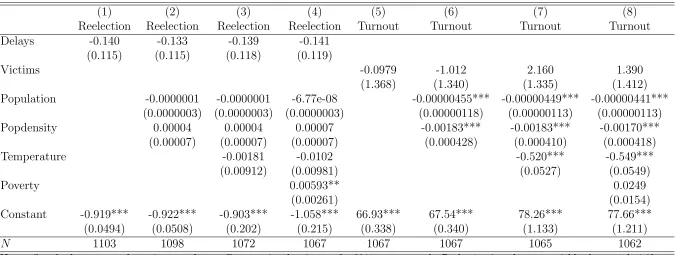
1-4 in table 5, are employed to determine the relation betweenDelays-a dummy variable indicating
if a municipality had any delayed projects- and the 2011 reelection indicator variable. The estimated
coefficients are insignificant for every specification, suggesting that it is not necessarily true that
inefficient governments -in terms of alleviating the effects of the disaster- are less likely to be reelected.
A second alternative approach is related to the political psychology of exposure to traumatic
events. It can be argued that citizens’ levels of political engagement changes drastically after they
experience traumatic situations, such as the loss of family members or property due to a natural
dis-aster. Two possibilities arise. Voters affected by the disaster could become less interested in politics
and participate less, because their own tragedy consumes their time and reduces access to
informa-tion about the electoral campaign. In such case, if -by chance or for any other reason- supporters
of challenger parties are more affected, in the end this situation would benefit the incumbent party
and the change in its probability of reelection should be higher in 2011.
Alternatively, an opposite mechanism could take place. Exposure to the disaster could increase
affected citizens’ level of political engagement. After suffering psychological and material damage,
voters could become more interested in the political process. For instance, affected citizens could
realize that the outcome of the election is crucial for the selection of future policies aimed to alleviate
the pervasive consequences of the disaster. If, for any reason, supporters of the incumbent party
are more affected, again the effect would be to see a bigger change in the probability of incumbent
reelection in affected municipalities. In any case -whether the disaster augments political engagement
of incumbent party supporters or decreases political engagement of opposers- the effect should be
the same: a differential change from 2007 to 2011 in voter turnout in municipalities affected by the
disaster.
If the traumatic events augment incumbent supporters’ level of engagement, more people from
this group should vote in 2011 and voter turnout should increase in relative terms. On the contrary,
if the disaster decreases incumbent opposers’ level of engagement, such group would vote less, so that
turnout should exhibit a relative reduction. In any case, the explanation of why we see a differential
change in the likelihood of reelection would differ from the clientelistic approach defended throughout
this paper.
Figure A7, in the On-line Appendix, depicts the correlation between municipalities’ number of
(if any) correlation between the two variables, situation that is corroborated by the standard
cross-sectional OLS regressions reported in columns 5-8 in table 5. Using 2011 data, it is clear thatV ictims
is a very bad predictor ofT urnout, suggesting that the disaster did not cause major shifts in citizens’
levels of political engagement, whether they support or oppose to the incumbent party.20
This subsection presents evidence against alternative mechanisms for why incumbent parties
experience a higher increase in the probability of reelection in municipalities affected by the disaster.
First, it does not seem to be the case that voters are rewarding efficient politicians that through
their behavior ameliorated the negative consequences of the disaster. Additionally, evidence does not
support the idea that the disaster changed relative levels of political engagement among incumbent
and challenger supporters.
7
Conclusion
Selectorate theory of political survival (Bueno de Mesquita et al. (2003)) suggests that the sizes of
the winning coalition (the set of essential supporters without whose support a leader would lose
power) and the selectorate (the set of people from which the winning coalition is formed) determine
the political incentives that shape leaders’ behavior. In larger coalition systems, like democracies,
natural disasters that affect a big proportion of the population inevitably diminish the welfare of
certain members of such winning coalition. For this reason, even if disasters are acts of God, citizens
might punish incumbents that fail to invest in preparedness or that inefficiently allocate disaster
relief. Consequently, political institutions have a direct effect on disasters’ lethality, explaining why
these events generally have more impact on autocratic regimes (Quiroz and Smith (2010)).
Nonetheless, not all democracies are the same and the size of winning coalitions differ across
democratic countries. In particular, clientelism and bloc voting (Gallego (2014) and Smith and
Bueno de Mesquita (2012)) are important traits of electoral systems that may significantly reduce
the size of the winning coalitions of political leaders in democratic countries. Even if all adult citizens
compose the selectorate, in clientelistic democracies, the size of the de facto winning coalition might
be small if it is comprised of local intermediaries capable of mobilizing blocs of voters through the
distribution of goodies before and after the election. Hence, in such systems, political incentives
differ radically from other scenarios in which democracy relies less on patronage and vote buying.
20
In terms of natural disasters, this description suggests that the political implications of the
lethality of such events in clientelistic democracies, in many cases, could be closer to what happens
in autocracies. The small size of the winning coalition implies that, even if many citizens are affected
by the catastrophe, as long as the welfare of those whose support is essential to stay in power
remains unaffected, incumbent parties have little reason to worry. In fact, given that the disaster
generates a positive stock of aid, private goods, and cash for leaders, the event might increase political
survival if incumbents use these resources strategically for buying votes. The evidence presented
above provides support for this assertion, as parties governing places more affected by floods and
landslides in Colombia were more likely to be reelected months after the disaster. Moreover, this
paper demonstrates that allocation of food relief, a very clear form of distribution of private goods
to potential supporters, increased the likelihood of reelection, while the same is not true for public
goods in the form of infrastructure aid.
Naturally, the conclusions of this paper do not imply that aid should not be allocated after a
disaster takes place, because politicians will use it strategically to obtain votes. The final message is
that policies aimed to diminish clientelism will also reduce the incentives to strategically manipulate
the utilization of disaster relief. In the meanwhile, alternative mechanisms can prevent this behavior
if aid is managed and distributed by truly independent agencies and not by political organizations
with clear electoral goals. In the context of climate change and global warming in which extreme
climatological events are expected to become more frequent, it is important to understand what the
political consequences of natural disasters are and what can be done to ameliorate the pervasive
consequences of these events.
Bibliography
Abney, G. and Hill, L. (1966). Natural Disasters as a Political Variable: The Effect of a Hurricane
on an Urban Election, American Political Science Review60(4): 974–981.
Achen, C. and Bartels, L. (2004). Blind Retrospection Electoral Response to Drought, Flu, and
Shark Attacks, Working Paper, Princeton University.
Anbarci, N., Escaleras, M. and Register, C. (2005). Earthquakes Fatalities: the Interaction of Nature
and Political Economy, Journal of Public Economics89(9-10): 1907–1933.