Predicting the prognosis in acute liver failure:
results from a retrospective pilot study using the LiMAx test
Johan Friso Lock,* Amir Nihad Kotobi,* Maciej Malinowski,Antje Schulz, Maximilian Jara, Peter Neuhaus, Martin Stockmann
Department of General, Visceral and Transplantation Surgery, Charité-Universitätsmedizin Berlin, Germany. * Contributed equally to this work.
ABSTRACT
Background. Acute liver failure (ALF) is a rare but potentially life-threatening condition and liver transplan-tation (LTX) remains frequently the only effective therapy. Nevertheless, some patients recover without LTX but the individual indication for or against LTX remains difficult. Aim. To evaluate maximal liver func-tion capacity (LiMAx) for predicting the prognosis of ALF. Material and methods. Clinic data of 12 patients was retrospectively analyzed to compare the different liver function test results with the patients’ clinical outcome. Patients were assessed by the LiMAx test, a non-invasive breath test determining cytochrome P450 1A2 capacity using intravenous 13C-methacetin. Statistical analysis compared patients with sponta-neous recovery versus non-recovery (LTX or death). Results. Twelve patients (6 male, 6 female; 49 [11-72] years) with viral hepatitis (n = 2), toxic liver injury (n = 3), or cryptogenic liver failure (n = 7) were analy-zed. Seven patients fully recovered from ALF and were discharged without LTX. Three patients died and two underwent LTX. The King’s College Criteria (KCC) was fulfilled in only one out of five patients without recovery. The LiMAx was 19 ± 19 (16-62) for non-recovery vs. 94 ± 119 (39-378) µg/kg/h for recovery (P = 0.018). In contrast, all biochemical parameters [bilirubin (P = 0.106), creatinine (P = 0.343), AST (P = 0.53), ALT (P = 0.876) and INR (P = 0.876) were statistically indistinct. Also the Model for End-Stage Liver Disease (MELD) score did not show a difference [35 ± 4.3 (29-40) vs. 30 ± 11.5 (6-40); P = 0.27]. Conclusions. Maximal liver function capacity determined by LiMAx test is severely impaired in patients with ALF. The LiMAx test might be effective in predicting the individual prognosis and the need for LTX in ALF.
Key words. Methacetin. Breath test. 13C. LiMAx. Liver function. Fulminant liver failure.
Correspondence and reprint request: PD Dr. med. Martin Stockmann Department of General,
Visceral and Transplantation Surgery, Carrito-Universitätsmedizin Berlin
Augustenburger Platz 1, 13353 Berlin, Germany Tel.: +49 30 450-552 001. Fax: +49 30 450-552 927 E-mail: [email protected]
Manuscript received: December 14, 2012. Manuscript accepted: February 11, 2013. INTRODUCTION
Acute liver failure (ALF) is a rare but potentially life-threatening condition. It is characterized by pro-gressive destruction of hepatic parenchyma with cell necrosis and/ or apoptosis. The genesis of ALF is di-verse and includes drug-induced liver injury (e.g. acetaminophen), viral or autoimmune hepatitis,
me-tabolic dysfunction and vascular genesis and yet unknown reasons.1
The most widely accepted definition of ALF inclu-des the evidence of coagulopathy, usually an INR ≥
1.5, and any degree of mental alteration (i.e. hepatic encephalopathy) after exclusion of preexisting cir-rhosis and without a disease history of more than 8 weeks.2 In many cases deterioration of liver
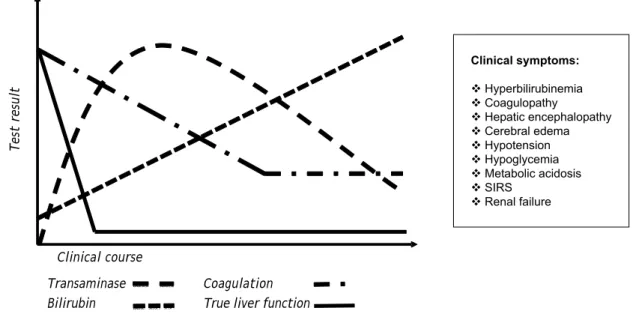
func-tion leads to multiple organ failure and death. Figure 1 provides an overview of commonly applied biochemical tests and clinical signs for the diagnosis of ALF.
Although the liver has a relevant regenerative po-tential, liver transplantation (LTX) remains the sin-gle curative therapy in severe cases.3 However, a
application of immunosuppressive agents. Thus the identification of patients with potential recovery is of major clinical importance. In addition, early and accurate assessment of liver injury and function is essential to implement best curative treatment. Specific prognostic factors and scores4-9 were developed
to support the crucial process of decision-making, against or in favor of transplantation. The current standard criteria for transplantation are the King’s College Criteria (KCC).10 Although its specificity of
67-86% is somehow acceptable, its reported sensiti-vity of only 48-68% excludes effective decision making in the assessment of ALF patients.4,11,12
As a consequence the indication for LTX remains a subjective decision on a case-by-case basis by the responsible physicians that includes all patient cri-teria. Taken together, no reliable diagnostic tools are yet available to predict the individual outcome of ALF. A promising method to overcome this diagnos-tic gap might be the assessment of the maximal liver function capacity. The LiMAx test enables a real-time in vivo determination of the capacity of the cytochrome P450 1A2 enzymatic system within one hour. Previous clinical trials have demonstrated its sensitivity, specificity and prognostic power in diffe-rent clinical situations.13-14 The aim of this study
was to explore the correlation between LiMAx and
the patients’ prognosis in non-acetaminophen-indu-ced ALF in a small pilot study.
MATERIAL AND METHODS
The retrospective analysis included twelve pa-tients’ hospitalized for ALF that were referred to the Department of Transplantation Surgery to evaluate the indication for LTX. In addition to the routine clinical tests, those patients were assessed by the LiMAx test. The test is currently used in the routine diagnostics of our clinic to assess patients undergo-ing liver resection and transplantation. The clinic data at the time point of inclusion were analyzed to compare the different liver function test results with the patients’ outcome. In selected patients a second test was performed during hospitalization if requested by the responsible physicians. The LiMAx test was performed as previously described.13 Readouts
from prior studies on healthy volunteers showed a normal value > 315 µg/kg/h (311-575).13
The study was approved by the local ethics com-mittee and all patients or their relatives provided written informed consent to undergo the LiMAx test. The study endpoints were either spontaneous recovery with survival, versus non-recovery, defined as LTX or death. The individual therapy and the
de-Figure 1. Schematic course of biochemical parameters and clinical symptoms in progressive acute liver failure. Acute liver failure can lead to typical progression of biochemical parameters, such as temporary elevation of transaminases, increasing levels of bilirubin, and coagulopathy. The individual progression of parameters not only depends upon the degree of functional impairment or the severity of liver damage, but also on the particular half-life of parameters in blood. Potentially true liver function is affected at an earlier point in time and decreased faster in comparison to blood parameters. In addition, several clinical signs can lead to the diagnosis of ALF. However, these parameters usually only become apparent in end-stage ALF and indicate a vital risk for the patient.
Test result
Transaminase Coagulation Bilirubin True liver function
cision for transplant listing were chosen by the res-ponsible physicians independent from the study pro-tocol. Additional data of clinical findings and biochemical tests were collected from the electro-nic hospital information system. KCC10 and Model
for End-Stage Liver Disease (MELD)15 were
calcula-ted for the time point of LiMAx assessment.
Statistical analysis
Statistical analysis compared LiMAx readouts, biochemical parameters, KCC and MELD score bet-ween recovery and non-recovery. Univariate analy-sis was performed by Mann-Whitney U test and Fisher’s exact test for independent samples accord-ing to the respective data distribution. Data were presented as median with range and SD. To assess the prognostic power of the LiMAx test, receiver-operating characteristics (ROC) were applied. A cut point was set at the maximum sum of sensitivity and specificity. Statistical significance was accepted at P < 0.05 (two-sided). Calculations were performed using IBM SPSS Statistics Version 20.
RESULTS
Detailed patient characteristics are provided in table 1. The LiMAx test was performed 3.5 days (1-12) days after admission to the hospital. The median age of the study group was 49 (11-72) years with equal gender ratio (6 male/6 female). ALF was caused by viral hepatitis (n = 2), toxic liver injury (n = 3), cryptogenic liver failure (n = 7). Seven patients recovered spontaneously and were discharged from the hospital without LTX. In the non-recovery group four patients died including one who had
un-dergone LTX. One single patient underwent success-ful LTX and was discharged in good condition. The causes for ALF among the group with non-recovery were viral hepatitis (n = 2) and cryptogenic liver failure (n = 3). The group analysis indicates differences in biochemical parameters and patient age (Table 1).
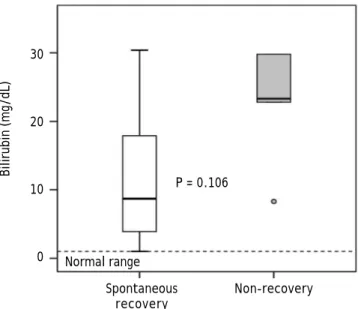
Median values of bilirubin (P = 0.106) (Figure 2), creatinine (P = 0.343), AST (P = 0.530) and ALT (P = 0.876) were higher in the non-recovery group, whereas INR (P = 0.876) was lower. However, these differences missed statistical significance. The
Table 1. Patients’ characteristics.
Patient characteristics All (n = 12) Spontaneous recovery (n = 7) Non-recovery (n = 5) p-value Age (years) 49 (11-72) 24 (11-69) 55 (44-72) 0.106
Gender (female/male) 6/6 4/3 2/3 1.0*
Bilirubin (mg/dL) 17.9 ± 12.6 (1-41) 8.70 ± 10.65 (1-30.4) 23.30 ± 19.35 (8.3-41) 0.106 INR 2.61 ± 1.04 (1-4.96) 2.67 ± 1.27 (1-4.96) 2.58 ± 0.77 (1.59-3.75) 0.876 Creatinine (mg/dL) 1.5 ± 1.7 (0.45-4.07) 0.74 ± 1.17 (0.45-3.24) 2.72 ± 1.7 (0.49-4.07) 0.343 AST (U/L) 576 ± 2,658 (48-8191) 277 ± 2,299 (48-5,550) 1,596 ± 3,311 (117-8,191) 0.530 ALT (U/L) 727 ± 1,355 (58-3,890) 556 ± 1,651 (131-3,890) 898 ± 843 (58-2253) 0.876 LiMAx (µg/kg/h) 44 ± 100 (16-378) 94 ± 119 (39-378) 19 ± 19 (16-62) 0.018
KCC (pos %) 16.7 14.3 20 1.0*
MELD 32.5 ± 9.7 (6-40) 30 ± 11.5 (6-40) 35 ± 4.3 (29-40) 0.268
Median values with interquartile range, analyzed by Mann–Whitney U test. *Group differences were analyzed for statistical significance by Fisher’s exact test. Bold values indicate significant values. INR: international normalized ratio. AST: aspartate-aminotransferase. ALT: alanine-aminotransferase. KCC: King’s College Criteria. MELD: Model for End-Stage Liver Disease.
Figure 2. Bilirubin values in patients with acute liver failure. Data presented as a box and whisker plot for patient with recovery and patient with non-recovery. Bold lines indicate median, whiskers the min–max range, boxes the interquartile range and circles outliers.
30
20
10
0
Bilirubin (mg/dL)
Spontaneous Non-recovery recovery
P = 0.106
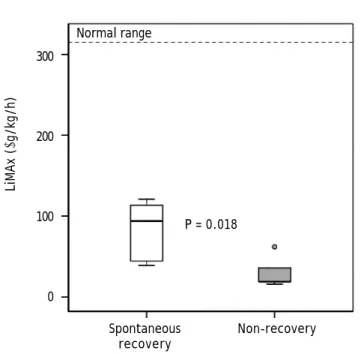
Figure 3. LiMAx readouts in patients with acute liver failure. Data presented as a box and whisker plot for patient with recovery and patient with non-recovery. Bold lines indi-cate median, whiskers the min–max range, boxes the inter-quartile range and circles outliers. The bold text indicates statistical significance (Mann-Whitney U test).
Figure 4. Receiver operating characteristic (ROC) analysis of LiMAx readouts in patients with ALF. Area under receiver operating characteristic curve (AUROC) was presented with 95% confidence intervals (95%CI). The best cutoff was obtai-ned at the maximum sum of sensitivity and specificity.
Cutoff Sensitivity Specificity
28 0.60 1.00
38 0.80 1.00
41 0.80 0.86
45 0.80 0.71
55 0.80 0.57
78 1.00 0.57
MELD score in the non-recovery group was 35 ± 4.3 (29-40) vs. 30 ± 11.5 (6-40) (P = 0.27). The King’s College Criteria were fulfilled in one out of five pa-tients in the non-recovery group (P = 1.0). In the recovery group six out of seven did not fulfill these criteria. In contrast, LiMAx readouts were 19 ± 19 (16-62) for non-recovery vs. 94 ± 119 (39-378) µg/ kg/h for recovery (P = 0.018) (Figure 3). The ROC analysis indicates an AUROC of 0.94 (95% confidence interval 0.74-1.00, P = 0.019) with a best cut off of 38 µg/kg/h (Figure 4). Thus a LiMAx < 38 µg/kg/h could be predictive for death or need for transplan-tation with a sensitivity of 80% and specificity of 100% in this small patient cohort.
Two selected clinical courses of one patient with spontaneous recovery and another without are ex-pressed in table 2.
DISCUSSION
The present pilot study presents for the first time the clinical significance of the maximal liver function capacity in ALF. It is shown that the LiMAx test cannot only determine ALF itself, but can potentially differentiate between those patients with sponta-neous recovery and those that require urgent listing for LTX. The lack of diagnostic tests to predict the
individual outcome of ALF was the reason to eva-luate the potential of the LiMAx test for this indica-tion. The LiMAx test has previously been shown to enable superior accuracy in the assessment of liver function prior to liver surgery13 and after LTX.14,16
The main focus of this study was the comparison of LiMAx test with biochemical testing, the KCC and the MELD score between patients with spontaneous recovery and non-recovery. Although laboratory pa-rameters and MELD differ between these groups, the results failed statistical significance. This is ob-viously due to the limited size of our study popula-tion. Nevertheless, the LiMAx results already achieved statistical significance despite the small sample size. This is of particular importance since a valuable decision for or against transplantation in ALF patients does require diagnostic tests with an individually accuracy for outcome prediction. Most biochemical liver parameters only correlate with
300
200
100
0
LiMAx (
μ
g/kg/h)
Spontaneous Non-recovery recovery
P = 0.018
Normal range 1.0
0.8
0.6
0.4
0.2
0.0
Sensitivity
0.0 0.2 0.4 0.6 0.8 1.0 1-Specificity
Best cutoff (38 μg/kg/h)
non-recovery but cannot predict it validly. There-fore various factors were included into scores in order to improve the diagnostic accuracy.
Today’s most widely utilized tool for the indica-tion of LTX in ALF is the King’s College Criteria.1,3
In literature its accuracy is controversially
discus-sed.12,17 McPhail, et al. investigated in a recent
meta-analysis the prognostic power of KCC in patients with non-acetaminophen-induced acute liver failure.12 Their findings indicated a specificity of
80% and a moderate sensitivity 70%. This means the KCC failed to identify 30% of patients requiring LTX. Another meta-analysis comparing different prognostic parameters to detect need for transplan-tation in patients with acetaminophen-induced ALF provides similar results.17 In the present study only
one patient in each group met KCC, so its lack of sensitivity and low negative predictive value are supported by our findings. An additional reported limitation of the score is the rapid clinical deteriora-tion in some patients who fulfilled KCC. Thus, LTX became contraindicated.18
The Model for End-Stage Liver Disease score15 is
commonly utilized in predicting 3-month survival of patients with chronic liver disease. It can be used to assess disease severity and it is a widespread-used Table 2. Selected case reports of recovery and non-recovery.
Patient Parameter Admission day Follow-up
• Male 21 yrs. LiMAx (μg/kg/h) 47 222
Diagnosis: Bilirubin (mg/dL) 5.8 3.8
ALF after rhabdomyolysis INR 4.96 1.39
Acute renal failure Creatinine (mg/dL) 2.5 1.88 Encephalopathy (Grade I) AST (U/L) 5,550 1,024
Therapy: ALT (U/L) 3,887 1,836
Volume therapy KCC (fulfilled yes/no) No No
Sodium bicarbonate MELD 40 25
• Male 68 yrs. LiMAx (µg/kg/h) 16 18
Diagnosis: Bilirubin (mg/dL) 29.8 33.8
Cryptogenic ALF INR 2.58 3.1
Acute renal failure Creatinine (mg/dL) 3.89 4.97 Encephalopathy (Grade IV) AST (U/L) 283 176 Primary graft nonfunction ALT (U/L) 468 281 Septic multiorgan failure KCC (fulfilled yes/no) No No
Death MELD 40 40
Therapy:
Liver transplantation and retransplantation
INR: international normalized ratio. AST: aspartate-aminotransferase. ALT: alanine-aminotransferase. KCC: King’s College Criteria. MELD: model for end-stage liver disease.
criterion for organ allocation. A study of Kremers, et al. assumed that a high MELD score in patients with non-acetaminophen induced ALF indicates poor prognosis and therefore listing for LTX is recom-mended.19 Another study on 109 patients proposed a
cut off value of 32 to discriminate between patients with spontaneous recovery and those with non-reco-very.20 In the present study, the MELD was > 30 in
all patients with severe ALF and did not allow any differentiation between potential recovery and non-recovery. Other studies confirmed that the MELD score cannot provide an adequate positive predictive value (PPV) and has only moderate specificity.21,22
Various studies failed to demonstrate any advantage of its use in patients suffering from ALF.23,24 Taken
together, MELD was implemented to detect liver function in patients with chronic liver disease and not ALF, which has a completely different patho-physiology.25
Furthermore, the timing of measurements was clini-cally selected and thus somehow arbitrary. Patients were assessed at the point of time of referral to the transplant center. Therefore the presented sensitivity and specificity of LiMAx for non-recovery can only be seen as preliminary. The ROC analysis was mainly performed to provide a certain cut off value for clinical decisions. Interestingly, the cut off value of 38 µg/kg/h for a negative outcome is slightly lower in comparison to liver transplantation (64 µg/ kg/h)14 and liver resection (74 µg/kg/h).13 Potentially
perioperative stress requires a certain magnitude of functional reserve to avoid severe complications, whereas non-surgical patients might tolerate hepatic impairment to a greater extent.
The detailed case reports show the potential appli-cation of the LiMAx test in patients with ALF. The definite advantage of the LiMAx test is its sensitivity for short-term changes that cannot be provided by any biochemical test. This has been particularly shown after liver resection, when the common liver function parameters remain unaltered within some hours after surgery, whereas the LiMAx is directly reduced according to the residual liver.13 This
pheno-menon is evident in the first patient example of this paper. While bilirubin slightly decreased from 5.8 to 3.8 mg/dL the LiMAx increased from 47 to 222 µg/kg/h. Thus the LiMAx enables short-term follow-up assessment of ALF patients. Patients with constant-ly poor function (approx. 30-50 µg/kg/h) seem to be prone of developing end-stage ALF and should be considered for transplant listing. In contrast, patients with increasing LiMAx results during follow-up are likely to recover spontaneously. Obvio-usly, further studies are necessary to confirm these results and the chosen cut off points.
In conclusion, maximal liver function capacity de-termined by the LiMAx test is markedly impaired in patients with ALF. The extent of functional impair-ment might be a very valuable parameter for predic-ting the individual prognosis and the need for LTX.
ABBREVIATIONS
• ALF: acute liver failure.
• ALT: alanine-aminotransferase. • AST: aspartate-aminotransferase.
• AUROC: area under the receiver operating
cha-racteristic curve.
• INR: international normalized ratio. • KCC: King’s College Criteria. • LTX: liver transplantation.
• MELD: Model for End-Stage Liver Disease.
• PPV: positive predictive value.
• ROC: receiver-operating characteristic.
CONFLICT OF INTEREST
Martin Stockmann is the inventor of the LiMAx test and has capital interest in Humedics, the com-pany marketing the LiMAx test.
FINANCIAL SUPPORT
None.
REFERENCES
1. Bernal W, Auzinger G, Dhawan A, Wendon J. Acute liver fa-ilure. Lancet 2010; 376: 190-201.
2. Trey C, Davidson CS. The management of fulminant hepa-tic failure. Progress in liver diseases 1970; 3: 282-98. 3. Liou IW, Larson AM. Role of liver transplantation in acute
liver failure. Semin Liver Dis 2008; 28: 201-9.
4. Polson J. Assessment of prognosis in acute liver failure. Se-min Liver Dis 2008; 28: 218-25.
5. Merle U, Sieg O, Stremmel W, Encke J, Eisenbach C. Sensi-tivity and specificity of plasma disappearance rate of in-docyanine green as a prognostic indicator in acute liver failure. BMC gastroenterology 2009; 9: 91.
6. Du WB, Pan XP, Li LJ. Prognostic models for acute liver fa-ilure. Hepatobiliary Pancreat Dis Int 2010; 9: 122-8. 7. Nakayama N, Oketani M, Kawamura Y, Inao M, Nagoshi S,
Fujiwara K, Tsubouchi H, et al. Algorithm to determine the outcome of patients with acute liver failure: a data-mining analysis using decision trees. J Gastroenterol 2012. 8. Kumar R, Shalimar, Sharma H, Goyal R, Kumar A, Khanal S,
Prakash S, et al. Prospective derivation and validation of early dynamic model for predicting outcome in patients with acute liver failure. Gut 2012; 61: 1068-75.
9. Naiki T, Nakayama N, Mochida S, Oketani M, Takikawa Y, Suzuki K, Tada SI, et al. Novel scoring system as a useful model to predict the outcome of patients with acute liver failure: Application to indication criteria for liver trans-plantation. Hepatol Res 2012; 42: 68-75.
10. O’Grady JG, Alexander GJ, Hayllar KM, Williams R. Early in-dicators of prognosis in fulminant hepatic failure. Gas-troenterology 1989; 97: 439-45.
11. Anand AC, Nightingale P, Neuberger JM. Early indicators of prognosis in fulminant hepatic failure: an assessment of the King’s criteria. J Hepatol 1997; 26: 62-8.
12. McPhail MJ, Wendon JA, Bernal W. Meta-analysis of perfor-mance of Kings’s College Hospital Criteria in prediction of outcome in non-paracetamol-induced acute liver failure. J Hepatol 2010; 53: 492-9.
13. Stockmann M, Lock JF, Riecke B, Heyne K, Martus P, Fric-ke M, Lehmann S, et al. Prediction of postoperative out-come after hepatectomy with a new bedside test for maximal liver function capacity. Ann Surg 2009; 250: 119-25.
14. Lock JF, Schwabauer E, Martus P, Videv N, Pratschke J, Malinowski M, Neuhaus P, et al. Early diagnosis of primary nonfunction and indication for reoperation after liver transplantation. Liver Transpl 2010; 16: 172-80.
Ther-neau TM, Kosberg CL, D’Amico G, et al. A model to predict survival in patients with end-stage liver disease. Hepato-logy 2001; 33: 464-70.
16. Stockmann M, Lock JF, Malinowski M, Seehofer D, Puhl G, Pratschke J, Neuhaus P. How to define initial poor graft function after liver transplantation? - a new functional de-finition by the LiMAx test. Transpl Int 2010; 23: 1023-32. 17. Bailey B, Amre DK, Gaudreault P. Fulminant hepatic failure
secondary to acetaminophen poisoning: a systematic re-view and meta-analysis of prognostic criteria determining the need for liver transplantation. Crit Care Med 2003; 31: 299-305.
18. Bernal W, Wendon J, Rela M, Heaton N, Williams R. Use and outcome of liver transplantation in acetaminophen-indu-ced acute liver failure. Hepatology 1998; 27: 1050-5. 19. Kremers WK, van IJperen M, Kim WR, Freeman RB, Harper
AM, Kamath PS, Wiesner RH. MELD score as a predictor of pretransplant and posttransplant survival in OPTN/UNOS status 1 patients. Hepatology 2004; 39: 764-9.
20. Hadem J, Tacke F, Bruns T, Langgartner J, Strnad P, Denk GU, Fikatas P, et al. Etiologies and Outcomes of Acute Li-ver Failure in Germany. Clin Gastroenterol Hepatol 2012. 21. Katoonizadeh A, Decaestecker J, Wilmer A, Aerts R,
Vers-lype C, Vansteenbergen W, Yap P, et al. MELD score to predict outcome in adult patients with non-acetamino-phen-induced acute liver failure. Liver Int 2007; 27: 329-34.
22. Cholongitas E, Theocharidou E, Vasianopoulou P, Betrosian A, Shaw S, Patch D, O’Beirne J, et al. Comparison of the se-quential organ failure assessment score with the King’s Co-llege Hospital criteria and the model for end-stage liver disease score for the prognosis of acetaminophen-induced acute liver failure. Liver Transpl 2012; 18: 405-12.
23. Schmidt LE, Larsen FS. MELD score as a predictor of liver failure and death in patients with acetaminophen-induced liver injury. Hepatology 2007; 45: 789-96.
24. Zaman MB, Hoti E, Qasim A, Maguire D, McCormick PA, He-garty JE, Geoghegan JG, et al. MELD score as a prognos-tic model for listing acute liver failure patients for liver transplantation. Transplant Proc 2006; 38: 2097-8. 25. Pelaez-Luna M, Martinez-Salgado J, Olivera-Martinez MA.