DEFECTS IN WOOD FROM ASPECT OF PHYSICAL ACOUSTICS
Emil Rajèan
Technical University in Zvolen
Department of Physics & Applied Mechanics, Technical University in Zvolen, SK – 960 53 Zvolen
Slovakia
Tel.: +421 45 5206460 Fax: +421 45 5321811 E-mail: [email protected]
ABSTRACT
Reaction wood is an important defect of wood structure. In conifers the abnormal wood on the underside of leaning trunks is generally called compression wood.
The most characteristic properties of fully developed compression wood are of physical nature: high density, low elasticity, tensile stress and rigidity, dark colour. Experiments were done on the typical compression spruce wood, common spruce and on the resonant spruce wood.
From the evaluation of experimental results follows that despite the high density of annual rings, the compression spruce wood is unsuitable material for making the resonant body of string mu-sical instruments.
INTRODUCTION
The resonant wood has a particular position in framework of technological materials. The task of resonant wood is to amplify and give appropriate timbre to a signal generated by a string of musical instrument. Thus the resonant spruce wood is a material used for making of the top plate of string instruments, top plate of acoustical guitars, resonant board of pianos etc. From macroscopic point of view the resonant spruce wood is characterised by relatively high density of annual rings (optimum 7 rings/cm in radial direction). The uniformity or evenness of annual rings, parallelism of annual rings in radial cut, low quotient of summer wood and overall impres-sion of “light wood”, almost “white wood” belong to the next macroscopic mark of the resonant spruce wood. The areas of the resonant wood are in the latitude of the middle Europe in the height above sea level of around 1000 m; in south the direction (e.g. in Italy) such wood grows in higher latitudes. It grows at the northern slopes with a relatively short vegetal period. For this reason, the resonant wood is typical by high density of annual rings.
The aim of our experiments was to study if there is any difference in the characteristics of physi-cal acoustics of the resonant and the compressed wood.
2. EXPERIMENTS
The following characteristics of physical acoustics: density ρ, modulus of elasticity E, acoustical constant A were examined experimentally. The results are introduced at the moisture content of wood 12 %. This moisture content is considered as referential.
2.1. Material
The test specimens were obtained from spruce trees, slashed in the middle Slovakia during the winter season of 1999/2000. The hight over sea of the coppice is 900 – 1000 m. The trees were sawed by two perpendicular cuts parallel with longitudinal axis short after slash. The radial boards were prepared from these quarters. These experimental radial boards were the same as the elements for the resonant board of piano. The boards containing the compressed zone were used for measurements. The characteristics of physical acoustics of these boards were calcu-lated and compared with characteristics of resonant wood (obtained in earlier experiments).
2.2. Method
[image:2.596.85.432.428.564.2]The test specimens obtained from radial cuts had a shape of boards, of thickness of 0.015 m, of various width, length of 0.6 m (axial direction) in the first experiment. The specimens were ex-posed to driven bending oscillations on the VIBROVIZER apparatus. The source of signal are the oscillations of loudspeaker membrane. The examined test board, appropriately supported under their influence gets some from basic vibration modes (2,0), or (0,2) – see fig. 1 and fig. 2. The resonant frequencies of modes were used for calculation of E-modulus and respectively for calculation of acoustical constant A.
Fig. 1 The Chladni pattern (2,0) of the tested plate R5a on f = 154 Hz
[image:2.596.87.433.602.728.2]The boards were cut into strips with cross dimensions 0.015 x 0,015 m after finishing the meas-urements on the VIBROVIZER. The characteristics of physical acoustics of these test speci-mens were measured on the system AKUSTOMAT. The test specimen is fastened in the middle in the AKUSTOMAT.
Consider the case of standing waves in a test bar of the density ñ, fastened in the middle. Com-ing out from wave equation
2 2 2 2 2 t s c 1 x s ∂ ∂ = ∂ ∂ (1)
Hooke’s law and Newton’s Second law of motion, the cross section displacement s is deter-mined by equation
2 2 2 2 t s E x s ∂ ∂ ρ = ∂ ∂ (2)
where ñ is the density of the material and E its Young’s modulus, for an elastic bar with length
l
for the modulus E, at the basic resonant frequency fr of standing waves it follows ρ = 2 r 2 f l 4 E (3)Thus the wood density ñ, the acoustic constant A given by [Andrejev, 1938]
3 E c A ρ = ρ
= (4)
and the modulus E (relation 3) are considered as the relevant characteristics of physical acous-tics when evaluating wood as a material for musical instruments. This fact follows from experi-ments (e.g. [Rajèan, 1998]).
The gist of the AKUSTOMAT is a PC with an MRF board (measurement of relevant frequencies) and with other subsystems. The MRF board generates a succession of signals at acoustic fre-quencies. The amplified signal goes to an exciter (e.g. loudspeaker) and creates oscillations in test specimen. On the other side of the test specimen, a piece of iron foil of negligible mass is glued. If from one side of such a test specimen is acted the sinusoidal signal in interval of ap-propriate frequencies, it rises in it, at certain – resonant frequencies, the longitudinal standing wave which manifests by maximum potential at the detector. The first, or basic resonant fre-quency was used for the calculation of E-modulus and the A-constant [Rajèan, 1998].
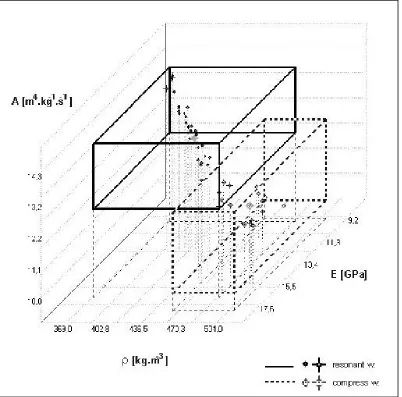
The selected results from our measurements are introduced in table form, as well as in 2D and 3D graphs.
2.3. Results
The main values of density, of E-modulus in longitudinal direction and inherent acoustical con-stant for the boards using VIBROVIZER and AKUSTOMAT are introduced in table 1. The val-ues in the columns “VIBROVIZER” were obtained on the base of one measurement and follow-ing calculations. The values in the columns “AKUSTOMAT” were calculated as mean values from 5 – 15 measurements on strips. (The number of strips depended on the width of inher-ent board).
Table 1 Mean values of physical and acoustical characteristics for individual plates obtained by use of the VIBROVIZER and AKUSTOMAT respectively
VIBROVIZER AKUSTOMAT
test
specimen ñ
[kg.m–3]
Ex
[GPa]
A [m4.kg–1.s–1]
ñ [kg.m–3]
Ex
[GPa]
A [m4.kg–1.s–1]
R1 469,916 10,902 10,250 472,140 11,9019 10,6330
R2 468,664 14,658 11,933 485,907 16,3325 11,9416
R3 467,035 12,651 11,144 483,440 14,3340 11,3241
R4a 497,090 15,220 11,131 500,198 16,1851 11,3594
R4b 494,821 14,437 10,916 496,069 15,4778 11,1915
R4c 452,587 14,186 12,370 462,767 14,5215 12,0357
R5a 477,987 12,297 10,612 485,774 13,2994 10,7576
R5b 468,740 11,021 10,345 479,507 12,8126 10,7865
R8a 468,434 15,860 12,422 476,533 16,4690 12,3595
R8b 471,850 15,623 12,195 482,220 16,8710 12,2729
R9 495,283 15,164 11,172 501,124 16,2002 11,3148
R11a 498,242 14,521 10,835 504,149 16,2590 11,2803
R11b 493,350 15,430 11,336 502,706 16,8829 11,5119
R12a 463,682 9,497 9,760 478,381 10,4864 10,0312
R12b 445,019 10,049 10,678 461,047 11,2594 10,8496
R13a 452,484 10,639 10,716 470,038 12,0735 10,9181
R13b 457,500 10,052 10,246 469,484 11,2925 10,5640
Fig. 3 Density, E–modulus and acoustical constant along the plate R13a
Table 2 ñ, E, A as a function of position in the plate R13a
test specimen
number of test specimen
ñ [kg.m–3]
Ex
[GPa]
A [m4.kg–1.s–1]
1 464,762 14,7650 12,1275
2 442,797 13,7753 12,5963
3 439,063 12,4359 12,1213
4 463,660 10,0514 10,0418
R13a
5 539,907 9,3398 7,7035
Fig. 4.Density ñ, E–modulus and A–constant of high–quality resonant spruce wood (mjstr) and set of compression spruce wood (reak12) at the reference moisture contend 12 %
The set of resonant spruce wood depicted in fig. 4 was obtained from high quality material de-termined by experts (Lupaè, Holiš, 1994) on the base of empirical knowledge for making a mas-ter violin.
3. DISCUSSION - CONCLUSION
We consider the use of 3D graphs going from measurements and calculations as the optimal means of evaluation of wood as a material for music instrument making. It has been shown that this means permits the evaluation of wood as a material for subsystems of various instruments [e.g. Urgela, 1998, Èulík, 2001], for indication of the influence of impregnation and other sub-stances used for surface treatment or the gluing of wood [Danihelová, 1998]. It is also accepted by some violin making masters [e.g. Pilaø, 2001].
acoustics and there exists also the physical justification for its rejection as a resonant material for string musical instruments.
REFERENCES
[1] Andrejev, N. N.: On the wood for musical instruments, In: Collection of Works of Scientific Research Institute of Musical Industry, Moscow, Leningrad, Issue 1, 1938, p. 13–18 (in Russian)
[2] Èulík, M.: Slovak Maple Wood as Material for Back or Sides of Acoustic Guitars. Wood Re-search, 46, 2001, p. 19-28
[3] Danihelová, A.: Influence of some gaseous and liquid substances on physico–acoustical characteristics of spruce wood. Wood Research, 43, 1998, 2, p. 29 – 39
[4] Lupaè, E. (master violin maker); Holiš, J. (manager of AKORDKVINT – private firm of bowed instruments.) Personal communication to author. Luby, 1994
[5] Pilaø, V. (violin maker): Personal communication to author. Hradec Králové, 2001
[6] Rajèan, E.: Application of Acoustics to some Problems of Material Science Related to the Making of Musical Instruments. ACUSTICA united with acta acustica, 84, 1998, p. 122 – 128