Otras secciones de este sitio:
☞ ☞ ☞ ☞
☞ Índice de este número ☞
☞ ☞ ☞
☞ Más revistas ☞
☞ ☞ ☞
☞ Búsqueda
Others sections in this web site:
☞ ☞ ☞ ☞
☞ Contents of this number ☞
☞ ☞ ☞
☞ More journals ☞
☞ ☞ ☞ ☞ Search Artículo:
Rapid latex agglutination test for antibody to hepatitis B surface antigen: performance study and comparison with enzyme immunoassay
Derechos reservados, Copyright © 2004: Federación Mexicana de Patología Clínica, AC Revista Mexicana de Patología Clínica
Número
Number2
Abril-Junio
April-June2 0 0 4
Volumen
93
edigraphic.com
for antibody to hepatitis B
surface antigen:
performance study and comparison with enzyme
immunoassay
Sergio A Oviedo,* Jorge A Zarzur*
* Laboratorio de Hemoderivados-Universidad Nacional de Córdoba.
Correspondence: Sergio A Oviedo
Av. Valparaíso s/n Ciudad Universitaria (Agencia Postal 4) X5000HRA-Córdoba-República Argentina
Tel: 054-351-433.4122/4123 Fax: 054-351-433-4124
E-mail: [email protected]
Key words: Latex agglutination, HbsAb, screening, anti HBV immunoglobulin G.
Palabras clave: Aglutinación látex, AcHBs, búsqueda poblacional, inmu-noglobulina anti VHB.
Recibido: 26/12/2003 Aceptado: 19/01/2004
Summary
Background and objective: A performance evaluation of a latex agglutination test (LAT) manufactured by the Labora-tory of Hemoderivados dependent, of the National Univer-sity of Cordoba, for antibody to Hepatitis B surface antigen (HBsAb), was carried out and compared with a commercial enzyme immunoassay. Material and methods: Testing 1,320 Cordoba’s National University Blood Bank donor and im-munized workers from Hemoderivados Laboratory were tested for the presence and levels of HbsAb with LAT and compared with commercial EIA (ABBOTT LABS, North Chi-cago, Illinois-USA) and RIA (SORIN/Biomedica-Divisione Diagnostica-Italy). Results: This tests showed 100% sensi-tivity and comparable specificity (LAT 99.5%, EIA 99.7% among donor samples). Conclusion: We conclude that LAT is a specific and sensitive test for HBsAb; it is simple to per-form and does no require sophisticated equipment. Hence, it is suitable for mass screening of blood donors in a third world country like Argentina.
Resumen
Oviedo SA y col. Rapid latex agglutination test for antibody to hepatitis B
94
edigraphic.com
:rop odarobale FDP
VC ed AS, cidemihparG
arap
acidémoiB arutaretiL :cihpargideM
sustraídode-m.e.d.i.g.r.a.p.h.i.c cihpargidemedodabor
Introduction
I
n the last few years, due to its high specificity and sensitivity, ELISA was chosen as the test for the determination against the surface antigen of Hepatitis B Virus (HBsAB) in human plasma or se-rum for fractionation to produce Hepatitis B im-munoglobulin (HBIg). This test has a very good specificity and sensitivity.The EIA requires expensive equipment and trained personnel to be performed,1-7 The latex
agglutination test (LAT) overcomes these prob-lems,8,9 and it involves a one step reaction of the
reagent with the antibody (Ab). The latex parti-cles are sensitized with HBsAg, so that results can be interpreted visually.1-12 The LAT has been
eval-uated in our Blood Banks (Cordoba University Blood Bank, Hemotherapy Institute and Neona-tology University Hospital)10,11 and found to be
re-liable as a screening test. In the third world, and particularly Argentina, there is also a real need for a simpler, specific, sensitive and cheap test in the Blood Bank’s Laboratories, specially in field stud-ies for plasma procurement to produce HBIg where trained personnel and equipment are not always available to perform EIA or RIA.
This work reports the performance of the LAT under our country conditions and compares it with the EIA of ABBOT Labs.
Material and methods
This work was done at the UNC-EMODERIVA-DOS Laboratory and the Blood Banks of the Cor-doba National University.
HBsAb was determined in 1,320 samples of human plasma collected. Among them, 55 sam-ples were from immunized workers from Hemo-derivados Labs and 8 from positive control patients with high HBsAb titers. Clinical data, including sex-ual behavior, were collected from each donor. Fur-ther evaluation was also carried out on 651 sam-ples of human plasma whose positive or negative
Hepatitis B condition had been previously known. Commercial EIA (Abbott Laboratories, North Chicago, Illinois, USA) and our LAT were used in the screening test; as well as a reference RIA test (SORIN/Biomedica Divisione Diagnostica-Italy).
The principle of the LAT/HBAB-HEMO DERI-VADOS is agglutination of the HbsAg-coated par-ticles with HBsAb present in human plasma or serum samples. Samples (25 µL) were mixed with the same volume of a 2% suspension of sensitized particles on a slide. Slides were gently and contin-uously shaken for 5 minutes at 25ºC. Agglutinated particles formed only in HBsAb positive samples.12
Samples were tested in duplicate by both LAT and EIA. RIA was utilized to check all samples with an initial HBsAb positive result. A sample was report-ed as positive if found to be repeatreport-edly reactive in a second assay. False positives samples were those found reactive by the screening test, but negative by RIA test.
Plasma samples were separated from the oth-er blood components, aliquoted in 1 mL and stored frozen (-20ºC) until tested.
Results
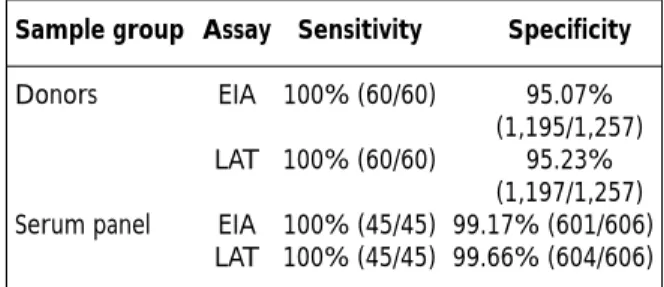
Of the 1,257 samples tested, 62 (4.9%) and 60 (4.8%) were repeatedly positive by EIA and LAT respectively; 58 (4.6%) of these samples were re-active by RIA. Forty-six of the 55 immunized work-ers from Hemoderivados Lab. were found repeat-edly positive by both screening tests. All samples of the testing serum were found to be repeatedly pos-itive by LAT, EIA and RIA test (table I).
The 651 samples of known HBsAb status showed comparable results (table II).
95
edigraphic.com
Discussion
The present practice is to use EIA, for the detec-tion of HBsAb and then to verify the EIA positive serum with RIA test.6,7,13-16
The currently available EIA requires infrastruc-ture and trained personnel. In the developing coun-tries, this infrastructure is not commonly available in rural areas, in these cases the LAT represents an interesting alternativem2d3g r 1 p(h)3c
This study shows that detection of HBsAb by LAT and EIA is similar. The false positivity rate of LAT was similar to that of the EIA. The LAT cor-rectly identified all the positive samples including the weak positives of the serum panel.
We found that this LAT is a very simple and eco-nomical method for the detection of HBsAb in the specific gammaglobulin; plasma procurement (ti-tle > 5 UI/mL).17,18 In most region of Argentina for
sure EIA and Nucleic Acid Testing of samples can be implemented. This LAT test has application in some areas, specially rural areas where presently no HBsAb testing facilities are available; if the data
regarding its sensitivity and specificity are con-firmed by others services.
This test is suitable for mass screening of blood donors and patients in a Third World country like Argentina or MERCOSUR community.
We conclude that the LAT is a specific and sen-sitive test for HBsAb. It is simple to perform does not require sophisticated equipment, is cost ef-fective and saves technician time.
References
1. Recommendation of the Immunization Practices Advisory Com-mittee. Update on hepatitis B prevention. MMWR 1987; 36: 352-366.
2. Hadler SC, Francis DP, Maynard JE et al. Long-term immunoge-nicity and efficacy of hepatitis B vaccine in homosexual men.
Engl J Med 1986; 315: 209-214.
3. Hollinger FB. Factors influencing the immune response to hep-atitis B vaccine, booster dose guidelines, and vaccine protocol recommendations. Am J Med 1989; 87 (suppl 3A): 36-40. 4. Racela LS, Tegtmeier GE, Hodges GR, Reed JS. Comparison of
two methods to determine hepatitis B surface antibody response to hepatitis B vaccine among healt-care workers. Am J Clin Pha-tol 1986; 86: 4-9.
5. Dienstag JL, Werner BG et al. Hepatitis B vaccine in healt-care personnel: Safety, immunogenicity and indicators of efficacy. Ann Inter Med 1984; 101: 30-34.
Table I. Comparative assay of 1,320 samples by LAT and EIA tests.
Category Samples LAT EIA RIA
Positive Negative Positive Negative Positive Negative
Blood donors 1,257 62 1,195 60 1,197 58 1,199
Positive testing 8 8 0 8 0 8 0
Immunized workers 55 46 0 46 0 46 0
Table II. Comparative evaluation of 651 sera, whose positive or negative HBV condition had been
previously known.
HBsAg status Samples LAT EIA RIA
Negative 599 0 0 0
Positive 40 40 40 40
Weak positive 5 5 5 5
False positive 7 2 5 0
Table III. Sensitivity and specificity values of LAT and EIA.
Sample group Assay Sensitivity Specificity
Donors EIA 100% (60/60) 95.07%
(1,195/1,257)
LAT 100% (60/60) 95.23%
(1,197/1,257) Serum panel EIA 100% (45/45) 99.17% (601/606)
Oviedo SA y col. Rapid latex agglutination test for antibody to hepatitis B
96
edigraphic.com
6. Nandi J, Bhawalkar V, Mody H, Elavia A, Banerjee K. Detec-tion of HIV-1, HBV and HCV antibodies in blood donors from Surat, Western India. Vox Sanguinis 1994; 67: 406-407. 7. Zumatea VE, Gonzales GA et al. Inmunogenicidad de la vacuna
recombinante cubana contra la hepatitis B en trabajadores de la salud del Instituto Peruano de Seguridad Social. Rev Med Cub
1996; 3: 31-35.
8. Booth JR, Nuttall PA. A Rapid automated latex screen for teta-nus toxoid antibodies. Vox Sanguinis 1979; 34: 239-240. 9. Elavia AJ, Rhomas A et al. Performance evaluation of a particle
agglutination test for antibody to human immunodeficiency vi-rus 1, comparison with enzyme immunoassay. Vox Sanguinis 1995; 69: 23-26.
10. Oviedo SA, Zarzur JA. Desarrollo de una técnica de aglutinación latex para la determinación de AcHBs (I). 1er Congreso de la Federación Farmacéutica Sudamericana, Montevideo, Repúbli-ca Oriental del Uruguay, 1993.
11. Oviedo SA, Bernardi ME, Giavedoni E. Desarrollo de una técnica de screening de AcHBs por aglutinación latex (II). V Congreso Argentino de Farmacia y Bioquímica Industrial, Buenos Aires, República Argentina, 1993.
12. Walsh JH, Yalow R, Berson SA. Detection of australia antigen
and antibody by means of radioimmunoassay techniques. J Infect Dis 1970; 121 (5): 550-554.
13. Shibata Y, Baba M, Kuniyuki M. Studies on the retention of passively transferred antibodies in man. (I): Quantitative mea-surement of the antibody activities to hbs radioimmunoassay and its application to studies on the blood level of intrave-nously administered 7S or 5S antibody. Vox Sanguinis 1982; 43: 205-211.
14. Shibata Y, Baba M, Kuniyuki M. Studies on the retention of passively transferred antibodies in man. (II). Antibody activi-ty in the blood after intravenous or intramuscular adminis-tration of anti-HBs human immunoglobulin. VoxSanguinis
1983; 45: 77-82.
15. Vranckx R, Muylle L, Moldenhaser R, Peetermans ME. HBV vaccination in medical and paramedical staff: The impact of age on immunization results. Vox Sanguinis 1986; 50: 220-222. 16. Leen CLS, Wilson R, Yap PL, Mc Clelland DBL. Immune hepati-tis B immunoglobulin plasma procurement. VoxSanguinis 1985; 49: 323-326.
17. Hopkins R, Ross S et al. Selection of plasma for hepatitis B im-mune globulin using a low cost radioimmunoassay. VoxSanguinis