http://journals.tubitak.gov.tr/botany/ (2013) 37: 769-777© TÜBİTAK
doi:10.3906/bot-1210-49
cpDNA supports the identiication of the major lineages of American
Blechnum
(Blechnaceae, Polypodiopsida) established by morphology
Jose María GABRIEL Y GALÁN1,*, Carmen PRADA1, Cristina ROLLERI2, Abdelkader AINOUCHE3, María VICENT1
1Plant Sciences Department, Universidad Complutense de Madrid, Avda. Jose Antonio Nováis 2, 28040 Madrid, Spain
2
Laboratorio de Estudios de Anatomía Vegetal Evolutiva y Sistemática (LEAVES), Facultad de Ciencias Naturales y Museo de La Plata, 64 entre 120 y diagonal 113, B1904 DZB, La Plata, Argentina
3
UMR CNRS 6553 Ecobio, Université de Rennes 1, Campus Scientiique de Beaulieu, Bât 14A, 35042 Rennes Cedex, France
1. Introduction
Blechnaceae is a medium-sized leptosporangiate fern family that comprises 220–250 species in an uncertain number of genera, sometimes reaching 10 (Kramer et al., 1990; Smith et al., 2006; Rothfels et al., 2012b). Around 80% of the species fall within Blechnum L. he family is sub-cosmopolitan with 2 notable areas of diversity, one in Central and South America, and the other in Southeast Asia and Oceania. Blechnaceae seems to be monophyletic (Smith et al., 2006; Schuettpelz & Pryer, 2007; Kuo et al., 2011; Rothfels et al., 2012a); however, genera and species relationships are still unclear. Blechnum is undoubtedly paraphyletic because Sadleria Kaulf. and Doodia R.Br. are embedded within it (Cranill & Kato, 2003; Shepherd et al., 2007). A new conception of Blechnum will probably result in the rearrangement of almost all of the genera (Cranill et al., 2001).
Much efort has been made to establish order in Blechnum, including its segregation into several smaller genera (e.g., Lomaria Willd., Lomaridium C.Presl, Struthiopteris Scop., Blechnopsis C.Presl, Distaxia C.Presl,
and Spicanta C.Presl). In a modern morphological conception, all of these genera are considered Blechnum subgenera or sections (Kramer et al., 1990; Smith et al., 2006); however, even moved into infrageneric positions they have rarely been used (Murillo, 1968; Ramos Giacosa, 2008). hus, knowledge of the genus Blechnum remains obscure and is complicated by the continuous publication of new local species, lack of a general review, and an exorbitant nomenclature.
In order to avoid a taxonomically uncertain scenario, specialists have proposed informal groups within Blechnum using morphological criteria. For the American diversity, where around 80 species are recognised (Rolleri & Prada, 2006a), a irst approach involving 8 groups has been made, mostly according to characters of rhizome, frond architecture, dimorphism, and habit (Figure 1): Blechnum loxense (Kunth) Hieron. group; B. cordatum (Desv.) Hieron. group; B. tabulare (hunb.) Kuhn group, originally named B. buchtienii Rosenst. group (Rolleri et al., 2013); B. fragile (Liebm.) C.V.Morton & Lellinger group; B. penna-marina (Poir.) Kuhn group; B. occidentale L. group;
Abstract: Blechnaceae is an important leptosporangiate family (9–10 genera, about 250 species). It is monophyletic and distributed
mainly in tropical America and Australasia. Among the species 80% belong to Blechnum, a genus with a very complextaxonomy and
uncertain internal relationships. In terms of American diversity, the results of morphological studies have arrived at 8 informal groups. Molecular works on this genus are scarce, and there is no information for the majority of American species. he main objective of this
work was to evaluate whether the groups proposed to organise the diversity of American of Blechnum are consistent with a molecular
analysis. We sequenced 2 chloroplastic regions from species representing all of the groups. In our molecular analysis most of the informal groups were maintained as well supported clades. Only 2 species, B. brasiliense and B. spicant, appear to be isolated from their alleged relatives. Combining our molecular results with previous morphological knowledge, we propose the recognition of 4 lineages: 1)
B. serrulatum , 2) B. spicant, and 3) core Blechnum, which represents a large clade that can be divided into core Blechnum I (arborescent species, cordatoids, and B. brasiliense) and core Blechnum II (epiphytic species and herbaceous terrestrials, both monomorphic and dimorphic groups).
Key words: America, Blechnum, chloroplast DNA, morphology
Received: 30.10.2012 Accepted: 04.03.2013 Published Online: 02.07.2013 Printed: 02.08.2013
B. divergens (Kunze) Mett. group; and B. serrulatum Rich. group (Tryon & Tryon, 1982; Durán, 1997; Dittrich, 2005; Rolleri & Prada, 2006b; Passarelli, 2007; Prada et al., 2007; Gabriel y Galán et al., 2008; Ramos Giacosa, 2008; Rolleri et al., 2008; Passarelli et al., 2010; Rolleri et al., 2010;
Gabriel y Galán et al., 2011; Rolleri et al., 2012a; Rolleri et al., 2012b; Rolleri et al., 2013).
Molecular studies focussing on Blechnum are very scarce and only partial in their taxonomic and geographical scope. he irst veriication that Blechnaceae
A
B
C
D
E
[image:2.553.80.474.72.578.2]F
is monophyletic but Blechnum is not was assessed using morphology and plastid markers (Cranill, 2001; Cranill et al., 2001) and later conirmed in several works (e.g., Cranill & Kato, 2003; Schuettpelz & Pryer, 2007). Very few American taxa were included in these studies. More recently, a phylogeny of 18 New Zealand Blechnum species (plus some other indigenous Blechnaceae) was completed using trnL-trnF sequences (Shepherd et al., 2007).
he main objective of this work was to evaluate whether the 8 informal morphological groups proposed to order the American diversity of Blechnum are coherent evolutionary lineages, by evaluating whether the groups are consistent with molecular analysis. herefore, this study is not intended to be a phylogeny of the genus; instead, it will help to expand taxonomical criteria beyond morphological data, in the search for a more comprehensive infrageneric ordering of the genus Blechnum.
2. Materials and methods
2.1. Plant materials
Biological materials representing all morphological groups of Blechnum (Tryon & Tryon, 1982) were taken either from ield samples, preserved in silica gel until extraction, or from herbarium material. he selected species are listed in Table 1. All samples correspond to American collections, except B. spicant (L) Sm., which is
from a European locality. Among the samples, 2 identiied as B. schomburgkii (Klotzsch) C.Chr. appeared in diferent positions within the tree, and we decided to maintain the labels as B. schomburgkii 1 (Costa Rica) and B. schomburgkii 2 (Peru). Woodwardia radicans (L.) Sm., from a European collection, was used as outgroup due to the known position of the genus (Cranill & Kato, 2003). We also included the American Salpichlaena volubilis (Kaulf.) J.Sm. in order to assess its position in a broader framework. Vouchers of all samples have been deposited in the herbarium of the Botanical Garden of Madrid (MA).
2.2. DNA extraction, PCR, and sequencing
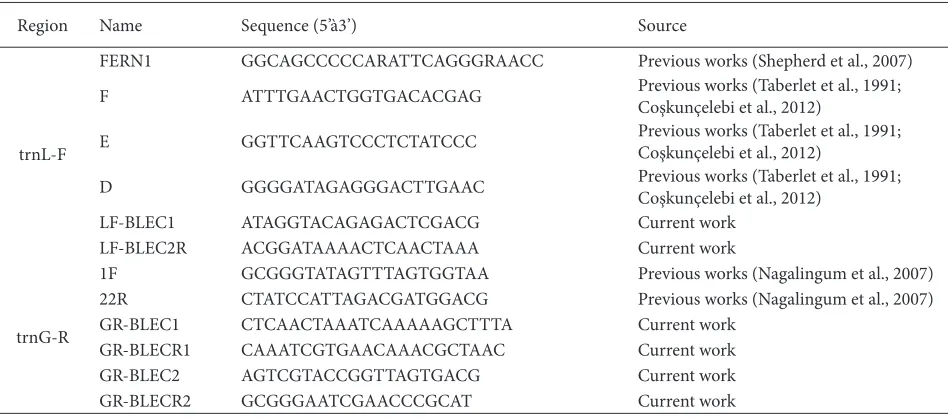
Total DNA was extracted with a DNeasy Plant Mini Kit (Quiagen). PCR was used to amplify 2 chloroplast regions, trnL-trnF and trnG-trnR, both successfully employed in the evaluation of fern species relationships including Blechnum (Shepherd et al., 2007). he primers used are as follows (Table 2): universal primers D, E, and F for trnL-trnF (Taberlet et al., 1991; Coskuncelebi et al., 2012); FERN1 (Shepherd et al., 2007) and 2 new primers designed for this work (LF-BLEC1 and LF-BLEC2R); 1F and 22R for trnL-trnG (Nagalingum et al., 2007) and 4 new primers developed for this work (BLEC1, BLECR1, GR-BLEC2, and GR-BLECR2).
[image:3.553.35.519.440.710.2]PCR was performed according to protocols speciied for Quiagen Taq polymerase and previously published
Table 1. Biological materials ordered by species with indication of country, collector, herbarium, and GenBank accession number (the irst stands for trnL-trnF and the second for trnG-trnR). All cited accessions correspond to new sequences.
Taxa Voucher information: country, collector, and
herbarium
trnL-trnF GenBank accession number
trnG-trnR GenBank accession number
Blechnum australe Argentina Prada s/n (MA) JQ907366 JQ907347
Blechnum brasiliense Argentina Prada s/n (MA) JQ907369 JQ907348
Blechnum fragile Costa Rica Gabriel y Galáns/n(MA) JQ907372 JQ907349
Blechnum laevigatum Argentina Prada s/n (MA) JQ907374 JQ907350
Blechnum loxense Peru Gabriel y Galán s/n (MA) JQ907375 JQ907351
Blechnum magellanicum Argentina Prada s/n (MA) JQ907376 JQ907352
Blechnum microphyllum Argentina Prada s/n (MA) JQ907377 JQ907353
Blechnum mochaenum Argentina Prada s/n (MA) JQ907378 JQ907354
Blechnum moritzianum Argentina Prada s/n (MA) JQ907379 JQ907355
Blechnum penna-marina Argentina Prada s/n (MA) JQ907380 JQ907356
Blechnum sampaioanum Brazil Silva 1651 et al. (UC) JQ907381 JQ907357
Blechnum schomburgkii 1 Costa Rica Gabriel y Galáns/n(MA) JQ907383 JQ907358
Blechnum schomburgkii 2 Peru Gabriel y Galán s/n(MA) JQ907384 JQ907359
Blechnum serrulatum Argentina Prada s/n (MA) JQ907385 JQ907360
Blechnum spicant France Gabriel y Galáns/n (MA) JQ907386 JQ907361
Blechnum stipitellatum Ecuador Neill & Manzanares 13118 (UC) JQ907388 JQ907362
Blechnum tabulare Argentina Prada s/n (MA) JQ907389 JQ907363
Salpichlaena volubilis Costa Rica Gabriel y Galáns/n (MA) JQ907390 JQ907364
procedures (Aydın et al., 2013), with the following reaction conditions: 1 U of Taq polymerase (5 U/µL), 5 µL at 10X bufer (which included 15 mM of MgCl2), 2 µL of each primer at 5 µM, 1 µL of dNTPs at 10 mM, and dH2O to a inal volume of 50 µL with 1–3 µL of DNA template. Cycling conditions were as follows; for trnL-trnF: 35 cycles of 1 min at 94 °C, 1 min at 51–56 °C (depending on the primer pairs), 1 min 30 s at 72 °C plus an extension period of 6 min at 72 °C; for trnG-trnR: 35 cycles of 1 min at 94 °C, 1 min at 50–58 °C (depending on the primer pairs), 2 min 30 s at 72 °C plus an extension period of 10 min at 72 °C. Cycling programmes were initiated with 5 min at 95 °C for enzyme activation. PCR products were checked by 1% agarose gel electrophoresis. Sizes were about 800 pb for trnL-trnF and 900 pb for trnG-trnR. Ampliication products were puriied using semi-automated kits (Quiagen PCR puriication kit), following manufacturer instructions; binding DNA to a column, double washing, and eluting to obtain a inal clean volume of 40–60 µL.
Sequencing was conducted at the Genomic Service, Universidad Complutense de Madrid (ABI Prism 3730, Applied Biosystems) and an external service (Macrogen, ABI Prism 3730XL, Applied Biosystems).
2.3. Data analysis
We obtained 38 useful sequences, 19 from each cpDNA region, and they have been published in GenBank (Table 2). Geneious 5.5 sotware (Drummond et al., 2011) was used to edit the sequences and create an alignment. All ambiguous sites were removed from the sequences. Finally, datasets from both trnL-trnF and trnG-trnR regions were concatenated into a single, 2-locus dataset that reached a total of 1671 sites.
he sotware jModeltest 2.1 (Darriba et al., 2012) was used for estimating evolutionary models and MEGA5
(Tamura et al., 2011) for conducting molecular analyses. Indels were coded as binary characters (Simmons & Ochoterena, 2000). Trees were constructed using the maximum likelihood method based on the GTR+G model. Bootstrap test values were inferred from 1000 replicates. A heuristic search was done by automatically obtaining the initial trees and applying the nearest neighbour interchange (NNI) algorithm.
3. Results
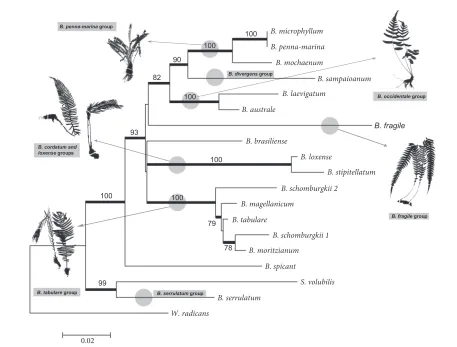
he maximum likelihood phylogram for cpDNA trnG-trnR + trnL-trnF combined regions (Figure 2) for the 19 species shows that most of the morphological groups slated for evaluation are well maintained in the tree. Blechnum brasiliense Desv. (usually considered part of B. tabulare group) and B. spicant (related to B. penna-marina group) are the only 2 species that appear separate from their respective morphological groups.
Blechnum serrulatum appears in the base of the tree and forms a group with S. volubilis. his clade is very well supported with high bootstrap values (99%) and occupies a position sister to the rest of taxa. Blechnum spicant, very distant from its supposed relatives (Blechnum penna-marina group), occupies a position sister to the rest of the taxa and is also highly supported (100%). he rest of species form a large, well-supported (93%) clade, sister to B. spicant.
[image:4.553.43.517.103.312.2]Within this clade there are 2 branches; one comprises Blechnum cordatum, B. loxense, and B. tabulare groups and the other forms the rest of the groups (i.e. Blechnum fragile, B. occidentale, B. divergens, and B. penna-marina groups). Segregation between the branches is not well deined as
Table 2. Primers used in current work to amplify 2 chloroplastic regions, trnL-trnF and trnG-trnR. Some of these primers were used previously with ferns; proper references are given. Other primers were developed ad-hoc in the current study for Blechnum.
Region Name Sequence (5’à3’) Source
trnL-F
FERN1 GGCAGCCCCCARATTCAGGGRAACC Previous works (Shepherd et al., 2007)
F ATTTGAACTGGTGACACGAG Previous works (Taberlet et al., 1991;
Coşkunçelebi et al., 2012)
E GGTTCAAGTCCCTCTATCCC Previous works (Taberlet et al., 1991;
Coşkunçelebi et al., 2012)
D GGGGATAGAGGGACTTGAAC Previous works (Taberlet et al., 1991;
Coşkunçelebi et al., 2012)
LF-BLEC1 ATAGGTACAGAGACTCGACG Current work
LF-BLEC2R ACGGATAAAACTCAACTAAA Current work
trnG-R
1F GCGGGTATAGTTTAGTGGTAA Previous works (Nagalingum et al., 2007)
22R CTATCCATTAGACGATGGACG Previous works (Nagalingum et al., 2007)
GR-BLEC1 CTCAACTAAATCAAAAAGCTTTA Current work
GR-BLECR1 CAAATCGTGAACAAACGCTAAC Current work
GR-BLEC2 AGTCGTACCGGTTAGTGACG Current work
these 2 clades are not supported by the bootstrap test. he irst clade presents an unresolved polytomy with 3 branches: cordatoids (B. cordatum group) + B. loxense group, arborescents (B. tabulare group), and B. brasiliense alone. he studied species representing the B. cordatum and B. loxense groups form a highly supported (100%) clade. he arborescent species group, without B. brasiliense, also forms a clear, well-supported (100%) monophyletic clade. Sequences of 2 individuals of B. schomburgkii from diferent geographical locations appeared at diferent positions within this group. Blechnum brasiliense appeared alone in its own phylogenetic lineage but quite near the arborescent group in which it was traditionally placed.
he second large clade includes small-to-medium– sized herbaceous plants and epiphytes. he group of Blechnum epiphytes, represented in the tree by B. fragile, is sister to the rest of the groups. he last 3 groups form a well-supported clade with an 82% bootstrap value. he B. occidentale group forms a monophyletic lineage
with bootstrap value support of 100% and is sister to a clade that comprises the B. divergens (represented by B. sampaioanum Brade) and B. penna-marina groups, which are also well supported (90%).
4. Discussion
Several previous molecular works stated that Blechnum is not a monophyletic genus (Cranill et al., 2001), a fact also derived from our analyses, as Salpichlaena volubilis appeared nested within Blechnum. Other known genera that are also embedded in Blechnum are Doodia (Schuettpelz & Pryer, 2007; Shepherd et al., 2007) and Sadleria (Shepherd et al., 2007).
he morphological groups proposed to arrange American Blechnum (Tryon & Tryon, 1982) are mostly maintained under our molecular analyses, with few notable exceptions. Main phylogenetic lineages supported by high bootstrap values seem to have diverged in correlation with basic sets of morphological characters.
B. tabulare group
B. penna-marina group
B. occidentale group
B. cordatum and loxense groups
B. fragile group
B. divergens group
B. serrulatum group
0.02
W. radicans
B. serrulatum
S. volubilis B. spicant
B. moritzianum B. schomburgkii 1 B. magellanicum
B. tabulare
B. schomburgkii 2
B. stipitellatum
100
100
82
100 90
93
100
100 100
79
78
99
B. loxense B. brasiliense
B. fragile
B. australe
B. laevigatum
B. sampaioanum B. mochaenum
[image:5.553.50.507.70.417.2]B. penna-marina B. microphyllum
Blechnum serrulatum was included alone in the B. serrulatum group (Tryon & Tryon, 1982) due to distinctive morphology characterised, for example, by articulate pinnae (Rolleri et al., 2010). In our molecular study B. serrulatum is strongly related to American Salpichlaena volubilis and, in previous molecular reports, to American S. thalassica Grayun & R.C.Moran and Philippine Stenochlaena milnei Underw. (Cranill & Kato, 2003). All of these species share interesting morphological features. Salpichlaena J.Sm. and Stenochlaena J.Sm. are high-climbing hemi-epiphytic ferns with 1- or 2-pinnate fronds. Blechnum serrulatum is a terrestrial, 1-pinnate species, but it has also been considered a climber in some localities (Rolleri et al., 2010). Some species of Stenochlaena such as S. palustris live in swamps, like B. serrulatum (known as swamp fern). Finally, B. serrulatum and Salpichlaena species have spores with orbiculate perispores carrying irregularly arranged rugose orbicules (Tryon & Lugardon, 1991; Giudice et al., 2008; Passarelli et al., 2010). Although it has been stated that these orbicules or spherules are common in Blechnum (Tryon & Lugardon, 1991), we have only seen them in B. serrulatum and B. fernandezianum, which belong to the B. penna-marina group (Passarelli, 2007; Passarelli et al., 2010). he major diferences between these taxa are the absence of indusia in Stenochlaena, and the fact that B. serrulatum is monomorphic while all Salpichlaena and Stenochlaena species are strongly dimorphic. In conclusion, Blechnum serrulatum is quite far from the rest of Blechnum and may deserve a distinct taxonomic treatment related to Salpichlaena.
he case of Blechnum spicant is striking. In all of the analyses performed it always appears in an isolate branch at the base of the tree as sister to the rest of the groups. According to its morphological traits, the species was placed within the Blechnum penna-marina group (Rolleri & Prada, 2006b); habit, rhizome scales, frond architecture, spores, and foliar dimorphism clearly informs this relationship. he reason why genetic data segregate B. spicant and place it so far from its presumed group could be related to its distribution. Efectively, this is the only Blechnum species with a temperate northern distribution (North Africa, Europe to the Caucasus, and North America). Further analyses are required to precisely determine the nature of the morphological set shared between B. spicant and B. penna-marina group, particularly if it is due to convergence with independent origins. In addition, analyses should be performed to investigate relationships with Woodwardia, the only other Blechnaceae with a temperate northern distribution (Kramer et al., 1990). We propose the creation of a new group, the monotypic B. spicant group, to include herbaceous, stoloniferous species with dimorphic fronds and adnate pinnae coming from temperate, northern continents.
Concerning the rest of the morphological groups, which could be called core Blechnum, 5 main lineages appear as well-deined clades. hese tend to form 2 groups, core Blechnum I and core Blechnum II: I) arborescents (B. tabulare group) + B. brasiliense + cordatoids (B. cordatum + B. loxense groups); II) epiphytes (B. fragile group) + herbaceous, small or medium-sized species (B. occidentale + B. divergens + B. penna-marina groups).
he group comprising the arborescent and sub-arborescent species of Blechnum, the so-called Blechnum tabulare group (Tryon & Tryon, 1982), forms a monophyletic clade if B. brasiliense is extracted. his arborescent clade is supported by many synapomorphic characters. Some morphological ones include the stout, massive vertical rhizomes, forming a more or less tall caudex; the long, acicular scales; an epidermal type of more-or-less rectangular cells; and densely folded spores (Ramos Giacosa, 2008; Rolleri et al., 2008; Passarelli et al., 2010; Rolleri et al., 2013). hey also present some shared nucleotide indels in the trnL-trnF region.
In our molecular tree and previous trees (Shepherd et al., 2007) Blechnum brasiliense is segregated from this arborescent group, in which it has been traditionally included (Rolleri et al., 2013). Some morphological features beyond the arborescent habit could support this position; B. brasiliense is the only arborescent species with monomorphic fronds and adnate pinnae that become reduced towards the base of the lamina. Apart from its evident molecular connection to the rest of the arborescent species, B. brasiliense is known for its strong relationship to the Asian-Austro-Paciic Doodia (Shepherd et al., 2007). here is no morphological evidence to support this relationship, as Doodia is very diferent from Blechnum in its anastomosing veins and discrete sori. Regardless, we think the available molecular data suggest that B. brasiliense merits an isolated taxonomic position within Blechnum, with the same rank as the rest of the groups.
morphologies (habit and general frond architecture) are also present in B. loxense.
he second large lineage core Blechnum II concerns terrestrial or epiphytic herbaceous plants that have slender, horizontal or vertical rhizomes and are never massive or arborescent. We include here 2 diferent morphological clades that are well supported by molecular data. he irst is the group of epiphytic species (B. fragile group), which is strongly supported by both morphology (habit, foliar dimorphism, and adnate pinnae) and molecular information (one large nucleotide indel in the trnL-trnF region). here is a bibliographic consensus for treating this group as a natural entity, an idea reinforced by our results. he second is a large clade comprising 3 diferent morphological groups: B. divergens, B. occidentale, and B. penna-marina. hese species are either monomorphic (B. occidentale group) or dimorphic (B. penna-marina and B. divergens groups).
We included Blechnum sampaioanum, which was previously part of the B. lineatum (Sw.) C.Chr. group (Tryon & Tryon, 1982), as representative of the B. divergens group. Morphological characters (Dittrich, 2005; Prada et al., 2007) and our molecular results unquestionably segregate both groups. Chloroplast data relate the B. divergens group to B. penna-marina and B. occidentale groups, far from the cordatoids. In addition, despite the gross resemblance of species of this group and elements of the B. fragile group, our results indicate a molecularly evident diference between them.
he Blechnum occidentale group is quite distinctive because it contains monomorphic or subdimorphic herbaceous plants with pinnatisect or mostly 1-pinnate fronds (Rolleri et al., 2012b), and it has been treated as Blechnum subgen. Blechnum (Murillo, 1968). his group deserves more attention, due to the high incidence of polyploidy and hybridisation processes (Murillo, 1968; Rolleri & Prada, 2006a).
he Blechnum penna-marina group is an evidently monophyletic clade, from both a morphological (Rolleri & Prada, 2006b; Passarelli, 2007) and molecular perspective, with the exception of B. spicant. From our analyses we can derive a virtually complete molecular similarity between B. penna-marina and B. microphyllum. his could explain the diiculty in distinguishing the 2 species morphologically (Rolleri & Prada, 2006b). Perhaps the combination of both species into a single entity is appropriate. In addition, the B. penna-marina group presents another outstanding feature; a large geographical disjunction. Several of its members, such as B. penna-marina and B. blechnoides, are distributed in South America and Oceania.
In conclusion, cpDNA demonstrated its value for deciphering some of the taxonomical problems in Blechnum. Most of the groups traditionally recognised with morphological characters are maintained in a molecular framework, so they can be seen as main natural evolutionary lineages within American Blechnum. By combining all the morphological and molecular information available, we propose the following 4 evolutionary lineages with their sub-clades:
- Blechnum serrulatum [+ Salpichlaena] - B. spicant
- Core Blechnum Core Blechnum I
■ Arborescents (B. tabulare group without B. brasiliense)
■ Cordatoids (B. cordatum + B. loxense groups) ■ B. brasiliense [+ Doodia]
Core Blechnum II
■ Epiphytes (B. fragile group) ■ Herbaceous terrestrials
• Monomorphic (B. occidentale group)
• Dimorphic (groups B. divergens + B. penna-marina without B. spicant)
It is obvious that more molecular accessions are needed to complete a comprehensive taxonomical ordering of American Blechnum. Morphological knowledge has already included all of the 8 informal groups (ater reviewing most of the American diversity), and we feel with some conidence that new species will it into the lineages we propose here. In the future we will be able to present a global phylogeny (the inclusion of more nucleotides will aid in statistically resolving some problematic branches) with proposals for formal taxonomic entities.
Acknowledgements
References
Aydın O, Coşkunçelebi K, Gültepe M & Güzel ME (2013). A contribution to taxonomy of Centaurea including Psephellus (Asteraceae) based on anatomical and molecular data. Turkish Journal of Botany 37: 419–427.
Coşkunçelebi K, Terzioğlu S, Karaköşe M & Güzel ME (2012). Contributions to the description and molecular properties of
Erodium hendrikii Alpinar (Geraniaceae), endemic to Turkey.
Turkish Journal of Botany 36: 455–461.
Cranill R (2001). Phylogenetic Studies in the Polypodiales (Pteridophyta) with an Emphasis on the Family Blechnaceae. Berkeley, CA: University of California.
Cranill R, Nakahira Y & Kato M (2001). A molecular phylogeny of
Blechnaceae inferred from three plastid gene sequences. Fith International Flora Malesiana Symposium Abstract.
Cranill R & Kato M (2003). Phylogenetics, biogeography, and classiication of the woodwardioid ferns (Blechnaceae). In: Chandra S & Srivastava M (eds.) Pteridology in the New Millennium. Netherlands: Kluwer Academic Publishers. Darriba D, Taboada G, Doallo R & Posada D (2012). jModelTest 2:
more models, new heuristics and parallel computing. Nature Methods 9: 772–772.
Dittrich V (2005). Estudos taxonômicos no gênero Blechnum L. (Pteridophyta-Blechnaceae) para as regiões Sudeste e Sul do Brasil. Universidad Estadual Paulista Julio de Mesquita Filho, Brasil.
Drummond A, Ashton B, Buxton S, Cheung M, Cooper A, Duran C, Field M, Heled J, Kearse M, Markowitz S, Moir R, Stones-Havas S, Sturrock S, hierer T & Wilson A (2011). Geneious 5.5. Website http://www.geneious.com [accessed 30 November 2010].
Durán M (1997). Estudios morfológicos, taxonómicos y biosistemáticos en el género Blechnum (Blechnaceae– Pteridophyta). Universidad Nacional de Córdoba, Córdoba, Argentina.
Gabriel y Galán JM, Passarelli LM, Prada C & Rolleri CH (2008). Sporophyte morphology and gametophyte development of the fern Blechnum sprucei (Pteridophyta: Blechnaceae). Revista de Biologia Tropical 56: 2027–2040.
Gabriel y Galán JM, Prada C, Rolleri CH, Lahoz-Beltrá R & Martínez-Calvo C (2011). A biometrical study of stomata in Blechnum
species (Blechnaceae) with some taxonomic and ecological implications for the ferns. Revista de Biología Tropical 59: 403–415.
Giudice GE, Luna ML, Carrion C & de La Sota ER (2008). Revision of the genus Salpichlaena J. Sm. American Fern Journal 98: 49–60. Kramer K, Chambers T & Hennipman E (1990). Blechnaceae. In:
Kramer K & Green P (eds.) he Families and Genera of Vascular Plants: I. Pteridophytes and Gymnosperms. Berlin: Springer. Kuo L-Y, Li F-W, Chiou W-L & Wang C-N (2011). First insights into
fern matK phylogeny. Molecular Phylogenetics and Evolution
59: 556–566.
Murillo M (1968). Blechnum subgénero Blechnum en Sur América, con especial referencia a las especies de Colombia. Nova Hedwigia 16: 329–366.
Nagalingum N, Schneider H & Pryer K (2007). Molecular phylogenetic relationships and morphological evolution in the heterosporous fern genus Marsilea. Systematic Botany 32: 16–25.
Passarelli L (2007). Estudios esporales en especies del grupo Blechnum penna-marina (Blechnaceae-Pteridophyta). Acta Botanica Malacitana 32: 1–19.
Passarelli L, Gabriel y Galán JM, Prada C & Rolleri CH (2010). Spore morphology and ornamentation in the genus Blechnum
(Blechnaceae, Pteridophyta). Grana 49: 243–262.
Prada C, Rolleri C & Passarelli L (2007). Morfología, caracterización y distribución geográica de Blechnum cordatum (Blechnaceae-Pteridophyta). Acta Botanica Malacitana 33: 29–46.
Ramos Giacosa JP (2008) Revisión sistemática, análisis cladístico y biogeográico de la sección Lomariocycas (J. Sm.) C. V. Morton del género Blechnum L. (Blechnaceae, Pteridophyta) en América. Universidad Nacional de La Plata, La Plata, Argentina. Rolleri C & Prada C (2006a). Catálogo comentado de las especies
de Blechnum (Blechnaceae-Pteridophyta) de Mesoamérica y Sudamérica. Anales del Jardin Botanico de Madrid 63: 67–106.
Rolleri C & Prada C (2006b). Revisión de los grupos de especies del género Blechnum (Blechnaceae- Pteridophyta): el grupo B. penna-marina. Acta Botanica Malacitana 31: 7–50.
Rolleri C, Prada C & Passarelli L (2008). Estudios morfológicos y taxonómicos en Blechnum (Blechnaceae-Pteridophyta):
Blechnum tabulare y B. magellanicum. Anales del Jardin Botanico de Madrid 65: 179–195.
Rolleri C, Prada C, Gabriel y Galán JM, Passarelli LM & Ciciarelli MM (2010). Morphology of the sporophyte and gametophyte of the swamp fern, Blechnum serrulatum (Blechnaceae, Pteridophyta).
Australian Journal of Botany 58: 508–518.
Rolleri C, Prada C, Passarelli L & Gabriel y Galán JM (2012a). Revisión de dos especies de Blechnum de las regiones montañosas tropicales e intertropicales de Centroamérica y Sudamérica.
Actes du Colloque Les Fougères d’Alsace, d’Europe et du Monde
1: 149–161.
Rolleri C, Prada C, Passarelli L, Gabriel y Galán JM & Ciciarelli MM (2012b). Revisión de especies monomóricas y subdimóricas del género Blechnum (Blechnaceae-Polypodiophyta). Botanica Complutensis 36: 51–77.
Rolleri C, Prada C, Gabriel y Galán JM & Passarelli L (2013). Caracterización y revisión de ocho especies arborescentes del género Blechnum (Blechnaceae-Polypodiophyta). Revista de Biologia Tropical 61: 377–408.
Rothfels CJ, Sundue MA, Kuo L-Y, Larsson A, Kato M, Schuettpelz E & Pryer KM (2012b). A revised family-level classiication for eupolypod II ferns (Polypodiidae: Polypodiales). Taxon 61: 515–533.
Schuettpelz E & Pryer KM (2007). Fern phylogeny inferred from 400 leptosporangiate species and three plastid genes. Taxon 56: 1037–1050.
Shepherd LD, Perrie LR, Parris BS & Brownsey PJ (2007). A molecular phylogeny for the New Zealand Blechnaceae ferns from analyses of chloroplast trnL-trnF DNA sequences. New Zealand Journal of Botany 45: 67–80.
Simmons MP & Ochoterena H (2000). Gaps as characters in sequence-based phylogenetic analyses. Systematic Biology 49: 369–81.
Smith AR, Pryer KM, Schuettpelz E, Korall P, Schneider H & Wolf PG (2006). A classiication for extant ferns. Taxon 55: 705–731.
Taberlet P, Gielly L, Patou G & Bouvet J (1991). Universal primers for ampliication of three noncoding regions of chloroplast DNA.
Plant Molecular Biology 17: 1105–1109.
Tamura K, Peterson D, Peterson N, Stecher G, Nei M & Kumar S (2011). MEGA5: molecular evolutionary genetics analysis using maximum likelihood, evolutionary distance and maximum parsimony methods. Molecular Biology and Evolution 28: 2731–2739.
Tryon AF & Lugardon B (1991). Spores of the Pteridophyta. New York: Springer.
Tryon RM & Tryon AF (1982). Ferns and Allied Plants with Special Reference to Tropical America. New York: Springer.