The AF5, Five-Factor Self-Concept Questionnaire (García & Musitu, 1999), was originally validated and normed in Spain on a large sample of almost 6,500 participants between the ages of 10 and 62 years old, providing Spanish national norms for sex and age. The AF5 consists of fi ve subscales (academic, social, emotional, family, and physical self-concept) of six items each (a total of 30 items, with response choices ranging from 1 to 99). The fi ve-dimensional structure of the questionnaire was defi ned theoretically based on the hierarchical and multidimensional theoretical model of the self-concept proposed by Shavelson and colleagues (Byrne & Shavelson, 1996; Shavelson, Hubner, & Stanton 1976).
Structural validity evidence for the AF5 is supportive. In addition to the initial scale development study, other studies, using exploratory (e.g., Cerrato, Sallent, Aznar, Pérez, & Carrasco, 2011; Martínez, Musitu, García, & Camino, 2003), and confi rmatory factor analysis (García, Musitu, & Veiga, 2006; Murgui, García, García, & García, 2012) supported the correlated fi ve-factor model of the AF5, and showed no method effects associated with negatively worded items (García, Musitu, Riquelme, & Riquelme, 2011; Tomás & Oliver, 2004). Two studies analyzing the structure invariance of a Basque language version showed the same results (see Elosua & Muñiz, 2010). All these studies reported that all AF5 items loaded on their assigned subscales and that there were no complex items. Additionally, reliability estimates for the AF5 subscale scores in the literature are in the .71 to .88 range, providing adequate evidence for the internal consistency of the subscales (García & Gracia, 2009; Fuentes, García, Gracia, & Lila, 2011ab; Martínez et al., 2003).
Available evidence also shows adequate convergent validity of the AF5. For example, statistically signifi cant and
Validation of the English version of the Five-Factor Self-Concept
Questionnaire
Fernando García
1, Enrique Gracia
1and Alina Zeleznova
21 Universidad de Valencia and 2 Rutgers State University of New Jersey
Abstract
Resumen
Background: The Spanish Five-Factor Self-Concept Questionnaire (AF5) is one of the most widely used instruments assessing self-concept with Spanish-speaking samples. It is also one of the few psychometrically sound instruments assessing self-concept from a multidimensional perspective. The availability of the AF5 in both languages (Spanish and English) would expand its potential, and would facilitate cross-cultural research.
Method: To validate the English version of the AF5, we used multi-sample confi rmatory factor analysis. The sample was 624 USA respondents, 301 males (48%) and 323 females, ranging in age from 14 to 18 (M = 16.21, SD = 1.08). Results: The English version of the AF5 does not change the original factor weights, the variances and covariances of the factors, or the error variances of items, with regard to the original Spanish fi ve-factor model. The fi ve factors proposed –academic, social, emotional, family, and physical– satisfactorily reproduce the inter-item relationships of the original Spanish version. The reliability for all items and dimensions of the English version was also good, with similar results as the original version.
Conclusions: This preliminary validation study of the English version of the AF5 showed that it is an acceptable measure to be used with English-speaking adolescents.
Keywords: Questionnaire, self-concept, Spanish, translation, validation.
Validación de la versión inglesa del Cuestionario de Autoconcepto AF5.
Antecedentes: la escala multidimensional de autoconcepto —Forma 5— (AF5) es uno de los instrumentos de evaluación del autoconcepto más ampliamente utilizados con muestras de habla española. Es uno de los pocos instrumentos que miden multidimensionalmente el autoconcepto con sólidos fundamentos psicométricos. La disponibilidad del AF5 en ambos lenguajes (español e inglés) ampliaría su potencial, y facilitaría la investigación intercultural. Método: para validar la versión inglesa del AF5 se utilizó el análisis factorial confi rmatorio multimuestra. La muestra fue de 624 norteamericanos, 301 hombres (48%) y 323 mujeres, de 14 a 18 años (M = 16.21, DT = 1.08). Resultados: la versión en inglés del AF5 no cambia los pesos factoriales originales, las varianzas o covarianzas de los factores, o los errores de la varianza de los ítems, comparados con el modelo de cinco factores del original. Los cinco factores propuestos –académico, social, emocional, familiar y físico– reproducen satisfactoriamente las relaciones inter-ítem de la versión original española. La fi abilidad de todos los ítems y dimensiones de la versión inglesa fue también adecuada, con resultados similares a los de la versión original. Conclusiones: esta validación preliminar de la versión inglesa del AF5 muestra que es una medida aceptable para su uso con adolescentes de habla inglesa.
Palabras clave: autoconcepto, cuestionario, español, traducción,
vali-dación.
Received: February 4, 2013 • Accepted: June 20, 2013 Corresponding author: Fernando García
meaningful relationships have been found between AF5 scales and psychosocial adjustment in adolescence (García & Gracia, 2010), depression and anxiety (Garaigordobil & Pérez, 2007), peer perceived popularity (Košir & Pečjak, 2005), emotional intelligence (Gorostiaga, Balluerka, Aritzeta, Haranburu, & Alonso-Arbiol, 2011), the improvement of the physical resistance in teenagers (Bernal, 2006), and family functioning (Martínez & García, 2007, 2008; Martínez, García, & Yubero, 2007). With respect to the relationships between the AF5 and other theoretically relevant variables, numerous empirical studies have also reported results generally in line with theoretical predictions. For example, relationships have been observed between scores on the AF5 and adolescent eating disorders (Guarnido, Cabrera, & Osuna, 2012); victimization (Estévez, Inglés, Emler, Martínez-Monteagudo, & Torregrosa, 2012), school violence (Garay, Ávila, & Martínez, 2013) and victimization at school (Jiménez, Musitu, Ramos, & Murgui, 2009); prejudices toward immigrants (del Barco, Castaño, & Carroza, 2010) and sexist prejudices (Garaigordobil & Aliri, 2011); substance use (Fuentes et al., 2011b); suicidal behavior (Pérez-Amezcua, Rivera-Rivera, Atienzo, Castro, Leyva-López, & Chávez-Ayala, 2010) and suicidal ideation (Sánchez-Sosa, Villarreal-González, Musitu, & Martínez Ferrer, 2010); perceived social support (Rodríguez-Fernández, Droguett, & Revuelta, 2012) and pro-social behavior (Inglés, Martínez-González, García-Fernández, Torregrosa, & Ruiz-Esteban, 2012).
Additionally, AF5 scales have been used as criteria to validate self-concept (Goñi, Madariaga, Axpe, & Goñi, 2011; Garaigordobil & Aliri, 2011) and self-esteem measures (Martín-Albo, Núñez, Navarro, & Grijalvo, 2007), as well as criteria to validate scales of related measures. For example, effective personality (Pellerano, Trigo, del Buey, Palacio, & Zapico, 2006), sport motivation (Martín-Albo, Núñez, Navarro, Leite, Almiron, & Glavinich, 2007), peer mentoring (Alonso, Castaño, Calles, & Sánchez-Herrero, 2010) and academic motivation (Núñez, Martín-Albo, Navarro & Suárez, 2010).
The aim of this paper is to validate the English translation of the Spanish Five-Factor Self-Concept Questionnaire (AF5, García & Musitu, 1999). The AF5 is one of the most widely used instruments assessing self-concept with Spanish-speaking samples, both in Spain (e.g., Fuentes et al., 2011a; García & Gracia, 2009), and other Spanish-speaking countries (e.g., Villareal-González, Sánchez-Sosa, Veiga, & Del Moral, 2011). It has been translated to Portuguese (e.g., Rodrigues, Veiga, Fuentes, & García, 2013) and other languages (Basque, Elosua & Muñiz, 2010; Catalan, Cerrato et al., 2011; and Italian, Marchetti, 1997). In addition, the AF5 is one of the few psychometrically sound instruments available in Spanish assessing self-concept from a multidimensional perspective (García & Musitu, 1999; García et al., 2011; Tomás & Oliver, 2004). The English and Spanish languages are two of the most widely used languages in the world. The availability of the AF5 in both languages (as well as in other languages where it is already available) would expand its potential, and would facilitate cross-cultural research. For the validation process, we applied a multi-sample confi rmatory factor analysis following two steps. First, we examined the fi t of the correlated fi ve-factor model of the AF5 factor structure (García & Musitu, 1999) versus one-dimensional and fi ve-dimensional orthogonal alternative models. Second, we tested the factorial invariance of the English translation of AF5 respect to the original Spanish version.
Method
Participants
The English sample was comprised of 624 students, 301 men (48%) and 323 women, with age ranging from 14 to 18 years (M = 16.21, SD = 1.08). Each age group had the following number of participants (in parentheses): 14 (33), 15 (136), 16 (211), 17 (165), and 18 (79). The participants identifi ed themselves according to their background as follows: 62.6% were White/Caucasian; 11.3%, Black/African American; 9.3%, Hispanic/Latino; and 2.7%, Asian. The remaining participants, 14.1%, were from other ethnic groups. The Spanish sample was larger, 7,320 students, 3,228 men (44%) and 4,092 women, ranged in age from 14 to 18 years (M = 16.25, SD = 1.11). Each age group had the following number of participants (in parentheses): 14 (360), 15 (1584), 16 (2385), 17 (1847), and 18 (1144).
Instrument
The Five-Factor Self-Concept Questionnaire (AF5, García & Musitu, 1999) was designed to measure fi ve self-concept dimensions: Academic (e.g. “I do my homework well”), Social (e.g. “I make friends easily”), Emotional (e.g., reverse scored, “I am afraid of some things”), Family (e.g., “I feel that my parents love me”), and Physical (e.g. “I take good care of my physical health”). The 30 items are answered on a 99-point scale, ranging from 1: complete disagreement, to 99: complete agreement.
Procedure
Sample selection. To obtain the English-speaking students we contacted the heads of three High Schools of United States of America. Trained groups of undergraduate psychology students administered the psychometric tests in northwestern (Walla Walla, Washington), southwestern (Angwin, California) and northeastern (South River, New Jersey) states of the United States of America. Note that thousands of kilometers separate these United States regions, so the total sample is not restricted to a particular geographical area (Reise et al., 2000). All students who participated in this study (89% response rate): (a) were English-speaking, as were their parents and four grandparents; (b) were students from 9th through 12th grades and ranged in age from 14 to 18; (c) had received their parents’ approval; and (d) attended the designated classroom where the research was conducted. Spanish-speaking students was obtained from previous studies using the Spanish version of the AF5 (previously published data, n = 6,852, 94%; unpublished data, n = 468, 6%).
values of factor loadings should be only .018 (Guadagnoli & Velicer, 1988).
Translation of the AF5. To translate the AF5 from Spanish to English, we followed the back-translation method proposed by Brislin (1970). With this procedure, the original version is translated into the target language and then is translated back to the original language by different translators. This method is considered particularly appropriate for identifying translation errors and achieving concept equivalence. We followed two steps. In the fi rst step, ten bilingual individuals, selected for their profi ciency in English and the Spanish language, translated the scale from Spanish to English. Then, four judges discussed and decided on the best translation for each item. In the second step, the selected English items were then translated back into Spanish by four bilingual individuals who did not know the original Spanish text. The judges once again discussed and compared the translations to the original Spanish scale. The English version was fi nalized by including the translations that most closely matched the original scale. The English version of the AF5 was distributed to ten English students of Psychology for comments on understanding and clarity of the items. It was ascertained that they had no previous knowledge of the AF5 items. The scale was considered ready for use when the students showed no diffi culty comprehending and completing the questionnaire (Muñiz, Elosua, & Hambleton, 2013).
Data analysis
We compared the fi t of the fi ve-factor correlated model of fi ve AF5 dimensions with four alternative models. First, we tested a one-factor model. This model represented a view of self-concept as a one-dimensional construct. Second, we tested an orthogonal fi ve-factor model. This model specifi ed self-concept as a multidimensional construct, consisting of fi ve AF5 dimensions —academic, social, emotional, family, and physical structure— but as orthogonal (separate) dimensions underlying self-concept. Third, we tested the correlated fi ve-factor model based on the AF5. This is the same model as the previous one, with the fi ve dimensions correlated. Finally, and fourth, we freed error covariances for the strongly correlated pairs of items in each factor of the third model (Byrne & Shavelson, 1986). We used maximum likelihood (ML) as the estimation method in the confi rmatory factor analyses.
To prove the negative effect of long standard errors on confi rmatory fi t indexes, we followed the variance reduction method used in a previous study (García et al., 2006). We repeated all analyses for the four models after transforming the 99 points scale item into a shortest dichotomous response scale (< median or ≥ median). This would correspond to employing a dichotomous (Yes/No) response format, but making sure to obtain a precise symmetric distribution (i.e., the long 99 points scale item of the AF5 allows splitting into two equal groups; García et al., 2006). As the new scale was dichotomous, tetrachoric correlations were estimated from the data. The Satorra-Bentler chi-squared statistic (Satorra & Bentler, 2001) and associated robust confi rmatory fi t index provided by EQS6.1 (Byrne, 2006) were examined to evaluate model fi t. The rest of analysis was provided by AMOS7. Also, as large sample size errors decrease as the degree that sample size increase (Bentler & Yuan, 1999), we expected systematically a better fi t for the Spanish sample than for the English sample.
Finally, we compared four nested models among samples of both countries. All the analyses described in this study were conducted
separately for the Spanish and English versions. However, once the baseline model was established with each version, to test if CFA model fi t both versions well, they were also fi tted simultaneously for both Spanish and English samples. We conducted the following sequence of increasingly restrictive tests of invariance across both samples via AMOS7: (a) unconstrained, without any restrictions across parameters, (b) factor pattern coeffi cients, (c) factor variances and covariances, and (d) the equality of the error variances.
Results
Preliminary item analyses
The skew and kurtosis indexed of each of AF5 items were examined and found to be in Spanish sample between |2.163| and |.005| and between |4.433| and |.192|, respectively; only two items (19 and 29) had a skew index higher than |2.0|, the rest were always lower than |1.5|. In the English sample, between |2.338| and |.005| and between |4.852| and |.095|, respectively; only two items (9 and 27) had a skew index higher than |2.0|, the rest were always lower than |1.7|.
Previous confi rmatory factor analysis
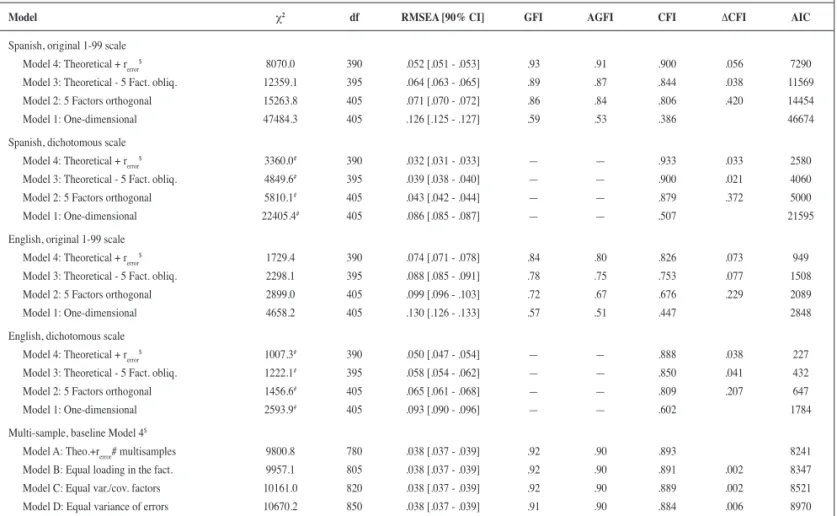
Fit indexes for the four alternative models of the AF5 are reported in Table 1. As expected, when models were applied on the transformed dichotomous scales, all indexes systematically achieved better fi t. The negatively skewed pattern greatly increases the error variance, reducing model fi t. As expected, when models were applied on the large Spanish sample, all indexes systematically achieved better fi t.
In the fi rst step, we constrained both samples data to be consistent with the single one-factor model (see Table 1). Statistics generally fail to meet conventional standards, indicating a bad fi t. In the second step, we constrained both samples data to the fi ve factors model proposed by AF5-structure, but as orthogonal dimensions. This model provided a considerable increase of fi t with respect to the one-factor model. In the third step, the same fi ve factors model was analyzed but with correlated fi ve dimensions. The correlated model produced an improved fi t over the orthogonal model. Finally, in the fourth step, we freed error covariances for the strongly correlated item pairs in each factor of third model. This model provided a new increase of fi t with respect to Model 3. Overall, the results conducted separately for the Spanish and English versions indicated that the AF5 model was supported and resulted in a better fi t than all alternative models.
Multi-sample confi rmatory factor analysis of invariance across both samples
Table 2 gives an overview of the parameters of the fi nal model. Invariance testing across the two speaking-versions suggested that the correlated fi ve-factor model of the AF5 factor structure operates in a similar way for these both versions.
Reliability
Alpha reliability coeffi cients for the total scale were .84 in the Spanish sample and .88 in English sample; for Academic, .88 and .86; for Social, .76 and .74; for Emotional, .74 and .78; for Family, .83 and .87; and, for Physical, .76 and .73.
Discussion
The aim of this paper was the validation of the English version of the AF5 measure with a multi-sample confi rmatory factor analysis. First, results of this study confi rmed that the fi ve-factor model of the AF5 consisting of academic, social, emotional, family, and physical self-concept, is preferable to the one-dimensional and fi ve-dimensional orthogonal alternative models in both Spanish and English versions. These results corroborate previous studies that supported the fi ve-factor model of the AF5, using both exploratory (Cerrato et al., 2011; Martínez et al., 2003)
and confi rmatory factorial analyses (Elosua & Muñiz, 2010; García et al., 2006; García et al., 2011; Murgui et al., 2012). The results of this study also support the hierarchical and multidimensional theoretical model on which the AF5 is based (Shavelson et al., 1976). Second, in this study, the English version of the AF5 has successfully met the four invariance tests (García et al., 2011; García et al., 2006; Tomás & Oliver, 2004). The results showed that the English version of the AF5 does not change the original factor weights, the variances and covariances of the factors, or the error variances of items with respect to the original Spanish fi ve-factor model of the AF5 factor structure. These results support the equivalence of AF5-factor ratings across the English version and the Spanish original AF5 factor structure. The fi ve factors proposed —Academic, Social, Emotional, Family, and Physical— satisfactorily reproduce the inter-item relationships of the original Spanish version. This invariant pattern supports the notion of self-concept (and their multidimensional components) as fully equivalent between both versions. Results also met the stringent test of equal error variances (Byrne, 2006). The reliability for all items and dimensions of the English version was also good, with similar results to the original version, and similar to those obtained in other studies (Elosua & Muñiz, 2010; Fuentes et al., 2011ab; García et al., 2006).
Table 1
Confi rmatory factor analysis and multi-sampleanalysis for the invariance between the Spanish original version and the English adaptation
Model χ2 df RMSEA [90% CI] GFI AGFI CFI ΔCFI AIC
Spanish, original 1-99 scale Model 4: Theoretical + rerror
$ 8070.0 390 .052 [.051 - .053] .93 .91 .900 .056 7290
Model 3: Theoretical - 5 Fact. obliq. 12359.1 395 .064 [.063 - .065] .89 .87 .844 .038 11569
Model 2: 5 Factors orthogonal 15263.8 405 .071 [.070 - .072] .86 .84 .806 .420 14454
Model 1: One-dimensional 47484.3 405 .126 [.125 - .127] .59 .53 .386 46674
Spanish, dichotomous scale Model 4: Theoretical + rerror
$ 3360.0# 390 .032 [.031 - .033] — — .933 .033 2580
Model 3: Theoretical - 5 Fact. obliq. 4849.6# 395 .039 [.038 - .040] — — .900 .021 4060
Model 2: 5 Factors orthogonal 5810.1# 405 .043 [.042 - .044] — — .879 .372 5000
Model 1: One-dimensional 22405.4# 405 .086 [.085 - .087] — — .507 21595
English, original 1-99 scale Model 4: Theoretical + rerror
$ 1729.4 390 .074 [.071 - .078] .84 .80 .826 .073 949
Model 3: Theoretical - 5 Fact. obliq. 2298.1 395 .088 [.085 - .091] .78 .75 .753 .077 1508
Model 2: 5 Factors orthogonal 2899.0 405 .099 [.096 - .103] .72 .67 .676 .229 2089
Model 1: One-dimensional 4658.2 405 .130 [.126 - .133] .57 .51 .447 2848
English, dichotomous scale Model 4: Theoretical + rerror
$ 1007.3# 390 .050 [.047 - .054] — — .888 .038 227
Model 3: Theoretical - 5 Fact. obliq. 1222.1# 395 .058 [.054 - .062] — — .850 .041 432
Model 2: 5 Factors orthogonal 1456.6# 405 .065 [.061 - .068] — — .809 .207 647
Model 1: One-dimensional 2593.9# 405 .093 [.090 - .096] — — .602 1784
Multi-sample, baseline Model 4$
Model A: Theo.+rerror# multisamples 9800.8 780 .038 [.037 - .039] .92 .90 .893 8241
Model B: Equal loading in the fact. 9957.1 805 .038 [.037 - .039] .92 .90 .891 .002 8347
Model C: Equal var./cov. factors 10161.0 820 .038 [.037 - .039] .92 .90 .889 .002 8521
Model D: Equal variance of errors 10670.2 850 .038 [.037 - .039] .91 .90 .884 .006 8970
Note: Chi-square tests statistically signifi cant (p<.01). χ2 = chi-squared; df = degrees of freedom; RMSEA = root mean squared error of approximation; GFI = goodness of fi t index; AGFI = adjusted goodness of fi t index; CFI = comparative fi t index; AIC = Akaike information criterion.
# Testing used a matrix of tetrachoric correlations and the Satorra-Bentler chi-square statistic. Goodness of fi t index (GFI) and adjusted goodness-of-fi t index (AGFI) are not available in EQS output.
Thus, the general picture that emerges from these studies is that the AF5-structure holds well across international contexts. When conducting international research, measures of psychological constructs cannot simply be translated into another language with the assumption that they can be interpreted in the same way across groups (García & Gracia, 2009; Lila & Gracia, 2005; Lila, García, & Gracia, 2007). Evidence for measurement invariance must be provided; without it, the basis for comparison is weak, and the conclusions drawn from differences among groups cannot be easily interpreted (Balluerka & Gorostiaga, 2012; Gracia, Fuentes, García, & Lila, 2012; Yin & Fan, 2003). The AF5-structure showed a satisfactory evidence of invariance when the samples from the two countries were compared simultaneously. In spite of the signifi cant differences in the hierarchical chi-square tests, there was support for multigroup invariance (factor forms, factor loadings, factor variances and covariances, and error variances) from the tests using ΔCFI, which has been recommended as preferable to the use of Δχ2 as a test of measurement invariance when conducting multigroup confi rmatory factor analysis (Cheung & Rensvold, 2002).
This preliminary validation of the English version of the AF5 showed that it is an acceptable measure to be used with English-speaking adolescents. In this regard, the AF5 provides scholars who favour a multidimensional approach to assess self-concept with a measure for comparative studies that displays a strong conceptual and theoretical foundation, coupled with sound psychometric properties. However, this study, like all scientifi c work, is not without limitations. First, the English-speaking sample was recruited from a single country (United States), which has its own cultural characteristics, which are different from those of the United Kingdom or Australia, for example. It would be of great interest to carry out more cross-cultural or cross-national studies to verify whether the results of our work are equivalent for other English-speaking countries. Second, the questionnaire was applied to a sample of adolescents; in subsequent studies we suggest applying this validation process to more divergent samples as well as to representative samples of the general population. And third, as in any measure regarding the self, there are limitations related to the diffi culty for some subjects to self-report their own behaviors, cognitions and affects.
To conclude, this study is the fi rst step to validate the English version of the Spanish Five-Factor Self-Concept Questionnaire. The psychometric properties of the English version of the AF5 found in the present study clearly replicated those reported by García and Musitu (1999) for the normed Spanish sample and also those presented by other numerous studies. The questionnaire is useful for assessing fi ve different domains of self-concept (academic, social, emotional, family, and physical) when applied to persons from different cultures and contexts (Muñiz et al., 2013). Additional research should focus on using and testing the psychometric characteristics of the English version of the AF5 with a more divergent sample and in the general population. However, our results showed that the instrument is comprehensive, psychometrically sound, brief, easy to complete, and adequate for the multidimensional assessment of self-concept.
Table 2
Summary of parameter estimates (and standard errors) for multi-sample confi rmatory factor analysis model
AC SO EM FA PH
Item Factor loading Errors
1 .72 219.8 (04.0)
6 .83 193.1 (04.3)
11 .75 276.0 (05.2)
16 .57 405.3 (06.9)
21 .81 205.2 (04.4)
26 .74 244.1 (04.6)
2 .74 205.0 (04.8)
7 .68 170.6 (03.5)
12 .46 522.7 (09.2)
17 .60 248.6 (04.7)
22 .25 811.4 (13.1)
27 .70 220.2 (04.7)
3 .43 629.2 (11.0)
8 .64 480.4 (10.3)
13 .52 567.2 (10.5)
18 .57 532.6 (10.3)
23 .51 690.0 (12.6)
28 .68 475.2 (10.9)
4 .48 603.5 (10.1)
9 .75 240.6 (04.9)
14 .51 494.0 (08.3)
19 .70 226.0 (04.3)
24 .76 251.5 (05.2)
29 .80 144.9 (03.3)
5 .49 508.5 (09.1)
10 .43 888.7 (15.3)
15 .52 532.3 (09.6)
20 .69 428.9 (09.5)
25 .52 617.0 (11.2)
30 .73 359.3 (08.9)
AC SO EM FA PH
Factor variances, covariances, and [correlations$]
AC 238.3 (6.7) [.15] [-.03] [.35] [.30]
SO 59.2 (3.4) 243.5 (7.3) [.21] [.22] [.33]
EM -7.3 (2.6) 24.0 (2.9) 141.0 (8.4) [.09] [.15]
FA 84.1 (3.5) 73.2 (3.4) 10.3 (2.3) 183.6 (8.6) [.19] PH 64.5 (3.3) 92.8 (4.0) 25.5 (2.4) 49.3 (2.9) 158.1 (8.0)
Error [correlations]
Pairs E16-26 E2-12 E3-13 E4-14 E10-25
Spain [.21] [.25] [.26] [.36] [.59]
USA [.30] [.29] [.26] [.66] [.53]
Note: AC = Academic; SO = Social; EM = Emotional; FA = Family; PH = Physical. All estimated parameters were statistically signifi cant for α = .001, except the covariance between EM and AC (p = .008). Negatively worded items (3, 4, 8, 12, 13, 14, 18, 22, 23, and 28) were inverted.
Alonso, M.A., Castaño, G., Calles, A.M., & Sánchez-Herrero, S. (2010). Assessment of the effi cacy of a peer mentoring program in a university setting. Spanish Journal of Psychology, 13, 685-696.
Balluerka, N., & Gorostiaga, A. (2012). Elaboración de versiones reducidas de instrumentos de medida: una perspectiva práctica [Elaboration of reduced versions of measurement tools: A practical perspective]. Psychosocial Intervention, 21, 103-110.
Bentler, P.M., & Yuan, K.H. (1999). Structural equation modeling with small samples: Test statistics. Multivariate Behavioral Research, 34, 181-197.
Brislin, R.W. (1970). Back-translation for cross-cultural research. Journal of Cross-Cultural Psychology, 1, 185-216.
Byrne, B.M. (2006). Structural equation modeling with EQS: Basic concepts, applications, and programming (2nd ed.). Mahwah, N.J.: Lawrence Erlbaum Associates.
Byrne, B.M., & Shavelson, R.J. (1996). On the structure of social self-concept for pre-, early, and late adolescents: A test of the Shavelson, Hubner, and Stanton (1976) model. Journal of Personality and Social Psychology, 70, 599-613.
Cerrato, S.M., Sallent, S.B., Aznar, F.C., Pérez, E.G., & Carrasco, M.G. (2011). Análisis psicométrico de la escala multidimensional de autoconcepto AF5 en una muestra de adolescentes y adultos de Cataluña [Psychometric analysis of the AF5 multidimensional scale of self-concept in a sample of adolescents and adults in Catalonia]. Psicothema, 23, 871-878.
Cheung, G.W., & Rensvold, R.B. (2002). Evaluating Goodness-of-Fit Indexes for testing measurement invariance. Structural Equation Modeling, 9, 233-255.
del Barco, B.L., Castaño, E.F., & Carroza, T.G. (2010). Variables individuales que infl uyen en las actitudes hacia la inmigración en el ámbito escolar [Individual variables that infl uence attitudes toward immigrants in schools]. Anales de Psicologia, 26, 359-368.
Elosua, P., & Muñiz, J. (2010). Exploring the factorial structure of the self-concept: A sequential approach using CFA, MIMIC, and MACS models, across gender and two languages. European Psychologist, 15, 58-67. Estévez, E., Inglés, C.J., Emler, N.P., Martínez-Monteagudo, M.C., &
Torregrosa, M.S. (2012). Análisis de la relación entre la victimización y la violencia escolar: el rol de la reputación antisocial [Analysis of the relationship between victimization and school violence: The role of antisocial reputation]. Psychosocial Intervention, 21, 53-65.
Fuentes, M.C., García, F., Gracia, E., & Lila, M. (2011a). Autoconcepto y ajuste psicosocial en la adolescencia [Self-concept and psychosocial adjustment in adolescence]. Psicothema, 23, 7-12.
Fuentes, M.C., García, F., Gracia, E., & Lila, M. (2011b). Autoconcepto y consumo de sustancias en la adolescencia [Self-concept and drug use in adolescence]. Adicciones, 23, 237-248.
Garaigordobil, M., & Aliri, J. (2011). Sexismo hostil y benevolente: relaciones con el autoconcepto, el racismo y la sensibilidad intercultural [Hostile and benevolent sexism: Relations with self-concept, racism and intercultural sensitivity]. Revista de Psicodidáctica, 16, 331-350. Garaigordobil, M., & Pérez, J.I. (2007). Self-concept, self-esteem
and psychopathological symptoms in persons with intellectual disability. Spanish Journal of Psychology, 10, 141-150.
Garay, R.M.V., Ávila, M.E., & Martínez, B. (2013). Violencia escolar: un análisis desde los diferentes contextos de interacción [School violence: An analysis from different interaction contexts]. Psychosocial Intervention, 22, 25-32.
García, F., & Gracia, E. (2009). Is always authoritative the optimum parenting style? Evidence from Spanish families. Adolescence, 44(173), 101-131.
García, F., & Gracia, E. (2010). ¿Qué estilo de socialización parental es el idóneo en España? Un estudio con niños y adolescentes de 10 a 14 años [What is the optimum parental socialisation style in Spain? A study with children and adolescents aged 10-14 years]. Infancia y Aprendizaje, 33, 365-384.
García, F., & Musitu, G. (1999). AF5: Autoconcepto Forma 5 [AF5: Self-concept form 5]. Madrid, Spain: TEA editions.
García, J.F., Musitu, G., Riquelme, E., & Riquelme, P. (2011). A confi rmatory factor analysis of the “Autoconcepto Forma 5” questionnaire in young
adults from Spain and Chile. Spanish Journal of Psychology, 14, 648-658.
García, J.F., Musitu, G., & Veiga, F.H. (2006). Autoconcepto en adultos de España y Portugal [Self-concept in adults from Spain and Portugal]. Psicothema, 18, 551-556.
Gorostiaga, A., Balluerka, N., Aritzeta, A., Aramburu, M., & Alonso-Arbiol, I. (2011). Measuring perceived emotional intelligence in adolescent population: Validation of the Short Trait Meta-Mood Scale (TMMS-23). International Journal of Clinical and Health Psychology, 1, 523-537.
Goñi, E., Madariaga, J.M., Axpe, I., & Goñi, A. (2011). Structure of the personal self-concept (PSC) questionnaire. International Journal of Clinical and Health Psychology, 11, 509-522.
Gracia, E., Fuentes, M.C., García, F., & Lila, M. (2012). Perceived neighborhood violence, parenting styles, and developmental outcomes among Spanish adolescents. Journal of Community Psychology, 40, 1004-1021.
Guadagnoli, E., & Velicer, W.F. (1988). Relation of sample size to the stability of component patterns. Psychological Bulletin, 103, 265-275. Guarnido, A.J.S., Cabrera, F.J.H., & Osuna, M.J.P. (2012). Eating disorder
detection through personality traits and self-concept. Eating and Weight Disorders, 17, e309-e313.
Inglés, C.J., Martínez-González, A.E., García-Fernández, J.M., Torregrosa, M.S., & Ruiz-Esteban, C. (2012). Prosocial behavior and self-concept of Spanish students of Compulsory Secondary Education. Revista de Psicodidáctica, 17, 135-156.
Jiménez, T.I., Musitu, G., Ramos, M.J., & Murgui, S. (2009). Community involvement and victimization at school: An analysis through family, personal and social adjustment. Journal of Community Psychology, 37, 959-974.
Košir, K., & Pečjak, S. (2005). Sociometry as a method for investigating peer relationships: What does it actually measure? Educational Research, 47, 127-144.
Lila, M., García, F., & Gracia, E. (2007). Perceived paternal and maternal acceptance and children’s outcomes in Colombia. Social Behavior and Personality, 35, 115-124.
Lila, M., & Gracia, E. (2005). Determinantes de la aceptación-rechazo parental [Determinants of parental acceptance-rejection]. Psicothema, 17, 107-111.
Martín-Albo, J., Núñez, J.L., Navarro, J.G., Leite, M., Almiron, M., & Glavinich, N. (2007). Propiedades psicomé tricas de la versió n españ ola de la escala de motivació n deportiva en Paraguay [Psychometric properties of the Spanish version of the sport motivation scale in Paraguay]. Revista Mexicana de Psicología, 24, 43-52.
Martín-Albo, J., Núñez, J.L., Navarro, J.G., & Grijalvo, F. (2007). The Rosenberg Self-Esteem Scale: Translation and validation in university students. Spanish Journal of Psychology, 10, 458-467.
Martínez, I., & García, J.F. (2007). Impact of parenting styles on adolescents’ self-esteem and internalization of values in Spain. Spanish Journal of Psychology, 10, 338-348.
Martínez, I., & García, J.F. (2008). Internalization of values and self-esteem among Brazilian teenagers from authoritative, indulgent, authoritarian, and neglectful homes. Adolescence, 43(169), 13-29.
Martínez, I., García, J.F., & Yubero, S. (2007). Parenting styles and adolescents’ self-esteem in Brazil. Psychological Reports, 100, 731-745. Martínez, I., Musitu, G., García, J.F., & Camino, L. (2003). Un
análisis intercultural de los efectos de la socialización familiar en el autoconcepto: España y Brasil [A cross-cultural analysis of the effects of family socialization on self-concept: Spain and Brazil]. Psicologia, Educação e Cultura, 7, 239-259.
Muñiz, J., Elosua, P., & Hambleton, R.K. (2013). Directrices para la traducción y adaptación de los tests: segunda edición [International Test Commission Guidelines for test translation and adaptation: Second edition]. Psicothema, 25, 151-157.
Murgui, S., García, C., García, A., & García, F. (2012). Autoconcepto en jóvenes practicantes de danza y no practicantes: análisis factorial confi rmatorio de la escala AF5 [Self-concept in young dancers and non-practitioners: Confi rmatory factor analysis of the AF5 scale]. Revista de Psicología del Deporte, 21, 263-269.
Núñez, J.L., Martín-Albo, J., Navarro, J. G., & Suárez, Z. (2010). Adaptación y validación de la versión española de la Escala de Motivación Educativa en estudiantes de Educación Secundaria postobligatoria [Adaptation and validation of the Spanish version of the Academic Motivation Scale in post-compulsory secondary education students]. Estudios de Psicología, 31, 89-100.
Pellerano, B.D., Trigo, R.M., del Buey, F.D.M., Palacio, E.M., & Zapico, A.F. (2006). Adaptación chilena del Cuestionario de Personalidad Efi caz para adolescentes [A Chilean version of the Effi cient Personality Questionnaire for adolescents]. Psicothema, 18, 130-134.
Pérez-Amezcua, B., Rivera-Rivera, L., Atienzo, E.E., Castro, F., Leyva-López, A., & Chávez-Ayala, R. (2010). Prevalencia y factores asociados a la ideación e intento suicida en adolescentes de educación media superior de la República Mexicana [Prevalence and factors associated with suicidal behavior among Mexican students]. Salud Pública de México, 52, 324-333.
Rodrigues, Y., Veiga, F., Fuentes, M.C., & García, F. (2013). Parenting and adolescents’ self-esteem: The Portuguese context. Revista de Psicodidáctica, 18, 395-416.
Rodríguez-Fernández, A., Droguett, L., & Revuelta, L. (2012). School and personal adjustment in adolescence: The role of academic self-concept and perceived social support. Revista de Psicodidactica, 17, 397-414.
Sánchez-Sosa, J.C., Villarreal-González, M.E., Musitu, G., & Martínez Ferrer, B. (2010). Ideación suicida en adolescentes: un análisis psicosocial [Suicidal ideation among adolescents: A psychosocial analysis]. Intervención Psicosocial, 19, 279-287.
Satorra, A., & Bentler, P.M. (2001). A scaled difference chi-square test statistic for moment structure analysis. Psychometrika, 66, 507-514. Shavelson, R.J., Hubner, J.J., & Stanton, G.C. (1976). Self-concept:
Validation of construct interpretations. Review of Educational Research, 46, 407-441.
Tomás, J.M., & Oliver, A. (2004). Análisis psicométrico confi rmatorio de una medida multidimensional del autoconcepto en español [Confi rmatory factor analysis of a Spanish multidimensional scale of self-concept]. Revista Interamericana de Psicología, 38, 285-293. Villarreal-González, M.E., Sánchez-Sosa, J.C., Veiga, F.H., & del Moral
Arroyo, G. (2011). Contextos de desarrollo, malestar psicológico, autoestima social y violencia escolar desde una perspectiva de género en adolescentes mexicanos [Development contexts, psychological distress, social self-esteem and school violence from a gender perspective in Mexican adolescents]. Psychosocial Intervention, 20, 171-181. Yin, P., & Fan, X.T. (2003). Assessing the factor structure invariance of