FACULTAD de FILOSOFÍA Y LETRAS
DEPARTAMENTO de FILOLOGÍA INGLESA
Grado en Estudios Ingleses
TRABAJO DE FIN DE GRADO
Study on the effectiveness of a bilingual
teaching program: The learning of double
negatives by L1 Spanish-L2 English students
Víctor González Arija
Vº Bº del tutor:
Tutor: Esther Álvarez de la Fuente
ABSTRACT
The acquisition of a second language, being English the most representative
example of this phenomenon, has become something essential for a person to be
immersed in the society of this day and age. Multiple investigations have proved
bilingual education to be crucially beneficial for personal, educational, and social
development for those students participating on it. Discerning the real effectiveness of
one of these programs was the main reason why we resolved to choose two groups of
students enrolled in a bilingual learning program and a traditional English as a second
language learning program respectively and carry out this study. The results were
genuinely revealing as they appear to demonstrate that there is some aspects that seem
to need a revision for these bilingual programs to be truly effective.
Keywords: CLIL - Double negation - Linguistic performance - Second Language Acquisition - TESOL
La adquisición de segundas lenguas, siendo el inglés el ejemplo más extendido
de este fenómeno, se ha convertido en algo esencial para que una persona pueda
participar en la sociedad actual. Numerosos estudios han demostrado que los programas
bilingües son realmente beneficiosos para el desarrollo personal, educativo y socia de
aquellos estudiantes que de ellos forman parte. Conocer la efectividad real de uno de
estos programas fue el principal motivo por el cual nos decidimos a escoger dos grupos
de estudiantes que siguen un programa bilingüe y uno tradicional de aprendizaje de
inglés como segunda lengua respectivamente y llevar a cabo este estudio. Los resultados
fueron ciertamente reveladores pues parecen demostrar que la existencia de ciertos
aspectos que necesitan ser revisados para que estos programas sean verdaderamente
efectivos.
TABLE OF CONTENTS
INTRODUCTION 1
THEORETICAL BACKGROUND 2
HYPOTHESES 12
DESCRIPTION OF THE STUDY 13
RESULTS 17
DISCUSSION 21
CONCLUSIONS 24
REFERENCES 26
1. INTRODUCTION
The first contact most of the people in my generation experienced with second
language learning occurred in the mid-nineties when we started studying English at
primary school. The teacher used to stand in front of the students reading the textbook
out loud and commenting grammar rules. We would reinforce the knowledge acquired
and demonstrate how much we have learned fulfilling exercises in the book or writing
short essays that we would afterwards read in front of the class; this was the only
interaction present in the course. This method, later in this paper referred to as
traditional L2 learning system, has kept on existing all throughout our academic
experience and it is still there.
Something changed for some of us when we enrolled in the Languages School at
the age of sixteen and started, at the same time, receiving feedback concerning the
bilingual programs which were being introduced in several educative centers in my city,
Palencia. In my case, that was a crucial moment for what I understood as foreign
language acquisition, something that was being born at that time and that I wanted to be
part of.
The increase of international relations as a consequence of educative, labor,
cultural, and, of course, tourist exchanges, together with the presence of new
technologies and possibilities in everyday life, has turned languages into an essential
condition if a person truly desires to be immersed in the society of this day and age.
Proficiency in foreign languages carries together the opportunity of getting closer to
new cultures and customs, encouraging at the same time interpersonal relationships.
This is one of the reasons for bilingual education not to be limited to the acquisition of
two languages but to be considered the mean of teaching and learning about several
areas of knowledge.
Multiple investigations have proved bilingual education to be crucially
beneficial for personal, educational, and social development for those students
participating on it. Discerning the real effectiveness of one of these programs was the
main reason why we resolved to choose two groups of students enrolled in the High
2. THEORETICAL BACKGROUND
This section is divided into the following three areas: 1) a general overview on
the acquisition of second languages with a remark to simple and double negatives as
these structures will be the focus of this study; 2) a grammatical approach to the use of
negation in English and Spanish and a comment on previous literature about the
acquisition of this grammatical feature in both monolingual and bilingual education; and
3) a more practical approximation to our subject of study, the way TESOL (Teaching of
English to Speakers of Other Languages) has been introduced into the Spanish
educative system and the relation of a specific bilingual program with the results
obtained in our study.
The combination of these three areas of study - second language acquisition,
English/Spanish grammar, and bilingual education - defines the body of this
investigation, which revolves around the learning of two types of negation exemplified
in (1) and (2).
(1)The student didn’t pass the exam.
(2)We didn’t see anything.
In this work, the type in (1) will be referred to as “simple negation”, that is, “a
process or construction in grammatical and semantic analysis which typically expresses
the contradiction of some or all of a sentence’s meaning” (Crystal, 1991, 231); and the
type in (2) will be referred to as “double negative”, which implies the use of two
negative words to express a simple negative idea (Oxford University Press, 2014).
2.1 Second Language Acquisition
In order to evaluate the way a given second language acquisition procedure
functions, it is necessary to stem from a theoretical approach that can account for the
mechanisms underlying this process. Hence, as part of our theoretical base, we will take
into consideration Van Patten and Williams’ work (2007: 7), in which these scholars assert that “any theory about second language acquisition needs to make clear what it
definition of the term “language” as “a system of communication consisting of sounds,
words, and grammar, or the system of communication used by people in a particular
country or type of work” (Cambridge University Press, 2014), we are missing an
important portion of what is implied by the idea of second language acquisition, that is,
the importance of the environment where language is acquired, and so in this work it is
also taken into deep consideration the context in which that acquisition does occur.
For the sake of using clear terminology, we will accept that a first language, also
referred to as native language or L1, is “the language that a person acquires in early
childhood because it is spoken in the family and/or it is the language of the region
where the child lives” (Nordquist, 2014) and that second language, also known as L2, is
“the language learned by a person after his or her native language, especially as a
resident of an area where it is of general use” (Dictionary.com Unabridged, 2014). At
the same time, although conscious about the differences between the process of
acquiring an L1 and that of learning an L2, we will refer interchangeably to Second
Language Acquisition (SLA) or Sequential Learning Acquisition (SLA) as “the process
of learning a second language after a first language is already established” (American
Speech-Language-Hearing Association, 2014).
Apart from the theoretical implications of the latter concept (acquiring versus
learning process distinction), we consider essential the inclusion of a social aspect in the
SLA process. It was in the 1920s when a group of psychologists led by B. F. Skinner1
proposed the idea of the Behavioristic Approach defending that, when applied to the
acquisition of languages, the environment decidedly marks the development of this
apprehension (Buitrago, 2014). In the same line, in bilingual training programs like the
one being discussed in this research, an Anglophone atmosphere is recreated through
the inclusion of not only an English as a second language subject but also other courses
such as science, history, or geography which are taught in English. This kind of
education corresponds with the one proposed by the so-called CLIL method (Tennant,
2013), which stands for Content and Language Integrated Learning. Consequently,
CLIL results in the simultaneous learning of content and English language and so, the
creation of an “English atmosphere” that reinforces the acquisition of knowledge,
1 B. F. Skinner (1904-1990) graduated in psychology and joined, in 1948, the Psychology Department at
appears to be mandatory and, at the same time, the natural outcome of this kind of
training methods. In fact, as stated by different scholars (e.g. Marsh, 2009 or Abroads,
2013, among others), when trying to learn English, in addition to linguistic features
such as vocabulary, pronunciation, or grammar, it is required to get closer to the culture
and daily life surrounding the language so as to be able to understand the way of
thinking that appears with it.
Once some basic concepts concerning our theoretical background have been
delimited, we can now establish some similarities and differences among them in order
to understand how the acquisition and learning of L1 and L2 do take place.
We take for granted that both L1 and L2 acquisition processes do share a similar
sequential pattern, which signifies that the two of them are developed in consecutive
stages (Ipek, 2009). In this sense, Ellis (1984) states the existence of three phases2
within the acquisition of a language, it is the third of these the level in which we
hypothesize the subjects of our study are located considering the skills and aptitudes
they are supposed to prove as a result of the input received.
Despite the numerous resemblances between acquisition and learning
proceedings, the vast majority of scholars agree on the fact that they are, ultimately,
different, as Towell & Hawkings (1994: 14) affirm: “very few L2 learners appear to be fully successful in the way that native speakers are” and so, a native-like proficiency is
hardly ever achieved by SLA (Larsen-Freeman & Long, 1991).
Although the main differences between L1 acquisition and L2 learning are found
within the field of biology and psychology and are related to the Critical Period
Theory3, there are some differences concerning the social and educational context that
will present a more important influence in the outcome of our paper and these are, for
instance, the social and academic background of the student or the environment in
which the education does take place.
2 The three phases which are affirmed by Rod Ellis to be noticeable before the full acquisition of a
language is achieved are: 1) The Silent Period, 2) The Formulaic Speech, and 3), the one which seems to be more clarifying and relevant for our study, that of Structural and Semantic Simplifications: during this last stage, the user of the language tends to omit grammatical functors such as articles and auxiliary verbs (structural simplification) and/or content words such as nouns or verbs (semantic simplification). These omissions may be due to the ineptitude of the speaker to achieve a concrete level of linguistic competence.
3 The Critical Period Hypothesis states that there is a period of growth in which full native competence is
It has been earlier mentioned that both L1 and L2 acknowledgement processes
do share a sequential pattern and so, in the same way we assume this as the fact that
would explain the way L1 and L2 acknowledgement processes do occur, numerous
scholars such as Brown (1973) or Lightbown and Spada (2006) ratify an idea which was
labeled by Krashen (1982) as Natural Order Hypothesis. This theory suggests that the
acquisition of certain grammatical functions or morphemes do happen, regularly, in the
same order. It is necessary to set clear that it is regularly, and not always, when this
happens. In addition to this, some scholars (Wells, 1986 or McLaughlin, 1987) claim
that some other morphemes studied do not follow the expected order but their
acquisition seems to be influenced by external factor such as sex, social background,
rate of learning, or native language influences.
In order to observe if the acquisition of a specific grammatical structure such as
negation follows a certain order in the SLA process in L1Spanish-L2 English speakers,
we must deal with the way negation functions in Spanish and in English, and also with
the main characteristics of this feature in both grammars.
2.2. Grammatical characteristics of double negatives in Spanish and in English
In Spanish (RAE, 2009), negative sentences are used, among other possibilities,
to express the falseness of a given state or the inexistence of a mentioned action,
process, or property (e.g. Mañana no voy al trabajo; Ella no dijo nada); to request
something to be stopped (e.g. No hables tanto); or to direct a question onto a certain
answer (e.g. ¿No son ya las dos?).
Negative words may belong, in Spanish, to different word classes. Nevertheless,
the most common one is the adverb no. Some other examples of negative adverbs such
as nunca, jamás, tampoco, or nada can be found within the same group and these stand
for different interpretations and so they may appear in sentences of frequency (e.g. No
voy nada al cine); intensity (e.g. El autor no profundiza nada en la psicología del
personaje); value or price (e.g. No cuesta nada); etc. There are some other contexts
where nada is analyzed as a degree adverb as in the cases of, for instance, nada fácil or
nada lejos.
In Spanish, double negatives are a grammatically correct structure as the use of
of them are discussed as a complex negative one (e.g. No hay nostalgia peor que añorar
lo que nunca jamás sucedió (Joaquín Sabina, 1990). The concurrence of several
indefinites within the same sentence may be paraphrased into a simple negative (e.g.
quiero algo) and hence, focusing for instance on the previous example, either nunca or
jamás could be omitted and the meaning would remain identical.
In the case of double negatives, when a negative indefinite pronoun (e.g. nada,
nadie, ninguno, etc.) appears in post verbal position, it requires a negative element in
the preverbal position. It is, hence, accepted No vino nadie or No fue a ningún sitio but
not others such as *Vino nadie or *Fue a ningún sitio which are, on the other hand¸
accepted in English (e.g. She/he went nowhere). The expressions that demand a negative
element in one of the mentioned contexts are referred to as términos de polaridad
negativa (RAE, 2009).
There is one more phenomenon concerning double negatives in Spanish: the
so-called alternancia negativa (RAE, 2009). This term is used to depict the existence of
couples such as No vino nadie ≈Nadie vino. In the first case, it must appear a negative
word – a negative indefinite pronoun in the example proposed – in post verbal position
and always under the influence of the negative adverb no. In the second case, the
negative word precedes the verb and it is incompatible with the adverb no in modern
language (*Nadie no vino). The importance of this phenomenon – the possibility of
having one (Nadie vino) or two (No vino nadie) negative elements4 in synonymous
sentences - proves that Spanish in one of those languages that own a unique group of
negative words either in post (after a verb in the negative) or preverbal position. In
opposition to these, we encounter languages like English or German which present a
second group of voices such as nothing, nobody, no one, none, etc. that lack this
double-position possibility (e.g. anybody/nobody can come but *cannot come
anybody/nobody); In the case of English, as it happens in Spanish, a negative
statement is used to express opposition to an affirmative one, or to set that another
statement is not true (Soanes, 2012).
There exist three main ways to construct negation in English: 1. Adding the
negative adverb not or the contraction to a verb (e.g. She is tired-She is not/isn’t tired);
2. Using negative words such as nothing, never, nobody, nowhere, neither, etc. with
verbs in the affirmative form (e.g. We have never been to Germany); and 3. Adding a
negative prefix (e.g. dis-, un-, non-, -in) to the start of an affirmative word (e.g.
common-uncommon). Concerning the first of these possibilities to negate in English,
there is a series of adverbs such as hardly, barely, scarcely, seldom and rarely which,
although not as recurrent as no and usually described as positive ones, may have a
negative meaning and so, according to the general rule, should not appear together with
another negative element within the same sentence, e.g. *He couldn’t hardly catch his
breath.
Focusing on the sentential level, there are a few special cases that deserve to be
remarked when explaining how negative sentences are formed in English:
Negative statements with be, have and modals: the negative is produced by
placing not after the auxiliary. It is always placed after the first auxiliary if there
are a number of them (e.g. He could not have been expelled).
Negative statements with “do”, “does”, and “did”: the negative form of this
auxiliary verb goes always after the subject and before the lexical verb which
appears in the form of a bare infinitive (e.g. He does not work well).
Negatives with “no” and “not any” (equivalent to no and none): the two kinds of
negatives have the same meaning, although no is generally more emphatic than
not…any. They form the negative construction as in I’ve got no time-I’ve seen
no one or I haven’t got any time-I haven’t seen any one.
It is mainly this last case and the difference in meaning between no – negative
adverb equivalent to not (Hornby, 1989) – and any– used to replace some in negative or
interrogative utterances (Mangold, 1958) – the one which appears to be more
meaningful in the special case of double negatives, e.g. I didn’t get no apples-I didn’t
get any apples; as these possibilities may be correct in modern English in the case of
didn´t… any… but not correct – although common in spoken American English –
according to prescriptive grammars in the case of didn´t… no… when no is used with a
verb in the negative form, this is, when a double negative appears.
Focusing on the (un)acceptance of double negatives in English, it is important to
Portuguese, or French, double negatives were accepted until the 17th century (e.g.
Shakespeare’s “I never was nor never will be” (Shakespeare, 1592). It was in this
period when several writers and grammarians, in their attempt to systematize the
English language, stated that “two Negatives in English destroy one another, or are
equivalent to an Affirmative” (Lowth, 1775, cited by Oxford English Dictionary) and
so, “double negatives, when used to express a negative idea, aren’t acceptable in
standard English” (Soanes, 2012). While, as above mentioned, in Spanish double
negatives are a common, accepted structure, in English, two negatives together are
usually studied as a typical case of either Old English or non-standard style in which
one is cancelling out the other. For instance, the sentence *I don’t know nothing about
computers is understood as either I don’t know anything about computers or as I know
nothing about computers.
To close this section, it might be helpful to mention that both Spanish and
English find a correspondence in some negative simple words such as “nobody”
(nadie), “nothing” (nada), “never” (nada) but not in others such as “nowhere” or “no
way”. Besides, considering double negatives, the subject of our study, it seems clear
that it is Spanish the language in which double negatives are wider preferred and
recognized as a correct part of the language while in English, although generally
accepted in the non-standard everyday use, some scholars (Labiak, 2014) remain
reluctant to introduce this structure into the prescriptive style.
Taking into account this difference between both languages, and as part of the
body of this work, we will present in the following section some observations about
how negation is acquired by L1 Spanish-L2 English speakers.
2.2.1THE ACQUISITION OF NEGATION BY L2ENGLISH SPEAKERS
The acquisition of negation has been largely examined as it is, by definition, a
crucial syntactic phenomenon in every language. Numerous publications have
concluded that, for this particular feature, its development in L1 and L2 shows several
aspects in common as we will discuss throughout this section (Meisel, 1997).
The first compelling research carried out covering this subject is that of Klima
and Bellugi´s (1966), who find out the existence of three stages in the development of
monolingual speaking children. They concluded that, when acknowledging the ability to
negate in English, the user of this language goes through the following three different
stages: I) the production of a sentence external negative particle, e.g. No singing songs;
II) the production of the negative element placed within the sentence and the possible
appearance of don’t and can’t, e.g. He not little, he big; and, III) the full realization of
the auxiliaries, which begin to appear in declarative and interrogatives and therefore
they are no longer simply part of the negative element in the sentence, e.g. No, it isn’t. It
is this last stage, considering the input received by our students and the output they are
expected to demonstrate, the one we use in order to frame the realization of our
questionnaire.
The next study that needs to be remarked, in our attempt to depict the process by
which negation is acquired and delimit what we may expect from the students that
would later fulfill our questionnaire at the same time, is that of Butterworth´s (1972), as
it is the first one with a deciding significance in Spanish. This scholar concludes that
there is a noticeable resemblance between Klima and Bellugi’s stages I and II– e.g. me
no go, no understand – and the production on negation made by the protagonist of his
study (Eisouh, 2011), an adolescent named Ricardo, L1 Spanish speaker – L2 learner of
English. Butterworth states that his research “may provide evidence that the universal
mechanism for language acquisition remains available to adolescents when acquiring a
second language” (Irvine, 2005: 39) and, consequently, the schemes followed by the
speaker when acquiring the capacity to negate in the L2 do not depend on his/her native
language.
Other work that deserves our attention is that of Lightbown and Spada´s (1999),
revisited by Ahmad (2002), who examines the acquisition of, among others, L1 Spanish
speakers. The hypotheses presented in the work may act as a model for the ones we
contemplate in our research. The outcome obtained by Ahmad establishes that there is a
remarkable difference in the developmental phases of the acquisition of negation as a
result of the higher or lower amount of input the student receives, what he names
beginner and higher level subjects. Also, as it had been previously set in other studies
such as the one by Lightbown & Spada´s, Ahmad establishes as a premise for his work,
when proving that “the acquisition of negation in these stages overlaps” and hence,
person. Besides he claims that “Spanish speakers tend to prolong the lower
developmental stage” (Ahmad, 2002: 13) and so they tend to make primary mistakes
even in more advanced stages.
We have been delineating in the previous paragraphs the ideas which have been
proposed by other authors in the issue of the acquisition of negation. These scholars
agree on the fact that this process goes through some stages which seem to depend on
the level of proficiency of the speakers. This last circumstance is utterly linked with our
hypotheses which, as it will be further explained later in this paper, deal with the
assumption that a higher proficiency in English, as a result of a more extensive input
received, will reflect a better performance on the negation in English. More specifically,
we will analyze how Spanish speakers learn this type of grammatical constructions,
taking into account how bilingual programs in Spanish schools work when teaching
English. In this way, in the next section we will describe briefly one of those bilingual
programs which will be used to frame the context of our study.
2.3. Pedagogical considerations on learning English by Spanish students
It has been no more than a few decades ago, but especially in the recent years,
when people have become aware of their averagely insufficient proficiency on foreign
languages and how important it is to master at least one of them. In a global,
information-driven society in which supranational organizations have a more influential
presence than national governments and traditional borders appear to be old-fashioned,
a common framework of references for languages is mandatory. Considering
Esperanto5 (1887) as a project which is not fully developed yet, it is, without any doubt,
English the worldwide language we all have to deal with.
This internationalization above commented is the main reason for a radical
change in education to be demanded. The situation in Spain is, to a certain extent,
different to the average considering the powers have been split into 17 communities,
which also affects the linguistic panorama. Out of the approximately 40 million
dwellers registered in the country, 72’8% of them refers to Spanish, officially named
Castellano, as their mother tongue (OLBI, 2014). Linguistic dissimilarities are present
within the regions in which Spanish coexists with other languages (Catalan, Galician
5Esperanto was intended to be a “second language” that would allow people who speak different native
and Basque) and this should, according to some scholars, help in the application of
these innovations as the so-called interlanguage6 is already present in the user.
It was in 1996 (Alan Dobson et. al., 1996) when the Ministry of Education and
Science and the British Council acknowledged a compromise by which English
language would gain presence in Spanish state schools. 43 schools and, approximately,
12,000 pupils (three to four years old) were integrated in the first phase of this plan.
From this moment on, following the exhortations promulgated by the Council of
Europe (Cervantes, 2014), Spanish education specialists have worked on the promotion
and enactment of laws that enhance the acknowledgment of foreign languages and the
student’s coexistence with them since the early stages of their primary education. One
of these decrees, the Spanish Organic Act 2/2006 (JCyL, 2006), insists on the need of a
school system which boosts foreign language learning.
Considering these governmental recommendations and recurrently referring to
them as “immersion in the English language”, numerous schools and high-schools in the
region carry out a bilingual training which is usually introduced when students start
primary education at the age of three and is, progressively, instituted so as to be
completed by the last year of the officially named ESO, or Secondary Compulsory
School, when students are 16 years old. The first results of this collaboration were
checked in 2006 by a group of scholars (Alan Dobson et. al., 1996) who confirmed the
advantages of such an academic methodology.
Practically ten years have passed since bilingual divisions were officially
institutionalized in Castile. Considering this, it seems adequate to revise this kind of
programs in order to know their current efficacy, which will be part of the aims of the
present work.
6 Interlanguage: when acquiring a second language, the learner may develop forms and, somehow, an
actual language that is neither the L1 nor the L2. As a result of this, rules and structures valid in the native
language can be misapplied in the target one although this may look correct in the language learner’s
4. HYPOTHESES
The main area of study in our research is one of the basic constructions in the
English language, as it is negation. Moreover, we will focus on double negatives as the
usage of these is regarded as different when comparing English and Spanish, the
languages our students coexist with. Being accepted and grammatically correct in
Spanish but observed as incorrect in standard modern English, this situation leads us to
suppose that our students may be taken to confusion by the influence of their L1 if the
knowledge they have acquired of the L2 is not enough so as to make them aware of the
distinct grammars they are dealing with.
In this way, the aim of our study is to analyze how L1 Spanish-L2 English
students perceive double negatives in English and check if the fact that they are
registered in a specific English-Spanish bilingual teaching program has any effect on
their learning of English. At the same time, we intend to compare the performance of
these students with that of other students coming from the same school but who follow a
more traditional (non-bilingual) educational program.
Given the advantages of the bilingual program followed in the school of the first
group of students, we expect that the first group of students will obtain a better
performance on how to construct double negation in English than those following the
traditional program.
More specifically, we expect to find that the acceptance of errors or
ungrammatical utterances in English will be higher in those students who receive a
lower input in English, this is, the ones within a traditional training. Considering this
and keeping in mind what Lightbown and Spada (1999) state, we expect to find a
correlation between the quantity of input received and the quantity of errors made or
accepted as correct. When analyzing these errors, we expect that they will be
presumably generated by the group with a lower input in English.
In short, and as a consequence of the amount of input, we think it will be
observed that a higher input in English and a more surrounding “L2 atmosphere” - as
the one developed in the bilingual program - will affect positively the acquisition of
English as an L2, that is, they will reflect a less amount of mistakes in how the L1
Finally, we will focus our attention on whether or not the application of these
bilingual syllabuses is still efficient or, au contraire, they should be, in some way,
updated to the new possibilities which are now open to both educators and students.
5. DESCRIPTION OF THE STUDY
The participants of our study are students of the Secondary School Jorge
Manrique (Palencia, Spain). A voluntary program of bilingual Spanish-English
education was introduced in this school during the academic year 2009/2010 as
exhorted by the Order EDU/221/20097 (JCyL E., 2009). In this way, two groups of
students that belong to two different training systems can be found in this school: (1)
those registered in the double-language program above mentioned, whose members will
be referred to as Group A hereafter, and (2) those registered in a “traditional” education
program in which English appears just as a second language subject with no more
subjects taught in this language and so, we will label these students as Group B from
now on.
In this section, both training systems will be described and we will comment the
different characteristics that define each of the groups as well as the procedure we
carried out in order to obtain the data. The results obtained will be analyzed in section 7.
5.1 Participants
As introduced in the previous section, all the students being tested in our
research belong to a High School located in Palencia and are currently taking the last
year of secondary education, which is mandatory as established by Spanish education
laws.
The vast majority of the students have been attending their lessons in this same
institution for four years now, so the input received by the participants in each group is
practically the same. As the degree of homogeneity between the level of English
competence of these students may not be balanced, we will take the academic year they
are in as a reference of their level in English. All the participants of this study have
7
taken ESL (English as a Second Language) lessons in the traditional way since they
were five years old and, more specifically, the members of Group A, have been having
bilingual instruction since their first year in the ESO, that is, for four years now.
Both of the groups are instructed as teacher-fronted classes so it is the lecturer
the main source of the knowledge proposed by the curriculum project for both of the
programs, always in conjunction with the textbooks8. As a result of this, for the two
groups, the normal procedure followed in a regular ESL class consists, on the
explanation of grammar rules followed by written exercises. Choral like repetition of a
given feature and loud-voice answers to the tasks proposed appear to be the most
recurrent output in which the student is able to show his/her proficiency apart from, of
course, the examinations that will later determine their final grade.
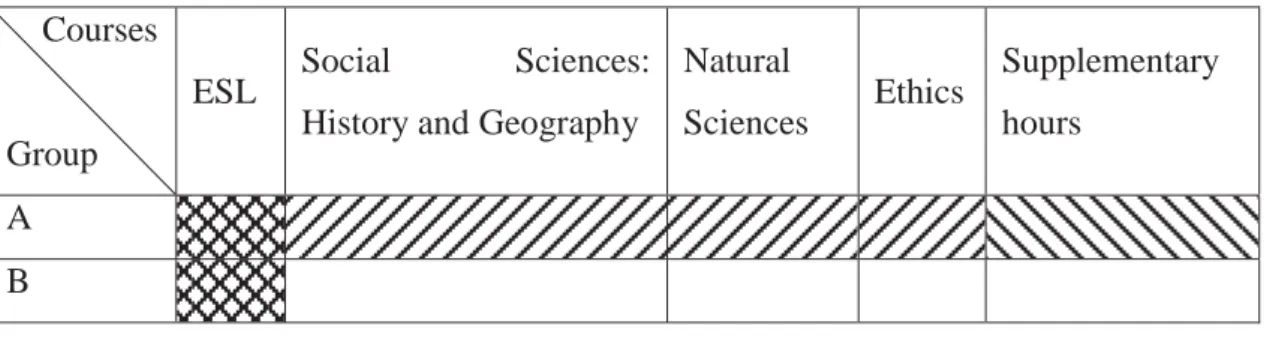
Group A, those students taking part in the bilingual education system, combines
being taught in Spanish in the majority of the courses with classes in English in four
hours per week of the actual ESL course in addition to Social Sciences (3 hours per
week), History and Geography; Natural Sciences (3h/w), and Ethics (1h/w). On the
other hand, Group B’s teaching is completely given in Spanish but for the four hours of
ESL. Besides the courses in English, the members of the bilingual groups in this high
school do have to attend two supplementary hours per week. During this time they
practice extra grammar tasks in order to deal better with the other subjects, listening and
reading comprehension, phonetics and conversation.
In order to obtain a more clear vision of this information, a tabulated summary is
presented in table 1:
Table 1. Distribution of groups: Subjects taught in English
Courses
Group
ESL Social Sciences:
History and Geography
Natural
Sciences Ethics
Supplementary hours A B 8
Group A uses a book called Frontrunner 3 (B1+) (Falla, 2011) while Group B follows Real English
ESO 4 (Mark, 2010). Apart from the workbook that comes together with each of the textbooks, the
5.2 Procedure
In order to test the knowledge and command on and double negation by our two
groups of participants and their response towards this phenomenon, we tested them
using a short questionnaire9 [see Appendix 1].
Trying not to interrupt the normal development of the lessons, the teachers
agreed on us using one of the ESL hours for each group and hence, once the
questionnaire was distributed, presented, and explained, the students had 50 minutes -
the time their classes and examinations last - to fill it in. These exercises were designed
to evaluate the quality of their linguistic performance in the specific grammatical feature
of double negation in English, their L2, and to check whether it is affected or not by the
different amount of input they are exposed to in English and/or by their linguistic
competence in Spanish.
The questionnaire consisted on three tasks and the students in both groups were
given the instructions to fulfill it as follows:
Task 1 is a multiple choice exercise in which the students are required to select,
among the two options given, the one that they consider to be the most accurate for each
question. With this exercise, we make the students choose among the negative and
non-negative pronouns or verbs that are offered as a response to the questions proposed.
Being the presence of a pronoun one of the most repeated examples of double negatives
in Spanish, we consider it important to have it compared with an “equivalent” in
English, e.g. No, no quiero nada – No, I don’t want anything/nothing. The negative
particle no and a finite form of the verb appear in the answer of 6 out of 9 entries. The
other three, questions number 2, 7, and 9, present a different structure which deals with
verbal conjugation, recurrently repeated as grammatical work throughout SLA, and so it
is the verb which needs to be inflected in the negative taking into account the context
within the sentence, e.g. Q-Do you have any money? A- No, I don’t have any/have none.
9
In task 2, the students are asked to paraphrase five sentences, e.g. I didn’t hardly
notice you had had your cut. These utterances, incorrect according to standard Modern
English rules but possible depending on the context are intended to check the ability of
these students to differentiate between Spanish, in which double negatives are accepted,
and English grammars and their proficiency in English at the same time.
The last task is one of acceptability judgment in which the students are asked to
grade, from 1 to 4, the examples of negative structures proposed in the different sets and
different languages (English and Spanish) as they find them more or less correct, e.g.
No necesitamos educación alguna –We don’t need no education. The different numbers
stand for 1 as very bad, 2 as bad, 3 as good, and 4 as very good. There is a series of
entries – no. 1C, 2B, 4B, 4C, and 5C – whose structure, later in the next section labelled
as structure no.3, will be analyzed into deeper detail in section 7.
We will put together, when working with the results, some of the sentences
given to the students considering the internal structure of these. Out of this
classification, we encounter the following five structures:
1. Negative form of the verb / negative indefinite in Spanish, e.g. No
necesitamos ninguna educación.
2. Negative form of the verb / positive indefinite in Spanish, e.g. No
necesitamos educación alguna.
3. Negative form of the verb / negative indefinite in English, e.g. We don’t need
no education.
4. Negative form of the verb / positive10 indefinite in English, e.g. I didn’t know
anything at all.
5. Positive form of the verb / negative indefinite in English, e.g. I know nothing
about sports.
Once this questionnaire was fulfilled by our students, it was corrected and the
results tabulated. In the next section, the answers we have collected will be analyzed
and discussed in order to obtain some conclusions that endorse, or not, our initial
hypotheses.
10 The indefinites any/anything are considered as positive ones in this paper in opposition to the use of the
6. RESULTS
For task no. 1, in which the students were asked to choose one of the two options
provided, the answers are presented in graph 1, where we can observe that, apparently, a
worst performance was demonstrated by the members of Group B.
Graph 1. Collection of answers given to task 1 by Groups A and B
For this first task proposed in the questionnaire, we have obtained, from Group
A, 89 correct answers out of 117 possible ones. For Group B, on the other hand, the
number is 131 out of 216. These figures, which represent a 76% and a 60’5% of proper
replies respectively, have been interpreted utilizing a contrast of proportions equation
resolving that the percentage of correct answers for Group A is significantly higher than
the one for Group B (p-value < 0,05).
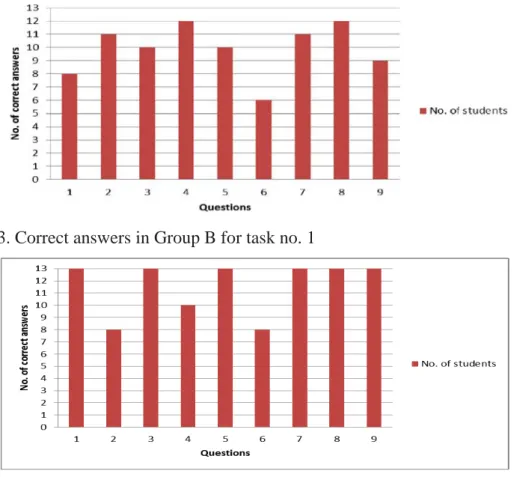
Graphs 2 and 3 portray the amount of correct responses for each of the questions
that were proposed by both of the groups. At first sight, we can observe that the output
of the students remains stable throughout the whole task but for a specific person in
each class. If analyzing the questions, we can state that it is question no.6 – Q.How
much money do you have? A.Not much. I hardly have none/any - the one which seems
to be more problematic for our students, as well as no. 2 – Q. Do you have any money?
Graph 2. Correct answers in Group A for each of the questions in task no. 1
Graph 3. Correct answers in Group B for task no. 1
In task 2, four sentences are offered to the students to spot the mistake in each of
them. The results of this first part of the exercise are shown in table 2, which shows the
amount of correct answers obtained by Group A – 46 (88.46%) – and Group B – 77
(80.21%) – out of the total of 52 and 96 possible correct answers, respectively, being
this difference not significant (p-value = 0.10).
Table 2. Collection of answers given to task 2 by Groups A and B
TASK 2 Group A Group B Correct 46 (88.46%) 77 (80.21%)
Incorrect 6 (11.54%) 19 (19.79%)
Once the first part of the task was done, the students were told to paraphrase the
examples given so that they became correct according to their knowledge. Out of the
structures. Using the second entrance in the exercise – e.g. I didn’t get no apples –, so as
to illustrate this distinction, we have observed, as shown in graph 6, the following
results: (1) the replacing of the whole double negative sentence – e.g. I didn’t get no
apples – by a positive one, e.g. I got apples [V(erb)-I(ndefinite) +]; (2) the
transformation of the verb into its positive form keeping a negative indefinite, e.g. I got
no apples [V(erb) +]; and, (3) the maintenance of the negative form of the verb and the
change of the negative indefinite such as no into any a positive one [I(ndefinite) +] e.g. I
didn’t get any apple. Examining graph 4, we detect that it is this third structure the one
which is mostly preferred (p-value < 0.’5 in favor of Group B). If we compare the other
two structures, those in which the verb is turned into its positive form, the results
obtained are approximately equivalent, this is, p-value = 0.43 in structure (1) and 0.04
in (2) both in favor of Group A.
Graph 4. Correct answers made by Groups A and B to task 2.
In task 3, there are neither correct nor incorrect answers. Students were expected
to grade the sentences suggested as they regarded them as more or less acceptable.
Considering this criterion, and as can be seen from graphs 5 and 6, we have grouped
negative responses (1-2) on one column, the red one; and positives (3-4) on the green
one. Besides, we have omitted invalid or null responses as we consider them
unnecessary for our research and, also, because we do believe that some of the students
understood these sentences in Spanish as mere examples and so they did not grade
Graph5. Collection of answers given to task 3 by the students in Group A
Graph 6. Collection of answers given to task 3 by the students in Group B
It seems clear that it is structure number (3) - Negative form of the verb /
negative indefinite in English – the one more rejected by students from both groups
(81’66% in group A; 70’75% in group B) (p-values =0.06). This means that the vast
majority of the students, it does not matter the teaching program in which they are
enrolled, react in the same “negative” way when they are exposed to this structure in
English. This is truly meaningful considering the fact that their reaction considerably
varies when it comes to evaluating the same structure in Spanish, their native language
because structures (1) - Negative form of the verb / negative indefinite in Spanish – is
regarded as more correct by those same students (71’42% in group A; 85’88% in group
If we compare structure (2) – negative form of the verb / positive indefinite in
Spanish – and its equivalent structure (4) - Negative form of the verb / positive
indefinite in English – we observe that 91.66% of Group A and 78.26% of Group B,
p-value = 0,15, accept the former as correct while for the latter the numbers are 83,01%
(Group A) and 74,73% (Group B) –p-value = 0,12.
A possible interpretation of these results will be further analyzed and
commented all throughout the following pages.
7. DISCUSSION
In the previous section, we have offered an approximation to the results we have
collected through the execution of this study. If we focus in deeper detail on the
performance of the students who fulfilled the questionnaire, there is a series of results
that merit to be remarked and so they will be commented in this section following the
order in which they can be encountered in the mentioned questionnaire.
If we concentrate on task 1, we observe that the amount of students who
answered properly each of the questions except for numbers 2 – e.g. Q. Do you have
any money? A. No I don’t have/have– and 6 – e.g. Q. How much money do you have?
A. Not much. I hardly have none/any. There were two possibilities, i.e. pronouns and
verbs, to be chosen among the options provided so, apparently, that seemed to be the
factor that most likely could have been crucial when answering these questions.
Notwithstanding, it has been the pronoun none the element that is shared by these two,
apparently problematic, examples. This word, defined as “not one (of a group of people or things), or not any” (reference?), looks not to be clear for the students of any of the
groups. It might be caused by the way pronouns and negatives are taught in schools:
when these two grammatical elements are put together during an L2 English lesson,
only the use of some and any is generally explained. A brief mention during these
lessons could, in our opinion, prevent students misunderstanding the meaning and use
English and which provoked errors in students’ performance in this part of the
questionnaire.
Moving now onto task 2, as expected, and linked with what has been just
commented about negative pronouns, the most recurrent option students used to
paraphrase was keeping the verb in its negative form and substituting the negative
indefinite by “equivalents” with a positive implication, e.g. some, somebody,
somewhere. This attitude might be due, again, to their ignorance on the way negative
pronouns are used. It also appeared to be predictable, at least among those students of
group B, the fact that a great number of students would automatically transform the
coexistence of two negative elements into a positive sentence. It has been largely
inculcated that two negatives cancel out each other and this idea, not always valid, is
used by many of our students.
Being urged on to spot the mistakes, if there were, we expected, out of the
interpretation proposed by the students for each of the sentences, to be able to find
where they chiefly place the errors. Knowing this, it was easier for us to clarify in what
way they are influenced by their native grammar. The outcome of task 2 was, by some
means, different than that of the previous one. A better performance was again achieved
by the members of Group A but the contrast of percentages obtained when analyzing the
results of this task – p-value = 0’10 – has been proved to state that there is not a
significant difference between both groups, which is enough to validate our initial
hypothesis, the effectiveness of a bilingual program over a traditional one.
Revising, finally, task 3, it has been proved that, although both structures (1) –
negative form of the verb / negative indefinite in Spanish, e.g. No necesitamos ninguna
educación – and (2) – negative form of the verb / positive indefinite in Spanish, e.g. No
necesitamos educación alguna – are widely accepted in Spanish, the former is
marginally better appreciated than the latter. This means that, admitting both cases are
grammatically accepted in the native language of the students, a double negation is
regarded as more correct than a simple one in which the negation falls only on the verb.
If we aim our attention on the examples in English, there is no doubt that, as earlier
perceive structure 3 – double negatives – as incorrect. Having put together utterances in
both Spanish and English, we feel capable to analyze to which extent the students are
influenced by the possibilities present in their native language and if more extensive
input helps the learner to differentiate it from the one in the L2.
We have left structures 4 – negative form of the verb / positive indefinite in
English, e.g. I didn’t know anything at all – and 5 – positive form of the verb / negative
indefinite in English, e.g. I know nothing about sports – for the final part of our
discussion as they are the ones our students are more used to work with. They differ
from each other on the position that the negative element occupies within the sentence,
this is, the negation falls on the verb or on the indefinite element. Among these two,
there is clear inclination in favor of the structure 4. It is this, again, the model
recurrently taught, i.e. negative form of the verb + positive indefinite, the one which is
largely preferred by both groups.
Having put together and analyzed the data extracted from task 3, we found out
that we cannot establish that the response of one of the groups towards double negatives
is significantly distinct from the other’s.
In the light of the results achieved in our study, we can conclude that even
though we expected that (1) as a consequence of a higher amount of input in English,
the students enrolled in the English-Spanish bilingual program would prove to perform
a better performance when dealing with negation structures; and (2) students in Group
B, those in the traditional L2 learning program, would make a larger amount of
mistakes in the same structures, notwithstanding, the outcome of this paper has not
endorsed our research premises. The results obtained by the two groups have
demonstrated that, despite the different instruction they receive, the output and
knowledge of the students in Group A is not that excelling when compared with the one
of Group B as we anticipated. Notwithstanding, inasmuch of the outcome of our study
and considering the different reaction towards double negatives demonstrated by our
students depending on the language being analyzed in each case, it seems that the data
we have obtained point in the same direction as Butterworth’s (1972, cited by Irvine,
2005), concluding that the mother tongue is not the most deciding factor for the final
8. CONCLUSIONS
It is four years now when it was introduced in the Secondary School Jorge
Manrique (Palencia, Spain) a bilingual learning program which has been coexisting
with a traditional L2 learning one. Nevertheless, some of the regulations that frame the
former program were signed almost ten years ago and so a new, brought-up-to-date
analysis is, in our opinion, fundamental so as to evaluate if this method is still valid or
if, on the other hand, any kind of revision might be necessary.
Given the results of our study, we consider crucially necessary the inclusion of
some changes in the way English is being taught as a second language in Spain or, at
least, in those centers which have introduced these new bilingual programs if they crave
them to be truly effective. We propose two options of change. The first one, the one we
acknowledge as easier to introduce, would imply a change in the syllabuses which are
currently being used. We have observed while analyzing the answers that, for instance,
numerous students do not recognize some pronouns which are repeatedly being used in
English. Therefore, we would advocate for the reduction of theoretical instruction in
favor of larger conversational task or work with audios and/or videos in which a more
real English can be appreciated.
The second option of change is connected with audiovisual materials as well,
which might seem in some way a bit more complicated to be put into practice as new
technologies and resources would need to be introduced in the classroom. This option,
which would improve a factor that has been analyzed as crucial in this paper for the
acquisition of languages to be successful, is the so-called CALL11 - Computer Assisted
Language Learning – methodology, which was studied, among many others, by
Torlakovic and Deugo (2004). They tested two groups of ESL learners, one of them
exposed to teacher-fronted instruction and the other to CALL software, which fulfilled
equal tasks. Results, as these scholars affirm in their research, showed a significant
improvement on the intuition task and a significant confidence improvement on both
11
SLA learning procedure which is often identified as an approximation to language teaching and learning in which some kind of software is used so as to reinforce and ease the use and acknowledgement
intuition and production tasks for the computer group while the in-class group showed
no significant gains.
Studies such as the one which has been just mentioned make us think that the
acquisition/learning of a second language following a new, up-to-date technique like
CALL would be much more effective. It seems clear that a SLA program structured
around CALL would widely improve the acquisition of a language. In the particular
case of double negatives, which constitute a phenomenon which is broadly changing
nowadays, the individualized and immediate feedback given to the student would allow,
for instance, a fast acknowledgement of the kind of English which is being used in this
day and age preventing the content becoming old fashioned even before it gets to the
student.
Notwithstanding, more realistic information could be obtained if a study like the
one we have carried out was repeated later in the time in order to study the evolution of
the students who have taken part on it and so proving a better understanding of simple
and double negation in English. This developmental perspective would enrich the study
of how efficiently our students learn a second language in different educational
9. REFERENCES
Abroads. Aprender inglés con un cerebro español. 2013. Accessed June 14,
2014 <https://owl.english.purdue.edu/owl/resource/747/08/>
Ahmad, Kay. “Don’t just say “No”: Developmental Sequence of Negation.”
TESOL Working Papers. College of Arts, the American University, 2002.
Alan Dobson et al. Bilingual Education Project, Spain. Evaluation Report. 1996.
Madrid, British Council (Spain) and Ministry of Education (Spain), 2010.
Accessed June 14, 2014.
<https://sede.educacion.gob.es/publiventa/detalle.action?cod=14326>
American Speech-Language-Hearing Association. Second Language
Acquisition. 2014. Accessed June 14, 2014.
<http://www.asha.org/public/speech/development/second/>
Bilash, Olenka. Krashen’s 6 Hypotheses. Best of Bilash. 2011. Acessed June 14,
2014.
<http://www.educ.ualberta.ca/staff/olenka.bilash/best%20of%20bilash/krashen.h
tml>
Boeree, George. B. F. Skinner. Personality Theories, 2006. Accessed June 14,
2014. <http://webspace.ship.edu/cgboer/skinner.html>
Bogglesworldesl. ESL Glossary: Interlanguage. 2014. Accessed June 14, 2014.
<http://bogglesworldesl.com/glossary/interlanguage.htm>
British Council. Critical Period Hypothesis. BBC, 2014. Accessed June 14,
2014. <
http://www.teachingenglish.org.uk/knowledge-database/critical-period-hypothesis>
Brown, Roger. A First Language. Cambridge, MA: Harvard University Press,
1973.
Buitrago, Mauricio. Behaviorist Theory on Language Learning and Acquisition.
2014. Accessed June 14, 2014.
<http://soda.ustadistancia.edu.co/enlinea/MAURICIO_BUITRAGO_ingles_PS
YCHOLINGUISTICS_PRIMER_MOMENTO/Behaviorist_theory_on_languag
Butterworth, Brian. A Spanish-speaking adolescent’s acquisition of English
syntax. In E. M. Hatch (Ed.), Second language acquisition: A book of readings.
(pp. 231-245). Rowley, MA: Newbury House Publishers. Inc, 1972.
Cambridge Dictionaries. Language. Memrise.com, 2014. Accessed June 14,
2014. <http://dictionary.cambridge.org/dictionary/british/language?q=language>
Centro Virtual Cervantes. Marco de referencia europeo en su contexto político y
educativo. Instituto Cervantes, 1997. Accessed June 14, 2014.
<http://cvc.cervantes.es/ensenanza/biblioteca_ele/marco/cap_01.htm#p11>
Consejería de Educación. B.O.C. Spain. JCyL y L. ORDER EDU/6/2006.
Valladolid, 2006. Accessed June 14, 2014.
<bocyl.jcyl.es/boletines/2006/01/12/pdf/BOCYL-D-12012006-18.pdf>
Crystal, David. A Dictionary of English Linguistics. Cambridge: Blackwell
Publishers Inc., 1991.
Dictionary.com. Second Language. Random House, Inc., 2014. Accessed June
14, 2014. <http://dictionary.reference.com/browse/second+language>
Educacyl. Order EDU/221/2009. JCyL. February 13, 2009. Accessed June 14,
2014. <
http://www.educa.jcyl.es/es/resumenbocyl/edu-221-2009-9-2-autoriza-creacion-secciones-bilingues-cent>
Eisouh, Zuhair S. Negation errors in English by University of Jordan students.
Vol. 48. Alabama: Project Innovation, 2011. Accessed June 14, 2014.
<http://www.freepatentsonline.com/article/Reading-Improvement/275849606.html>
Ellis, Rod. Classroom Second Language Development. Oxford: Pergamon, 1984.
European Comission. Content and Language Integrated Learning (CLIL) at
School in Europe. Belgium. Eurydie, 2006.
Hornby, Albert S. Oxford’s Advanced Learner’s Dictionary of Current English.
4th ed. Oxford: Oxford University Press, 1989.
Ipek, Hulya. “Comparing and Costrasting First and Second Language
Acquisition: Implications for Language Teachers” English Language Teaching.
Canadian Center of Science and Education. June 2009: 155.
Irvine, Martha G. Developmental Stages of Negation in One Learner’s
Klima, E. S., and Ursula Bellugi. Syntactic Regularities in the Speech of
Children. Edinburgh: Edinburgh University Press, 1966.
Larsen-Freeman, Diane and Michael H. Long. An introduction to second
language acquisition research. New York: Longman. 1991.
Laviak, Eva. Classical Examples of Double Negatives for Teaching Grammar.
Answers Corporation. 2014. Accessed June 14, 2014.
<http://english.answers.com/grammar/classic-examples-of-double-negative-for-teaching-grammar>
Lightbown, Patsy, and Nina M. Spada. How Languages Are Learned. 1999.
Oxford: Oxford University Press, 2006.
Lowe, Charles. CLIL: An Interview with Professor David Marsh. International
House, 2009. Accessed June 14, 2014.
<http://ihjournal.com/content-and-language-integrated-learning>
Lowth, Robert. A Short Introduction to English Grammar. 1775.
Mangold, ed. Modern English I. Madrid: Mangold Editorial, 1958.
McLaughlin, Barry. Theories of second language learning. London: Arnold,
1987.
Meisel, Jürgen M. The acquisition of the syntax of negation in French and
German: contrasting first and second language acquisition. 1997.
Nordquist, Richard. Native Language (L1). About.com, 2014. Accessed June 14,
2014. <http://grammar.about.com/od/rs/g/Second-Language-l2.htm>
OLBI (Official Languages and Bilingualism Institute). Spain: A Different
Approach to Institutionalized Bilingualism. University of Ottawa, 2014.
Accessed June 14, 2014. <http://www.slmc.uottawa.ca/?q=bi_spain>
Oxford Dictionaries. Double Negatives. Oxford University Press, 2014.
Accessed June 14, 2014.
<http://www.oxforddictionaries.com/words/double-negatives>
R.A.E. Nueva gramática de la lengua española. Vol. Sintaxis II. Madrid: Espasa
Libros S.L.U., 2009.
Sabina, Joaquín, and Pancho Varona. Con la frente marchita. Mentiras piadosas.
Estudios Cinearte. 1990. CD.
Soanes, Catherine. Grammar myths #3: Don’t know nothing about double
negatives? Oxford Dictionaries. Oxford University Press, 2012. Accessed June
14, 2014. <http://blog.oxforddictionaries.com/2012/02/grammar-myths-3/>
Tennant, Adrian. What is CLIL? One Stop English. 2013.
Torlakovic, Edina, and Dwight Deugo. Application of a CALL System in the
Acquisition of Adverbs in English. Ottawa: Institute of Cognitive Science, 2010.
Towell, Richard, and Roger D. Hawkins. Approaches to Second Language
Acquisition. Bristol: Multilingual Matters, 1994. Accessed June 14 2014.
<http://www.onestopenglish.com/community/our-people/author-of-the-month/author-of-the-month-adrian-tennant/156801.article>
VanPatten, Bill, and Jessica Williams. Theories in Second Language
Acquisition: An Introduction. New Jersey: Lawrence Erlbaum Associates, 2006.
Wells, Gordon. The Meaning Makers: Children learning language and using
10. APPENDIX
APPENDIX 1. – QUESTIONNAIRE
IMMERSION - TRADITIONAL GROUP STUDENT NO. _________
Are you currently taking, or have taken, any extra courses in English language? If yes,
please, specify: ………
TASK 1, (MULTIPLE CHOICE)
1.- Complete each of the answers choosing the option(s) that you find most accurate in each case:
1. Q- Do you want anything? A- No, I don’t want ____________.
-anything -nothing
2. Q-Do you have any money? A- No, I ____________ none.
-don’t have -have
3. Q- Did you see those people? A- No, I didn’t see ____________.
-no one -anyone
4. Q- Do you have any candy? A- No, I don’t have ____________.
-any -none
5. Q- Didn’t he tell you not to come here? A- No, he didn’t tell me ____________. -nothing -anything 6. Q- How much money do you have?
A- Not much. I hardly have ____________-
-none -any
7. Q- Where are you going?
A- I ____________ anywhere. I’m staying right here. -am going -am not going
8. Q- So, you’re staying right here?
A- That’s right. I’m not going ____________-
-nowhere -anywhere
TASK 2. (PRODUCTION)
2.- Rewrite only those sentences in which you find a mistake, leave a blank in the rest. Explain, briefly, the meaning of the sentences proposed:
1- I didn’t hardly notice you had had your hair cut.
______________________________________________________________________. 2- I didn’t get no apples.
______________________________________________________________________. 3- She wouldn’t get no credit for her answers.
______________________________________________________________________. 4- I am surprised that you won’t get no money.
______________________________________________________________________.
TASK 3. (ACCEPTABILITY JUDGMENT)
3.- Grade 1-4 (1- very bad, 2- bad, 3- good, 4- very good) the next sentences as you find them more or less acceptable:
1) Set 1
a) No necesitamos ninguna educación. b) No necesitamos educación alguna. c) We don’t need no education. d) We need no education.
e) We don’t need any education.
2) Set 2
a) Yo no sabía nada en absoluto. b) I didn’t know nothing at all. c) I didn’t know anything at all.
3) Set 3
a) Mis amigos nunca hacen nada divertido. b) My friends never do nothing fun.
c) My friends never do anything fun.
4) Set 4
a) Pedro no hablará con nadie sobre su película. b) Peter won’t talk to nobody about his movie. c) Peter won’t talk to no one about his movie. d) Peter won’t talk to anybody about his movie.
5) Set 5