FACULTAD de FILOSOFÍA Y LETRAS
DEPARTAMENTO de FILOLOGÍA INGLESA
Grado en Estudios Ingleses
TRABAJO DE FIN DE GRADO
Double Object Constructions: A Comparison between their
Production by L1 English Speakers, 2L1 English/Spanish
Speakers, and L1 Spanish/L2 English Speakers
Radoslava Stankova Laykova
Tutor: Isabel Pizarro Sánchez
ABSTRACT
This dissertation provides an analysis of spontaneous data from four different corpora: the
Brown, the FerFuLice, the Paradis, and the Barcelona English Language Corpus (BELC)
corpus, contained in CHILDES project (MacWhinney 2000). The main objective of this
paper is to study the acquisition of the English double object construction in different types
of speakers of English, i.e. monolingual, simultaneous bilingual, who acquire English and
Spanish from birth, and sequential bilingual speakers of English, whose first language is
Spanish, to determine if they acquire double object constructions before prepositional object
contructions, if the acquisition occurs at the same age, and if there is cross-linguis t ic
influence when dealing with non-native speakerse of English. The results show that
monolingual and simultaneous bilingual speakers of English acquire this structure at the same
age, and both of them produce double object constructions before prepositional object
constructions. Moreover, simultaneous bilingual speakers’ data display some cross-lingus it ic
influence from Spanish into English.
Key words: Double object construction, prepositional object construction, dative movement,
language acquisition, cross-linguistic influence.
RESUMEN
Este trabajo de fin de grado se basa en el análisis de datos orales espontáneos extraidos de
cuatro corpus diferentes: Brown, FerFuLice, Paradis y BELC, todos ellos incluídos en la base
de datos CHILDES project (MacWhinney 2000). El objetivo principal de este trabajo es el
estudio de la adquisición de la estructura de doble objecto, típica de la lengua inglesa, en
distintos tipos de hablantes del inglés, tales como monolingües, bilingües simultáneos que
adquieren el español y el inglés desde su nacimiento y bilingües consecutivos cuya primera
lengua es el español, con el fin de establecer si las construcciones de doble objeto se
adquieren antes que las construcciones de objeto preposicional, si esto ocurre a la misma
edad, en el caso de los hablantes nativos, y si existe influencia interlingüística en el caso de
los hablantes no nativos de inglés y los bilingües simultáneos. Los resultados obtenidos
construcciones de doble objeto a la misma edad y en ambos casos antes de empezar a producir
construcciones de objeto preposicional. Así mismo, hay indicios de influe nc ia
interlingüística en aquellos hablantes bilingües que tienen como lenguas maternas tanto el
inglés como el español.
Palabras clave: construcciones de doble objeto, construcciones de objeto preposiciona l,
CONTENTS
1. INTRODUCTION 1
2. STATE OF THE ART 3
2.1. Semantic and pragmatic conditions for the double object structures 8
2.1.1. Lexical restrictions 10
2.1.2. Morpho-phonological restrictions 11
2.2. Case assignment 13
3. EMPIRICAL STUDY 17
3.1. Corpora and participants 18
3.2. Methodology 21
3.3. Data analysis 25
4. DISCUSSION 30
5. CONCLUSIONS 34
1
1. Introduction
The present study focuses on the so-called double object structures, its production, and usage
by different types of speakers of English since I deal with monolingual speakers of Englis h
(hence L1 speakers of English), simultaneous bilingual1 speakers who have both English and
Spanish as their first languages (henceforth 2L1 English/ Spanish speakers), and with
sequential bilingual2 speakers of English who have Spanish as their mother tongue
(henceforward L1 Spanish/ L2 English speakers). The data used for the analysis and
comparison of the production and usage of double object constructions in these types of
speakers are taken from CHILDES (MacWhinney 2000); being the Brown, the FerFuLice,
the Paradis, and the Barcelona English Learning Corpus (BELC) corpora, the main sources
of data. Moreover, I use the Corpus of Contemporary American English (COCA) (Davies
2008-) in order to determine which structure is more frequently used in the oral data of native
speakers of American English as for this study I consider the oral production of children who
are either L1 or L2 speakers of American English. Finally, the results obtained througho ut
the analysis of the corpus data are compared between them.
The purpose of this study is to provide a detailed description of how this structure is used in
conjunction with the verb to give which is very frequently used by children and fulfills the
semantic and pragmatic requirements for this movement to be considered grammatic a lly
correct. Besides, this paper aims to determine at what age children start to use this structure
correctly, and which might be the causes for this structure to be acquired earlier or later in
the language acquisition process considering children’s linguistic background. Another
objective of this study is to determine whether the prepositional object structure or the double
object construction is acquired earlier. Ultimately, I want to establish if adult learners of
English, whose L1 is Spanish, are faster than children who are learning English, and whose
1 Simultaneous bilingualism has been defined as the “[a]quisition of more than one language during early childhood” (Saville-Troike 2012, 4).
2 L1 is Spanish as well, in achieving a native-like competence of this structure. This leads me
to establish the following hypotheses:
My first research question deals with which type of speaker, among those who have been
analyzed (L1 English speakers, 2L1 English/ Spanish speakers, or L1 Spanish/ L2 Englis h
speaker), acquires double object constructions faster. My hypothesis is that it takes less time
to monolingual speakers of English to acquire this structure as they do not have the
interference of other languages; what influences my third research question.
My second research question addresses the issue of whether the prepositional object
construction or the double object construction is uttered earlier in the adult-like form.
Consequently, my second hypothesis establishes that double object constructions are
expected to be acquired earlier as they lack the preposition which assigns dative case and,
since prepositions are function words, they are acquired later than the lexical ones.
My third research question is whether the different linguistic backgrounds of the speakers
considered in this study influence their process of acquisition of the studied feature of the
English language; in other words, this research question considers the existence of
cross-linguistic influence in the case of bilingual speakers of English. Hence, my third hypothesis
claims that the fact that Spanish is a language which shuns double object constructions slows
down the process of acquisition of this structure; therefore, both 2L1 English/ Spanish
speakers and L1 Spanish/ L2 English speakers are influenced by their Spanish. Consequently,
these speakers are expected to acquire the prepositional object construction earlier than the
double object construction due to the cross-linguistic influence since it is possible in Spanish.
My fourth and last research question aims to establish whether children or adults whose L1
is Spanish and are learning English as L2 are faster in achieving the native-like competence
in the use of this particular feature of the English language. My hypothesis establishes that
children must be faster as they have not set all the parameters of their L1 yet.
This paper is organized as follows: In section 2, I discuss the previous literature with regard
to double object structures, taking into account the semantic and pragmatic conditions along
3 section, I discuss case assignment in prepositional and double object structures. This
theoretical background is an important framework for a proper understanding of how
ditransitive verbs work, why they may cause problems during the process of acquisitio n of
English as well as the problems double object constructions bring about in terms of case
assignment and grammaticality, and which the requirements that a verb must fulfill are so as
to allow dativization. Besides, this theoretical framework is useful for the understanding of
the ideas developed throughout this study.
Afterwards, in section 3, I develop my empirical study. Therefore, in this section, I
concentrate on the description of the corpora and participants from which I have selected
data. The methodology applied to the data selection and analysis is thoroughly explained for
a better understanding of the succeeding section where the results are presented. This leads
to a discussion on the similarities and differences found among the data of each speaker,
relating them to the theoretical background previously expounded. After that, in section 5, I
offer the conclusions I have reached throughout this essay along with some hints for further
research. Eventually, in section 6, a list of the resources used in order to carry out this study
is provided.
1. State of the art
Some English verbs must be followed by two noun phrase (henceforth NP) complements;
these are the so-called ditransitive verbs, the ones that allow double object constructio ns.
These verbs permit two different forms in their construction: one of the forms involves the
presence of two objects, a direct object3 (abbreviated as O
d) and an indirect object4
3 Direct object (Od): “A noun phrase or clause which is licensed by a transitive verb and normally occurs after the verb, typically carrying the semantic role of patient. When a pronoun is used, it appears in the objective (1) case. […] Generally the [Od] of an active declarative clause can become the subject of a passive clause” (Aarts 2014).
4 (abbreviated as Oi), being the second one preceded by a preposition which assigns it its dative
case; this type of construction is exemplified by instance (1) below and is referred to as
prepositional object construction. The second alternative that ditransitive verbs allow is the
placement of the Oi next to the verb and the omission of the preposition that it should take in
the first type of construction as it is shown in example (2) below; therefore, the verb is
followed by two NPs. This fact causes a problem in terms of case assignment. The second
construction which ditransitive verbs permit is my main concern in this study, and it is
referred to as double object construction.
(1) Thelma gave the draft to Louise. (Haegeman and Guéron 2012, 123)
(2) Thelma gave Louise the draft. (Haegeman and Guéron 2012, 123)
It has to be pointed out that in any of these constructions both complements are obligatory
since the absence of any of them encompasses the ungrammaticality of the structure as in
instances (3) and (4) below.
(3) *Thelma gave the draft.
(4) *Thelma gave Louise. (Haegeman and Guéron 2012, 124)
In sentence (3), the meaning of the verb to give is incomplete as it involves that someone
gives something to someone, if the speaker selects a prepositional object construction, or
someone gives someone something, if the speaker prefers to use a double object constructio n.
However, in this sentence, the recipient of the object which is given (or the beneficiary of the
action) is omitted. In example (4), the object which is given (or theme) is omitted; thus, the
meaning of the verb is partly missed, and the construction is, consequently, rendered
ungrammatical.
According to Quirk et al., ditransitive verbs, in their basic form, take two NP objects: an Oi,
“which is normally animate and positioned first” (Quirk et al. 1985, 1208) and an Od, “which
is normally inanimate” (1985, 1208). These two NPs differ from those that can be found in
5 sentences containing complex transitive verbs in that their relationship is not copular; that is,
the second NP in complex transitive constructions describes the first one.
(5) We consider him a genius. (Quirk et al. 1985, 1200)
Example (5) illustrates a complex transitive structure in which a close relationship is found
between the Od and the object complement; that is, the NP which provides a characteristic of
the Od. To demonstrate that the NP “a genius” is complementizing the NP “him”, I present
this sentence in the phrase marker found in (5.1.) below.
(5.1.) Phrase marker:
The phrase marker in (5.1) illustrates that the verb to consider takes one object, which is a
Od “him a genius”, and at the same time, this Od is comprised of a subject “him” which takes
its own complement “a genius”, which is designated object complement. Moreover, this
combination is an example of the so-called small clauses5
As it is mentioned before, Quirk et al. (1985) consider that the basic form of ditransitive verbs
is the double object construction, being the prepositional object construction derived from
5 Small clauses are constructions which have the semantic subject-predicate relation lacking the tense which finite clauses have.
IP
NP I’
I VP
V’
V NP
[1st p.p.] N’
[-past] N’ NP
N Det N’
N
6 the first one. However, Larson (1988) upholds that the prepositional object construction is
the basic form from which the double object construction derives.
Some ditransitive verbs allow the formation of passive structures in two different ways which
are referred to [FIRST PASSIVE] and [SECOND PASSIVE] in Quirk et al. (1985, 1208) presented in (6)
and (7) below; these are the possible passive voice constructions of the active sentence in
example (2) above.
(6) Louise was given the draft. [FIRST PASSIVE] (adapted from Haegeman and Guéron
2012)
(7) The draft was given Louise. [SECOND PASSIVE] (adapted from Haegeman and Guéron
2012)
The most common passive construction in English is (6) where the Oi of the active sentence
becomes the subject of the passive one. These are the so-called indirect passives discussed in
Larson (1988). On the other hand, when the Od is placed in the subject position of the passive
sentence, the usage of a prepositional phrase (PP) is more common, as in example (8) below.
(8) The draft was given to Louise. (adapted from Haegeman and Guéron 2012)
Quirk et al. also distinguish different types of ditransitive verbs which are the following:
1. Indirect object + direct object [D1] (Quirk et al. 1985, 1208)
2. Direct object + prepositional object [D2a] (Quirk et al. 1985, 1208)
3. Indirect object + prepositional object [D2b] (Quirk et al. 1985, 1208)
Type [D1] involves sentences in which an Oi and a Od can be found as in example (2) above.
The second type of constructions, [D2a], allowed by ditransitive verbs is illustrated in
example (1) above where a Od and a prepositional object are encountered. Finally, the thir d
type of construction, [D2b], which ditransitive verbs allow is the one which contains an Oi
followed by a prepositional object as in example (9) below. This study concentrates on the
first type of constructions which ditransitive verbs permit.
7 According to Larson (1988), who follows Kayne’s (1981) proposal on why Germanic
languages allow preposition stranding6 and Romance languages do not, dative movement is
unavailable in Spanish. Kayne (1981) establishes that prepositions in English assign
objective case, and this is why the English language allows prepositions stranding. “This
allows prepositions in English to be thematically reanalyzed with the verb when a
prepositional object is extracted, which permits the trace of the latter to be licensed under the
Empty Category Principle (ECP)7” (Larson 1988, 379); that is, when the prepositional object
is omitted, the NP is assigned theta-role by the verb while the trace of the preposition is
identified under the ECP. On the other hand, in Romance languages such as Spanish,
prepositions assign oblique case, and the reanalysis is blocked because verbs are unable to
assign oblique case, but they rather assign objective case. Consequently, if the prepositiona l
object is omitted it could not be identify; thus the ECP would be violated, and the sentences
would be rendered ungrammatical as in example (10b).
(10) a. Pablo dio un libro a Cristina. (adapted from Perpiñán and Montrul 2006)
PABLO GAVE A BOOK T O CRIST INA.
b. *Pablo dio Cristina un libro. (adapted from Perpiñán and Montrul 2006)
PABLO GAVE CRIST INA A BOOK.
Moreover, Spanish does not allow indirect passives; therefore examples like (11) are
ungrammatical in this language because the subject position of the passive construction needs
to be fulfilled by an objective case, and, in this context, the NP “Cristina” is assigned oblique
case.
(11) *Cristina fue dada un libro por Pablo. (adapted from Perpiñán and Montrul 2006)
CRIST INA WAS GIVEN A BOOK BY PABLO.
Other researchers, such as Chomsky (1981) or Perpiñán and Montrul (2006), defend the
existence of double object constructions in Spanish. They consider examples (12) and (13)
6 Preposition stranding is an expression used to refer to a preposition which is left untouched after the NP has been moved out of the prepositional phrase (PP).
8 below as examples of these type of structures; however, there is no enough support for this
notion.
(12) Le hicimos llamar a sus padres a Pedro. (Chomsky 1981, 171) WE MADE PEDRO CALL HIS PARENT S.
(13) Pablo le mandó una carta a Andreína. (Perpiñán and Montrul 2006, 136)
PABLO SENT A LET T ER T O ANDREÍNA.
As it happens in English, the Oi in Spanish can also be placed next to the verb, but the
preposition is maintained resulting in a sentence such as the one in example (14) below. In
this example, the clitic pronoun “le” has been omitted; nevertheless, the preposition has been
maintained in order to render this sentence grammatical.
(14) Pablo dio a Cristina un libro. (adapted from Perpiñán and Montrul 2006)
PABLO GAVE CRIST INA A BOOK.
Owing to the lack of evidence for the existence of double object constructions in Romance
languages, in this paper, I follow Larson’s (1988) view sustaining that such constructions are
not found in Spanish.
A great amount of research has been carried out in the field of double object constructio ns
including the properties that a verb must have in order to allow it, how the objects are
assigned case, and the use of double object constructions in the spontaneous or experimenta l
data elicited from different types of speakers.
1.1. Semantic and pragmatic conditions for the double object structures
Krifka (2004) reviews previous works on the pragmatic and semantic conditions for dative
movement. By using the term dative movement, he refers to those verbs which allow either
prepositional object construction or double object constructions as it is observed in examples
(1) and (2) respectively. He classifies all the studies he reviewed in three different groups:
the monosemy view, the polysemy view, and the information structure view.
The authors encompassed in the monosemy view group support the idea that both double
9 and that “they are related to each other by a syntactic derivation that is not sensitive to the meaning of the verbs” (Krifka 2004, 2). Within this perspective, there are three differe nt
views: First, Larson (1988) upholds the idea that the prepositional object construction is the
basic form, while the double object construction is the one that derives from the former.
Second, Aoun and Li (1989) defend that the double object construction is the basic form,
whilst the prepositional object construction is the derived one. Third, Butt et al. (1997) state
that there is no derivation, but the same thematic structure can be realized by two differe nt
syntactic patterns. Nevertheless, these accounts do not consider the semantic accounts which
underlie dative movement. That is why Krifka (2004, 2) also considers the polysemy view.
Authors who support the polysemy view state that depending on the syntactic structure that
is being used, the verb may have one meaning or another. One of the most representative
researchers within the polysemy view approach is Pinker who establishes that the “double
object [construction] means ‘cause someone to gain possession of an object’” (1989, 100)
while the “prepositional object form means ‘cause an object to go into someone’s
possession’” (1989, 100). The difference in meaning between both structures is slight, and
with some verbs it might be inexistent. Moreover, Pinker found that there are verbs with
slightly different meaning to that abovementioned that also allow double object constructio n
(see section 2.1.1.).
Finally, the information structure view defends the idea that the selection of one syntactic
pattern rather than the other depends on which NP the focus is placed; that is, “the DO/PO alternation allows a shift of focus or heavy constituent to the right” (Krifka 2004, 3). This
view can be related to the previous ones. It is related to the monosemy view in that emphasis
or focus may be the only factor in selecting one structure over the other as there is no semantic
difference. On the other hand, it can be related to the polysemy view since the informat io n
structure view may determine which structure is more accurate depending on the context.
In this study, I follow the polysemy view because, as it is mentioned in Krifka (2004), it may
cause language acquisition problems as to how the restrictions to dative alternation are learnt
10
1.1.1. Lexical restrictions
Krifka (2004) also discusses dative movement in terms of lexical restrictions, i.e. the lexical
features that a verb must have in order to allow dative movement. He deals with this topic
considering possession, continuous imparting force, communication verbs, and verbs of
prevention of possession, and following Pinker’s (1989) work.
According to Pinker, the possessor constrain is crucial for the interpretation and allowance
of the double object structure as he states that “if a verb is incompatible with a meaning
causing change of possession, it cannot dativize, a successful change of possession is implied
in the resulting double-object form” (1989, 69). Following Green (1974), he argues that
double object construction, balanced against prepositional object construction, implies
“successful possession” as it is shown in examples (15a) and (15b) below. Besides, Green
(1974) does not only consider the possession of an object, but also the possession of abstract
things such as information or knowledge.
(15) a. The teacher taught linguistics to John.
b. The teacher taught John linguistics.
Example (15a) contains a ditransitive verb, to teach, which is followed by a prepositiona l
object construction. In this example, there are no implications of whether John learnt
linguistics or not. Nonetheless, in example (15b), which contains a double object form, there
is an implication that John actually learnt linguistics when the teacher taught him.
The possessor must satisfy “the selectional restrictions for possession” (Krifka 2004, 3). The
possessor must be either a person or an organization, therefore structures like the one in
example (2) are possible, but example (16a) below is ungrammatical.
(16) a. *I sent Spain a letter.
b. I sent a letter to Spain.
This construction, (16a), is ungrammatical because Spain cannot become the possessor of the
11 as Spain is the direction to which the letter goes; according to theta-theory, Spain is the goal
of the action whereas, in examples (1) and (2), Louise above is the NP that will possess NP2
after the action is completed, or the possessor following theta-theory.
Pinker (1989) distinguishes between those ditransitive verbs which require a to-object and
those which select a for-object. He also discusses which verbs can be dativized and why they
allow this shift. Finally, he organizes them into nine different groups: firstly, he considers
the so-called giving verbs; then, the sending verbs group; afterwards, verbs which cause
instantaneous ballistic motion such as the verb to throw; next, he studies the communicat io n
or illocutionary verbs such as to ask; after that, he expounds the group of verbs which imply
future having; he also discusses verbs of future not having; then, he focuses on the verbs of
instrument of communication such as to fax; afterwards, he concentrates on creation verbs
like to cook; lastly, he deals with verbs which imply obtaining something as to buy.8
Furthermore, Pinker discusses that in American English, there are some idioms which
dativize such as “[s]he gave him a hand [or] [s]he did him a favor” (1989, 115). Artistic performances as “[s]he danced us a waltz” (1989, 115) also allow double object
constructions. Finally, there are symbolic acts of dedications which allow double object form as well such as “[c]ry me a river!” (1989, 115).
In this study, I concentrate on the group of giving verbs, more specifically, on the verb to
give as I consider it more likely to be used by children who are the main subjects examined
throughout this paper. As I deal with the verb to give, I am concerned with to-datives for this
is the preposition this verb selects.
1.1.2. Morpho-phonological restrictions
The morpho-phonological restrictions for dative alternation are the ones concerned with the
morphological and phonological features of a verb; the most common verbs which do not
12 allow double object constructions are Latinate verbs as it is exemplified in (17); however,
there are some exceptions such as the verb to promise or to offer as in examples (18) and (19)
below.
(17) a. I donate the book to him.
b. *I donate him the book.
(18) a. I promised the book to him.
b. I promised him the book.
(19) a. I offered the book to him.
b. I offered him the book.
Although instances (17), (18), and (19) contain Latinate verbs, the double object constructio n
is ungrammatical only in the case of example (17b). This ungrammaticality has been
explained by researchers such as Grimshaw and Prince (1986) and Pinker (1989).
Grimshaw and Prince (1986) determined that a phonological feature of Latinate verbs does
not allow them to take double object constructions, and that the double object construction is
allowed only to verbs which have one metrical foot. Pinker (1989), on the other hand, found
that Latinate verbs are more complex in terms of semantics, and it is this semantic complexit y
which prevents these type of verbs from taking double object constructions. Nevertheless, he
does not clarify why sematic complexity influences the syntactic pattern that Latinate verbs
can follow. Hence, Grimshaw and Prince’s (1986) perspective is taken into account. They
found that those Latinate verbs which carry their primary stress on the first syllable are more
likely to be compatible with double object construction as it happens with the verbs to
promise () and to offer (). Contrary to these verbs, to donate is another
Latinate verb, yet it is stressed on the second syllable (); consequently it shuns
double object form.
The compatibility of the former verbs with double object form is associated with McCarthy
13 native speaker considers natural or native, and those which any native speaker of a language
rates as foreign words. Basic words in English are one metrical foot long (Pinker 1989, 121);
therefore, native English words are usually stressed on the first syllable. This may lead some
Latinate verbs which are stressed on the first syllable to allow double object form.
The verb I selected for this study is to give which is etymologically connected with the Old
English strong verb giefan; thus, it is a native English word. Besides, this verb has only
syllable, , what makes it likely to allow dativazation.
1.2.Case assignment
Case is defined as “a grammatical category used in the analysis of word-classes (or their
associated phrases) to identify the syntactic relationship between words in a sentence,
through such contrasts as nominative, accusative, etc.” (Crystal 2008, 66). Case theory is a
subsystem of Chomsky’s (1981) Government and Binding Theory. Its main concern is the
“assignment of abstract Case and its morphological realization” (Chomsky 1981, 6). It is
closely related to theta-theory9.
Case assignment is studied within the syntactic framework of government, thus it can be
explained in terms of constituent-command (hence c-command). Moreover, Chomsky states
that “the notion of government must meet several conditions” (1981, 163) regarding the
choice of governor, the governed terms, and the structural conditions on the relation of
government. This author concentrates on the conditions on governed term and establishes that “α governs β only and only if:
(i) α = Xº
(ii) α commands β and if γ commands β then γ either commands α or is
c-commanded by β” (Chomsky 1981, 163).
14 It is used to express the structural relations between two elements in a phrase marker.
Chomsky also discusses maximal-command (henceforth m-command) and states that “the
intuitive idea that we will pursue is that α governs β and if α m-commands and there is no
barrier10 γ that dominates α but not β” (Chomsky 1986, 8). This leads Chomsky to formula te
the following rule:
(20) α governs β and if α m-commands β and every barrier for β dominates α.
(1986, 8)
Finally, both c-command and m-command cannot take place simultaneously.
As it is abovementioned, the assignment of case is problematic in double object structures as
it is not clear how case is assigned to the two NPs that follow the verb. Moreover, case is a
property that all NPs in a sentence must have in order to be rendered grammatical; this is
Chomsky’s “[Case] filter (70) *N, where N has no Case” (1980, 25). In English, there are
two cases assigned by verbs, nominative and accusative case, and another which is assigned
by prepositions, i.e. dative case. Although there are three other cases, genitive, ablative, and
partitive, I do not focus on them as they are not relevant for double object constructions.
Chomsky (1980) refers to nominative, accusative and dative case as nominative, objective,
and oblique respectively. This author states that “NP is nominative when governed by Tense”, that “NP is objective when governed by V11”, and that “NP is oblique when governed
by P12 and certain marked verbs” (Chomsky 1980, 25). This is illustrated by the phrase
marker in (21) bellow.
10 Barrier is a category which prevents “β from being governed by α which m-commands it” (Chomsky 1986, 8).
15 (21) Phrase marker: prepositional object construction.
Even though, nominative case is usually associated with subject, accusative with Od, and
dative with Oi, syntactic case and syntactic functions are different terms as there are
constructions which require the subject position to be occupied by a case which is not
nominative as the examples (22), (23), (24), and (25) below, in which the accusative pronoun
“her” is the subject of the clause in (22), the subject of a small clause in (23), the object of
the preposition in (24), and the subject of the infinitival clause in example (25).
(22) [For [IP her to invite Thelma]] was entirely unjustified. (Haegeman and
Guéron 2012, 128)
(23) I consider [IP her a good candidate for the job]. (Haegeman and Guéron 2012,
128)
(24) They talked to her. (Haegeman and Guéron 2012, 128)
(25) I expect [IP her to invite Thelma]. (Haegeman and Guéron 2012, 128) IP
NP I’
I VP
V’
V’ PP
V NP P’
Det N’ P NP
N N’
N
Thelma [+past] give the draft to Louise
[3rd p.s.]
16 Recalling example (2) above, in that sentence, the verb to give is ditransitive; therefore, it
allows double object constructions. However, it is not clear how both NPs receive case from
just one verb as it can assign just one accusative case. The case filter establishes that an NP
can only be interpreted if it is identified by case and, consequently, it can only function as an
argument of a verb and can receive a theta-role if it is assigned case. This means that both
objects that follow the verb in double object constructions must be assigned case.
Chomsky (1981) distinguishes between structural case and inherent case. For him, structural
cases are those which are governed either by a verb, the tense of a verb, or by a preposition
– this case is assigned in the S-structure, whereas the inherent case is that “NP [which] is
inherently Case-marked as determined by properties of its [-N]13 governor” (Chomsky 1981,
170) and it is assigned at the D-structure so as not to violate the Case filter. He also points
out that theta-role is not so closely linked to structural case as it is to inherent case.
Consequently, in sentences like (1), only structural cases are found, one assigned by the verb
and another assigned by the preposition; while in sentence (2), a structural and an inherent
case are found as it is observed in example (26) below.
(26) Thelma gave Louise the draft. STRUCTURAL INHERENT
Chomsky (1980) suggests another way of analyzing double object construction which
assumes that the verbal phrase (hence VP) contains an internal VP. This encompasses that
both NPs are assigned structural cases by both VPs; therefore, in this analysis the existence
of inherent case is not considered. According to this analysis, the sentence in (27) is
represented as follows:
17 (27) Thelma gave her sister the book.
In this phrase marker, it is clearly represented that V2 is an empty category (ec) closely
related to V1, i.e. give. Hence, there are two verbs in double object constructions although
just one of them is overtly expressed. As a result of this analysis, there are three structural
cases, the nominative case assigned by the tense, the first accusative case assigned by the
overt verb, and the second accusative case assigned by the null verb.
2. Empirical study
From now on, I focus on the data selected from the Brown, the FerFuLice, the Paradis, and
the BELC corpora in order to answer my research questions which are stated in section 1 and
are further developed in section 3.3. Moreover, I analyze data from COCA so as to determine
if the double object construction or the prepositional object construction is more frequently
used together with the verb to give by speakers of American English. Finally, the corpus data
analysis is related to the theoretical part previously expounded.
IP
NP I’
I VP1
V’1
V1 VP2
Thelma [+past] give NP V’2
[3rdp.s.] Det N’ V2 NP
N Det. N’
Nominative Accusative/Objective N
her sister ec the book
18
2.1.Corpora and participants
In orderto carry out this analysis, I study data from the Brown, the FerFuLice, the Paradis’,
and the BELC corpora.
Roger Brown’s corpus contains spontaneous data elicited from three American children:
Adam, Eve, and Sarah. Adam has been recorded from the age of 2;03 until the age of 4;10,
Eve from the age of 1;06 until the age of 2;03, and Sarah from 2;04 to 5;01. All these children
are monolingual speakers of American English. I deal with Adam’s data in this study since I
found it interesting for this research.
Adam was born in a middle-class family as he is the child of a minister and an elementar y
school teacher. Both his parents are well-educated people. Although Adam is black, he
speaks standard American English.
The FerFuLice corpus was compiled by Raquel Fernández Fuertes and Juana Liceras. These
linguistic researchers elicited spontaneous data from two English/Spanish bilingual identica l
twins who were born in a middle-class family in Spain – this type of bilingualism is referred
to as individual bilingualism14. The father is a native speaker of Peninsular Spanish, whereas
the mother is a native speaker of American English. The father addresses to the children only
using his mother tongue, so does the mother; hence, the twins are simultaneous bilingua l
speakers or 2L1. The parents speak Spanish between them; and English is only used as a
means of communication between all speakers when they are in California, USA for a couple
of months each year, or when a monolingual speaker of English is present. The twins are
referred to along the transcriptions as SIM and LEO, or SOL when it is not clear who is
talking.
During their first year of life, their mother was their main caretaker; therefore, they were
addressed to in English. Their father spent more time with them during the weekends than
during weekdays; thus, during the weekends they received more Spanish input. At the age of
19 1;10, they began to attend a Spanish day care for 3 hours a day where they were addressed
to in Spanish by the personnel and the other children.
The data collection period covers the age range of 1;01 to 6;11, that is, 178 session of which
117 are in an English context and 61 in a Spanish one. All recordings took place in naturalis t ic
contexts; that is, normal play activities, in which both children were present together with the
interlocutor. I find interesting the use of this corpus because double object constructions are
not allowed in Spanish, but they are in English. Therefore, there must be a difference
compared to their monolingual counterpart.
The Paradis corpus was compiled by Johanne Paradis, and it contains samples of naturalis t ic
language from 25 children learning English a second language. It is a longitudinal corpus
with five rounds of data collection spanning a two-year period. The data have been collected
in Edmonton, Canada. Data for this research project consisted of a battery of standardized
language assessments in addition to naturalistic language samples. Children were recorded
in conversations with a researcher in their homes for approximately 45 minutes. The
researchers relied on a list of interview questions in case the conversation stopped and a new
topic needed to be introduced, and the child did not take the initiative to introduce one. Data
were collected approximately every 6 months for 5 rounds.
The participants in this corpus are children belonging to immigrant or refugee families in
Canada. They started acquiring English as L2 after their L1 had been established, that is, they
are sequential bilingual children. Although some children were born in Canada, their parents
assured that they were not exposed to English until they entered an English language
pre-school or pre-school program. From all the participants who have been recorded for the
compilation of this corpus, I only consider the date of DVDC whose L1 is Spanish as one of
the purposes of this research is to determine if the fact that Spanish does not also allow double
object constructions influences their acquisition15 and use of this structure in English.
20 The BELC corpus has been compiled by the GRAL research group based at the Univers it y
of Barcelona. They created this corpus in order to study the effect that age has on the
acquisition of English as a L2. They elicited data from students of public schools in Catalonia,
Spain. This area of Spain is bilingual (2L1 Spanish/ Catalan); however, this should not
influence the L2 of this speakers as both Spanish and Catalan are Romance languages, and
as it is above-named, Romance languages do not dativize.
The speakers received a total of 800 hours of instruction in English in 10 years’ time,
although some students received more hours because they were attending extracurric ular
lessons of English or retaking course grade. The subjects were recorded four times: The first
time they were recorded, they had received 200 hours of instruction in English; the second,
416 hours; the third, 726; and the fourth, 826 hours of instruction in English. Finally, they
were grouped in four different groups: The first group is comprised of those students who
were exposed to English for the first time at the age of 8; in the second group, those students
who started learning English at the age of 11 are found; the third group contains those
speakers who were exposed to English at the age of 14; ultimately, the last group is formed
by those learners whose age of onset is 18 or above.
The data were elicited in four different ways. Firstly, the subjects were asked to write a
composition. Then the participants participated in an oral narrative, an oral interview, and a
role play. I only analyzed oral data as I am not interested in the written production of double
object constructions, but in their oral production, and because in his first recording this
subject has overcome the critical period16. Finally, I used the data of the subject designated
as L7 as this participant has taken part in all spoken tasks. The recordings of this speaker start
when he was 10;09.00 until the age of 17;09.00.
Finally, the COCA corpus is the largest freely-available compilation of spoken and written
texts in American English, being the group of written texts organized in four sub-groups
which are the following: fiction, magazine, newspaper, and academic papers. Currently, it
21 contains 450 million words which have been collected between 1990 and 2012. I use this
corpus to determine which structure is more frequently used because it deals with American
English, which is the variety of English that the children I have analyze acquire. Moreover,
it is larger, more balanced, and contains more recent data than other important Englis h
corpora such as the British National Corpus (BNC).
2.2.Methodology
In order to consider the double object constructions formulated with the verb to give by the
children abovementioned, I use CLAN, a tool designed to work with corpora contained in
CHILDES (MacWhinney 2000). I analyze the data using the KWAL program which allows
me to search for the specific verbs I am interested in together with the context in which the
selected speaker produces them.
I have selected the files which are analyzed in order to carry out this study on the basis of
MLU, a program in CLAN used to determine the mean length of the utterances that the
selected speaker produces. The reason why I use this criterion is because in order to produce
double object constructions, a child needs to produce utterances of approximately two words:
a verb and two NPs.
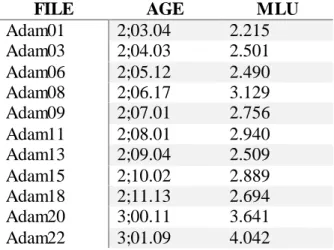
The files selected for the analysis of each speaker are the following:
Table 1. Brown Corpus: Adam
FILE AGE MLU
Adam01 2;03.04 2.215
Adam03 2;04.03 2.501
Adam06 2;05.12 2.490
Adam08 2;06.17 3.129
Adam09 2;07.01 2.756
Adam11 2;08.01 2.940
Adam13 2;09.04 2.509
Adam15 2;10.02 2.889
Adam18 2;11.13 2.694
Adam20 3;00.11 3.641
22
Adam24 3;02.09 3.537
Adam26 3;03.04 3.930
Adam28 3;04.01 4.213
Adam30 3;05.01 4.190
Adam33 3;06.09 4.390
Adam34 3;07.07 4.404
Adam35 3;08.01 4.569
Adam38 3;09.16 4.657
Adam39 3;10.15 4.618
Adam40 3;11.01 4.679
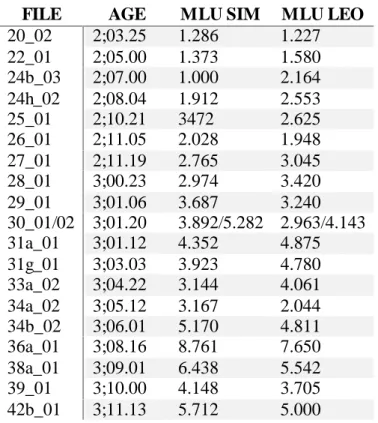
Table 2. FerFuLice Corpus: Simon & Leo
FILE AGE MLU SIM MLU LEO
20_02 2;03.25 1.286 1.227
22_01 2;05.00 1.373 1.580
24b_03 2;07.00 1.000 2.164
24h_02 2;08.04 1.912 2.553
25_01 2;10.21 3472 2.625
26_01 2;11.05 2.028 1.948
27_01 2;11.19 2.765 3.045
28_01 3;00.23 2.974 3.420
29_01 3;01.06 3.687 3.240
30_01/02 3;01.20 3.892/5.282 2.963/4.143
31a_01 3;01.12 4.352 4.875
31g_01 3;03.03 3.923 4.780
33a_02 3;04.22 3.144 4.061
34a_02 3;05.12 3.167 2.044
34b_02 3;06.01 5.170 4.811
36a_01 3;08.16 8.761 7.650
38a_01 3;09.01 6.438 5.542
39_01 3;10.00 4.148 3.705
42b_01 3;11.13 5.712 5.000
Table 3. Paradis Corpus: DVDC
FILE AGE MLU
DVDC1 6;03.23 3.615
DVDC2 6;10.05 4.362
DVDC3 7;03.27 5.021
DVDC4 7;09.29 4.603
23
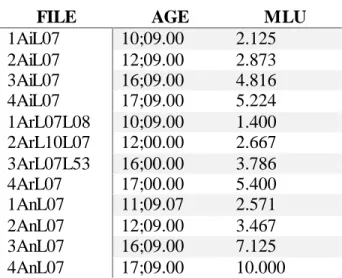
Table 4. BELC Corpus: L07
FILE AGE MLU
1AiL07 10;09.00 2.125
2AiL07 12;09.00 2.873
3AiL07 16;09.00 4.816
4AiL07 17;09.00 5.224
1ArL07L08 10;09.00 1.400
2ArL10L07 12;00.00 2.667
3ArL07L53 16;00.00 3.786
4ArL07 17;00.00 5.400
1AnL07 11;09.07 2.571
2AnL07 12;09.00 3.467
3AnL07 16;09.00 7.125
4AnL07 17;09.00 10.000
For the analysis of the data, I used tables such as 5 below, where I classified the number of
grammatical double object constructions and prepositional object constructions produced by
each child in any of the abovementioned files.
Table 5. Classification of the data
CORPUS AND PARTICIPANT’S NAME
AGE Double object constructions Prepositional object
constructions
---- ---- ----
---- ---- ----
---- ---- ----
TOTAL ---- ----
Regarding the COCA corpus, I sorted the results of the constructions which contain the verb
to give in oral production by frequency using the interface included in the corpus website.
Furthermore, I considered the first 27 examples (see table 6) as I think they are enough to
24
Table 6. COCA
1 programmers often build task-specific tools, one way to make them more productive is to give them better tool-making tools. When tools take the form of program generators, this
2 it is instead intended to create a wider understanding of the pervasive problem and to give a call to action. internet Buffers and Congestion The latency a packet experiences in
3 reasoned that since the business already had their information, it would be safe to give it again. Sheng et al.30 conducted a follow up study involving a large-scale survey examining
4 warning, thinking Microsoft would not put them at risk, and went on to give sensitive personal information. In response to this work, Microsoft redesigned its anti-phishing warnings
5 contrast to other forms of security training that might take place in a classroom and give people few opportunities to test what they’ve learned. Kumaraguru et al.24 developed an
6 a suitable simulator engine (such as Shawn14). Running their experimental code would give an initial feel for the general behavior of the candidate protocols and likely critical areas
7 at risk. By taking advantage of a PKI property called asymmetric secrecy, we give a specific solution addressing PFW. This method can be further developed to extend the
8 triangulation systems, and stereo vision systems). Some ETAs are meant to simply give an indication of the presence of an obstacle at a certain distance along a given
9 as prompts; how to present these prompts to the artists; what instructions to give the artists; and how to scan and process the drawings. The following sections
10 and the computer drawings (by using statistical correlations with human tendencies). We give each artist verbal and written instructions to make drawings with lines that convey the shape
11 exams, Fair Assessments) if available for demonstrating student learning. In order to give flexibility to elective teachers, additional measures of student learning gains could include anecdotal records
12 can also be taken from a sibling's umbilical cord. # Bone and tendons give structure to the human body. Injuries and excessive wear of these can cause pain
13 level, and five at the high school level. # Question 6: Please give an estimated number of elementary schools (K-S/6) in your state that are teaching
14 states. Refer to the Appendix table at **56;137792;TOOLONG. # Question 7: Please give an estimated number of technology and engineering teachers in your state during this school year
25
16 patients to come to an appointment better prepared to share in planning treatment is to give them their test results, with explanations (in appropriate languages if necessary),
17 # - Acknowledge that most decisions do not have to be taken immediate ly, and give patients and their families the resources and help to reach decisions # We call on
18 ECG has become an expected part of their daily workload. This article aims to give an overview of the test, helping nurses to understand the procedure and its use
19 go and see the person you are trying to influence. Ask your tester to give you feedback: # * Was your objective SMART? # * Were your arguments
20 periods as a means of obtaining a COC prescription. It is therefore important to give contraceptive use advice, even when prescribing for another indication. # Alverine citrate (
21 know if a client is meeting criteria for dependence now, but that doesn't give me any certainty that they will meet the criteria for dependence in 10 years,
22 be improved in terms of comprehensiveness following that first step -- the first-generation therapies that give robust human refirst-generation -- in order to stay one step ahead of the problem and
23 , and 20 more years until the first supersonic airlines. # Can we actually give more direct evidence that we are likely to achieve longevity escape velocity? I believe
24 's inescapable. If and when we do succeed in developing these rejuvenat io n therapies that give us those first couple of decades more of health and the postponement of age-related ill
25 getting anyone who is 150 until such time as we do develop these technologies that give us robust human rejuvenation. But we will have done the hard part, so
26 me that we have a clear moral obligation to develop these technologies so as to give humanity of the future the choice. And the sooner, the better. #
27 dismissed in the eyes of the average person, the business sector is starting to give it serious consideration based on its potential to increase revenue. # Economic value is
2.3.Data analysis
For the analysis of the selected data from the Brown, the FerFuLice, the Paradis, and the
BELC corpora, it is important to establish whether the double object construction or the
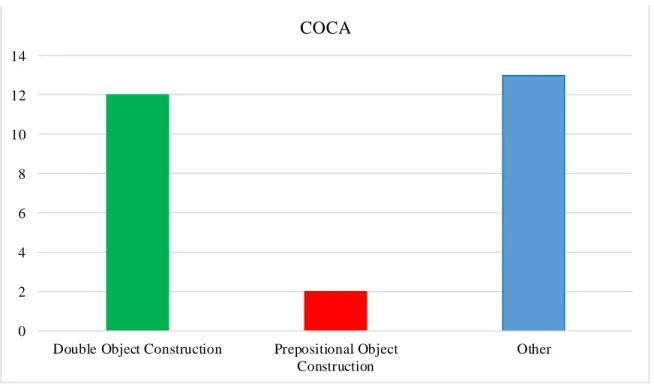
prepositional object construction is more common in spoken American English. From these
data, I may conclude that native speaker of American English prefer the use of the double
object construction in their oral production as 12 out of the 27 cases contain this structure
26 other examples encompass the use of transitive structures rather than ditransit ive
constructions. These data are illustrated in figure 1 below.
Figure 1. COCA
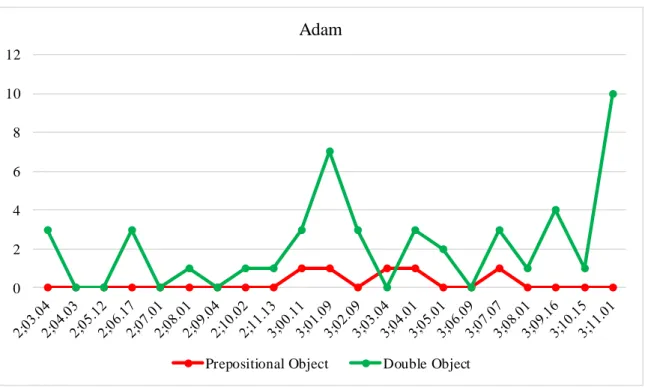
Adam, the child selected for the analysis of double object constructions as well as
prepositional object constructions in monolingual production, utters his first grammat ica l
double object construction at the age of 2;03.04 as it is illustrated in example (28) below.
Moreover, he does not produce any prepositional object construction until the age of 3;00.11
(see instance 29) as it is illustrated in figure 2 below.
(28) *CHI: give me screwdriver.
(29) *CHI: give that to me.
Furthermore, this figure shows that the production of grammatical double object
constructions is highly superior to that of prepositional object constructions at any analyzed
age with the exception of file Adam26, when the child is 3;03.04. At this age, he produces
one example of prepositional object constructions, but there is no evidence of double object
constructions in his data.
0 2 4 6 8 10 12 14
Double Object Construction Prepositional Object
Construction
Other
27
Figure 2: Adam
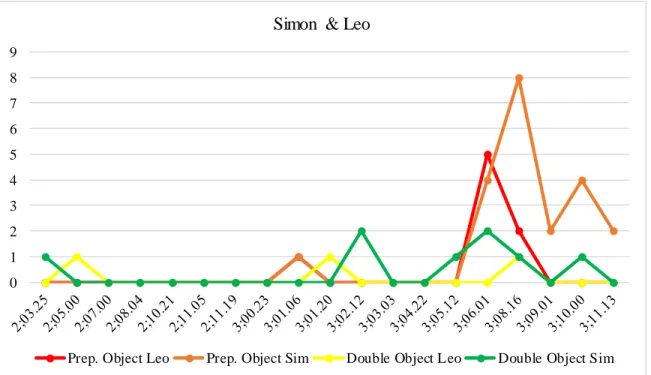
Secondly, I have analyzed simultaneous bilingual data of two identical twins, Simon and Leo,
taken from the FerFuLice corpus. The data of these children show that Simon starts producing
the double object structure correctly at the age of 2;03.25 (see example 31), whereas Leo
produces it for the first time at the age of 2;05.00 (see example 32). As far as prepositiona l
object constructions are concerned, Simon’s first correct production of this structure takes
place at the age of 3;06,01 (see example 33) while Leo’s is at the age of 3;01.06 (see example
34). They were expected to produce these structures more or less at the same age as they both
receive the same amount of input from their parents.
(31) *SIM: give me Tv.
(32) *LEO: give me farmer.
(33) *SIM: when [/] when you wake up then [/] then give it to me because it’s for
sharing, ok?
(34) *LEO: give it to the zoo.
0 2 4 6 8 10 12
Adam
28 Furthermore, these children’s data illustrate that the production of prepositional object
constructions is higher than that of double object constructions in almost all the files analyzed
as it is exemplified in figure 3 below. A possible explanation to this phenomenon can be that
they are influenced by their Spanish, which always requires the presence of a preposition so
as to assign dative case; and the acquisition of both languages at the same time may be
playing a role.
Figure 3: Simon & Leo
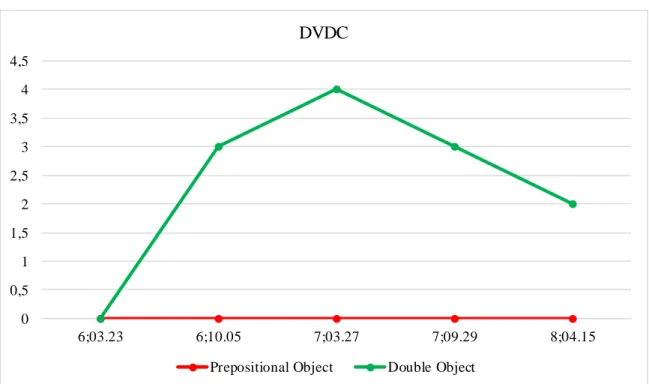
Thirdly, the data analyzed from DVDC, that belongs to the Paradis corpus, shows that this
child starts his production of adult-like double object constructions at the age of 6;03.23 (see
example 35); that is, after having been exposed to English for 15 months. On the other side,
there is no evidence in his data of prepositional object constructions. Considering that
DVDC’s L1 is Spanish, he might have been influenced by his L1 for the sooner production
of prepositional object construction; however, he seems to behave like an L1 speaker of
English as his throughout his data, it is observed that the production of double object
constructions is significantly higher compared to that of prepositional object constructio ns as
figure 4 illustrates.
0 1 2 3 4 5 6 7 8 9
Simon & Leo
29 (35) *CHI: but <my and my my> [/] my friend give me money [/] money.
Figure 4: DVDC
In the last corpus I analyzed, the BELC corpus, I found that the production of both double
object constructions and prepositional object constructions is almost inexistent, as there is
only one example of double object construction and no examples at all of prepositional object
constructions. The participant L07 produces his double object construction at the age of
17;00.00, as it is shown in example (36), in his fourth recording of role-play when he utters
the following (see figure 5 below):
(36) *L07: I need that you give me some.
0 0,5 1 1,5 2 2,5 3 3,5 4 4,5
6;03.23 6;10.05 7;03.27 7;09.29 8;04.15
DVDC
30
Figure 5: L07
The lack of production of this type of structures can be due to the fact that these data are not
simultaneous, but it is experimental as the participants were given the activities they had to
perform during all the recordings.
3. Discussion
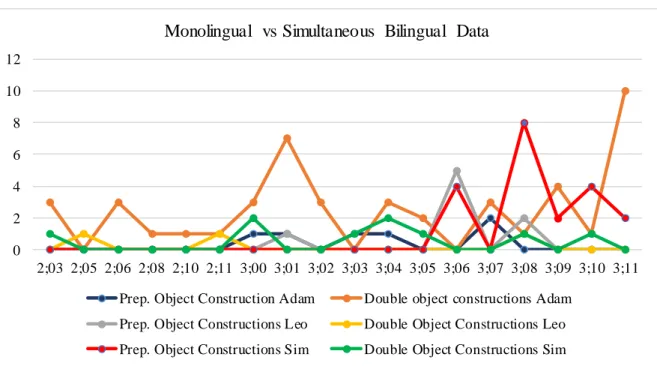
First of all, I would like to compare the production of this structure by Adam, the monolingua l
speaker of English, with that of Simon and Leo, the bilingual identical twins, in figure 6
below.
0 0,2 0,4 0,6 0,8 1 1,2
L07
31
Figure 6: Monolingual vs Bilingual Data
It can be determined from the data above illustrated that the amount of double object
constructions produced by the monolingual speaker of English is higher than that of the
bilingual twins. This can be due to the fact that double object constructions in English are
more frequently used than prepositional object constructions. Moreover, as the bilingua l
twins receive less English input than Adam, they are more likely to start producing this
structures later and acquire them in slightly different order as their other L1 is Spanish, a
Romance language, which does not allow double object constructions. Consequently, they
receive more input of prepositional object constructions than monolingual speakers of
English motivating the higher usage of prepositional object constructions.
Hence, for 2L1 English/ Spanish speakers of English, their linguistic background plays an
important role insofar as they seem to prefer prepositional object constructions rather than
double object constructions which are the ones that seem to be more frequently used by
monolingual speakers of English as the spoken data from the COCA corpus shows (see table
5 above).
Comparing the data analyzed from the simultaneous bilingual twins and that from the L1
Spanish/ L2 English speaker, it can be established that sequential bilinguals need less
0 2 4 6 8 10 12
2;03 2;05 2;06 2;08 2;10 2;11 3;00 3;01 3;02 3;03 3;04 3;05 3;06 3;07 3;08 3;09 3;10 3;11
Monolingual vs Simultaneous Bilingual Data
Prep. Object Construction Adam Double object constructions Adam
Prep. Object Constructions Leo Double Object Constructions Leo
32 exposure to English in order to start producing these constructions as this child does not
produce any prepositional object construction in the data that have been analyzed, and his
first production of the double object construction takes place after having been exposed to
English for 8 months, as it has been established in the previous section. DVDC was expected
to utter prepositional object constructions before double object constructions due to his
linguistic background since Spanish does not allow double object constructions; however, he
behaves like L1 speakers of English as it has been previously stated.
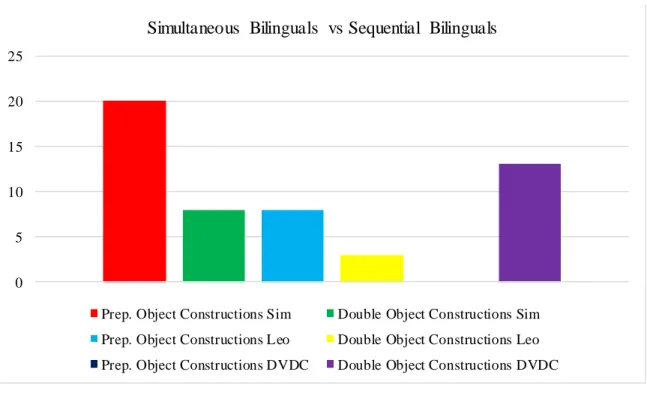
Contrary to Simon and Leo, DVDC establishes the double object structure as his preferred
construction with this verb as figure 7 below illustrates. It can be concluded from these data
that L2 speakers of English behave more like monolingual speakers of English than the 2L1
English/ Spanish identical twins.
Figure 7. Simultaneous Bilinguals vs Sequential Bilinguals
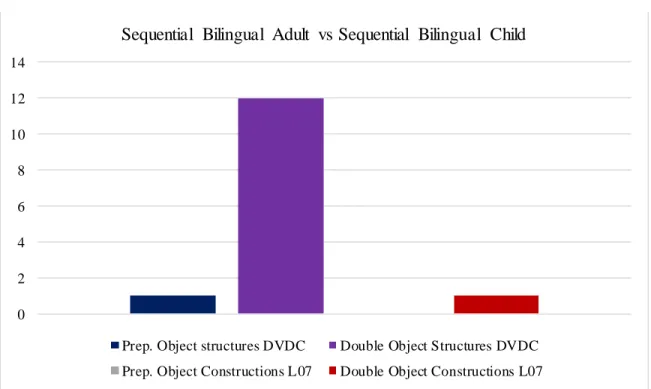
Comparing the production of double object constructions and prepositional object
constructions between children who acquire English in a naturalistic setting and adults who
learn English in an institutional setting in Spain, it can be stated that the speaker from the
BELC corpus, as well as the participant from the Paradis corpus, shows preference towards
0 5 10 15 20 25
Simultaneous Bilinguals vs Sequential Bilinguals
Prep. Object Constructions Sim Double Object Constructions Sim
Prep. Object Constructions Leo Double Object Constructions Leo
33 double object constructions, yet this is not a strong evidence as there is just one example of
this structure in his data. This is shown in figure 8 below.
Figure 8. Sequential Bilingual Adult vs Sequential Bilingual Child
Considering that these speakers use these two structures irrespectively, it seems that there is
no difference in meaning, at least taking into account the verb to give. Therefore, Larson’s
(1988) monosemy view applies better to this study. In terms of lexical restrictions, the verb
which has been chosen for this paper selects a to-object and also involves change in
possession what makes it likely to allow dativazation. Moreover, as it has been previously
expounded it is a verb with only one syllable and of English origin, what increases its
possibility to allow dativization.
The data show that the analyzed speakers are aware of the fact that the possessor must be a
person as they select the correct Oi. Furthermore, they are aware that this verb has all the
characteristics required to allow dativazation as both monolingual and bilingual speakers use
both constructions in their data. The difference between all these types of speakers is that
Adam, the monolingual child, prefers the use of double object constructions as well as the
0 2 4 6 8 10 12 14
Sequential Bilingual Adult vs Sequential Bilingual Child
Prep. Object structures DVDC Double Object Structures DVDC