Storage stability of SBS/sulfur modified bitumens at high temperature:
Influence of bitumen composition and structure
Inigo Aguirre de Career
3, Rosa M. Masegosa
3'*, M. Teresa Vinas
3, Marta Sanchez-Cabezudo
3,
Catalina Salom b, Margarita G. Prolongo b, Veronica Contrerasc, Francisco Barceloc, Antonio Paez'
*E.U.I.T. Aeronautica, Universidad Politecnica de Madrid, Spain bE.T.S.I. Aeronauticos, Universidad Politecnica de Madrid, Spain cRepsol, CTR, 28931 Mostoles, Madrid, Spain
• The composition of bitumen affects the storage stability of hot SBS modified bitumens. • Aromatic content of 40% and solid phase volume lower than 22% improve the stability. • The increase of solid phase content hinders the dispersion of the SBS rich phase. • Changes of the physical properties at 160 eC are related to the biphasic morphology.
Keywords: SBS copolymer
Polymer modified bitumen Thermal stability Phase separation Structure
Polymer modified bitumens, PMBs, are usually prepared at high temperature and subsequently stored for a period of time, also at high temperature. The stability of PMBs, in these conditions, has a decisive influence in order to obtain the adequate performances for practical applications. In this article the attention is focused in the analysis of the factors that determine the stability of styrene-butadiene-styrene copolymer (SBS)/sulfur modified bitumens when the mixtures are maintained at high temperature. Bitumens from different crude oil sources were used to prepare SBS/sulfur modified bitumens. Changes in the values of viscosity, softening point, as well as in the morphology of PMB samples, stored at 160 °C, were related to the bitumen chemical composition and to the amount of asphaltene micelles present in the neat bitumen used in their preparation.
1. Introduction
Polymer modified b i t u m e n s (PMBs) are widely used for paving roads. It has been widely shown that t h e presence of polymer in PMBs considerably improves its performance over a w i d e range of t e m p e r a t u r e s . In general, polymer modified bitumens display improved properties with respect to neat bitumens, increasing resistance to p e r m a n e n t deformation at relatively high t e m p e r a -tures without leading to deterioration of their properties at low t e m p e r a t u r e s .
Due to t h e structural complexity of bitumen, in t h e literature t h e r e are several models describing its behavior [1-5]. The colloidal model attributed to Nellensteyn [1] and later developed
* Corresponding author. Address: E.U.I.T. Aeronautica, Universidad Politecnica de Madrid, Plaza de Cardenal Cisneros no. 3, 28040 Madrid, Spain. Tel: +34 91 3367483(101).
E-mail address: [email protected] (R.M. Masegosa).
by Pfeiffer and Saal [2] is one of t h e most used to explain u n i q u e aspects of t h e b i t u m e n properties. According to t h e colloidal model t h e b i t u m e n s w e r e classified in t h r e e categories according their structure and rheological behavior. Sol-bitumens (Newtonian behavior) characterized by t h e existence of asphaltenes micelles isolated fully dispersed in maltenic phase, gel-bitumens (non-Newtonian behavior) characterized by t h e presence of asphaltene micelles interconnected forming a network, and finally, t h e s o l -gel b i t u m e n s w i t h an intermediate structure. Subsequent investigations have failed to d e m o n s t r a t e t h e existence of a gel-like structure in t h e b i t u m e n s [6]. Therefore, u n d e r t h e current knowl-edge, t h e differences of behavior of paving grade b i t u m e n s is only a m a t t e r of t h e low or high content of t h e solid fraction present in their structure [6].
the bitumen. The swollen polymer makes up the polymer-rich phase. At low concentrations of polymer, this phase is dispersed in a continuous asphaltene rich phase [6]. The biphasic structure of these systems is the key to improve the behavior of the PMB in relation to neat bitumen. Completely miscible PMBs have also been studied but their properties are very similar to those of neat bitumen. For this reason the total miscibility is not appropriate to achieve a significant improvement in properties compared to pure bitumen.
The thermodynamic equilibrium of PMBs corresponds to the total separation of the coexisting phases; this separation may occur during storage if the system has enough time and mobility. Accord-ingly, one of the main problems is to maintain polymer-bitumen mixture stable during the preparation and subsequent storage per-iod at high temperature [7]. It has been demonstrated [8,9] that the stability of the PMB's depends on factors such as chemical compo-sition and structure of the bitumen and polymer, and factors related to the operating conditions of the mixing procedure, including temperature, time and stirring speed.
There are different kinds of polymers used in the preparation of PMBs [10], polymers such as styrene butadiene rubber (SBR), ethylene vinyl acetate (EVA) and ethylene glycydyl acrylate (EGA) have been used. One of the most used polymers in the manufacture of PMBs is styrene-butadiene-styrene block copoly-mer (SBS) [7-11]. SBS polymers are available as linear, radial or branched copolymers. Radial SBS structure is formed by rigid styrene domains that act as physical crosslinks conferring resis-tance to the material, connected with butadiene segments of elastomeric nature that confer elasticity to SBS. In the tempera-ture range between the glass transition temperatempera-tures of the elastomeric blocks (-80 °C) and the rigid blocks (70 °C), SBS behaves as an elastomer.
SBS modified bitumens may not be fully stable when kept at high temperature during a large period of time, due to the differ-ences in the solubility parameter and density between SBS and bitumen [7,9,11]. In such systems, it is usual to add sulfur during the preparation process to increase the stability. The sulfur reacts with the alkene moieties present in SBS, creating chemical cross-links which help to stabilize the system [8,9,12].
In the literature there are numerous articles dedicated to investigate the stability behavior and the morphology of PMBs, analyzing the influence of aging [13-15], the use of graft copoly-mers containing ending reactive groups [7,16], the effect of the vulcanization reaction [8,12], the influence of polymer parame-ters such us, content [11], molecular weight [9], or even the chemical nature of the polymer [17,18]. However there are fewer studies dedicated to analyze the influence of the nature of the bitumen and its structure on the storage stability at high temper-ature of PMBs [9].
This paper is focused on the study of the stability behavior of SBS modified bitumens in the presence of sulfur. The study has two objectives, to analyze the influence of the structure and com-position of the bitumen on the stability and to check the change in the properties produced by the storage of the SBS bitumen mix-tures at high temperature (r=160°C). Bitumens from different crude oil sources have been selected for this study. The bitumens have been chemically characterized by SARA fractioning, and X-ray diffractometry has been used for structural characterization of asphaltene fractions. The SBS bitumen blends have been pre-pared using different bitumens mixed with 3 wt% of SBS, relative to the bitumen content. For these samples the macroscopic physi-cal properties, such as viscosity, penetration, softening point, and storage stability have been determined. Finally the storage stability at high temperature of SBS modified bitumens is discussed in terms of the structure and composition of the bitumens used in their preparation.
2. Materials and methods
2.1. Materials
In order to prepare SBS modified bitumens differing in structure and composi-tion, the procedure shown in Scheme 1 has been followed. The starting point corre-sponds to four bitumens supplied by Repsol, with different penetration values, belonging to different crude oil sources, arabian (A17, A570) and maya (M18, Ml 72). Mixing of these pairs of bitumens allows the manufacture of two new bit-umens, A100 and M100, which differ in the crude oil source but have penetration values around 100 dmm. Finally A100 and Ml 00 are mixed in appropriate amounts in order to obtain bitumens, with penetration values around 100 dmm, designated as M/A, that will be subsequently modified with SBS. For clarification, M20/A80 bitumen contains 20 wt% of M100 bitumen and 80 wt% of A100 bitumen. The sep-aration of bitumens into four generic fractions was performed by column chroma-tography (ASTM D4124-01). The asphaltene content of the bitumens was determined by n-heptane extraction. Subsequently deasphalted fraction was sepa-rated using different eluents. Heptane, toluene, methanol/toluene (50/50) and tri-chloroethylene were used to extract saturates, aromatics and resins fractions for each bitumen, respectively.
In order to characterize the macroscopic physical properties of the bitumens conventional test methods such as penetration test, viscosity test and softening point test were performed. The results are shown in Table 1.
The modifying polymer, supplied by Dynasol, was the styrene-butadiene-rene (SBS) block copolymer, Calpstyrene-butadiene-rene 411, a radial polymer containing 30 wt% sty-rene and 70% of butadiene and an average molecular weight Mw = 300 x 103 .
2.2. Preparation of samples
SBS modified bitumens were prepared by melt blending using a high shear mix-er Silvmix-erson L4RT. 500 g of bitumen samples placed in a metal containmix-er wmix-ere heated and stirred at T= 190 °C, then 3 pph of SBS polymer was added gradually, and stirring was maintained at 5000 rpm for 5.5 h. Finally, for vulcanizing, 0.05 pph of sulfur and 0.075 pph of ZnO were added to the blend, while the stirring was continued for 30 min under the same stirring conditions. All amounts are re-ferred to the amount of bitumen in the blends. It is worthy mention that the phys-ical properties of neat bitumens did not undergo significant changes when the bitumens were subjected to the same process used to prepare blends with SBS.
2.3. Test methods and storage stability
The base bitumens and SBS modified bitumens were subjected to the following conventional tests: penetration (UNE-EN 1426), softening point (UNE-EN 1427) and viscosity (UNE-EN 12595:2007). Viscosity measurements were performed in a Brookfield Model DV-II + Pro viscometer at T= 135 °C.
Aluminum toothpaste tubes (32 mm in diameter and 160 mm in height) filled with vulcanized SBS modified bitumens have been used for determining the storage stability of the blends. Difference between softening points of the blends fractions placed at the top and at the bottom of the tubes has been determined after main-taining them in vertical position for 72 h at 160 °C.
2.4. Infrared spectroscopy (FTIR)
A FT-IR Nicolet 6700 spectrometer was used to determine the distribution of polymer rich phase in the samples subjected to stability test. IR spectra were re-corded in the range 600-4000 cm- 1, and the standard analytical conditions were 32 scans, resolution 4 c m- 1 and transmission mode. Solutions of 5 wt% of SBS mod-ified bitumens in dichloromethane were prepared. Subsequently these solutions were dropped onto a KBr disk and finally dried in a dry nitrogen stream.
Table 1
Properties of the bitumens.
Bitumen Ml 72 M18 A17 A570 A100 Ml 00 M80/A20 M60/A40 M40/A60 M20/A80 Penetration 25 °C 172 18 17 570 100 103 102 104 104 103 (0.1 mm)a Softening point (°C)b 44 66 61 30 45 44 45 45 44 45 Viscosity 135 °C (Pas)c
0.22 1.65 1.02 0.96 0.27 0.35 0.31 0.3 0.29 0.28
2.5. X-ray diffractometry
X-ray diffractometer Xpert-PRO ALPHA 1 with fast Xcelerator detector operat-ing at 45 kV and 40 mA was used to obtain the diffractograms of powdered asphalt-enes samples. The diffraction patters (26 = 3-110°) were recorded at room temperature using Cu Kotl radiation (A = 1.5406 A) by continuous scanning with a step size of 0.1°. Using adequate software the backgrounds were subtracted from the diffractograms and the overlapped bands deconvoluted in order to obtain peak position, peak intensity, area and width of the band at half maximum for each of the bands.
2.6. Fluorescence microscopy
Small amounts of hot SBS modified bitumen samples were deposited over slides and viewed under a Leica DM100 microscope with a 400x magnification at room temperature. The microscope was equipped with a UV lamp and a filter in the range 390-490 nm.
3. Results and discussion
3.1. Bitumen characterization
60
50
40
30
20
10
0
u
-HMaya 172
DMaya 18
B A r a b i a 5 7 0
D Arabia 17
V
Saturates Aromatics Resins Asphaltenes
Fig. 1. SARA fractions for arabian and maya bitumens.
Bitumens are very complex materials which consist of numer-ous species of hydrocarbons. Depending on their origin, the chem-ical composition of the bitumen can change significantly. The stability of SBS-modified bitumens is determined mainly by the interaction between SBS and the aromatic fraction of bitumen
[6]. Consequently, the aromatic fraction is compromised between the need to interact with the polymer giving rise to polymer swell-ing and the need to maintain the colloidal equilibrium of bitumen in order to keep the stability of SBS modified bitumen. On the other hand, taking into account that polymers and asphaltenes do not mix, the content of asphaltenes will be another factor to consider when analyzing polymer-bitumen stability.
The macroscopic physical properties and SARA fractions of the bitumens used are shown in Table 1 and Figs. 1 and 2. The data for AlOO and M100 bitumens and their blends M/A, shown in
Fig. 2, have been obtained from the data in Fig. 1 taking into ac-count the amounts of the bitumens Ml8, Ml72, A17 and A570 used their respective fabrication.
Bitumens with high aromatic/asphaltene ratios favor the stabil-ity of bitumen and polymer mixtures. Fig. 2 shows, for the M/A bitumen series, a gradual change of aromatic/asphaltene ratio from AlOO bitumen to Ml00 bitumen. Therefore, it can be expected that bitumens with a higher proportion of maya bitumens would be less stable with the polymer.
However this statement does not consider that, according to the colloidal model, the asphaltenes in the bitumen are surrounded by a solvation shell of solid resins forming micelles, making the total fraction of solids dispersed in the maltene matrix higher than that obtained by considering only the solid asphaltene content obtained in the SARA fraction. It has been demonstrated that the increase in the fraction of the solid phase due to the surfactant resins, has importance in the rheological behavior of bitumens [6,19,20]. The thickness of this solvation shell is a function of the type of bitumen, asphaltene content and temperature [6,19]. Consequently, it would be expected that bitumens, with similar content of asphaltenes,
M18 ^
>
M172 ^
A17 ~~"\
A570 -"""' M100
A100 x
)
/
M80/A20
M60/A40
M40/A60
M20/A80
60
50
40
% 30
20
10
0 r
DA100
DM20/A80
DM40/A60
HM60/A40
• M80/A20
DM100
Saturates Aromatics Resins Asphaltenes
Fig. 2. SARA fractions for AlOO, M100 and M/A bitumens.
' 1 '
Scheme 1. Mixtures of bitumens used in the preparation of SBS modified bitumen.
0.05 0.10 0.15 0.20 0.25 0.30
(sine) ix
Fig. 3. X-ray diffraction patterns for asphaltene fractions.
could have different percentage of solid phase, depending on their origin or the temperature at which they are stored. This circum-stance will certainly have influence in the polymer stability behav-ior and deserves to be taken into account.
rings and long aliphatic chains. The structure of maya and arabian asphaltenes has been studied by X-ray diffractometry measure-ments. The X-ray diffraction patterns of dust samples of arabian and maya asphaltenes were obtained at room temperature, and the results are displayed in Fig. 3.
The diffractograms show three independent bands according to literature, the y-band and the 002-band overlapped in the region of sin 0/1 = 0.05-0.15, and a third band, 10-band, located at sin 0/
X ~ 0.24. Using adequate software the backgrounds were
sub-tracted from the diffractograms and the overlapped bands decon-voluted in order to obtain peak position, peak intensity, area and width of the band at half maximum for each of the bands.
From the y-band and 002-band it is possible to calculate the distance between aliphatic chains or saturated rings, dy, and the distance between two aromatic layers of condensed aromatic rings, dm, applying the Brag law, as:
2 sin( (1)
where the subscript i correlate to y or m and 0 indicates the peak position of the y-band or 002-band, respectively.
The diameter of the aromatic cluster perpendicular to the plane of the aromatic sheets, Lc, can be obtained from W1/2 (width of the band at half maximum) of the 002-band, using equation [21,22]:
U =
W 0.451/2 (2)
The ratio LJdm indicates the average number of aromatic sheets, Me.
From the W ^ of thelO-band the diameter of the condensed aromatic sheets, La, can be calculated using equation [21,22]:
U
0.92W1 li (3)
The structural parameters, dm, dy, lc, La and Me are shown in
Table 2. The structural parameters calculated show no appreciable differences in the structure of the maya and arabian asphaltenes. For all the asphaltenes studied the values of Lc, the diameter of the aromatic cluster, show values around 20 A, and Me, the average number of aromatic sheets, around 6, in concordance with litera-ture results [21,22]. The only significance difference is observed for the La values, which indicates aromatic ring structures slightly
more condensed for maya asphaltenes than for asphaltenes of ara-bian origin.
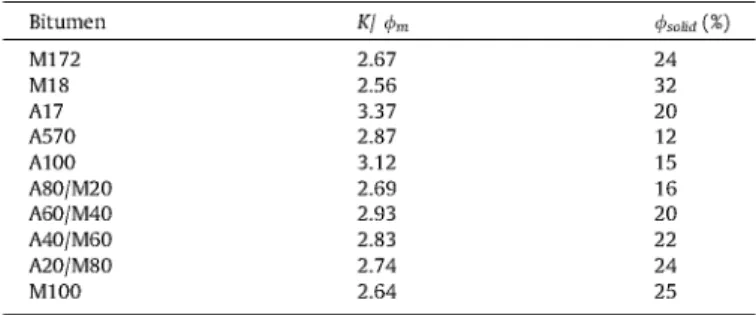
To determine the total amount of solid phase present in bitu-men (asphaltenes + surfactant resins), it is necessary to know the size of the solvation layer of resins which act as surfactant. A solvation parameter K has been proposed [19]. The product of the solvation parameter and the weight fraction of asphaltenes,
Kwasph is equal to the total mass fraction of solid phase in bitumen.
This solvation parameter K can be obtained from rheological mea-surements using the Roscoe law [23]:
n = Vm i Kw, asph (4)
where r\ and r\m represent the viscosity of the bitumen and the
maltene matrix, respectively, and <pm is the maximum packing
Table 2
Structural parameter obtained from X-ray diffraction patterns for arabian and maya asphaltenes. Bitumen A17 A570 M18 Ml 72 dT(A) 4.76 4.76 4.72 4.71 dm(A) 3.57 3.57 3.57 3.57 Lc(A) 19.6 22.1 21.4 20.4 La(A) 11.5 10.6 13.7 15.3 Me 5.5 6.1 6.0 5.7 Table 3
K/ <j>m values and volume fraction of solid phase, atT=160°C.
, for arabian and maya bitumens
Bitumen I<l 4>m 4>solid (%)
Ml 72 M18 A17 A570 A100 A80/M20 A60/M40 A40/M60 A20/M80 Ml 00 2.67 2.56 3.37 2.87 3.12 2.69 2.93 2.83 2.74 2.64 24 32 20 12 15 16 20 22 24 25
fraction of asphaltene particles. Eq. (4) has been used to explain the variation of the bitumen viscosity with the temperature in the Newtonian regime [19], that is, at temperatures above 60 °C [6].
On other hand, Eq. (4) also provides the possibility to obtain the re-duced solid fraction, Kwasphl4>m, in the bitumen by rheological
mea-surements. K/4>m at 160 °C have been determined for M18, M172,
A17 and A570 bitumens from r\ and r\m measurements obtained
in the temperature range T= 93-185 °C Table 3. The volume frac-tion of solid phase 4>SoUd ~ ^Wasph for arabian and maya bitumens
can be determined from KJ4>m values using <pm = 0.57 corresponding
to asphaltenes dispersed in toluene [19] and considering Wasph
-~ 4>asph (volume fraction of asphaltenes), given that the density of asphaltenes is very close to 1. The values of </>soKd are shown in Table 3. The values of KJ4>m and 4>soiid from M/A bitumen series, have
been calculated from the weight percentage of maya and arabian bitumens used in their preparation (see Scheme 1). The results ob-tained are also shown in Table 3.
Given that maya bitumens have a higher content of asphaltenes and lower content of resins and aromatics, the values of K/<j> de-crease with increasing proportions of maya bitumens in M/A bitu-men series. As consequence the size of the solvation shell for bitumens with high content of maya component is less than those with high content of arabian bitumens. However, since maya bitu-mens have higher amounts of asphaltenes, in the M/A bitubitu-mens series it is observed a gradual increase of the volume fraction of so-lid phase disperse in the maltene matrix. When the solvation of asphaltenes micelles is considered, all the bitumens show higher percentage of solid phase than the corresponding to the percentage of asphaltenes obtained from the SARA fractions.
SBS modified bitumens are heterogeneous systems in which the SBS is swollen in aromatic components dispersed in a maltene ma-trix, this maltene matrix contains less aromatics than the original bitumen and is therefore enriched in solid solvated asphaltenes. The volume occupied by swollen polymer and the volume of solid phase are important factors to take into account for understanding the stability behavior of these kinds of systems. The stability behavior of SBS modified bitumens will be analyzed below as a function of the content of solid solvated asphaltenes.
3.2. Stability of SBS modified bitumens
Table 4
Properties of SBS modified bitumens.
Bitumen Viscosity a (135°C;Pa-s)
Penetration 25 °C; 0.1 mm
Softening pointc (°C)
A100 A80/M20 A60/M40 A40/M60 A20/M80 Ml 00
0.986 1.065 1.180 1.280 1.637
75 73 71 64 60
62 60 61 66 76
UNE-EN 12595:2007. UNE-EN 1426. UNE-EN 1427.
90
85
80
O 7 5
-.5 70
o a,
bp 65
=S 601
Q
CO
55
50
45 J
• TOP • BOTTOM
T6
68 68 ,—,66 63
65
£ -61
6 2 ,M80/A20 M60/A40 M40/A60 M20/A80 A100
Fig. 4. Difference in softening points between top and bottom sections for SBS
modified bitumens.
0.25
0.20
0.15
'••_
3 0.10
0.05
0.00
DTOP a BOTTOM
M80/A20 M60/A40 M40/A60 M20/A80 A100
Fig. 5. FTIR area ratio, A966/A1376, bitumens.
for top and bottom sections for SBS modified
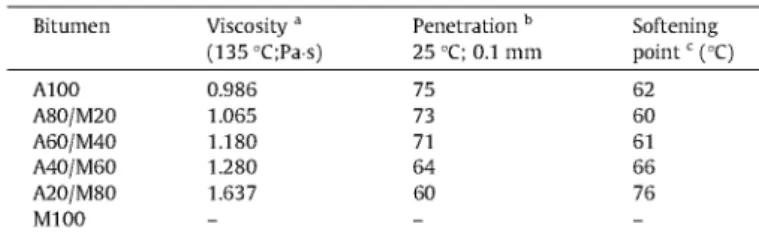
FTIR spectra of PMBs have been used to explore the separation process of the SBS-bitumen samples in the stability tests. The band found at 966 e n r1 corresponding to the trans disubstituted —CH=CH— butadiene block [24] has been used as reference. In or-der to make a comparison between the results for different sam-ples, the area of the band at 966 c m1 was normalized by the area of the band at 1376 c m- 1 assigned to the bending of C—H groups of ending CH3 present in bitumen, obtaining a butadiene in-dex proportional to the amount of butadiene present in the sam-ples. The results shown in Fig. 5 indicate that an enrichment of bitumen with maya component above 40 wt% provokes the migra-tion of the SBS polymer towards top secmigra-tion, which is reflected by
an increase of the difference between the value of A366IA1376 for the
top and bottom sections. These results agree with those obtained from the softening points and imply that the FTIR technique is suit-able for determining the stability of bitumen-SBS systems.
Although the macroscopic properties of the bitumens belonging to M/A series are similar (see Table 1), the physical macroscopic properties of SBS modified bitumens (see Table 4) and their stabil-ity behavior are significantly different. This differentiating behav-ior can be explained by the differences in the composition and structure of the bitumens. The amount of the aromatic fractions in-creases around 25% going from M100 bitumen to A100 bitumen (see Fig. 2) making the interaction with SBS blocks more favorable. On the other hand the fraction of solid volume dispersed in the maltene matrix increases 67% going from A100 bitumen to M100 bitumen (see Table 3). It is also important to consider that this in-crease will be even greater if the dein-crease of the aromatic fraction provoked by the swelling of the polymer is taken into account. These two factors (composition of maltene matrix and increase in solid volume fraction) have certainly influence when it comes to analyze the changes observed on the stability SBS-bitumen as seen for M80/A20 and M100 bitumens.
3.1
2.6
,-, 2.1
d
'Tri O
U
w > I.I
0.6-O
0.1
90
85
80
75
OA100/SBS
• M20/A80/SBS
OM40/A60/SBS
XM60/A40/SBS
• M80/A20/SBS
A M80/A20
x< —<v
.-—«
•
-A
X
m - •
20 40 60
t ( h )
80 100
I 70
<§ 65
60
55
OA100/SBS
• M20/A80/SBS
OM40/A60/SBS
XM60/A40/SBS
• M80/208/SBS
B
:*
20 40 60
t(h)
80 100
Fig. 6. Variation of macroscopic physical properties of SBS modified bitumens
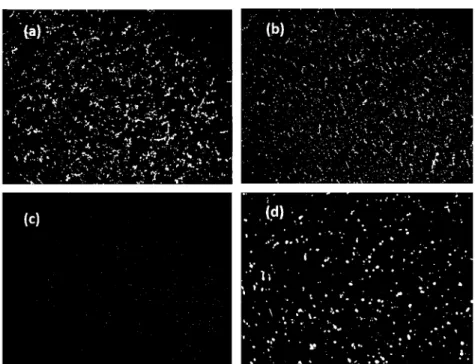
Fig. 7. Fluorescence micrographs (400x) of the AlOO/SBS sample, without sulfur added, taken at stirring times: (a) 2 h; (b) 4 h; (c) 6 h. (d) AlOO/SBS sample subsequently
stored 20 h at T=160°C.
3.3. Storage stability ofSBS modified bitumens
From a practical point of view one of the major limitations of the PMBs is the lack of stability when they are stored for long peri-ods of time at high temperatures. This situation facilitates the dif-fusion and may even provoke polymer phase separation due to the difference in density between SBS and bitumen. The tendency to phase separation causes changes in the physical properties of these systems that they can become critical for practical applications.
In order to evaluate changes in the behavior of SBS-bitumen sys-tems, viscosity and softening points have been determined as a function of storage time at 160 °C The results are shown in Fig. 6.
It can be seen that the bitumen-SBS systems stored at 160 °C evolve over time provoking a continuous rise of the viscosity and softening point. It is also observed that the evolution of the systems is more noticeable in those with higher content of maya bitumen.
To attempt to explain this behavior the changes in the structure of neat bitumen were considered. At high temperature oxidation could provoke an increase in viscosity and softening point when neat bitumen undergoes the same treatment as PMB samples.
Fig. 6 shows the behavior of M80/A20 bitumen when it is subjected to the same thermal treatment, showing that the changes observed in the PMBs systems cannot be attributed to changes in the properties of neat bitumen.
Fig. 8. Fluorescence micrographs (400x) of the M100/SBS sample, without sulfur added, taken at stirring times: (a) 2 h; (b) 4 h; (c) 6 h. (d) M100/SBS sample subsequently
Fig. 9. Fluorescence micrographs (400x) of the AlOO/SBS sample estabilized by sulfur and stored at T= 160 °C, taken at storage times: (a) 26 h; (b) 30 h; (c) 50 h; (d) 72 h.
Fig. 10. Fluorescence micrographs (400x) of the M80/A20/SBS sample estabilized by sulfur and stored at T= 160 °C, taken at storage times: (a) 26 h; (b) 30 h; (c) 50 h; (d)
72 h.
Fluorescence microscopy allows observation of the dispersed polymer phase in the bitumen, showing the areas containing poly-mer in white color, while black color corresponds to bitumen areas. In order to analyze the morphological changes of bitumen/SBS sys-tems, Figs. 7 and 8 show micrographs of the AlOO/SBS and M100/ SBS systems. These micrographs were taken during the mixing pro-cess and upon subsequent storage at 160 °C for 20 h, without the addition of sulfur. In order to reflect, as accurately as possible the morphology of bitumen/SBS system, the micrographs were taken of fresh samples immediately after being cooled quenched. Simi-larly, micrographs of the AlOO/SBS and M80/A20/SBS, show in
Figs. 9 and 10, were taken after the addition of sulfur during stor-age at r = 1 6 0 ° C
possible to observe that, the average particle size of SBS polymer phase in the A100/SBS sample is slightly lower than in the M100/ SBS sample, which could be indicative that SBS reaches a lower swelling degree in the maltene matrix of A100 bitumen.
The observation of the bitumen/SBS samples without sulfur may be helpful to explain the stability and storage behavior of the samples stabilized with sulfur. When sulfur is added to SBS/ bitumen samples reacts with the alkene moieties of SBS, creating chemical crosslinks that stabilize the system. Due to the higher le-vel of dispersion of the polymeric phase and the lower degree of swelling of SBS in A100 bitumen the accessibility of the SBS alkene groups to react with the sulfur will be greater, and consequently the efficiency of the reaction with sulfur will increase. This can be observed in Fig. 9 corresponding to the A100/SBS sample stored at T= 160 °C after being stabilized by vulcanizing sulfur. However, poorer dispersion of SBS in M80/A20 bitumen provokes that the vulcanizing sulfur reaction is not so effective. Fig. 10 shows the evolution of the M80/A20/SBS sample as a function of storage time at r=160°C, where it is possible to distinguish, at long storage times (72 h), discrete polymer domains in agreement with a more heterogeneous system. These results agree with stability test dis-cussed above.
These microscopy observations also agree with viscosity and softening points results (Fig. 6). Due to the low percentage of solid phase (asphaltene solvated by solid resins) and high amount of aromatics (see Table 3 and Fig. 2), bitumen with high content of arabian component, such as A100 bitumen and M20/A80 bitumen, show a good interaction with SBS which facilitates its stabilization by sulfur vulcanization. In this situation the macroscopic proper-ties of such SBS modified bitumen remain practically stable during storage at high temperatures, and therefore are suitable for practi-cal applications. On the other hand, the higher the content of maya bitumen in the mixture, the poorer is the interaction with SBS. Higher content of solid phase (asphaltene solvated by solid resins) and lower aromatic proportion leads to lower polymer dispersion making sulfur stabilization less efficient in systems with higher maya content. These systems show significant changes in their macroscopic properties during storage at high temperature, becoming unstable when the amount of maya bitumen is higher than 60 wt%.
4. Conclusions
Good storage stability at high temperature for SBS modified bitumen, depends on the structural parameters of bitumen used in their preparation. The bitumens used in this work display simi-lar values in their physical macroscopic properties, suitable for polymer modification, and similar asphaltene structures, but show evident differences in stability behavior in the presence of a radial SBS modifier. Significant changes in aromatic content and in the percentage of solid phase (asphaltene solvated by solid resins) dispersed in maltene matrix are responsible of this behavior. The
results show that a good interaction of SBS modified-bitumen needs, in these preparatory conditions, the presence of aromatic contents around 40 wt%, and solid phase volume, tpsoud, lower than 22%.
References
Nellensteyn FJ. The constitution of asphalt. J Inst Pet Technol 1924;10:311-25. Pfeiffer JP, Saal RNJ. Asphaltic bitumen as colloid systems. J Phys Chem 1940;44:139-49.
Petersen JC, Robertson RE, Branthaver JF, Harnsberger PM, Duvall JJ, Kim SS, et al. Binder characterization and evaluation, vol. 1. SHRP report A-367. Washington, DC: National Research Council; 1994.
Christensen DW, Anderson DA. Rheological evidence concerning the molecular architecture of asphalt cements. In: Proceedings chemistry of bitumen, vol. 2. Rome; 1991. p. 568-95.
Redelius P. The structure of asphaltenes in bitumen. Road Mater Pave Des 2006:143-62 [special issue EATA 2006].
Lesueur D. The colloidal structure of bitumen: consequences on the rheology and on the mechanisms of bitumen modification. Adv Colloid Interface Sci 2009;145:42-82.
Fu H, Xie L, Dou D, Li L, Yu M, Yao S. Storage stability and compatibility of asphalt binder modified by SBS graft copolymer. Constr Build Mater 2007;21:1528-33.
Chen JS, Huang CC. Fundamental characterization of SBS-modified asphalt mixed with sulphur. J Appl Polym Sci 2007;103:2817-25.
Larsen DO, Alessandrini JL, Bosch A, Cortizo MS. Micro-structural and rheological characteristics of SBS-asphalt blends during their manufacturing. Constr Build Mater 2009;23:2769-74.
Yildirim Y. Polymer modified asphalt binders. Constr Build Mater 2007;21:66-72.
Sengoz B, Isikyakar G. Analysis of styrene-butadiene-styrene polymer modified bitumen using fluorescent microscopy and conventional test methods. J Hazard Mater 2008;150:424-32.
Wen G, Zhang Y, Zhang Y, Sun K, Chen Z. Vulcanization characteristics of asphalt/SBS blends in the presence of sulphur. J Appl Polym Sci 2001;82:989-96.
Wua S, Pang L, Moa L, Chen Y, Zhu G. Influence of aging on the evolution of structure, morphology and rheology of base and SBS modified bitumen. Constr Build Mater 2009;23:1005-10.
Zhang F, Yu J, Wu S. Effect of ageing on rheological properties of storage-stable SBS/sulfur-modified asphalts. J Hazard Mater 2010;182:507-17.
Zhang F, Yu J, Han J. Effects of thermal oxidative ageing on dynamic viscosity, TG/DTG, DTA and FTIR of SBS- and SBS/sulfur-modified asphalts. Constr Build Mater 2011;25:129-37.
Luo W, Chen J. Preparation and properties of bitumen modified by EVA graft copolymer. Constr Build Mater 2011;25:1830-5.
Lu X, Isacsson U. Modification of road bitumens with thermoplastic polymers. Polym Testing 2001;20:77-86.
Sengoz B, Topal A, Isikyakar G. Morphology and image analysis of polymer modified bitumens. Constr Build Mater 2009;23:1986-92.
Storm AS, Ronald J, Barresi, Sheu EY. Rheological study of Ratawi vacuum residue in the 298-673 K temperature range. Energy Fuels 1995;9:168-76. Lesseur D, Gerard JF, Claudy P, Letoffe JM, Plance JP, Martin D. Relationship between structure and the mechanical behaviour of paving grade asphalt cements. J Assoc Asphalt Paving 1997;66:486-507.
Yen TF, Erdman JG, Pollack SS. Investigation of structure of petroleum asphaltenes by X-ray diffraction. Anal. Chem. 1961;33:1587-93.
Christopher J, Sarpal AS, Kapur GS, Krishna A, Tyagi BR, Jain MC, et al. Chemical structure of bitumen-derived asphaltenes by nuclear magnetic resonance spectroscopy and X-ray diffractometry. Fuel 1996;75:999-1008.
Roscoe R The viscosity of suspensions of rigid spheres. Br J Appl Phys 1952;3:267-9.