A molecular electron density theory study of the
[3 + 2] cycloaddition reaction of nitrones with
strained allenes
†
Luis R. Domingo, *a
Mar R´ıos-Guti´errez aand Patricia P´erez b
The [3 + 2] cycloaddition (32CA) reaction of C-phenyl-N-tert-butylnitrone with 1,2-cyclohexadiene (CHDE), a strained allene, has been studied within Molecular Electron Density Theory (MEDT) at the DFT B3LYP/6-311G(d,p) computational level. This polar 32CA reaction, which takes place through a non-concertedtwo-stage one-stepmechanism, proceeds with a moderate Gibbs free activation energy of 22.7 kcal mol1, and presents low stereo- and regioselectivities. The reaction begins by the creation of a pseudoradicalcenter at the central carbon of the strained allene with a relatively low energy cost, which immediately promotes the formation the first C–C single bond. This scenario is completely different from that of the 32CA reaction involving the simplest allene. The strain present in CHDE changes its reactivity to that characteristic of radical species. Consequently, not distortion as previously proposed, but the radical reactivity type of the strained allene is responsible for the feasibility of this 32CA reaction.
1.
Introduction
The use of strained species such as benzyne5and cyclic alkynes such as cyclopentyne 8 in organic synthesis permits their participation in organic reactions in which linear alkynes do not react (see Scheme 1). Thus, while the non-polar ene reaction between 2-methylpropene1and ethylene2presents a very high activation energy, 34.7 kcal mol1,1the non-polar ene reaction
between 2-methylbut-2-en4and benzyne5has an unappreci-able activation energy, 1.2 kcal mol1.2 Similarly, the [2 + 2] cycloaddition between enol ether 7 and cyclopentyne 8 also presents a low activation energy, 6.2 kcal mol1.3
One appealing procedure that provides a straightforward connection between the electron density distribution and the chemical structure is the quantum chemical analysis of the Becke and Edgecombe's Electron Localisation Function (ELF).4 An ELF topological analysis of the electronic structure of ben-zyne 5 made it possible to explain the high reactivity of this strained aromatic alkyne.2 The ELF of benzyne 5 shows the
Scheme 1 Non-polar reactions of ethylene and strained species. Activation energies, in parentheses, are given in kcal mol1.
aDepartment of Organic Chemistry, University of Valencia, Dr Moliner 50, E-46100
Burjassot, Valencia, Spain. E-mail: [email protected]; Web: http://www. luisrdomingo.com
bUniversidad Andres Bello, Facultad de Ciencias Exactas, Departamento de Ciencias
Qu´ımicas, Millennium Nucleus Chemical Processes and Catalysis (CPC), Av. Rep´ublica 498, 8370146, Santiago, Chile
†Electronic supplementary information (ESI) available: Study of the reaction paths associated with the 32CA reaction between nitrone15and the simplest allene18. BET study of the regiosiomericr1reactive channel associated with the 32CA reaction between nitrone15 and the simplest allene 18and the endo/r1reactive channel associated with the 32CA reaction between nitrone15
and strained allene CHDE10. ELF topological analysis along theexo/r1reactive channel associated with the 32CA reaction between nitrone15and strained allene CHDE 10. Theoretical background of the ELF and BET. B3LYP/6-311G(d,p) thermodynamic data. B3LYP/6-311G(d,p) thermodynamic data of the stationary points involved in the 32CA reaction of nitrone15with CHDE 10. Analysis of the dependence of the thermodynamic data of the stationary points involved in the 32CA reaction between nitrone15and CHDE
10with the DFT functional. B3LYP/6-311G(d,p) total and relative energies, in gas phase and in acetonitrile, of the stationary points involved in the 32CA reaction of nitrone15with the simplest allene18and CHDE10andnally, the computed total energies, the only imaginary frequency and Cartesian coordinates, in acetonitrile, of the structures involved in the 32CA reaction between nitrone15and strained allene CHDE10. See DOI: 10.1039/c7ra01916e Cite this:RSC Adv., 2017,7, 26879
Received 15th February 2017 Accepted 10th May 2017
DOI: 10.1039/c7ra01916e
rsc.li/rsc-advances
PAPER
Open Access Article. Published on 17 May 2017. Downloaded on 13/12/2017 20:05:28.
This article is licensed under a
Creative Commons Attribution 3.0 Unported Licence.
presence of two monosynaptic basins, V(C1) and V(C2), inte-grating 0.64eeach one (see Fig. 1). This electronic characteristic of benzyne5allowed associating its reactivity to that of a high reactivepseudodiradicalspecies.2,5Note thatpseudoradicalsare closed-shell species topologically characterised by the presence of at least one V(C) monosynaptic basin integrating less than 1.0eat one carbon atom.6
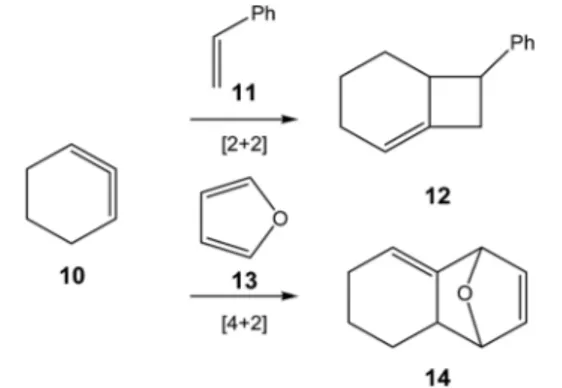
Unlike arynes and cyclic alkynes, whose structure and reac-tivity have been widely studied,1–3,7 highly strained allene species have been studied to a much lesser extent. Since 1966, when Wittig reported, for therst time, the existence of 1,2-cyclohexadiene (CHDE) 10,8 the chemistry of this highly strained species has received little attention especially compared to its aryne and alkyne counterparts. Only some theoretical studies devoted to [2 + 2]9–13and [4 + 2]14,15 cycload-ditions of CHDE10 yielding cycloadducts12 and14, respec-tively, have been reported (see Scheme 2).
Very recently, Houket al.studied experimentally as well as theoretically the [3 + 2] cycloaddition (32CA) reaction of thein situgenerated CHDE 10with nitrone 15participating as the three-atom-component (TAC), yielding the two stereoisomeric isoxazolidines 16 (Ph/H syn:anti 9.5 : 1); regioisomeric iso-xazolidines17were not observed (see Scheme 3).16
B3LYP/6-31G(d) calculations for the four competitive chan-nels resulted in a poor stereoselectivity,DDGs¼0.1 kcal mol1, and a poor regioselectivity,DDGs¼0.7 kcal mol1.16For the stereoisomeric channels giving isoxazolidines 16a, Ph and H syn, and16b, Ph and Hanti, associated with the attack of the C5 carbon of CHDE10on the C1 carbon atom of the nitrone (see Scheme 4 for atom numbering), two reaction mechanisms were established: (i) a “concerted” mechanism yielding syn iso-xazolidine16a; and (ii) a stepwise mechanism yielding an open-shell diradical intermediateIN. From this open-shell interme-diate, two competitive reaction channels associated to the ring closures yielding isoxazolidines16aand16bwere characterised (see Scheme 4). Houk proposed that the “concerted” mecha-nism giving cis isoxazolidine 16a via TSc was easily charac-terised, while the“concerted”exotransition state structure (TS) could not be located, suggesting that the “concerted” exo reaction was higher in energy. Furthermore, he suggested that the low15 kcal mol1barrier for these reactions compared with the >30 kcal mol1for the 32CA reaction with the simplest
allene18can be attributed to the predistortion of CHDE10into geometries similar to those of the TSs for cycloadditions.16
To explain the reactivity of a series of TACs towards ethylene
2in 32CA reactions, in 2008, Houk introduced the Distortion/ Interaction Energy Model (DIEM) in order to interpret the activation energies.17,18He concluded that the distortion energy of the reagents towards the TS is the major factor controlling the reactivity differences of TACs. However, the distortion energy, which is computed through the partition of the TS geometry into two separated structures, has no physical meaning, since within Density Functional Theory (DFT)19the energy of a system is a functional of the electron density and the external potential, i.e.the nuclei positions. Consequently, the energy of the two separated fragments cannot be correlated with the energy of the TS as each of them loses the external potential created by the other fragment.20
The theoretical study of strained compounds is of special interest for organic chemists as it allows establishing a rela-tionship between structure and reactivity. As aforementioned, Houk proposed that the predistortion of CHDE10into geom-etries similar to those of the TSs for cycloadditions could be responsible for the low activation energy of these reactions.16 However, similarly to benzyne5,2the strain present at the sp hybridised C5 carbon of CHDE 10 could provide some pseu-doradical character to the C5 carbon, enabling CHDE 10 to experience a different reactivity pattern to that of linear allenes, and consequently, the corresponding reaction paths will be non-comparable.
These different interpretations about the role of the strain in the reactivity of strained species prompted us to revisit the 32CA reaction of the strained CHDE10with nitrone 15within the recently proposed Molecular Electron Density Theory (MEDT)21 (see Scheme 3). The main purpose of the present theoretical
Fig. 1 ELF localisation domains of benzyne5. The two non-bonding V(C1) and V(C2) monosynaptic basins are represented in red.
Scheme 2 Cycloaddition reactions of CHDE10.
Scheme 3 32CA reaction of CHDE10with nitrone15 yielding the stereoisomeric isoxazolidines16.16
Open Access Article. Published on 17 May 2017. Downloaded on 13/12/2017 20:05:28.
This article is licensed under a
study is to understand how the strain modies the reactivity of CHDE10with respect to the non-strained linear allene18; this MEDT study provides a different explanation to the one previ-ously reported.16Thus, in order to establish the special reactivity of the strained allene CHDE10, an MEDT study of the 32CA reaction of nitrone15with the simplest allene18is also per-formed for comparative analysis. This MEDT study is given in ESI.†
2.
Computational methods
DFT calculations were performed using the B3LYP func-tional22,23 together with the 6-311G(d,p) basis set.24 Optimisa-tions were carried out using the Berny analytical gradient optimisation method.25,26 The stationary points were charac-terised by frequency computations in order to verify that TSs have one and only one imaginary frequency. The IRC paths27 were traced in order to check the energy proles connecting each TS to the two associated minima of the proposed mecha-nism using the second order Gonz´alez–Schlegel integration method.28,29 Solvent effects of acetonitrile were taken into account by full optimisation of the gas phase structures using the polarisable continuum model (PCM) developed by Tomasi's group30,31in the framework of the self-consistent reactioneld (SCRF).32–34 Enthalpies, entropies and Gibbs free energies in acetonitrile were calculated with standard statistical thermo-dynamics at 80C and 1 atm from the optimised structures in acetonitrile.24 A comparative analysis of the thermodynamic data, obtained by using the MPWB1K,35uB97XD36and M06-2X37 functionals, indicates that the B3LYP and MPWB1K ones are the more adequate to study this non-polar 32CA reaction (see the comparative analysis in ESI†);38therefore, the B3LYP func-tional was selected in the present MEDT study to be consistent with previously reported calculations.16 The global electron density transfer39(GEDT) is computed by the sum of the natural atomic charges (q), obtained by a natural population analysis (NPA),40,41of the atoms belonging to each framework (f) at the TSs; GEDT¼Sqf. The sign indicates the direction of the
elec-tron densityux in such a manner that positive values mean a ux from the considered framework to the other one. All
computations were carried out with the Gaussian 09 suite of programs.42
ELF studies were performed with the TopMod43 program using the corresponding gas phase B3LYP/6-311G(d,p) mono-determinantal wavefunctions. For the BET study, the corre-sponding gas phase reaction channel was followed by performing the topological analysis of the ELF for 862 nuclear congurations along the IRC path. ELF calculations were computed over a grid spacing of 0.1 a.u. for each structure and ELF basin isosurfaces were obtained for an ELF value of 0.75.
Conceptual DFT44,45 (CDFT) provides different indices to rationalise and understand chemical structure and reactivity. The global electrophilicity index,46u, is given by the following expression, u ¼ (m2/2h), in terms of the electronic chemical potential,m, and the chemical hardness,h. Both quantities may be approached in terms of the one-electron energies of the frontier molecular orbitals HOMO and LUMO,3Hand3L, asmz
(3H + 3L)/2 and h z (3L 3H), respectively.47,48 The global
nucleophilicity index,49,50N, based on the HOMO energies ob-tained within the Kohn–Sham scheme,51 is dened as N ¼ EHOMO(Nu) EHOMO(TCE), where tetracyanoethylene (TCE) is
the reference.
3.
Results and discussion
The present MEDT study has been divided into four parts: (i) in the
rst one, an analysis of the CDFT reactivity indices at the ground state (GS) of the reagents involved in the 32CA reactions of nitrone
15with allenes10and18is performed; (ii) then, the reaction paths associated the 32CA reaction of nitrone 15 with CHDE 10are explored and characterised; (iii) in the third part, a topological analysis of the ELF of the simplest allene18and strained CHDE10
is performed in order to characterise their electronic structures; and (iv)nally, a BET study of the 32CA reaction of nitrone15with CHDE10is carried out in order to establish the origin of the high reactivity of the strained allene CHDE10.
3.1. Analysis of the CDFT reactivity indices of nitrone 15 and allenes 10 and 18
Numerous studies devoted to Diels–Alder and 32CA reactions have shown that the analysis of the reactivity indices dened within the CDFT44,45is a powerful tool to understand the reac-tivity in cycloaddition reactions. Recent MEDT studies have shown that the feasibility of the 32CA reactions involving nitrones depends on the nucleophilic character of these TACs and the electrophilic character of the ethylene derivative.52,53 Consequently, an analysis of the CDFT reactivity indices computed in gas phase at the GS of nitrone15and allenes10
and18was performed to predict their reactivity in 32CA reac-tions. The global indices, namely, the electronic chemical potential, m, chemical hardness, h, electrophilicity, u, and nucleophilicity,N, at the GS of the reagents involved in these 32CA reactions are given in Table 1.
The electronic chemical potential of nitrone 15, m ¼
3.29 eV, is close to that of the simplest allene18,m¼ 3.30 eV, and only slightly higher than that of CHDE10,m¼ 3.44 eV. Scheme 4 Houk's“concerted”and stepwise mechanisms associated
to the formation of the stereosiomeric isoxazolidines16aand16b.16
B3LYP/6-31G(d) relative Gibbs free energies, in parentheses, are given in kcal mol1.
Open Access Article. Published on 17 May 2017. Downloaded on 13/12/2017 20:05:28.
This article is licensed under a
Thus, none of the reagents will have a tendency to exchange electron density with the other along these 32CA reactions, suggesting non-polar reactions.
Nitrone15presents an electrophilicityuindex of 1.26 eV and a nucleophilicity N index of 3.70 eV, being classied as a moderate electrophile and as a strong nucleophile according to the electrophilicity54and nucleophilicity55scales. Note that nitrones usually behave as nucleophilic zwitterionic TACs participating in polar 32CA reactions towards electrophilic ethylene derivatives.52,53
Polar cycloaddition reactions require the participation of good electrophiles and good nucleophiles. Ethylene2is one of the poorest electrophilic,u¼0.73 eV, and nucleophilic,N
¼1.87 eV, species involved in cycloaddition reactions, being classied as a marginal electrophile and a marginal nucleo-phile. CDFT reactivity indices of the simplest linear allene18
are very similar to those of ethylene2(see Table 1), thus being also classied as a marginal electrophile and on the border-line between marginal and moderate nucleophiles. Other-wise, the angular strain of the allene framework in CHDE10
causes an increase of both the electrophilicityuand nucleo-philicityNindices to 1.24 eV and 3.29 eV, respectively, being classied as a moderate electrophile and a strong nucleo-phile. However, in spite of this electrophilic activation with respect to the simplest linear allene18, this is not sufficient to
favour the GEDT,39in clear agreement with the analysis of the electronic chemical potentials of the reagents. Consequently, it is expected that the corresponding non-polar 32CA reac-tions will present high activation barriers (see the 32CA reaction between nitrone 15 and the simplest allene 18 in ESI†).
3.2. Study of the reaction paths associated with the 32CA reaction of nitrone 15 with CHDE 10
Due to the non-symmetry of the two reagents, the 32CA reaction of nitrone15with CHDE10can take place along four isomeric channels: one pair of stereoisomeric channels and one pair of regioisomeric ones. The regioisomeric channels are related to the initial formation of the C1–C5 single bond, channelr1, or to the initial formation of the O3–C5 single bond, channel r2, while theendoandexostereoisomeric channels are related to the relative position of the allenic H4 hydrogen with respect to the nitrone N2 nitrogen, in such a manner that along theendo channel this hydrogen atom is far away. This 32CA reaction presents a one-step mechanism; only one TS,TS1n,TS1x,TS2n
andTS2x, and the corresponding isoxazolidine,16a,16b,17a
and 17b, were located and characterised along each reactive channel (see Scheme 5). Relative Gibbs free energies in aceto-nitrile of the stationary points involved in the 32CA reaction of nitrone15 with CHDE10 are given in Scheme 5, while total thermodynamic data are gathered in Table S5 in ESI.† The Gibbs free energy prole is represented in Fig. 2.
The activation Gibbs free energies associated with the four competitive channels are 22.7 (TS1n), 23.2 (TS1x), 25.5 (TS2n), and 23.7 (TS2x) kcal mol1, the reaction being strongly exer-gonic, between 22–31 kcal mol1. Some appealing conclusions can be drawn from these relative energies: (i) the activation Gibbs free energy associated with the 32CA reaction of nitrone
15with CHDE10viaTS1nis 19.9 kcal mol1lower in energy than that associated with the 32CA reaction of nitrone15with the simplest allene18(see ESI†); (ii) this 32CA reaction presents a lowendoselectivity asTS1nis 0.5 kcal mol1lower in energy thanTS1x; (iii) this 32CA reaction presents a low regioselectivity asTS2xis only 1.0 kcal mol1higher in energy thanTS1n; (iv) the 32CA reaction of nitrone 15 with CHDE 10 presents an opposed regioselectivity to that found in the reaction with the simplest allene 18 (see ESI†). The most favourable reactive channel corresponds to the initial C1–C5 bond formation; (v) this 32CA reaction is strongly exergonic by 30.9 kcal mol1 (16a). Note that the most favourable reactive channel associated with the 32CA reaction involving the simplest allene 18 is exergonic by only 4.3 kcal mol1(see ESI†). Consequently, the strain present in CHDE10does not only affect the kinetics, but
also the thermodynamics; andnally, (vii) the Gibbs free energy prole corresponding to the exo/r1 reactive channel in aceto-nitrile is quite different to that reported by Houket al.in gas phase (see the stepwise mechanismviaan open-shell interme-diate given in Scheme 4 as proposed by Houk,16and the one-step mechanism shown in Fig. 2). It is interesting to note that the gas phase B3LYP/6-311G(d,p) IRC from exo TS1x to exo
Table 1 B3LYP/6-31G(d) electronic chemical potential (m), chemical hardness (h), electrophilicity (u) and nucleophilicity (N), in eV, of nitrone15, allenes10and18, and ethylene2
m h u N
Nitrone15 3.29 4.27 1.26 3.70
CHDE10 3.44 4.77 1.24 3.29
Ethylene2 3.37 7.77 0.73 1.87 Allene18 3.30 7.72 0.70 1.97
Scheme 5 The four competitive reactive channels associated with the 32CA reaction of nitrone15with CHDE10.B3LYP/6-311G(d,p) relative Gibbs free energies, in acetonitrile, are given in kcal mol1.
Open Access Article. Published on 17 May 2017. Downloaded on 13/12/2017 20:05:28.
This article is licensed under a
isoxazolidine 16b discontinues at a species that is not a stationary point; a downhill calculation from this species gives thenalexoisoxazolidine16bin a straightforward manner (see Fig. S10 in ESI†).
The optimised geometries of the TSs in acetonitrile involved in the 32CA reaction of nitrone15with CHDE10, including the distances between the four interacting atoms, are given in Fig. 3. Some appealing conclusions can be drawn from these geometrical parameters: (i) the distances between the interact-ing atoms at the four TSs indicate that they correspond to highly asynchronous C–C and C–O single bond formation processes;
(ii) at the two pairs of stereoisomeric TSs associated with the most favourable regioisomeric r1 channel, the more unfav-ourable exo TS1x is slightly more advanced and more asyn-chronous thanendoTS1n; (iii) at the four TSs, the formation of the single bond involving the C5 atom of CHDE 10 is more advanced than that involving the C4 atom; (iv) CHDE 10
approaches nitrone 15 perpendicularly, while in the 32CA reaction between nitrone15and the simplest allene18, the two frameworks approach each other in a parallel manner (see Fig. S1 in ESI†). These different approach modes emphasise different reactivities; (v) both geometries and relative energies of the four TSs indicate that the strain present in CHDE 10
notably modies the reactivity of this strained cyclic allene when it is compared to that of the simplest allene18. Note that the two regioisomeric TSs associated with the 32CA reaction of nitrone15with the simplest allene18are poorly asynchronous (see ESI†).
In acetonitrile,endoTS1nandexoTS1xhave a great simili-tude; they present a similar only imaginary frequency,
297.6918 cm1 (TS1n) and 311.8100 cm1 (TS1x), with
a similar transition vector, 0.86023 B(C1–C5) and 0.25045 B(C4– O3) (TS1n) and 0.80798 B(C1–C5) and 0.31925 B(C4–O3) (TS1x). The vibration modes of these stereoisomeric TSs are completely different to those of the TSs associated with the 32CA reaction of nitrone15with the linear allene18, indicating again different
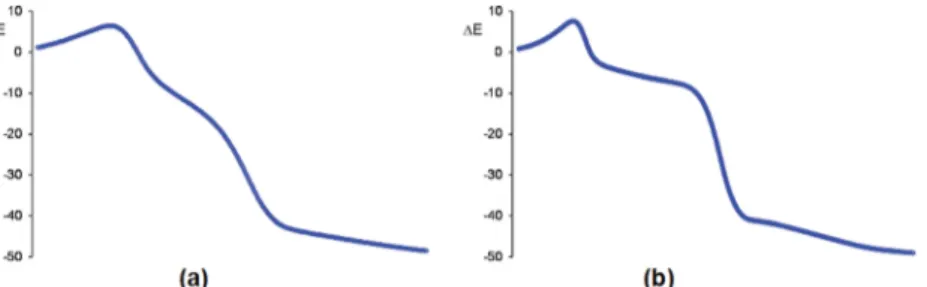
reactivities; TS1n and TS1x are associated to a two-center interaction in which only the C5 carbon of CHDE10and the C1 carbon of nitrone15participate. In addition, these stereo-isomeric channels, which are associated to a non-concerted two-stage one-stepmechanism,56present analogous IRCs (see Fig. 4). In this mechanism, the formation of the second O3–C4 single bond begins once the rst C1–C5 single bond has been completely formed in a single elementary step (see later).
In order to evaluate the polar or non-polar electronic nature of these TSs, the GEDT was analysed.39The GEDT at the four TSs, whichuxes from the nitrone to the CHDE frameworks, is 0.02eatTS1n, 0.02eatTS1x, 0.02eTS2nand 0.09eatTS2x. These negligible values indicate that this 32CA reaction has a non-polar character.
3.3. Topological analysis of the ELF of linear allene 18 and strained CHDE 10
As commented in the introduction, the high reactivity of ben-zyne5was attributed to itspseudodiradicalcharacter, which was topologically characterised by the presence of two ELF V(C) monosynaptic basins (see Fig. 1).2Consequently, a topological analysis of the ELF of linear allene18and strained CHDE10was performed in order to characterise their electronic structure. ELF attractors, together with the C4–C5 valence basin pop-ulations, ELF localisation domains and the proposed ELF-based Lewis structures are shown in Fig. 5.
ELF topological analysis of both allenes10and18shows the presence of two V(C4,C5) and V0(C4,C5) disynaptic basins within the C4–C5 bonding region, integrating a total population of 3.68eat both allenes, which indicates that the C4–C5 bonding region possesses a strong double bond character (see Fig. 5). Fig. 2 B3LYP/6-311G(d,p) Gibbs free energy profile, in kcal mol1, of
the 32CA reaction of nitrone15with CHDE10.
Fig. 3 B3LYP/6-311G(d,p) geometries in acetonitrile of the TSs involved in the 32CA reaction of nitrone15with CHDE10. Distances are given in angstroms,A.˚
Open Access Article. Published on 17 May 2017. Downloaded on 13/12/2017 20:05:28.
This article is licensed under a
However, the topology of the ELF V(Cx,Cy) disynaptic basins associated with the C4–C5 and C5–C6 bonding regions shows a notable difference at the two structures; while these disynaptic basins are clearly differentiated in the linear allene18as they are positioned in two perpendicular molecular planes, they are linked in a singular and twisted manner at strained CHDE10
due to the slight torsion of the C1]C2]C3 framework (see ELF localisation domains in Fig. 5). This particular feature found in the strained CHDE10suggests the participation of the two C–C double bonds of the strained allene in the special reactivity of this strained species.
Consequently, although the strained CHDE 10 does not present apseudoradicalstructure such as benzyne5(see Fig. 1), the ELF topological analysis of the C4–C5–C6 bonding region suggests that this species will have a different chemical behaviour to that of linear allene18.
3.4. BET study of the 32CA reaction between nitrone 15 and strained allene CHDE 10 yieldingendoisoxazolidine 16a
When trying to achieve a better understanding of bonding changes in organic reactions, the so-called BET57has proven to be a very useful methodological tool. This quantum-chemical methodology makes it possible to understand the bonding changes along a reaction path and, thus, to establish the nature of the electronic rearrangement associated with a given molecular mechanism.58–60
Recently, a BET study of the bonding changes along the 32CA reactions of C-phenyl-N-methyl nitrone 21 with electron-decient acrolein 22 was carried out in order to understand the molecular mechanism of these 32CA processes.61Herein, in order to understand the different reactivity of linear or cyclic strained allenes towards nitrones, a BET study of the molecular mechanism of the most favourable endo/r1 reaction channel associated with the 32CA reaction between nitrone 15 and strained allene CHDE10is performed; the complete BET study is discussed in ESI.† The characterisation of the molecular mechanism of the 32CA reaction of nitrone15with the simplest linear allene18is also carried out with the aim of rationalising the origin of the differences between the reactivity of both allenes (see ESI†). The attractor positions of the ELF basins for the points involved in the bond formation processes are shown in Fig. 6.
Some appealing conclusions can be drawn from this BET study: (i) the IRC of theendo/r1reactive channel is divided in ten differentiated phases related to the disappearance or creation of valence basins, emphasising the non-concertedness of the reaction; (ii) the reaction begins with the depopulation of the allenic C4–C5–C6 bonding region of the strained CHDE10in order to permit the creation of a C5pseudoradical center. Due to the strain present in CHDE10, this electronic change demands a moderate energy cost of 8.3 kcal mol1(see Table S3 in ESI†), which is 15.1 kcal mol1 lower than that demanded for the creation of therstpseudoradicalcenter at the nitrone15in the reaction involving the simplest allene18(see Table S2 in ESI†); (iii) thus, the moderate activation energy found in this non-polar 32CA reaction, 8.5 kcal mol1, can be mainly associated to the creation of a pseudoradicalcenter at the C5 carbon of strained allene CHDE10; (iv) once the C5pseudoradicalcenter is formed in the allenic framework, the subsequent rupture of the C1–N2 double bond of the nitrone fragment and creation of the Fig. 4 Relative energy (DE, in kcal mol1) variations along the IRC (amu1/2bohr) associated with theendo/r1(a) andexo/r1(b) reactive channels of the 32CA reaction between nitrone15and strained allene CHDE10in acetonitrile. Relative energies are given with respect to the separated reagents.
Fig. 5 ELF attractors, together with the C4–C5 valence basin pop-ulations, in average number of electrons (e), ELF localisation domains and the proposed Lewis structures for allenes10and18.
Open Access Article. Published on 17 May 2017. Downloaded on 13/12/2017 20:05:28.
This article is licensed under a
C1pseudoradicalcenter has an unappreciable energy cost, 0.1 kcal mol1. Consequently, once the C5pseudoradicalcenter is created, it induces the easy rupture of the C1–N2 double bond (see Table S3 in ESI†). This reactivity behaviour is characteristic of radical species. (v) Formation of therst C1–C5 single bond begins at a C1–C5 distance of 1.94A through a C-to-C coupling˚ of two C1 and C5 pseudoradical centers (see P4 and P5 in Fig. 6).39Interestingly, the C5pseudoradicalcenter participates with a high electron density, 0.89e, in the formation of the new C1–C5 single bond; (vi) however, formation of the second O3– C4 single bond begins at an O3–C4 distance of 1.75˚A through the donation of the electron density of one of the two O3 oxygen lone pairs of the nitrone framework to the C2 carbon atom of the allene fragment, similar to previous O–C bond formations,61 (seeP8andP9in Fig. 6); and (vii) formation of the second O3– C4 single bond takes place at the end of the reaction path once therst C1–C5 single bond has already reached 99% of its the population present atendoisoxazolidine16a. This fact allows characterising the molecular mechanism of this 32CA reaction as a non-concertedtwo-stage one-stepmechanism56associated to the attack of thepseudoradicalallenic C5 carbon of CHDE10
on the C1 carbon of the nitrone which, aer the complete C1–C5 single bond formation, experiences a rapid ring-closure process.
A comparative analysis of the BET studies of the non-polar 32CA reactions between nitrone 15 and allenes 10 and 18
makes it possible to explain the high reactivity of strained cyclic allene CHDE 10. The bonding changes along the non-polar 32CA reaction between nitrone 15and the simplest allene18
are very similar to those along the less favourable ortho/endo regioisomeric channel associated with the low-polar 32CA reaction of nitrone21with electron-decient acrolein22, which begins with the rupture of the nitrone C1–N2 double bond.61 The lower activation energy associated with the reaction involving acrolein22can be related to the slight GEDT, which favours the rupture of the double bonds in the nitrone and ethylene frameworks involved in this 32CA reaction.61However, a completely different scenario is found along the non-polar 32CA reaction between nitrone15and strained allene CHDE10. At the beginning of the reaction, apseudoradical center is created at the central C5 carbon of the strained allene CHDE10
with an energy cost of 8.3 kcal mol1. Interestingly, once this C5 pseudoradicalcenter reaches a population of 0.89e, the subse-quent bonding changes take place very easily (see the shortness ofphases II–IVin the reaction involving CHDE10in Fig. S5†in contrast to their extension in the reaction involving the linear allene 18 in Fig. S2†). This behaviour indicates that, at the beginning of the reaction, CHDE 10becomes apseudoradical
Fig. 6 ELF attractor positions for the points of the IRC involved in the formation of the C1–C5 and O3–C4 single bonds along the most favourableendo/r1reactive channel associated with the 32CA reaction between nitrone15and strained allene CHDE10. The electron pop-ulations, in e, are given in brackets.
Open Access Article. Published on 17 May 2017. Downloaded on 13/12/2017 20:05:28.
This article is licensed under a
species,5which explains the high reactivity of strained allenes in cycloaddition reactions.9–15
These ndings clearly reveal that the bonding changes demanded to reach the corresponding TSs are completely different and, consequently, they are neither electronically nor geometrically comparable.
4.
Conclusions
The 32CA reaction of nitrone15with the strained allene CHDE
10 giving isoxazolidines 16 and 17 has been studied within MEDT at the DFT B3LYP/6-311G(d,p) computational level in order to explain the higher reactivity of CHDE10with respect to linear allenes.
This 32CA reaction can take place along two pairs of regio-and stereoisomeric reaction channels. In acetonitrile, this reaction presents a low activation Gibbs free energy, 22.7 kcal mol1, as well as low endostereo- and regioselectivities. The non-polar character of the reaction measured by the GEDT at the TSs agrees with the analysis of the CDFT reactivity indices carried out at the GS of the reagents.
Analysis of the geometries of theendoandexostereoisomeric TSs associated with the more favourable r1 regioisomeric channels indicates that they are related to highly asynchronous C–C and C–O single bond formation processes. Analysis of the IRCs associated to these TSs in acetonitrile clearly permits to establish that this 32CA reaction takes place through a non-concerted two-stage one-step mechanism initialised by the attack of the central C5 carbon of CHDE10on the C1 carbon of nitrone15.
BET analysis of the most favourableendo/r1reactive channel allows establishing the molecular mechanism of the 32CA reaction of nitrone 15 with strained allene CHDE 10. At the beginning of the reaction, apseudoradical center with a pop-ulation of 0.89e is created at the central C5 carbon of the strained allene framework with a moderate energy cost of 8.3 kcal mol1, which induces the formation of the C1
pseudor-adicalcenter at the nitrone moiety, demanded for the formation of therst C1–C5 single bond through a two-center interaction. Formation of the second O3–C4 single bond takes place at the end of the reaction path when therst C1–C5 single bond is almost completely formed. This behaviour supports the mech-anism of this 32CA reaction as a non-concertedtwo-stage one-stepone.
This mechanism is completely different to that associated with the 32CA reaction involving the simplest linear allene18, which begins with the rupture of the C1–N2 double bond of the nitrone framework in order to create the C1pseudoradicalcenter required for the formation of therst C1–C5 single bond. This bonding change demands an energy cost of 23.4 kcal mol1,
justifying the high activation energy associated to this non-polar process, 26.2 kcal mol1.
Consequently, when comparing the mechanisms of the 32CA reactions of nitrone 15 with allenes 10 and 18 characterised from an MEDT perspective, we can conclude that the geomet-rical predistortion of strained allene CHDE10is not responsible for the high reactivity of this species as previously proposed,16
but a change of reactivity of the strained CHDE 10, which behaves as a radical species rather than an ethylene derivative, as occurs in the case of linear allene18. It is worth mentioning that while the pseudoradical character of a species can be correlated with a molecular strain, the energy associated with the geometrical distortion of a relaxed species cannot give any information about its electronic structure.
Acknowledgements
This work has been supported by the Ministry of Economy and Competitiveness (MINECO) of the Spanish Government, project CTQ2016-78669-P, Fondecyt (Chile) grants 1140341, Millen-nium Nucleus Chemical Processes and Catalysis (CPC) project No. 120082, and the Universidad Andres Bello (UNAB) by grant DI-793-15/R. Prof L. R. D. thanks FONDECYT for continuous support through Cooperaci´on Internacional. Finally, M. R.-G. also thanks MINECO for a pre-doctoral contract co-nanced by the European Social Fund (BES-2014-068258).
References
10 M. Christl, H. Fischer, M. Arnone and B. Engels,Chem.–Eur. J., 2009,15, 11266–11272.
11 M. Christl and M. Schreck,Angew. Chem., Int. Ed. Engl., 1987,
26, 449–451.
12 W. R. Moore and W. R. Moser,J. Org. Chem., 1970,35, 908– 912.
13 I. Quintana, D. Pena, D. Perez and E. Guitian,Eur. J. Org. Chem., 2009, 5519–5524.
Open Access Article. Published on 17 May 2017. Downloaded on 13/12/2017 20:05:28.
This article is licensed under a
18 D. H. Ess and K. N. Houk, J. Am. Chem. Soc., 2008, 130, 21 L. R. Domingo,Molecules, 2016,21, 1319.
22 A. D. Becke,J. Chem. Phys., 1993,98, 5648–5652.
23 C. Lee, W. Yang and R. G. Parr,Phys. Rev. B: Condens. Matter Mater. Phys., 1988,37, 785–789.
24 W. J. Hehre, L. Radom, P. V. R. Schleyer and J. A. Pople,Ab initio Molecular Orbital Theory, Wiley, New York, 1986. 25 H. B. Schlegel,J. Comput. Chem., 1982,3, 214–218.
26 H. B. Schlegel, inModern Electronic Structure Theory, ed. D. R. Yarkony, World Scientic Publishing, Singapore, 1994. 27 K. Fukui,J. Phys. Chem., 1970,74, 4161–4163.
28 C. Gonz´alez and H. B. Schlegel, J. Phys. Chem., 1990, 94, 5523–5527.
29 C. Gonz´alez and H. B. Schlegel, J. Chem. Phys., 1991, 95, 5853–5860.
30 B. Y. Simkin and I. Sheikhet, Quantum Chemical and Statistical Theory of Solutions – A Computational Approach, Ellis Horwood, London, 1995.
31 J. Tomasi and M. Persico,Chem. Rev., 1994,94, 2027–2094. 32 M. Cossi, V. Barone, R. Cammi and J. Tomasi,Chem. Phys.
Lett., 1996,255, 327–335.
33 E. Cances, B. Mennucci and J. Tomasi,J. Chem. Phys., 1997,
107, 3032–3041.
34 V. Barone, M. Cossi and J. Tomasi,J. Comput. Chem., 1998,
19, 404–417.
35 Y. Zhao and G. D. Truhlar,J. Phys. Chem. A, 2004,108, 6908– 6918.
36 J.-D. Chai and M. Head-Gordon,Phys. Chem. Chem. Phys., 2008,10, 6615–6620. M. A. Robb, J. R. Cheeseman, G. Scalmani, V. Barone, B. Mennucci, G. A. Petersson, H. Nakatsuji, M. Caricato, X. Li, H. P. Hratchian, A. F. Izmaylov, J. Bloino, G. Zheng, J. L. Sonnenberg, M. Hada, M. Ehara, K. Toyota, R. Fukuda, J. Hasegawa, M. Ishida, T. Nakajima, Y. Honda, O. Kitao, H. Nakai, T. Vreven, J. A. Montgomery Jr, J. A.,
J. E. Peralta, F. Ogliaro, M. Bearpark, J. J. Heyd, E. Brothers, K. N. Kudin, V. N. Staroverov, T. Keith, R. Kobayashi, J. Normand, K. Raghavachari, A. Rendell, J. C. Burant, S. S. Iyengar, J. Tomasi, M. Cossi, N. Rega, J. M. Millam, M. Klene, J. E. Knox, J. B. Cross, V. Bakken, C. Adamo, J. Jaramillo, R. Gomperts, R. E. Stratmann, O. Yazyev, A. J. Austin, R. Cammi, C. Pomelli, J. W. Ochterski, R. L. Martin, K. Morokuma, V. G. Zakrzewski, G. A. Voth, P. Salvador, J. J. Dannenberg, S. Dapprich, A. D. Daniels, O. Farkas, J. B. Foresman, J. V. Ortiz, J. Cioslowski and D. J. Fox, Gaussian 09, Gaussian 09 D.01, Gaussian, Inc, Wallingford CT, 2013. 43 S. Noury, X. Krokidis, F. Fuster and B. Silvi,Comput. Chem.,
1999,23, 597–604.
44 P. Geerlings, F. De Proand W. Langenaeker,Chem. Rev., 2003,103, 1793–1873.
48 R. G. Parr and W. Yang,Density Functional Theory of Atoms and Molecules, Oxford University Press, New York, 1989. 49 L. R. Domingo, E. Chamorro and P. P´erez, J. Org. Chem.,
52 L. R. Domingo and S. R. Emamian,Tetrahedron, 2014,70, 1267–1273.
53 L. R. Domingo, M. J. Aurell and P. P´erez,Tetrahedron, 2014,
70, 4519–4525.
54 L. R. Domingo, M. J. Aurell, P. P´erez and R. Contreras, Tetrahedron, 2002,58, 4417–4423.
55 P. Jaramillo, L. R. Domingo, E. Chamorro and P. P´erez,J. Mol. Struct.: THEOCHEM, 2008,865, 68–72.
56 L. R. Domingo, J. A. Sa´ez, R. J. Zaragoz´a and M. Arn´o,J. Org. Chem., 2008,73, 8791–8799.
57 X. Krokidis, S. Noury and B. Silvi,J. Phys. Chem. A, 1997,101, 7277–7282.
58 J. Andr´es, P. Gonz´alez-Navarrete and V. Safont, Int. J. Quantum Chem., 2014,114, 1239–1252.
Open Access Article. Published on 17 May 2017. Downloaded on 13/12/2017 20:05:28.
This article is licensed under a