
First impressions of Sarah Palin: Pit bulls, politics, gender performance and a discursive media (re)contextualization
23
0
0
Texto completo
(2) First Impressions of Sarah Palin. D. Harp et al.. power within the political sphere of American life and have been judged through traditional gendered notions when entering this space (e.g., Devitt, 2002; Jamieson; 1995; Scharrer, 2002). But when barriers are broken within the political sphere and gender is seen as a performance, as something less rigid and more fluid, we argue it is valuable to consider the media discourse (e.g., Vavrus, 2002). The importance rests on the idea that mass media play a role in structuring our understanding of reality and helping us make sense of the world. This is particularly true when we as a community lack first-hand knowledge. In the case of Palin, very few were familiar with her as a political figure. This research, then, offers an opportunity to understand gender performance and mediated discourses that constructed the world’s first impressions of Palin. This research begins with the belief in importance of first impressions and the role news media play in these (re)constructions.2 Many Americans initially believed Palin’s candidacy represented a breakthrough for women and a chance for women to finally secure a leading role in American politics (see, for instance, Pazniokas, 2008). In those first days, news media scrambled and the nation watched to learn who exactly is Sarah Palin. This research investigates those first 8 days of Palin’s national introduction through video clips from an array of news programs. The researchers are aware that with the passing of time mediated constructions of Palin became increasingly complex, particularly as the discourse of news and entertainment media (especially well-known American comedian Tina Fey’s imitation of Palin on Saturday Night Live on the TV channel, NBC) were intertwined. As researchers, however, we are convinced of the importance and committed to investigating the earliest discourse. This research, then, stresses the necessary examination of the primary images of Palin as she rose from being a relatively unknown politician to becoming one of the public’s most heavily focused on individuals in the United States in a matter of days. Rising from a place of almost complete obscurity, Palin’s sudden spotlight as Republican vice-presidential candidate was for most of the public their first introduction to her, which resulted in a rapid formation of initial impressions. We argue that many of these impressions relied on gendered understandings of the world, both presented in Palin’s gendered performances and subsequent mediated discourse. This is not unusual as gender serves as a primary means for organizing our understanding of the world and consequently becomes something journalists and mediated talking heads fall back on. To further argue for the importance of investigating initial mediated discursive (re)contextualizations of Palin, our research rests on numerous studies in psychology that have explored and strongly supported the importance of primary effects in influencing long-term opinions. Information presented early in a sequence possesses more influence on final judgments compared to information that is presented later in a sequence (Tetlock, 1983). In an experiment conducted by DiGirolamo and Hintzman (1997), first impressions are ones that linger the longest and strongest. The first representations that have been established are the ones that are key in influencing 292. Communication, Culture & Critique 3 (2010) 291–309 © 2010 International Communication Association.
(3) D. Harp et al.. First Impressions of Sarah Palin. all other later representations (DiGirolamo & Hintzman, 1997). Moreover, people interpret their subsequent opinions on later representations that are consistent with the initial impressions they first formed and are unlikely to change even when presented later with information that conflicts with the first impression (Asch, 1946; Jones, Rock, Shaver, Goethlas, & Ward, 1968; Nisbett & Ross, 1980: Chapter 8). First impressions, unlike later ones, are not only retained longer but also ingrained in one’s memory much quicker (DiGirolamo & Hintzman, 1997). The research offers a contribution to theoretical understandings of gender performance, mediated constructions of women who navigate the political sphere, and how the practice of journalism and mediated discourse rely on and (re)contextualize women through gender schema. We believe Palin and subsequent mediated constructions of her offer a rich space for analysis as she articulated a complex gender performance that might have significant consequences for moving beyond a simple feminine/masculine dichotomy in the political sphere. The article offers a theoretical framework from which to understand and consider gender roles and performance before discussing in more depth primary aspects of femininity that are particularly relevant to the introduction of Palin. Before moving into the analysis, we ground our research within previous studies that identify how gender has influenced news coverage of female politicians. Making sense of gender. Psychological theories of development explain how children gain knowledge about gender roles. Gender schema theory emphasizes the dominant role of gender in not only grasping but also processing knowledge and beliefs and guiding behavior in a given culture (Steinke, 1998). Bem’s gender schema theory explains how girls and boys exposed to cultural definitions of maleness and femaleness—embedded in discourse and social practices—will identify with them (Bem, 1981, 1983, 1993). Within this rubric, ‘‘female’’ and ‘‘male’’ are biological terms, whereas feminine and masculine are cultural constructions. Gender schema theory points to cognitive structures that are historical, contextual, and persuasive and illustrate the significance of gender stereotypes. Within contemporary U.S. society, gender schema exists as a set of cultural norms, part of mainstream discourse to inform women and men’s behavior within a dominant heterosexual and patriarchal gender dichotomy. This cultural structure ensures that masculinity is valued over femininity (Steinke, 1998). Golombisky (2006) notes that the relationship between feminine and masculine is not equal, but is asymmetrical and hierarchical. Bem’s sex role index assesses degrees of masculinity, femininity, and androgyny, yet gender in this theoretical perspective rests on society’s insistence on a gender dichotomy (Bem, 1981). This work in sex roles informs our research by indicating normative cultural understandings of masculinity in American society, which includes dominance, aggression, self-reliance, and personal control. Femininity within this rubric is linked to sensitivity and warmth. Communication, Culture & Critique 3 (2010) 291–309 © 2010 International Communication Association. 293.
(4) First Impressions of Sarah Palin. D. Harp et al.. Bem’s gender schema theory provides a useful starting point when considering how politicians’ gender identities—both performed and within media discourse—assist in sense making. It serves as a means for understanding how gender is learned, presented, and perceived and how female politicians are structured through society’s gender-role stereotypes. Further, feminist theorists have also noted how in the United States femininity is tied to the way women have been identified within traditional roles revolving around the domestic sphere. While the relationship to this domestic sphere has not remained monolithic over the years or across diverse female demographics, a constant has been the link between mothering and femininity (Collins, 1994; Rothman, 1994; Thurer, 1994), with mothering seen as a woman’s primary identity (or sex role).3 To witness another idealized form of femininity in the United States one need to only look to the pages of women’s magazines or the stages of beauty pageants. These standards of femininity are relevant to the analysis of Palin’s first impressions as we seek to understand how she is presented and performs within the context of gender. Connell (1995) describes masculinity as the practices in which men employ male gender roles, and explains that the effects are expressed through the body, personality, and culture. The same can be said for femininity, and the presentation of self is a form of practicing gender roles. These gender role ideals, in conjunction with gender schema theory, offer context from which to structure a critical analysis of discursive constructions of Palin. Gender performance theory. More recent theories of gender identity have helped negotiate the space between essentialism and social constructionism through the idea of presentation or ‘‘performativity’’ (Butler, 1990). Butler explains gender as an intentional act or ‘‘strategy’’ that suggests a ‘‘dramatic and contingent construction of meaning’’ (1990, p. 139). Within this framework of gender it should be seen as changeable and fluid—the way individuals behave at different times and in different situations rather than who they are. This means individuals continually put on a gender performance, whether traditional or not, so it is not a question of whether to do a gender performance, but what form that performance will take. Butler argues that choosing to perform outside of the traditional notions of gender might work to change gender norms and the binary understanding of masculinity and femininity (Butler, 1990). Butler’s work has been instrumental in theorizing gender and power. She asserts that the way we view gender roles rests at the very root of inequality of the sexes. Deconstructing the way society perceives gender roles might lead to changes in political culture by erasing conventional roles (Butler, 1990). The erasure of conventional gender roles would mean a woman leader would not be seen as unnatural. Butler’s theory of gender performance has been particularly influential in the area of Queer Theory where cultural practices like crossdressing are noted as subversive acts of gender performance (Halberstam, 1998). In analyzing the gender performance 294. Communication, Culture & Critique 3 (2010) 291–309 © 2010 International Communication Association.
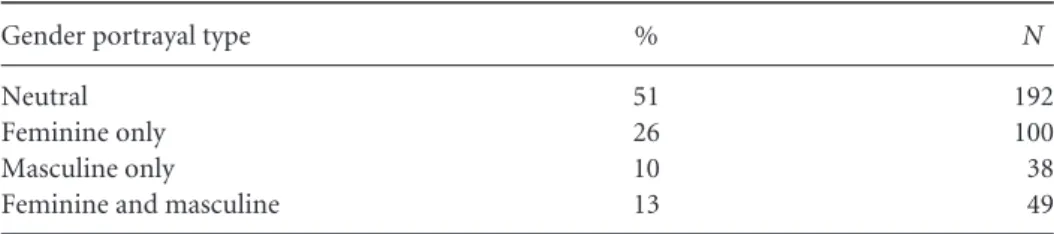
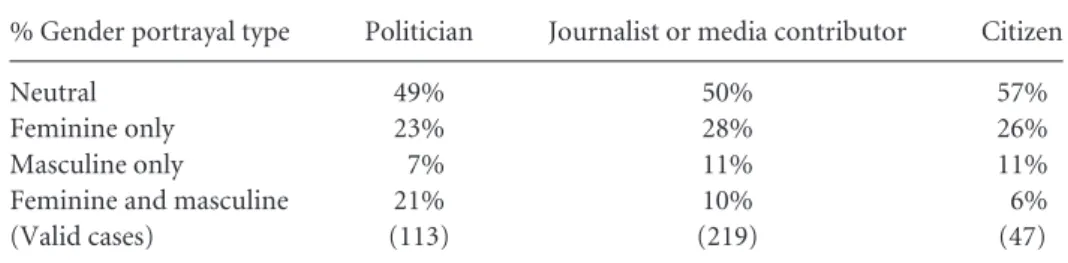
(5) D. Harp et al.. First Impressions of Sarah Palin. of Sarah Palin and resulting mediated discursive (re)contextualization, this research considers subtler cultural practices of gender performance. The analysis attends to linguistics and the stylized body.. Female politicians. Typically women politicians are portrayed by the media as essentially different from their male counterparts, thanks to mostly gender-specific media portrayals—at least in Western societies—that reinforce the idea that women are not meant to engage in the public world of politics, policy, and authority, certainly not in equal terms to men (see, e.g., Byerly & Ross, 2006; Gallagher, 2001; Norris, 1997; Rakow & Kranich, 1991; Ross, 2002, 2004; Sreberny-Mohammadi & Ross, 1996; Vavrus, 2002). Thus, female candidates and officials are presented as less qualified and knowledgeable of the issues of the campaign (Devitt, 2002; Kahn, 1994; Robertson & Anderson, 2001), steadily trivialized and casually undermined by the media (Byerly & Ross, 2006; Ross & Sreberny, 2000). They are regarded as either ‘‘too nice’’ to get involved in politics or downright anomalies, as they contravene expectations about the appropriate place of a woman (Ross, 2002). These findings have been consistent in the last 30 or so years in places as diverse as Europe, Pakistan, the Philippines, South Africa, Australia, and the United States (see, for instance, Genovese, 1993; Hoogensen & Solheim, 2006). Within a Western scope, the literature shows that women in politics themselves complain that the media operates a double standard when considering female politicians (Sreberny-Mohammadi & Ross, 1996). To succeed in politics, they must show masculine traits, but when they do they are portrayed as breaking the mold, contravening the deeply held notions of appropriate and acceptable female behavior. Thus, taking up positions of authority makes women open to a highly critical form of scrutiny that is entirely gender specific (Norris, 1997; Ross, 2004; SrebernyMohammadi & Ross, 1996), as seen in the cases of Hillary Clinton (Scharrer, 2002), the so-called ‘‘Blair’s babes’’ in the UK (Ross, 2005), or New Zealand’s Helen Clark (Devere & Davies, 2006). The private/public boundary still heavily influences the definitions of gendered identities, and the media do not only contribute to the definition of said boundary, but also promote the expected behavior for women (Vavrus, 2002), including their political roles by representing stories consistent with the dominant, gendered understandings (Howard & Prividera, 2004) that keep women in their place: out of the centers of authority and decision making in a society. The media subject females in politics to negative gender distinctions (Jamieson, 1995). These discourses insist that women do not belong in politics (Ross, 2002, 2004; Sreberny & Ross, 2000; Norris, 1997), as the role of a political leader is often associated with the stereotypical attributes and qualities of a man, such as assertiveness, ambition, and strength—which are viewed as inappropriate for a woman and counterstereotypical (Devere & Davies, 2006; Hoogensen & Solheim, 2006). One only need to think of the pants-wearing, Communication, Culture & Critique 3 (2010) 291–309 © 2010 International Communication Association. 295.
(6) First Impressions of Sarah Palin. D. Harp et al.. harsh-speaking, ball-busting stereotype of Hillary Clinton, or the rottweiller comparison used to refer to Helen Clark in New Zealand for an illustration of the point. Accordingly, female politicians’ behavior is subject to more evaluation and interpretation, and disproportionate media attention, as they are the odd element out (Ross & Sreberny, 2000; Sreberny-Mohammadi & Ross, 1996). In her studies of the relationships between women, politics, and media in three countries in different continents, Ross concluded that women still are viewed as needing ‘‘to convince a traditional polity that they are competent as politicians despite their gender’’ (Ross, 2002, p. 43, added emphasis). The role of the media, as they expose audiences to socially constructed concepts of women and appropriate gender roles, is pivotal in this attempt. In this research, we explore Palin’s mediated gender performances and subsequent discursive (re)contextualizations. Our intention is to understand if and how gender as a social construct is utilized in these media discourses. We engage in the research with the knowledge that gender is an often-utilized schema for understanding the world but consider how Palin’s performance and discursive construction might be unique. We theorize that Palin’s gender performance is a complex mixture of masculinity and femininity. Our goal is to understand how this is articulated in mediated discourse. Central to our research is how Palin’s gender performance might maintain traditional femininity and in what ways she performs masculinity and how mediated discourse might reconcile this mixed gender performance. We ask: To what extent does the discourse focus on gendered identities that affirm Palin’s femininity while allowing for a performance of masculinity? Context and methods. This study is based on a qualitative analysis of online videos posted by five national broadcast news websites in the United States—ABC, MSNBC, CBS, CNN, and Fox News—and also includes some quantitative analysis to contextualize the research. These websites have large audiences in the United States and represent different news media conglomerates. ABC.com is part of the broadcast network ABC, owned by The Walt Disney Company; MSNBC.com is a joint venture from NBC Universal (in turn, owned by General Electric) and Microsoft; CBSnews.com is the website of the news division of the American network CBS, property of CBS Corporation (formerly Viacom); CNN.com is the website of the widely known cable channel that has Time-Warner as a parent company, and Fox News.com is the website of a similar cable news channel owned by Rupert Murdoch’s News Corp. For the qualitative assessment of the videos, the authors looked for ways in which culturally understood ideals of femininity and masculinity as outlined above were contextualized within the discourse. Informed by the literature that indicates stereotypical ways female politicians are covered in news and also ideas from gender performance theory, the authors looked for ways traditionally understood ideas of masculine and 296. Communication, Culture & Critique 3 (2010) 291–309 © 2010 International Communication Association.
(7) D. Harp et al.. First Impressions of Sarah Palin. feminine were reflected in the discourse both through Palin’s performance and the mediated (re)construction of Palin. Specifically, the authors identified ways in which traditional understandings of femininity—sensitivity, warmth, mothering, and idealized outward beauty—and masculinity—dominance, aggression, self-reliance, and personal control—were articulated in the discourse. We were particularly interested in ways these gender dichotomies might be discussed in conjunction to portray a mixed rather than dichotomous gendered identity of masculinity and femininity. The study focuses on the process of meaning making through the discursive practices of the news media. The goals were to identify and recognize how Palin’s words and images (gender performance) and media (re)constructions articulated a discourse about femininity and masculinity and how that related to traditional coverage of female politicians in the first week when first impressions of a political figure are formed. To understand in what manifest and latent ways gender was performed and (re)presented, the authors chose a discourse analysis focused on significant meanings, forms, and patterns in this particular situation. The analysis had a mixed approach, with a qualitative interpretation of the media messages and meanings supported by a quantitative assessment of the portrayals regarding Palin. The authors were able to focus on the content and context of the messages, as well as its implications, informed by feminist theory. Within this approach, quantitative data adds context to the deeper qualitative analysis of meaning making, as accurate and generalizable evidence of our findings and interpretations. The analysis included online video clips about Palin from August 29, 2008 (the day McCain announced his running mate) through September 5, 2008 (the day after Palin’s speech at the Republican National Convention). Video clips from the national broadcast news websites were chosen for two reasons. First, they offer a means for analyzing condensed broadcast data—rather than entire programs that might only present a few moments of relevant data within an hour-long show. Second, we argue, these clips represent what news media gatekeepers find most relevant from a larger array of broadcast material shown on television. We base this on the fact that many of the clips available on the website originated in a broadcast but were chosen for availability on the websites. After collecting every video available on each of the news websites that referred to or included Sarah Palin (N = 328) during the stated period, a systematic random sample of 150 videos was analyzed. Authors viewed the videos multiple times to look for obvious and obscure references to gender roles and stereotypes. The authors, within the framework of past research on women politicians and media coverage and theoretical ideas of gender performance, identified the patterns, context, and discursive meanings of these references. The analysis included the comparison between the visual presentations and the narrative that accompanied them, in particular how these images presented different and specific gendered portrayals circulated to describe Palin. Communication, Culture & Critique 3 (2010) 291–309 © 2010 International Communication Association. 297.
(8) First Impressions of Sarah Palin. D. Harp et al.. Two of the authors also conducted a basic quantitative coding of all videos in the sample. Intercoder reliability, measured by Cohen’s kappa, was calculated to range between .87 and 1.0. In addition to identifying variables (such as news organization, date, and type of show), the quantitative analysis included coding of the first five people in each clip who commented on Palin (politicians, journalists, or citizens), whether the comments contained gendered references, and the specific masculine and feminine traits associated with Palin in those comments. If just feminine traits were mentioned, it was coded as ‘‘feminine-only portrayal’’ (e.g., ‘‘Palin is a caring mother and former beauty queen’’); a similar approach was used to code for ‘‘masculine-only portrayals’’ (e.g., ‘‘The governor of Alaska has made headlines with her toughness and aggressiveness in office’’). If the descriptions were not gendered, they were coded as ‘‘neutral’’ and if referred to both masculine and feminine traits, they were labeled as ‘‘feminine and masculine.’’ The combined methods provide a rich picture of how Palin’s gender performance was (re)presented within media discourse during her first week of national news. Who spoke and in what context. Television news shows represented the majority of the videos (72%), whereas journalists and anyone affiliated with the media represented 58% of the 379 people commenting on Palin. Another 30% of those who commented in the analyzed videos were politicians, campaign staff, and anyone affiliated to either political party. In the majority of the cases (51%) commentators made gender-neutral remarks, followed by remarks that noted Palin’s femininity-only (26%), then those that noted both masculine and feminine notions (13%), and finally those that noted Palin in masculine-only terms (10%) (Table 1). Politicians were more likely to refer to Palin in both masculine and feminine ways, whereas journalists emphasized her feminine side more (Table 2). Palin’s condition as a mother and motherly characteristics were the most predominant traits commented on in the videos. More than half of the videos that had some gendered portrayal explicitly referred to Palin’s motherliness or defined her as a mother (60%), followed by compassion, integrity, and her looks or physical appeal. Among the masculine characteristics, her toughness, strength, and leadership skills constituted 37% of the comments (Table 3). Interestingly, nonnews shows were. Table 1 Quantity of Gendered Type Coverage Gender portrayal type. %. N. Neutral Feminine only Masculine only Feminine and masculine. 51 26 10 13. 192 100 38 49. 298. Communication, Culture & Critique 3 (2010) 291–309 © 2010 International Communication Association.
(9) D. Harp et al.. First Impressions of Sarah Palin. Table 2 Comparison of the Gender Portrayal of Palin, by Type of Commentator % Gender portrayal type. Politician. Journalist or media contributor. Citizen. Neutral Feminine only Masculine only Feminine and masculine (Valid cases). 49% 23% 7% 21% (113). 50% 28% 11% 10% (219). 57% 26% 11% 6% (47). Note. χ2 = 11.752, df = 6, p < .05.. Table 3 Quantity of Gendered Trait Mentions Attributes Feminine Motherhood Truthfulness/integrity Empathy/compassion Other None Masculine Toughness Strength Assertiveness/leadership Other None. %. N. 60 5 3 9 24. 112 10 5 16 44. 17 13 7 11 52. 31 24 13 22 97. much more likely than news shows to portray Palin with feminine attributes other than motherhood (χ2 = 9.754, df = 4, p < .05). This analysis indicates that Palin is portrayed in a way that is not the norm reserved for female politicians. Female politicians are usually portrayed as a challenge to masculine authority (abnormal) as they are incompatible with expectations of a woman and are downright (negatively) aggressive (Gallagher, 2001; Ross, 2002). Palin, on the other hand, is constructed in a more complex manner that maintains her feminine character. Consequently, her stereotypically understood masculine traits are securely situated within the context of femininity. What follows is an identification of the three primary discursive gender frames we found in the media clips and a discussion of how they articulated a complex gendered presentation of Palin. No doubt the (re)contextualization is directly related to Palin’s mixed gender performance. The devoted mother. When Cindy McCain said, ‘‘John has picked a reform-minded, hockey-mommin’, basketball-shooting, moose-hunting, salmon-fishing, pistol-packing, mother of five Communication, Culture & Critique 3 (2010) 291–309 © 2010 International Communication Association. 299.
(10) First Impressions of Sarah Palin. D. Harp et al.. for vice president’’ (CBS, 2008a), she paraded Sarah Palin into the national spotlight with a complex image of masculinity and femininity. How these two gendered positions were presented, however, is interesting. The masculine is constructed through toughness and the arena of sports. Her feminine side is understood through a heavy emphasis on her motherhood. This strategic and complex gender performance set the stage for Palin’s (re)contextualization in the media. Arendell (2000) notes that ‘‘mothering and motherhood are viewed as dynamic social interactions and relationships, located in a societal context organized by gender and in accord with the prevailing gender belief system’’ of a given society. The discursive construction of Palin serves as a classic example of how the prevailing gender system is being maintained by this historic nomination of a female vicepresidential candidate in the Republican Party. Palin’s motherhood status is (re)contextualized in an interesting way. Palin is repeatedly portrayed in the video clips through visual presentations and discursive constructions as a devoted and caring individual because of the number of her children. With five children, including the youngest having Down syndrome (demanding more of a mother in her), her role as a mother is centralized and solidified. The emphasis on the number of children and the fact that she recently bore a child with special needs are facts used within the discourse to portray Palin as a mother that is even more devoted, more caring, and more loving than just the average mother. Palin is presented in one clip saying, ‘‘Children with special needs inspire very, very special love’’ (ABC, 2008) and subsequent mediated constructions of Palin as the special mother who is able to provide this special love. According to Harp and Bachmann (2008), women must be self-sacrificial and place the child as top priority to be a ‘‘good mother’’ in this culture—a requirement that ironically Palin fulfills according to the media discourse. This construction is a bit surprising considering that often women who work in high-profile jobs are constructed outside the framework of the ‘‘good mother’’ because of their work outside of the home and away from their children. That discussion, in fact, is surprisingly absent in this initial discourse. When debates do occur about whether Palin should be running for vice president when her special needs child demands more of her time and attention, there is no discussion of her as a bad mother who will work long hours as vice president. Instead, the discursive (re)contextualization is of a mother going to Washington to be ‘‘a friend and advocate in the White House’’ for special needs children. The question formed within the discourse is: Who better to fight for this nation’s special needs children than a mother of a special needs child? A self-proclaimed hockey mom, Palin consistently credits the start of her political career to the time of her joining the local Parent Teacher Association (PTA), as stated in her speech at the Republican National Convention in Saint Paul on September 3, 2008. Her nomination as the vice-presidential candidate is framed as a journey rooted in motherhood, or in her desire to ensure the well-being of her children rather than personal political aspirations. In other words, she put her children’s well-being before her personal desires. ‘‘I was just your average hockey mom and 300. Communication, Culture & Critique 3 (2010) 291–309 © 2010 International Communication Association.
(11) D. Harp et al.. First Impressions of Sarah Palin. signed up for the PTA. . . . because I wanted to make my kids’ public education even better,’’ said Palin. Through this framing Palin successfully articulated a feminine role within the masculine realm of politics, a role that dominated mediated discourse. In the midst of revelations of Palin’s teen daughter’s pregnancy, the mediated discursive (re)contextualization again portrays Palin as a very supportive mother. Palin, who is clearly against premarital sex as her record has shown, stressed in a public statement that she and her husband were proud of her daughter’s decision to have the baby and ‘‘even prouder to become grandparents.’’ The construction in the media emphasizes Palin’s role as a supportive mother with a pregnant teenage daughter and a devoted mom to a newborn baby with special needs, reinforcing her primary role of mother over her role as politician. Palin’s entire character in the mediated discourse is firmly rooted in her role as a mother. This is the way she was introduced (and initially performs gender identity) and this is the primary way the nation gets to know her through mediated discourse. In a news segment on CNN, the voiceover on a clip said, ‘‘Moments like these are a big reason McCain picked her. Images of a young mother trying to do it all.’’ The visual accompanying this narrative is Palin’s youngest daughter, Piper, showing off a little handbag she has on her arm as Palin gushes saying, ‘‘Oh, how cute!’’ while at the same time Palin fields questions from reporters in a souvenir store in Ohio (CNN, 2008b). The beauty queen. Women have long been judged by their physical appearances, and news reports of female politicians have often been chastised for their often-critical focus on hairstyles and clothing choices. Palin, having been a former beauty queen, escaped the media’s critical view and instead is constructed through mediated discourse as fitting into ideal notions of femininity. Known as the ‘‘hottest VP in the coolest state,’’4 Palin’s attractiveness became the center of mediated attention in many instances throughout the analysis. Both the Republican Party and Palin’s supporters drew attention to Palin’s physical traits with buttons like ‘‘Hoosiers for the hot chick’’ but the mediated discourse reinforced its (false) importance. For example, on CNN’s website, Lisa Bloom, a lawyer who was interviewed about Palin, said that ‘‘we’re all a little dazzled by how great she looks’’ (CNN, 2008c). During a segment on Hardball with Chris Matthews on MSNBC, Matthews asked Howard Fineman, Newsweek’s senior Washington correspondent, to elaborate more on Palin. Matthews prefaced by saying, ‘‘I don’t know her. . . who is Sarah Palin?’’ (MSNBC, 2008b). Fineman in his reply said Palin is a popular and attractive woman. The need to even mention whether or not Palin is an attractive woman is in itself problematic. In another example of how the news discourse focused on and lent importance to Palin’s appearance, a clip on CNN’s website titled ‘‘Sarah Palin’s style’’ contained a short sound bite from the morning talk show The View (CNN, 2008c), a television Communication, Culture & Critique 3 (2010) 291–309 © 2010 International Communication Association. 301.
(12) First Impressions of Sarah Palin. D. Harp et al.. show that straddles the line between news and entertainment. Joy Behar of The View said, ‘‘She’s a hot looking babe, and somebody explained to me, one of my friends, a guy, he said she looks like the kind of woman who, like a librarian who has the ponytail and the glasses, and then she takes it all off and then she’s like va va va voom.’’ Palin is vying for the job of the first person in the presidential line of succession but her physical attributes, which are not pertinent to the job, dominated a great deal of the mediated discussion. Interestingly, much of the discussion of Palin’s style included obligatory acknowledgments of double standards, as if this then made the sexist behavior acceptable. Bill O’Reilly on Fox News’ website wonders, ‘‘. . . would we be asking these questions . . . about a man?’’ (Fox News, 2008a). On CNN, A. J. Hammer said, ‘‘. . . we wouldn’t be talking about a man’s sense of style, for better or worse, that is what our culture does’’ (CNN, 2008c). Hammer commented that it is a ‘‘sad double standard that we have in our society and has been for a long time,’’ but immediately proceeds to ask Katrina Szish of In Style magazine ‘‘what does Sarah Palin need to do in terms of her style.’’ Behar, after her comment on Palin mirroring a sexy librarian on the morning talk show The View, also said she understands that it does sound sexist. It does not merely sound sexist—it is blatant sexism. These obligatory acknowledgments are presented as if to say that, because it was noted, the sexist portrayals may proceed and in the end the discourse reinforces the relevance of feminine beauty and firmly contextualizes Palin’s femininity. Palin’s winks at the camera illustrate ways her gender performance drew attention to her femininity. The tough politician. Being known as tough, aggressive, and strong has generally been (re)contextualized as taking away from a female politician’s femininity. Palin’s toughness, however, is accepted and discursively welcomed within the texts examined. We argue that this celebration of Palin’s masculinity happens because she successfully performs and the media solidly articulate her femininity. Then masculinity is discursively under the guise of her mothering or feminine role. Although Palin’s gender performance through the stylized body and role of mother is decidedly feminine, her talk is tough as she positions herself within the masculine framework of a strong and aggressive politician. The media followed Palin’s lead in portraying her as tough but still very much a feminine or ideal woman. When she jokingly compared hockey moms to pit bulls, the crowd at the Republican convention roared with laughter and applause (MSNBC, 2008a). The media picked it up and suddenly descriptions of Palin often included ‘‘pit bull.’’ The pit bull reference is repeated continuously in media discussion during the first week of coverage when the public was still getting to know Palin, but it is framed as a celebrated toughness firmly within the context of mothering. When a mother is exerting force to protect her children, the toughness is admired, commended, and heralded but not when the toughness stands without the escort of this feminine role. It is worth asking, had Palin used the pit bull analogy to compare herself 302. Communication, Culture & Critique 3 (2010) 291–309 © 2010 International Communication Association.
(13) D. Harp et al.. First Impressions of Sarah Palin. to ousting corrupt officials in Alaska, would the reception have been as well received? Other examples illustrate how within the discourse those who depicted Palin as tough were also quick to root the trait within a feminine context. Jen Dillman, a Palin supporter interviewed on CNN, said, ‘‘She was tough but yet elegant and graceful, and a mom, and I think it’s awesome to have a mom up there giving such a dynamic speech’’ (CNN, 2008a). Dillman explained Palin’s toughness but yet quickly reminded that Palin is still elegant and graceful (idealized feminine traits) and emphasized Palin’s role as a mother. Palin may be tough (masculine) but includes her role of a mother within the discursive space, and she is returned to the safe confines of femininity. When journalists covered Palin’s speech at the Republican National Convention, a clip from MSNBC described Palin as there that night to ‘‘bare her teeth and a bit of her soul describing herself as a daughter of teachers, wife of a union member, and a mother of five’’ (MSNBC, 2008a). Another example is of Howard Wolfson, former communications director for Hillary Clinton’s campaign, who described Palin as ‘‘on the attack’’ but quickly added, ‘‘but without being nasty’’ and still coming off as ‘‘nice’’ and ‘‘with a smile’’ (Fox News, 2008b). Again here the toughness descriptions are quickly softened (or feminized) for Palin. As a woman, being tough can be a positive trait but not without a string of additional attributes—cultural reminders of a woman’s femininity. Another way that Palin performs toughness and is portrayed as tough is through her hunting skills, which were initially noted in McCain’s advertisement introducing her keynote speech at the Republican National Convention. Palin’s hunting abilities, however, were again within the context of her feminine roles, which created a complex picture of gender performance that neither adhered to strict masculinity or femininity. A McCain campaign advertisement included within one clip introduced Palin as a strong woman who ‘‘joined her father on 3 a.m. moose hunts,’’ and showed a younger Palin with her father. It is notable that the image was not of a female hunter standing alone. In another picture portraying Palin as hunter, the image is of her with a slain moose while beside her is a young child. Both visuals place Palin within the realm of family—she is a daughter and a mother. These reminders of her feminine roles blur the dichotomy of the stereotypical masculine activity of hunting and (re)contextualize Palin as masculine yet feminine at the same moment. Images of Palin spending time with the armed forces were also found within the examined texts, including those of Palin being shown how to use a firearm and aiming a firearm (CBS, 2008b). Significant, however, is that these images in our analysis were always juxtaposed with images of Palin with her family. For example, in a clip on CBS, the pictures of Palin and the armed forces were shown along with pictures of her and her children. So even while Palin is seen handling guns, the (re)contextualized discourse serves as a reminder of Palin’s feminine role of mother. Communication, Culture & Critique 3 (2010) 291–309 © 2010 International Communication Association. 303.
(14) First Impressions of Sarah Palin. D. Harp et al.. Discussion and conclusions. Gender serves as a schema through which we process knowledge and beliefs. But rather than determined biologically, gender is culturally constructed and performed. People then perform gender, presenting themselves as masculine and feminine through linguistics and the stylized body. Through this theorization, gender is less fixed, and we can begin to see how female politicians might perform a blend of idealized gendered roles in order to promote a (re)contextualized mediated discourse that serves to avoid some of the problems female politicians face within the public space of politics. Examining mass media is important as it serves as spectator and interpreter of public gendered performances. In the case of Sarah Palin during her first week in the national spotlight, the performance of femininity and masculinity and the interpretation of that performance from start to finish allow for and even celebrate a masculine toughness as it reinforces traditional femininity. Palin’s public performance of masculinity (her toughness and ability to lead) is accepted in conjunction with a hyper-traditional femininity. The celebration of a female politician’s toughness in conjunction with an ultrafeminine frame is unusual for female politicians and illustrates some differences in media coverage of Palin compared to past studies about news coverage of female politicians in the United States. Typically, women politicians who show traditionally understood masculine traits like toughness and assertiveness are framed as harsh and lacking femininity, as seen with Hillary Clinton. Palin is celebrated for her toughness while she and the mediated discourse remind news audiences of her femininity and ‘‘appropriate’’ female role. Conversely, the emphasis on physical traits within the mediated discussion is usual for a female candidate. But here again the discourse diverges as Palin’s stylized body is celebrated for fitting into idealized notions of femininity and female beauty. The power to define this ideal beauty, however, is not Palin’s. Overall, the analysis delivers interesting news and offers a means by which female politicians might consider how to perform gender in ways that could successfully navigate the ideologically laden landscape of gender and politics. Yet the research can be read as a delivery of the bad news that women are accepted as tough only when they can uphold ideal forms of femininity. The sensitivity and warmth noted earlier in this paper is closely tied to the role of mother, one that is increasingly framed as natural and self-sacrificing (Barnett, 2004). A ‘‘good mother’’ ideology adds another layer of behavioral expectations on women—they must be all loving, all nurturing, and always available (Johnston & Swanson, 2006). This ideological positioning that links femininity to mothering (Douglas & Michael, 2005; Hays, 1996; Hochschild, 1989) is particularly relevant within the context of Palin who was introduced in the political arena within a context that stressed her motherhood. Further, the beauty standard of femininity was equally relevant to the analysis of Palin’s first impressions as she was presented and performed within the context of gender. Such images reflect cultural definitions of ideal femininity, and women are 304. Communication, Culture & Critique 3 (2010) 291–309 © 2010 International Communication Association.
(15) D. Harp et al.. First Impressions of Sarah Palin. often compared and held to these standards of beauty. Contemporary western ideals of feminine ‘‘beauty’’ are constructed as objective and universal (Wolf, 1991), and one way to reveal these ideal images is to examine various images in media (Lakoff & Scherr, 1984). From Hollywood to the pages of fashion and beauty magazines, American ideal heterosexual feminine beauty looks remarkably similar: Women are thin, light skinned, and with long, flowing hair. These women, too, adorn their bodies with an extensive array of costly beauty products. The research also leads to some interesting questions: At what level must a woman conform to patriarchal expectations based on dichotomous gender roles—particularly mother and beauty queen—in order to gain access and be accepted into the male world of national level politics? If a female politician adheres to idealized standards of beauty and the ‘‘good mother’’ ideology, will she be more successful in the realm of politics? The ‘‘good mother’’ ideology, however, turns problematic for female politicians. As stated above, typically the ‘‘good mother’’ standard is measured by a mother’s willingness to be ever present and giving all to her children (e.g., Harp & Bachmann, 2008; Johnston & Swanson, 2006). Particularly interesting within the case of Palin is how she was able to successfully portray herself as a ‘‘good mother’’ (perform femininity) and how subsequently the mediated discourse reinforced this notion. Particularly interesting, too, is that journalists were more likely to emphasize Palin’s femininity devoid of masculine characteristics, and nonnews shows were more likely to discuss femininity in ways other than through motherhood. Palin’s run for vice president also offers a means for considering gender performance theory through subtle masculine acts like linguistic turns and gun-toting, rather than crossdressing and transgender performance—ways that the theory is often applied within the framework of Queer Theory. Queer is that which is not normal or dominant. Questions worth asking include: Does Palin offer new ways to perform masculinity and femininity in a fluid way, making it acceptable for women to be tough and soft? How much does her performance break the binary construction of gender? The answers here are complex. While Palin at times performs and is constructed as masculine, Palin’s gender is normalized (feminized) as her masculine performance is mixed with a normative feminine identity. The indication is that women are allowed to be tough as long as they continue to fit stereotypical notions of femininity. Think female athletes who invariably pose half-clothed in men’s magazines to prove their ‘‘normal’’ (hetero)sexuality. Women can be tough in U.S. culture but are accepted when they are brought back within the confines of traditional femininity. Still, Palin’s gender performance and the mediated discursive interpretation of that performance are illustrations of how traditional masculinity and femininity function in a less dichotomous yet far from ideal manner. Traditional expectations exist but the fluidity of these roles exists as well. Gender performance can be seen as an important strategy in a culture that values traditions but also desires particular attributes within specific context, that is, toughness within the political realm. Communication, Culture & Critique 3 (2010) 291–309 © 2010 International Communication Association. 305.
(16) First Impressions of Sarah Palin. D. Harp et al.. The discourse surrounding Palin’s first week in the national spotlight offered a rich example from which to consider women, politics, gender performances, and interpretations of femininity and masculinity. Butler’s theory offers a means for considering gender within the framework of a dominant heterosexual and patriarchal society, one that at one level reinforces a hierarchical gender dichotomy but at another allows for a more fluid performance. Further research about Palin that looks beyond the first week is needed, however, as her (re)contextualization in mediated discourse offers new ways to consider female politicians. Also, the rich blend of news and entertainment media, highlighted by Saturday Night Live and Tina Fey’s performance as Palin, and the notion of politicians as celebrities, deserves further investigation. Notes 1 (Re)contextualization is understood here as locating text in a ‘‘new’’ context in which it then adds new rationalization or justification to the frames of the language structure and use (Blommaert, 2005; Silverstein, 1979). 2 According to Delgado (2003), construction ‘‘refers to the action of framing, devising, or forming, by the putting together of already existing parts’’ while the ‘‘re’’ denotes the unfixed nature of these constructions, which are ‘‘always subject to contestation, negotiation and reorganization’’ (p. 5). Therefore, (re)construction is a process by which one construction is a part of a circular phenomenon and reconstructed repeatedly. It is a particular kind of perception that is focused mainly on repetition: With each process, each construction defamiliarizes each other yet instills similar qualities with each (re)construction. 3 Traditional patriarchal gender roles have historically ascribed child-rearing and home-making to women, opposed to the traditional bread-winning man. See, for instance, Barnett, 2004; Penelope, 1990; Thurer, 1994. 4 Buttons sold at the Republican convention.. References ABC video. Palin’s address: Introducing the family [Online video clip]. (2008, 4 September). Retrieved September 6, 2008, from http://abcnews.go.com/video/playerIndex?id= 5721799 Arendell, T. (2000). Conceiving and investigating motherhood: The decade’s scholarship. Journal of Marriage and the Family, 62, 1192–1207. Asch, S. (1946). Forming impressions of personality. Journal of Abnormal and Social Psychology, 41, 258–290. Barnett, R. C. (2004). Preface: Women and work: Where are we, where did we come from, and where are we going? Journal of Social Issues, 60(4), 667–674. Bem, S. L. (1981). Gender schema theory: A cognitive account of sex typing. Psychological Review, 88 (4), 354–364. Bem, S. L. (1983). Gender schema theory and its implications for child development: Raising gender-aschematic children in a gender-schematic society. Signs: Journal of Women in Culture and Society, 8(4), 598–616. 306. Communication, Culture & Critique 3 (2010) 291–309 © 2010 International Communication Association.
(17) D. Harp et al.. First Impressions of Sarah Palin. Bem, S. L. (1993). The lenses of gender: Transforming the debate on sexual inequality. New Haven: Yale University Press. Blommaert, J. (2005). Discourse. Cambridge: Cambridge University Press. Butler, J. (1990). Gender trouble. New York: Routledge. Byerly, C., & Ross, K. (2006). Women and media. A critical introduction. Malden, MA: Blackwell. CBS video. Cindy McCain’s sense of duty [Online video clip]. (2008a, 5 September). Retrieved September 8, 2008, from http://www.cbsnews.com/video/watch/?id=4417911n% 3fsource=search video CBS video. Joe Biden on Palin’s speech [Online video clip]. (2008b, 4 September). Retrieved September 8, 2008, from http://www.cbsnews.com/video/watch/?id=4415745n% 3fsource=search video CNN video. iReporters weigh in on speech [Online video clip]. (2008a, 4 September). Retrieved September 10, 2008, from http://www.cnn.com/video/#/video/politics/2008/09/04/ ireports.palin.speech.reax.cnn?iref=videosearch CNN video. McCain, Palin hit trail [Online video clip]. (2008b, 29 August). Retrieved September 10, 2008, from http://www.cnn.com/video/#/video/politics/2008/08/30/ac. raw.politics.fri.cnn?iref=videosearch CNN video. Sarah Palin’s style [Online video clip]. (2008c, 5 September). Retrieved September 10, 2008, from http://www.cnn.com/video/#/video/showbiz/2008/ 09/05/Sarah.palins.style.cnn?iref=videosearch Collins, P. H. (1994). Shifting the center: Race, class, and feminist theorizing about motherhood. In D. Bassin, M. Honey, & M. M. Kaplan (Eds.), Representations of motherhood (pp. 56–74). New Haven, CT: Yale University Press. Connell, R. W. (1995). Masculinities. Cambridge, UK: Polity Press. Delgado, L. E. (2003). Re/Constructions: An introduction. Journal of Spanish Cultural Studies, 4(1), 3–10. Devere, H., & Davies, S. G. (2006). The Don and Helen New Zealand election 2005: A media a-gender? Pacific Journalism Review, 12(1), 65–85. Devitt, J. (2002). Framing gender on the campaign trail: Female gubernatorial candidates and the press. Journalism & Mass Communication Quarterly, 79(2), 445–463. DiGirolamo, G., & Hintzman, D. L. (1997). First impressions are lasting impressions: A primacy effect in memory for repetitions. Psychonomic Bulletin & Review, 4(1), 121–124. Douglas, S., & Michael, M. (2005). The mommy myth: The idealization of motherhood and how it has undermined all women. New York: Free Press. Fox News video. Double standard? [Online video clip]. (2008a, 2 September). Retrieved September 9, 2008, from http://www.foxnews.com/video/index.html?playerId= videolandingpage&streamingFormat=FLASH&referralObject=3063566 Fox News video. The Palin push? [Online video clip]. (2008b, 4 September). Retrieved September 9, 2008, from http://www.foxnews.com/video/index.html?playerId= videolandingpage&streamingFormat=FLASH&referralObject=3069374 Gallagher, M. (2001). Gender setting: New agendas for media monitoring and advocacy. New York: Palgrave. Genovese, M.A. (Ed, 1993). Women as national leaders. London: Sage. Golombisky, K. (2006). Gendering the interview: Feminist reflections on gender as performance in research. Women’s Studies in Communication, 29(2), 165–192. Halberstam, J. (1998). Female masculinity. Durham, NC: Duke University Press. Communication, Culture & Critique 3 (2010) 291–309 © 2010 International Communication Association. 307.
(18) First Impressions of Sarah Palin. D. Harp et al.. Harp, D., & Bachmann, I. (2008). News judgment: The framing of contemporary motherhood in the United States. Media Report to Women, 36(3), 8–14. Hays, S. (1996). The cultural contradictions of motherhood. New Haven, CT: Yale University Press. Hochschild, A. (1989). The second shift: Working parents and the revolution at home. New York: Viking Penguin. Hoogensen, G., & Solheim, B. (2006). Women in power. World leaders since 1960. Westport, CT: Praeger. Howard, J. W., & Prividera, L. C. (2004). Rescuing patriarchy or ‘‘Saving Jessica Lynch’’: The rhetorical construction of the American woman soldier. Women and Language, 27(2), 89–97. Jamieson, K. H. (1995). Beyond the double bind: Women and leadership. New York: Oxford University Press. Johnston, D. D., & Swanson, D. H. (2006). Constructing the ‘‘Good Mother’’: The experience of mothering ideologies by work status. Sex Roles, 54, 509–519. Jones, E. E., Rock, L., Shaver, K. G., Goethlas, G. R., & Ward, L. (1968). Pattern of performance and ability attribution: An unexpected primacy effect. Journal of Personality and Social Pscyhology, 10, 317–340. Kahn, K. F. (1994). The distorted mirror: Press coverage of women candidates for statewide office. Journal of Politics, 54, 154–173. Lakoff, R. T., & Scherr, R. L. (1984). Face value: The politics of beauty. Boston: Routledge and Kegan Paul. MSNBC video. After Palin’s punch, a lighter touch expected from McCain [Online video clip]. (2008a, 4 September). Retrieved September 7, 2008, from http://www.msnbc.msn.com/ id/22425001/vp/26547270#26547270 MSNBC video. Vetting Sarah Palin [Online video clip]. (2008b, 2 September). Retrieved September 7, 2008, from http://www.msnbc.msn.com/id/22425001/vp/26514570# 26514570 Nisbett, R. E., & Ross, L. (1980). Human inference: Strategies and shortcomings of social judgment. Englewood-Cliffs, NJ: Prentice-Hall. Norris, P. (1997). Women leaders worldwide: A splash of color in the photo op. In P. Norris (Ed.), Women, media, and politics (pp. 77–98). New York: Oxford University Press. Pazniokas, M. (2008, September 4). GOP women cheer for Palin. Hartford Courant, A8. Penelope, J. (1990). Speaking freely: Unlearning the lies of the fathers’ tongues. New York: Pergamon Press. Rakow, L. F., & Kranich, K. (1991). Women as sign in television news. Journal of Communication, 41(1), 8–23. Robertson, T., & Anderson, M. (2001). Gender and politics: Messages by female candidates in political ads in 1998 senatorial and gubernatorial. North Dakota Journal of Speech, 17, 1–18. Ross, K. (2002). Women, politics, media. Uneasy relations in comparative perspective. Cresskill, NJ: Hampton Press. Ross, K. (2004). The gendered turn in mediated politics. In K. Ross & C. M. Byerly (Eds), Women and media. International perspectives (pp. 60–80). Malden, MA: Blackwell. Ross, K. (2005). Condoleezza’s in the (White) House, but the game goes on: Why gender still matters. International Communication Gazette, 67(6), 531–533. 308. Communication, Culture & Critique 3 (2010) 291–309 © 2010 International Communication Association.
(19) D. Harp et al.. First Impressions of Sarah Palin. Ross, K., & Sreberny, A. (2000). Women in the house: Media representations of British politicians. In A. Sreberny & L. Van Zoonen (Eds.), Gender, politics, and communication. Cresskill, NJ: Hampton Press. Rothman, B. K. (1994). Beyond mothers and fathers: Ideology in a patriarchal society. In E. N. Glenn, G. Chang, & L. R. Forcey (Eds.), Mothering: Ideology, experience, and agency (pp. 139–157). New York: Routdlege. Scharrer, E. (2002). An ‘‘Improbable Leap’’: A content analysis of newspaper coverage of Hillary Clinton’s transition from first lady to Senate candidate. Journalism Studies, 3(3), 393–406. Silverstein, M. (1979). Language structure and linguistic ideology. In P. R. Clyne, W. F. Hanks, & C. L. Hofbauer (Eds.), The elements: A parasession on linguistic units and levels (pp. 193–247). Chicago Linguistic Society. Sreberny-Mohammadi, A., & Ross, K. (1996). Women MPs and media: Representing the body politic. Parliamentary Affairs, 49, 103–115. Steinke, J. (1998). Connecting theory and practice: Women scientist role models in television programming. Journal of Broadcasting & Electronic Media, 42(1), 142–152. Tetlock, P. E. (1983). Accountability and the perseverance of first impressions. Social Psychology Quarterly, 46(4), 285–292. Thurer, S. L. (1994). The myths of motherhood: How culture reinvents the good mother. New York: Houghton Mifflin. Vavrus, M. D. (2002). Postfeminist news: Political women in media culture. Albany: State University of New York Press. Wolf, N. (1991). The beauty myth. New York: Anchor Books.. Communication, Culture & Critique 3 (2010) 291–309 © 2010 International Communication Association. 309.
(20) 萨拉帕林的第一印象:斗牛、政治、性别表现和话语媒体(重)建语境 Dustin Harp Jaime Loke Ingrid Bachmann 德克萨斯大学奥斯汀分校新闻学院. 【摘要:】. 本研究探讨和比较在萨拉帕林被提名为共和党副总统候选人的首个星期,媒体对她的描 绘中的话语结构和性别表现。通过对五个美国电视新闻网站上的视频剪辑进行话语分析,作 者发现在不论是在帕林的性别表现还是在由此产生的媒体对帕林的话语(重)建语境中都有 复杂的论述。帕林的性别表现体现了男性和女性在一个复杂的混合体中的表述。但同时,她 的“阳刚之气”是在深深植根于更为传统的女性观念中被接受和流传的。.
(21) Premières impressions de Sarah Palin : Pitbulls, politique, accomplissement du genre et (re)contextualisation discursive dans les médias Dustin Harp, Jaime Loke & Ingrid Bachmann Cette étude examine et compare les constructions discursives et l'accomplissement du genre dans la représentation médiatique de Sarah Palin lors de la première semaine de sa nomination à la candidature au poste de vice-présidente dans le camp républicain. Par une analyse discursive de clips vidéos mis en ligne par cinq sites de nouvelles américains, les auteurs ont découvert un discours riche en complexité, tant dans l'accomplissement du genre de Palin que dans la (re)contextualisation discursive subséquente de Palin dans les médias. Son accomplissement du genre est un exemple de la manière dont la masculinité et la féminité sont accomplies à travers un assemblage complexe. Il illustre aussi la manière dont la « masculinité » de Palin est acceptée et célébrée, tout en étant fermement ancrée dans des notions plus traditionnelles de ce qu'est la féminité..
(22) First Impressions of Sarah Palin: Pit Bulls, Politics, Gender Performance, and A Discursive Media (Re)contextualization Sarah Palin에 대한 첫번째 인상: 사나운 사람, 정치, 젠더 성취 그리고 추론적인 미디어 (재)문맥화 Dustin Harp, Jaime Loke, & Ingrid Bachmann School of Journalism, University of Texas at Austin, Austin, TX 78712, USA 요약 본 논문은 공화당 부통령후보로 지명된 첫째 주 동안 Sarah Palin의 미디어 노출에 있어 추론적인 구성들과 젠더 성취를 연구하고 비교한 것이다. 다섯개의 미국 네트웍 뉴스 웹사이트에 의해 포스트된 온라인 비디오 클립들의 담화분석을 이용, 본 논문은 Palin의 젠더역할과 Palin의 결과적인 추론적 미디어 문맥에서 복잡성을 가진 담화를 발견하였다. 그녀의 젠더 수행은 어떻게 남성적인 것과 여성적인 면들이 복잡한 혼합속에서 수행되었는가를 보여주는 예로 기여하였으며, Sarah Palin의 남성적인 면은 동시에 여성적인 전통적 개념들내에서 확고하게 잘 받아들여짔다..
(23) Las Primeras Impresiones de Sarah Palin: Los Pit Bulls, Los Políticos, la Representación del Género, y una Re-contextualización Discursiva de los Medios Dustin Harp, Jaime Loke, & Ingrid Bachmann School of Journalism, University of Texas at Austin, Austin, TX 78712, USA Resumen Este estudio examina y compara las construcciones discursivas y la representación de género en los retratos de Sara Palin hechos por los medios durante la primera semana de su nominación a la candidatura como vicepresidente por el partido Republicano. Usando un análisis de discurso de los fragmentos de video online puestos en la Web por 5 redes de noticias de los EEUU, los autores encontraron un discurso rico de complejidad en la representación de género de Palin y la re-contextualización discursiva resultante de los medios de Palin. Su representación de género sirve como un ejemplo de cómo la masculinidad y la feminidad son representados en una fusión compleja y cómo la ‘‘masculinidad’’ de Palin es aceptada y celebrada, mientras que al mismo tiempo está basada firmemente en nociones tradicionales de feminidad..
(24)
Figure
Documento similar
Continuous Petri nets can be seen as a relaxation of discrete models allowing more efficient (in some cases polynomial time) analysis and synthesis algorithms..
Translation into LGSPN The performance model obtained from an activity diagram in terms of LGSPNs as proposed in [22] can be used with performance evaluation purposes with two goals:
We propose to model the software system in a pragmatic way using as a design technique the well-known design patterns; from these models, the corresponding formal per- formance
Figure 7.2(a) represents the problem domain (any software system), Figure 7.2(b) means that the software engineer has modeled the UML diagrams for the system using the
Concerning related work, we are unable to compare our tool due to the fact that, as far as we know, there exist four SPE tools [3, 2, 10, 15] based on UML and none of them
Hence, with the initial configuration and the given budget, the number of security hosts needs to be increased by five units and the number of DB application hosts by two units in
We have developed PeabraiN, a collection of PIPE tool- compliant modules for performance estimation and resource optimisation based on bounds computation for Stochastic Petri
We reproduced these experiments using our performance model, which meant to put as many tokens as users in places users and p userDevice of the GSPN, so to also match one user to
