
Angular analysis of B d(0) > K* mu(+)mu( ) decays in pp collisions at root s=8 tev with the ATLAS detector
47
0
0
Texto completo
(2) Contents 1. 2 Analysis method. 2. 3 The ATLAS detector, data, and Monte Carlo samples. 4. 4 Event selection. 4. 5 Maximum-likelihood fit 5.1 Signal model 5.2 Background modes 5.3 K ∗ cc control sample fits 5.4 Fitting procedure and validation. 6 7 8 10 11. 6 Results. 11. 7 Systematic uncertainties. 18. 8 Comparison with theoretical computations. 21. 9 Conclusion. 23. A Correlation matrices. 24. The ATLAS collaboration. 30. 1. Introduction. Flavour-changing neutral currents (FCNC) have played a significant role in the construction of the Standard Model of particle physics (SM). These processes are forbidden at tree level and can proceed only via loops, hence are rare. An important set of FCNC processes involve the transition of a b-quark to an sµ+ µ− final state mediated by electroweak box and penguin diagrams. If heavy new particles exist, they may contribute to FCNC decay amplitudes, affecting the measurement of observables related to the decay under study. Hence FCNC processes allow searches for contributions from sources of physics beyond the SM (hereafter referred to as new physics). This analysis focuses on the decay Bd0 → K ∗0 (892)µ+ µ− , where K ∗0 (892) → K + π − . Hereafter, the K ∗0 (892) is referred to as K ∗ and charge conjugation is implied throughout, unless stated otherwise. In addition to angular observables such. –1–. JHEP10(2018)047. 1 Introduction.
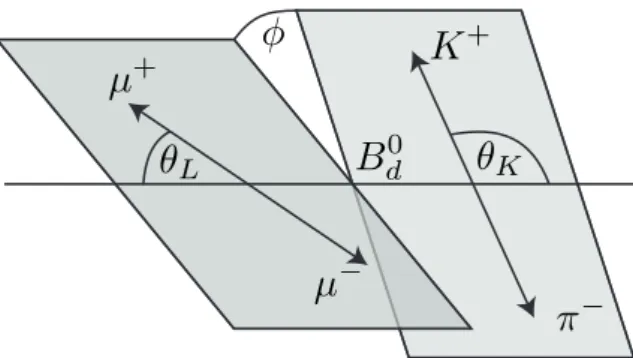
(3) 2. Analysis method. Three angular variables describing the decay are defined according to convention described by the LHCb Collaboration in ref. [9]: the angle between the K + and the direction opposite to the Bd0 in the K ∗ centre-of-mass frame (θK ); the angle between the µ+ and the direction opposite to the Bd0 in the dimuon centre-of-mass frame (θL ); and the angle between the two 0 decay planes formed by the Kπ and the dimuon systems in the Bd0 rest frame (φ). For B d mesons the definitions are given with respect to the negatively charged particles. Figure 1 illustrates the angles used. 1. The forward-backward asymmetry is given by the normalised difference between the number of positive muons going in the forward and backward directions with respect to the direction opposite to Bd0 momentum in the dimuon rest frame.. –2–. JHEP10(2018)047. as the forward-backward asymmetry AFB ,1 there is considerable interest in measurements of the charge asymmetry, differential branching fraction, isospin asymmetry, and ratio of rates of decay into dimuon and dielectron final states, all as a function of the invariant mass squared of the dilepton system q 2 . All of these observable sets can be sensitive to different types of new physics that allow for FCNCs at tree or loop level. The BaBar, Belle, CDF, CMS, and LHCb collaborations have published the results of studies of the angular distributions for Bd0 → K ∗ µ+ µ− [1–8]. The LHCb Collaboration has reported a potential hint, at the level of 3.4 standard deviations, of a deviation from SM calculations [3, 4] in this decay mode when using a parameterization of the angular distribution designed to minimise uncertainties from hadronic form factors. Measurements using this approach were also reported by the Belle and CMS Collaborations [6, 8] and they are consistent with the LHCb experiment’s results and with the SM calculations. This paper presents results following the methodology outlined in ref. [3] and the convention adopted by the LHCb Collaboration for the definition of angular observables described in ref. [9]. The results obtained here are compared with theoretical predictions that use the form factors computed in ref. [10]. This article presents the results of an angular analysis of the decay Bd0 → K ∗ µ+ µ− with the ATLAS detector, using 20.3 fb−1 of pp collision data at a centre-of-mass energy √ s = 8 TeV delivered by the Large Hadron Collider (LHC) [11] during 2012. Results are presented in six different bins of q 2 in the range 0.04 to 6.0 GeV2 , where three of these bins overlap. Backgrounds, including a radiative tail from Bd0 → K ∗ J/ψ events, increase for q 2 above 6.0 GeV2 , and for this reason, data above this value are not studied. The operator product expansion used to describe the decay Bd0 → K ∗ µ+ µ− encodes short-distance contributions in terms of Wilson coefficients and long-distance contributions in terms of operators [12]. Global fits for Wilson coefficients have been performed using measurements of Bd0 → K ∗ µ+ µ− and other rare processes. Such studies aim to connect deviations from the SM predictions in several processes to identify a consistent pattern hinting at the structure of a potential underlying new-physics Lagrangian, see refs. [13–15]. The parameters presented in this article can be used as inputs to these global fits..
(4) µ. φ. +. K+ Bd0. θL. θK. µ−. π−. The angular differential decay rate for Bd0 → K ∗ µ+ µ− is a function of q 2 , cos θK , cos θL and φ, and can be written in several ways [16]. The form to express the differential decay amplitude as a function of the angular parameters uses coefficients that may be represented by the helicity or transversity amplitudes [17] and is written as2 " 1 d4 Γ 9 3(1−FL ) 2 1−FL 2 = sin θK +FL cos2 θK + sin θK cos 2θL 2 2 dΓ/dq d cos θL d cos θK dφdq 32π 4 4 −FL cos2 θK cos 2θL +S3 sin2 θK sin2 θL cos 2φ +S4 sin 2θK sin 2θL cos φ+S5 sin 2θK sin θL cos φ +S6 sin2 θK cos θL +S7 sin 2θK sin θL sin φ # +S8 sin 2θK sin 2θL sin φ+S9 sin2 θK sin2 θL sin 2φ .. (2.1). Here FL is the fraction of longitudinally polarised K ∗ mesons and the Si are angular coefficients. These angular parameters are functions of the real and imaginary parts of the transversity amplitudes of Bd0 decays into K ∗ µ+ µ− . The forward-backward asymmetry is given by AFB = 3S6 /4. The predictions for the S parameters depend on hadronic form factors which have significant uncertainties at leading order. It is possible to reduce the theoretical uncertainty in these predictions by transforming the Si using ratios constructed to cancel form factor uncertainties at leading order. These ratios are given by refs. [17, 18] as 2S3 1 − FL 2 AFB P2 = 3 1 − FL S9 P3 = − 1 − FL Si=4,5,7,8 0 Pj=4,5,6,8 =p . FL (1 − FL ) P1 =. 2. (2.2) (2.3) (2.4) (2.5). This equation neglects possible Kπ S-wave contributions. The effect of an S-wave contribution is considered following the method used by LHCb in ref. [3].. –3–. JHEP10(2018)047. Figure 1. An illustration of the Bd0 → K ∗ µ+ µ− decay showing the angles θK , θL and φ defined in the text. Angles are computed in the rest frame of the K ∗ , dimuon system and Bd0 meson, respectively..
(5) (0). All of the parameters introduced, FL , Si and Pj , may vary with q 2 and the data are analysed in q 2 bins to obtain an average value for a given parameter in that bin.. 3. The ATLAS detector, data, and Monte Carlo samples. 4. Event selection. Several trigger signatures constructed from the MS and ID inputs are selected based on availability during the data-taking period, prescale factor and efficiency for signal identification. Data are combined from 19 trigger chains where 21%, 89% or 5% of selected events pass one or more triggers with one, two, or at least three muons identified online in the MS, respectively. Of the events passing the requirement of at least two muons, the largest contribution comes from the chain requiring one muon with a transverse momentum pT > 4 GeV and the other muon with pT > 6 GeV. This combination of triggers ensures that the analysis remains sensitive to events down to the kinematic threshold of q 2 = 4m2µ , 3. ATLAS uses a right-handed coordinate system with its origin at the nominal interaction point (IP) in the centre of the detector and the z-axis along the beam pipe. The x-axis points from the IP to the centre of the LHC ring, and the y-axis points upward. Cylindrical coordinates (r, Φ) are used in the transverse plane, Φ being the azimuthal angle around the z-axis. The pseudorapidity is defined in terms of the polar angle θ as η = − ln tan(θ/2).. –4–. JHEP10(2018)047. The ATLAS experiment at the LHC is a general-purpose detector with a cylindrical geometry and nearly 4π coverage in solid angle [19]. It consists of an inner detector (ID) for tracking, a calorimeter system and a muon spectrometer (MS). The ID consists of silicon pixel and strip detectors, with a straw-tube transition radiation tracker providing additional information for tracks passing through the central region of the detector. 3 The ID has a coverage of |η| < 2.5, and is immersed in a 2T axial magnetic field generated by a superconducting solenoid. The calorimeter system, consisting of liquid argon and scintillator-tile sampling calorimeter subsystems, surrounds the ID. The outermost part of the detector is the MS, which employs several detector technologies in order to provide muon identification and a muon trigger. A toroidal magnet system is embedded in the MS. The ID, calorimeter system and MS have full azimuthal coverage. The data analysed here were recorded in 2012 during Run 1 of the LHC. The centre√ of-mass energy of the pp system was s = 8 TeV. After applying data-quality criteria, the data sample analysed corresponds to an integrated luminosity of 20.3 fb−1 . A number of Monte Carlo (MC) signal and background event samples were generated, with b-hadron production in pp collisions simulated with Pythia 8.186 [20, 21]. The AU2 set of tuned parameters [22] is used together with the CTEQ6L1 PDF set [23]. The EvtGen 1.2.0 program [24] is used for the properties of b- and c-hadron decays. The simulation included modelling of multiple interactions per pp bunch crossing in the LHC with Pythia soft QCD processes. The simulated events were then passed through the full ATLAS detector simulation program based on Geant 4 [25, 26] and reconstructed in the same way as data. The samples of MC generated events are described further in section 5..
(6) –5–. JHEP10(2018)047. where mµ is the muon mass. The effective average trigger efficiency for selected signal events is about 29%, determined from signal MC simulation. Muon track candidates are formed offline by combining information from both the ID and MS [27]. Tracks are required to satisfy |η| < 2.5. Candidate muon (kaon and pion) tracks in the ID are required to satisfy pT > 3.5 (0.5) GeV. Pairs of oppositely charged muons are required to originate from a common vertex with a fit quality χ2 /NDF < 10. Candidate K ∗ mesons are formed using pairs of oppositely charged kaon and pion candidates reconstructed from hits in the ID. Candidates are required to satisfy pT (K ∗ ) > 3.0 GeV. As the ATLAS detector does not have a dedicated charged-particle identification system, candidates are reconstructed with both possible Kπ mass hypotheses. The selection implicitly relies on the kinematics of the reconstructed K ∗ meson to determine which of the two tracks corresponds to the kaon. If both candidates in an event satisfy selection criteria, they are retained and one of them is selected in the next step following a procedure described below. The Kπ invariant mass is required to lie in a window of twice the natural width around the nominal mass of 896 MeV, i.e. in the range [846, 946] MeV. The charge of the kaon candidate is used to assign the flavour of the reconstructed Bd0 candidate. The Bd0 candidates are reconstructed from a K ∗ candidate and a pair of oppositely charged muons. The four-track vertex is fitted and required to satisfy χ2 /NDF < 2 to suppress background. A significant amount of combinatorial, Bd0 , B + , Bs0 and Λb background contamination remains at this stage. Combinatorial background is suppressed by requiring a Bd0 candidate lifetime significance τ /στ > 12.5, where the decay time uncertainty στ is calculated from the covariance matrices associated with the four-track vertex fit and with the primary vertex fit. Background from final states partially reconstructed as B → µ+ µ− X accumulates at invariant mass below the Bd0 mass and contributes to the signal region. It is suppressed by imposing an asymmetric mass cut around the nominal Bd0 mass, 5150 MeV < mKπµµ < 5700 MeV. The high-mass sideband is retained, as the parameter values for the combinatorial background shapes are extracted from the fit to data described in section 5. To further suppress background, it is required that the angle Θ, defined between the vector from the primary vertex to the Bd0 candidate decay vertex and the Bd0 candidate momentum, satisfies cos Θ > 0.999. Resolution effects on cos θK , cos θL and φ were found to have a negligible effect on the ATLAS Bs0 → J/ψφ analysis [28]. It is assumed to also be the case for Bd0 → K ∗ µ+ µ− . On average 12% of selected events in the data have more than one reconstructed Bd0 candidate. The fraction is 17% for signal MC samples and 2–10% for exclusive background MC samples. A two-step selection process is used for such events. For 4% of these events it is possible to select a candidate with the smallest value of the Bd0 vertex χ2 /NDF. However, the majority, about 96%, of multiple candidates arise from four-track combinations where the kaon and pion assignments are ambiguous. As these candidates have degenerate values for the Bd0 candidate vertex χ2 /NDF, a second selection step is required. The Bd0 candidate reconstructed with the smallest value of |mKπ − mK ∗ |/σ(mKπ ) is retained for analysis, where mKπ is the K ∗ candidate mass, σ(mKπ ) is the per-event uncertainty in this quantity, and mK ∗ is the world average value of the K ∗ mass..
(7) 5. Maximum-likelihood fit. Extended unbinned maximum-likelihood fits of the angular distributions of the signal decay are performed on the data for each q 2 bin. The discriminating variables used in the fit are mKπµµ , the cosines of the helicity angles (cos θK and cos θL ), and φ. The likelihood L for a given q 2 bin is L=. N e−n Y X b nl Pkl (mKπµµ , cos θK , cos θL , φ; pb, θ), N! k=1. (5.1). l. where N is the total number of events, the sum runs over signal and background components, nl is the fitted yield for the lth component, n is the sum over nl , and Pkl is the pdf evaluated for event k and component l. In the nominal fit, l iterates only over one signal. –6–. JHEP10(2018)047. The selection procedure results in an incorrect flavour tag (mistag) for some signal 0 events. The mistag probability of a Bd0 (B d ) meson is denoted by ω (ω) and is determined from MC simulated events to be 0.1088 ± 0.0005 (0.1086 ± 0.0005). The mistag probability varies slightly with q 2 such that the difference ω − ω remains consistent with zero. Hence the average mistag rate hωi in a given q 2 bin is used to account for this effect. If a candidate is mistagged, the values of cos θL , cos θK and φ change sign, while the latter two are also slightly shaped by the swapped hadron track mass hypothesis. Sign changes in these angles affect the overall sign of the terms multiplied by the coefficients S5 , S6 , S8 and S9 (similarly for the corresponding P (0) parameters) in equation (2.1). The corollary is that mistagged events result in a dilution factor of (1 − 2hωi) for the affected coefficients. The region q 2 ∈ [0.98, 1.1] GeV2 is vetoed to remove any potential contamination from the φ(1020) resonance. The remaining data with q 2 ∈ [0.04, 6.0] GeV2 are analysed in order to extract the signal parameters of interest. Two K ∗ cc control regions are defined for Bd0 decays into K ∗ J/ψ and K ∗ ψ(2S), respectively as q 2 ∈ [8, 11] and [12, 15] GeV2 . The control samples are used to extract values for nuisance parameters describing the signal probability density function (pdf) from data as discussed in section 5.3. For q 2 < 6 GeV2 the selected data sample consists of 787 events and is composed of signal Bd0 → K ∗ µ+ µ− decay events as well as background that is dominated by a combinatorial component that does not peak in mKπµµ and does not exhibit a resonant structure in q 2 . Other background contributions are considered when estimating systematic uncertainties. Above 6 GeV2 the background contribution increases significantly, including events coming from Bd0 → K ∗ J/ψ with a radiative J/ψ → µ+ µ− γ decay. Scalar Kπ contributions are neglected in the nominal fit and considered only when addressing systematic uncertainties. The data are analysed in the q 2 bins [0.04, 2.0], [2.0, 4.0] and [4.0, 6.0] GeV2 , where the bin width is chosen to provide a sample of signal events sufficient to perform an angular analysis. The width is much larger than the q 2 resolution obtained from MC simulated signal events and observed in data for Bd0 decays into K ∗ J/ψ and K ∗ ψ(2S). Additional overlapping bins [0.04, 4.0], [1.1, 6.0] and [0.04, 6.0] GeV2 are analysed in order to facilitate comparison with results of other experiments and with theoretical predictions..
(8) and one background component. The pb are parameters of interest (FL , Si ) and θb are nuisance parameters. The remainder of this section discusses the signal model (section 5.1), treatment of background (section 5.2), use of K ∗ cc decay control samples (section 5.3), fitting procedure and validation (section 5.4). 5.1. Signal model. 0. FL , S 3 , S 4 , P 4 :. φ→π−φ θ → π − θ L. ( 0. FL , S 3 , S 5 , P 5 :. L. φ → −φ. 0. FL , S 3 , S 8 , P 8 :. for θL > for φ < 0. θL → π − θL φ → π − φ 0 FL , S3 , S7 , P6 : φ → −π − φ θ → π − θ L. π 2 π 2,. for θL >. L. for θL > π2 , for φ >. (5.2). (5.3). π 2. for φ < − π2. (5.4). for θL > π2 ,. φ→π−φ φ → −π − φ. for φ >. θL → π − θL θ → π − θ K K. for θL >. π 2. for φ < − π2 for θL >. π 2 π 2.. (5.5). On applying transformation (5.2), (5.3), (5.4), and (5.5), the angular variable ranges become cos θL ∈ [0, 1],. cos θK ∈ [−1, 1]. and. φ ∈ [0, π],. cos θL ∈ [0, 1],. cos θK ∈ [−1, 1]. and. φ ∈ [0, π],. cos θL ∈ [0, 1],. cos θK ∈ [−1, 1]. and. φ ∈ [−π/2, π/2],. cos θL ∈ [0, 1],. cos θK ∈ [−1, 1]. and. φ ∈ [−π/2, π/2],. –7–. JHEP10(2018)047. The signal mass distribution is modelled by a Gaussian distribution with the width given by the per-event uncertainty in the Kπµµ mass, σ(mKπµµ ), as estimated from the track fit, multiplied by a unit-less scale factor ξ, i.e. the width given by ξ · σ(mKπµµ ). The mean values of the Bd0 candidate mass (m0 ) and ξ of the signal Gaussian pdf are determined from fits to data in the control regions as described in section 5.3. The simultaneous extraction of all coefficients using the full angular distribution of equation (2.1) requires a certain minimum signal yield and signal purity to avoid a pathological fit behaviour. A significant fraction of fits to ensembles of simulated pseudo-experiments do not converge using the full distribution. This is mitigated using trigonometric transformations to fold certain angular distributions and thereby simplify equation (2.1) such that only three parameters are extracted in one fit: FL , S3 and one of the other S parameters. For these folding schemes the angular parameters of interest, denoted by pb in equation (5.1), are (FL , S3 , Si ) where i = 4, 5, 7, 8. These translate into (FL , P1 , Pj0 ), where j = 4, 5, 6, 8, using equation (2.5). Following ref. [3], the transformations listed below are used: for φ < 0 φ → −φ.
(9) Pkl = ε(cos θK )ε(cos θL )ε(φ)g(cos θK , cos θL , φ) · G(mKπµµ ), where g(cos θK , cos θL , φ) is an angular differential decay rate resulting from one of the four folding schemes applied to equation (2.1) and G(mKπµµ ) is the signal mass distribution. The MC sample generated with uniform cos θK , cos θL and φ distributions is used to determine the nominal acceptance functions for each of the transformed variables defined in equations (5.2)–(5.5). The other samples are used to estimate the related systematic uncertainty. Among the angular variables the cos θL distribution is the most affected by the acceptance. This is a result of the minimum transverse momentum requirements on the muons in the trigger and the larger inefficiency to reconstruct low-momentum muons, such that large values of | cos θL | are inaccessible at low q 2 . As q 2 increases, the acceptance effects become less severe. The cos θK distribution is affected by the ability to reconstruct the Kπ system, but that effect shows no significant variation with q 2 . There is no significant acceptance effect for φ. Figure 2 shows the acceptance functions used for cos θK and cos θL for two different q 2 ranges for the nominal angular distribution given in equation (2.1). 5.2. Background modes. The fit to data includes a combinatorial background component that does not peak in the mKπµµ distribution. It is assumed that the background pdf factorises into a product of onedimensional terms. The mass distribution of this component is described by an exponential function and second-order Chebychev polynomials are used to model the cos θK , cos θL and φ distributions. The values of the nuisance parameters describing these shapes are obtained from fits to the data independently for each q 2 bin. Inclusive samples of bb → µ+ µ− X and cc → µ+ µ− X decays and eleven exclusive Bd0 , Bs0 , B + and Λb background samples are studied in order to identify contributions of interest. –8–. JHEP10(2018)047. respectively. A consequence of using the folding schemes is that S6 (AFB ) and S9 cannot be extracted from the data. The values and uncertainties of FL and S3 obtained from the four fits are consistent with each other and the results reported are those found to have the smallest systematic uncertainty. Three MC samples are used to study the signal reconstruction and acceptance. Two of them follow the SM prediction for the decay angle distributions taken from ref. [29], with separate samples generated for Bd0 and B 0d decays. The third MC sample has FL = 1/3 and the angular distributions are generated uniformly in cos θK , cos θL and φ. The samples are used to study the effect of potential mistagging and reconstruction differences between particle and antiparticle decays and for determination of the acceptance. The acceptance function is defined as the ratio of reconstructed and generated distributions of cos θK , cos θL , φ, i.e. it is compensating for the bias in the angular distributions resulting from triggering, reconstruction and selection of events. It is described by sixth-order (secondorder) polynomial distributions for cos θK and cos θL (φ) and is assumed to factorise for each angular distribution, i.e. using ε(cos θK , cos θL , φ) = ε(cos θK )ε(cos θL )ε(φ). A systematic uncertainty is assessed in order to account for this assumption. The acceptance function multiplies the angular distribution in the fit, i.e. the signal pdf is.
(10) Probability Density. Probability Density. 0.7 q2 ∈ [0.04, 2.0] GeV2 q2 ∈ [4.0, 6.0] GeV2. 0.6 0.5 0.4. 0.1. 1 0.8 0.6. 0.3 0.2. q2 ∈ [0.04, 2.0] GeV2 q2 ∈ [4.0, 6.0] GeV2. 1.2. 0.4. ATLAS Simulation. 0. 0.2 0.4 0.6 0.8. 1. cos θK. ATLAS Simulation. 0 −1 −0.8 −0.6 −0.4 −0.2. 0. 0.2 0.4 0.6 0.8. 1. cos θL. Figure 2. The acceptance functions for (left) cos θK and (right) cos θL for (solid) q 2 ∈ [0.04, 2.0] GeV2 and (dashed) q 2 ∈ [4.0, 6.0] GeV2 , that shape the angular decay rate of equation (2.1).. to be included in the fit model, or to be considered when estimating systematic uncertainties. The relevant exclusive modes found to be of interest are discussed below. Events with Bc decays are suppressed by excluding the q 2 range containing the J/ψ and ψ(2S), and by charm meson vetoes discussed in section 7. The exclusive background decays considered for the signal mode are Λb → Λ(1520)µ+ µ− , Λb → pK − µ+ µ− , B + → K (∗)+ µ+ µ− and Bs0 → φµ+ µ− . These background contributions are accounted for as systematic uncertainties estimated as described in section 7. Two distinct background contributions not considered above are observed in the cos θK and cos θL distributions. They are not accounted for in the nominal fit to data, and are treated as systematic effects. A peak is found in the cos θK distribution near 1.0 and appears to have contributions from at least two distinct sources. One of these arises from misreconstructed B + decays, such as B + → K + µµ and B + → π + µµ. These decays can be reconstructed as signal if another track is combined with the hadron to form a K ∗ candidate in such a way that the event passes the reconstruction and selection. The second contribution comes from combinations of two charged tracks that pass the selection and are reconstructed as a K ∗ candidate. These fake K ∗ candidates accumulate around cos θK of 1.0 and are observed in the Kπ mass sidebands away from the K ∗ meson. They are distinct from the structure of expected S-, P - and D-wave Kπ decays resulting from a signal Bd0 → Kπµµ transition. The origin of this source of background is not fully understood. The observed excess may arise from a statistical fluctuation, an unknown background process, or a combination of both. Systematic uncertainties are assigned to evaluate the effect of these two background contributions, as described in section 7. Another peak is found in the cos θL distribution near values of ±0.7. It is associated with partially reconstructed B decays into final states with a charm meson. This is studied using Monte Carlo simulated events for the decays D0 → K − π + , D+ → K − π + π + and Ds+ → K + K − π + . Events with a B meson decaying via an intermediate charm meson D0 , D+ or Ds+ are found to pass the selection and are reconstructed in such a way that. –9–. JHEP10(2018)047. 0 −1 −0.8 −0.6 −0.4 −0.2. 0.2.
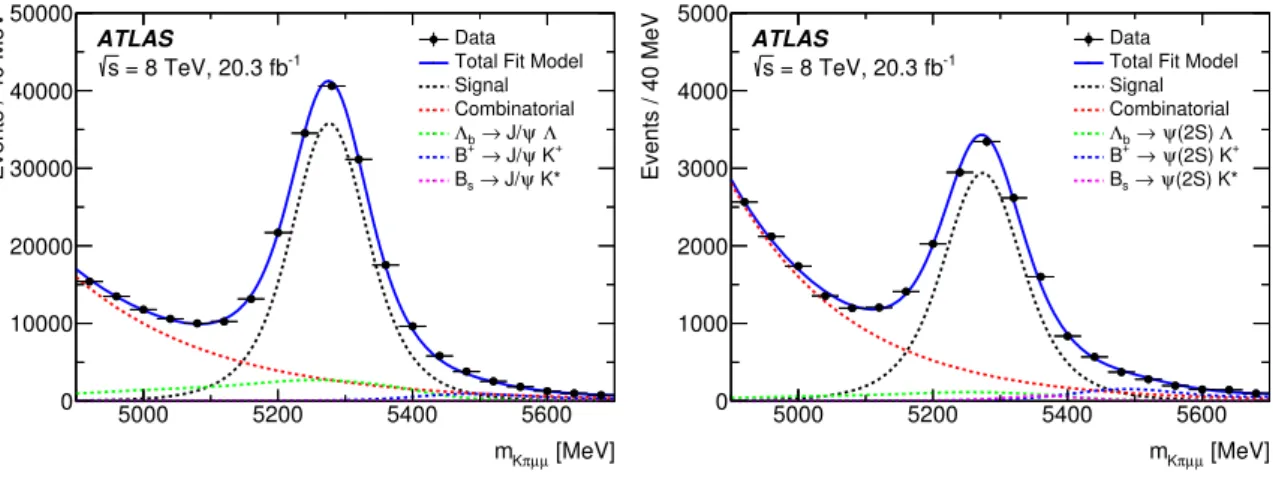
(11) Events / 40 MeV. Events / 40 MeV. 50000 Data Total Fit Model Signal Combinatorial Λb → J/ ψ Λ + + B → J/ ψ K Bs → J/ ψ K*. ATLAS s = 8 TeV, 20.3 fb-1 40000 30000. 5000 4000 3000. 20000. 2000. 10000. 1000. 0. 5200. 5400. 0. 5600 mKπµµ [MeV]. 5000. 5200. 5400. 5600 mKπµµ [MeV]. Figure 3. Fits to the Kπµµ invariant mass distributions for the (left) K ∗ J/ψ and (right) K ∗ ψ(2S) control region samples. The data are shown as points and the total fit model as the solid lines. The dashed lines represent (black) signal, (red) combinatorial background, (green) Λ b background, (blue) B + background and (magenta) Bs0 background components.. they accumulate around 0.7 in | cos θL |. These are removed from the data sample when estimating systematic uncertainties, as described in section 7.. 5.3. K ∗ cc control sample fits. The mass distribution obtained from the simulated samples for K ∗ cc decays, respectively as q 2 ∈ [8, 11] and [12, 15] GeV2 , and the signal mode, in different bins of q 2 , are found to be consistent with each other. Values of m0 and ξ for Bd0 → K ∗ J/ψ and Bd0 → K ∗ ψ(2S) events are used for the signal pdf and extracted from fits to the data. An extended unbinned maximum-likelihood fit is performed in the two K ∗ cc control region samples. There are three exclusive backgrounds included: Λb → Λcc, B + → K + cc and Bs0 → K ∗ cc. The K ∗ cc pdf has the same form as the signal model, combinatorial background is described by an exponential distribution, and double and triple Gaussian pdfs determined from MC simulated events are used to describe the exclusive background contributions. A systematic uncertainty is evaluated by allowing for 0, 1, 2 and 3 exclusive background components. The control sample fit projections for the variant of the fit including all three exclusive backgrounds can be found in figure 3. The impact of the used exclusive background model on the peak position and scale factor of the signal pdf is negligible. From these fits the statistical and systematic uncertainties in the values of m0 and ξ are extracted for the Bd0 component in order to be used in the Bd0 → K ∗ µ+ µ− fits. From the J/ψ control data it is determined that the values for the nuisance parameters describing the signal model pdf in the Kπµµ mass are m0 = 5276.6 ± 0.3 ± 0.4 MeV and ξ = 1.210 ± 0.004 ± 0.002, where the uncertainties are statistical and systematic, respectively. The ψ(2S) sample yields compatible results albeit with larger uncertainties. These results are similar to those obtained from the MC simulated samples, and the numbers derived from the K ∗ J/ψ data are used for the signal region fits.. – 10 –. JHEP10(2018)047. 5000. Data Total Fit Model Signal Combinatorial Λb → ψ (2S) Λ + + B → ψ (2S) K Bs → ψ (2S) K*. ATLAS s = 8 TeV, 20.3 fb-1.
(12) 5.4. Fitting procedure and validation. The fit procedure is validated using ensembles of simulated pseudo-experiments generated with the FL and S parameters corresponding to those obtained from the data. The purpose of these experiments is to measure the intrinsic fit bias resulting from the likelihood estimator used to extract signal parameters. These ensembles are also used to check that the uncertainties extracted from the fit are consistent with expectations. Ensembles of simulated pseudo-experiments are performed in which signal MC events are injected into samples of background events generated from the likelihood. The signal yield determined from the first step in the fit process is found to be unbiased. The angular parameters extracted from the nominal fits have biases with magnitudes ranging between 0.01 and 0.04, depending on the fit variation and q 2 bin. A similar procedure is used to estimate the effect of neglecting S-wave contamination in the data sample. Neglecting the S-wave component in the fit model results in a bias between 0.00 and 0.02 in the angular parameters. Similarly, neglecting exclusive background contributions from Λb , B + and Bs0 decays that peak in mKπµµ near the Bd0 mass results in a bias of less than 0.01 on the angular parameters. All these effects are included in the systematic uncertainties described in section 7. The P (0) parameters are obtained using the fit results and covariance matrices from the second fit along with equations (2.2)–(2.5).. 6. Results. The event yields obtained from the fits are summarised in table 1 where only statistical uncertainties are reported. Figures 4 through 9 show for the different q 2 bins the distributions of the variables used in the fit for the S5 folding scheme (corresponding to the transformation of equation (5.3)) with the total, signal and background fitted pdfs superimposed. Similar sets of distributions are obtained for the three other folding schemes: S4 , S7 and (0) S8 . The results of the angular fits to the data in terms of the Si and Pj can be found in tables 2 and 3. Statistical and systematic uncertainties are quoted in the tables. The distributions of FL and the Si parameters as a function of q 2 are shown in figure 10 and (0) those for Pj are shown in figure 11. The correlations between FL and the Si parameters (0). and between FL and the Pj. are given in appendix A.. – 11 –. JHEP10(2018)047. A two-step fit process is performed for the different signal bins in q 2 . The first step is a fit to the Kπµ+ µ− invariant mass distribution, using the event-by-event uncertainty in the reconstructed mass as a conditional variable. For this fit, the parameters m0 and ξ are fixed to the values obtained from fits to data control samples as described in section 5.3. A second step adds the (transformed) cos θK , cos θL and φ variables to the likelihood in order to extract FL and the S parameters along with the values for the nuisance parameters related to the combinatorial background shapes. Some nuisance parameters, namely m0 , ξ, signal and background yields, and the exponential shape parameter for the background mass pdf, are fixed to the results obtained from the first step..
(13) nsignal. nbackground. [0.04, 2.0]. 128 ± 22. 122 ± 22. [2.0, 4.0]. 106 ± 23. 113 ± 23. [4.0, 6.0]. 114 ± 24. 204 ± 26. [0.04, 4.0]. 236 ± 31. 233 ± 32. [1.1, 6.0]. 275 ± 35. 363 ± 36. [0.04, 6.0]. 342 ± 39. 445 ± 40. Events / 0.04 π. Events / 25 MeV. Table 1. The values of fitted signal, nsignal , and background, nbackground , yields obtained for different bins in q 2 . The uncertainties indicated are statistical.. ATLAS s = 8 TeV, 20.3 fb-1 S5 fold, q2 ∈ [0.04, 2.0] GeV2. 40. 30. Data Total Fit Model Signal Background. 20. 30. ATLAS s = 8 TeV, 20.3 fb-1 S5 fold, q2 ∈ [0.04, 2.0] GeV2. Data Total Fit Model Signal Background. 20. 10 10. 30. 5200. 5400. ATLAS s = 8 TeV, 20.3 fb-1 S5 fold, q2 ∈ [0.04, 2.0] GeV2. 0 0. 5600 mKπµµ [MeV] Events / 0.04. Events / 0.08. 0. Data Total Fit Model Signal Background. 20. 1. 2. ATLAS s = 8 TeV, 20.3 fb-1 2 2 30 S5 fold, q ∈ [0.04, 2.0] GeV. 3 φ [rad] Data Total Fit Model Signal Background. 20. 10. 0 −1. 10. −0.5. 0. 0.5. 1 cos θK. 0 0. 0.2. 0.4. 0.6. 0.8. 1 cos θL. Figure 4. The distributions of (top left) mKπµµ , (top right) φ, (bottom left) cos θK , and (bottom right) cos θL obtained for q 2 ∈ [0.04, 2.0] GeV2 . The (blue) solid line is a projection of the total pdf, the (red) dot-dashed line represents the background, and the (black) dashed line represents the signal component. These plots are obtained from a fit using the S5 folding scheme.. – 12 –. JHEP10(2018)047. q 2 [GeV2 ].
(14) Events / 0.04 π. Events / 25 MeV. 30. Data Total Fit Model Signal Background. 20. ATLAS s = 8 TeV, 20.3 fb-1 S5 fold, q2 ∈ [2.0, 4.0] GeV2. Data Total Fit Model Signal Background. 20. 10 10. 30. 5200. 5400. ATLAS s = 8 TeV, 20.3 fb-1 S5 fold, q2 ∈ [2.0, 4.0] GeV2. 0 0. 5600 mKπµµ [MeV] Events / 0.04. Events / 0.08. 0. Data Total Fit Model Signal Background. 20. 2. ATLAS s = 8 TeV, 20.3 fb-1 S5 fold, q2 ∈ [2.0, 4.0] GeV2. 20. 3 φ [rad] Data Total Fit Model Signal Background. 10. 10. 0 −1. 1. −0.5. 0. 0.5. 1 cos θK. 0 0. 0.2. 0.4. 0.6. 0.8. 1 cos θL. Figure 5. The distributions of (top left) mKπµµ , (top right) φ, (bottom left) cos θK , and (bottom right) cos θL obtained for q 2 ∈ [2.0, 4.0] GeV2 . The (blue) solid line is a projection of the total pdf, the (red) dot-dashed line represents the background, and the (black) dashed line represents the signal component. These plots are obtained from a fit using the S5 folding scheme.. – 13 –. JHEP10(2018)047. ATLAS s = 8 TeV, 20.3 fb-1 S5 fold, q2 ∈ [2.0, 4.0] GeV2.
(15) Events / 0.04 π. Events / 25 MeV. 30. Data Total Fit Model Signal Background. 20. 30. ATLAS s = 8 TeV, 20.3 fb-1 S5 fold, q2 ∈ [4.0, 6.0] GeV2. Data Total Fit Model Signal Background. 20. 10 10. 50. 5200. 5400. ATLAS s = 8 TeV, 20.3 fb-1 S5 fold, q2 ∈ [4.0, 6.0] GeV2. 40. 0 0. 5600 mKπµµ [MeV] Events / 0.04. Events / 0.08. 0. Data Total Fit Model Signal Background. 30. 30. 1. 2. ATLAS s = 8 TeV, 20.3 fb-1 S5 fold, q2 ∈ [4.0, 6.0] GeV2. 3 φ [rad] Data Total Fit Model Signal Background. 20. 20 10 10 0 −1. −0.5. 0. 0.5. 1 cos θK. 0 0. 0.2. 0.4. 0.6. 0.8. 1 cos θL. Figure 6. The distributions of (top left) mKπµµ , (top right) φ, (bottom left) cos θK , and (bottom right) cos θL obtained for q 2 ∈ [4.0, 6.0] GeV2 . The (blue) solid line is a projection of the total pdf, the (red) dot-dashed line represents the background, and the (black) dashed line represents the signal component. These plots are obtained from a fit using the S5 folding scheme.. – 14 –. JHEP10(2018)047. ATLAS s = 8 TeV, 20.3 fb-1 S5 fold, q2 ∈ [4.0, 6.0] GeV2. 40.
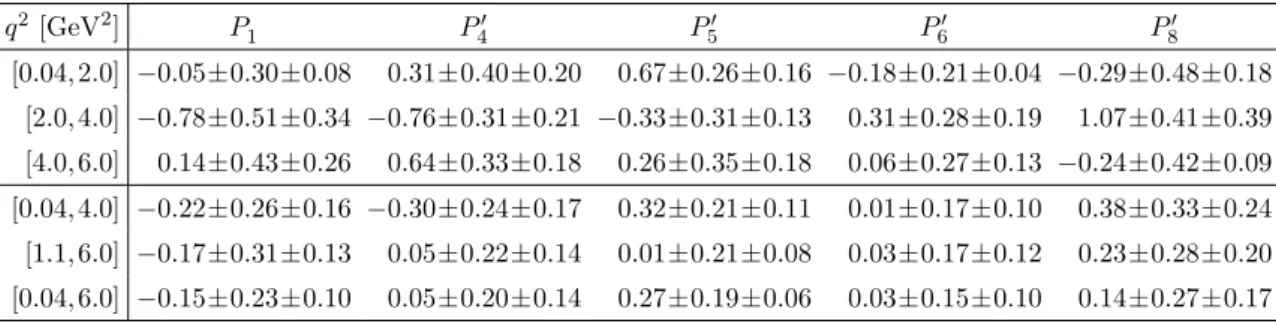
(16) Events / 0.04 π. Events / 25 MeV. 60. Data Total Fit Model Signal Background. 40. ATLAS s = 8 TeV, 20.3 fb-1 40 S5 fold, q2 ∈ [0.04, 4.0] GeV2. Data Total Fit Model Signal Background. 30. 20. 20 10. 5200. 5400. ATLAS s = 8 TeV, 20.3 fb-1 S5 fold, q2 ∈ [0.04, 4.0] GeV2. 40. 0 0. 5600 mKπµµ [MeV] Events / 0.04. Events / 0.08. 0. Data Total Fit Model Signal Background. 20. 0 −1. 1. 2. ATLAS s = 8 TeV, 20.3 fb-1 S5 fold, q2 ∈ [0.04, 4.0] GeV2. 40. 3 φ [rad] Data Total Fit Model Signal Background. 20. −0.5. 0. 0.5. 1 cos θK. 0 0. 0.2. 0.4. 0.6. 0.8. 1 cos θL. Figure 7. The distributions of (top left) mKπµµ , (top right) φ, (bottom left) cos θK , and (bottom right) cos θL obtained for q 2 ∈ [0.04, 4.0] GeV2 . The (blue) solid line is a projection of the total pdf, the (red) dot-dashed line represents the background, and the (black) dashed line represents the signal component. These plots are obtained from a fit using the S5 folding scheme.. – 15 –. JHEP10(2018)047. ATLAS s = 8 TeV, 20.3 fb-1 S5 fold, q2 ∈ [0.04, 4.0] GeV2.
(17) Events / 0.04 π. Events / 25 MeV. ATLAS s = 8 TeV, 20.3 fb-1 S5 fold, q2 ∈ [1.1, 6.0] GeV2. 60 Data Total Fit Model Signal Background. 40. 60. ATLAS s = 8 TeV, 20.3 fb-1 S5 fold, q2 ∈ [1.1, 6.0] GeV2. Data Total Fit Model Signal Background. 40. 20 20. 80. 5200. 5400. ATLAS s = 8 TeV, 20.3 fb-1 S5 fold, q2 ∈ [1.1, 6.0] GeV2. 60. 0 0. 5600 mKπµµ [MeV] Events / 0.04. Events / 0.08. 0. Data Total Fit Model Signal Background. 60. 1. 2. ATLAS s = 8 TeV, 20.3 fb-1 S5 fold, q2 ∈ [1.1, 6.0] GeV2. 3 φ [rad] Data Total Fit Model Signal Background. 40. 40 20 20. 0 −1. −0.5. 0. 0.5. 1 cos θK. 0 0. 0.2. 0.4. 0.6. 0.8. 1 cos θL. Figure 8. The distributions of (top left) mKπµµ , (top right) φ, (bottom left) cos θK , and (bottom right) cos θL obtained for q 2 ∈ [1.1, 6.0] GeV2 . The (blue) solid line is a projection of the total pdf, the (red) dot-dashed line represents the background, and the (black) dashed line represents the signal component. These plots are obtained from a fit using the S5 folding scheme.. – 16 –. JHEP10(2018)047. 80.
(18) Events / 0.04 π. Events / 25 MeV. 100. Data Total Fit Model Signal Background. 60. ATLAS s = 8 TeV, 20.3 fb-1 S5 fold, q2 ∈ [0.04, 6.0] GeV2. Data Total Fit Model Signal Background. 40. 50 20. 80. 5200. 5400. ATLAS s = 8 TeV, 20.3 fb-1 S5 fold, q2 ∈ [0.04, 6.0] GeV2. 0 0. 5600 mKπµµ [MeV] Events / 0.04. Events / 0.08. 0. Data Total Fit Model Signal Background. 60. 80. 1. 2. ATLAS s = 8 TeV, 20.3 fb-1 S5 fold, q2 ∈ [0.04, 6.0] GeV2. 60. 3 φ [rad] Data Total Fit Model Signal Background. 40 40 20. 20. 0 −1. −0.5. 0. 0.5. 1 cos θK. 0 0. 0.2. 0.4. 0.6. 0.8. 1 cos θL. Figure 9. The distributions of (top left) mKπµµ , (top right) φ, (bottom left) cos θK , and (bottom right) cos θL obtained for q 2 ∈ [0.04, 6.0] GeV2 . The (blue) solid line is a projection of the total pdf, the (red) dot-dashed line represents the background, and the (black) dashed line represents the signal component. These plots are obtained from a fit using the S5 folding scheme.. – 17 –. JHEP10(2018)047. ATLAS s = 8 TeV, 20.3 fb-1 S5 fold, q2 ∈ [0.04, 6.0] GeV2.
(19) q 2 [GeV2 ]. FL. S3. S4. [0.04, 2.0] 0.44±0.08±0.07 −0.02±0.09±0.02. S5. 0.15±0.20±0.10. S7. S8. 0.33±0.13±0.08 −0.09±0.10±0.02 −0.14±0.24±0.09. [2.0, 4.0] 0.64±0.11±0.05 −0.15±0.10±0.07 −0.37±0.15±0.10 −0.16±0.15±0.06. 0.15±0.14±0.09. [4.0, 6.0] 0.42±0.13±0.12. 0.52±0.20±0.19. 0.32±0.16±0.09. 0.13±0.18±0.09. 0.03±0.13±0.07 −0.12±0.21±0.05. [0.04, 4.0] 0.52±0.07±0.06 −0.05±0.06±0.04 −0.15±0.12±0.09. 0.00±0.12±0.07. 0.16±0.10±0.05. 0.01±0.08±0.05. 0.19±0.16±0.12. [1.1, 6.0] 0.56±0.07±0.06 −0.04±0.07±0.03. 0.03±0.11±0.07. 0.00±0.10±0.04. 0.02±0.08±0.06. 0.11±0.14±0.10. [0.04, 6.0] 0.50±0.06±0.04 −0.04±0.06±0.03. 0.03±0.10±0.07. 0.14±0.09±0.03. 0.02±0.07±0.05. 0.07±0.13±0.09. Table 2. The values of FL , and S3 , S4 , S5 , S7 and S8 parameters obtained for different bins in q 2 . The uncertainties indicated are statistical and systematic, respectively. P1. [0.04, 2.0] −0.05±0.30±0.08. P40 0.31±0.40±0.20. P50. P60. P80. 0.67±0.26±0.16 −0.18±0.21±0.04 −0.29±0.48±0.18. [2.0, 4.0] −0.78±0.51±0.34 −0.76±0.31±0.21 −0.33±0.31±0.13. 0.31±0.28±0.19. [4.0, 6.0]. 1.07±0.41±0.39. 0.64±0.33±0.18. 0.26±0.35±0.18. 0.06±0.27±0.13 −0.24±0.42±0.09. [0.04, 4.0] −0.22±0.26±0.16 −0.30±0.24±0.17. 0.32±0.21±0.11. 0.01±0.17±0.10. 0.38±0.33±0.24. 0.14±0.43±0.26. [1.1, 6.0] −0.17±0.31±0.13. 0.05±0.22±0.14. 0.01±0.21±0.08. 0.03±0.17±0.12. 0.23±0.28±0.20. [0.04, 6.0] −0.15±0.23±0.10. 0.05±0.20±0.14. 0.27±0.19±0.06. 0.03±0.15±0.10. 0.14±0.27±0.17. Table 3. The values of P1 , P40 , P50 , P60 and P80 parameters obtained for different bins in q 2 . The uncertainties indicated are statistical and systematic, respectively.. 7. Systematic uncertainties. Systematic uncertainties in the parameter values obtained from the angular analysis come from several sources. The methods for determining these uncertainties are based either on a comparison of nominal and modified fit results, or on observed fit biases in modified pseudo-experiments. The systematic uncertainties are symmetrised. The most significant ones are described in the following, in decreasing order of importance. • A systematic uncertainty is assigned for the combinatorial Kπ (fake K ∗ ) background peaking at cos θK values around 1.0 obtained by comparing results of the nominal fit to that where data above cos θK = 0.9 are excluded from the fit. • A systematic uncertainty is derived to account for background arising from partially reconstructed B → D0 /D+ /Ds+ X decays, that manifest in an accumulation of events at | cos θL | values around 0.7. Two-track or three-track combinations are formed from the signal candidate tracks, and are reconstructed assuming the pion or kaon mass hypothesis. A veto is then applied for events in which a track combination has a mass in a window of 30 MeV around the D0 , D+ or Ds+ meson mass. Similarly, a veto is implemented to reject B + → K + µ+ µ− and B + → π + µ+ µ− events that pass the event selection. Here B + candidates are reconstructed from one of the hadrons from the K ∗ candidate and the muons in the signal candidate. Signal candidates that have a threetrack mass within 50 MeV of the B + mass are excluded from the fit. A few percent of signal events are removed when applying these vetoes, with a corresponding effect on the acceptance distributions. The fit results obtained from the data samples with. – 18 –. JHEP10(2018)047. q 2 [GeV2 ].
(20) vetoes applied are compared to those obtained from the nominal fit and the change in each result is taken as the systematic uncertainty from these backgrounds. This systematic uncertainty dominates the measurement of FL at higher values of q 2 . • The combinatorial background pdf shape has an uncertainty arising from the choice of the model. For the mass distribution it is assumed that an exponential function model is adequate; however, for the angular variables the data are re-fitted using third-order Chebychev polynomials. The change from the nominal result is taken as the uncertainty from this source.. • A systematic uncertainty is assigned for the angular pdf model for the background by comparing the nominal result to that with a reduced fit range of mKπµµ ∈ [5200, 5700] MeV, in particular to account for possible residues of the partially reconstructed B-decays. • A correction is applied to the data by shifting the track pT according to the uncertainties arising from biases in rapidity and momentum scale. The change in results obtained is ascribed to the uncertainty in the ID alignment and knowledge of the magnetic field. • The maximum-likelihood estimator used is intrinsically biased. Ensembles of MC simulated events are used in order to ascertain the bias in the extracted values of the parameters of interest. The bias is assigned as a systematic uncertainty. • The pT spectrum of Bd0 candidates observed in data is not accurately reproduced by the MC simulation. This difference in the kinematics results in a slight modification of the acceptance functions. This is accounted for by reweighting signal MC simulated events to resemble the pT spectrum found in data. The change in fitted parameter values obtained due to the reweighting is taken as the systematic uncertainty resulting from this difference. • The signal decay mode is resonant K ∗ → Kπ decay, but scalar contributions from non-resonant Kπ transitions may also exist. The LHCb Collaboration reported an Swave contribution at the level of 5% of the signal [4, 30]. Ensembles of MC simulated events are fitted with 5% of the signal being drawn from an S-wave sample of events and the remaining 95% from signal. The observed change in fit bias is assigned as the systematic uncertainty from this source. Any variation in S-wave content as a function of q 2 would not significantly affect the results reported here.. – 19 –. JHEP10(2018)047. • The acceptance function is assumed to factorise into three separate components, for cos θK , cos θL and φ. To validate this assumption, the signal simulated events are fitted with the acceptance function obtained from that same MC sample. Differences in the fit results from expectation are small and taken as the uncertainty resulting from this assumption..
(21) • The values of the nuisance parameters of the fit model obtained from MC control samples and fits to the data mass distribution have associated uncertainties. These parameters include m0 , ξ, the signal and background yields, the shape parameter of the combinatorial background mass distribution, and the parameters of the signal acceptance functions. The uncertainty in the value of each of these parameters is varied independently in order to assess the effect on parameters of interest. This source of uncertainty has a small effect on the measurements reported here.. • The difference from nominal results obtained when fitting the Bd0 signal MC events with the acceptance function for B 0d is taken as an upper limit of the systematic error resulting from event migration due to mistagging the Bd0 flavour. (0). • The parameters S5 and S8 , as well as the respective Pj parameters are affected by dilution and thus have a multiplicative scaling applied to them. This dilution factor depends on the kinematics of the K ∗ decay and has a systematic uncertainty associated with it. The effect of data/MC differences in the pT spectrum of Bd0 candidates on the mistag probability was studied and found to be negligible. The uncertainty due to the limited number of MC events is used to compute the statistical uncertainty of ω and ω. Studies of MC simulated events indicate that there is no significant difference between the mistag probability for Bd0 and B 0d events and the analysis assumes that the average mistag probability provides an adequate description of this effect. The magnitude of the mistag probability difference, |ω − ω|, is included as a systematic uncertainty resulting from this assumption. (0). The total systematic uncertainties of the fitted Si and Pj parameter values are presented in tables 2 and 3, where the dominant contributions for FL come from the modelling of the angular distributions of the combinatorial background and the partially reconstructed decays peaking in cos θK and cos θL . These contributions and in addition also ID alignment and magnetic field calibration affect S3 (P1 ). The largest systematic uncertainty contribution to S3 (P1 ) comes from partially reconstructed decays entering the signal region. This also affects the measurement of S5 (P50 ) and S7 (P60 ). The partially reconstructed decays peaking in cos θL affect the measurement of S4 (P40 ) and S8 (P80 ), whereas the fake K ∗ background in cos θK affects S4 (P40 ), S5 (P50 ), and S8 (P80 ). The parameterization of the signal acceptance is another significant systematic uncertainty source for S4 (P40 ). The systematic uncertainties are smaller than the statistical uncertainties for all parameters measured.. – 20 –. JHEP10(2018)047. • Background from exclusive modes peaking in mKπµµ is neglected in the nominal fit. This may affect the fitted results and is accounted for by computing the fit bias obtained when embedding MC simulated samples of Λb → Λ(1520)µ+ µ− , Λb → pK − µ+ µ− , B + → K (∗)+ µ+ µ− and Bs0 → φµ+ µ− into ensembles of pseudodata generated from the fit model containing only combinatorial background and signal components. The change in fit bias observed when adding exclusive backgrounds is taken as the systematic error arising from neglecting those modes in the fit..
(22) 1.6. S3. FL. 1.8. s = 8 TeV, 20.3 fb-1. ATLAS. Data CFFMPSV fit theory DHMV theory JC. 1.4 1.2. 0.8. Data CFFMPSV fit theory DHMV. 0.6 0.4. 1. 0.2. 0.8 0.6. 0. 0.4. −0.2. 0.2 0 0. s = 8 TeV, 20.3 fb-1. ATLAS. −0.4. 2. 4. 6. 8. 10. 0. 2. 4. 6. 8. S5. S4. 0.8. s = 8 TeV, 20.3 fb-1. ATLAS. Data CFFMPSV fit theory DHMV. 0.6 0.4. 0.8. s = 8 TeV, 20.3 fb-1. ATLAS. Data CFFMPSV fit theory DHMV. 0.6 0.4. 0.2. 0.2. 0. 0. −0.2. −0.2. −0.4. −0.4. −0.6 0. −0.6. 2. 4. 6. 8. 10. 0. 2. 4. 6. 8. s = 8 TeV, 20.3 fb-1. ATLAS. Data CFFMPSV fit theory DHMV. 0.6. 0.8. s = 8 TeV, 20.3 fb-1. ATLAS. Data CFFMPSV fit theory DHMV. 0.6. 0.4. 0.4. 0.2. 0.2. 0. 0. −0.2. −0.2. −0.4 0. 10. q2 [GeV2] S8. S7. q2 [GeV2] 0.8. 10. q2 [GeV2]. −0.4. 2. 4. 6. 8. 10. 0. q2 [GeV2]. 2. 4. 6. 8. 10. q2 [GeV2]. Figure 10. The measured values of FL , S3 , S4 , S5 , S7 , S8 compared with predictions from the theoretical calculations discussed in the text (section 8). Statistical and total uncertainties are shown for the data, i.e. the inner mark indicates the statistical uncertainty and the total error bar the total uncertainty.. 8. Comparison with theoretical computations. The results of theoretical approaches of Ciuchini et al. (CFFMPSV) [31], Descotes-Genon et al. (DHMV) [32], and Jäger and Camalich (JC) [33, 34] are shown in figure 10 for the S parameters, and in figure 11 for the P (0) parameters, along with the results presented here.4 4. This result uses the experimental convention of equations (2.2)–(2.5) following the LHCb Collaboration’s notation in ref. [3]. In the DHMV calculation, a different convention is used as explained by equation (16) in ref. [15].. – 21 –. JHEP10(2018)047. q2 [GeV2].
(23) P1. s = 8 TeV, 20.3 fb-1. 2 ATLAS. Data theory DHMV theory JC. 1.5 1 0.5 0 −0.5 −1 −1.5 −2 0. 2. 4. 6. 8. 10. P'5. P'4. s = 8 TeV, 20.3 fb-1. 2 ATLAS. Data theory DHMV theory JC. 1.5 1. s = 8 TeV, 20.3 fb-1. 2 ATLAS. Data CFFMPSV fit theory DHMV theory JC. 1.5 1. 0.5 0. 0.5. −0.5. 0. −1. −0.5. −1.5 −2 0. −1 2. 4. 6. 8. 10. 0. 2. 4. 6. 8. s = 8 TeV, 20.3 fb-1. 2 ATLAS. Data theory DHMV theory JC. 1.5. 0.5. 0.5. 0. 0. −0.5. −0.5. −1. −1 4. 6. 8. Data theory DHMV theory JC. 1.5 1. 2. s = 8 TeV, 20.3 fb-1. 2 ATLAS. 1. 0. 10. q2 [GeV2] P'8. P'6. q2 [GeV2]. 10. 0. q2 [GeV2]. 2. 4. 6. 8. 10. q2 [GeV2]. Figure 11. The measured values of P1 , P40 , P50 , P60 , P80 compared with predictions from the theoretical calculations discussed in the text (section 8). Statistical and total uncertainties are shown for the data, i.e. the inner mark indicates the statistical uncertainty and the total error bar the total uncertainty.. QCD factorisation is used by DHMV and JC, where the latter focus on the impact of long-distance corrections using a helicity amplitude approach. The CFFMPSV group takes a different approach, using the QCD factorisation framework to perform compatibility checks of the LHCb data with theoretical predictions. This approach also allows information from a given experimentally measured parameter of interest to be excluded in order to make a fit-based prediction of the expected value of that parameter from the rest of the data.. – 22 –. JHEP10(2018)047. q2 [GeV2].
(24) With the exception of the P40 and P50 measurements in q 2 ∈ [4.0, 6.0] GeV2 and P80 in q 2 ∈ [2.0, 4.0] GeV2 there is good agreement between theory and measurement. The P40 and P50 parameters have statistical correlation of 0.37 in the q 2 ∈ [4.0, 6.0] GeV2 bin. The observed deviation from the SM prediction of P40 and P50 is for both parameters approximately 2.7 standard deviations (local) away from the calculation of DHMV for this bin. The deviations are less significant for the other calculation and the fit approach. All measurements are found to be within three standard deviations of the range covered by the different predictions. Hence, including experimental and theoretical uncertainties, the measurements presented here are found to agree with the predicted SM contributions to this decay.. Conclusion. The results of an angular analysis of the rare decay Bd0 → K ∗ µ+ µ− are presented. This flavour-changing neutral current process is sensitive to potential new-physics contributions. √ The Bd0 → K ∗ µ+ µ− analysis presented here uses a total of 20.3 fb−1 of s = 8 TeV pp collision data collected by the ATLAS experiment at the LHC in 2012. An extended unbinned maximum-likelihood fit of the angular distribution of the signal decay is performed in order (0) to extract the parameters FL , Si and Pj in six bins of q 2 . Three of these bins overlap in order to report results in ranges compatible with other experiments and phenomenology studies. All measurements are found to be within three standard deviation of the range covered by the different predictions. The results are also compatible with the results of the LHCb, CMS and Belle collaborations.. Acknowledgments We thank CERN for the very successful operation of the LHC, as well as the support staff from our institutions without whom ATLAS could not be operated efficiently. We acknowledge the support of ANPCyT, Argentina; YerPhI, Armenia; ARC, Australia; BMWFW and FWF, Austria; ANAS, Azerbaijan; SSTC, Belarus; CNPq and FAPESP, Brazil; NSERC, NRC and CFI, Canada; CERN; CONICYT, Chile; CAS, MOST and NSFC, China; COLCIENCIAS, Colombia; MSMT CR, MPO CR and VSC CR, Czech Republic; DNRF and DNSRC, Denmark; IN2P3-CNRS, CEA-DRF/IRFU, France; SRNSFG, Georgia; BMBF, HGF, and MPG, Germany; GSRT, Greece; RGC, Hong Kong SAR, China; ISF, I-CORE and Benoziyo Center, Israel; INFN, Italy; MEXT and JSPS, Japan; CNRST, Morocco; NWO, Netherlands; RCN, Norway; MNiSW and NCN, Poland; FCT, Portugal; MNE/IFA, Romania; MES of Russia and NRC KI, Russian Federation; JINR; MESTD, Serbia; MSSR, Slovakia; ARRS and MIZŠ, Slovenia; DST/NRF, South Africa; MINECO, Spain; SRC and Wallenberg Foundation, Sweden; SERI, SNSF and Cantons of Bern and Geneva, Switzerland; MOST, Taiwan; TAEK, Turkey; STFC, United Kingdom; DOE and NSF, United States of America. In addition, individual groups and members have received support from BCKDF, the Canada Council, CANARIE, CRC, Compute Canada, FQRNT, and the Ontario Innovation Trust, Canada; EPLANET, ERC, ERDF, FP7, Horizon 2020 and Marie Sklodowska-Curie Actions, European Union; Investissements d’Avenir Labex and Idex, ANR, Région Auvergne and Fondation Partager. – 23 –. JHEP10(2018)047. 9.
(25) A. Correlation matrices. Four folding schemes are applied to the data in order to extract FL , S3 , S4 , S5 , S7 and S8 from four separate fits. The P (0) parameters are subsequently derived from the fit results using equations (2.2)–(2.5). It is not possible to extract a full correlation matrix between fitted parameters obtained from different fits. In order to reconstruct the correlation matrix, ensembles of pseudo-experiments are simulated using the pdf corresponding to the nominal angular distributions. Each simulated ensemble has the four folding schemes applied to it and four fits are performed on the resulting samples. The distributions obtained for pairs of parameters obtained from fits to these ensembles are used to compute Pearson correlation coefficients for those pairs. Correlation matrices for FL and the S parameters are reconstructed from all possible pairings for a given q 2 bin. A similar method is used to extract the correlation matrices for the P (0) parameters. This procedure is repeated for each q 2 bin studied in order to obtain correlation matrices given in the remainder of this appendix. The correlation matrices are statistical only. Contributions from systematic uncertainties are not included, since the measurement precision is statistically limited. • Table 4 (5) shows the statistical correlation matrix for FL and S (P (0) ) parameters for the q 2 bin [0.04, 2.0] GeV2 . • Table 6 (7) shows the statistical correlation matrix for FL and S (P (0) ) parameters for the q 2 bin [2.0, 4.0] GeV2 . • Table 8 (9) shows the statistical correlation matrix for FL and S (P (0) ) parameters for the q 2 bin [4.0, 6.0] GeV2 . • Table 10 (11) shows the statistical correlation matrix for FL and S (P (0) ) parameters for the q 2 bin [0.04, 4.0] GeV2 . • Table 12 (13) shows the statistical correlation matrix for FL and S (P (0) ) parameters for the q 2 bin [1.1, 6.0] GeV2 . • Table 14 (15) shows the statistical correlation matrix for FL and S (P (0) ) parameters for the q 2 bin [0.04, 6.0] GeV2 .. – 24 –. JHEP10(2018)047. le Savoir, France; DFG and AvH Foundation, Germany; Herakleitos, Thales and Aristeia programmes co-financed by EU-ESF and the Greek NSRF; BSF, GIF and Minerva, Israel; BRF, Norway; CERCA Programme Generalitat de Catalunya, Generalitat Valenciana, Spain; the Royal Society and Leverhulme Trust, United Kingdom. The crucial computing support from all WLCG partners is acknowledged gratefully, in particular from CERN, the ATLAS Tier-1 facilities at TRIUMF (Canada), NDGF (Denmark, Norway, Sweden), CC-IN2P3 (France), KIT/GridKA (Germany), INFN-CNAF (Italy), NL-T1 (Netherlands), PIC (Spain), ASGC (Taiwan), RAL (U.K.) and BNL (U.S.A.), the Tier-2 facilities worldwide and large non-WLCG resource providers. Major contributors of computing resources are listed in ref. [35]..
(26) FL 1.00. FL S3 S4 S5 S7 S8. S3 0.11 1.00. S4 −0.13 0.31 1.00. S5 0.03 0.28 0.58 1.00. S7 0.16 0.73 0.19 0.14 1.00. S8 0.24 0.45 0.22 0.28 0.59 1.00. P1. P1. P40. 1.00. P40. P50. P60. P80. 0.04. 0.05. 0.62. 0.32. 1.00. 0.53. −0.08. −0.06. 1.00. 0.00. 0.22. 1.00. 0.55. P50 P60 P80. 1.00. Table 5. Statistical correlation matrix for the P (0) parameters obtained for q 2 ∈ [0.04, 2.0] GeV2 .. FL S3 S4 S5 S7 S8. FL 1.00. S3 0.27 1.00. S4 0.35 −0.08 1.00. S5 −0.04 −0.44 0.60 1.00. S7 −0.15 −0.09 −0.02 −0.11 1.00. S8 −0.37 −0.20 −0.12 −0.20 0.63 1.00. Table 6. Statistical correlation matrix for the FL and S parameters obtained for q 2 ∈ [2.0, 4.0] GeV2 .. P1 P1 P40 P50 P60 P80. 1.00. P40. P50. P60. P80. −0.12. −0.21. 0.05. 0.05. 1.00. 0.51. 0.08. 0.03. 1.00. −0.23. 0.22. 1.00. 0.66 1.00. Table 7. Statistical correlation matrix for the P (0) parameters obtained for q 2 ∈ [2.0, 4.0] GeV2 .. – 25 –. JHEP10(2018)047. Table 4. Statistical correlation matrix for the FL and S parameters obtained for q 2 ∈ [0.04, 2.0] GeV2 ..
(27) FL 1.00. FL S3 S4 S5 S7 S8. S3 0.33 1.00. S4 −0.18 0.15 1.00. S5 0.04 0.23 0.52 1.00. S7 0.22 0.60 0.03 0.28 1.00. S8 0.28 0.05 0.01 0.27 0.60 1.00. P1. P1. P40. 1.00. P40. P50. P60. P80. 0.11. 0.34. 0.41. 0.16. 1.00. 0.37. 0.06. 0.04. 1.00. 0.39. 0.33. 1.00. 0.62. P50 P60 P80. 1.00. Table 9. Statistical correlation matrix for the P (0) parameters obtained for q 2 ∈ [4.0, 6.0] GeV2 .. FL 1.00. FL S3 S4 S5 S7 S8. S3 0.08 1.00. S4 0.05 −0.04 1.00. S5 0.01 0.03 0.79 1.00. S7 0.18 0.29 0.08 0.03 1.00. S8 0.14 −0.16 0.03 −0.02 0.60 1.00. Table 10. Statistical correlation matrix for the FL and S parameters obtained for q 2 ∈ [0.04, 4.0] GeV2 .. P1 P1 P40 P50 P60 P80. 1.00. P40. P50. P60. P80. −0.07. 0.00. 0.21. 0.12. 1.00. 0.78. 0.08. 0.02. 1.00. 0.03. −0.04. 1.00. 0.59 1.00. Table 11. Statistical correlation matrix for the P (0) parameters obtained for q 2 ∈ [0.04, 4.0] GeV2 .. – 26 –. JHEP10(2018)047. Table 8. Statistical correlation matrix for the FL and S parameters obtained for q 2 ∈ [4.0, 6.0] GeV2 ..
(28) FL 1.00. FL S3 S4 S5 S7 S8. S3 0.05 1.00. S4 0.00 0.41 1.00. S5 0.07 0.46 0.60 1.00. S7 0.18 0.32 0.09 0.17 1.00. S8 −0.03 −0.01 0.03 0.24 0.67 1.00. P1 P1. 1.00. P40. P40. P50. P60. P80. 0.23. −0.09. 0.08. −0.07. 1.00. 0.53. 0.15. 0.08. 1.00. 0.28. 0.24. 1.00. 0.67. P50 P60 P80. 1.00. Table 13. Statistical correlation matrix for the P (0) parameters obtained for q 2 ∈ [1.1, 6.0] GeV2 .. FL S3 S4 S5 S7 S8. FL 1.00. S3 0.03 1.00. S4 0.01 −0.02 1.00. S5 −0.10 −0.09 0.68 1.00. S7 0.13 0.32 0.00 −0.05 1.00. S8 0.06 −0.01 0.04 0.03 0.65 1.00. Table 14. Statistical correlation matrix for the FL and S parameters obtained for q 2 ∈ [0.04, 6.0] GeV2 .. P1 P1 P40 P50 P60 P80. 1.00. P40. P50. P60. P80. −0.02. −0.14. 0.17. 0.04. 1.00. 0.65. 0.00. 0.05. 1.00. −0.06. 0.09. 1.00. 0.61 1.00. Table 15. Statistical correlation matrix for the P (0) parameters obtained for q 2 ∈ [0.04, 6.0] GeV2 .. – 27 –. JHEP10(2018)047. Table 12. Statistical correlation matrix for the FL and S parameters obtained for q 2 ∈ [1.1, 6.0] GeV2 ..
(29) Open Access. This article is distributed under the terms of the Creative Commons Attribution License (CC-BY 4.0), which permits any use, distribution and reproduction in any medium, provided the original author(s) and source are credited.. References [1] Belle collaboration, J.T. Wei et al., Measurement of the Differential Branching Fraction and Forward-Backword Asymmetry for B → K (∗) `+ `− , Phys. Rev. Lett. 103 (2009) 171801 [arXiv:0904.0770] [INSPIRE].. [3] LHCb collaboration, Measurement of Form-Factor-Independent Observables in the Decay B 0 → K ∗0 µ+ µ− , Phys. Rev. Lett. 111 (2013) 191801 [arXiv:1308.1707] [INSPIRE]. [4] LHCb collaboration, Angular analysis of the B 0 → K ∗0 µ+ µ− decay using 3 fb−1 of integrated luminosity, JHEP 02 (2016) 104 [arXiv:1512.04442] [INSPIRE]. [5] CMS collaboration, Angular analysis of the decay B 0 → K ∗0 µ+ µ− from pp collisions at √ s = 8 TeV, Phys. Lett. B 753 (2016) 424 [arXiv:1507.08126] [INSPIRE]. [6] CMS collaboration, Measurement of angular parameters from the decay B0 → K∗0 µ+ µ− in √ proton-proton collisions at s = 8 TeV, Phys. Lett. B 781 (2018) 517 [arXiv:1710.02846] [INSPIRE]. [7] BaBar collaboration, J.P. Lees et al., Measurement of angular asymmetries in the decays B → K ∗ `+ `− , Phys. Rev. D 93 (2016) 052015 [arXiv:1508.07960] [INSPIRE]. [8] Belle collaboration, S. Wehle et al., Lepton-Flavor-Dependent Angular Analysis of B → K ∗ `+ `− , Phys. Rev. Lett. 118 (2017) 111801 [arXiv:1612.05014] [INSPIRE]. [9] LHCb collaboration, Differential branching fraction and angular analysis of the decay B 0 → K ∗0 µ+ µ− , JHEP 08 (2013) 131 [arXiv:1304.6325] [INSPIRE]. [10] A. Bharucha, D.M. Straub and R. Zwicky, B → V `+ `− in the Standard Model from light-cone sum rules, JHEP 08 (2016) 098 [arXiv:1503.05534] [INSPIRE]. [11] L. Evans and P. Bryant, LHC Machine, 2008 JINST 3 S08001 [INSPIRE]. [12] K.G. Wilson and W. Zimmermann, Operator product expansions and composite field operators in the general framework of quantum field theory, Commun. Math. Phys. 24 (1972) 87 [INSPIRE]. [13] W. Altmannshofer and D.M. Straub, New Physics in B → K ∗ µµ?, Eur. Phys. J. C 73 (2013) 2646 [arXiv:1308.1501] [INSPIRE]. [14] T. Hurth, F. Mahmoudi and S. Neshatpour, Global fits to b → s`` data and signs for lepton non-universality, JHEP 12 (2014) 053 [arXiv:1410.4545] [INSPIRE]. [15] S. Descotes-Genon, L. Hofer, J. Matias and J. Virto, Global analysis of b → s`` anomalies, JHEP 06 (2016) 092 [arXiv:1510.04239] [INSPIRE]. [16] I. Dunietz, H.R. Quinn, A. Snyder, W. Toki and H.J. Lipkin, How to extract CP-violating asymmetries from angular correlations, Phys. Rev. D 43 (1991) 2193 [INSPIRE]. [17] S. Descotes-Genon, T. Hurth, J. Matias and J. Virto, Optimizing the basis of B → K ∗ ll observables in the full kinematic range, JHEP 05 (2013) 137 [arXiv:1303.5794] [INSPIRE].. – 28 –. JHEP10(2018)047. [2] CDF collaboration, T. Aaltonen et al., Measurements of the Angular Distributions in the Decays B → K (∗) µ+ µ− at CDF, Phys. Rev. Lett. 108 (2012) 081807 [arXiv:1108.0695] [INSPIRE]..
(30) [18] S. Descotes-Genon, J. Matias, M. Ramon and J. Virto, Implications from clean observables for the binned analysis of B → K ∗ µ+ µ− at large recoil, JHEP 01 (2013) 048 [arXiv:1207.2753] [INSPIRE]. [19] ATLAS collaboration, The ATLAS Experiment at the CERN Large Hadron Collider, 2008 JINST 3 S08003 [INSPIRE]. [20] T. Sjöstrand, S. Mrenna and P.Z. Skands, PYTHIA 6.4 Physics and Manual, JHEP 05 (2006) 026 [hep-ph/0603175] [INSPIRE]. [21] T. Sjöstrand, S. Mrenna and P.Z. Skands, A Brief Introduction to PYTHIA 8.1, Comput. Phys. Commun. 178 (2008) 852 [arXiv:0710.3820] [INSPIRE].. [23] J. Pumplin, D.R. Stump, J. Huston, H.L. Lai, P.M. Nadolsky and W.K. Tung, New generation of parton distributions with uncertainties from global QCD analysis, JHEP 07 (2002) 012 [hep-ph/0201195] [INSPIRE]. [24] D.J. Lange, The EvtGen particle decay simulation package, Nucl. Instrum. Meth. A 462 (2001) 152 [INSPIRE]. [25] GEANT4 collaboration, S. Agostinelli et al., GEANT4: A Simulation toolkit, Nucl. Instrum. Meth. A 506 (2003) 250 [INSPIRE]. [26] ATLAS collaboration, The ATLAS Simulation Infrastructure, Eur. Phys. J. C 70 (2010) 823 [arXiv:1005.4568] [INSPIRE]. [27] ATLAS collaboration, Measurement of the muon reconstruction performance of the ATLAS detector using 2011 and 2012 LHC proton-proton collision data, Eur. Phys. J. C 74 (2014) 3130 [arXiv:1407.3935] [INSPIRE]. [28] ATLAS collaboration, Measurement of the CP-violating phase φs and the Bs0 meson decay width difference with Bs0 → J/ψφ decays in ATLAS, JHEP 08 (2016) 147 [arXiv:1601.03297] [INSPIRE]. [29] A. Ali, P. Ball, L.T. Handoko and G. Hiller, A comparative study of the decays B → (K, K ∗ )`+ `− in standard model and supersymmetric theories, Phys. Rev. D 61 (2000) 074024 [hep-ph/9910221] [INSPIRE]. [30] LHCb collaboration, Measurements of the S-wave fraction in B 0 → K + π − µ+ µ− decays and the B 0 → K ∗ (892)0 µ+ µ− differential branching fraction, JHEP 11 (2016) 047 [Erratum ibid. 04 (2017) 142] [arXiv:1606.04731] [INSPIRE]. [31] M. Ciuchini et al., B → K ∗ `+ `− decays at large recoil in the Standard Model: a theoretical reappraisal, JHEP 06 (2016) 116 [arXiv:1512.07157] [INSPIRE]. [32] S. Descotes-Genon, L. Hofer, J. Matias and J. Virto, On the impact of power corrections in the prediction of B → K ∗ µ+ µ− observables, JHEP 12 (2014) 125 [arXiv:1407.8526] [INSPIRE]. [33] S. Jäger and J. Martin Camalich, On B → V `` at small dilepton invariant mass, power corrections and new physics, JHEP 05 (2013) 043 [arXiv:1212.2263] [INSPIRE]. [34] S. Jäger and J. Martin Camalich, Reassessing the discovery potential of the B → K ∗ `+ `− decays in the large-recoil region: SM challenges and BSM opportunities, Phys. Rev. D 93 (2016) 014028 [arXiv:1412.3183] [INSPIRE]. [35] ATLAS collaboration, ATLAS Computing Acknowledgements, ATL-GEN-PUB-2016-002 (2016).. – 29 –. JHEP10(2018)047. [22] ATLAS collaboration, Summary of ATLAS PYTHIA 8 tunes, ATL-PHYS-PUB-2012-003 (2012)..
Figure
![Figure 2. The acceptance functions for (left) cos θ K and (right) cos θ L for (solid) q 2 ∈ [0 .04, 2.0] GeV 2 and (dashed) q 2 ∈ [4.0, 6.0] GeV 2 , that shape the angular decay rate of equa-tion (2.1).](https://thumb-us.123doks.com/thumbv2/123dok_es/7320251.451889/10.892.129.770.124.373/figure-acceptance-functions-right-solid-dashed-shape-angular.webp)
![Figure 4. The distributions of (top left) m Kπµµ , (top right) φ, (bottom left) cos θ K , and (bottom right) cos θ L obtained for q 2 ∈ [0.04, 2.0] GeV 2](https://thumb-us.123doks.com/thumbv2/123dok_es/7320251.451889/13.892.123.771.484.947/figure-distributions-left-kπµµ-right-left-right-obtained.webp)
+7
![Figure 5. The distributions of (top left) m Kπµµ , (top right) φ, (bottom left) cos θ K , and (bottom right) cos θ L obtained for q 2 ∈ [2.0, 4.0] GeV 2](https://thumb-us.123doks.com/thumbv2/123dok_es/7320251.451889/14.892.124.769.329.786/figure-distributions-left-kπµµ-right-left-right-obtained.webp)
![Figure 6. The distributions of (top left) m Kπµµ , (top right) φ, (bottom left) cos θ K , and (bottom right) cos θ L obtained for q 2 ∈ [4.0, 6.0] GeV 2](https://thumb-us.123doks.com/thumbv2/123dok_es/7320251.451889/15.892.123.770.330.785/figure-distributions-left-kπµµ-right-left-right-obtained.webp)
![Figure 7. The distributions of (top left) m Kπµµ , (top right) φ, (bottom left) cos θ K , and (bottom right) cos θ L obtained for q 2 ∈ [0.04, 4.0] GeV 2](https://thumb-us.123doks.com/thumbv2/123dok_es/7320251.451889/16.892.125.772.329.783/figure-distributions-left-kπµµ-right-left-right-obtained.webp)
![Figure 8. The distributions of (top left) m Kπµµ , (top right) φ, (bottom left) cos θ K , and (bottom right) cos θ L obtained for q 2 ∈ [1.1, 6.0] GeV 2](https://thumb-us.123doks.com/thumbv2/123dok_es/7320251.451889/17.892.124.771.327.787/figure-distributions-left-kπµµ-right-left-right-obtained.webp)
![Figure 9. The distributions of (top left) m Kπµµ , (top right) φ, (bottom left) cos θ K , and (bottom right) cos θ L obtained for q 2 ∈ [0.04, 6.0] GeV 2](https://thumb-us.123doks.com/thumbv2/123dok_es/7320251.451889/18.892.129.771.321.784/figure-distributions-left-kπµµ-right-left-right-obtained.webp)
Documento similar
63 Department of Physics and Astronomy, Iowa State University, Ames IA, United States of America. 64 Joint Institute for Nuclear Research, JINR Dubna,
64 Department of Physics and Astronomy, Iowa State University, Ames IA, United States of America. 65 Joint Institute for Nuclear Research, JINR Dubna,
Department of Physics, University of Illinois, Urbana IL, United States of America Department of Physics and Astronomy, University of Uppsala, Uppsala, Sweden 167 Instituto de
Narino, Bogota, Colombia 163 Department of Physics and Astronomy, University of California Irvine, Irvine CA, United States of America 164 a INFN Gruppo Collegato di Udine; b
Fermi, Università di Pisa, Pisa, Italy 124 Department of Physics and Astronomy, University of Pittsburgh, Pittsburgh, PA, United States 125 a Laboratorio de Instrumentacao e
Albert Einstein Center for Fundamental Physics and Laboratory for High Energy Physics, University of Bern, Bern, Switzerland 18 School of Physics and Astronomy, University
Dodge Department of Physics and Astronomy, University of Oklahoma, Norman OK, United States of America 114 Department of Physics, Oklahoma State University, Stillwater OK, United
Petersburg, Russia n Also at Louisiana Tech University, Ruston LA, United States of America o Also at Institucio Catalana de Recerca i Estudis Avancats, ICREA, Barcelona, Spain p
