
APOE AND ALZHEIMER DISEASE: A MAJOR GENE WITH SEMI-DOMINANT INHERITANCE
Emmanuelle Genin1,2, Didier Hannequin3,4, David Wallon3,4, Kristel Sleegers5,6, Mikko Hiltunen7, Onofre Combarros8, Maria J Bullido9, Nathalie Brouwers5,6, Karolien Bettens5,6, Claudine Berr10, Florence Pasquier11,4, Bruno Dubois 12,4, Steven T DeKosky13, Gloria Tognoni14, Nathalie Fiévet15,16, Sebastiaan Engelborghs6,17, Beatrice Arosio18, Elicer Coto19, Peter De Deyn6,17, Maria Del Zompo20, Ignacio Mateo8, Jacques Epelbaum21, Ana Frank-Garcia22, Seppo Helisalmi7, Elisa Porcellini23, Alberto Pilotto24, Paola Forti25, Raffaele Ferri26, Elio Scarpini27, Gabriele Siciliano14, Vincenzo Solfrizzi28, Sandro Sorbi29, Gianfranco Spalletta30, Giovanni Ravaglia31, Fernando Valdivieso9, Saila Vepsäläinen7, Victoria Alvarez19, Paolo Bosco26, Michelangelo Mancuso14, Francesco Panza28, Benedetta Nacmias29, Paola Bossù30, Olivier Hanon31, Paola Piccardi20, Giorgio Annoni31, Davide Seripa24, Daniela Galimberti27, Federico Licastro23, Hilkka Soininen7, Jean-François Dartigues32, Christophe Tzourio33,34, Christine Van Broeckhoven9,10, M Ilyas Kamboh35, Annick Alpérovitch33,34, Jean Charles Lambert11,15,16, Philippe Amouyel11,12,15,16, Dominique Campion3,4.
1. Inserm UMRS-946, Paris, France
2. Institut Universitaire d’Hématologie, Univ Paris Diderot, Paris, France 3. INSERM U 614, Faculté de Médecine, Rouen , France
4. Centre National de reference maladie d’Alzheimer du sujet jeune, France
5. Neurodegenerative Brain Diseases group, Department of Molecular Genetics, VIB, Antwerp, Belgium
6. Institute Born-Bunge and University of Antwerp, Antwerp, Belgium
7. Department of Neurology, Kuopio University and University Hospital, 70211, Kuopio, Finland
8. Neurology Service and CIBERNED, "Marqués de Valdecilla" University Hospital (University of Cantabria), Santander, Spain.
9. Centro de Biologia Molecular Severo Ochoa (UAM-CSIC) and CIBERNED, Universidad Autonoma, Cantoblanco, S-28049, Madrid, Spain
10. INSERM U888, Hôpital La Colombière, F-34093 Montpellier, France 11. CHRU de Lille, F-59000 Lille, France
12. Hopital Pitié Salpetriere , Paris , France
13. University of Virginia School of medicine, Charlottesville, VA, USA
14. Department of Neuroscience, Neurological Clinic, University of Pisa, I-56100, Italy 15. INSERM U744, F-59019 Lille, France
16. Institut Pasteur de Lille, F-59019, Lille, France
17. Memory Clinic and Department of Neurology, ZNA Middelheim, Antwerpen, Belgium 18. Department of Internal Medicine, Fondazione Policlinico IRCCS, Milan Italy
19. Genetic Molecular Unit, Hospital Universitario Central de Asturias, 33006-Oviedo, Spain
20. Section of Clinical Pharmacology, Department of Neuroscience, University of Cagliari, Italy
21. UMR 894, INSERM Faculté de Médecine, Université Paris Descartes, F-75014 Paris, France
22. Servicio de Neurologia, Hospital Universitario La Paz (UAM) and CIBERNED, 28034 Madrid, Spain
24. Geriatric Unit & Gerontology-Geriatric Research Laboratory, Department of Medical Science, IRCCS Casa Sollievo della Sofferenza, San Giovanni Rotondo , I-71013, Italy 25. Department of Internal Medicine Cardiology and Hepatology, University Hospital S. Orsola-Malpighi, Bologna, Italy
26. IRCCS Oasi Maria SS, 94018 Troina , Italy
27. Dept. of Neurological Sciences, Dino Ferrari Center, University of Milan, IRCCS Ospedale Maggiore Policlinico, Milan, Italy
28. Department of Geriatrics, Centre for Aging Brain, Memory Unit, University of Bari, Policlinico, 70124 Bari, Italy
29. Department of Neurological and Psychiatric Sciences, 50134 Florence, Italy
30. Department of Clinical and Behavioral Neurology, IRCCS Santa Lucia Foundation, 00179 Roma – Italy
31. Department of Clinical Medicine and Prevention, University of Milano-Bicocca, Monza Italy
32. INSERM U897, Victor Segalen University, F-33076, Bordeaux, France 33. INSERM U708, F-75013 Paris, France
34. UPMC Univ. Paris 06, F-75005 Paris, France
35. Department of Human Genetics and Alzheimer's Disease Research Centre, University of Pittsburgh, USA
Since the initial report of an enrichment of the APOE 4 allele of the Apolipoprotein E ( APOE) gene among Alzheimer disease (AD) patients (Saunders et al. 1993), the strength of the association between different APOE genotypes and the disease is reported as odds ratios (ORs). Taking as a basis the most frequent genotype (APOE 33), the odds ratios are estimated to be 3.2 for APOE 34 and 14.9 for APOE 44 whereas, the APOE 2 allele has a protective effect in Caucasian subjects (Farrer et al. , 1997). However, ORs, that are basically
epidemiological measures, are of limited interest in medical practise. What the physician (and the carrier of an “ at risk “ genotype) want to know is not the magnitude of the increased risk conferred by this particular genotype with respect to the most frequent genotype in the population but the actual probability to develop the disease according to age and sex. To address this issue, we (Bickeboller et al. 1997) and others ( Myers et al. 1996 , Seshadri et al. 1995) previously attempted to calculate genotype-dependent AD lifetime risks (LTRs); i.e. the risk to develop the disease between birth and some particular age t (Thompson and Weissman, 1981). The LTR of a given APOE genotype could also be seen as the penetrance at age t of AD among carriers of this APOE genotype or the probability that a randomly selected individual with this APOE genotype will develop AD by that age assuming that he does not die of another cause before that age (Satagopan et al. 2001).
However, due to the limited sample sizes available at that time, 95% confidence intervals (95% CI) were huge and precluded any reasonable estimate of LTRs especially in APOE 4 homozygotes. Taking advantage of the large case/control sample used in a recent European AD Genome wide association study (GWAS) (Lambert et al. 2009) and adding two novel case/control cohorts, we undertook a novel attempt to estimate these values.
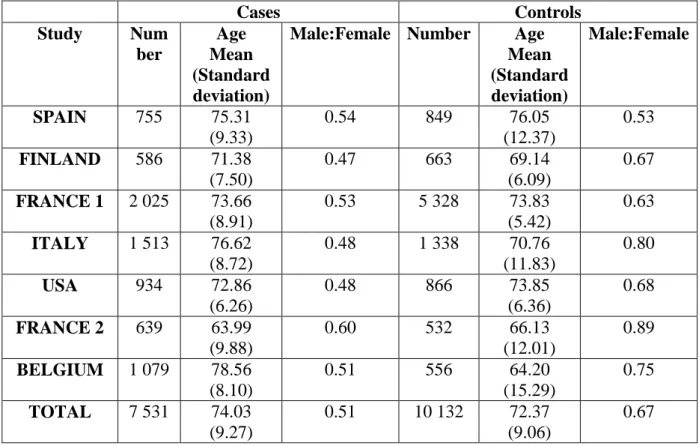
All subjects included in the GWAS as well as 2,971 new Caucasian subjects (1398 controls and 1573 AD patients) originating from the west of France and the USA and ascertained according to the same criteria than the GWAS subjects were included in this study. Therefore,
a total of 7,531 cases and 10,132 controls from seven different sub-studies were available. Demographic characteristics of the samples are summarized in Table 1.
Individuals were stratified into 4 age categories (less than 60, between 60 and 69, between 70 and 79 and more than 80 years old) depending on either the age of onset of the disease for patients or the current age for controls. APOE genotype frequency estimates and their 95% CI are shown in Figure S1 for cases and controls in the different samples stratified by age (males and females were considered together as no frequency difference was found between gender). After stratification on age, only limited heterogeneity could be seen between samples and we thus decided to pool them all. Table 2 gives the ORs (taking APOE 33 as reference) obtained for the different APOE genotypes on the pooled data in the different age categories and over all age categories. The OR of APOE 44 in the whole sample (OR=14.49; 95%CI = [11.91; 17.64]) is consistent with previous estimates (Farrer et al. 1997) but varies significantly with age, ranging from 5.6 (95%CI = [3.17; 9.89]) when the onset is before the age of 60 years old to 35.07 (95%CI = [23.8; 51.68]) when the onset is between 60 and 69. The same if true for APOE 34 with ORs in the range between 2.09 (95%CI= [1.61; 2.71]) for patients with an onset before 60 years and 4.18 (95%CI=[3.59; 4.88]) for the patients with an onset between 70 and 79 years. For the other APOE genotypes, ORs are more homogeneous across age-groups and are estimated to be 2.64 [2.13; 3.27] for APOE 24 and 0.56 [0.49; 0.64] for APOE 22 and 23 considered together.
Age dependant penetrances of the different APOE genotypes were computed using a method similar to those described in Bickeboller et al. (1997) and Satagopan et al. (2001). The only difference is that in our computation we account for mortality rates over the different age and genotype categories (see Supplementary Data for a description of the method used).
At age 85, they reach 51 % (95%CI=[41;69]) and 56% (95%CI=[45;75]) for APOE 44 male and female carriers and 23% (95%CI=[22;25]) and 26% (95%CI=[24;28]) for APOE 34 male and female carriers, consistent with semi dominant inheritance of a moderately penetrant gene. Clearly these values indicate that the effect of APOE on Alzheimer disease is more similar to the one of major genes in mendelian diseases such as BRCA1 in breast cancer than the one of low-risk common alleles identified by recent GWASs in complex diseases. For a comparison, the lifetime risk of breast cancer in BRCA1 mutation carriers by age 70 is estimated to be around 57% (95% CI, 47% to 66%), so very similar to our estimated APOE 44 penetrances by age 85 (Chen and Parmigiani ; 2007).
The allelic frequency of the APOE 4 allele in human populations ranges from 0.09 to 0.19 (Farrer et al. 1997). These values are well above those found for other deleterious alleles responsible for mendelian diseases, even those involved in recessive disorders. This apparent paradox might be explained by the fact that the APOE 4 allele, that is probably the ancestral APOE allele in humans (Fullerton et al., 2000), exerts its deleterious effect mainly in elderly individuals. Its impact on the reproductive fitness of the carriers is probably very limited. However, its reduced frequency compared to the one of the APOE 3 allele, if not due to genetic drift, suggests that it might slightly reduce the fitness.
As discussed by Yang et al. (Yang et al. 2009), lifetime risk estimates suffer from uncertainties in the population incidence rates, genotype frequencies and effect sizes. By using a bootstrap method, we were able to account for these two latter uncertainties but since we had to rely on published records of incidence rates, we were not able to model
uncertainties in incidence rates. We also had to account for the fact that mortality rates vary depending on APOE genotypes. In particular, the APOE 4 allele has been shown to increase cardiovascular mortality (Schachter et al. 1994) and a recent GWAS confirmed that the APOE locus plays a role in longevity as this locus stands up among the ones with the most extreme
allele frequencies differences in centenarians compared to younger controls (Sebastiani, et al. 2010). To account for mortality differences depending on APOE genotypes in LTRs
computations, we built a new model that assumes that for a given APOE genotype, survival probabilities are proportional to the genotype frequency differences observed over the different age categories in the sample (see supplementary data).
In conclusion, we think that our results urge for a shift of category of the APOE gene from “risk factor” to “major gene”. This shift is not a pure semantic exercise. It has profound implications for patients. In Caucasian populations roughly 2% of the population bears an APOE 44 genotype. Considering the major risk conferred by this genotype, it becomes necessary to target at a presymptomatic state these individuals , as well as PSENs or APP mutation carriers, in clinical trials aimed at developing novel preventive therapeutics.
References
Bickeboller, H., D. Campion, et al. (1997). "Apolipoprotein E and Alzheimer disease: genotype-specific risks by age and sex." Am J Hum Genet 60(2): 439-46.
Chen, S. and G. Parmigiani (2007). "Meta-analysis of BRCA1 and BRCA2 penetrance." J Clin Oncol 25(11): 1329-33.
Fullerton, S.,M., et al. (2000) Apolipoprotein E variation at the sequence haplotype level: implications for the origin and maintenance of a major human polymorphism . Am. J.Hum. Genet. 67: 881-900.
Lambert, J. C., S. Heath, et al. (2009). "Genome-wide association study identifies variants at CLU and CR1 associated with Alzheimer's disease." Nat Genet 41(10): 1094-9. Myers, RH et al. Apolipoprotein E element 4 association with dementia in a population based
study: the Framingham Study (1996) Neurology 46: 673-677.
Satagopan, J. M., K. Offit, et al. (2001). "The lifetime risks of breast cancer in Ashkenazi Jewish carriers of BRCA1 and BRCA2 mutations." Cancer Epidemiol Biomarkers Prev 10(5): 467-73.
Schachter, F., L. Faure-Delanef, et al. (1994). "Genetic associations with human longevity at the APOE and ACE loci." Nat Genet 6(1): 29-32.
Sebastiani, P., N. Solovieff, et al.(2010) "Genetic Signatures of Exceptional Longevity in Humans." Science: pub ahead of print.
Seshadri, S., Drachman, DA., Lippa, C. (1995) Apolipoprotein E4 allele and the lifetime risk of Alzheimer's disease. Arch Neurol 52: 1074-1079.
Thompson, W. D. and M. M. Weissman (1981). "Quantifying lifetime risk of psychiatric disorder." J Psychiatr Res 16(2): 113-26.
Yang, Q., W. D. Flanders, et al. (2009). "Using lifetime risk estimates in personal genomic profiles: estimation of uncertainty." Am J Hum Genet 85(6): 786-800.
Cases Controls Study Num ber Age Mean (Standard deviation)
Male:Female Number Age
Mean (Standard deviation) Male:Female SPAIN 755 75.31 (9.33) 0.54 849 76.05 (12.37) 0.53 FINLAND 586 71.38 (7.50) 0.47 663 69.14 (6.09) 0.67 FRANCE 1 2 025 73.66 (8.91) 0.53 5 328 73.83 (5.42) 0.63 ITALY 1 513 76.62 (8.72) 0.48 1 338 70.76 (11.83) 0.80 USA 934 72.86 (6.26) 0.48 866 73.85 (6.36) 0.68 FRANCE 2 639 63.99 (9.88) 0.60 532 66.13 (12.01) 0.89 BELGIUM 1 079 78.56 (8.10) 0.51 556 64.20 (15.29) 0.75 TOTAL 7 531 74.03 (9.27) 0.51 10 132 72.37 (9.06) 0.67
Age-group Sample Size (Cases/Controls) APOE 44 APOE 34 APOE 24 APOE 22+23 Less than 60 593 / 610 5.60 [3.17;9.89] 2.09 [1.61;2.71] 1.29 [0.61;2.71] 0.43 [0.24;0.77] 60 to 70 1511 / 2614 35.07 [23.8;51.68] 4.18 [3.59;4.88] 2.2 [1.32;3.68] 0.59 [0.43;0.82] 70 to 80 3244 / 5175 15.75 [11.93;20.8] 4.54 [4.09;5.05] 2.79 [2.05;3.8] 0.51 [0.41;0.63] More than 80 2183 / 1733 7.87 [4.28;14.46] 3.16 [2.68;3.72] 3.77 [2.28;6.23] 0.59 [0.47;0.74] All 7531/10132 14.49 [11.91; 17.64] 3.63 [3.37; 3.90] 2.64 [2.13; 3.27] 0.56 [0.49; 0.64] p-valuea 1.05×10⁻⁷ 3.40×10⁻⁸ 0.11 0.64
Table 2 Odds-Ratios [95% Confidence Interval] of the different APOE genotypes (using APOE 33 genotype as reference).
a
Age Gender APOE 44 APOE 34 APOE 24 APOE 33 APOE 22+23 65 Male 4.14 [1.48;10.19] 1.02 [0.83;1.27] 0.28 [0.09;0.81] 0.28 [0.25;0.32] 0.21 [0.13;0.34] Female 4.25 [1.52;10.46] 1.06 [0.85;1.31] 0.29 [0.09;0.84] 0.29 [0.26;0.32] 0.22 [0.13;0.34] 75 Male 28.35 [21.21;43.63] 6.96 [6.35;7.62] 4.39 [3.14;6.80] 1.77 [1.69;1.86] 1.12 [0.92;1.38] Female 29.89 [22.39;45.96] 7.36 [6.72;8.06] 4.65 [3.32;7.19] 1.88 [1.79;1.97] 1.18 [0.97;1.47] 85 Male 50.92 [41.08;68.65] 23.22 [21.64;25.05] 19.99 [14.10;29.51] 7.76 [7.46;8.05] 4.87 [4.20;5.67] Female 56.03 [45.43;75.40] 26.09 [24.33;28.14] 22.55 [15.92;33.30] 8.76 [8.43;9.09] 5.51 [4.75;6.41]
Table 3 Penetrance estimates [95% Confidence Interval] (%) of the different APOE genotypes by different ages in males and females after
![Table 2 Odds-Ratios [95% Confidence Interval] of the different APOE genotypes (using APOE 33 genotype as reference)](https://thumb-us.123doks.com/thumbv2/123dok_es/6926861.298072/9.1262.93.1047.127.422/table-ratios-confidence-interval-different-genotypes-genotype-reference.webp)
![Table 3 Penetrance estimates [95% Confidence Interval] (%) of the different APOE genotypes by different ages in males and females after](https://thumb-us.123doks.com/thumbv2/123dok_es/6926861.298072/10.1262.93.935.128.379/penetrance-estimates-confidence-interval-different-genotypes-different-females.webp)
