SPEAKING PRACTICE USING WEB 2.0 TECHNOLOGIES TEFL 1
Speaking practice using web 2.0 technologies in TEFL
Analysis of a Case study.
By
Jose Ignacio Hermosa Bonilla
Adviser
Yesenia María Escobar Espitia
Universidad Nacional Abierta y a Distancia UNAD Escuela de Ciencias de la Educación ECEDU Bachelor of Arts in English as a Foreign Language
SPEAKING PRACTICE USING WEB 2.0 TECHNOLOGIES TEFL 2
Educational Analytical Summary
Case study: Speaking practice using Web 2.0 Technology in TELF. Analysis of a case study
Author: Jose Ignacio Hermosa Bonilla.
Degree Sought: Bachelor of Arts in English as a Foreign Language.
Keywords: Web 2.0, Speaking practice, Case of Study, teaching strategies.
Description: This search aims to improve TEFL strategies focusing web 2.0 tools, in virtual educative environments. In general, the level of English in Colombia is relatively low, and teachers training in one angle stone in the process of enhancing a better English level. This issue also generates an impediment to be hired in internationally interlinked companies. There are several influencing factors related to such a deficient English language proficiency in Colombia. Some of them are educational policies, scarce economic resources, a very mountainous geography, poor access to information networks, and little didactic material, among others.
References
British Council.org. English in Colombia: An examination of policy perceptions and
influencing factors. 2015. Retrieved from: https://ei.britishcouncil.org/sites/ efau
lt/files/latin-americaresearch/English%20in% 20Colombia.pdf
Cambridge University Press (2017) Diccionario Inglés. Recuperado de: https://dictionary.
cambridge.org/es/diccionario/ingles/
Flick, U. (2012) Introducción a la investigación cualitativa. Coruna: Ediciones Morata, S.L.
Recuperado de: http://bibliotecavirtual.unad.edu.co:2162/openurl?sid=EBSCO%
SPEAKING PRACTICE USING WEB 2.0 TECHNOLOGIES TEFL 3
&spage=&pages=&title=Introduccio01n+a+la+investigacio01n+cualitativa &atitle=
Introduccio%CC%81n+a+la+investigacio%CC%81n+cualitativa&aulast=&id=DOI
%3a&site=ftf-live
Ivic,I. (1999) Lev Semionovich Vygotsky (1896-1934). UNESCO. Oficina Internacional de
Educación. Recuperado de:http://www.ibe.unesco.org /sites/default/ files/vygotskys.
Jonassen,D. Davidson,M. Collins,M. Campbell,J.& Haag,B.(1995). Constructivism and
computer‐mediated communication in distance education. 9 (2), Recuperado de: http: //www. tandfonline.com/doi/citedby/10.1080/08923649509526885?scroll
=top&need Access=true+
Leppink,J. 2017. Cognitive load theory: Practical implications and an important challenge.
Journal of Taibah University Medical Sciences, 12 (5) 385-391. Recuperado de:
http://bi bliotecavirtual.unad.edu.co:2454/S1658361217300835/1-s2.0-S16583
612173 00835-main. pdf?_tid=cbdd6c8a-7259-11e7-9375-00000aacb35 f&a cd
nat=1501111745 _6e003d5e5 2f5c7c01e3c68cbd9f8e1ca
Martín,D. Arendale,D. (1992). Supplemental Instruction: Improving First-Year Student Su
ccess in High-Risk Courses. The Freshman Year Experience: Monograph Series 7
Ministerio de Educación Nacional de Colombia. Colombia Bilingüe. Recuperado de http://
aprende.colombiaaprende.edu.co/es/colombiabilingue/86689
SPEAKING PRACTICE USING WEB 2.0 TECHNOLOGIES TEFL 4
Recuperado de: http://www.plandecenal.edu.co/cms/media/herramientas /oecd_ ed
ucacion_ en_colombia_aspectos.pdf
Sánchez, A. (2012). El bilingüismo en los bachilleres colombianos. Documentos de Trabajo
Sobre Economía Regional, No. 159, Banco de la República. Recuperado de: http://
www.banrep.gov.co/docum/Lectura_finanzas/pdf/dtser_159.pdf
Sánchez, A. (2013). Bilingüismo en Colombia. Documentos de trabajo sobre economía
regional. Banco de la República (191). Recuperado de: http://www.banrep. gov.
co/docum/ Lectura_ fina nzas/pdf/dtser_191.pdf
Stake,R. (1988).Case Studies. Handbook of Qualitative Research Recuperado de: https:
//www. sfu.ca/~palys/Stake2003-CaseStudies.pdf
Sweller, J. (2016) Story of a Research Program. Education Review (10945296), (23), 1-19.
Recuperado de: http://bibliotecavirtual.unad.edu.co:2139/eds/pdfviewer/pdfviewer?
vid=3&sid= 2073ff8f-d3ac-4a1c-96b60c0af87754f5%40pdc-v-sessmgr01
Sweller, J. (2017) Cognitive load theory and teaching English as a second language to adult
learners. Contact Magazine university of New South Wales
Ungvarsky, J. 2017. Cognitive load. Salem Press Encyclopedia, January. Recuperado de:
http://bibliotecavirtual.unad.edu.co:2139/eds/detail/detail?vid=1&sid=59a7fcd7-4743-4777ac28b232d17c7e5a%40sessionmgr104&bdata=Jmxhbmc9ZXMmc2l
SPEAKING PRACTICE USING WEB 2.0 TECHNOLOGIES TEFL 5
University of Pittsburgh. Web 2.0 Tools in Teaching and Learning. Recuperado de:
https://teaching.pitt.edublog/web-2-0-tools-in-teaching-and-learning/
Yin, R.(1989).Investigación sobre estudio de casos diseño y métodos. Applied Social
Research Methods Series. (5). Recuperado de: https://panel.inkuba. com/ sites
/2/archivos /YIN%20ROBERT%20.pdf
Contents: This paper presents the results of a case study analysis in which oral English practices are conducted, seeking strategies to strengthen this ability, considered by many students as the most difficult to achieve.
The level of English spoken in Colombia is relatively low, making it difficult to obtain international jobs. Research shows that both teachers and students also lack the training to perform well in the English language. Thus, the training of teachers who teach English is important to raise the level of English spoken in Colombia. In this case study, the use of web 2.0 tools is analyzed in order to determine their performance in improving English speaking practices.
As research method, the qualitative method is applied, specifically the case study already mentioned, as the most appropriate to know and analyze the phenomena given in the social and educational field. The present work presents the problem to be addressed, its theoretical foundations and moves on to a description of the case studied, to subsequently provide the relevant findings, conclusions and recommendations.
Methodology: The investigation was based on a qualitative paradigm, no manipulative observation conducted at UNAD, Centro Educativo, Abierto a Distancia CEAD Jose Acevedo y Gómez, in Bogotá. It’s also articulated to the Research line of Bilingualism in distance education mediated by technologies.
SPEAKING PRACTICE USING WEB 2.0 TECHNOLOGIES TEFL 6
Table of Contents
Educational Analytical Summary
Introduction
Statement of Problem
Justification
Objectives
General Objective
Specific Objectives
Conceptual and theoretical framework
Methodology
Applied research paradigm
Population
Sample of the Population
Instrument
Fieldwork
Opportunities of Distance Learning Technologies
Web 2.0 and web 2.0 tools
Practices Description
Student´s notion about native speaking English
Going Alive
Listening Practice
Reading Practice
SPEAKING PRACTICE USING WEB 2.0 TECHNOLOGIES TEFL 7
Assesments
Results
Discussion
Conclusions
Recommendations
References
Appendix
SPEAKING PRACTICE USING WEB 2.0 TECHNOLOGIES TEFL 8
Index of Graphs
Figure 1 Hangout Code sent to students via Skype
Figure 2: Google Hangout Screen
Figure 3 Class topic to be developed in a typical online class
Figure 4. Student very attentive on class
Figure 6. Virtual classes may be as warm as presential classesses may be.
Figure 7. Student practicing listening English skill
Figure 8. Student practicing reading English skill.
Figure 9. Writing performance in virtual class
Figure 11. Writing practice in online class.
Figure 12. Educaplay assesment tool
Figure 13. Crossword test.
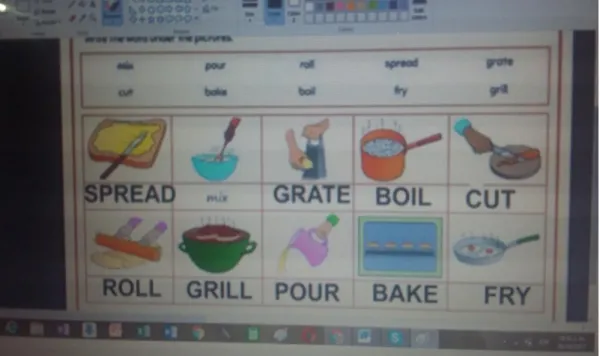
Figure 14. Identifying and writing objects names test
SPEAKING PRACTICE USING WEB 2.0 TECHNOLOGIES TEFL 9
Introduction
This Case study aims to generate teaching/learning strategies to enhance a better
performance in speaking English in TEFL. It analyzes and makes recommendations based
on web 2.0 Technology tools used in a speaking practice case study and using a no
manipulative observation. It also takes as a reference the question “Which strategies are
viable to improve English language speaking practices mediated by web 2.0 Technologies?
Observes and examines English practices performed at UNAD, CEAD Jose Acevedo y
Gómez. These activities were applied with the purpose of training students of the Bachelor
of Arts in Teaching English as a Foreign Language program.
The research presents a description of the problem that motivates it, followed by the
corresponding justification and objectives; later on, it includes the theoretical foundations,
the proposed methodology for taking the research itself to the practical field. Then the field
work itself, to move on to the results obtained and the resulting conclusions and
recommendations. Is completed with appendices containing the location of the participating
students, each located in different regions of the country. Also the request for permission and
response, addressed to participants, for the use of the information in this research. Respect
for the privacy of students is treated with due respect.
The theoretical framework is based on constructivism theories. The method utilized is
a case study, which is considered a kind of qualitative research used to understand in depth
the social and educational reality. It gives priority to the notion of the existence of a tight
SPEAKING PRACTICE USING WEB 2.0 TECHNOLOGIES TEFL 10
the former relation in order to establish the appropriate cognitive load. The sample of
populations is made up of 16 students of TEFL from different regions of Colombia.
The results of the analysis are focused to enhance scope as well as quality in English
language teaching/learning, in virtual learning environments, also to help students to remain
persevering up to the end of their bachelor and avoiding dropout.
A common paradigm among English learners is that in order to learn to speak English as a
foreign language, it is essential to travel to a place where English is commonly used. This
statement may be contradictory because when traveling to a country where the first language
is English, English learners in that environment would no longer be learning English as a
foreign language but as a second language. The above statement would undermine the
learning of English as a foreign language and limit students to longing for a journey that in
SPEAKING PRACTICE USING WEB 2.0 TECHNOLOGIES TEFL 11
Statement of Problem
Despite the great effort from the National Ministry of Education in Colombia as well as
educative institutions, in general, the level of English in Colombia is relatively low, and
teachers’ training is one angle stone in the process of enhancing a better English level. This
low English level also generates an impediment to be hired in many internationally
interlinked companies. There are several influencing factors related to such a deficient
English language proficiency in Colombia.
Simultaneously there is also need of better English language speaking levels, according
with Sanchez (2013) “most students and teachers are ranked at the lowest levels” and this
entire context finally may be interpreted as a higher demand of effective and actualized
learning practices. Sánchez (2012) concluded that, in general, the level of English in
Colombia is relatively low, and that the proportion of students who can be classified as
bilingual is approximately 1%.
One of the causes is the geographical conditions of Colombia, with a very mountainous
territory, and its many cultural niches widespread all over the country making difficult to
offer a high-quality instruction even to the remotest places in little cities, villages and rural
areas. Appendix 1 shows how widespread and far, one form the other, students are in this
SPEAKING PRACTICE USING WEB 2.0 TECHNOLOGIES TEFL 12
Glossary
Speaking practice: The act or skill of giving a speech at a public event. The connotation
in this work implies also the speaking training performed by students during their English
classes in order to enhance this foreign language skill. Cambridge University Press (2017).
Web 2.0 tools: When it was first invented, the Internet was merely a place to store and
locate information. It was static and non-interactive. A Web 2.0 site allows users to interact
and collaborate with one another as content creators in a virtual community using wikis,
blogs, web applications, social networking sites such as Facebook or video sharing sites such
as YouTube, and more. University Center for Teaching and Learning (2017).
Case study: detailed account giving information about the development of a person,
group, or thing, especially in order to show general principles. Cambridge University Press
(2017).
Bilingualism: the fact of being able to use two languages equally well. Cambridge
University Press (2017.
Constructivism: 0theory that learning is an active process and that people gain
knowledg and understanding through the combination of experiences and ideas. Cambridge
University Press (2017).
Didactic: intended to teach, especially in a way that is too determined or eager, and
SPEAKING PRACTICE USING WEB 2.0 TECHNOLOGIES TEFL 13
Strategy: a detailed plan for achieving success in situations such as war, politics,
business, industry, or sport, or the skill of planning for such situations. Cambridge
University Press (2017).
Cognitive load: refers to the amount of information the active part of human memory
can process at one time. The brain can store and process a vast amount of data, but it is limited
in the number of things it can think about simultaneously. In educational settings, knowing
this limit exists and understanding how it impacts learning is important. The effects of
SPEAKING PRACTICE USING WEB 2.0 TECHNOLOGIES TEFL 14
Justification
Given that the level of English in Colombia is relatively low, and that teachers training
is so important, and that there is insufficient didactic material, this investigation attempts to
help developing strategies in TEFL, in particular, to enhance speaking skills.
The aim of this investigation is to enhance effective performance of speaking English
as a factor that contributes to boosting the effective training of English language learners, so
that they in turn are in a position to multiply this dynamism when in due course they become
teachers of English. Given that the low level of English spoken in Colombia is well known,
it is intended that the results of this research will contribute to establish factors that positively
drive the pace of acquisition of a better performance of English teachers at UNAD.
The selected population is composed of students of the English as a foreign language
career in virtual environments developed by the UNAD. This group has 10 different origins
in Colombia. It is considered that it is precisely this group that represents most faithfully the
students in virtual media that study English at UNAD. This selected group, and by extension
those represented by them, is the one that justifies this investigation, and would be the one
that would receive in the first instance the impact of the results of this investigation.
The methodolgy is qualitative and rely in a case sudy. The case study is a method of
qualitative research that has been widely used to understand in depth the social and
SPEAKING PRACTICE USING WEB 2.0 TECHNOLOGIES TEFL 15
(2017) cites a study by the Colombian Ministry of National Education, according to which
virtual education in Colombia has grown at a rate of 500% between 2010 and 2015.
The speaking skill is one of the four skills to develop in the professional formation of
an English language teacher, one of the Bachelors of Arts, offered by the School of Education
at the National Open and Distance University in Colombia.
Teaching English as a Foreign Language is a career increasing students in Colombia,
many of them enrolled in a distance pre-grade programs and needing effective speaking
practice strategies adapted to their learning style and situation.
Without a doubt, English is one of the most important languages used in today´s
civilization, by number of users, by its use as an official language, by its economic power
and the volume of information spread out in that language, among other factors.
As a mean of retention strategy and as a solution to one of the academic causes of
leaving the university program the web 2.0 tools application is evaluated. The students’
desertion facts show how important is to establish group activities to humanize virtual
environments, because one of the desertion causes is the academic stress and the lack of
friendly contact with peers, also the knowledge creation is powered by the social intercourse
resulting from the discussion and the sharing of individual contributions, as stated by Martin
& Arendale (1992).
The aim of this investigation is to enhance effective performance of speaking English
SPEAKING PRACTICE USING WEB 2.0 TECHNOLOGIES TEFL 16
from the utilization of adequate learning strategies and at the same time impelling a
SPEAKING PRACTICE USING WEB 2.0 TECHNOLOGIES TEFL 17
Objectives
General objective
To enhance effective performance of speaking English by means of applicable teaching
strategies using web 2.0 tools in TEFL.
Specific Objectives
• To observe speaking English practices developed at UNAD, identifying
weakness and strengths as well as students reactions in their English speaking
practices.
• To search innovative solutions applicable to speaking English skills practices
engaging students’ attention and enjoyment.
• To analize pedagogical strategies adopting web 2.0 tools in developing speaking
SPEAKING PRACTICE USING WEB 2.0 TECHNOLOGIES TEFL 18
Conceptual and theoretical framework
This case study is based on the learning Cognitive theories.Cognitive models
considered the effects of mental activities in learning Vygotsky´s Socio-historical-cultural
theory of high mental functions development focused on the cultural instruments function is
“historically and scientifically, the only important source of research on metacognitive
processes in contemporary psychology. According to Topel (1998) “Vygostky hypothesis:
the thinking which develops from practical activity is mediated by speech, by the word”
This paper is based on the learning Cognitive theories as conceptualized by J. Sweller
(2016) who makes emphasis in Cognitive Load Theory applied to human problem solving
and by extension to educational problems. His earlier investigations showed him that students
were able to solve problems but not necessarily to learn the subjacent principles that lead
them to the found solutions.
The role of these processes in education and development has an importance that can
never be overestimated” (Ivic 1994.p.9). In the present research, Vygotsky´s theory is
considered part of its conceptual framework, because up to now ICT is one of the most
impacting cultural developments not only in almost all daily life aspects of these days
civilization but also in educative practice. In fact, his theories were taken in order to generate
several learning methods by authors as “Perret-Clermont, (1979); Doise & Mugny (1981);
Cresas, 1987; Hinde, Perret-Clermont y Stevenson-Hinde (1988); Rubcov (1987); Wertsch
SPEAKING PRACTICE USING WEB 2.0 TECHNOLOGIES TEFL 19
Moreover, Cognitive models considered the effects of mental activities in learning
promotion, becoming adequate models to sustain Web 2.0 tools as means of motivation and
impulse of mind performance on meaning creation (Jonassen et.all. 1995 p.2). Now, as
Leppink (2017 p.2) states “we define learning as the development and automation of
cognitive schemas” and additionally explains there is a tight relation between learning
efficiency and cognitive load hence teachers should have in mind the former relation in order
SPEAKING PRACTICE USING WEB 2.0 TECHNOLOGIES TEFL 20
Methodology
One of the lines of research of the School of Education is Bilingualism in distance
education mediated by technologies and to this line is linked the present work.
The present research deepens in a case study lived by students of Teaching English as
a Foreign Language at UNAD, in Bogotá, observing their online pedagogical strategies
practices, based on Web 2.0 teaching tools, applied in a set of speaking practices performed
by them, during an academic semester, determining the favorable as well as the unfavorable
aspects defined of the aforementioned practices.
The case study is a method of qualitative research that has been widely used to
understand in depth the social and educational reality. For Yin (1989) the case study consists
of a detailed description and analysis of social units or unique educational entities, and for
Stake (1998) it is the study of the particularity and the complexity of a singular case, to come
to understand its concrete circumstances.
At this point, the web 2.0 technologies appear accessible as a way to facilitate the English Language learning in Virtual Learning Environments, surpassing traditional
classrooms, physical didactic materials, and professional teachers’ limitations.
In this research the core issue spins around: “Which pedagogical strategies, using web
2.0 Technologies as tools, are viable to improve English language speaking practices, at
SPEAKING PRACTICE USING WEB 2.0 TECHNOLOGIES TEFL 21
The case of study took place at UNAD; Centro de Educación, Abierta y a Distancia,
CEAD, José Acevedo y Gómez based in Bogotá city, during the first academic semester of
the year 2017, and with participation of twelve beginners’ teacher students and one last
semester teacher-student, all of them studying Bachelor of Arts in English Language as a
Foreign Language, during their learning/teaching speaking practice.
Applied research paradigm
The qualitative research method is applied with predilection to small samples or niches
of human realities that often fail to be detected or understood by the figures that are accurate
for large masses or broad and general cases. In this type of research information is presented
as quantitative information. Therefore, it is the optimal one for the population chosen in this
study. Applying what Flick (2012) said when he said that "The defenders of postmodernism
have affirmed that the era of great narratives and theories has passed: today, limited narratives
are required locally, temporarily and situationally".
Continuing with Flick (2012), in qualitative methods the participation of the researcher
is an intrinsic part of the research process itself, and his inferences and emotions have room
for par excellence, unlike the usual established quantitative methodology.
With regard to the background of qualitative research, he also illustrates this, stating
that Wilhelm Wundt (1900-1920) had already used it, while in North America it was
predominant until 1940, when it was re-established in 1960. Subsequently in Germany,
SPEAKING PRACTICE USING WEB 2.0 TECHNOLOGIES TEFL 22
the 1980s it was revitalised by Schütze (1977). Denzin and Lincoln (2000) have already
structured the qualitative research methodology since 2000, all this in accordance with what
Flick (2012) has said.
The qualitative method of research is confronted with the quantitative research method.
The qualitative method is mainly applied to the observation, analysis and evaluation of
human behavior, mainly, and therefore its data and inferences are characterized by the
variability and subjectivity of human beings. However, this does not disqualify him in his
field, but on the contrary, it makes him the most suitable one to deal with the facts and events
generated by the rich and sometimes unpredictable human culture.
While the quantitative method focuses on the objective analysis of the concrete and
measurable nature of its objects of research, which apparently detracts from the
characteristics of the qualitative methodology, this is only a partial assessment of the whole.
A broader and more complete perspective of being and its circumstances allows us to
appreciate the complementary function of both the qualitative and quantitative methods.
More specifically, speaking of the qualitative method, this one is applied more
effectively to the cases in which human behavior is the one that generates the inputs from
which inferences will be made in order to understand in depth causes, consequences and,
eventually, projections of them. Qualitative research is preferably applied to the social
SPEAKING PRACTICE USING WEB 2.0 TECHNOLOGIES TEFL 23
This is how the qualitative research method is determined as the most suitable for the
study of the strategies for the teaching of Speaking in English as a Foreign Language.
Foreign, in the context of the Bachelor's Degree in English as a Foreign Language given
at the National Open and Distance University UNAD, given that as Flick (2012) mentions,
"Qualitative Research is oriented to analyze specific cases in their temporal and local
particularities, and from the expressions and activities of people in their local contexts",
specifically through the case study.
Population
The population of this research is English learners in virtual learning environments, of
course including the sample population. “But in Research Methodology population means
characteristics of a specific group. For example secondary school teachers of, who have some
specific features like teaching experience, teaching attitudes etc” as Pandey & Pandey (2015)
mentioned. Appendix 1 place the students origins in different colombian regions.
Sample of the Population
The sample population is the one that, by participating in the characteristics common
to the target population, is accessible to the researcher and is the one that will be effectively
studied.
The sample population of this work is made up of 16 students of English as a Foreign
Language, enrolled to develop their distance learning studies at UNAD, in Colombia.
SPEAKING PRACTICE USING WEB 2.0 TECHNOLOGIES TEFL 24
behavioral research and not so common in physical sciences. It is fundamental to all statistical
methodology of behavioral and social research. It makes research findings economical and
accurate.” Making this a privacy-friendly research, Appendix 2 contains students
permisions to use the speaking practice information.
Instrument
Observation is the selected instrument in order to gather research information.
Following to the concept of Pandey & Pandey (2015) “Observation seeks to ascertain what
people think and do by watching them in action as they express themselves in various
situations and activities. Observation is recognized as the most direct means of studying
people when one is interested in their overt behavior”.
Observation has an advantage in relation to survey and is that observation facilitates
authentic human responses instead of the elaborated ones that sometimes may propitiate
survey or another investigation tools.
SPEAKING PRACTICE USING WEB 2.0 TECHNOLOGIES TEFL 25
Fieldwork
Opportunities of Distance Learning Technologies
The World Wide Web opened a valid alternative to transcend the limitation imposed
by the learning process in the classic face to face education system, is to say the traditional
one-way discourses from the teachers to the passive students. At the beginning of the
implementation of the Web the first strategies were based on Web 1.0, delivering only textual
contents, and thus the only obtained benefit was by means of reading. Instead, Web 2.0
strategies offer a two-way interchange in Virtual Learning Environments involving teachers
and students as active partners in the knowledge creation and at the same time facilitating the
learning of the English Language and in this case the speaking practices.
Likewise, ICT surpasses past times limitations determined by time, space, distance and
budget, characteristic of traditional educative institutions and policies. ICT allow at the same
time to break excluding factors that created masses of people segregated from education.
Web 2.0 and web 2.0 tools
When it was first invented, the Internet was merely a place to store and locate
information. It was static and non-interactive. A Web 2.0 site allows users to interact and
collaborate with one another as content creators in a virtual community using wikis, blogs,
web applications, social networking sites such as Facebook or video sharing sites such as
SPEAKING PRACTICE USING WEB 2.0 TECHNOLOGIES TEFL 26
When learning is very important to apply as many senses as possible, the more
sensations and cognitive impressions involve in the learning/teaching process the better
yielded academic results. Traditional classrooms education allow teachers and students
interact in order to achieve the benefits of the human relationship. In the so-called web 1.0
communications where asynchronous and always one way, making difficult a fluid and
productive teacher students’ relation, but now, by means of technological advance, the
creation of web 2.0 make it possible to interact with synchronicity obtaining the total
exchange of ideas and concepts.
Using web 2.0 tools such as YouTube, Google Hangouts, Skype, among others, the
speaking practices were developed in alive lessons, carried out in 64 hours, in two sessions
per week, 2 hours long each one, during 8 weeks, in two groups of 6 students’ each approx.
The speaking practices aim to improve students’ speaking skills fostering, mainly; but
of course, at the same time, side by side students´ will improve their management of
grammatical rules in order to appropriate English language correctness, as well as the other
SPEAKING PRACTICE USING WEB 2.0 TECHNOLOGIES TEFL 27
Practices Description
The present research deepens in a case study lived by students of Teaching English as
a Foreign Language at Universidad Nacional Abierta y a Distancia, UNAD, in Bogotá by
observing the Pedagogical Practices, based on Web 2.0 teaching tools. Pedagogical practices
were carried out during an academic semester, and these papers are determining the favorable
as well as the unfavorable aspects found in the mentioned practices and finally aim to propose
pedagogical strategies in order to enhance students’ satisfaction depending on academic
results. Very often students’ satisfaction is a consequence of the higher grades resulting
from the utilization of adequate learning strategies, and at the same time, students’
satisfaction is a factor impelling a decreasing trend of desertion.
The case study took place at UNAD CEAD José Acevedo y Gómez based in Bogotá,
during the first academic semester of the year 2017, and with participation of twelve
beginners’ teacher students and one last semester teacher-student, all of them studying
Bachelor of Arts of Teaching English as a Foreign Language, engaged in a training of
speaking skills.
Student´s notion about native speaking English
Creating opportunities to informal speaking interventions makes language go deeper
SPEAKING PRACTICE USING WEB 2.0 TECHNOLOGIES TEFL 28
from daily student’s life and, consequently, they acquire self-empowerment in managing
spontaneously English language.
One of the most menacing psychological ghosts, stalking, subjectively, students of
English as a foreign language, is their conception about native speaking English. Although
being subjective, this concept generates real and adverse consequences on learning and
resembles a very high wall blocking pupils’ path toward C1 level, according to Common
European Reference Framework, CERF, standards. The specific skill involved in this notion
is pronunciation, and when students realize that there are many different intonations and
accents problem becomes greater.
In Colombia there are heard most often the American pronunciation; American culture
the closer one to people and thus American English´s sounds are relatively common, at least
in bigger Colombian cities. British accent is not so known, but several English teaching
institutions from England have established headquarters in main Colombian cities and
because English proficiency test are based on CERF, British speaking suddenly appear in
front of many students and just at the beginning of a certification test which may mean a
significant grade reduction of the final test score, with disappointing consequences over
learners.
Frequently some students feel frustrated because they cannot afford English language
studies abroad in an English speaking country. They know that to speak a foreign language
is not merely to manage the four skills related to it, in other words, listening, reading, writing
SPEAKING PRACTICE USING WEB 2.0 TECHNOLOGIES TEFL 29
on should be backed by a clear cultural vision of the nation that generate that culture and
language.
The web 2.0 tools mitigate the frustration derived from the impossibility of affording
a trip abroad to get closer to the natives pronunciation and culture. In this days advances in
Information and communications technologies, in Colombia, are enough to give to average
students possibility of interact actively with residents of many English speaking countries
and get closer to their culture and their country’s characteristics in order to reach an adequate
level of empathy facilitating communication, being communications the very goal of
learning any language.
Another obstacle to starting developing speaking abilities is students’ shyness. Fear of
ridicule becomes a heavy burden for students, and, again, web 2.0 tools help to this students
because allow them to participate gradually in conversations without being seen, and at home
comfy, free from direct judgments and just a click away from embarrassing situations.
Going alive
Several days before starting the Speaking Practice, all students are informed about the
procedure which starts with everybody getting connected through the website called
YouTube. By the live streaming option the teacher sets up his/her personal YouTube channel
and streams live to the students. To start streaming, the teacher starts his/her encoder and the
SPEAKING PRACTICE USING WEB 2.0 TECHNOLOGIES TEFL 30
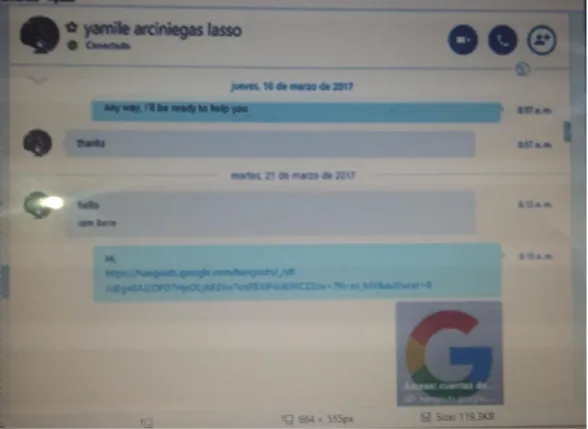
emailed to every student. Once he or she receives the code they copy and paste it into a
browser in order to get into the online meeting. Figure 1 shows the code sent by skype, down
right corner.
Figure 1 Hangout Code sent to students via Skype. Source: Author.
Immediately after switching the event, there opens a new window or screen displaying
a Google Hangout on Air so the teacher streams live from his/her webcam. From now every
student, using the aforementioned code, pops up in the hangout allowed to see and hear other
participants as well as showing himself/herself and speak to others when considered
SPEAKING PRACTICE USING WEB 2.0 TECHNOLOGIES TEFL 31
public video will be automatically created and uploaded for his/her students to view later.
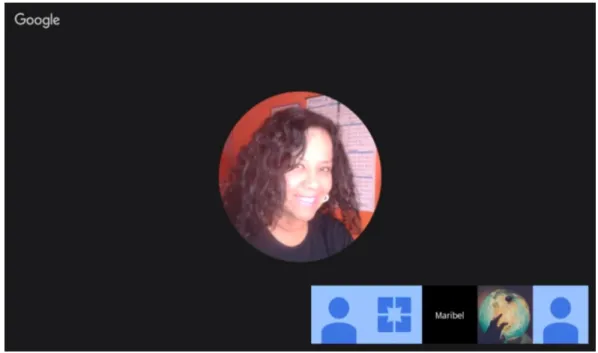
Figure 2 displays Google Hangout on Air wich works as a classroom board, where every
student participates synchronously.
Figure 2: Google Hangout Screen. Source: Author.
Each student is emailed asking him or her to sign up a Gmail account because this is
the one which better works with the web 2.0 applications to be used. In the same e-mail is
given the schedule containing dates as well as hours at which speaking practices will be held.
Several minutes before each session begins, every student is emailed informing him or her
SPEAKING PRACTICE USING WEB 2.0 TECHNOLOGIES TEFL 32
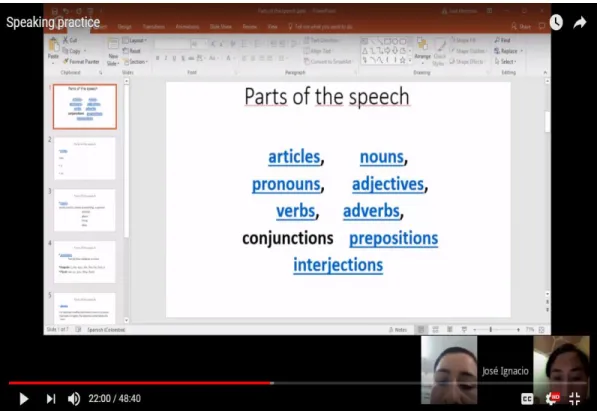
The teacher developed the scheduled topics, trying to bring to class different and
cultural related themes. Figure 3 shows some issues to develop in a typical class.
Figure 3 Class topic to be developed in a typical online class. Source: Author.
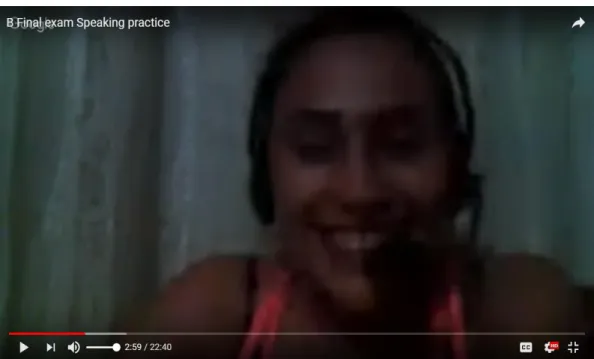
Spontaneous participations were propitiated as well as warm relationship between
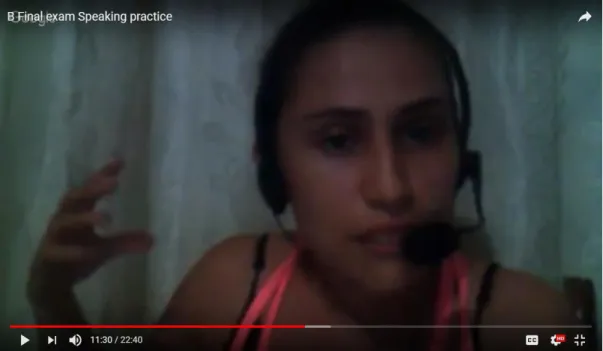
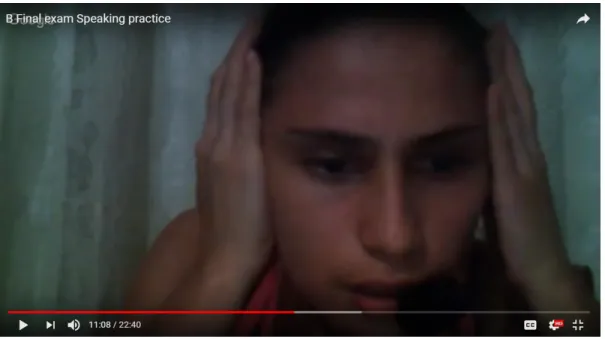
students and teacher. Figures 4, 5, 6, and 7, are demostrating how authenctic and emotive are
SPEAKING PRACTICE USING WEB 2.0 TECHNOLOGIES TEFL 33
Figure 4. Student very attentive on class. Source: Author.
SPEAKING PRACTICE USING WEB 2.0 TECHNOLOGIES TEFL 34
Figure 6. Virtual classes may be as warm as presential classesses may be. Source: Author.
Listening Practice
Other 3 language skills were practiced in every class, let´s say listening, reading and
SPEAKING PRACTICE USING WEB 2.0 TECHNOLOGIES TEFL 35
Figure 7. Student practicing listening English skill. Source: Author.
Reading Practice
SPEAKING PRACTICE USING WEB 2.0 TECHNOLOGIES TEFL 36
Writing Practice
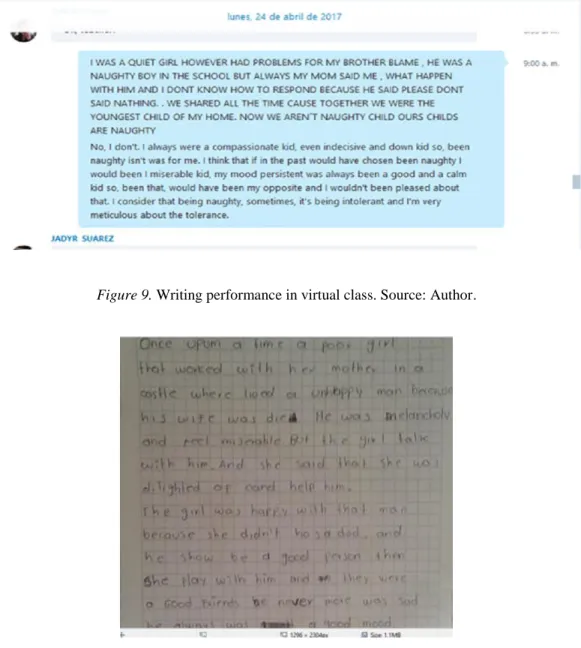
The investigative practice is speaking, mainly, but, of course, all four language skills
are trained in every session. Figures 9, 10 and 11 are samples of writing students performance.
Figure 9. Writing performance in virtual class. Source: Author.
SPEAKING PRACTICE USING WEB 2.0 TECHNOLOGIES TEFL 37
Figure 11. Writing practice in online class. Source: Author.
´
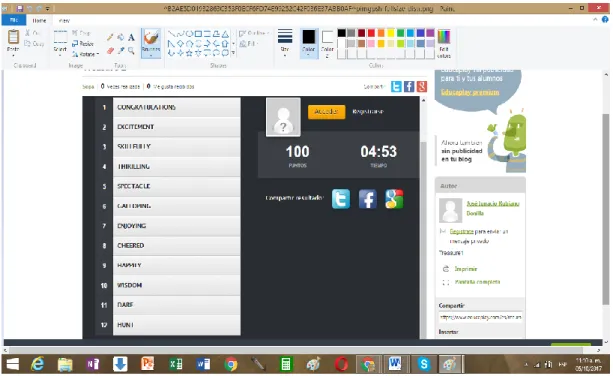
Assesment
Assessment was integral part of sessions, in order to measure students advance in their
skills learning. Different presentations of test were offered adding interest and challenge to
SPEAKING PRACTICE USING WEB 2.0 TECHNOLOGIES TEFL 38
Figure 12. Educaplay assesment tool. Source: Author.
SPEAKING PRACTICE USING WEB 2.0 TECHNOLOGIES TEFL 39
SPEAKING PRACTICE USING WEB 2.0 TECHNOLOGIES TEFL 40
Results
Level of assistance and punctuality was high and constant. Students declared to have
reached their expectatives.
Web 2.0 tools were applied as Web 2.0 presented by Youtube to generate live sessions,
Google Hangout, Skype and various applications to generate simultaneous and synchronous
evaluations. The tools themselves proved to be ideal in facilitating communication and
interaction that would allow for the practice of speaking in English with good achievement
by all the students involved.
The main objective is achieved since the proposed observations were advanced and
both strengths and aspects to be improved were known within the process of practicing
English speaking in the sessions observed. The use of web 2.0 tools is effective in the practice
of distance English speaking, regardless of the geographic location of the participants.
Adequate electronic equipment and basic technical knowledge are necessary to ensure
that the sessions run smoothly and without delays. On the other hand, it is important to ensure
that the environment within which the student connects, in order to participate in virtual
meetings, is calm and as far as possible separate from other events that take place in the
family, so that family activities do not interfere with the normal development of the activities
SPEAKING PRACTICE USING WEB 2.0 TECHNOLOGIES TEFL 41
In addition to the development and strengthening of English language speaking,
complementary skills were practiced, i.e. listening, reading and writing, which led to the
production of individual texts by each student.
It is estimated that the objectives were partially achieved. Although the fundamental
circumstances for the development of research, and the structural guidelines in terms of
theoretical conception and methodology, as well as the collaboration and enthusiasm of the
participating students, only an approximation to the proposed goals is repeated.
Students who merely receive information perpetuate remedial tendencies while
thinking allows them to build knowledge; Supplemental instruction can provide a safe
environment where they can discuss and process the material, and interact with other peers;
Group work in addition to improving academic performance, raises self-esteem and
competitiveness; and Speaking practice of students.
Students created a very friendly and warm relationship, this relation seems to boost
their creativity and speed their speaking, breaking the old conception about cold online
SPEAKING PRACTICE USING WEB 2.0 TECHNOLOGIES TEFL 42
Discussion
The qualitative information compiled, based on the observations, gives rise to the
impression that the creation of an informal environment is of great help for the practice of
speaking in English to become fluent. The psychological barrier created by the fear of making
a fool of themselves and with them a kind of social degradation is minimized when
participants feel that they are welcomed and that everything they say will be listened to and
properly attended to.
Often, especially for beginners, the limitations in the knowledge of the correct
vocabulary as well as the ignorance of the corresponding grammatical compositions oblige
them to express basic or rudimentary ideas, making them seem to be people of short
comprehension or even with mental disabilities, a circumstance that reinforces their growing
fear of ridicule. On the other hand, their pronunciation difficulties tend to increase making
the understanding of what they want to express more difficult, especially when their
interlocutors are English-speaking.
One aspect that is also relevant is body language, whose interpretation provides the
student with information about his or her speech performance and the effect it has on his or
her interlocutors. In the case of English speakers, the level of tolerance is lower than that of
interlocutors belonging to the same cultural group of the student. When the newcomer
belongs to the same cultural group as his interlocutors, the created atmosphere is friendlier
SPEAKING PRACTICE USING WEB 2.0 TECHNOLOGIES TEFL 43
would, because they share similar vocal sounds, intonations and pronunciations even if they
are not adjusted to the foreign language being practiced.
Thus, in the interaction developed between the groups observed, the psychological
barrier raised by the fear of ridicule was practically non-existent, with the risk of even falling
into the use of a "protolanguage" apart from the ideal language in terms of fidelity in
pronunciation and more aspect that characterize the language to be learned. Obviously, if it
is considered that in infants during the learning of speech, they also babble and utter
expressions far from the ideal language, they come closer and closer to it with each new
attempt they make.
It is considered, as a point of discussion, that although the web 2.0 tools are very useful,
as demonstrated in the present case study, for the practice of speaking English, some aspects
have to be polished when the process has advanced, since the communicative interaction
conjugates aspect involving broader and more complex aspects that are only fully satisfied
SPEAKING PRACTICE USING WEB 2.0 TECHNOLOGIES TEFL 44
Conclusions
Inferring from this research results, feeling uncertainty when speaking a foreign
language increases the cognitive load at the end of the process creating a wall that separates
the student and his/her interlocutor, and thus blocking a fluid communication between them,
and consequently the importance of carry out strategies that make aware students of this
psychological reactions that avoid an adequate messages interchange.
The retrieved positive feedback given by the students of a warm relationship between
them and between them and the teacher is evidence of the favorable effect on the speaking
practices of this kind of human relation. The virtual educative environment is known as cold
spaces, psychologically speaking, in consequence, humanization becomes a positive fact
boosting learning and appropriation of the speaking skills, in TEFL.
In spite of all the difficulties and shortcomings presented, whether of technical or
human origin, the atmosphere of friendship and solidarity allowed the students to show their
respect and consideration and finally help each other. In the first instance, the group of
students with the same level of English proficiency, i. e. with the same skill level, would be
considered ideal. However, after the first moments of confusion, the fact that students have
had significant differences in their level of command of the English language is considered
as enriching, because this allowed us to recreate an environment of speech practice more
SPEAKING PRACTICE USING WEB 2.0 TECHNOLOGIES TEFL 45
instead of prefabricated and stereotyped responses that disappear once they have left the
classroom session.
Another conclusion, no less important, is flexibility in relation with studied topics.
Students by themselves have inherent motivations that impulse them to speak about specific
topics and that inner motivation adds emotion, strength and thus recordation to the studied
concepts. Motivation produced from students is a fact leading pupils to involve foreign
language with their own cultural roots and social medium.
Additionally, the Web 2.0 tools are optimal on creating an excellent workspace in
order to train foreign language speaking skills on virtual environments. Consequently, Web
2.0 tools, interlinked with the World Wide Web, let overcome natural limitations imposed
by long distances, mountainous region, and even economical and policies adversities.
As aspects to be strengthened in the practices of speaking English as a foreign language
at the UNAD, as induced, based on what has been observed and analyzed in the activity
developed by the sample population, there is basic training in the technological aspects
involved in teaching and learning in virtual environments, for students. The training would
mainly emphasize specialized software in web 2.0 tools, since these specifically favour full
human interaction between students and teachers and vice versa, as well as between students
themselves, with obvious benefits for all in terms of knowledge creation.
The distance learning platform established by UNAD promotes cutting-edge solutions
SPEAKING PRACTICE USING WEB 2.0 TECHNOLOGIES TEFL 46
appropriateness of the programmes offered become determining factors in overcoming the
barriers imposed by a geography characterized by mountainous systems that make it difficult
for students to access urban educational centres. In addition, it minimizes the impact of
education and budgetary policies that do not allow education to be provided with the required
SPEAKING PRACTICE USING WEB 2.0 TECHNOLOGIES TEFL 47
Recommendations
A recommendation in this research is that teachers will help efficiently to their pupils
if besides the pronunciation and grammatical exercises they also explain to them how to go
beyond the “solution” of each class aim, and really get empowered of their learning process
as much as to be capable of performing their speaking skills in front of a native speaker as
fluently as they usually do it in class.
It seems it will be useful to know the student´s notions about what they think is their
speaking obstacles and confront those notions with reality in order to abolish wrong cultural
ideas without logical or scientific roots.
The current degree of interaction with electronic devices and programs linked to the
Internet is of great magnitude among the general population, and this fact propitiates the
recomedation of strongly boosting the appropriate applications and methods so that the
practice of English as a foreign language skills, especially to practice speech, ability in which
it notes a greater need for support for students.
It is also recommended that some of the subjects include clarifications regarding the
inaccurate cultural notions surrounding the learning and acquisition of a foreign language, in
this case English.
The magnitude of the objectives, in terms of extension and depth, make it advisable to
continue the research activity, through other projects with similar approach and bases, in
SPEAKING PRACTICE USING WEB 2.0 TECHNOLOGIES TEFL 48
continue to hold true and the students' need for English as a foreign language learning
strategies as well.
The challenges are vast, yet the opportunities offered by information and
communication technologies are rapidly advancing and are expected to be equally rapidly
SPEAKING PRACTICE USING WEB 2.0 TECHNOLOGIES TEFL 49
References
British Council.org. English in Colombia: An examination of policy perceptions and
influencing factors. 2015. Retrieved from: https://ei.britishcouncil.org/sites/ efault/
files/latin-americaresearch/English%20in% 20Colombia.pdf
Cambridge University Press (2017) Diccionario Inglés. Retrieved from: https://dictionary.
cambridge.org/es/diccionario/ingles/
Fernández, M. (2017, 11 de Marzo) Crecimiento en educación virtual. Revista Educación
virtual Retrieved from: https://revistaeducacionvirtual.com/archives/3011
Flick, U. (2012) Introducción a la investigación cualitativa. Coruna: Ediciones Morata, S.L.
Retrieved from: http://bibliotecavirtual.unad.edu.co:2162/openurl?sid=EBSCO%
3aedsebk&genre=book&issn=&ISBN=9788471124807&volume=S&issue=&date=& spage
=&pages=&title=Introduccio01n+a+la+investigacio01n+cualitativa &at itle=
Introduccio %CC%81n+a+la+investigacio%CC%81n+cualitativa&aulast =&i
d=DOI%3a&site=ftf-live
Ivic,I.(1994) Lev Semionovich Vygotsky (1896-1934). UNESCO. Oficina Internacional de
Educación. 24, ( 3-4), 773-799 Retrieved from: http://www.ibe.unesco.org/sites/ default/ files/vygotskys. PDF
Jonassen,D. Davidson,M. Collins,M. Campbell,J.& Haag,B.(1995). Constructivism and
SPEAKING PRACTICE USING WEB 2.0 TECHNOLOGIES TEFL 50
http://www. tandfonline.com/doi/citedby/10.1080/08923649509526885?scroll=
top&need Access=true
Leppink,J. 2017. Cognitive load theory: Practical implications and an important challenge.
Journal of Taibah University Medical Sciences, 12 (5) 385-391. Retrieved from:
http://bi bliotecavirtual.unad.edu.co:2454/S1658361217300835/1-s2.0-S165
83612173 00835-main. pdf?_tid=cbdd6c8a-7259-11e7-9375-00000aacb35
f&acdnat=1501111745 _6e003d5e5 2f5c7c01e3c68cbd9f8e1ca
Martín,D. Arendale,D. (1992). Supplemental Instruction: Improving First-Year Student
Success ifrom:-Risk Courses. The Freshman Year Experience: Monograph Series 7.
Retrieved from: https://eric.ed.gov/?id=ED354839
Ministerio de Educación Nacional de Colombia. Colombia Bilingüe. Retrieved from : http://
aprende.colombiaaprende.edu.co/es/colombiabilingue/86689
Ministerio de Educación Nacional de Colombia. Guía de deserción estudiantil. Retrieved
from : https://spadies.mineducacion.gov.co/spadies/consultas_ predefin idas.html?2
OCDE: Revisiones de Políticas Nacionales de Educación: La Educación en Colombia.2016.
Retrieved from: http://www.plandecenal.edu.co/cms/media/herramientas /oecd_
educacion_ en_colombia_aspectos.pdf
Pandey,P. & Pandey, M.(2015) M. RESEARCH METHODOLOGY: TOOLS. AND
TECHNIQUES. Bridge Center. 2015. Retrieved from: http://euacademic.org/Book
SPEAKING PRACTICE USING WEB 2.0 TECHNOLOGIES TEFL 51
Sánchez, A. (2012). El bilingüismo en los bachilleres colombianos. Documentos de Trabajo
Sobre Economía Regional, No. 159, Banco de la República. Recuperado de: http://
www.banrep.gov.co/docum/Lectura_finanzas/pdf/dtser_159.pdf
Sánchez, A. (2013). Bilingüismo en Colombia. Documentos de trabajo sobre economía
regional. Banco de la República (191). Retrieved from: http://www.banrep. gov.
co/docum/ Lectura_ fina nzas/pdf/dtser_191.pdf
Stake,R. (1988).Case Studies. Handbook of Qualitative Research Retrieved from:
https://www. sfu.ca/~palys/Stake2003-CaseStudies.pdf
Sweller, J. (2016) Story of a Research Program. Education Review (10945296), (23), 1-19.
Retrieved from: http://bibliotecavirtual.unad.edu.co:2139/eds/pdfviewer/pdfviewer?
vid=3&sid= 2073ff8f-d3ac-4a1c-96b60c0af87754f5%40pdc-v-sessmgr01
Sweller, J. (2017) Cognitive load theory and teaching English as a second language to adult
learners. Contact Magazine university of New South Wales.Retrieved from: http://
contact.teslontario.org/wp-content/uploads/2017/05/Sweller-CognitiveLoad.pdf
Topel, R. (1998). The collected works of L.S. Vygotsky, Volume 3: Problemas of the theory
and history of psychology, Volume 4: The history of the development of higher
mental functions, Journal Of the History Of the behavioral Sciences, 34(4=, 394-396
Ungvarsky, J. 2017. Cognitive load. Salem Press Encyclopedia, January. Retrieved from:
http://bibliotecavirtual.unad.edu.co:2139/eds/detail/detail?vid=1&sid=59a7fcd7-SPEAKING PRACTICE USING WEB 2.0 TECHNOLOGIES TEFL 52
4743-4777ac28b232d17c7e5a%40sessionmgr104&bdata=Jmxhbmc9ZXMmc
++i2l0ZT1lZHMtbGl2ZQ%3d%3d#AN=119214040&db=er
University of Pittsburgh. Web 2.0 Tools in Teaching and Learning.Retrieved from: https://
teaching.pitt.edublog/web-2-0-tools-in-teaching-and-learning/
Yin, R.(1989).Investigación sobre estudio de casos diseño y métodos. Applied Social
Research Methods Series. (5). Retrieved from: https://panel.inkuba. com/ sites/
2/archivos /YIN%2 0ROBERT%20.pdf
Yin, R. (2003) Case.Study. Research. Design and Methods. Second Edition. Applied Social
Research Methods Series. (5) ~ SAGE Publications. Retrieved from: http://www.
SPEAKING PRACTICE USING WEB 2.0 TECHNOLOGIES TEFL 53
Appendix
Appendix 1 - Students´ background
SPEAKING PRACTICE USING WEB 2.0 TECHNOLOGIES TEFL 54
Appendix 2 - Participants Permissions
Re: Greetings from Jose Ignacio
olga restrepo <[email protected]> 18 may.
Hello tutor!!!
Of course, my dear tutor you can use our past interaction information as investigative material. If I can help in another way, just let me know.
Best regards
Olga Restrepo
Cead Yopal - Casanare
2017-05-17 18:43 GMT-05:00 José Ignacio Hermosa <[email protected]>:
Dear Olga, I´m really so impressed with our English speaking practice performance that I´m thinking to draw up about it an investigation paper in order to describe our experience and try to write conclusions that may help future English Language teaching/learning process.
That´s why I´m now asking for your permission to use our past interaction information as investigative material. If you agree please let me know answering this note.
Wishing you the best.